
Key Takeaways
- A Forrester TEI-style framework grounds the business case by quantifying benefits, costs, risk adjustments, and future flexibility rather than relying on rankings or traffic alone 1.
- Triple-digit ROI is defensible when models include incremental organic revenue, paid media offset, and recovered budget, while applying a 15–25% risk haircut for algorithm volatility and adoption drag.
- Automation only delivers full economic value when paired with workflow redesign that collapses handoffs between briefs, execution, analytics, and prioritization into a single governed loop 3.
- VPs should populate the ROI worksheet with company-specific data traceable to auditable systems, treating composite figures like 611% or 315% as directional benchmarks, not forecasts 11.
The ROI Question a CFO Actually Asks
When a marketing VP considers an automatic SEO platform, the CFO's primary concern is the return on investment: what will it yield, over what timeframe, and how can the numbers be verified? Proving ROI with analytics is a significant challenge for tech marketing leaders, despite abundant data 7. The difficulty lies in connecting SEO activities to revenue in a way that satisfies finance. Forrester's Total Economic Impact (TEI) framework provides a robust structure for this discussion, evaluating SEO investments across quantified benefits, direct and indirect costs, risk adjustments, and future flexibility 1. This article applies the TEI model to automatic SEO, establishing an ROI framework, calibrating expectations against similar platform studies, identifying labor and budget recovery mechanisms, and concluding with a worksheet for CFO presentations. The aim is to build a business case that withstands scrutiny, focusing on program economics rather than just software features.
Why SEO ROI Resists Simple Math
The Attribution Gap That Blocks Investment Cases
Organic search often precedes a buyer's self-identification, spanning multiple sessions and devices, and competes for attribution with paid, email, and direct channels. This creates a measurement challenge that finance teams view as a risk. Gartner research highlights that proving ROI with analytics is a top challenge for tech marketing leaders seeking investment 7. While SEO teams use various tools like Google Search Console, web analytics, and rank trackers, the data remains siloed. Google's Organic Search Report provides visibility metrics like impressions and clicks 10, but these don't directly translate to pipeline revenue for a CFO. Bridging this gap requires integrated data, consistent definitions, and regular reporting that aligns with financial cycles. Without this infrastructure, investment proposals often falter.
Vanity Metrics vs. Business Metrics in Organic Search
Traditional SEO reports often emphasize rankings, traffic, and backlinks, which CFOs typically view as interesting but not directly tied to financial outcomes. Forrester's TEI framework for SEO shifts the focus to business metrics such as incremental organic revenue, conversion rate lift on organic sessions, average order value, and paid media offset 1. These are the quantifiable inputs that finance teams can model and defend. Rankings and traffic then become intermediate indicators. This distinction is crucial for automation decisions. A platform that improves rankings but fails to link these improvements to revenue leaves the attribution gap unaddressed. Conversely, a platform that integrates Search Console data with conversion and revenue data begins to close this gap 8. The key is consistent data pulls, defined fields, and uniform query grouping, which contribute more to ROI defensibility than any single algorithm improvement. The ultimate test for any SEO investment is whether its reporting can answer, in financial terms, organic search's contribution to revenue and its associated costs.
A TEI-Style Model for Automatic SEO
Benefits: Organic Revenue, Conversion Lift, Paid Media Offset
The benefits section of a TEI model for automatic SEO includes three quantifiable elements, each with a clear source and financial owner. First is incremental organic revenue. Forrester's composite global e-commerce organization achieved a 611% ROI from its SEO program, driven by increased organic traffic, improved conversion rates, and reduced paid media spend for queries now won organically 11. While this composite figure is a directional benchmark, the underlying structure—sessions multiplied by conversion rate and average order value, minus a counterfactual—is applicable. Second is conversion lift on organic sessions, where automatic platforms accelerate the process from query insight to page optimization, ensuring pages convert effectively. Third is paid media offset: every query ranked organically reduces the need for paid advertising, directly impacting the paid media budget. These benefits, alongside costs, risk adjustments, and flexibility, form the core of the TEI view, with automation significantly enhancing the economic benefits.
Costs: Platform, Integration, and Oversight Labor
The cost component of the model typically includes three key areas. Platform fees, covering licensing and usage, are the most visible but often the smallest. Integration costs, frequently underestimated, involve engineering hours for setting up scheduled data pulls from Google Search Console, web analytics, and CRM systems, and ongoing maintenance 8. Oversight labor, often overlooked by executives, accounts for the human effort required for approvals, prioritization, and strategic review, even with automation. Forrester's TEI framework for SEO includes internal salaries to reflect this persistent cost 11. A model that assumes zero labor costs will not pass financial scrutiny. These three cost lines form the denominator of the ROI calculation, and including all of them ensures a realistic assessment.
Risk and Flexibility: Algorithm Volatility, Adoption, Channel Expansion
Risk and flexibility differentiate a TEI model from a simple payback calculation. Risk adjustments discount projected benefits for potential issues, such as algorithm updates impacting organic traffic or low platform adoption. Forrester's SEO TEI framework explicitly incorporates algorithm changes and implementation challenges into its risk layer, providing risk-adjusted composite figures 11. An internal model should apply a discount, typically a percentage reduction on projected benefits, and clearly state this assumption. Flexibility captures the option value of unactivated capabilities. An automatic SEO platform that also supports content, backlink, or local optimization workflows offers the ability to expand into adjacent channels without new procurement. Forrester's TEI methodology recognizes this as a distinct value category, representing future optionality 1. Together, these four quadrants yield a robust ROI figure: benefits minus costs, discounted for risk, with flexibility noted as unpriced upside, forming a compelling case for CFOs.
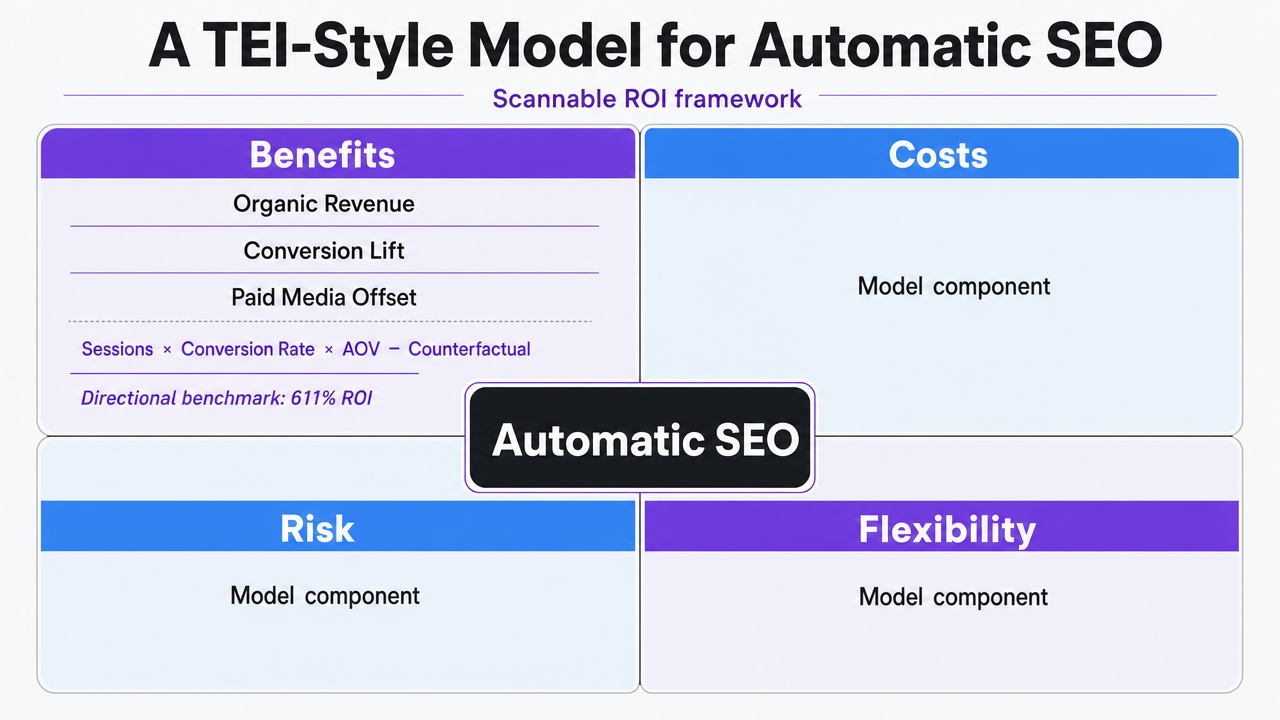 Visualize the four-quadrant TEI framework (Benefits, Costs, Risk, Flexibility) that structures the section, giving readers a scannable map of the ROI model components discussed in the three subsections
Test AI-driven SEO execution in real time
Experience measurable organic impact by publishing live content and tracking results throughout your free trial.
Calibrating Expectations Against Adjacent Platform Studies
While Forrester's SEO TEI reports a 611% risk-adjusted ROI for its composite global e-commerce organization 11, this figure serves as a directional anchor rather than a precise forecast. To calibrate expectations, it's useful to examine adjacent Forrester TEI studies. Microsoft Dynamics 365 Customer Service achieved a 315% ROI over three years, driven by automation and integration 4. LinkedIn Sales Navigator delivered a 312% ROI over three years, generating $6.25 million in benefits from a $1.5 million investment 5. Both studies use the same methodology, featuring modeled customers and risk adjustments. This pattern suggests that triple-digit ROI is a defensible expectation for platforms that automate knowledge work and consolidate reporting, a category that includes automatic SEO. The higher ROI for SEO platforms (611% vs. ~315%) reflects the compounding nature of organic search, where ranking pages continue to generate traffic long after the initial effort.
For CFO discussions, it's prudent to model towards the lower end of this range, treating figures above 300% as upside, and clearly labeling all composite figures as benchmarks from cross-category comparisons. A model projecting a risk-adjusted 200-300% return, with appropriate references, is more likely to secure funding than one promising 611% based solely on a composite study.
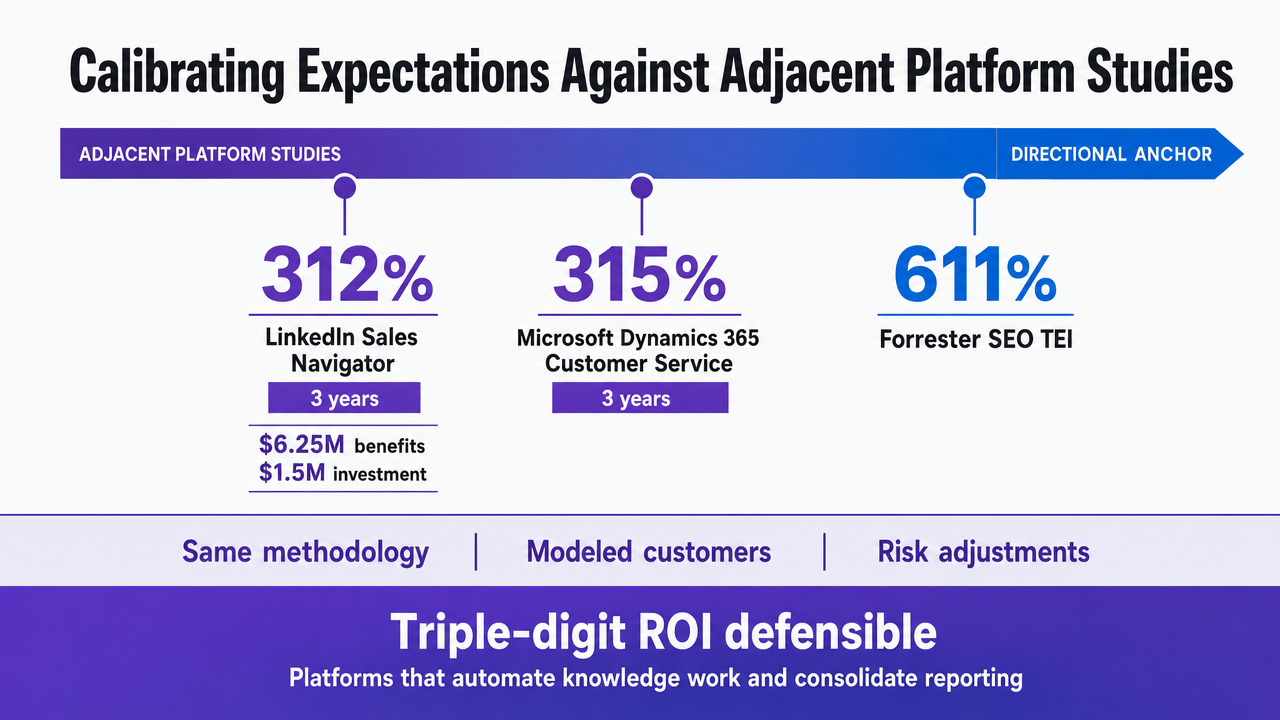 Compare the three cited Forrester TEI composite ROI figures (611% SEO, 315% Dynamics 365, 312% Sales Navigator) that anchor the calibration argument in this section
The Recovered Waste Lever: Where Automation Reclaims Budget
While benefits often receive the most attention, significant and rapid payback can come from recovering wasted budget. McKinsey's analysis suggests that 15 to 20 percent of marketing budgets could be reallocated or returned to the bottom line through smart analytics, without diminishing ROI 6. This waste stems from inefficient spending rather than a lack of growth. In organic search, this "recovered waste" manifests in three areas:
- First, content spend on pages that fail to rank or convert. An automatic platform can identify query-to-page mismatches using Search Console data 8, accelerating the review cycle.
- Second, agency or freelance retainers for work that duplicates internal efforts; unified reporting can expose this overlap.
- Third, paid media spend on queries that could be won organically, as discussed in the benefits section.
It's crucial to explicitly state the recovery assumption. While McKinsey suggests up to 20%, a more conservative internal estimate of 8–12% of current SEO and content spend, phased over the first year, is more likely to be accepted by a CFO. The actual amount recovered depends on the existing inefficiencies within the program.
Workflow Redesign Is the Real ROI Driver
A common pitfall in automation business cases is treating new platforms as merely faster versions of existing processes. McKinsey emphasizes that the true value of AI-powered workflows emerges when they are integrated into redesigned processes linked to specific growth or efficiency targets, not when deployed as isolated tools 3. This applies directly to automatic SEO. In a typical enterprise SEO setup, content teams write briefs, agencies execute, analysts pull data, and priorities are set in quarterly meetings that quickly become outdated. Simply adding a platform accelerates individual steps but doesn't eliminate the handoffs that cause delays. Workflow redesign addresses these handoffs by integrating query insights, page recommendations, brief generation, approval, publishing, and performance tracking into a single, governed loop. This transforms monthly analyst reports into live views and quarterly planning into weekly priority rankings. The agency's role for repeatable production work can then shrink or shift to strategic tasks that automation cannot handle. This redesign is where significant labor efficiencies are realized. McKinsey estimates that combining generative AI with other technologies could automate roughly half of current work activities between 2030 and 2060 2. While a long-term macro figure, it provides context for the direction of travel. The immediate question is identifying which SEO tasks can shift from "create-from-scratch" to "review-and-approve" with the platform in place. A model that quantifies this workflow redesign, rather than just tool adoption, is more likely to achieve triple-digit ROI, whereas a platform layered over an unchanged process will yield only software savings and disappoint its sponsors.
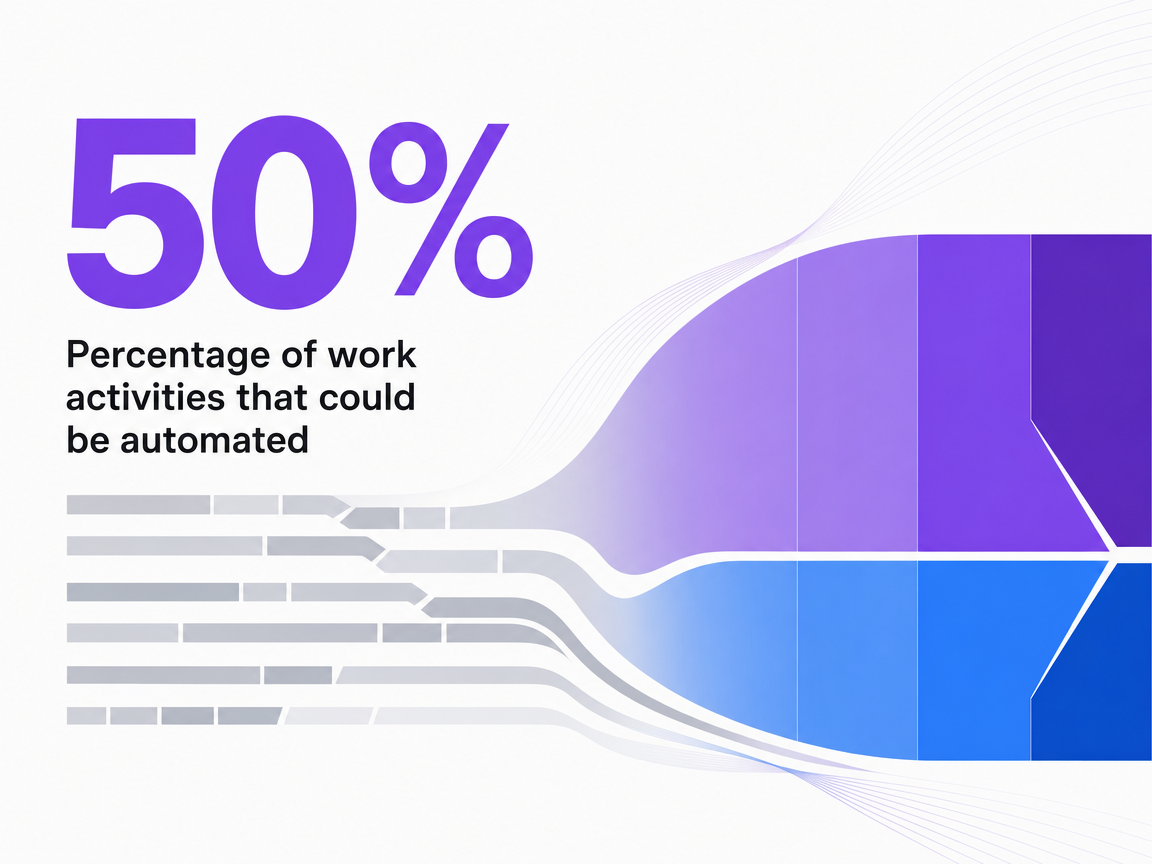 Percentage of work activities that could be automated
Percentage of work activities that could be automated
See the Real Impact of Automated SEO on Pipeline and Conversion Rates
Request a data-backed assessment of how automatic SEO platforms deliver measurable gains in lead quality and efficiency—without expanding your team or adding new vendor relationships.
A Defensible ROI Worksheet for the CFO Conversation
A robust ROI worksheet for an automatic SEO investment case defines variables with auditable sources, rather than relying on fabricated figures. This version distills the TEI model to its essential components for CFO review.
Benefits (annualized):
- Incremental organic revenue = (Δ organic sessions) × (organic conversion rate) × (average order value), less the counterfactual sessions the site would have produced without the program. Source: web analytics joined to commerce or CRM data, following the business-metric structure Forrester applies in its SEO TEI 11.
- Paid media offset = sum of monthly spend on queries the site now ranks for organically at position 1–3. Source: ad platform cost data filtered by query.
- Recovered budget = (current SEO and adjacent content spend) × (recovery rate R), where R is stated in writing and defended against McKinsey's 15–20% smart-analytics band 6. A conservative internal R of 8–12% survives review; the full 20% does not.
Costs (annualized):
- Platform fees = licensing plus usage components.
- Integration = one-time engineering hours for scheduled data pulls from Search Console, analytics, and CRM 8, plus a maintenance load thereafter.
- Oversight labor = fully-loaded hours for approvals, editorial review, and strategy work that automation does not replace 11.
Risk adjustment: apply a haircut H to the benefits total, typically 15–25%, to account for algorithm volatility and adoption drag. State H in writing.
ROI formula: ((Benefits × (1 – H)) – Costs) ÷ Costs, expressed as a percentage over a three-year horizon with net present value calculated at the company's discount rate.
The key is not just the calculation, but naming every variable, linking it to a system a CFO can query, and defending each assumption within the document. This approach frames the SEO investment as a capital request that finance teams are accustomed to evaluating.
If You Manage Multiple Locations: Consolidation Economics
For organizations managing organic search across numerous locations (e.g., ten, fifty, or two hundred), the economics shift significantly. Multi-location service businesses often incur SEO costs per site, which can accumulate into a substantial aggregate expense. The following table illustrates common cost structures using variables that finance teams can trace to actual line items:
$A : agency retainer per location per month
$F : fully-loaded in-house SEO FTE
$T : annual point-tool stack
$P : automatic SEO platform on a portfolio basis
| Structure | 1 Location | 10 Locations | 50 Locations |
|---|---|---|---|
| Agency retainer | $A × 12 | $A × 10 × 12 | $A × 50 × 12 |
| In-house FTE(s) | $F | $F to 2×$F | 3×$F to 5×$F |
| Point-tool stack | $T | $T (shared) | $T (shared) |
| Automatic platform | $P | $P (portfolio) | $P (portfolio) |
Agency costs scale linearly with the number of locations. FTE costs increase in steps as headcount is added. Platform costs, however, scale sub-linearly because underlying reporting pipelines and models are shared across sites 8. This sub-linear scaling represents the consolidation lever. It's also where the "recovered waste" discussed earlier applies most acutely, as duplicated retainer work across multiple sites is a common source of the 15–20% waste identified by McKinsey 6. Each row should be modeled against actual invoices before presentation.
Where Vectoron Fits in the Category
Automatic SEO platforms in this category consolidate query data, page recommendations, production, and reporting into a single, governed workflow. This design enables the labor and analytics efficiencies modeled in this article. As McKinsey advises for AI-powered workflows, value is realized when these tools are integrated into redesigned processes with executive sponsorship, not merely stacked alongside existing ones 3. Vectoron operates within this category, featuring an approval-first design that ensures human oversight for every recommendation before execution. For VPs constructing an ROI case, Vectoron's two-week trial at $599 per month offers a low-cost method to populate worksheet variables with real data before committing to a full deployment.
Frequently Asked Questions
References
- 1.The ROI Of SEO.
- 2.The economic potential of generative AI: The next productivity frontier.
- 3.Transforming the enterprise through AI-powered workflows.
- 4.Forrester TEI study shows 315% ROI when modernizing customer service with Dynamics 365.
- 5.What's the ROI of Sales Navigator? Here's What a Forrester Study Says.
- 6.“Smart analytics” can tap up to 20% of lost ROI.
- 7.Tech marketing leaders struggle to prove ROI, Gartner says.
- 8.Fetch Data From Google Search Console to Create Your Automated SEO Dashboards.
- 9.The ROI of Email Marketing [Infographic].
- 10.How to Use the Google Organic Search Report.
- 11.You Can Quantify The ROI Of SEO - Forrester.