Key Takeaways
- Point Automators like rank trackers, technical crawlers, and on-page scorers produce data and findings, not finished deliverables, so they speed up human roles rather than replace them.
- Workflow Orchestrators such as Conductor, BrightEdge, seoClarity, and Botify sequence briefs, drafts, audits, and reporting under one interface but still depend on in-house writers, engineers, and strategists to ship work.
- Coordinated AI Systems plan, produce, route, and measure across an account on their own, compressing the human role from operator to approver and absorbing most retainer deliverables 5.
- Portfolio operators running multiple locations or sites see the sharpest economic break, because retainer billing multiplies per property while coordinated platforms fold expansion into a single account-level priority list.
- Before the next renewal, directors should score their stack against keyword research, technical audits, content production, internal linking, and reporting, and require vendors to substantiate outcome claims with methodology and review documentation 3.
The Agency Replacement Question Has a New Answer
For most of the last decade, "automatic SEO tools" meant rank trackers, audit crawlers, and on-page scorers that fed a human team — usually an agency — doing the actual execution. That category has split. One half remains single-purpose utilities. The other half has matured into coordinated systems that produce content, run audits, manage internal linking, and report on outcomes from a single account plan.
That split changes the buying question for growth marketing directors. The relevant comparison is no longer tool versus tool. It is platform versus retainer. Forrester's Q3 2025 evaluation of enterprise SEO solutions reframed the category around automation depth, AI capabilities, content intelligence, and workflow integration rather than rank tracking and keyword databases 6. Harvard's professional education group reached a parallel conclusion about marketing more broadly: AI is absorbing routine execution and pushing human teams toward strategy and oversight 7.
This article scores tools against the work an agency actually delivers — keyword research, technical audits, content production, internal linking, reporting — and groups them into three functional tiers. It also flags what each tier does not replace, where governance evaluation matters, and how the math changes for directors managing more than one site or location.
What 'Automatic' Means in 2025
From Rank Trackers to Coordinated Systems
The phrase "automatic SEO tool" once described a single utility: a crawler that flagged broken canonicals, a scraper that pulled SERP positions every Monday, a scoring engine that graded a draft against a target query. Those products still exist, and most directors still own at least one. What has changed is the ceiling.
Forrester's Q3 2025 Wave on enterprise SEO solutions scored vendors on four dimensions that would have been adjacent to the category five years ago: automation depth, AI capabilities, content intelligence, and workflow integration 6. Rank tracking and keyword databases were treated as table stakes, not differentiators. The vendors clustered at the top of the evaluation were the ones whose products produced recommendations and executed them inside content and technical pipelines, rather than handing a CSV to a human analyst.
That reframing matters for buyers because it groups the market into three functional tiers that behave very differently in a stack:
- Point Automators run one job well.
- Workflow Orchestrators connect a sequence of jobs to a human approver.
- Coordinated AI Systems plan, produce, and report across an account with the human acting as governor rather than operator.
The tiers are not a ranking. They describe what the tool actually finishes on its own.
The Architectural Line Between Automators and Agents
The cleanest way to separate a workflow automator from a coordinated AI system is to ask who decides the next step. An automator runs a defined task when triggered: scrape, score, alert, repeat. The sequence lives in the user's head or in a Zap.
BCG describes AI agents as autonomous systems that perform sequences of tasks toward a stated goal, analyzing data and collaborating with humans along the way 5. Applied to SEO, that shifts the operator's job from running tools to approving plans. A coordinated system reads Search Console and analytics data, identifies the next priority, drafts the brief, produces the content, queues the technical fix, and reports the result without a human stitching the steps together.
The practical test for directors is whether the tool produces a finished deliverable or a finished task. A platform that publishes optimized content with internal links and a measurement plan attached behaves architecturally different from one that returns a content score and waits. Both can be useful. Only one absorbs the work an agency currently bills for.
The Evaluation Rubric Directors Should Apply
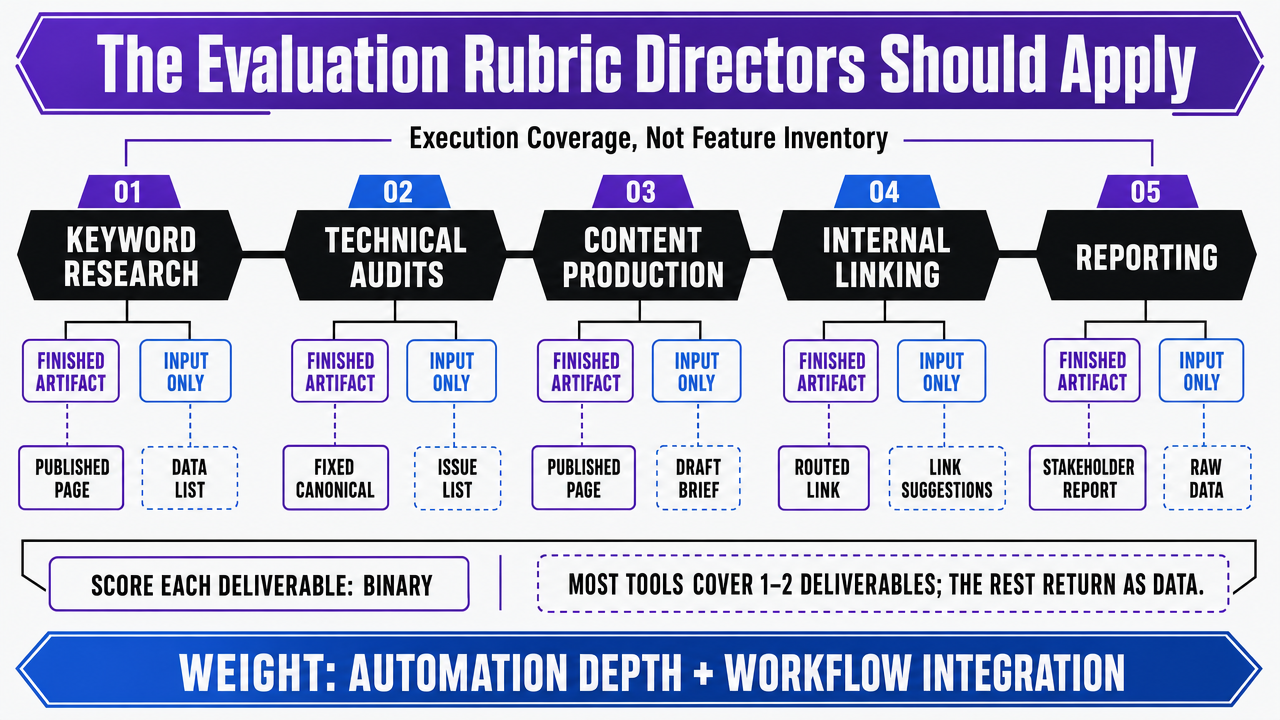
Execution Coverage, Not Feature Inventory
Feature lists flatter every vendor. A more useful rubric asks which agency deliverables the tool actually finishes without a human picking up the work mid-flight. Directors who run this exercise tend to find that most products in their stack cover one or two deliverables and hand the rest back as data.
The five deliverables worth scoring are keyword research, technical audits, content production, internal linking, and reporting. For each, the question is binary: does the platform produce a finished artifact — a published page, a fixed canonical, a routed link, a stakeholder report — or does it produce an input that still requires a strategist, a writer, or an analyst to convert? Forrester's Q3 2025 scoring of enterprise SEO solutions weighted automation depth and workflow integration precisely because the gap between recommendation and execution is where retainer hours accumulate 6.
The scorecard does not need to be elaborate. A five-column grid by deliverable, with completion marked as full, partial, or input-only, surfaces overlap and gaps faster than any RFP response.
Governance, Provenance, and Claim Substantiation
Once execution coverage is mapped, the second filter is whether the vendor can document how the work gets done and defend the outcomes it promises. This is where most procurement reviews stall, and it is the lens that separates platforms suitable for regulated buyers from those built for low-stakes content velocity.
NIST's AI Risk Management Framework is the document directors should map vendor controls against. It is voluntary, but it codifies the trustworthiness criteria — validity, reliability, accountability, transparency, and human oversight — that procurement, legal, and compliance teams now expect AI vendors to address 2. A vendor that cannot describe how its models are documented, how outputs are reviewed, and where humans intervene in the production loop is not ready for a regulated account.
Provenance is the second control. NIST's report on synthetic content treats recording and revealing the provenance of generated material as a core trust mechanism, while noting that no single technique solves the problem alone 1. For SEO buyers, that translates into specific vendor questions: is generated content tagged, versioned, and traceable to the prompts and source data that produced it, or does it enter the CMS as an unattributed asset.
The third control is claim substantiation. The FTC's Operation AI Comply sweep targeted companies using AI claims to supercharge deceptive conduct, signaling that promises of guaranteed traffic, ranking outcomes, or agency replacement now sit inside the agency's enforcement radius 3. Directors should require any outcome claim — lift percentages, time savings, ranking improvements — to come with the methodology, sample, and time window behind it. Vendors that cannot produce that documentation are not safer to buy from because they are quiet about their numbers; they are exposed.
 Visualize the five-deliverable scoring rubric described in the section as a clear evaluation framework directors can apply when comparing tools to agencies
Test Automated SEO Execution On Live Campaigns
Experience automated SEO workflows and publish real content across your domains before committing to a full plan.
Tier One: Point Automators
Rank and Visibility Trackers
Rank trackers are the oldest automatic SEO tools in the stack, and most directors already pay for one. Products in this group — the SERP modules inside Semrush, Ahrefs, and Sistrix, plus standalone trackers like AccuRanker — pull keyword positions on a schedule, surface share-of-voice movement against a competitive set, and alert on volatility. The work they automate is observation, not execution.
Forrester's Q3 2025 evaluation treated rank tracking as table stakes precisely because the output is a dataset, not a deliverable 6. A position drop from four to nine is information; the page rewrite, internal link adjustment, or schema fix that recovers it still has to be assigned, drafted, and shipped by someone else. Directors evaluating this tier should ask whether the alerts route into a production queue or stop at a dashboard.
Technical Audit Engines
Crawlers like Screaming Frog, Sitebulb, Lumar, and OnCrawl belong in the same bucket. They walk a site, flag broken canonicals, identify orphaned URLs, surface render-blocking resources, and export a prioritized issue list. For a single-domain SaaS site, the weekly crawl plus a developer ticket queue can carry a meaningful share of the technical SEO workload.
The gap shows up in two places:
- First, the audit produces findings, not fixes — the engineering hours to ship the changes still sit with the buyer's team or an agency.
- Second, the prioritization logic is generic. A 404 cluster on a deprecated product line and a 404 cluster on a high-converting comparison page receive similar treatment until a human sorts them.
Workflow tier platforms close part of that gap by routing issues to owners; point automators surface and stop.
On-Page Scoring Tools
Clearscope, Surfer, MarketMuse, and Frase score a draft against the SERP for a target query, recommend entities to add, and grade coverage. The automation runs at the document level: paste a draft, return a score. Many in-house teams and freelance writers use these tools as a finishing pass before publishing.
The output is useful and narrow. The tool does not pick the topic, build the brief from search intent and competitive gaps, write the draft, place internal links into the existing content graph, or measure whether the published page earned the traffic forecast. Directors who confuse a high content score with a finished asset tend to end up with optimized pages that still need a strategist behind them.
What This Tier Does Not Replace
Point automators do not replace the keyword research analyst, the technical SEO lead, the content strategist, the writer, or the analyst building the monthly report. They make each of those roles faster and better instrumented. A stack built entirely from this tier still requires the human coordination layer an agency provides — which is why directors who cancel the agency without changing the tooling tier usually rebuild it internally within a quarter.
Tier Two: Workflow Orchestrators
Content Optimization Platforms
Workflow orchestrators sit between point automators and coordinated systems. They sequence work — brief, draft, score, route, publish — and add a human approver between each step. Content optimization platforms like Conductor, BrightEdge, and seoClarity belong here when their content modules are configured to drive a production calendar, not just grade individual drafts.
What changes at this tier is that the tool owns more of the pipeline. The platform pulls keyword opportunities from Search Console and competitive data, generates a brief tied to a content score, assigns the brief to a writer queue, and reattaches the scored draft to the originating opportunity for measurement. The strategist still picks topics and approves briefs. The system handles the connective tissue an account manager used to email.
Enterprise SEO Suites With Workflow Layers
The enterprise suites — Conductor, BrightEdge, seoClarity, Botify — pair their content modules with technical crawl data, internal linking analysis, and stakeholder reporting in a single interface. Forrester's Q3 2025 evaluation placed the strongest of these vendors near the top of the Wave specifically because their workflow integration converted recommendations into routed tasks rather than CSVs 6.
The practical effect for a director is that one platform can carry the keyword research, on-page scoring, technical issue routing, and reporting deliverables an agency typically splits across three or four contributors. Botify's segmentation by template and Conductor's content workspace are examples of the orchestration layer at work. What these suites still require is a human deciding the next priority, writing the draft, and shipping the engineering fix. The platform points; people produce.
What This Tier Does Not Replace
Workflow orchestrators do not replace the writer, the engineer, or the strategist who decides what matters this quarter. They compress coordination overhead and give the in-house team a shared production view, which is meaningful. They do not finish content, ship technical fixes, or build the next quarter's plan on their own. Directors evaluating this tier should be honest that the agency's strategy and production hours move in-house, not out of the budget.
Tier Three: Coordinated AI Systems
What Defines a Coordinated System
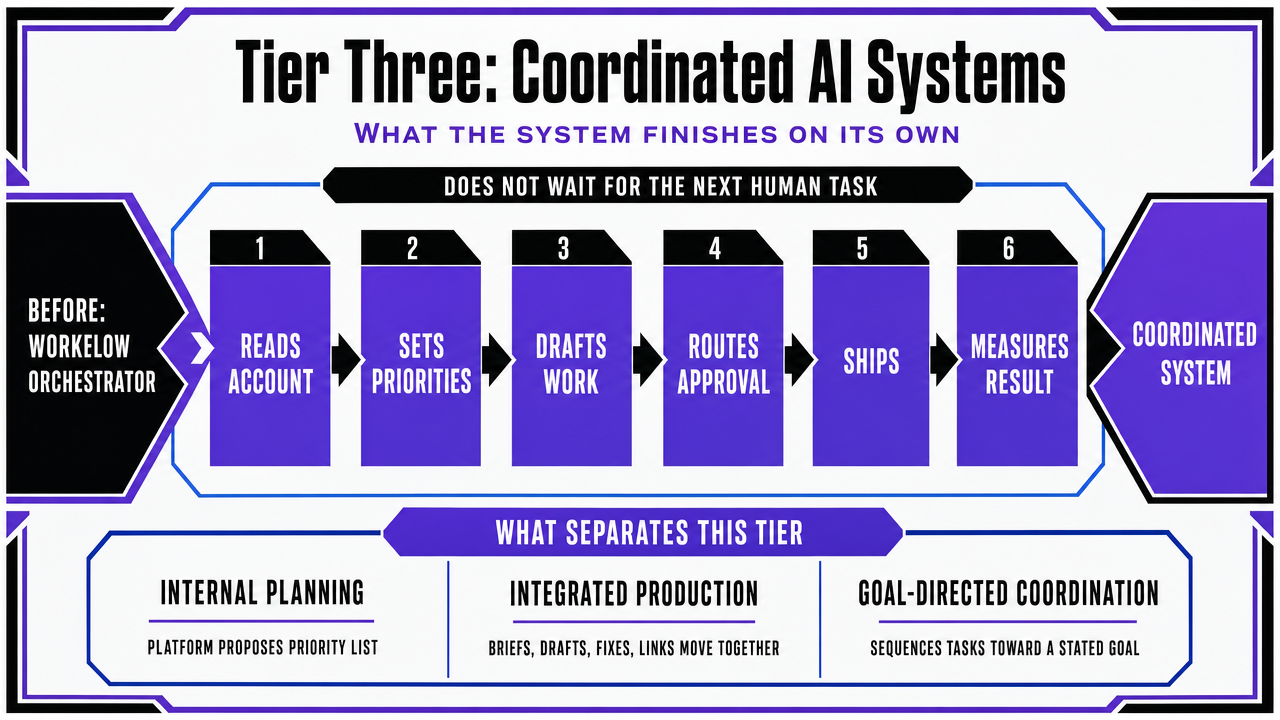
A coordinated AI system does not wait for a human to assign the next task. It reads the account, decides what matters this week, drafts the work, routes it for approval, ships it, and measures the result. BCG's framing of AI agents — autonomous systems that perform sequences of tasks toward a stated goal, analyzing data and collaborating with humans along the way — is the cleanest architectural definition available, and it maps directly onto what distinguishes this tier from the workflow orchestrators that came before it 5.
Three properties separate a coordinated system from a workflow tool:
- First, the planning layer is internal: the platform proposes the priority list rather than displaying one for a strategist to build.
- Second, production is integrated: briefs, drafts, technical fixes, and internal links move through one pipeline rather than across three tools.
- Third, the human role compresses from operator to approver.
Directors evaluating this tier should ask the vendor to demo a deliverable from data signal to published artifact without a person stitching the steps.
Vectoron and the Account-Level Execution Model
Vectoron sits in this tier as an account-level execution platform rather than a per-task utility. The model assigns specialist AI roles — a lead strategist plus content, SEO, conversion, PPC, and backlink strategists — against a single account plan that spans every site, location, and service line under one program. Account data from GA4, Search Console, SEMrush, and Google Ads feeds a continuously updated priority list, and approved work executes through an integrated production pipeline with a 12-stage content workflow and review checkpoints.
What this changes structurally is the unit of work. A retainer agency bills hours against deliverables negotiated per scope. A workflow suite organizes tasks for a human team. An account-level execution model ships approved work continuously across the portfolio, with the Command Center acting as the approval surface rather than the production floor. Directors evaluating the platform should apply the same rubric used elsewhere in this article: which of the five deliverables — keyword research, technical audits, content production, internal linking, reporting — does it finish, and what governance documentation backs the outcome claims it makes 2.
Adjacent Entrants and How to Evaluate Them
Several adjacent products now market themselves into this tier, including AI-native content systems like Writesonic's Botsonic SEO agent, Jasper's marketing workflows, AirOps content pipelines, and emerging agentic layers from incumbents like Semrush and HubSpot. The category is unsettled, and vendor language outpaces vendor architecture in most demos.
The evaluation question is not whether the product calls itself autonomous. It is whether the platform plans, produces, and measures across the account without a human moving work between tools, and whether the vendor can document how outputs are reviewed and how outcome claims are substantiated 3. Directors should ask for a recorded production run on a representative account, not a sandbox demo.
 Show the three-tier functional model the article uses to organize the market, helping readers place vendors and understand what each tier finishes on its own
See How Automated SEO Tools Outperform Traditional Agencies—Backed by Real Data
Request a walkthrough of AI-driven SEO workflows proven to reduce campaign costs and coordination time for multi-location brands and agencies managing complex growth portfolios.
If You Manage Multiple Locations or a Portfolio of Sites
Where Portfolio Scope Breaks Retainer Models
The reader scope narrows here. Directors running a single SaaS marketing site can stop at the rubric in the previous sections. The economics shift when one operator carries a portfolio — a multi-location healthcare group with thirty clinics, an agency servicing twelve client domains, or a SaaS company with a primary site plus regional subdomains and acquired brands.
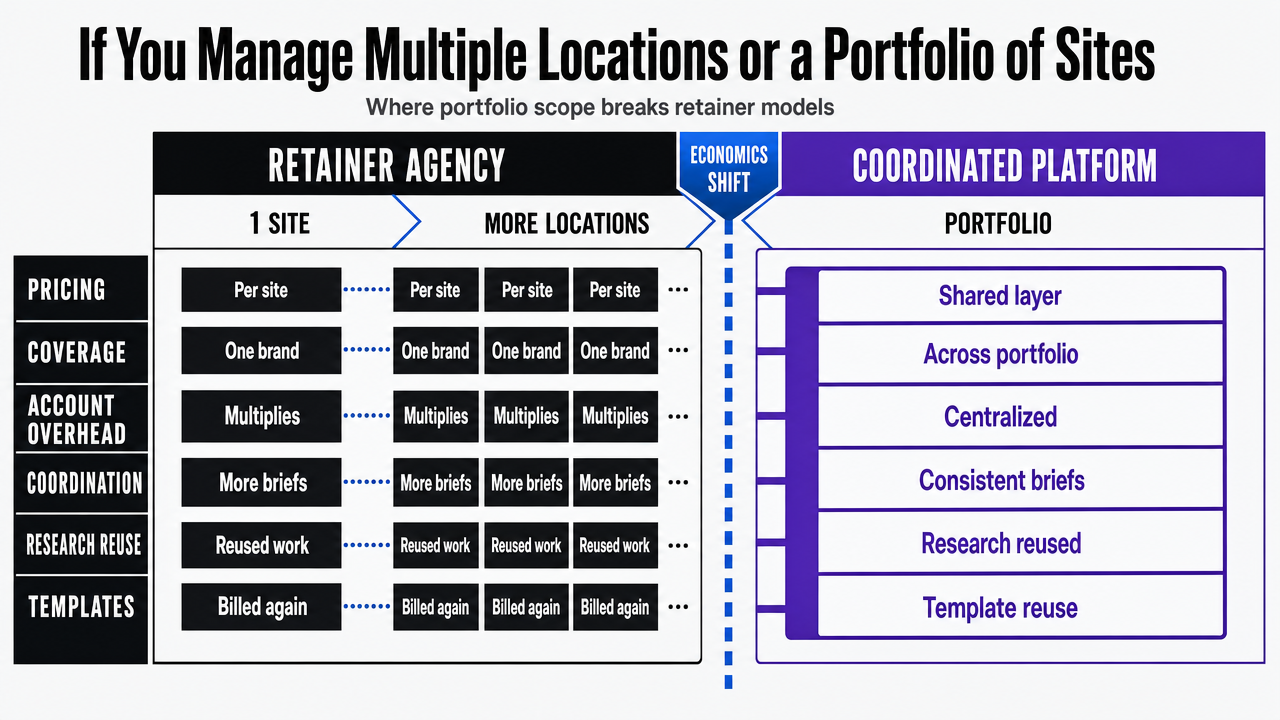
Retainer pricing tends to scale linearly with that scope. A standard agreement covers one site, one location, or one brand, and each addition multiplies the retainer, the account management overhead, and the coordination tax of keeping briefs consistent across properties. The work itself does not get linearly harder — competitive research and content templates often reuse — but the billing structure assumes it does.
Coordinated platforms behave differently because the planning layer operates at the account level. One priority list spans every property, one production pipeline produces the work, and the marginal cost of adding a location is closer to the marginal cost of adding a row to a dashboard than to onboarding a new account team.
Agency Retainer vs Coordinated Platform: Structural Comparison
The comparison below uses structural variables only. No dollar figures are invented; the cost model column describes the billing structure, not the price. Forrester's Q3 2025 evaluation of enterprise SEO solutions weighted workflow integration and automation depth precisely because portfolio-scale buyers were the ones for whom the difference compounds 6.
| Variable | Retainer Agency | Coordinated AI Platform |
|---|---|---|
| Cost model | Monthly retainer scoped to deliverables | Subscription scoped to account |
| Per-location or per-site billing | Typically multiplied per property | Single account covers all properties |
| Scope expansion cost | New SOW, new fee, new onboarding | Added to existing priority list |
| Turnaround for a standard deliverable | Bound by account manager queue and freelancer capacity | Bound by approval cadence and production pipeline |
| Headcount required to manage | Internal point of contact plus reviewers | Approver in the platform's command surface |
The variable that most often surprises directors is the third one. Retainer agreements quote a starting scope, and the expansion path — a new service line, an acquired brand, a regional rollout — runs through a new statement of work rather than the existing one. Platforms that plan at the account level absorb that expansion into the same priority list, which is the structural reason portfolio operators tend to evaluate this tier first.
 Visualize the structural comparison table between retainer agency and coordinated platform that the section presents, making the portfolio economics break-point legible at a glance
What to Decide Before the Next Renewal Cycle
The renewal calendar is the forcing event most directors do not schedule around, and it is the one that decides whether next year's SEO program looks like this year's. Three decisions are worth making before the next agency contract or platform subscription comes up for signature.
- Score the current stack against the five deliverables — keyword research, technical audits, content production, internal linking, reporting — and mark each as finished, partial, or input-only. The cells marked partial or input-only are where retainer hours quietly accumulate, and they are the candidates for tier-two or tier-three replacement.
- Require any vendor under consideration to produce the documentation behind its outcome claims: methodology, sample, time window, and the human review steps inside its production loop. The substantiation bar is not optional for regulated buyers, and it filters serious platforms from marketed ones.
- Decide whether the next twelve months will be spent coordinating an agency, coordinating an in-house team, or approving work a coordinated system finishes. The category has matured enough that the third option is now a defensible choice rather than a speculative one.
Frequently Asked Questions
References
- 1.Reducing Risks Posed by Synthetic Content.
- 2.AI Risk Management Framework | NIST.
- 3.FTC Announces Crackdown on Deceptive AI Claims and Schemes.
- 4.NIST’s AI Standards “Zero Drafts” Pilot Project to Accelerate Standardization.
- 5.AI Agents: What They Are and Their Business Impact.
- 6.Search Engine Optimization Solutions, Q3 2025.
- 7.AI Will Shape the Future of Marketing.
- 8.The Forrester Wave™: Autonomous Testing Platforms, Q4 2025, Is Out.
- 9.Reducing Risks Posed by Synthetic Content.
- 10.FTC Authorizes Compulsory Process for AI-related Products and Services.
- 11.The Role of Artificial Intelligence in Personalizing Social Media ....