
Key Takeaways
- Treat automation SEO as a production operating system with standardized inputs, approval gates, and feedback loops, not a loose collection of generators, crawlers, and reporting tools.
- Automate the repeatable layer—technical audits, on-page tags, schema, internal linking, and reporting—while keeping strategy, E-E-A-T narratives, and sensitive-vertical review above the synthesis ceiling.
- Margin gains come from reallocating senior strategists from production into approval throughput, satisfying FTC substantiation and NIST traceability through a documented approval log 4, 5.
- To clear the pilot-to-scale wall, assign one owner of the production system, anchor a shared definition of done to Google's quality signals, and start with high-volume deliverables 14.
The Margin Math Forcing Agencies to Rethink SEO Production
The agency SEO services market is projected to reach USD 165.29 billion by 2030, up from USD 87.82 billion in 2026, according to Research and Markets 17. This demand contrasts with an agency supply side that has remained largely unchanged for a decade: a writer drafts, an editor revises, an SEO specialist optimizes, a project manager coordinates, and a senior strategist approves. This traditional model leads to flat retainers, escalating client expectations, and compressed gross margins per account.
Automation SEO offers an operational solution, but the approach is critical. The question is not whether to adopt AI—78 percent of organizations reported using AI in 2024, a significant increase from 55 percent the previous year, according to Stanford's AI Index as cited by the U.S. Census Bureau 1. Instead, the challenge for agencies is to absorb demand growth without proportionally increasing billable headcount.
Agency P&Ls face converging pressures: client briefs have expanded due to search fragmentation across AI overviews, video carousels, and vertical SERPs; production cycle times have not kept pace; and the talent market for senior SEO strategists remains competitive. This means valuable strategist time is often spent on routine tasks like formatting meta descriptions or audit checklists, rather than high-value strategic work.
Leading agencies are adopting automation as a production redesign, standardizing repeatable SEO delivery layers and directing senior expertise to critical decisions that drive rankings and client retention. This analysis explores how this redesign addresses governance, quality, and headcount realities.
Automation SEO as a Production Operating System, Not a Tool Stack
Many agencies attempting to scale through automation focus on individual tools—a content generator here, a technical audit crawler there—and then find production bottlenecks persist. The key to margin improvement is treating automation SEO as a comprehensive production operating system. This involves a standardized sequence of inputs, transformations, approvals, and outputs that every account follows, irrespective of the specific tools used at each stage.
Deloitte highlights this gap in enterprise AI adoption: despite a 50 percent increase in worker access to AI by 2025, expectations for scale often exceed actual delivery 13. Access to AI without standardized workflows only speeds up individual tasks, not overall agency efficiency. McKinsey's analysis of workplace AI similarly concludes that execution maturity, rather than tooling, is the primary constraint 12.
An operating-system perspective necessitates three critical decisions:
- defining which deliverables require a fixed production template,
- establishing human approval gates, and
- determining how data feeds back into subsequent cycles.
Google's guidance emphasizes the importance of templates for producing content that is up-to-date, helpful, reliable, and people-first to achieve high rankings 11. Meeting this standard at scale requires repeatability, not reliance on individual heroic efforts.
Which SEO Tasks Automate Cleanly, and Which Resist It
The Repeatable Layer: Audits, On-Page, Internal Linking, Reporting
The most suitable tasks for automation within an agency are those that are already rule-based. These include technical audits, on-page tag generation, internal linking decisions, and monthly reporting. AI can compress tasks that once took hours into minutes, a shift observed across routine marketing tasks such as copy drafting, data mining, and visual production, as documented by Harvard's continuing education research 10.
Five production layers fit this profile in SEO delivery:
- Crawl-based technical audits (flagging missing canonicals, broken redirects, orphan pages, Core Web Vitals issues),
- Meta title and description generation (adhering to character limits and keyword targets),
- Schema markup application (based on page type),
- Internal link suggestions (ranked by topical proximity and authority flow), and
- Standardized client reporting (integrating Search Console, analytics, and rank-tracking data).
Each of these layers shares three characteristics: structured inputs, documented rules, and objectively verifiable outputs. This defines a cleanly automatable SEO task. Tasks lacking these characteristics fall into the synthesis layer.
The quality bar remains high. Google's ranking signals emphasize meaning, relevance, and quality 14, and its starter guide stresses that content must be up-to-date, helpful, reliable, and people-first 11. Automation does not lower this bar; it increases the throughput at which an agency can meet it. The senior strategist's role evolves to confirming automated output meets quality standards, rather than creating it from scratch.
The Synthesis Ceiling: Strategy, E-E-A-T, Sensitive Verticals
Tasks that resist automation typically have ambiguous inputs, contested rules, and outputs that demand domain expertise for evaluation. Nature's analysis of AI in scientific review highlights that current tools are not yet capable of replacing human methodological judgment, and in some expert tasks, AI can even prolong the process when review and correction time is factored in 16. This "synthesis ceiling" applies to the highest-value layers of agency SEO.
Three categories remain above the automation line:
- Account strategy (requiring an understanding of client context not found in data feeds for positioning, competitive angles, and cross-channel prioritization),
- E-E-A-T narrative construction (especially for verticals like legal, healthcare, and medical content where Google's quality raters prioritize first-hand expertise), and
- Sensitive-vertical content review (where errors can lead to client liability rather than just ranking penalties).
Agencies attempting to automate beyond this synthesis ceiling risk producing content that appears competent but performs poorly, or worse, triggers client complaints that negate any margin gains. Successful agencies automate up to this ceiling, routing all tasks above it to senior judgment, thereby preserving both quality and throughput. The boundary between these two layers is crucial for a production system's success.
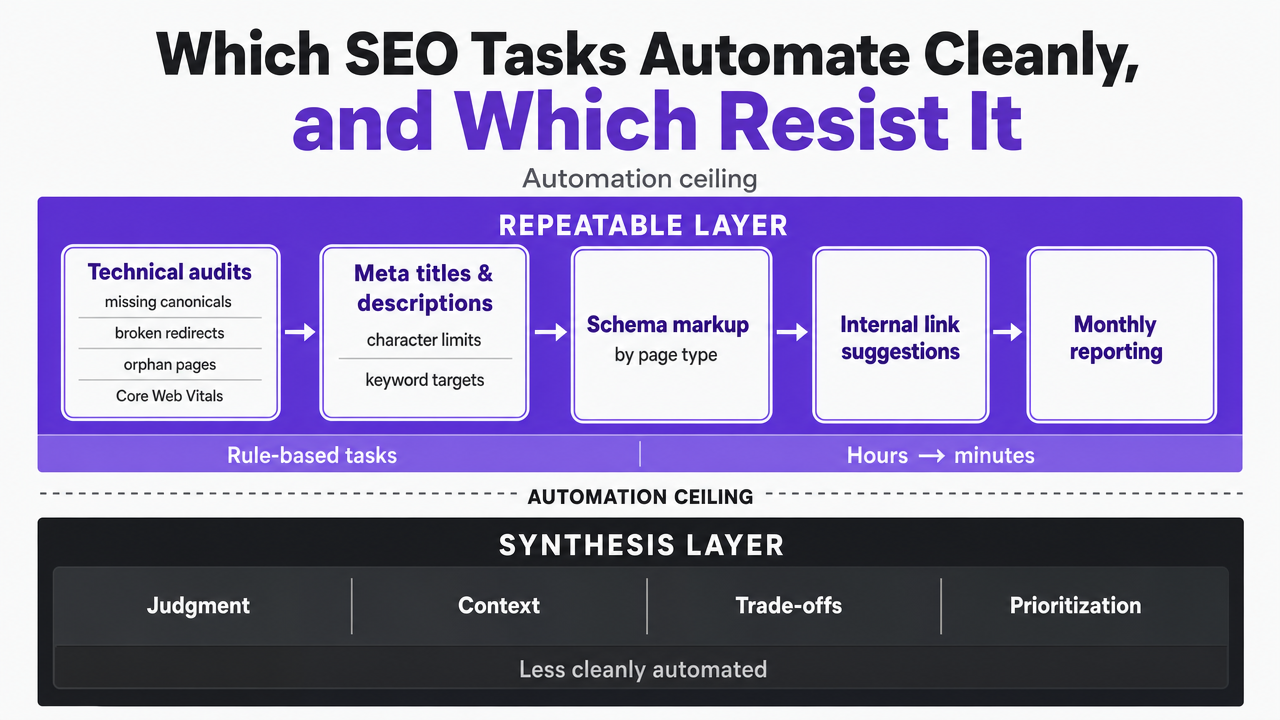 Visualize the automation ceiling concept by clearly separating the repeatable layer from the synthesis layer, which is the core framework of this section
Experience Automation SEO Workflow With Full Access
Test automation-driven SEO processes on real campaigns and measure impact before making a long-term commitment.
Reallocating Senior Strategists Instead of Cutting Headcount
A common concern regarding automation SEO is its impact on teams. However, the Bureau of Labor Statistics views automation as a task-shifting force rather than a job-elimination mechanism, reshaping roles more often than removing workers 2. For agencies, this distinction means expanding capacity per strategist rather than cutting payroll.
The software developer role, which has long integrated automation, provides a clear example. The BLS projects software developer employment to grow by 17.9 percent from 2023 to 2033, even with the rise of generative AI 3. Roles closest to automation are expanding, not shrinking, as work shifts to higher-value problems while routine tasks become more efficient.
Agencies implementing production redesigns effectively observe a similar pattern. A senior SEO strategist who previously spent 60 percent of their time on meta tag generation, audit checklists, and report assembly will not lose their job when these tasks are automated. Instead, their hours shift to competitive positioning across accounts, E-E-A-T narrative development in regulated verticals, and client conversations that secure renewals and expand scope. This allows for a reduction in headcount per account while total agency headcount can remain stable or grow, as each strategist manages more accounts with higher quality output.
McKinsey's research on workplace AI also indicates employee readiness for AI, with execution maturity being the main constraint 12. Agencies that prioritize layoffs treat automation as a cost-cutting measure, risking the loss of strategists essential for the new operating model. Conversely, agencies that focus on reallocation leverage automation to increase capacity, capturing margin gains without disrupting their core team.
The operational test is straightforward: after automation, a senior strategist's calendar should reflect more time on strategy reviews, client business discussions, and quality approvals, and less time on production tools. If the calendar remains unchanged, the automation has merely added a faster tool without fundamentally transforming the workflow.
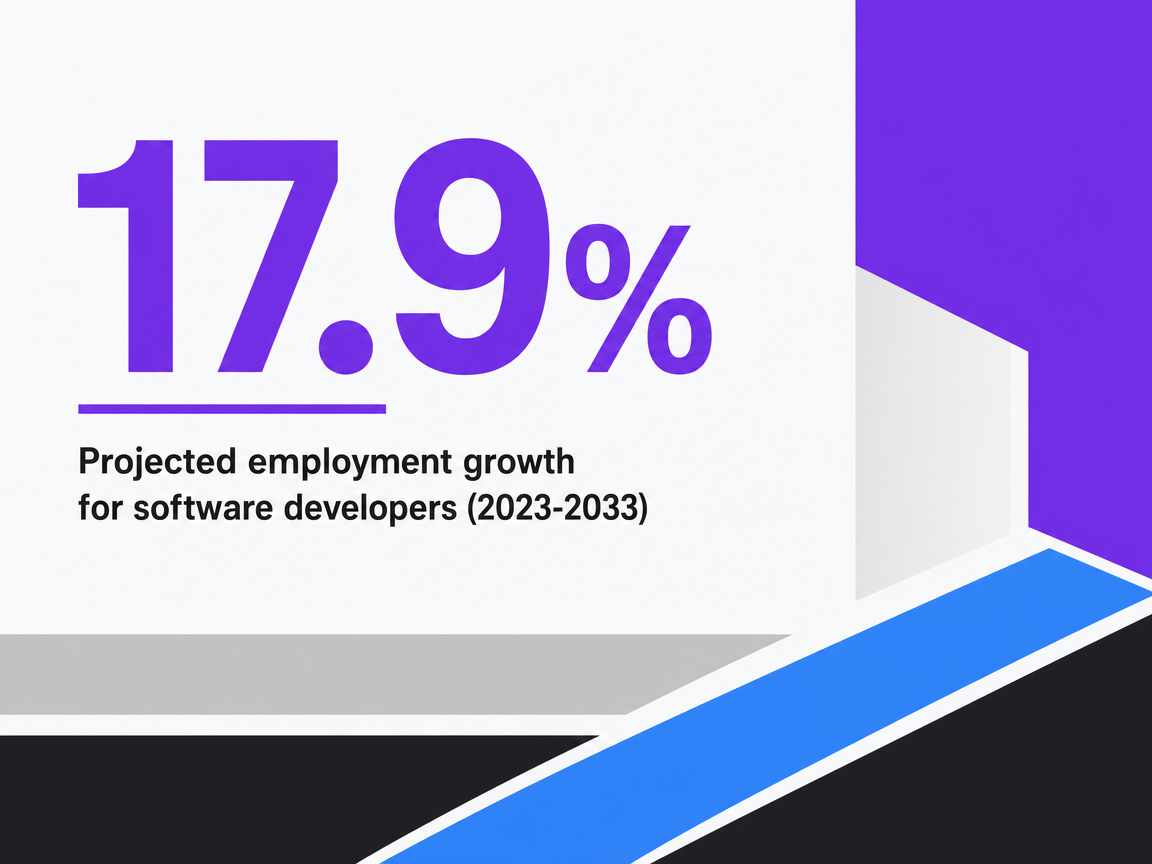 Projected employment growth for software developers (2023-2033)
Projected employment growth for software developers (2023-2033)
The Economics of an Automation-First Production Line
Traditional vs. Automation-Assisted SEO Production: A Variable Comparison
Evaluating automation SEO effectively requires modeling the production line, not just the tool budget. Key variables influencing gross margin per account—hours per deliverable, deliverables per FTE per month, approval cycle time, and the proportion of senior strategist hours spent on judgment versus production—remain constant across models. The difference lies in how hours are allocated.
The table below compares traditional and automation-assisted models using internal agency production variables.
| Production Variable | Traditional SEO Production | Automation-Assisted Production |
|---|---|---|
| Hours per standard content deliverable (brief → draft → edit → optimize) | Writer hours + editor hours + SEO specialist hours + PM coordination | AI draft minutes + senior strategist review hours + PM coordination (reduced) |
| Hours per technical audit | Specialist crawl review + manual prioritization + report assembly | Automated crawl + rules-based flagging + strategist prioritization review |
| Internal linking cycle | Manual anchor inventory + page-by-page placement | Automated link candidates ranked by topical proximity + strategist approval |
| Monthly client reporting | Analyst pulls + manual narrative + PM formatting | Automated data join + templated narrative + strategist annotation |
| Approval cycle time per deliverable | Multiple internal handoffs before client review | Single strategist approval gate before client review |
| Deliverables per senior strategist per month | Constrained by production participation | Constrained by approval throughput, not production |
| Gross margin per account | Pressured by flat retainers vs. expanding scope | Improves as approval throughput rises faster than headcount |
The economic advantage is evident in the last two rows. In the traditional model, a senior strategist's output is limited by their direct involvement in production. In the automation-assisted model, the limit shifts to their approval capacity. Harvard's continuing education research notes that routine tasks like copy drafting, data mining, and visual production transition from hours to minutes 10. This time saving creates margin, provided that approval throughput, not draft generation, becomes the new constraint managed by the agency.
Two important caveats apply: automated drafts without strategist review often lead to rework cycles if they fail to meet Google's meaning, relevance, and quality signals 14. Additionally, auto-generated audit reports without prioritization waste strategist time on triage instead of decision-making. The model's effectiveness relies on a genuine approval gate.
If You Manage Multiple Locations: Portfolio Production Economics
For agencies managing multi-location accounts—such as dental support organizations, multi-office legal portfolios, or franchise groups—the economics shift. Here, the production unit is a portfolio of locations under a master account, where content, schema, and reporting layers are repeated with local variations.
At portfolio scale, three economic differences are significant:
- First, the marginal cost of adding a new location decreases sharply with templated automation for location pages, schema, and Google Business Profile updates. Concurrently, the marginal value of senior strategist time increases, as one approval can govern numerous location-specific outputs.
- Second, internal linking and topical authority decisions benefit from automated mapping across the portfolio, which manual production cannot match without additional headcount per location.
- Third, reporting consolidates, with a single automated rollup replacing individual analyst pulls for each location.
The primary constraint for portfolio economics is governance, not production. SBA research indicates that marketing automations are common among small businesses 9, meaning multi-location operators often use their own in-house tools. This raises the bar for agencies to justify portfolio retainers. The defensible position is approval-first orchestration across locations: templated production, strategist-approved local variations, and an auditable trail of human-approved decisions. Agencies lacking this trail will compete on price against clients' internal tooling.
Approval-First Governance: The NIST and FTC Layer Agencies Cannot Skip
Sophisticated clients consistently ask about the approval process for automated SEO work. Agencies unable to provide a clear answer face exposure from two fronts: federal regulators prosecuting unsubstantiated AI claims, and voluntary risk frameworks increasingly cited in client procurement reviews.
The Federal Trade Commission has initiated enforcement actions against schemes using AI claims to sell deceptive promises, indicating that marketing claims based on AI performance require substantiation 4. For agencies reselling automation SEO, this means any claim about AI-driven ranking improvement, traffic gains, or production speed must be supported by verifiable evidence. "Powered by AI" in a proposal is a representation that the FTC can scrutinize.
The NIST AI Risk Management Framework, though voluntary, is increasingly recognized by clients. It structures trustworthiness considerations across the design, development, use, and evaluation of AI systems 5, providing agencies with a framework to explain how automated SEO work is governed 6. Practically, this translates to a documented approval gate: a designated senior strategist reviews AI-generated briefs, drafts, audits, and optimization recommendations before they reach the client or go live.
An approval log serves as the artifact that operationalizes both regulatory compliance and client expectations. It records who approved which output, against what quality criteria, and on what date. This single record addresses FTC substantiation requirements and NIST traceability expectations simultaneously, streamlining processes and preventing repeated disputes across accounts.
See Automation SEO in Action: Reduce Manual Tasks, Increase Throughput
Request a walkthrough of AI-driven SEO automation purpose-built for agencies. Discover how unified workflows and automated execution can cut production overhead while maintaining client oversight and quality benchmarks.
Getting Past the Pilot-to-Scale Wall
Most agencies struggle with automation SEO not because tools underperform, but because workflows beyond the initial pilot fail to standardize. Deloitte's research on enterprise AI highlights this "pilot-to-scale" gap as a common stalling point, despite a 50 percent increase in worker access to AI by 2025 13. In agencies, this manifests as disconnected automations—one for content, another for audits—that lack a unified approval log or client deliverable template.
Three factors predict an agency's ability to scale automation:
- First, a single owner for the production system, distinct from account managers, to prevent automations from becoming competing side projects.
- Second, a shared definition of "done" for all deliverables, anchored to Google's quality signals—meaning, relevance, and people-first content 14—rather than individual strategist preferences.
- Third, a feedback loop that integrates ranking outcomes, client edits, and approval rejections back into templates. Automation that fails to learn from its approval log will degrade.
The sequencing of automation is also crucial. Agencies that attempt to automate strategy first often hit the synthesis ceiling. Those that start with reporting may save analyst hours but fail to address core production bottlenecks. The most effective scaling pattern begins with high-volume, repeatable deliverables—typically on-page optimization or technical audits—establishes a working approval gate, and then extends this gate to other deliverable types. By the time subsequent workflows are implemented, the operating system, rather than individual tools, becomes the foundation for new hire training.
The challenge of scaling is operational, not technological. Agencies that assign ownership, define clear completion criteria, and establish feedback loops can overcome this hurdle, while others accumulate isolated pilot projects.
What an Approval-Gated Automation Workflow Looks Like in Practice
While the concept of approval-first automation appears straightforward, its operational implementation involves four critical, interconnected stages that determine scalability. A functional workflow operates as a closed loop: input intake, AI generation, strategist review against a fixed checklist, and a logged approval that releases the work.
Agencies often underinvest in the intake stage. The input package for any automated SEO deliverable—including target query, page intent, audience, internal link targets, schema type, and client-specific vertical guardrails—must be structured. A senior strategist provides a single upstream approval at the start of an engagement, eliminating the need to re-establish context for every brief. This initial approval is what makes downstream automation valuable.
Generation then proceeds based on these fixed inputs. Drafts, audit prioritizations, internal link candidates, and reporting narratives are produced in minutes, reflecting the time compression observed in routine marketing tasks by Harvard's continuing education research 10. This output is a candidate, not a final deliverable.
Review serves as the critical gate. A designated strategist evaluates the candidate output against Google's published quality criteria—meaning, relevance, and quality 14—and client-specific vertical requirements. The approval log documents who reviewed the work, what changes were made, and when it was released. This log provides an auditable record for clients, auditors, or regulators, and also serves as data for the agency to refine subsequent cycles, thereby closing the loop that distinguishes a coherent production system from a collection of disconnected tools.
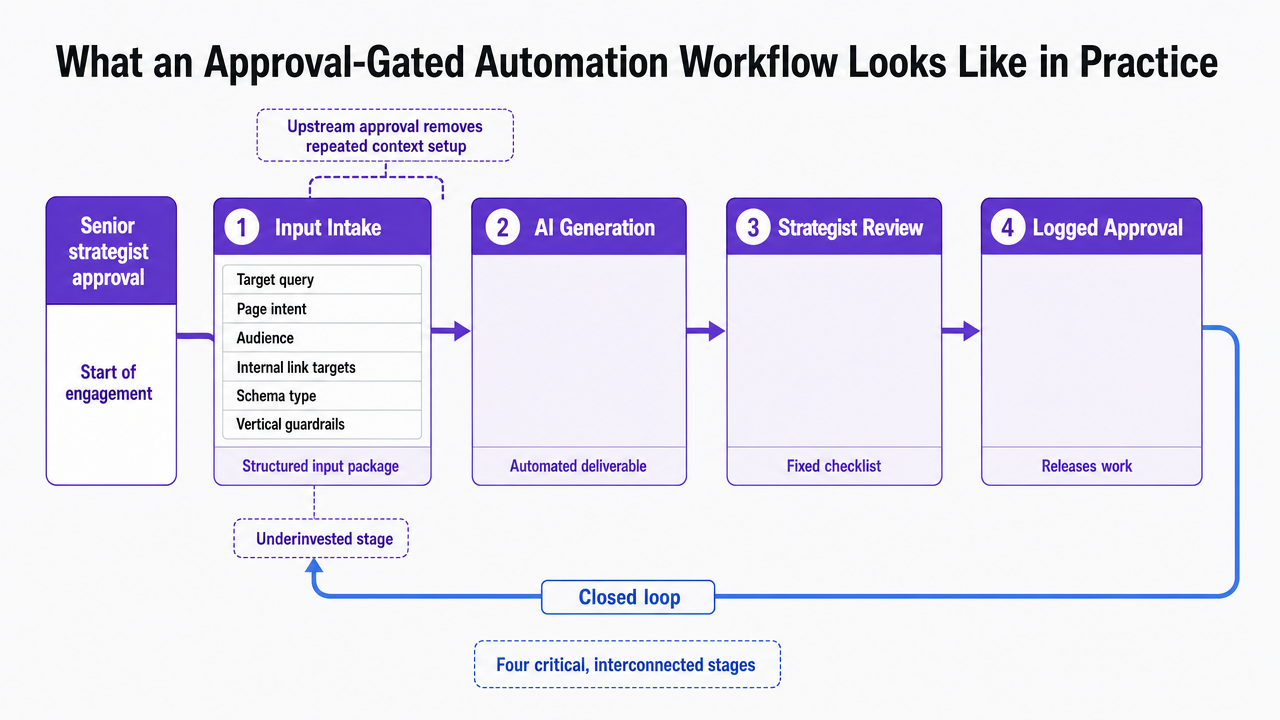 Visualize the four-stage closed-loop workflow described in this section (intake, generation, review, logged approval) which is explicitly the structure of the prose
Frequently Asked Questions
References
- 1.How AI and Other Technology Impacted Businesses and Workers.
- 2.Assessing the Impact of New Technologies on the Labor Market.
- 3.AI impacts in BLS employment projections.
- 4.FTC Announces Crackdown on Deceptive AI Claims and Schemes.
- 5.AI Risk Management Framework | NIST.
- 6.AI RMF - AIRC - NIST AI Resource Center.
- 7.America’s AI Action Plan.
- 8.Are North Carolina Businesses Using AI? A Look at Current Use and ....
- Research Spotlight - AI In Business: Small Firms Closing In. https://advocacy.sba.gov/wp-content/uploads/2025/09/Research-Spotlight-AI-in-Business-Small-Firms-Closing-In-092425.pdf
- 10.AI Will Shape the Future of Marketing.
- 11.Search Engine Optimization (SEO) Starter Guide.
- 12.Superagency in the Workplace: Empowering People to Unlock AI’s Full Potential at Work.
- 13.The State of AI in the Enterprise - 2026 AI report | Deloitte US.
- 14.How Does Google Determine Ranking Results.
- 15.The Role of Artificial Intelligence in Personalizing Social Media Marketing Strategies.
- 16.Why AI can't be trusted to write scientific reviews.
- 17.Agencies SEO Services Market Report 2026 - Research and Markets.