
Key Takeaways
- Surfer SEO turns keyword intent into a consistent, scored brief, keeping multiple writers aligned to the same search relevance signals before drafting begins.
- Ahrefs supplies the diligence layer behind the editorial calendar, using content gap reports and decay flags to decide which posts deserve creation or refresh.
- Clearscope guides writers toward related concepts inside the document without dictating phrasing, making it useful for teams protecting a distinctive brand voice.
- Jasper works best for scaffolding outlines, headlines, meta descriptions, and product copy, since unedited AI output triggers the consumer perception issues flagged in 10.
- Descript's edit-by-transcript model multiplies throughput per recorded hour, turning one interview into long-form, vertical, and email assets without a separate editor cycle.
- HubSpot ties published content to email sends, lifecycle stages, and closed deals, giving content managers defensible attribution evidence for budget conversations.
- Airtable treats content as queryable data rather than tasks, letting managers filter by funnel stage, keyword, or MQL outcome in seconds rather than hours.
- Vectoron represents the coordinated execution category, routing strategy, production, and publishing through one approval surface to eliminate the briefing and re-export costs of fragmented stacks.
The Handoff Tax Is the Real Problem
AI adoption among content marketers jumped from 65% to 95% in two years, according to Orbit Media's survey of working content professionals 7. This figure measures self-reported tool usage across the content lifecycle, not full automation. The question for in-house managers is no longer whether to add AI to the stack, but which configuration of tools shortens the distance between a strategic decision and a published asset.
Most content teams lose hours to a "handoff tax" that doesn't appear on any invoice. A keyword target is researched in one tool, briefed in a second, drafted in a third, optimized in a fourth, routed for approval in a fifth, and scheduled in a sixth. Each transition introduces a status meeting, a Slack thread, or a re-export. The actual writing is rarely the bottleneck; the coordination around the writing is.
This shortlist prioritizes handoff cost as the primary selection criterion. The eight picks that follow are scored on production velocity, integration with SEO and distribution, and their ability to reduce briefing and approval friction. Feature counts are secondary. A tool that does one job well but requires three exports per article costs more time than a less-featured tool wired directly into the next step.
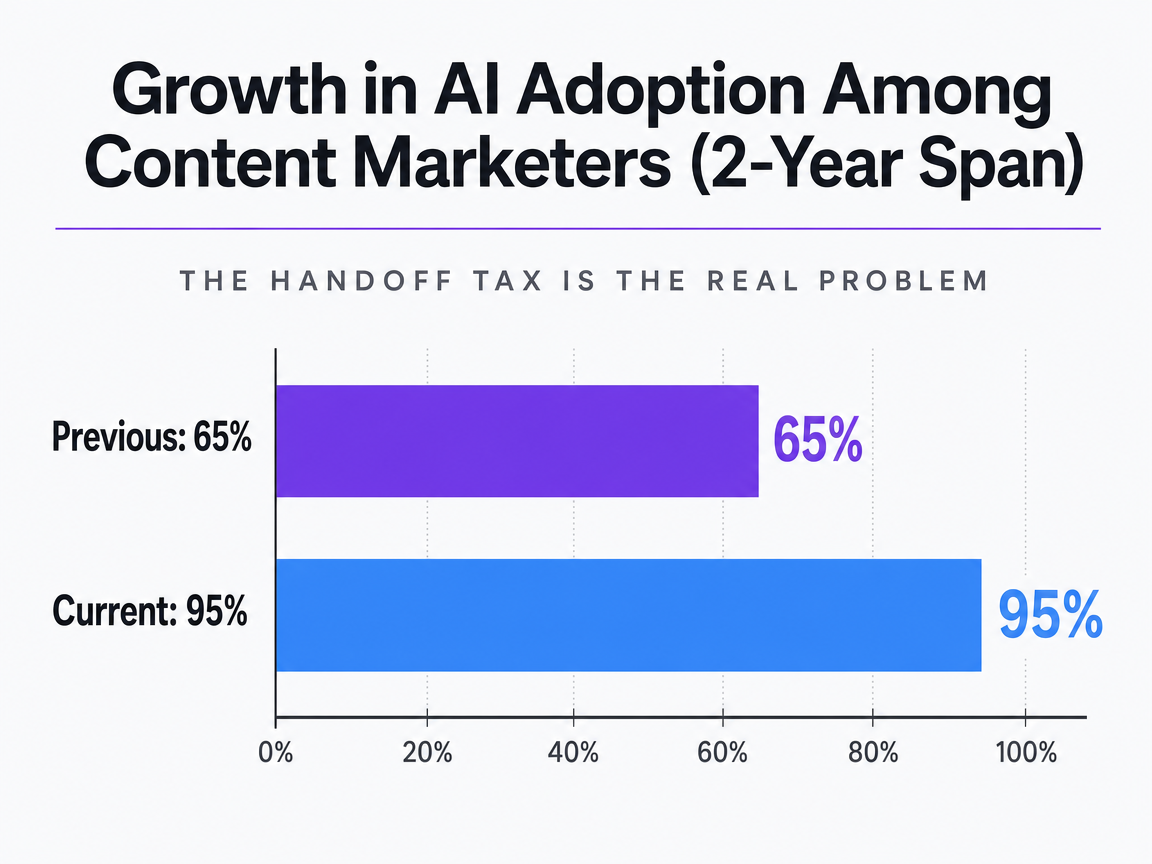 Growth in AI Adoption Among Content Marketers (2-Year Span)
A comparison chart (e.g., two bars) showing the significant increase in AI tool adoption by content marketers over a two-year period, from 65% to 95%.
How This Shortlist Was Filtered
Eight tools made the list based on three operator-relevant tests, not G2 rankings or affiliate programs.
The first test was production velocity impact. A tool had to demonstrably shorten the path from idea to draft to published asset. Orbit Media's research found that AI tools produced roughly a 10% efficiency gain in content production, and that "suggest edits" — not "write the whole article" — is the dominant use case 7. Tools assuming full automation were weighted lower than those accelerating steps human writers and editors already perform.
The second test was SEO and distribution integration. A drafting tool that cannot pass briefs, optimization scores, or published assets into the next stage of the workflow creates a handoff. Tools were judged on their connectivity, not just their generation capabilities.
The third test was handoff reduction. Each pick was scored on how much briefing, approval, or vendor coordination friction it removes. Tools that consolidate two or more steps in a single approval surface ranked higher than single-purpose tools, even if the latter were best-in-class at their narrow job.
Two Categories, Not One Long List
Point Solutions Versus Coordinated Execution Platforms
The eight picks split cleanly into two groups: point solutions and coordinated execution platforms. Point solutions handle one specific job in the content lifecycle, such as keyword research, on-page optimization, drafting, scheduling, or analytics. They are typically deep and mature in their specific function. Coordinated execution platforms manage the connections between these jobs, overseeing strategy, production, approval, and publishing as a unified workflow rather than separate vendor relationships.
The 2026 Content Marketing Trend Study by Statista highlights the operational significance of this distinction. Just over half of B2B content marketing professionals (51%) use AI for text, image, or video production, while 45% use AI for reporting and performance measurement. Only 4% report no AI use 8. A stack that excels at production but leaves measurement to a separate tool, or vice versa, leaves nearly half the AI-enabled workflow fragmented by an export.
Point solutions remain valuable. Several on this list are point solutions, earning their place because no coordinated platform yet matches their depth in a specific area. The strategic question is how many such tools a team can manage before the coordination cost outweighs their specialized value. This threshold is where coordinated execution platforms become competitive based on operational efficiency rather than just feature parity.
The Cost of a Fragmented Stack
A typical in-house content stack often involves four to six separate subscriptions: an AI writer, an SEO platform, an analytics layer, a social scheduler, a project management tool, and often a digital asset manager. Each requires its own login, permissions, export format, and renewal cycle. The direct spending is visible, but the coordination cost is often hidden.
This cost escalates when budgets are under scrutiny. The Content Marketing Institute and MarketingProfs 2025 outlook reports that 46% of B2B marketers expect their content marketing budget to increase in 2025 4. However, more budget in a fragmented stack doesn't automatically lead to more output. Instead, it can result in more tools, more seats, and more handoffs unless the workflow is redesigned.
A more profound cost is the loss of strategic context. When a brief is in one tool, the draft in a second, the optimization score in a third, and the approval thread in Slack, the reasoning behind decisions rarely accompanies the asset. Editors re-derive intent, writers reverse-engineer briefs, and approvers ask questions already answered. The work progresses, but the underlying rationale is lost, making future planning slower.
Test High-Velocity Content Production This Week
Experience full-scale content workflow acceleration and publish results-driven campaigns before your trial ends.
The Eight Picks
Surfer SEO — Search Brief Discipline
Surfer SEO initiates the production line by translating keyword intent into a usable brief for writers. Its core value lies in embedding search relevance into the draft before it's even written. The tool analyzes top-ranking pages for a target query, identifies common terms and structural patterns, and generates a brief with a content score that updates as the writer edits.
For content managers overseeing multiple writers, Surfer ensures brief consistency. A freelancer and a staff writer using the same Surfer outline will produce more comparable drafts than those working from disparate sources.
The handoff cost is moderate. While Surfer integrates with Google Docs and some CMS platforms, the brief often still needs to be exported or copied into the primary editorial system. Effective teams treat Surfer as the definitive brief layer, avoiding redundant outline creation in other tools.
Ahrefs — Keyword and Competitive Visibility
Ahrefs provides the foundational data layer beneath the brief. While Surfer guides what to include in a page, Ahrefs helps managers determine if a page is worth creating at all. Its extensive keyword database, backlink index, and traffic estimates form the diligence layer that informs editorial calendar decisions.
For content managers focused on ROI, the most valuable Ahrefs feature is often the content gap report. This report compares a brand's performance against competitors, highlighting queries where rivals are capturing traffic that the brand could potentially win. This directly translates into a quarter's worth of briefs.
Ahrefs also helps identify decaying older posts. Its site explorer flags pages losing position, feeding a refresh queue that often yields better results than net-new publishing. This tool is deep, expensive, and primarily a research instrument, not a content generator.
Clearscope — Editorial Optimization for Writers
Clearscope and Surfer SEO appear similar but differ in application. Surfer is a brief-and-score system for planning, while Clearscope is designed for writers within the document. Its interface is less intrusive, its term recommendations are more conservative, and its grading system often aligns well with how editors evaluate drafts.
Teams already using Surfer for briefs sometimes add Clearscope for a final editing pass, especially for senior writers who find Surfer's prescriptions too detailed. Other teams choose one or the other to avoid redundancy.
Clearscope's strength is its ability to guide writers toward covering related concepts without dictating phrasing, making it suitable for teams with a distinctive brand voice. The handoff cost is low when integrated directly into the drafting document, but higher if it requires reconciling against a separate brief.
Jasper — Drafting and Brand Voice Assistance
Jasper is a prominent yet often misunderstood AI drafting tool. Its primary value isn't in writing entire articles; Orbit Media's research indicates that "suggest edits" is the dominant AI use case, with only about one in ten content marketers using AI for complete articles 7. Jasper excels at automating time-consuming, low-judgment tasks like generating first-draft outlines for low-stakes pages, headline variations, meta descriptions, and scalable product-page copy.
The limitation for this category is consumer perception. Bynder's study on AI-generated text found that roughly 50% of consumers can spot AI-written content, 26% perceive impersonal copy as such, and 20% view the brand as lazy 10. Jasper operates within these perception boundaries. Teams that use it for scaffolding and then heavily edit their content succeed; those that publish unedited output do not.
Descript — Short-Form Video and Repurposing
Descript is included because short-form video has become a high-ROI format, often overlooked by content teams. Taboola's 2026 statistics hub reported that short-form video generated over 100% ROI in 2025 2. A content team without a video tool risks ceding this high-performing format to social or brand teams that may not optimize for search-adjacent intent.
Descript's edit-by-transcript model significantly reduces the cost of repurposing content. A 30-minute podcast or webinar can be quickly transformed into clipped vertical assets, eliminating the need for a separate editor or brief cycle. The tool also offers voice cloning, screen recording, and overdub corrections, addressing common reasons for video re-edits.
For an in-house content manager, the value is increased throughput per recorded hour. One interview can yield a long-form blog post, a YouTube cut, four short vertical videos, and an email teaser when the editing process is unified.
HubSpot — Distribution, Email, and Pipeline Attribution
HubSpot bridges content and revenue. While its CMS, email engine, and CRM may not be best-in-class compared to pure-play competitors, their interconnectedness is its key advantage. A blog post published in HubSpot can be directly linked to an email send, a lifecycle stage change, and an MQL conversion without manual CSV exports.
For content managers measured on pipeline contribution, this connection is crucial for a defensible quarterly review. HubSpot's attribution reporting, often underutilized, maps which posts contributed to closed deals, providing compelling evidence for budget discussions.
The 2025 B2B outlook from Content Marketing Institute and MarketingProfs indicated that 46% of B2B marketers expect their content marketing budget to increase in 2025 4. In a scrutinized environment, budget growth goes to teams that can demonstrate revenue impact. HubSpot provides the platform for presenting this evidence.
Airtable — Editorial Calendar and Workflow Backbone
Airtable, though less glamorous, is often the daily hub for content managers. It serves as a central repository for calendar, status, and accountability. Every brief, draft, approver, target keyword, publish date, and post-publish metric resides in a single relational table, which other tools can reference.
Unlike generic project management tools that handle tasks, Airtable treats content as data. This distinction becomes clear when a manager needs to answer questions like "which posts published in Q2 targeted bottom-funnel queries and converted at least one MQL?" This is a quick filter in Airtable but a multi-hour rebuild in a Kanban tool.
The risk with Airtable is that it can become another fragmented source of truth in an already complex stack. Used effectively, it acts as a central index. Used poorly, it becomes another tab requiring manual updates while the rest of the workflow happens elsewhere.
Vectoron — Coordinated AI Execution Across the Brief-to-Publish Loop
Vectoron exemplifies the coordinated execution category, distinct from point solutions. It spans strategy, production, and publishing within a single approval workflow. Specialist AI strategists manage content, SEO, backlinks, social, PPC, and call intelligence, routing all recommendations through a Command Center for human approval before deployment.
The operational argument for this category is supported by Deloitte's research, which found that 26% of surveyed marketers were already using generative AI for marketing content production, with another 45% planning adoption 3. This adoption curve increases AI output, but doesn't necessarily reduce handoffs unless the production layer is integrated with strategy and measurement.
The trade-off is depth versus consolidation. A coordinated platform may not match Ahrefs for link data or Descript for video editing. Its value lies in eliminating the briefing, status, and re-export costs inherent in a fragmented stack. For content managers facing headcount pressure, this efficiency often proves decisive.
Where Coordinated Platforms Came From
The coordinated execution category emerged not because AI became smarter, but because the economics of running a fragmented stack became unsustainable. With 95% of content marketers using AI tools, and 51% for production versus 45% for measurement 8, the volume of output for any team increases significantly. The number of decisions, approvals, and asset handoffs rises proportionally. Fragmented stacks were designed for a slower content cadence and fewer decision points.
Deloitte's research captured this inflection point: 26% of marketers were already using generative AI for content production, with 45% planning to adopt it 3. This trend leads to a predictable operational consequence: teams that simply bolt AI onto legacy stacks generate more drafts than their review processes can handle, widening the gap between produced and approved content each quarter.
Coordinated platforms are a direct response to this gap. They prioritize approval, not generation, as the scarce resource and design workflows to protect it. While the effectiveness of any single platform is a separate question, the category exists because the alternative no longer scales.
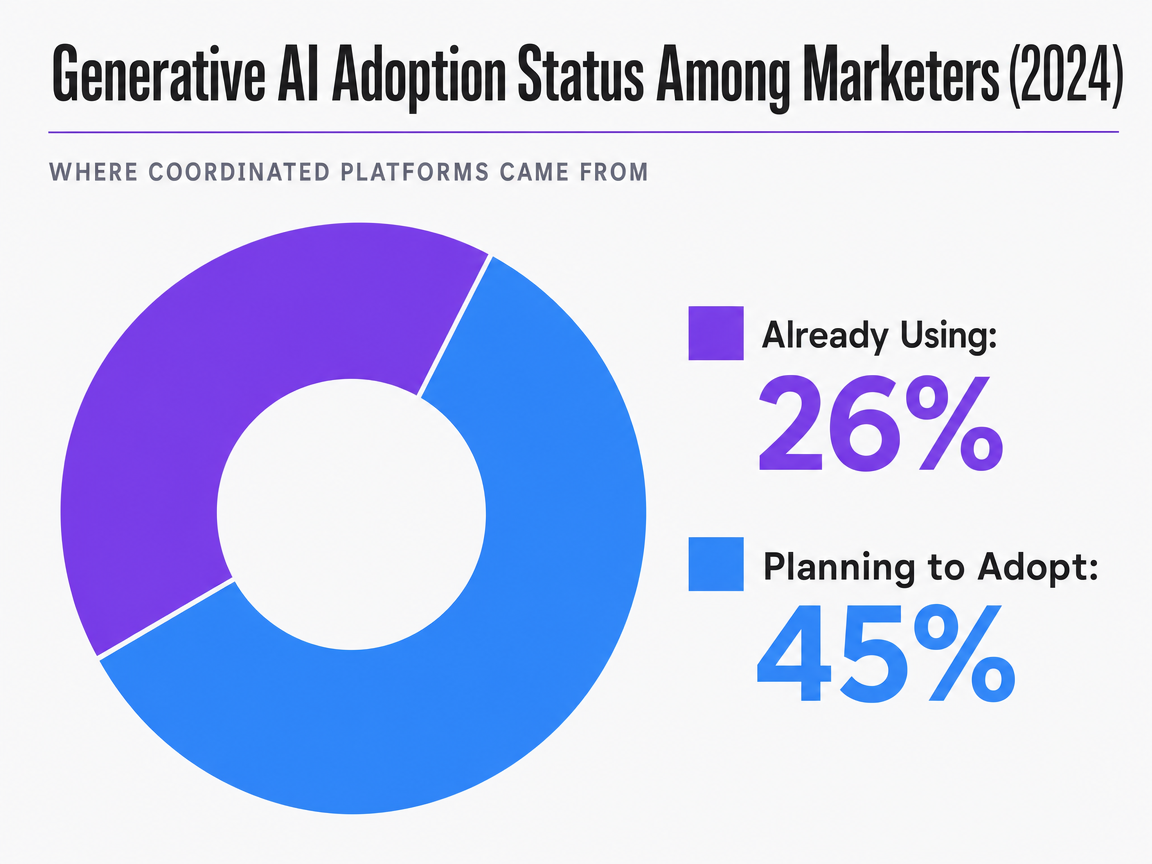 Generative AI Adoption Status Among Marketers (2024)
A stacked bar or pie chart showing the percentage of marketers who already use generative AI and those who plan to adopt it by the end of 2024.
See How Leading Teams Streamline Content Production With AI Coordination
Request a walkthrough of unified workflows that enable in-house teams to accelerate content creation, maintain brand standards, and measure SEO impact—without adding writers or agency overhead.
If You Manage Content Across Multiple Brands or Business Units
This section addresses content teams managing output for multiple brands, subsidiaries, or business units. The economics of content management change significantly in this scenario.
The cost of fragmentation multiplies exponentially. A four-tool stack across three brands isn't just three times the work; it often requires a different operating model. Each tool now needs to accommodate three sets of brand voice guidelines, three CMS connections, three approver groups, and three distinct reporting views. Point-solution depth becomes less critical when consistency across portfolios is the primary constraint.
This is where coordinated execution platforms offer a clear advantage over point solutions, based on operational math rather than ideology. A single approval workflow that manages brand voice rules, optimization scores, and publishing destinations per entity eliminates this multiplication of effort. The 95% AI adoption rate among content marketers 7 is accelerated in multi-brand portfolios due to higher volume pressure. Managers overseeing multiple brands should prioritize consolidation first, then consider adding point solutions only where the coordinated layer has a measurable gap.
Building the Stack: A Three-Layer Configuration
An effective content stack can be conceptualized in three layers, rather than as a collection of eight disparate tools. The first layer focuses on research and briefing, where keyword intent, competitive gaps, and target outlines are determined before writing begins. Tools like Ahrefs and Surfer fit here. The second layer is production and optimization, where drafts are written, scored, and refined to align with brand voice. Clearscope, Jasper, and Descript operate in this layer, with the format mix driven by channel data. For instance, short-form video's over 100% ROI in 2025 2 justifies a video tool alongside writing tools.
The third layer encompasses publishing, attribution, and coordination. HubSpot manages the revenue-side, linking posts to email touches and pipeline. Airtable serves as the editorial calendar, storing queryable data. A coordinated execution platform, if adopted, can replace or consolidate parts of this third layer by unifying strategy, production, and approval workflows.
The choice of configuration depends on where a team experiences the most handoff cost. Teams struggling with briefing inconsistency should invest in layer one. Those facing format throughput issues should focus on layer two. Teams losing time to approval cycles, status meetings, or reporting rebuilds should invest in layer three, where platforms like Vectoron compete.
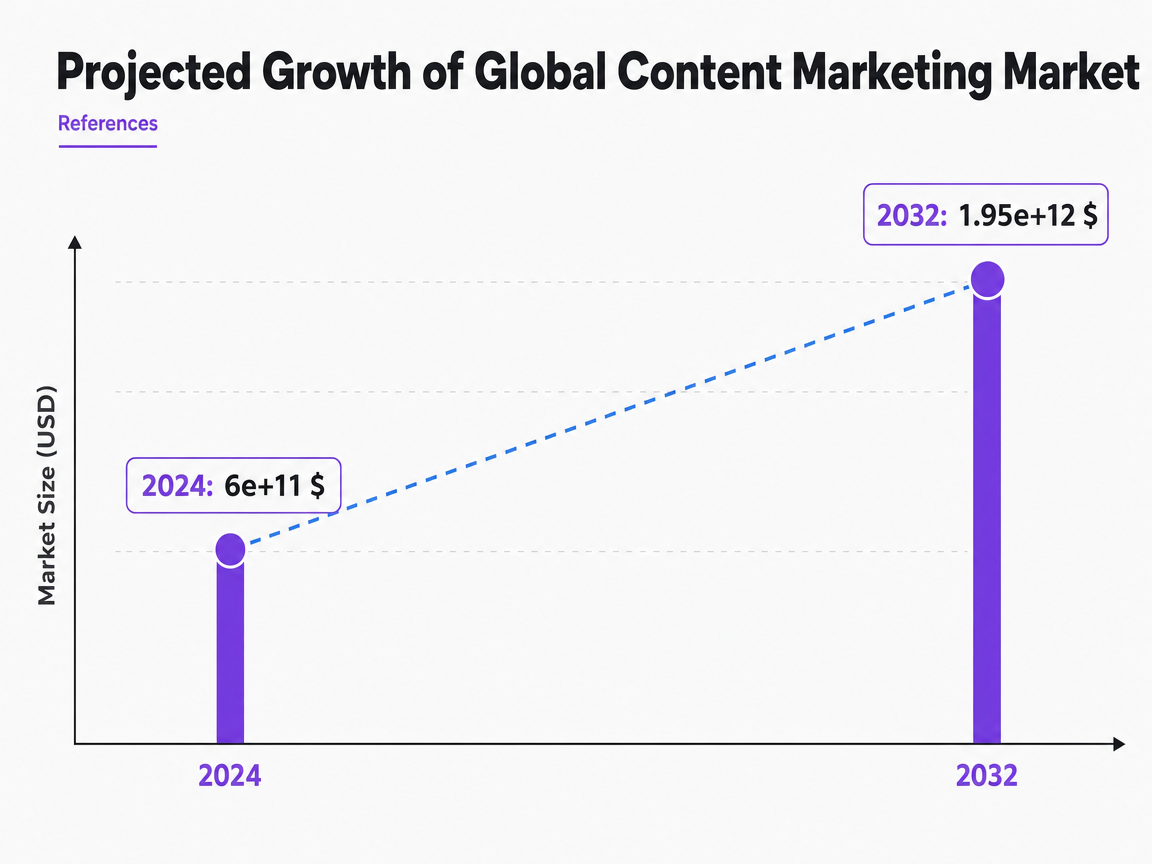 Projected Growth of Global Content Marketing Market
A time series chart showing the projected market size in 2024 and 2032, illustrating substantial industry growth.
Frequently Asked Questions
References
- 1.Content marketing statistics 2026.
- 2.2026 Content Marketing Statistics: Key Data to Shape Your Strategy.
- 3.Deloitte Digital's latest research forecasts generative AI's impact on marketing content production.
- 4.B2B Content Marketing Benchmarks, Budgets, and Trends: Outlook for 2025.
- 5.AI Will Shape the Future of Marketing.
- 6.B2B Content Marketing Benchmarks, Budgets, and Trends: Outlook for 2024.
- 7.The Most Effective AI Uses for Content Marketing in 2025.
- 8.Chart: Content Marketers Embrace AI in Content Creation.
- 9.Top Content Marketing Statistics.
- 10.How consumers interact with AI vs human content.