
Key Takeaways
- Research-layer automation (Ahrefs, Semrush, Keywords Insights) lifts clients-per-strategist from 8 to 12–14 by collapsing seed-to-cluster discovery into a single approved pass, defending margin floors without reshaping the org chart.
- Continuous crawling tools like Screaming Frog, Sitebulb, and Lumar let one technical strategist cover 20–30 accounts by surfacing only revenue-exposing deltas, but alert fatigue sinks deployments without tiered routing.
- Content automation through Surfer, Frase, or MarketMuse delivers the highest margin gain when paired with a pre-publish editor, and the steepest churn when teams skip the QA gate.
- Internal linking platforms such as Link Whisper and InLinks quietly raise portfolio performance by activating content already paid for, with one coordinator managing 40–60 accounts via batched weekly approvals.
- Reporting automation through AgencyAnalytics, Looker Studio, and Databox raises clients-per-account-manager from 15 to 35 by replacing recurring assembly with scheduled pipelines and strategist-reviewed AI commentary.
- GEO tracking via Profound, Otterly, and Peec AI converts citation share inside ChatGPT, Perplexity, and AI Overviews into a defensible renewal metric Forrester argues should replace average position 23.
- Full-stack execution platforms consolidate all six layers under one approval workflow, letting a senior strategist supervise 20–30 accounts — the only category that meaningfully changes the clients-per-strategist ratio account-wide.
The labor math forcing agencies to pick an automation layer
Forrester projects that US advertising agencies will automate 32,000 roles by 2030, equal to 7.5% of the total agency workforce 22. For an SEO delivery lead running 15 to 150 client accounts, that forecast is not a talking point. It is a budget instruction. The roles most exposed are the ones that currently absorb keyword research, on-page edits, audit triage, and reporting cycles, which is precisely the production layer that determines gross margin per account.
The economic question has narrowed. Headcount growth no longer keeps pace with client demand for content velocity, technical hygiene, and AI-snippet visibility across multiple surfaces. Agencies that try to hire through it watch utilization collapse on senior strategists who end up reviewing junior output instead of shaping strategy. Agencies that automate without a workflow design end up with faster bad work and faster churn.
That leaves one operational decision: which automation layer to standardize on next. The seven categories in this shortlist map directly to the workflow stages an agency already staffs against — research, technical, content, internal linking, reporting, GEO and AI-snippet visibility, and full-stack execution. Each category compresses labor in a different place in the delivery chain, and each carries a distinct oversight cost. Picking well is less about feature parity and more about where the agency wants its senior people to spend the next billable hour.
The sections that follow score each layer on three operator criteria — scale ceiling, oversight model, and gross-margin impact per account — before naming the tools that actually fit the workload.
How to read this shortlist: workflow stages, not feature checklists
Most agency tool reviews compare features side by side and call it analysis. That format collapses the moment a delivery lead asks a different question: which automation layer changes the cost structure of an account, and which one just adds another login? This shortlist is organized around the seven stages an agency actually staffs against, because the answer depends on where in the delivery chain a tool sits — not on how many checkboxes its pricing page lists.
The reframe matters because automation compounds margin differently at each stage. A research tool that saves a strategist four hours a week behaves nothing like a reporting tool that eliminates a coordinator role, which behaves nothing like a content layer that shifts who writes the first draft. Treating them as comparable line items is how agencies end up with seven subscriptions and no measurable change in clients-per-strategist. Forrester's Q3 2025 Wave evaluation now scores SEO solutions on data integration, workflow support, AI capability, and reporting — the same axes a delivery lead has to defend internally 19. The shift from feature parity to workflow orchestration is already the analyst consensus.
The three operator criteria: scale ceiling, oversight model, gross-margin impact
Each tool in this shortlist is judged against three criteria a delivery lead can actually defend in a margin review.
Scale ceiling answers how many client accounts one strategist can manage before quality degrades. A research tool might raise the ceiling from 8 to 14 accounts; a full-stack execution platform might raise it to 25. Oversight model answers where the human approval gate sits — pre-publish, post-publish, or no gate at all. This is the criterion that separates compounding automation from compounding QA debt. Gross-margin impact per account answers whether the tool replaces billable strategist hours or merely supplements them. McKinsey's 2025 survey found that high performers redesign workflows rather than bolt AI onto existing ones, with 80% of companies setting efficiency as the primary AI objective 17. The three criteria force that redesign question into every tool decision.
Why platform consolidation is beating point-tool stacking
The market data settles an argument that used to be ideological. The AI-powered SEO software segment is projected to grow from $3.98 billion in 2025 to $32.6 billion by 2035, a 23.4% CAGR 1. Compare that to the global SEO software market growing at 13.65% through 2034 2and the enterprise SEO platforms segment at roughly 14% through 2032 4. The AI-native layer is compounding nearly twice as fast as the legacy categories it sits on top of.
That gap explains why integrated platforms keep absorbing point-tool functionality and why Forrester has argued for years that SEO has become too complex to manage without dedicated platforms 24. Agencies running 50+ accounts feel this directly: every additional point tool adds a login, a data reconciliation step, and a training tax on junior staff. The math favors fewer, deeper platforms that own multiple workflow stages — which is also why the seventh tool category in this shortlist (full-stack execution) is treated as a distinct layer rather than a feature bundle. Consolidation is not a preference; it is where the capital is going.
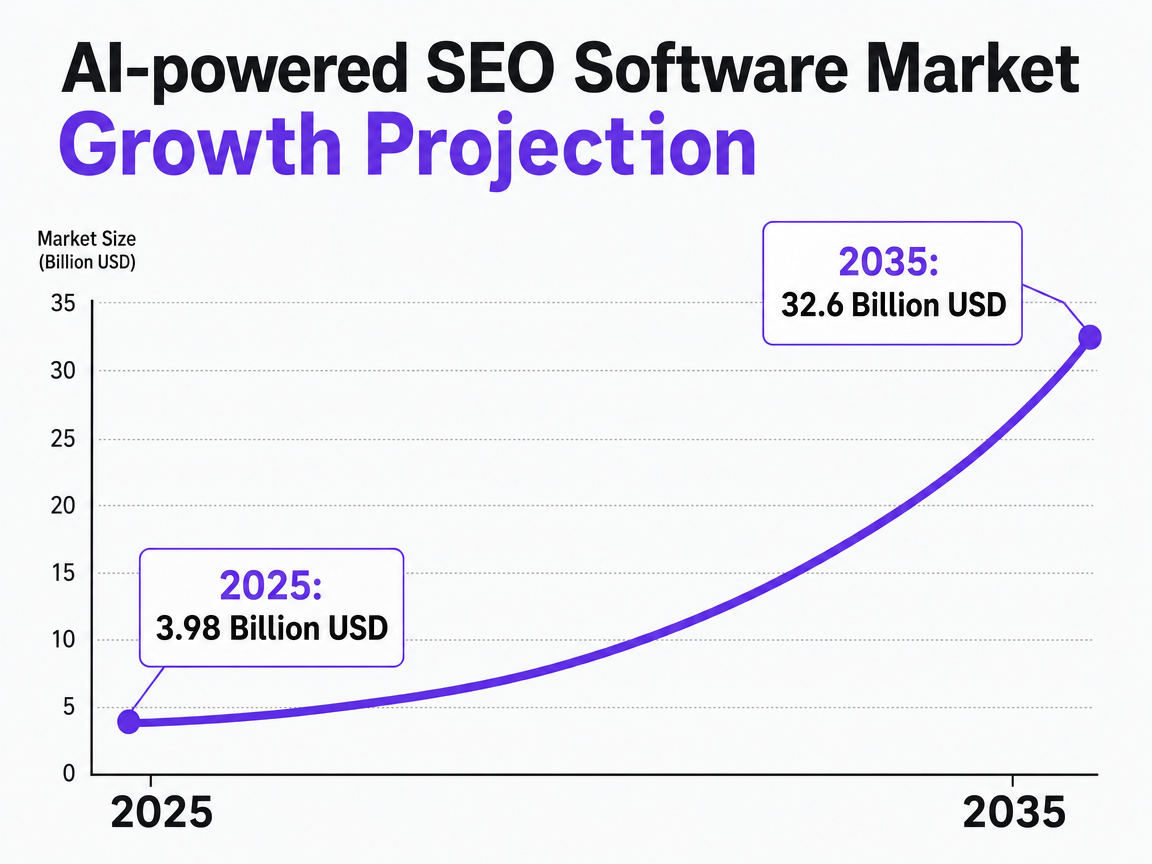 AI-powered SEO Software Market Growth Projection
A line or bar chart showing the projected growth of the AI-powered SEO software market from $3.98 billion in 2025 to $32.6 billion in 2035.
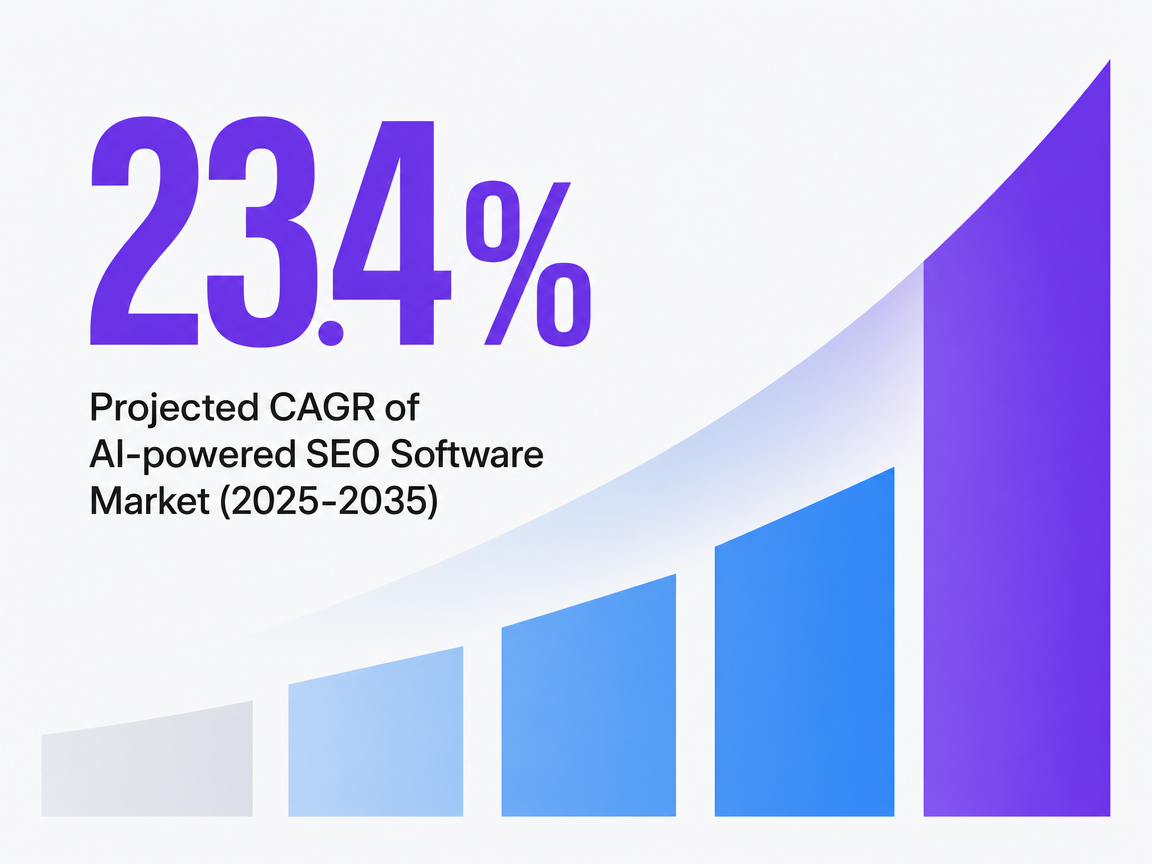 Projected CAGR of AI-powered SEO Software Market (2025-2035)
Projected CAGR of AI-powered SEO Software Market (2025-2035)
Tool 1 — Research layer: automating keyword and competitor discovery
Keyword and competitor research is the workflow stage where junior strategist hours leak fastest. A delivery lead managing 30 accounts is paying for the same tab-switching pattern repeated hundreds of times a week: pull a seed list, run it through a volume tool, scrape competitor URLs, cluster intents, hand off to a content lead. The research layer compresses that loop into a single automated pass and outputs a prioritized opportunity set per account.
Ahrefs, Semrush, and the newer AI-native entrants (Keywords Insights, ZipTie, SE Ranking) own this category. The functional baseline is consistent: large-scale SERP scraping, intent clustering using NLP, gap analysis against named competitors, and clustered output ready for brief generation 12. The differentiator is no longer the size of the keyword database — it is how quickly the tool moves from raw query data to a clustered, intent-tagged worklist a strategist can approve in minutes rather than hours.
Scale ceiling: Research automation typically raises clients-per-strategist from roughly 8 to 12–14 accounts, because the discovery phase is the most repetitive part of an SEO retainer. Oversight model: Human approval sits at the cluster-prioritization step — the strategist still picks which clusters earn briefs, but no longer hand-builds the list. Gross-margin impact: Modest but reliable. Research automation removes coordinator and junior hours, not senior strategist hours, so it improves utilization without reshaping the org chart.
The honest limit: research tools are now table stakes. Forrester's Q3 2025 Wave assumes every evaluated platform offers AI-assisted keyword and competitor discovery 19. Standardizing here defends margin floors; it does not raise the ceiling. Agencies that stop their automation roadmap at this layer keep their cost structure intact and lose the next bid to a competitor who automated further down the chain.
Tool 2 — Technical layer: continuous crawling and audit automation
Technical SEO is the workflow stage where one missed redirect chain or a botched canonical rollout can erase three months of content gains across an account. The cost structure problem: most agencies still run technical audits on a quarterly cadence because manual crawls and ticket triage absorb 8–15 senior hours per account per cycle. Continuous crawling tools flip that economics by running scheduled bot passes, diffing the results against the prior crawl, and surfacing only the deltas that breach defined thresholds.
Screaming Frog, Sitebulb, Lumar (formerly Deepcrawl), and OnCrawl define this category, with Botify and ContentKing extending into log-file analysis and near-real-time monitoring. The automation that matters is not the crawl itself — it is the alert layer that ranks issues by revenue exposure: orphaned money pages, indexable thin templates, broken hreflang on multi-region sites, and Core Web Vitals regressions after a CMS deploy 12.
Scale ceiling: Audit automation typically lets a single technical strategist cover 20–30 accounts instead of 8–10, because the diff-and-alert pattern eliminates the recurring crawl-review hours. Oversight model: The approval gate sits at remediation, not detection. Tools flag; humans decide which fixes ship and in what order. Gross-margin impact: High and durable. Technical hours are the most expensive billable category an agency runs, and continuous crawling removes the discovery layer entirely.
The honest caveat: alert fatigue kills these deployments. Teams that turn on every threshold inside two weeks abandon the dashboard. Configure scope to client revenue tiers, route alerts to a single triage owner, and the technical layer pays back inside one quarter.
Trial Full-Scale SEO Automation Without Limits
Test-drive scalable SEO workflows and publish live content across real client projects during your trial period.
Tool 3 — Content layer: briefs, drafts, and optimization at portfolio scale
Content is the workflow stage where automation either compounds margin or destroys it — there is no middle outcome. A delivery lead running 40 accounts is staring at the same arithmetic every month: 4 to 8 pieces per account, 6 to 12 senior hours per piece between brief, draft, edit, and on-page optimization. That math is what AI content tooling is now being aimed at, and the client side has already caught up. OECD data shows firm-level AI adoption jumping from 8.7% in 2023 to 14.2% in 2024 to 20.2% in 2025 10. Agencies are no longer selling AI-assisted content to skeptics. They are competing on QA depth.
Surfer, Frase, Clearscope, MarketMuse, and Jasper define the legacy entrants in this category, with newer AI-native platforms layering brief generation, draft production, and on-page scoring into a single pass. The automation pattern that matters is the brief-to-draft-to-optimized handoff: structured outlines built from SERP and entity analysis, drafts generated against those outlines, and an optimization score that catches thin coverage before publish 12. McKinsey's analysis of generative AI in marketing notes that gen AI is already delivering value by helping companies produce copy at scale and respond to customer feedback faster, provided governance and roadmap are in place 8.
Scale ceiling: Content automation can raise per-strategist output by 2–3x, but only when the editor role is reshaped around QA rather than rewriting. Oversight model: The approval gate must sit pre-publish, at the editor stage, not post-publish. Skipping that gate is the failure pattern that kills agencies — covered later in this piece. Gross-margin impact: Highest of any single layer when paired with disciplined editorial review; negative when paired with publish-and-pray workflows.
The operator takeaway: content tooling is the layer where workflow redesign matters more than vendor choice. Pick the platform that fits the editorial process the agency already enforces, then staff the QA gate as a non-negotiable role.
Tool 4 — Internal linking and on-page execution
Internal linking is the workflow stage agencies underprice and underdeliver against. On a 500-URL site, mapping topical authority by hand burns a strategist's afternoon; on a 5,000-URL site, it stops happening altogether. The result is the familiar pattern of orphaned money pages, anchor text drift, and clusters that never consolidate ranking signal — quality leakage that doesn't show up in a monthly report until traffic flattens.
Link Whisper, InLinks, and the linking modules inside Surfer and Semrush define this category, with crawler-based platforms like Sitebulb extending into anchor distribution analysis. The automation pattern that matters: entity-aware graphs that propose contextual links between related pages, batch-apply approved suggestions through CMS connectors, and flag anchor over-optimization before it triggers a manual review. The same engines now extend to on-page execution — schema injection, meta tag refresh, image alt audits — turning what used to be a checklist into a queued worklist 12.
Scale ceiling: Modest at the strategist level, significant at the production level. One coordinator can manage internal linking across 40 to 60 accounts when suggestions are batched and approved weekly. Oversight model: Approval gate sits at the bulk-accept step, not per-link. Gross-margin impact: The category most likely to silently raise organic performance across a portfolio without expanding scope, because it activates content the agency has already been paid to produce.
Tool 5 — Reporting and client communication automation
Reporting is the workflow stage where agencies bleed coordinator hours into work the client glances at for ninety seconds. A delivery lead running 30 accounts is staffing 2 to 4 hours per account per month against ranking pulls, GSC exports, Looker Studio refreshes, and the inevitable Slack thread asking why organic sessions dipped in week three. Reporting automation collapses that loop into scheduled data pipelines, templated narratives, and anomaly alerts that surface before the client asks.
AgencyAnalytics, Looker Studio with connector layers (Supermetrics, Funnel), Databox, and SE Ranking's reporting module own the legacy end of this category. The newer pattern adds AI-generated commentary that explains what moved and why — pulling from GSC, GA4, rank tracking, and call data into a single client-facing narrative 13. The shift Forrester flags in its Q3 2025 Wave is that reporting is no longer a deliverable; it is the orchestration layer where data integration and workflow support converge 19.
Scale ceiling: Reporting automation raises clients-per-account-manager from roughly 15 to 35, because the recurring assembly work disappears entirely. Oversight model: The approval gate sits at the commentary layer — auto-generated narratives still need a strategist's read before they reach the client, especially when explaining a downturn. Gross-margin impact: Direct and immediate. Reporting is the single largest source of non-billable coordinator hours in most agencies, and automating it converts that capacity into either lower delivery cost or more accounts per pod without changing the org chart.
Tool 6 — GEO and AI-snippet visibility tracking
Generative engine optimization is the workflow stage most agencies still treat as a research project rather than a tracked deliverable. That is a mistake worth correcting before the next renewal cycle. Forrester argues that practitioners should reduce reliance on outmoded metrics like average position and search volume, because AI-powered snippets at the top of SERPs are becoming the quality signal that actually moves traffic and qualified leads 23. A delivery lead who cannot answer a client question about citation share inside ChatGPT, Perplexity, Google AI Overviews, and Gemini is reporting on a search landscape that no longer fully exists.
Profound, Otterly, Peec AI, AthenaHQ, and the GEO modules now appearing inside Semrush and Ahrefs define this category. The automation pattern is consistent: scheduled prompt panels query the major answer engines on a defined keyword set, parse the responses for brand mentions and citation links, and surface a citation share metric alongside the queries where the client is invisible. Some tools extend into content recommendations — flagging which existing pages are structured well enough for LLM ingestion and which need schema, review, or entity rework 16.
Scale ceiling: Tracking automation lets one strategist monitor GEO performance across 25–40 accounts, because the prompt-and-parse loop is fully scriptable. Oversight model: Approval sits at the strategy layer — humans decide which gaps to chase, since chasing every uncited prompt produces noise. Gross-margin impact: Modest today, defensive long-term. The agencies adding GEO tracking to retainers now are protecting renewal conversations against the moment a client's CMO asks why their brand is not cited in the answer their buyer actually reads.
See How Top Agencies Automate SEO at Scale—Without Expanding Headcount
Connect with our team to evaluate workflow automation that consolidates strategy, production, and reporting for multi-client SEO—enabling consistent, high-quality output and oversight across all campaigns.
Tool 7 — Full-stack execution: approval-gated workflow platforms
Full-stack execution is the category that does not fit on a feature comparison chart, because it replaces the chart. Instead of automating one workflow stage, this layer connects research, technical, content, internal linking, reporting, and GEO tracking under a single approval workflow — and then executes approved work without a coordinator routing the handoff. The category is new enough that Forrester's Q3 2025 Wave still treats most entrants under broader SEO solutions, but the evaluation criteria are already converging: data integration, workflow support, AI capability, and reporting scored as one system rather than four 19.
The platforms staking out this category — including Vectoron alongside emerging multi-agent execution systems — share a structural decision that separates them from the six layers above. The AI does not just recommend; it executes. The human does not just review dashboards; the human approves work units before they ship. That inversion is what McKinsey identifies as the difference between AI adopters and AI high performers: high performers redesign workflows around AI, with 80% of companies setting efficiency as the primary AI objective and the top quartile pulling measurable margin from operating-model change rather than tool stacking 17. The complementary McKinsey workplace analysis reinforces the same point — value comes from redesigning work so AI can do more than sit beside it 18.
Scale ceiling: Full-stack execution is the only category that meaningfully changes the clients-per-strategist ratio across the entire account, not just one workflow stage. Agencies running this layer report a single senior strategist supervising 20 to 30 accounts because production, QA queuing, and reporting all flow through one approval surface.
Oversight model: Approval-gated. Nothing ships without a human sign-off, but the strategist's time is spent on approve/reject decisions and strategic direction rather than assembly. This is the model that resolves the tension between scale and quality — the same tension every other category in this shortlist accepts as a tradeoff.
Gross-margin impact: Highest of any category, but only when the agency commits to the workflow redesign. Bolting an execution platform onto a point-tool stack without retiring overlapping subscriptions and reshaping roles produces the worst of both worlds: a new line item without a corresponding labor reduction.
The honest caveat: this layer demands the most upfront change management. Senior strategists have to give up assembly work they have done for years, and account managers have to learn to operate a Command Center rather than a project board. Agencies that get the change management right are the ones quietly absorbing the labor pressure Forrester forecast for 2030 22.
If you manage 50+ accounts: point-tool stack vs integrated execution economics
This subsection narrows to agency operators running 50 or more accounts, where the consolidation math becomes unambiguous rather than directional. Below that threshold, a point-tool stack can survive on individual strategist discipline. Above it, the coordination tax becomes the dominant cost line.
The comparison below uses the supplied Vectoron post-trial price of $599/month per account and explicit variables for strategist time, rather than invented dollars. Hour ranges reflect the operator criteria established earlier in this shortlist — they are budget anchors, not benchmarks.
| Dimension | Point-tool stack + senior strategist | Integrated execution + approval workflow |
|---|---|---|
| Active tool subscriptions per account | 5–8 (research, technical, content, linking, reporting, GEO) | 1 platform at $599/mo post-trial |
| Senior strategist hours per account per month | X hours (assembly, QA, reporting commentary) | ~0.4X hours (approval, strategy, exception handling) |
| Clients per strategist ceiling | Y accounts | ~2–2.5Y accounts |
| Approval surface | Distributed across tools and email threads | Single Command Center, pre-publish gate |
The math behind the right column is the McKinsey workflow-redesign finding applied to agency delivery: efficiency comes from changing the operating model, not from adding the eighth tool 17. The 50-account threshold is where that redesign stops being optional.
The over-automation tax: a cautionary read before you standardize
Every category in this shortlist assumes the agency keeps a working approval gate. Skip that assumption and the automation layer that was supposed to compound margin compounds churn instead. The most credible version of this warning comes from practitioner Noel Ceta, who documented how chasing automated scale nearly collapsed his agency: thinner content shipped faster, quality complaints accumulated, and clients left before the production savings showed up in retained revenue 16. The pattern is not exotic. It is the predictable result of removing the human review step from a layer that depends on it.
The mechanics are worth naming. Content automation without a pre-publish editor produces work that ranks for a quarter and then degrades as answer engines reweight toward structured, review-rich, user-validated pages over keyword-optimized templates 16. Technical automation without a remediation owner produces alert dashboards no one reads. Reporting automation without a strategist's read sends clients commentary that explains a downturn in the same tone it explains a win, which erodes trust faster than the underlying dip ever would.
The operator implication is narrow and direct. Before standardizing on any layer in this shortlist, name the role that owns the approval gate, write the rejection criteria into the SOW, and staff the QA hour against billable margin rather than treating it as overhead. Agencies that skip that step are not buying automation. They are buying a faster way to lose accounts.
Picking the layer to standardize on next quarter
The selection logic comes down to where the delivery chain is bleeding the most senior hours right now. Agencies under 30 accounts and still hiring through demand should standardize on the technical and reporting layers first — those two categories convert the highest-cost billable hours into approval clicks without forcing an editorial redesign. Agencies between 30 and 50 accounts should add the content and internal linking layers next, with a named editor owning the pre-publish gate.
Agencies above 50 accounts have a different decision. The coordination tax across a point-tool stack has already started compressing margin, and adding an eighth subscription will not reverse it. The move at that scale is workflow redesign around an approval-gated execution layer — the consolidation thesis Forrester has argued for years 24and the operating-model change McKinsey ties to measurable AI value 18. Platforms in that category, Vectoron among them, are where the next quarter's planning conversation should land. Pick the layer, name the approval owner, and retire the tools it replaces in the same cycle.
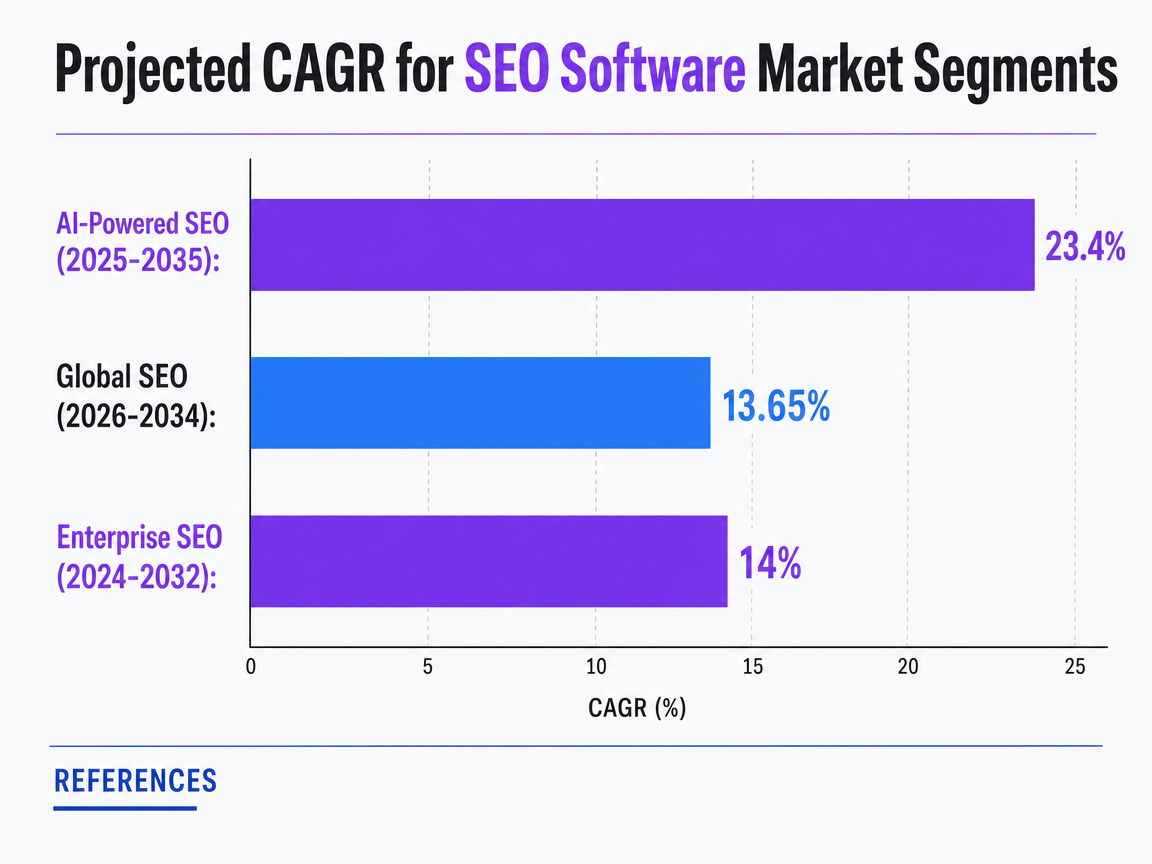 Projected CAGR for SEO Software Market Segments
A bar chart comparing the Compound Annual Growth Rate (CAGR) for different segments of the SEO software market, using data from sources 0, 1, and 4.
Frequently Asked Questions
References
- 1.AI-powered SEO Software Market Size | CAGR of 23.4%.
- 2.SEO Software Market Size, Share & Forecast 2026-2034.
- 3.Enterprise SEO Platforms Market Share, Size, Trends | 2035.
- 4.Enterprise SEO Platforms Market Size, Share and Forecast 2032.
- 5.Enterprise SEO Platforms Market Growth, Size & Forecast by 2034.
- 6.Current Trends in Enterprise SEO Platforms.
- 7.A guide to AI in marketing.
- 8.How generative AI can boost consumer marketing.
- 9.AI and the future of work.
- 10.Accelerated increase in the use of AI by individuals in OECD member countries.
- 11.OECD urges to prepare for AI revolution.
- 12.AI-Powered SEO Automation Examples That Actually Work.
- 13.Guide to SEO Automation in 2026: Tools, Strategies & Future Trends.
- 14.Global Enterprise SEO Platforms Market Outlook 2026-2033: Trends and Opportunities.
- 15.SEO Software Market Research Report - Forecast to 2030.
- 16.SEO automation nearly destroyed my agency (and why it might destroy yours too).
- 17.The State of AI: Global Survey 2025.
- 18.Superagency in the workplace: Empowering people to unlock AI’s full potential at work.
- 19.The Forrester Wave™: Search Engine Optimization Solutions, Q3 2025.
- 20.The state of AI in early 2024: Gen AI adoption spikes and the stakes are rising.
- 21.Automation And AI Will Reshape Media And Creative Agencies.
- 22.Advertising Agencies In The US Will Automate 7.5% Of Jobs By 2030.
- 23.Generative AI Has Answers, But SEO Practitioners Are Still Guessing.
- 24.Every Company Needs An SEO Platform.