
Key Takeaways
- Research and brief generation tools matter because weak inputs produce weak content; the best ones ingest first-party data and rank topics by pipeline potential, not just search volume.
- Drafting and personalization tools should enforce brand voice and segment definitions at the model layer, generating segment-specific variants without requiring new prompts for every audience.
- Visual generation tools earn their place by maintaining brand consistency at campaign scale and writing back to the DAM, rather than producing impressive but unrepeatable one-off assets.
- SEO and optimization tools drive pipeline when they prioritize edits by conversion value across Search Console, CMS, and CRM, not by raw traffic potential alone.
- Distribution and syndication tools should atomize assets into channel-native formats while attaching UTMs and reconciling assisted conversions, so VPs can see which channels source booked pipeline.
- Content intelligence tools tag assets at the paragraph level and correlate consumption with CRM opportunity stages, revealing which specific arguments—not just pages—actually move deals 14.
- Governance, disclosure, and risk control tools require a mandatory approval gate that can block publication, aligning with NIST oversight guidance 5and audience expectations around AI disclosure 11.
- Workflow orchestration tools remove manual handoffs between stages, automating execution up to defined checkpoints while preserving human sign-off at critical approval junctures.
- Coordinated production platforms consolidate the prior eight jobs into one system with unified data, shared brand controls, and a single approval workflow measured against pipeline outcomes 13.
Why the Tool Question Changed for VPs in 2025
The question for in-house VPs is no longer whether to use AI for content, but which tools effectively drive pipeline growth versus merely adding cost and coordination overhead. This shift reflects the widespread adoption of generative AI; McKinsey's early-2024 survey found that 65% of organizations regularly use generative AI in at least one business function, with marketing and sales showing the largest year-over-year adoption jump 16.
The buying decision has evolved. Two years ago, a standalone drafting tool could be justified as an experiment. Now, with marketing and sales functions demonstrating clear revenue and cost benefits from generative AI 16, point solutions are measured against pipeline outcomes, not just output volume. Boards are focused on metrics like cost per qualified lead and publish cycle time, rather than word counts.
A critical shift is the understanding of AI-driven business development as a multi-stage pipeline—crawling, extraction, enrichment, and summarization—rather than a single generative step 17. Content operations follow this logic. Tools that neglect the stages before and after drafting rarely impact pipeline metrics, regardless of the prose quality.
The Pipeline Job Rubric: How to Evaluate a Tool in Under Five Minutes
Before considering specific tools, VPs need a robust scoring framework. Four criteria are essential for evaluating tools across categories:
Time-to-publish : This measures the elapsed hours from brief acceptance to asset going live. It reveals whether a tool genuinely streamlines processes or simply shifts tasks to different stages.
Integration surface : This refers to the number of systems (CMS, CRM, analytics, ad platforms, DAM) the tool natively reads from and writes to. A drafting tool lacking integration with a CMS or campaign data functions more like a document editor with autocomplete than a true productivity enhancer.
Oversight model : This defines the specific mechanism for human review before publication. NIST's generative AI profile identifies structured human oversight as a core risk control 5. A tool without a clear approval point presents a governance liability rather than a productivity gain.
Pipeline attribution : This assesses whether the tool links published assets to sourced leads, booked consultations, or qualified calls, rather than just sessions or scroll depth. Forrester describes this as content intelligence: collecting and correlating data about content and its consumption to inform activation and performance measurement 14.
Any tool that cannot address all four criteria during a demonstration is likely a point solution, regardless of its marketing claims.
Test data-driven content creation at full scale
Publish live content and measure immediate impact on pipeline and engagement during your trial period.
The Nine Tools, Mapped to the Jobs They Actually Do
Research and Brief Generation: The Input Layer
Poor briefs lead to poor content, even with AI. Effective content operations require a research and brief generator that draws from diverse, real sources such as SERP data, competitor analysis, customer interview transcripts, and sales call notes. This aligns with the crawling and extraction stage of the multi-stage pipeline described for lead generation systems, applied here to editorial planning 17.
A true research tool distinguishes itself from a mere prompt library by its ability to rank topics based on pipeline potential, not just search volume. A high search volume query is irrelevant if it doesn't convert to booked consultations. Valuable tools connect keyword clusters to historical conversion data from the CRM, providing an expected pipeline contribution for each brief.
During demonstrations, watch for two common shortcomings:
- The inability to ingest first-party data (e.g., sales transcripts, chat logs), leading to recommendations that merely echo current search rankings.
- Structurally identical briefs across topics, which result in generic content.
Drafting and Personalization at Segment Depth
While many VPs already use drafting tools, this category demands re-evaluation. The standard has shifted from generating coherent paragraphs to producing segment-specific variants that reflect actual customer language. McKinsey's research highlights generative AI's contribution to marketing through tailored content and customized copy for targeted promotions, emphasizing quality over generic scale 4.
Operationally, the key is whether the tool can maintain a segment definition—for example, distinguishing between a mid-market dental group evaluating a DSO transition and a solo practice buying its first intraoral scanner—and generate copy with appropriate decision criteria without extensive human rewriting. Tools requiring a new prompt for each segment are impractical for real editorial calendars.
Adoption is no longer a primary hurdle, with the share of U.S. workers using AI for some tasks rising from 16% in 2024 to 21% in 2025 10. This widespread use elevates the importance of quality control. When a personalization engine errs at segment depth, it affects numerous assets before detection. Therefore, style guides, brand voice constraints, and terminology must be enforced at the model layer, not merely caught during copy editing.
Visual Generation for Multimodal Campaign Assets
Text-only content programs are increasingly rare. Modern campaigns require hero images, comparison charts, short videos for landing pages, graphics for social media, and visual anchors for emails. Forrester's 2025 visual GenAI report identifies seven distinct use cases for generative AI in visual content, from concepting to final production, and tracks adoption patterns across marketing organizations 12.
Effective visual tools maintain brand consistency across assets, including locked palettes, approved typography, accurate product photography, and realistic human likenesses. A tool that produces impressive one-off visuals but cannot replicate them at campaign scale functions more as a mood board generator.
Beyond image quality, two integration points are crucial: first, the tool's ability to write back to the DAM with correct metadata for future asset retrieval. Second, its capacity to accept brand guardrails as system-level constraints rather than requiring per-prompt instructions. Without these, visual generation can become a bottleneck during review, negating any speed advantages.
SEO and Optimization: Making Content Findable at the Query Level
Optimization tools generally fall into two categories. The first uses a scoring system: input a keyword, receive a checklist of headings, entities, and word counts. The second approaches optimization as a continuous loop, monitoring rank changes, click-through rates, and downstream conversions, then suggesting edits for specific paragraphs on particular URLs.
The second category directly impacts pipeline. A page ranking #4 for a query with 800 monthly searches and a 3% conversion rate is more valuable than a page ranking #1 for a 5,000-search query that yields no booked consultations. Optimization tools that prioritize rankings by pipeline value, rather than just traffic, provide VPs with a defensible weekly priority list.
Integration is also vital here. A tool that integrates with Search Console, the CMS, and the CRM can propose edits with an estimated pipeline impact. A tool limited to Search Console provides only traffic recommendations, serving a different, less strategic purpose.
Distribution and Syndication Beyond the Blog
Relying solely on blog publishing for organic pickup is an insufficient distribution strategy. Tools in this category atomize a single asset into channel-native formats—LinkedIn carousels, email sequences, short video scripts, community posts—while preserving the core message and citations. This allows one long-form piece to generate multiple assets across various channels without manual rewriting.
The key evaluation question is whether the tool respects channel-specific requirements. LinkedIn favors specificity and strong opening lines; email requires a clear call to action; YouTube demands an engaging hook in the first eight seconds. A distribution tool that applies the same voice and structure across all channels is merely a sophisticated copy-paste macro.
Measurement is often a weakness for distribution tools. Publishing to multiple channels without unified tracking results in fragmented performance reports. Effective tools attach UTM parameters, sync with the CRM, and reconcile assisted conversions across channels, enabling VPs to identify which distribution efforts genuinely contribute to booked pipeline.
Content Intelligence and Measurement
This category is frequently overlooked in content stacks, which explains why many content programs struggle to answer pipeline questions. Forrester defines content intelligence as the capture, correlation, and analysis of data about content and its consumption to generate insights, inform activation, and measure performance 14. In practice, this means treating every published asset as a data object with metadata on topic, audience, funnel stage, and downstream outcomes.
Valuable tools in this area go beyond basic page-view dashboards. They tag content at the paragraph level, correlate consumption patterns with CRM opportunity stages, and identify which specific arguments—not just pages—drive deals. A whitepaper with 3,000 downloads but zero sourced opportunities is underperforming, whereas a 400-word FAQ with 200 views that sources 40 booked calls is highly effective.
Instrumentation is the challenge. Content intelligence requires consistent tagging across the editorial team, CRM integration, and a data model resilient to platform changes. Tools promising intelligence without addressing the tagging problem deliver dashboards, not insights. VPs should inquire about how new assets are tagged, who manages the taxonomy, and how the tool handles historical content. These answers differentiate a true measurement platform from a mere analytics wrapper.
Governance, Disclosure, and Risk Controls
Governance, often managed through spreadsheets and Slack channels, is no longer sufficient. NIST's generative AI profile outlines structured risk management practices, including data provenance, content authenticity, model behavior monitoring, and human oversight, as essential controls for generative systems 5. The FTC has also signaled enforcement focus on deceptive AI claims, privacy commitments, and impersonation risks in generated content 6, 7, 8.
Customer expectations align with regulatory trends. A significant 76% of Americans consider it extremely or very important to distinguish between AI-generated and human-created content 11. This indicates that disclosure and authenticity are becoming purchase criteria, particularly in high-trust sectors like healthcare, legal, and senior living.
Tools in this category perform three key functions: logging AI-generated assets and their creation stages, enforcing disclosure rules, and routing generated content through defined approval checkpoints before publication.
A governance tool without a mandatory approval gate is merely a compliance log, not a control. VPs in regulated industries should prioritize approval workflow as a procurement requirement, ensuring the tool can block publication if a required review is missing. This transfers liability from the marketing team to the tool.
Workflow Orchestration: The Connective Tissue
Orchestration transforms a collection of tools into a cohesive system. Its role is coordination: routing a brief to a drafting tool, sending the draft to a visual generator, passing the assembled asset for optimization, then to review, distribution, and finally measurement. Without orchestration, this sequence involves manual handoffs across multiple browser tabs.
Research on multi-stage AI pipelines describes this coordinated flow in lead generation—crawling, extraction, entity resolution, enrichment, and summarization operating as integrated steps 17. Content pipelines follow the same principle; any stage requiring manual transfer of output between tools negates most of the speed benefits.
When evaluating orchestration tools, consider what they can automate without human intervention and what explicitly requires approval. A tool that automates everything risks compliance issues. One that demands approval at every stage is merely a project management app with an AI label. The optimal solution lies in automated execution up to defined checkpoints, with human sign-off at critical junctures, maximizing operational leverage.
Coordinated Production Platforms: When One System Replaces Eight
This newest category is poised to redefine buying decisions. Coordinated production platforms integrate the previous eight functions into a single system, featuring unified data, shared brand controls, and a single approval workflow. Instead of managing multiple vendors and integration points, VPs evaluate one platform against pipeline outcomes.
Forrester's 2025 report on generative AI in U.S. marketing agencies notes agencies are consolidating tools to reduce overhead and accelerate campaign delivery 13. In-house teams face similar pressures, often more intensely, as they lack the billable-hour incentive to maintain manual processes. Vectoron exemplifies this category, utilizing specialist agents for content, SEO, distribution, and measurement, all managed through a central Command Center that routes recommendations for approval before execution. This model, or similar competitor offerings, can significantly streamline operations, depending on specific vertical, channel, and oversight requirements.
The evaluation criteria for these platforms are stricter than for point tools. A platform must demonstrate proficiency across all four rubric criteria—time-to-publish, integration surface, oversight model, and pipeline attribution—for every job, not just one. It also requires a defined approval gate at each stage, as a coordinated platform without human review at publication represents a coordinated liability.
The Consolidation Math: What Collapsing Point Tools Actually Costs and Saves
Managing eight disparate tools with human project management is not a system; it incurs a weekly coordination tax through status updates, format conversions, and version control. VPs must determine if this tax outweighs the switching cost of consolidating to fewer, coordinated platforms. McKinsey's economic analysis estimates generative AI's potential marketing productivity contribution at 5–15% of total marketing spending value, contingent on workflow integration, not just tool selection 1. This range represents the potential ceiling for consolidation, achievable only when tools effectively communicate.
Forrester's 2025 report highlights how U.S. marketing agencies are consolidating their tool stacks to reduce production overhead and speed campaign delivery 13. In-house teams face similar pressures without the billable-hour incentive to retain manual steps. The table below maps the pipeline jobs to key questions for VPs during a consolidation review.
| Pipeline Job | Typical Standalone Tool | Integration Burden | Oversight Model |
|---|---|---|---|
| Research and brief | SEO research suite | Medium | Self-serve |
| Drafting and personalization | AI writing platform | Medium | Human-in-loop |
| Visual generation | Image/video AI tool | High | Human-in-loop |
| SEO optimization | On-page optimizer | Medium | Self-serve |
| Distribution | Social scheduler + ESP | High | Human-in-loop |
| Content intelligence | Analytics platform | High | Self-serve |
| Governance and disclosure | Compliance log | Low | Approval-gated |
| Workflow orchestration | Project management app | High | Human-in-loop |
The oversight column is as crucial as integration, reflecting public trust data. While 73% of AI experts foresee a positive impact of AI on jobs, only 23% of U.S. adults share this view 9. This 50-point gap defines the environment VPs operate in. Consolidation that eliminates human review to boost productivity risks alienating an audience that views AI with skepticism. The math only works if approval gates remain intact post-consolidation.
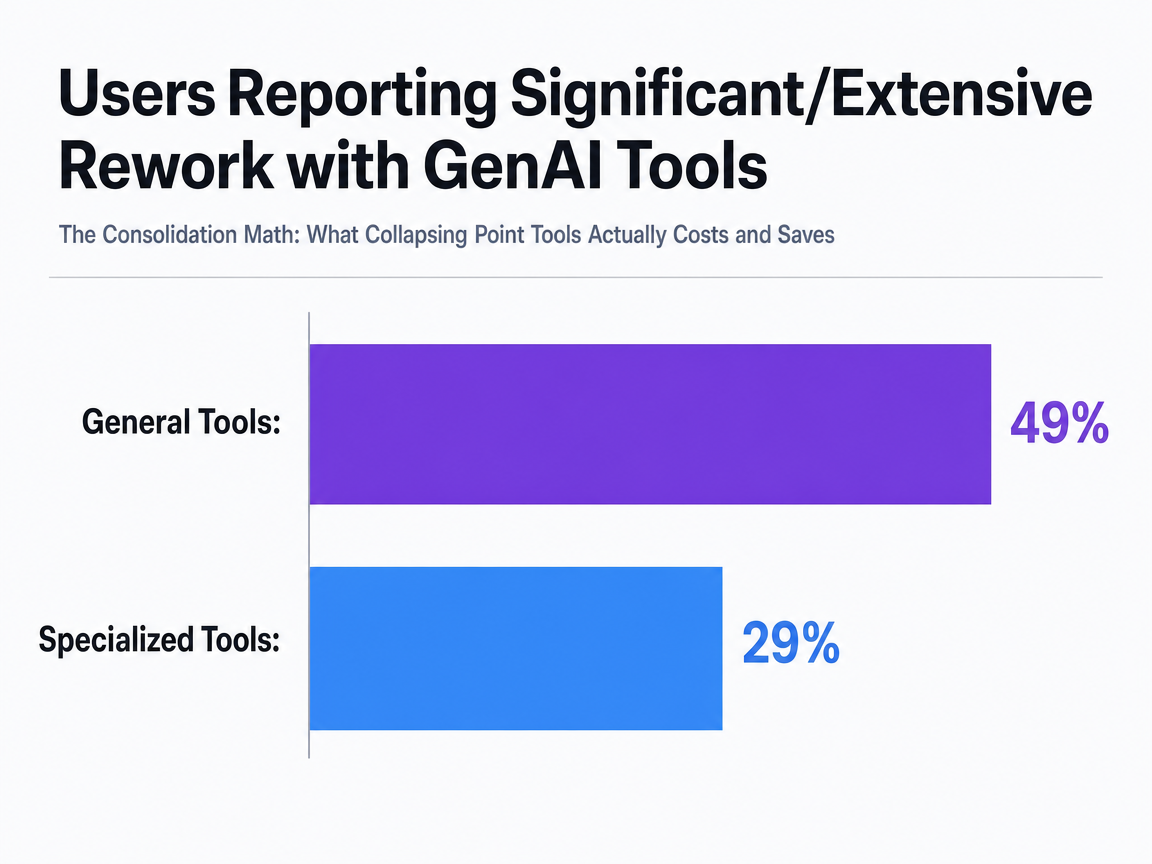 Users Reporting Significant/Extensive Rework with GenAI Tools
Compares the percentage of users of general-purpose vs. specialized GenAI tools who reported needing significant or extensive rework.
See How Leading Teams Automate Content Creation at Scale
Request a demo to benchmark your current content workflow against AI-driven solutions designed to increase pipeline velocity and reduce manual coordination—purpose-built for agency and enterprise environments.
If You Manage Multiple Locations, Brands, or Practices
The guidance thus far assumes a single content operation. Multi-location DSOs, regional law firm networks, behavioral health groups with numerous clinics, and home services franchises face a distinct challenge: the tool stack question multiplies by the number of brands, altering the consolidation calculus.
A common operational failure is each location or brand using its own drafting tool, scheduler, and analytics. Central marketing then spends time reconciling reports instead of driving pipeline. Forrester's 2025 agency report observes a similar pattern in agencies serving multi-brand accounts, where tool sprawl impedes campaign speed 13. Portfolio operators inherit this sprawl without the agency margin to absorb it.
For portfolio operators, three evaluation criteria shift:
- The tool must support brand-level guardrails within a single tenant, allowing separate style guides, disclosure rules, and approval routes per location, not per license.
- Pipeline attribution needs to aggregate to the parent level while remaining accurate at the location level, as a DSO CFO and a practice manager require different data perspectives.
- The governance model must consistently enforce disclosure and privacy commitments across all brands 7, as a misstep in one location can impact the entire portfolio.
What a VP Should Do in the Next Quarter
Rather than immediately replacing the current stack, VPs should conduct a ninety-day diagnostic using the four rubric criteria—time-to-publish, integration surface, oversight model, and pipeline attribution—applied to every tool currently in the budget. Most VPs will find two or three tools that fail all four tests and are simply consuming license spend.
Prioritize instrumenting one pipeline job thoroughly before addressing others. Content intelligence is often the most impactful starting point, as it reveals which existing assets already generate booked consultations and which do not, thereby informing all subsequent tool decisions 14. Without this baseline, consolidation efforts are speculative.
Simultaneously, run a consolidation pilot in a single vertical, brand, or funnel stage using a coordinated production platform. Measure the same four criteria over ninety days. If time-to-publish decreases and pipeline attribution remains strong, the case for consolidation becomes clear for the board. Vectoron is one such coordinated production platform worth considering for a scoped pilot alongside existing solutions.
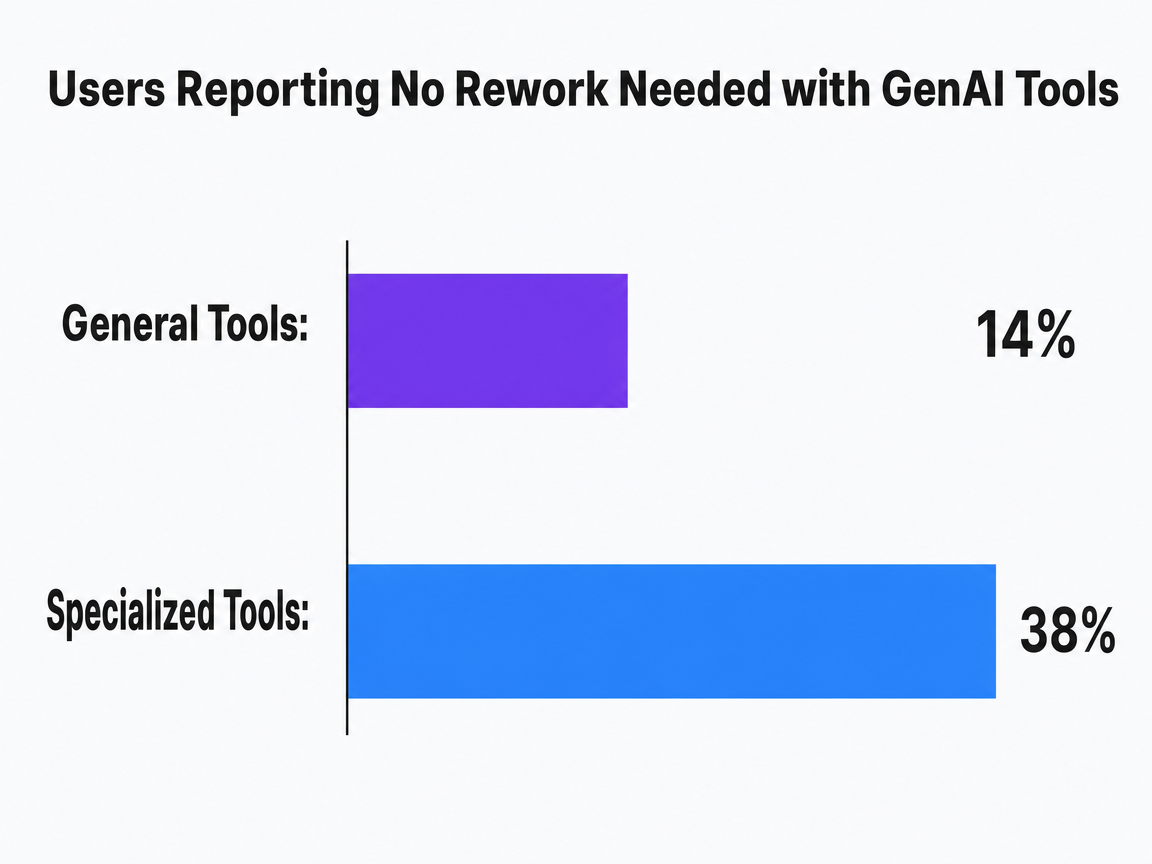 Users Reporting No Rework Needed with GenAI Tools
Compares the percentage of users of general-purpose vs. specialized GenAI tools who reported that no rework was needed.
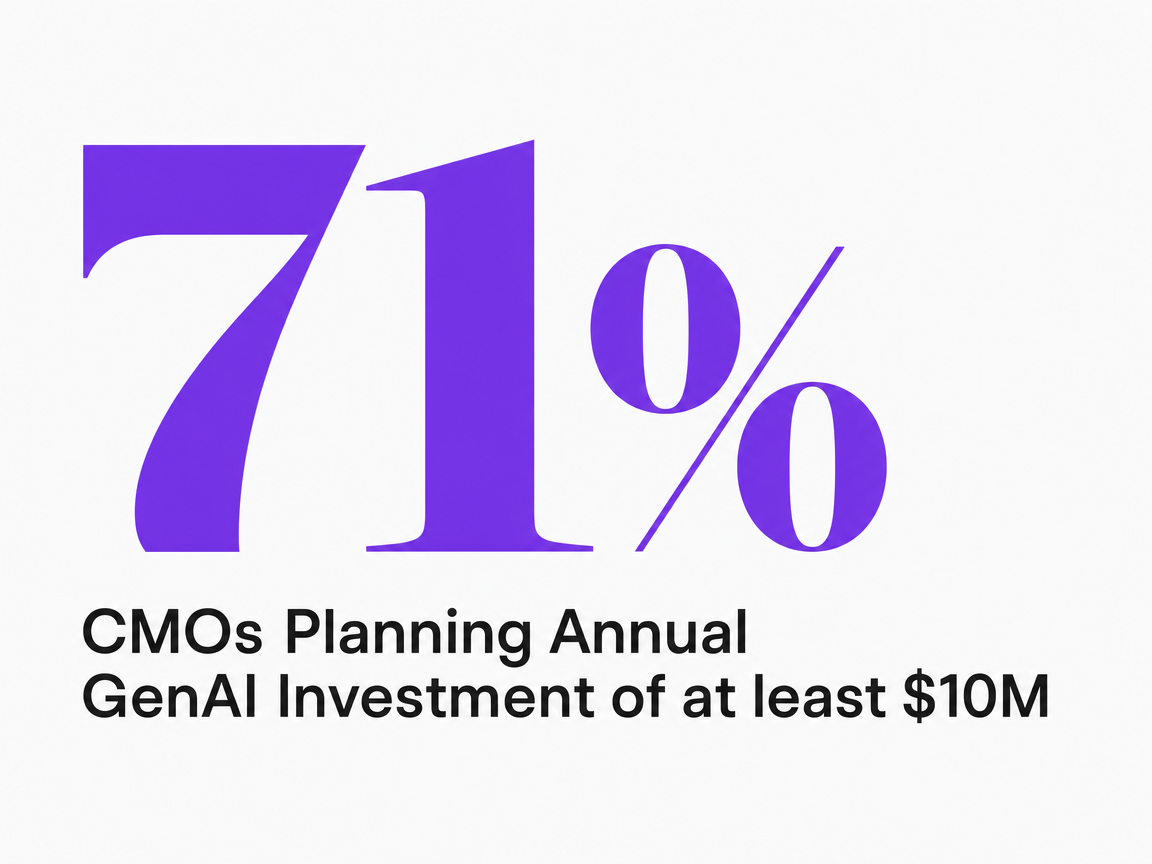 CMOs Planning Annual GenAI Investment of at least $10M
CMOs Planning Annual GenAI Investment of at least $10M
Frequently Asked Questions
References
- 1.The economic potential of generative AI: The next productivity frontier.
- 2.The state of AI in 2023: Generative AI's breakout year.
- 3.The State of AI.
- 4.The next frontier of personalized marketing - McKinsey.
- 5.Artificial Intelligence Risk Management Framework: Generative Artificial Intelligence Profile.
- 6.FTC Announces Crackdown on Deceptive AI Claims and Schemes.
- 7.AI Companies: Uphold Your Privacy and Confidentiality Commitments.
- 8.FTC Proposes New Protections to Combat AI Impersonation of Individuals.
- 9.How the US Public and AI Experts View Artificial Intelligence.
- 10.Key findings about how Americans view artificial intelligence.
- 11.How Americans View AI and Its Impact on People and Society.
- 12.The State Of Generative AI For Visual Content, 2025.
- 13.The State Of Generative AI Inside US Marketing Agencies, 2025.
- 14.Getting Smart On Content Intelligence.
- 15.As AI Spreads, Experts Predict the Best and Worst Changes in Digital Life by 2035.
- 16.The state of AI in early 2024.
- 17.A review of AI-based business lead generation: Scrapus as a case.