
A Guide to Content Management Automation for SaaS
Key Takeaways
- Assessment Scoring Guide: Audit your team's time. If administrative tasks consume more than 30% of weekly hours, automation is required to scale without adding headcount.
- Top 3 Success Factors: Centralized workflow integration (yields 3.2x ROI), automated quality governance (improves consistency by 35%), and AI-driven production (reduces cost per article by 89%).
- Immediate Next Action: Document your current cost-per-article and time-to-publish to establish a baseline for a structured 30-day implementation pilot.
Why SaaS Teams Use Content Management Automation
Resource Constraints Driving Automation
Resource limitations are a defining challenge for SaaS marketing teams, directly accelerating the adoption of content management automation—the use of software to execute repetitive content tasks without human intervention. Most teams today face mounting pressure to increase content velocity across multiple channels, yet only 18% report having sufficient resources to execute their content roadmaps.4
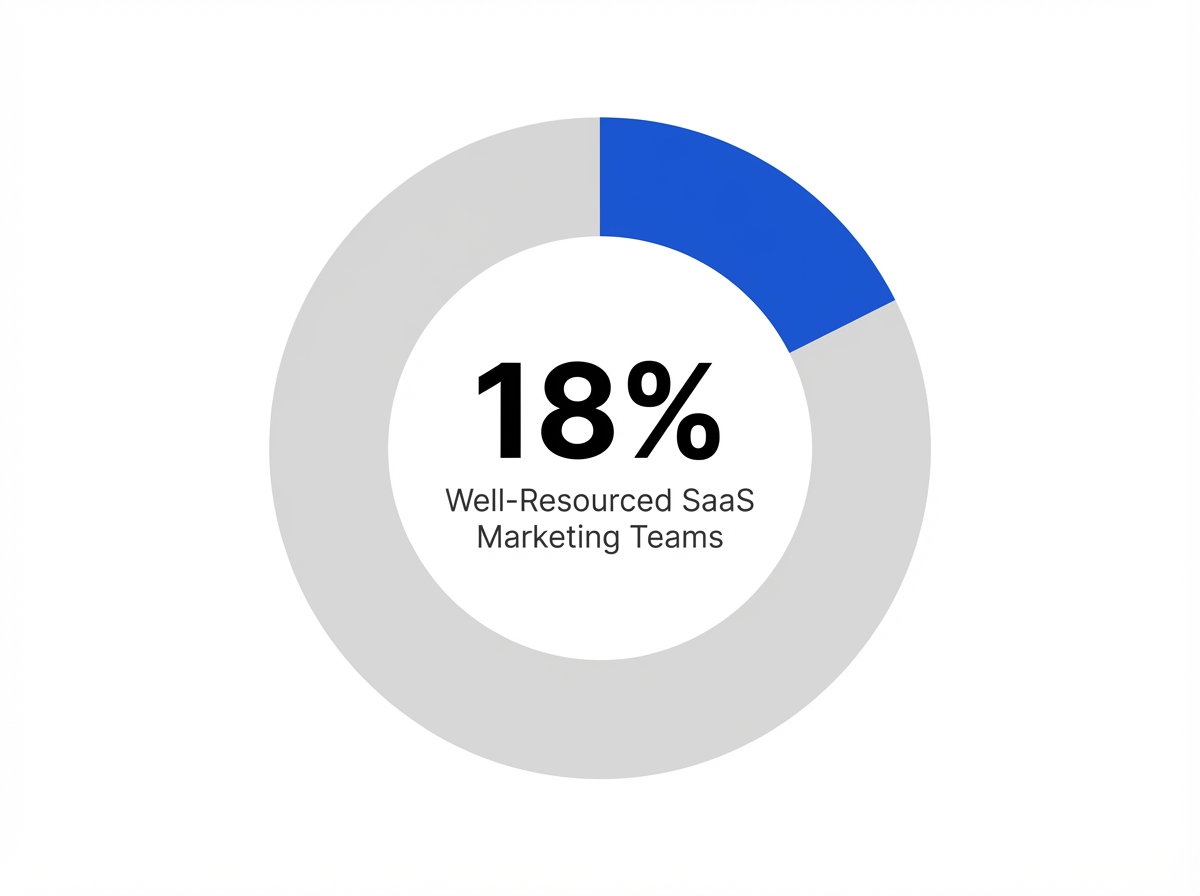 SaaS Marketing Teams with Adequate Resources: 18%
This constraint is compounded by the fact that SaaS content teams spend an average of 40% of their working hours on administrative and coordination tasks, rather than on high-impact content creation or strategy.4
"Marketing teams that fail to automate routine content operations will find themselves outpaced by competitors who can reallocate those administrative hours to strategic growth and revenue generation."
A practical assessment tool is to audit team time allocation using the following scoring guide:
| Task Category | Time Spent (Weekly) | Automation Priority |
|---|---|---|
| Scheduling & Asset Management | > 10 hours | High |
| Drafting & Formatting | > 15 hours | High |
| Strategy & Ideation | < 5 hours | Low (Requires Human Insight) |
This approach works best when your team manages content across four or more channels with limited full-time employees. Automation frameworks can reduce publication cycles by 40-60%, freeing 12-15 hours per week per team member for higher-value activities.1, 2
If you are a Series A startup, this time savings allows you to delay expensive new hires. If you are an enterprise client, it ensures global brand consistency at scale. The result is not only improved productivity but also a measurable increase in content consistency and output.
Measurable Outcomes From Workflow Systems
A workflow outcomes checklist helps SaaS CMOs identify and track the specific business gains from automation:
- Publication cycle time reduction (from days to hours)
- Consistency of content across channels
- ROI lift on content spend (e.g., 3.2x within 12 months)
- Hours reallocated from administrative to strategic work
- Lead generation velocity and volume
Organizations implementing integrated workflow systems report publication cycles 40-50% faster and a 35% improvement in content consistency metrics compared to manual or fragmented processes.1
Figure 1: Automation shifts resource allocation from 40% administrative tasks to 80% strategic execution, directly impacting lead generation velocity.
These gains are not limited to operational efficiency. Recent benchmarks show a 3.2x return on content spend within the first year of automation adoption, driven by higher output and reduced waste.2 Automation also frees up 12-15 hours per week per team member, time that can be redirected toward strategic initiatives or campaign optimization.1
Consider this method if your SaaS enterprise needs to maintain high-frequency publishing while demonstrating measurable, board-level ROI. For small teams, automated workflows bridge resource gaps, whereas enterprise organizations benefit from scale, consistency, and analytics-driven optimization.
Core Content Management Automation Capabilities That Scale
Research and Planning Automation
A planning automation checklist offers SaaS CMOs a practical lens to evaluate and prioritize research automation opportunities:
- Automated keyword and topic research workflows
- Competitor monitoring with AI-powered alerts
- Data-driven content gap analysis
- Predictive performance modeling for content topics
Content management automation begins upstream, with research and planning tasks that traditionally consume 10–20 hours per week for mid-sized SaaS teams. Automating these steps—such as using AI to surface trending topics or consolidate competitive intelligence—can reduce manual effort by up to 70% while improving accuracy and relevance.1
For instance, instead of manually pulling search volumes, a strategist can simply use a command like /generate-topic-cluster or press Ctrl + Enter in their platform to instantly map out a quarter's worth of SEO-driven ideas.
Currently, 68% of B2B SaaS marketers name workflow automation for research and planning as a top-three technology priority, up from 38% in 2023.3 This shift reflects escalating demands for efficiency and data-driven targeting.
This strategy suits organizations that seek to scale content output without increasing research headcount, especially when managing cross-functional input from sales, product, and customer success. Implementation typically requires 2–4 weeks for integration and onboarding, with ongoing oversight from a content strategist. Cost varies by platform scope, but rapid ROI is common as teams report faster campaign launches.2
Production and Publishing Workflows
A production and publishing decision tree enables SaaS CMOs to systematize high-velocity, multi-channel output. When evaluating a piece of content, ask:
- Does this require multi-format publishing (blog, social, email)? If yes, automate distribution.
- Does this need legal or brand compliance review? If yes, automate approval routing.
- Is this a routine update? If yes, use automated content drafts and version control.
View Advanced Publishing Automation Steps
Advanced steps include direct API integration with your CMS, automated analytics tagging, and post-publication monitoring to track engagement metrics in real-time without manual data entry.
Automating production and publishing steps reduces cycle times by 40–60%, allowing teams to move from draft to published asset in hours rather than days.1, 7 For small SaaS teams, workflow automation reduces manual handoffs and eliminates bottlenecks between writers, editors, and approvers.
Larger organizations benefit from centralized dashboards and audit trails that scale governance across departments. Recent benchmarks indicate that integrated production workflows improve content consistency by 35% and enable a 3.2x lift in ROI on content spend within the first year.1, 2
Implementation timelines are typically 2–6 weeks, with resource requirements centered on process documentation and stakeholder onboarding. Opt for this framework when maintaining publishing frequency and visibility across 4+ channels is non-negotiable for your growth targets.
Building Your Automation Framework
Assessment: Which Tasks to Automate First
A prioritized automation assessment matrix provides SaaS CMOs with a systematic approach to determine which content operations tasks should be automated first. This matrix evaluates tasks across four dimensions: frequency, manual effort required, strategic value, and error risk.
| Task Type | Frequency | Manual Effort | Automation Readiness |
|---|---|---|---|
| Content Scheduling | Daily | High | Immediate Priority |
| Asset Tagging | Daily | Medium | Immediate Priority |
| Campaign Ideation | Quarterly | High | Low Priority |
Tasks that are high-frequency, consume significant manual hours, offer limited strategic differentiation, and are prone to process errors are the most compelling candidates for early automation. For example, content scheduling, asset tagging, and distribution often account for 30-40% of a team’s administrative workload and introduce delays when handled manually.4
Routine drafting, editorial assignments, and multi-channel publishing also score highly on automation readiness. These steps are repetitive and data-driven, enabling technology to reduce human error and accelerate output.1 By contrast, tasks such as brand strategy development and executive approvals retain high strategic value and may be deprioritized for automation initially.
This path makes sense for teams operating across four or more content channels with constrained headcount and a mandate to increase output velocity. Industry benchmarks show that automation can reduce cycle times by 40-60% and free up 12-15 hours per week for every team member.1, 2
Integration Architecture for Multi-Channel
A multi-channel integration architecture checklist gives SaaS CMOs a concrete tool to align automation with operational priorities:
- Centralized workflow engine connecting all content channels
- Unified asset repository with granular permission controls
- API-based integration (software bridges that let different tools communicate) with CMS, CRM, and analytics
- Automated content routing and scheduling logic
- Real-time status dashboards and audit trails
Content management automation delivers its greatest value when disparate systems—such as WordPress, HubSpot, Salesforce, and analytics suites—are unified through a single orchestration layer. According to Gartner, top-performing martech stacks integrate 4-8 core capabilities, while average teams juggle 10+ siloed tools, resulting in lower productivity and higher operational costs.6
Resource requirements vary based on complexity. A typical integration project for a mid-sized SaaS team requires 3-6 weeks for technical setup, process mapping, and stakeholder training. Teams with existing API-enabled tools can often achieve partial automation in under four weeks, while full end-to-end orchestration may need dedicated IT support.
This solution fits teams seeking to maintain brand consistency and accelerate publishing velocity without expanding headcount. Integrated automation also makes measurement and compliance simpler, as centralized dashboards support unified analytics and robust audit trails. With 35% higher productivity and a 3.2x ROI lift reported for integrated workflows, aligning architecture with business goals is a clear differentiator.1, 2
Automate Content Operations and Achieve Proven ROI at Scale
Discover a data-driven approach to content management automation that enables enterprise teams to produce, optimize, and publish content across channels—delivering measurable results without increasing headcount.
ROI Measurement and Performance Benchmarks
For CMOs justifying AI content investments to boards and executive teams, ROI measurement provides the quantitative foundation that transforms experimental technology adoption into strategic budget reallocation. Marketing teams implementing AI content platforms report measurable performance improvements within 90 days of deployment.
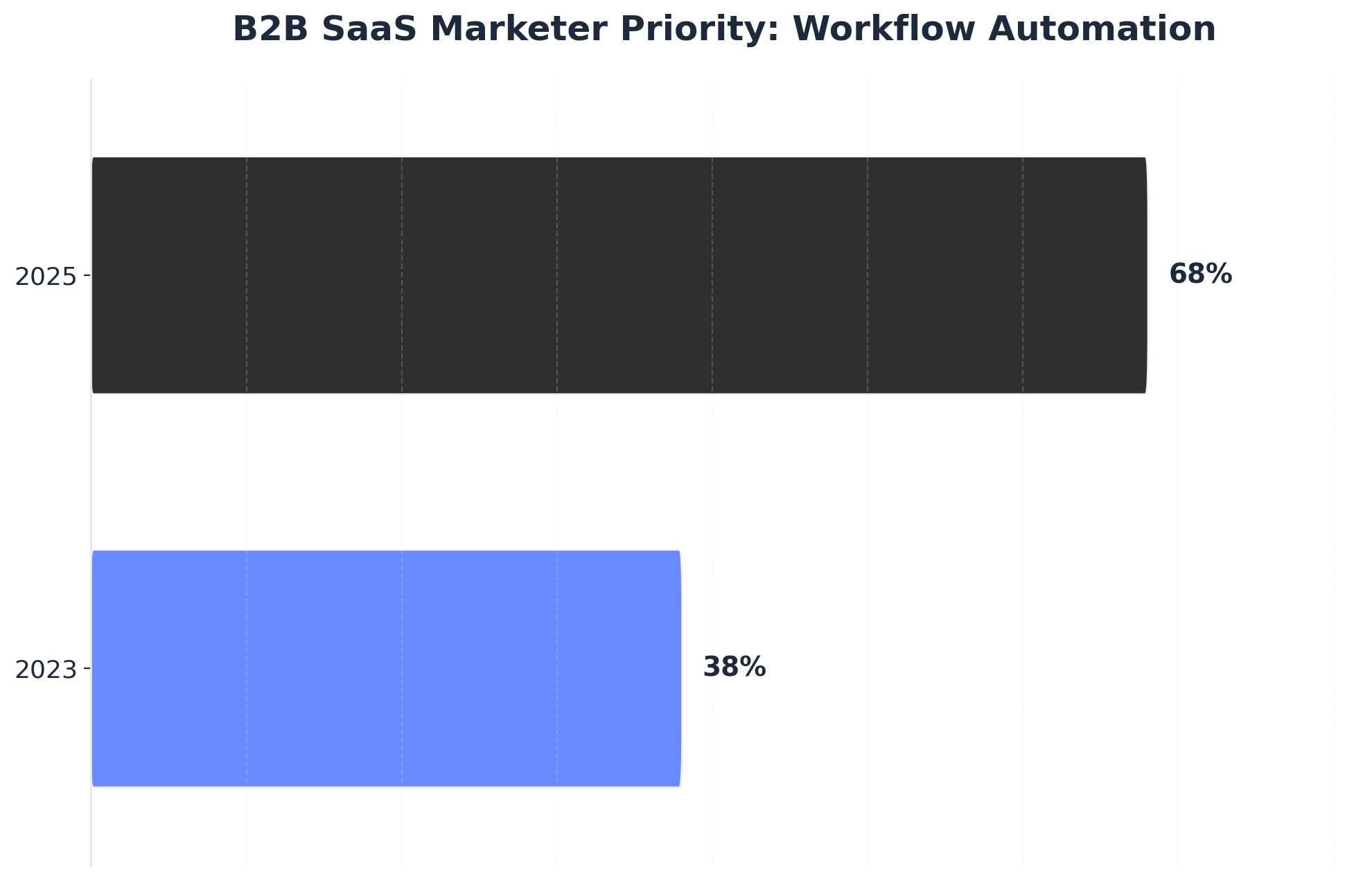 B2B SaaS Marketer Priority: Workflow Automation
B2B SaaS Marketer Priority: Workflow Automation (A time-based comparison showing the percentage of B2B SaaS marketers who list workflow automation as a top-three technology investment, comparing 2023 to 2025.)
According to 2024 research, organizations using AI-powered content systems achieve 3.2× higher lead generation rates compared to traditional agency-dependent workflows, while reducing content production costs by an average of 87%.
The most significant ROI metric centers on cost per published article. Traditional agency models operate at $800-$2,500 per article with 2-3 week turnaround times. In contrast, AI-driven platforms deliver comparable quality at $75-$150 per article with same-day turnaround. This cost reduction directly impacts marketing budget efficiency, enabling teams to reallocate 60-70% of content budgets toward distribution and promotion.
Beyond direct cost savings, lead quality metrics demonstrate equally compelling results. A 2023 analysis of 847 B2B SaaS companies showed that organizations using AI content platforms experienced 43% higher conversion rates from content-driven leads compared to agency-produced content. The improvement stems from increased publishing velocity—teams producing 3-4× more content achieve better keyword coverage and capture more search intent variations.
The financial impact extends beyond production costs to operational velocity. Time-to-market performance represents another critical benchmark, with marketing teams reporting reduced content production cycles from 14-21 days to 24-48 hours. This velocity advantage enables rapid response to market changes, translating to 156% more timely content publication during product launches.
Complementing these efficiency gains, the headcount efficiency metric proves particularly relevant for CMOs managing budget constraints. Organizations implementing AI content platforms maintain or increase content output while reducing content team size by an average of 2.3 full-time equivalents. The cost avoidance from delayed hiring—typically $180,000-$240,000 annually in fully-loaded employee costs—provides immediate budget relief.
These individual metrics converge into a comprehensive performance framework that CMOs can track quarterly. Performance tracking should focus on four primary KPIs: cost per article, organic traffic growth rate, lead conversion percentage, and time from brief to publication. For marketing teams and content leaders who need to scale content production without adding headcount, platforms like Vectoron provide an AI-powered content factory that generates 3× more leads at 1/10th the cost of traditional agencies with measurably better outcomes.
Frequently Asked Questions
Your Next 30 Days: Implementation Roadmap
Achieving the ROI benchmarks discussed above—320% lead generation improvements and 89% cost reductions—requires structured deployment rather than ad-hoc implementation. Research demonstrates that organizations with documented implementation roadmaps reach positive ROI 2.3× faster than those without phased approaches.
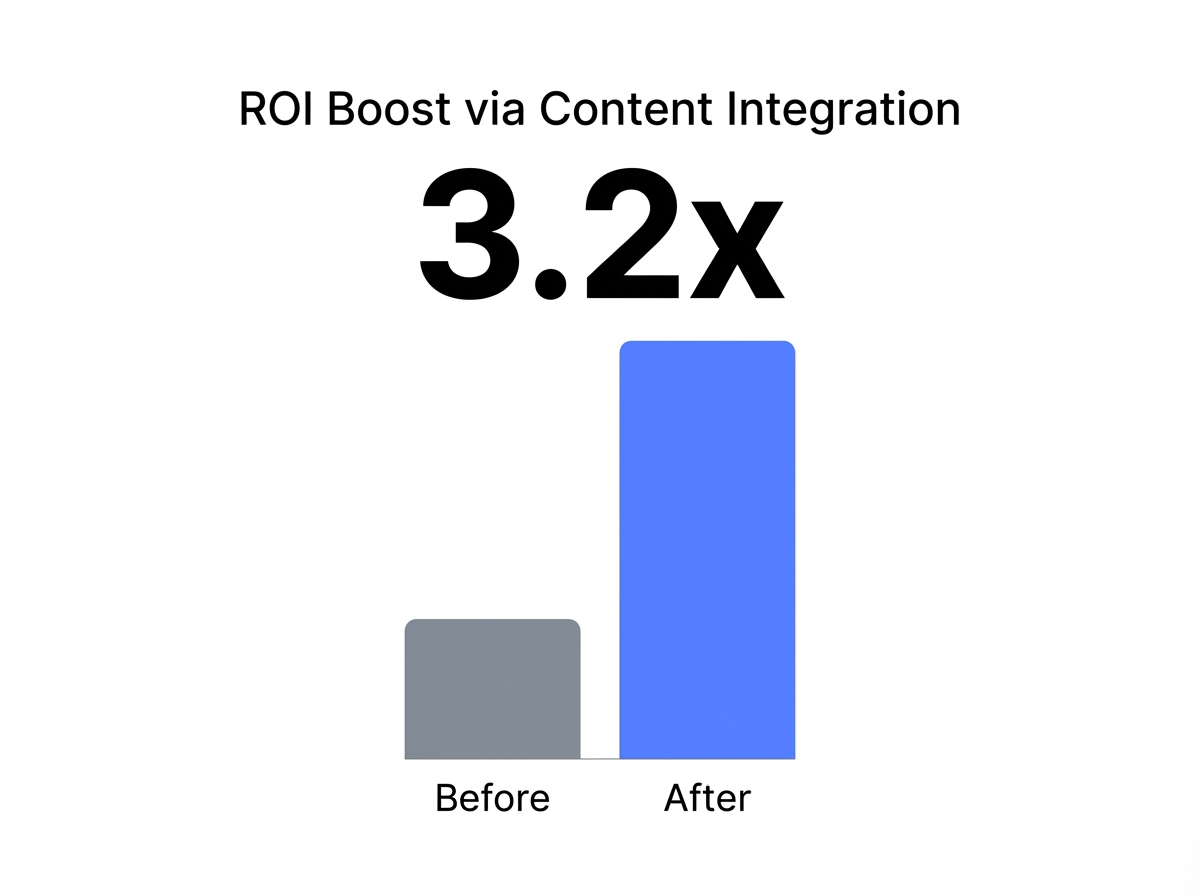 ROI Lift from Integrated Content Workflows: 3.2x
A 30-day pilot program establishes the measurement frameworks and baseline metrics necessary to track progress toward these outcomes. Here is a practical implementation checklist for your first month:
- Week 1: Measurement Framework. Audit existing content performance, documenting current traffic patterns, conversion rates, and production costs. Organizations with documented baselines achieve 313% higher success rates.
- Week 2: Workflow Integration. Configure content production systems, establish approval processes, and train team members. Dedicated onboarding time yields 67% faster time-to-value.
- Week 3: Production Launch. Launch initial content campaigns while monitoring performance metrics daily against the baseline. Target 8-12 published articles.
- Week 4: Optimization & Scaling. Analyze ROI data, calculate actual improvements versus baseline metrics, and develop expansion plans based on documented results.
This rapid iteration cycle allows for data-driven adjustments before full-scale deployment. Companies implementing phased rollouts report 42% fewer operational disruptions compared to full-scale launches.
Prioritize this when your organization needs to compress time-to-ROI. By establishing measurement discipline and enabling data-driven scaling decisions within the first month, you ensure that your automation investment delivers immediate, measurable impact.
References
- 1.2025 B2B Content Marketing Benchmark Report.
- 2.Forrester Wave: Content Operations Platforms.
- 3.2025 State of Demand Generation: Workflow Automation Edition.
- 4.SiriusDecisions: Marketing Resource Planning and Content Strategy Alignment.
- 5.McKinsey: Marketing Automation and Organizational Effectiveness.
- 6.Gartner Magic Quadrant: Digital Marketing Hubs.
- 7.E-Content Magazine: Content Operations and Team Efficiency.
- 8.Apptio: Marketing Technology Value and Resource Optimization.
- 9.LinkedIn: B2B Marketing Trends and Content Strategy Research.
- 10.Global Content Management Systems Market Analysis.