
Key Takeaways
- Content demand has outpaced hiring, forcing teams to redesign their operating model around a six-stage loop: signal intake, ranked recommendations, AI-assisted production, human approval, publishing, and attribution feedback.
- Approval throughput, not draft speed, is the binding constraint once AI production is running, which is why named reviewers, tiered review, and reviewer SLAs matter more than model selection.
- Brand voice survives automation only when treated as production infrastructure — a versioned prompt library, exemplar corpus, and a single voice owner who feeds editor corrections back weekly.
- Teams should sequence rollout as plumbing first, then refresh work on existing pages, then net-new longform with attribution wired back into ranking, rather than attempting the full loop in one quarter.
The Supply-Demand Gap That Forced a New Operating Model
Content output expectations have moved faster than any reasonable hiring plan can absorb. Deloitte Digital found that average content demands nearly doubled between 2023 and 2024, layered on top of a 55% increase the year before 1. Headcount budgets did not follow that curve. Editorial calendars did.
The math is unforgiving. A team of four that produced 200 assets in 2022 is now being asked to deliver something closer to 600 across more formats, more languages, and more channels, without a proportional increase in writers, editors, or designers. Agency retainers can buffer the gap, but they introduce briefing cycles and revision rounds that cap throughput at the speed of email threads.
This is the operating condition that made content marketing automation a board-level conversation rather than a tooling preference. The question stopped being whether automation belongs in the content stack and became how the stack itself should be redesigned so a small in-house team can govern output at the volume the business now requires. Scale without structure produces inconsistent voice, duplicated assets, and missed SEO opportunities 2. The rest of this piece walks through the execution loop that closes that gap, where AI changes the per-asset economics, and where human judgment remains the gating function.
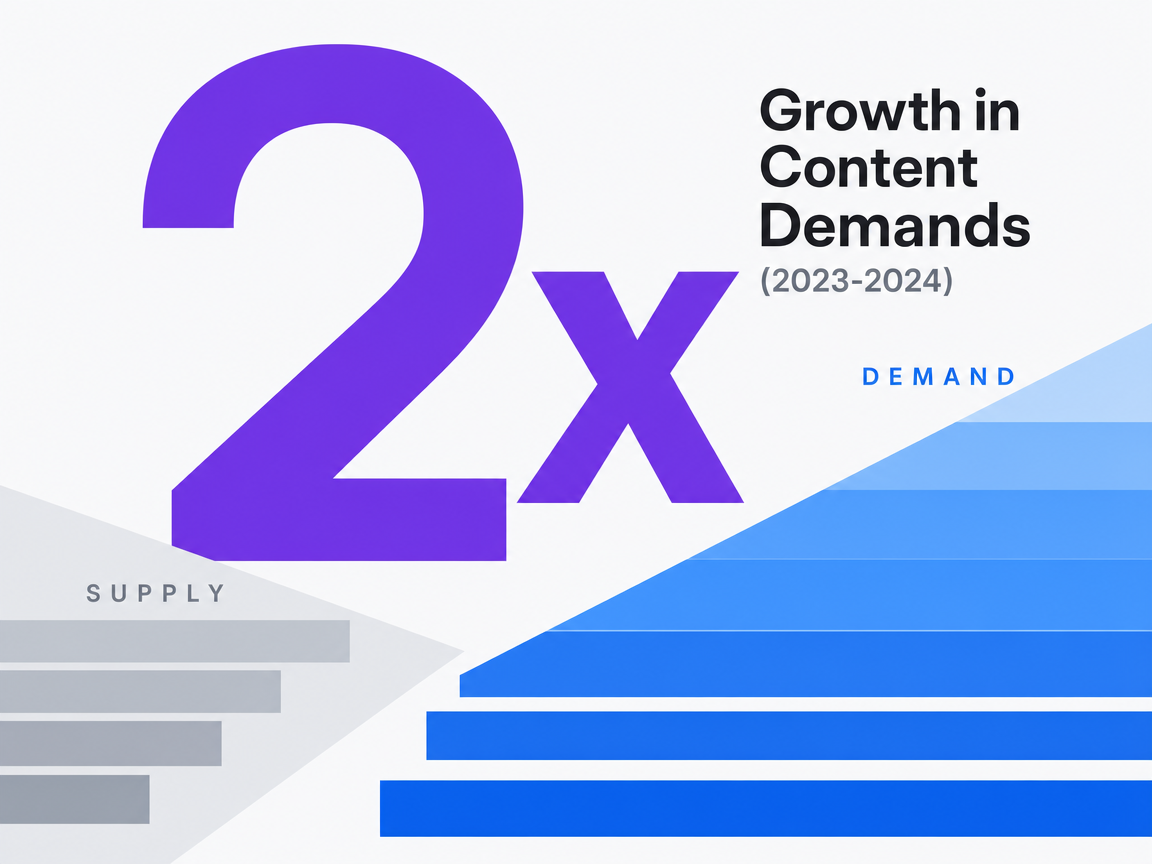 Growth in Content Demands (2023-2024)
Growth in Content Demands (2023-2024)
The Six-Stage Execution Loop
Signal Intake: What Feeds the System
An automated content engine starts with what it can see. Signal intake is the layer that pulls live data into the planning surface: keyword rank movement, organic landing-page performance, paid search query reports, CRM lifecycle stage, email engagement, sales call transcripts, support ticket themes, and competitor publishing cadence. The richer the signal mix, the better the system can prioritize what to produce next.
Most in-house teams already sit on this data. It lives in GA4, Search Console, HubSpot or Salesforce, Ahrefs or Semrush, and a call-tracking tool. The automation layer's job is to read those feeds on a schedule rather than waiting for a quarterly planning meeting to surface the same insights manually.
Ascend2 found that 47% of marketers rank identifying ideal customers as their top automation goal, with 40% citing data quality 5. Both depend on intake. A loop fed only by keyword volume will produce SEO-shaped content that misses the buyer signals already sitting in CRM and call data. Intake design is the first place the operating model either compounds or stalls.
Ranked Recommendations: Turning Signals Into a Calendar
Raw signal is not a calendar. The second stage scores opportunities against business outcomes and produces a ranked list: which topics to publish, which existing pages to refresh, which assets to repurpose into a different format, and which sequences to send. Ranking is where strategy becomes visible.
A well-designed recommendation layer weights pipeline influence, search opportunity, content decay, and competitive gap. A page that ranks #6 for a high-intent query with declining CTR is a higher-value refresh than a net-new post on a thin topic. The system surfaces that trade-off explicitly, with the reasoning attached.
This is the stage that replaces the recurring "what should we write this month" meeting. The content lead is no longer assembling the calendar from scratch; they are reviewing a prioritized queue and accepting, rejecting, or reordering items. Deloitte's framing is direct: scale without structure becomes chaos, and ranking is the structure that prevents an automated production line from producing the wrong work faster 2.
AI-Assisted Production: Where the Economics Shift
Production is where the per-asset cost curve changes shape. Once a topic is approved off the ranked queue, the system drafts to a structured brief: target query, intent, outline, internal links, brand-voice prompt library, source requirements, and format. A generative model produces a first draft against that brief, pulls supporting data, and proposes visuals. Editors then operate on a draft instead of a blank page.
McKinsey's economic analysis put concrete numbers on this shift. Generative AI is projected to deliver productivity gains worth 5–15% of total marketing spend, with marketing and sales among the four functions capturing roughly 75% of the total value generative AI could create across the economy 4. For a content team, that lift shows up as compressed cycle time on drafting, faster localization, quicker variant generation for paid and social, and lower marginal cost on the second, third, and fourth format of the same core asset.
The point is not that AI replaces the writer. It changes which part of the writer's hour creates the most value. Drafting time shrinks; editorial judgment, source verification, and angle refinement expand. The economics shift because the system absorbs the repetitive scaffolding work — outline structuring, metadata, alt text, schema, summary blurbs, channel-specific rewrites — that previously consumed the back half of every production day. A team that was producing four longform pieces a month with the same headcount can credibly target eight to twelve, provided the approval stage can keep up.
Human Approval: The Real Bottleneck
Production speed exposes the next constraint. When drafts arrive faster, the queue waiting for editorial sign-off grows, and approval throughput becomes the binding constraint on the entire loop. This is the part of the model that most tooling pitches skip.
Approval covers three distinct decisions:
- does this asset meet brand and editorial standards,
- does it represent the company's positioning correctly, and
- is it factually defensible.
None of those decisions should be automated away. NIST's AI Risk Management Framework is built around exactly this principle — that trustworthiness in AI systems requires deliberate human checkpoints during use and evaluation, not just at design time 11. For content operations, that translates to a named reviewer, a defined SLA on turnaround, and a clear escalation path for anything touching regulated claims, customer data, or executive positioning.
The practical implication is that approval workflow design matters more than model selection. A team that can sustain twelve approvals a week will out-produce a team with a better AI stack that can only sustain six. Queue visibility, batch review windows, and a lightweight comment-and-revise interface are the operational levers. The bottleneck moves from writing capacity to reviewer capacity, and the operating model has to plan for that explicitly.
Publishing and Channel Adaptation
Approved assets do not ship as a single file. The publishing stage fans the canonical piece into channel-native formats: the CMS post with full schema, the LinkedIn carousel, the email send with personalized subject lines, the short-form video script, the syndicated excerpt. Each variant carries its own metadata, UTM structure, and review status.
Channel adaptation is no longer optional. Deloitte's 2025 Digital Media Trends survey documents how attention has shifted toward hyperscale social video, creator-driven formats, and recommendation-model-driven discovery, with traditional channels losing share of consumption time 10. A piece that lives only as a 1,800-word blog post leaves most of its potential audience on the table.
Ascend2's automation research underscores that email and social management remain the most commonly automated activities for the third year running, including triggered, behavior-based sends tied to content engagement 7. Publishing is where the loop touches the customer, and where consistent metadata and tagging determine whether the next stage — measurement — can attribute anything cleanly.
KPI Attribution and the Feedback Loop
The final stage closes the loop by routing performance data back into signal intake. Each published asset is tagged against the recommendation that produced it, so the system can measure which signals produced which outcomes: organic sessions, assisted conversions, pipeline influence, qualified calls, email-driven revenue.
Attribution at this stage is not about a single-source-of-truth report. It is about teaching the ranking layer which patterns produced results. A refresh that moved a page from position #6 to #2 and lifted demo requests becomes training data for prioritizing similar refreshes. A net-new post that ranked but produced no pipeline gets weighted down.
This is what makes the operating model a loop rather than a pipeline. Signals feed recommendations, recommendations drive production, production passes through approval, publishing executes, and measurement updates the signal layer with what actually worked. Each cycle sharpens the next. The team is no longer running a content factory; it is running a learning system with editorial judgment at the center.
What Teams Actually Automate First
The order in which teams automate reveals what they are actually trying to fix. Ascend2's 2024 survey of marketers ranked the top automation goals as:
- identifying ideal customers (47%),
- improving data quality (40%), and
- decreasing costs (39%) 5.
None of those goals describe writing assistance. They describe targeting precision and unit economics.
That ordering reshapes the first wave of automation work. Teams start with the audience layer: cleaning CRM segments, deduplicating contact records, enriching firmographic fields, and wiring lifecycle stage into the content tagging system. Without that foundation, every downstream personalization rule fires on bad inputs. A nurture sequence segmented by industry that pulls from a free-text industry field will mis-route a third of its sends.
The second wave is distribution. Email triggers, behavioral re-engagement sends, and social scheduling get automated next because they touch existing infrastructure and produce measurable lift quickly. Ascend2 reports email and social management have been the most commonly automated activities for three years running 7.
Production automation — AI-assisted drafting, variant generation, schema markup — comes third in most rollouts. It produces the largest cycle-time savings, but it depends on the first two layers being clean. A faster content engine pointed at the wrong segments simply ships more irrelevant assets to more inboxes.
Test AI-driven content automation in real workflows
Experience measurable improvements in content velocity and quality by publishing live during your trial period.
Approval-First Automation as a Governance Posture
The phrase "AI content automation" reads to most executives as a synonym for autonomous generation. That conflation is the source of most failed pilots. A defensible operating model separates execution speed from decision authority, and routes every shipped asset through a named human approver before publish. Approval-first automation is the posture; the speed gains are downstream of it.
NIST's AI Risk Management Framework codifies the principle. The framework is built to embed trustworthiness considerations across the design, development, use, and evaluation stages of AI systems, with explicit emphasis on human oversight during the use phase 11. For content operations, that translates into three governance requirements that hold regardless of model choice:
- source attribution on every factual claim,
- brand and legal review on every customer-facing asset, and
- an auditable record of who approved what and when.
The operational benefit is that approval-first design makes scale safe. Deloitte's content operations research argues the same point from the business side: scale without structure produces inconsistent voice, duplicated assets, and brand exposure that compounds faster than the team can correct it 2. Governance is not a tax on velocity; it is the precondition for sustaining it.
Three controls do most of the work:
- A reviewer SLA tied to queue depth so approval throughput scales with production throughput.
- Tiered review — light-touch for low-risk variants like social rewrites, full review for net-new longform or regulated topics.
- Version history that captures both the AI draft and the human edits, so the system learns from accepted changes and the team retains the audit trail that legal and compliance functions require.
Throughput Math: Agency Cycle vs. Automated Loop
The clearest way to compare operating models is to count days, not deliverables. A traditional agency cycle for a single longform asset typically runs: kickoff brief, account-manager handoff, writer assignment, first draft, internal agency QA, client revision round one, client revision round two, final approval, design pass, and publishing handoff. Each step lives in a separate inbox. Two to four weeks per asset is a normal cadence; six is not unusual for regulated topics or executive bylines.
An automated loop collapses the handoffs without removing the decisions. Brief generation happens against the ranked recommendation, draft production runs in hours rather than days, and the editor receives a near-complete asset with sources attached. The remaining cycle is review, revise, approve, publish. Same-week turnaround on a longform asset becomes the baseline rather than the exception.
The economic gap is what makes the comparison material. McKinsey's analysis estimates generative AI can deliver marketing productivity gains worth 5–15% of total marketing spend, and Deloitte's adoption research finds early gen-AI adopters in marketing seeing roughly a 12% return on their investment 4, 3. Those figures are not promises for every team. They are the directional case for shifting where the team spends its hours: less on assembling first drafts, more on the approval and measurement work that actually moves pipeline.
Preserving Brand Voice Inside an Automated Pipeline
Brand voice is the objection that kills most AI content pilots before they reach steady state. The fear is reasonable: a generic model trained on the open web produces generic prose, and a content team that has spent years sharpening a point of view does not want to publish work that sounds like every other vendor in the category.
The fix is not better prompts written ad hoc. It is a brand-voice prompt library treated as production infrastructure — a versioned set of voice rules, banned phrases, sentence-rhythm examples, and approved analogies that every draft is generated against. Pair that library with a corpus of fifteen to thirty best-in-class published pieces the model can reference for tone, and the first-draft output narrows toward house style rather than drifting away from it.
Two operational habits hold the line. Editors flag voice deviations during review and feed those corrections back into the prompt library each week, so the system learns from accepted edits. And a single voice owner — usually the senior editor — maintains the library as a living document rather than a one-time setup. Deloitte's content operations research is blunt on this point: scale without structure produces inconsistent voice and brand exposure that compounds faster than a small team can correct manually 2. The library is the structure.
See Content Marketing Automation in Action—Without Compromising Control
Get a personalized walkthrough of AI-driven workflows that accelerate content production, maintain brand standards, and deliver measurable ROI—purpose-built for agencies and enterprise marketing teams.
What Changes for Headcount and Team Shape
Automation does not eliminate the content team. It changes which roles carry the most leverage. The writer-heavy org chart — three to five generalists producing assets to a calendar — flattens into a smaller core of senior operators, each handling more surface area than before.
Three roles gain weight:
- The senior editor becomes the approval bottleneck and the voice owner, reviewing more drafts per week and curating the prompt library that shapes every output.
- The content strategist shifts from calendar maintenance to recommendation tuning, deciding which signals get weighted up and which topics get killed.
- The analyst — often a new hire or a reallocated marketing ops resource — owns attribution and feeds outcomes back into the ranking layer.
Junior writing roles compress. The work that used to fill an associate's week — first drafts, metadata, social rewrites, summary blurbs — now arrives pre-generated. Harvard's commentary on the 2024 State of Marketing AI Report frames the same shift: AI is taking on segmentation, content generation, and performance analysis, and marketers who keep their seats are the ones developing new competencies around oversight, editorial judgment, and ethical review 9. Headcount does not drop by half. The composition changes, and the senior-to-junior ratio inverts.
Adoption Trajectory: Where the Market Is Heading
The adoption curve is no longer a leading-edge story. McKinsey data shows 65% of enterprises now use generative AI regularly, double the prior year's share, with marketing and sales registering the largest function-level jump 8. The technology has crossed from pilot to standard operating layer in eighteen months.
Marketing-specific numbers track the same slope. Deloitte's research found 26% of marketers already using generative AI and another 45% planning adoption by the end of 2024, putting the addressable share above 70% within a single planning cycle 3. Teams that wait another year are not choosing whether to automate; they are choosing how much catch-up debt to absorb.
What the trajectory implies for in-house content leaders is concrete. Recommendation layers, brand-voice libraries, and approval workflows are becoming table-stakes infrastructure rather than competitive advantage. The edge moves to teams that operate the loop well — clean signal intake, disciplined review SLAs, attribution that actually feeds back into ranking. The next eighteen months separate operators who built the discipline from those who only bought the tools.
A Pragmatic Path to Implementation
Most teams that try to stand up the full loop in one quarter fail at the approval stage. A staged rollout is the more defensible path.
- Quarter one is plumbing. Connect GA4, Search Console, CRM, and the rank tracker into a single planning surface. Clean the segment fields the personalization rules will depend on. Pick five recurring content jobs — meta descriptions, social rewrites, summary blurbs, internal link suggestions, alt text — and automate them against the existing CMS. The goal is reclaiming editor hours, not shipping AI-drafted longform yet.
- Quarter two introduces production automation on a contained surface. Pick one content type — refresh work on existing ranking pages is the lowest-risk starting point — and run it through the full loop with a named editor as approver. Build the brand-voice prompt library from the first ten approved pieces. Track cycle time and approval throughput weekly.
- Quarter three expands the surface and tightens governance. Add net-new longform, layer in tiered review, and wire attribution back into the ranking layer. Platforms like Vectoron are built around this approval-first sequence, but the discipline matters more than the tool. Teams that build the loop in this order keep their voice, their judgment, and their ability to scale.
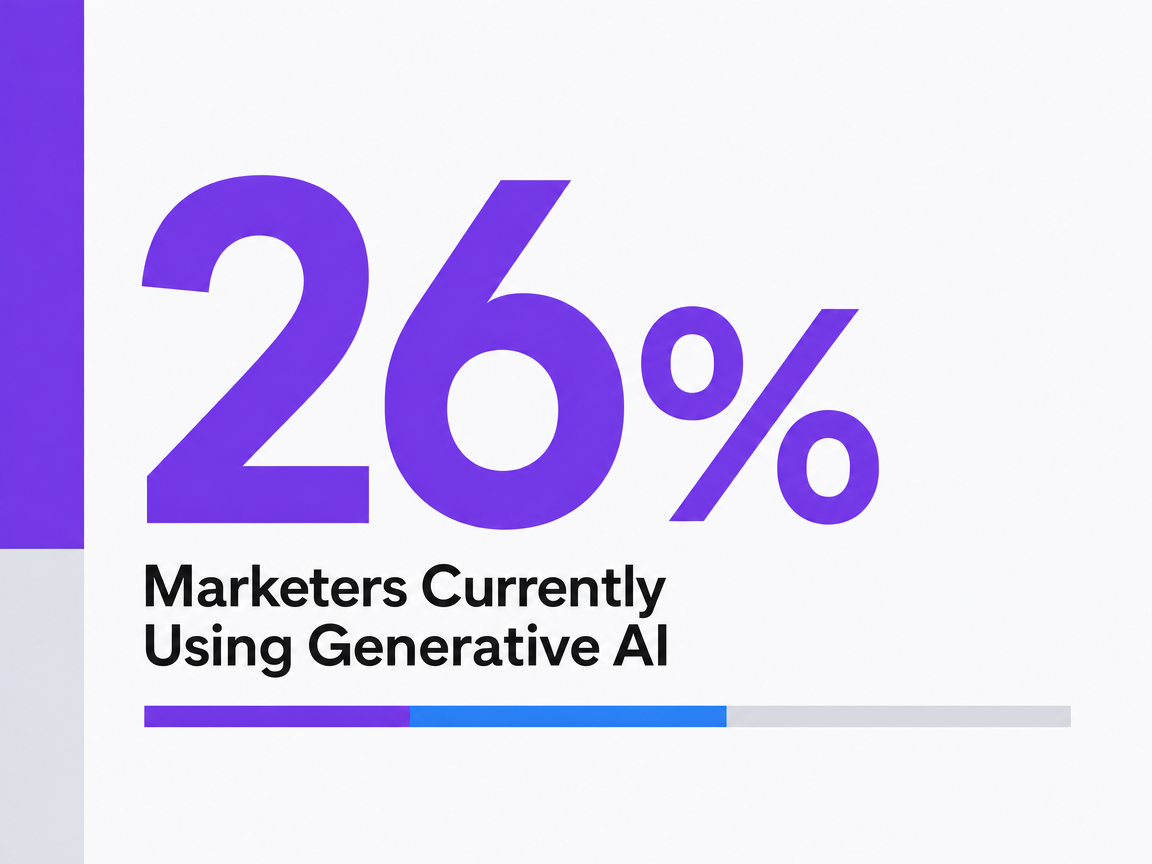 Marketers Currently Using Generative AI
Marketers Currently Using Generative AI
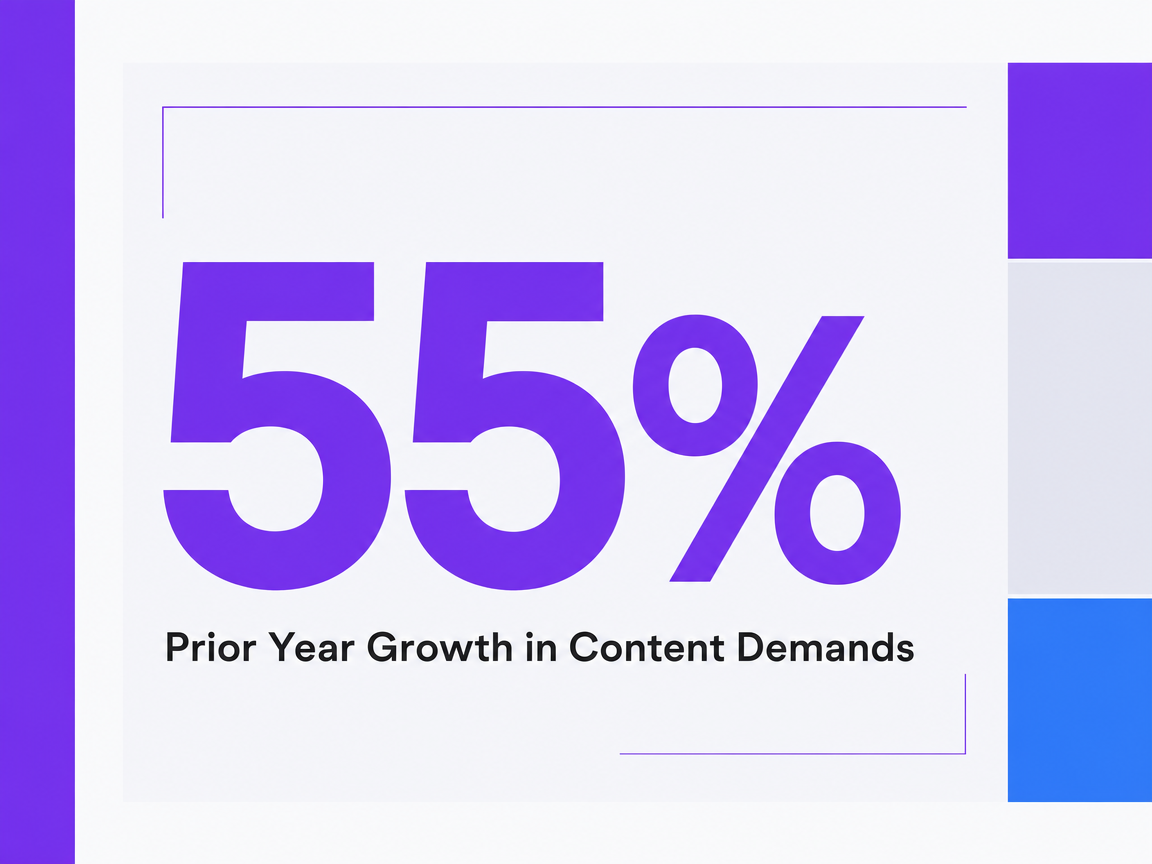 Prior Year Growth in Content Demands
Prior Year Growth in Content Demands
Frequently Asked Questions
References
- 1.Marketing content automation.
- 2.Content (R)evolution.
- 3.Deloitte Digital's latest research forecasts generative AI's transformation of content marketing.
- 4.The economic potential of generative AI: The next productivity frontier.
- 5.The State of Marketing Automation 2024 – Survey Summary Report.
- 6.THE STATE OF MARKETING AUTOMATION 2024 | Ascend2.
- 7.The State of Email and Automation in 2024.
- 8.Almost two thirds of businesses already incorporating generative AI into day-to-day work.
- 9.AI Will Shape the Future of Marketing.
- 10.2025 Digital Media Trends.
- 11.AI Risk Management Framework.