Key Takeaways
- Lifecycle stage promotion based on behavioral thresholds replaces brittle manual list audits and keeps contact stages aligned with actual buying behavior at above 90% accuracy 2.
- Lead scoring with demographic and behavioral branching retires SDR morning triage and routes sales-ready contacts to owners within a defined SLA window 8.
- Round-robin lead routing with territory and ICP overrides eliminates the spreadsheet-and-Slack assignment dance and drives unowned-lead rate toward zero 8.
- Multi-touch nurture for unqualified leads replaces one-size-fits-all batch sends with segmented sequences that recover conversion from contacts who would otherwise decay 9.
- Dormant lead re-engagement with tiered exit paths retires the Monday morning stale-contact pull and protects sending reputation by archiving shallow-history non-responders 2.
- Trial activation and PQL promotion react to product events rather than signup date, concentrating AE attention on accounts already signaling intent 4.
- Demo no-show recovery fires within minutes of the missed meeting, splits on lead value, and preserves reschedule odds that decay sharply with elapsed time.
- Customer onboarding handoff from sales to CSM triggers on Closed Won, branches by ARR tier, and prevents context loss between contract signature and kickoff.
- Renewal risk detection from usage signals reacts the moment thresholds break, replacing the quarterly spreadsheet scramble that closes the save window too late.
- Closed-lost reanimation fires on signal events like champion job changes or funding announcements, surfacing accounts when something actually changed rather than on a calendar pull 3.
Manual Follow-Up Is the Most Expensive Failure Mode in SaaS Demand Gen
The economics of manual follow-up in mid-market SaaS are brutal once anyone bothers to model them. An SDR earning a fully loaded $85K spends roughly a third of the workday on tasks a deterministic system handles better: sorting MQLs by hand, retyping the same five-touch cadence, chasing demo no-shows, pulling dormant leads back into view every Monday. McKinsey's analysis of sales automation puts the math plainly — automating outreach and CRM administration both reduces cost of sales and frees rep capacity for the deals where human judgment actually moves revenue 4.
The failure mode is not laziness. It is variance. A human follow-up queue depends on who is in the office, who remembers the lead, and which spreadsheet got updated last. Trigger-based workflows do not forget, do not take Fridays off, and do not de-prioritize accounts that look small on paper but score high on fit. Forrester's nurturing research makes the same point from the demand-gen side: orchestrated multi-touch programs consistently outperform fragmented manual follow-up because they hold cadence and segmentation steady across thousands of contacts 9.
The deeper problem is that most HubSpot Pro and Enterprise accounts use a small slice of the workflow engine — welcome emails, a few internal notifications, maybe a lifecycle stage update. The ten workflows in this piece are framed as labor-replacement units. Each one names the human step it retires, the trigger that fires it, and the branch logic that decides what happens next. Workflows are best applied to high-volume, low-complexity tasks where deterministic logic beats human attention 2— exactly the pattern that defines SDR queues, lifecycle transitions, and revenue-ops routing.
How to Read Each Workflow: Trigger, Branch Logic, Benchmark
Every workflow below follows the same four-part structure so directors can scan, compare, and prioritize without rereading.
Manual task retired : Names the specific human step the workflow eliminates — a Monday morning re-engagement pull, an SDR's no-show callback, a CSM check-in cadence.
Trigger : Defines the precise enrollment condition: a property change, a form submission, a behavioral threshold crossed.
Branch logic : Covers what happens after enrollment, including if/then splits, delays, goal criteria, and suppression rules that keep contacts from colliding with other active sequences.
Benchmark : States what good looks like, anchored to either supplied research or a stated variable when no benchmark exists in the literature.
One ground rule applies across all ten: workflow automation pays off when applied to high-volume, low-complexity tasks with stable inputs 2. Workflows handling judgment-heavy decisions or freeform content tend to break. The list below stays inside that boundary.
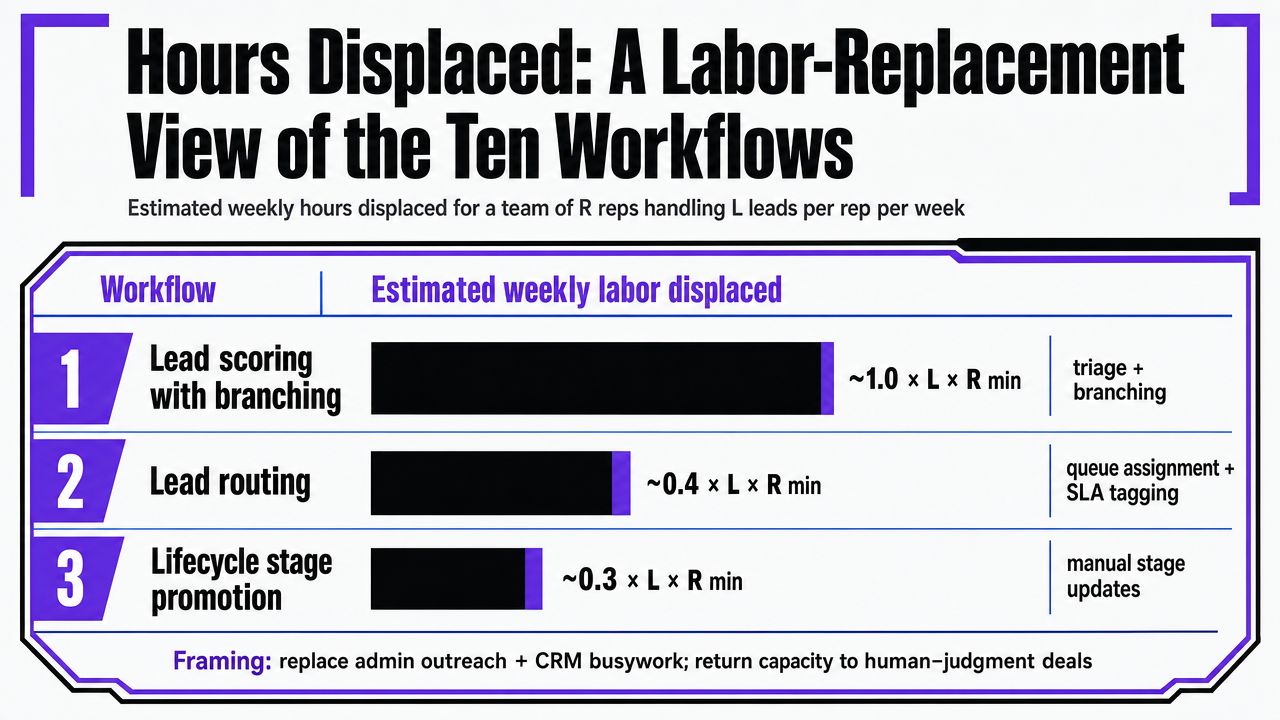
Hours Displaced: A Labor-Replacement View of the Ten Workflows
Before reading the individual workflows, directors should see them ranked by the labor they retire. The chart below estimates SDR and revenue-ops hours displaced per week for a team of R reps handling L leads per rep per week. Each row uses a stated variable rather than an invented dollar figure, so the math survives translation to any team size. McKinsey's analysis of sales automation supports the framing: replacing administrative outreach and CRM busywork lowers cost of sales and returns capacity to deals that require human judgment 4.
Estimated weekly hours displaced per workflow (team of R reps, L leads per rep per week) Lead routing: ~0.4 × L × R minutes (queue assignment + SLA tagging) Lifecycle stage promotion: ~0.3 × L × R minutes (manual stage updates) Lead scoring with branching: ~1.0 × L × R minutes (triage + ICP review) Multi-touch nurture: ~2.0 × L × R minutes (cadence sends) Dormant re-engagement: ~3.0 minutes per dormant contact, weekly pull Demo no-show recovery: ~8 minutes per no-show, callback + reschedule Trial activation: ~5 minutes per trial, manual check-in CSM handoff: ~12 minutes per closed-won, account briefing Renewal risk detection: ~15 minutes per at-risk account, usage review Closed-lost reanimation: ~4 minutes per trigger event, manual research
The pattern is consistent with what high-yield automation looks like in practice: high-volume, low-complexity tasks where deterministic logic outperforms human attention. The next ten sections walk through each workflow in that order.
 Visualize the relative weekly labor displacement across the ten workflows referenced in the section, supporting the labor-replacement framing
Lifecycle Stage Promotion Based on Behavioral Thresholds
Manual task retired: the demand-gen analyst's weekly pass through HubSpot lists, hand-promoting contacts from Subscriber to Lead, Lead to MQL, or MQL to SQL based on activity they spotted in a report. That work is brittle, inconsistent across teammates, and almost always lagging the actual buyer signal by days.
Trigger: a contact crosses a defined behavioral threshold — a third pricing-page visit inside fourteen days, a demo request, a product webinar attendance, or a content-score sum above a set integer. Enrollment is set to re-enroll only when the contact drops back below the threshold and crosses it again, preventing thrash.
Branch logic: the workflow checks the current lifecycle stage before promoting, so a contact already at Opportunity is not demoted to MQL by a content view. If/then branches handle edge cases: existing customers route to a product-marketing list instead of sales, and contacts missing firmographic data fork into an enrichment sub-workflow before any stage change fires. Exit criteria suppress further promotion once the contact is owned by a rep.
Benchmark: lifecycle stage accuracy, measured as the share of contacts whose stage matches their actual buying behavior in a weekly audit, should sit above 90% once the workflow runs for a full cycle. Standardizing this transition is exactly the high-volume, low-complexity pattern automation handles well 2.
Lead Scoring with Demographic and Behavioral Branching
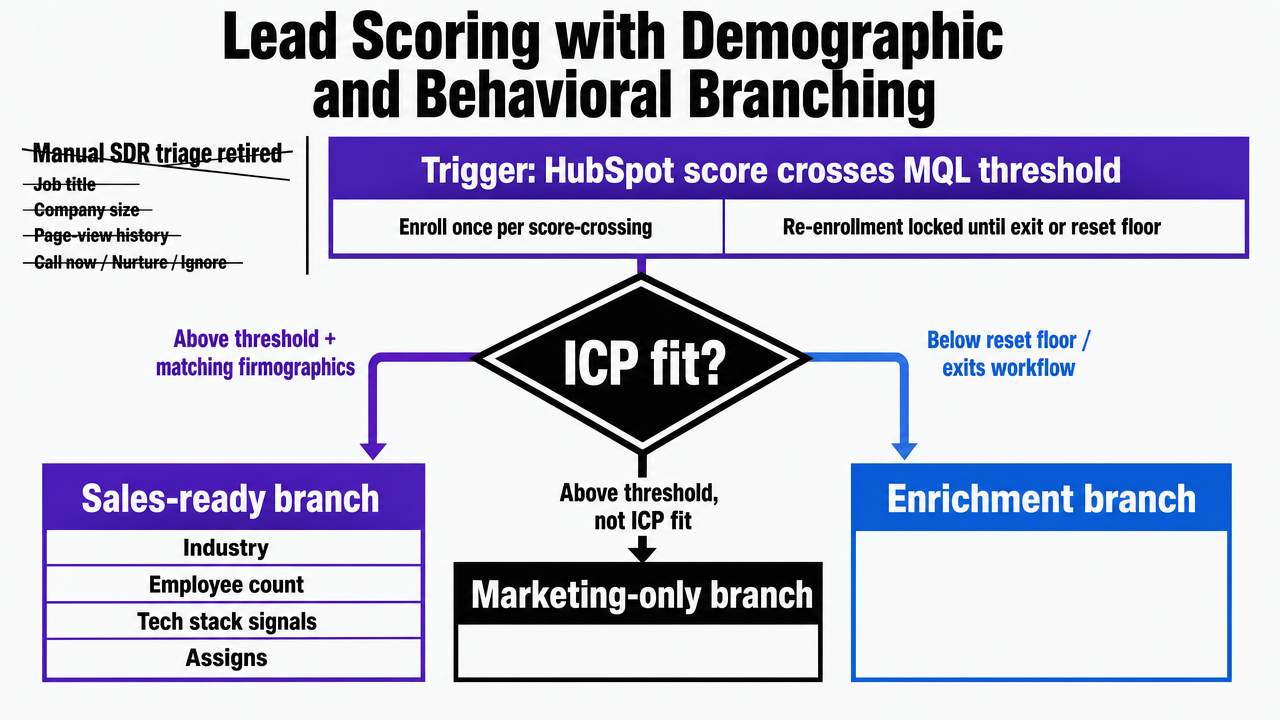
Manual task retired: the SDR's morning triage of inbound MQLs, where a human reads each contact record, eyeballs job title and company size, scrolls through page-view history, and decides whether to call now, nurture, or ignore. That decision gets made hundreds of times a week, inconsistently, by people with different definitions of "good fit."
Trigger: a HubSpot score property crosses a defined threshold — typically the moment a contact's combined demographic and behavioral score clears the MQL bar. Enrollment fires once per score-crossing event, with re-enrollment locked until the contact exits the workflow or drops below a reset floor.
Branch logic: the workflow splits first on ICP fit. Contacts above the threshold with matching firmographics (industry, employee count, tech stack signals) route to a sales-ready branch that assigns an owner, starts an SLA timer for first-touch within a stated window, and posts a Slack alert to the assigned rep. Contacts above the threshold but outside ICP route to a marketing-only branch that suppresses sales notification and enrolls them in a longer-arc nurture. A third branch handles contacts whose score spiked from a single high-intent action (pricing page, demo request) but lacks supporting firmographic data — these route to an enrichment sub-workflow before any owner is assigned. Forrester's minimum-requirements standard treats this exact combination as table stakes: marketing automation platforms must support scoring on demographic and behavioral attributes and route qualified leads to the correct rep with automated alerts 8.
Benchmark: MQL-to-SQL conversion should climb measurably within one full sales cycle after the branching logic replaces manual triage, with first-touch latency on sales-ready leads compressed to the SLA window rather than the next business day.
 Visualize the three-branch decision tree described in the section (sales-ready, marketing-only, enrichment) to clarify the workflow's branch logic
Test Automated HubSpot Workflows With Live Data
Experience hands-on workflow automation and measure its impact using your actual campaign follow-up scenarios.
Round-Robin Lead Routing with Territory and ICP Overrides
Manual task retired: the revenue-ops manager's spreadsheet of rep assignments, the Slack DMs to confirm who is covering which territory this week, and the inevitable Friday audit of inbound leads that landed in nobody's queue. Routing is where manual follow-up actually breaks at scale, because the rules are simple but the volume punishes any human in the loop.
Trigger: a contact reaches sales-ready status — either through a score crossing in the qualification workflow above, a direct demo request, or a sales-assisted form submission. Enrollment fires once per qualification event, with re-enrollment locked while the contact has an active owner.
Branch logic: the workflow evaluates conditions in a fixed priority order:
- Named-account matches route first to the assigned strategic rep, bypassing the round-robin pool entirely.
- Territory rules check next, filtering by country, region, or state property.
- ICP score above a defined ceiling routes to the senior AE bench rather than the general queue.
- Everything remaining drops into a round-robin distribution across reps marked available, with a capacity cap that pauses assignment when a rep's open-lead count exceeds a stated threshold.
An SLA timer starts at assignment, and a fallback branch reassigns the lead if first-touch does not register within the window. Forrester's platform standard treats this layered logic — scoring, routing, automated alerts to the correct rep — as a baseline capability, not an advanced feature 8.
Benchmark: unowned-lead rate should approach zero within the first full week, and first-touch SLA compliance should hold above the threshold the team sets for itself, typically measured against a stated minute or hour window rather than "same day."
Multi-Touch Nurture for Unqualified Leads
Manual task retired: the marketing coordinator's batch email sends to the "not ready yet" pile — the contacts who downloaded a guide, attended a webinar, or filled a contact form but failed the ICP or intent bar. Without a workflow, this segment either gets a one-size-fits-all newsletter or nothing at all, and the pipeline value sitting inside it quietly decays.
Trigger: enrollment fires when a contact reaches Lead or MQL stage without meeting the sales-ready threshold, or when a contact submits a top-of-funnel form (content download, webinar registration) and lacks the firmographic or behavioral signals that would route them to sales. Enrollment is gated by suppression lists for active opportunities, existing customers, and contacts already enrolled in a higher-priority sequence.
Branch logic: the workflow segments first on declared topic interest, then on persona inferred from job title, then on engagement depth. A contact who downloaded a technical eBook routes into a problem-solution arc with case studies relevant to their persona. A webinar registrant who did not attend gets a recording plus a complementary asset. Engagement scoring runs throughout — contacts who click two or more sends inside fourteen days promote into a higher-intent branch, and contacts who fail to open three consecutive sends route into a dormancy sub-workflow. Goal criteria exit the contact the moment they cross the MQL threshold and hand off to the scoring and routing workflows above. Forrester's research on nurture competencies treats this orchestration discipline — planning, segmenting, and measuring multi-touch programs against buyer stage — as the practice that separates programs delivering measurable uplift from fragmented sends that underperform 9.
Conversion lift: structured nurture vs. unnurtured leads Forrester's lead nurturing research finds that orchestrated multi-touch programs consistently produce measurable conversion uplift over fragmented or absent nurture, where unqualified leads sit idle until they self-identify or expire 9. The delta is the economic justification for the build: each percentage point of recovered conversion on a stalled segment compounds across the volume already entering the funnel.
Benchmark: nurtured-to-MQL promotion rate inside ninety days of enrollment, measured against a control segment held out of the program, is the cleanest read on whether the workflow is doing work the manual batch send was not.
Dormant Lead Re-Engagement with Tiered Exit Paths
Manual task retired: the Monday morning re-engagement pull, where a marketing ops contributor exports stale contacts to a spreadsheet, sorts by last activity date, and hand-builds a list for a one-off blast. The list is different every week, the messaging is improvised, and the contacts who actually re-engage rarely route back into sales with any context attached.
Trigger: enrollment fires when a contact's last meaningful activity timestamp crosses a dormancy threshold — typically 90, 120, or 180 days since last email open, page view, or property change — while lifecycle stage remains Lead or MQL and no open opportunity exists. A re-enrollment lock prevents the workflow from firing again until the contact either re-engages or exits to a long-term suppression list.
Branch logic: the workflow splits into tiered re-entry paths based on historical engagement depth.
- Contacts with prior high-intent signals (demo request, pricing page, free-trial start) route into a direct-offer branch with a single value-dense send and a sales-alert trigger if any link is clicked.
- Contacts with mid-tier history (multiple content downloads, webinar attendance) route into a three-touch educational sequence anchored to a new asset, with engagement scoring resuming on the first open.
- Contacts with shallow history get a single permission-pass send asking whether to stay subscribed; non-responders exit to a cold archive list rather than continuing to absorb sending reputation.
Goal criteria promote any contact back into the active nurture or scoring workflows the moment they cross a re-engagement threshold.
Benchmark: dormant-to-active conversion rate measured against a holdout, plus a hard floor on unsubscribe and spam-complaint rates per send. Re-engagement workflows are the right automation target precisely because the inputs are stable and the volume punishes manual handling 2.
Trial Activation and Product-Qualified Lead Promotion
Manual task retired: the SDR's daily skim of new trial signups, the guesswork about which accounts are actually exploring the product, and the inconsistent outreach to trials that hit value milestones over a weekend when nobody was watching the queue.
Trigger: a product-event property updates from the application back-end — workspace created, integration connected, first project published, seat added, or aggregate usage score crossing a defined PQL threshold. Enrollment fires on the event timestamp rather than the signup date, so the workflow reacts to behavior, not calendar position in the trial.
Branch logic: the workflow splits on activation depth.
- Trials that hit two or more activation events inside the first 72 hours route into a sales-assist branch that assigns an AE, opens a Slack channel with the account, and sends a personalized outreach template referencing the specific event fired.
- Trials with a single activation event route into a self-serve nurture that reinforces the next likely milestone with in-app tips and email.
- Trials that signed up but logged zero activation events by day three route into a recovery sequence focused on the most common first-value action, with a hard exit if no event registers by day seven.
Suppression rules prevent contacts already owned by an AE from receiving the self-serve track. McKinsey's analysis treats this kind of behavior-triggered outreach as the highest-leverage automation pattern, since it lowers cost of sales while concentrating rep attention on accounts already signaling intent 4.
Benchmark: trial-to-paid conversion on PQL-flagged accounts measured against non-PQL trials, plus time-to-first-activation as a leading indicator that the workflow is shaping behavior earlier in the window.
Demo No-Show Recovery and Reschedule Logic
Manual task retired: the AE's end-of-day glance at the calendar, the awkward Slack thread asking the SDR who owned the lead, and the cold-callback attempt forty-eight hours later when the prospect has already cooled or booked a competitor's demo.
Trigger: a meeting object in HubSpot reaches its scheduled end time without a status change from Scheduled to Completed, or a calendar integration flags the meeting as missed. Enrollment fires within minutes of the no-show, not the next morning, since recovery odds decay sharply with elapsed time.
Branch logic: the workflow splits on lead value.
- High-ICP, sales-ready contacts route into a same-day branch that sends a short reschedule email with a one-click booking link, posts a Slack alert to the assigned AE, and creates a task with a two-business-hour SLA.
- Mid-tier contacts get a two-touch sequence — booking link first, value-reinforcement asset second — over three days.
- Low-tier or repeat no-shows route into nurture rather than another sales attempt, conserving rep capacity for accounts that re-book.
A goal criterion exits the contact the moment a new meeting is scheduled.
Benchmark: reschedule rate within seven days of the original meeting, measured against the pre-workflow baseline.
See How Top Agencies Automate 10+ Workflow Touchpoints in HubSpot
Request a live walkthrough of advanced HubSpot workflows—designed to streamline post-demo follow-up, nurture sequences, and sales handoffs—optimized for multi-channel execution at scale.
Customer Onboarding Handoff from Sales to CSM
Manual task retired: the closed-won handoff meeting that gets scheduled, rescheduled, and eventually skipped because the AE is closing the next deal and the CSM is buried in QBRs. The result is a customer who signed the contract on a Tuesday and gets a generic welcome email on the following Monday, with no context about what was promised in the sales cycle.
Trigger: a deal stage updates to Closed Won, or a subscription property flips to Active. Enrollment fires once per deal, with the associated company and primary contact pulled into the workflow as enrollment objects.
Branch logic: the workflow splits on contract value and product mix.
- Enterprise deals above a stated ARR threshold route into a high-touch branch that assigns a named CSM, creates an internal handoff document populated with deal-stage notes, and books a kickoff call inside a five-business-day window.
- Mid-market deals route into a pooled CSM queue with a templated onboarding sequence and a thirty-day check-in task.
- Self-serve upgrades route into a product-led onboarding track with no human assignment unless usage signals stall.
A goal criterion exits the workflow once the kickoff call is marked completed.
Benchmark: time from Closed Won to first CSM touch, measured against the SLA the team commits to, and onboarding milestone completion rate inside the first thirty days.
Renewal Risk Detection from Usage Signals
Manual task retired: the quarterly CSM scramble through usage dashboards, where someone exports login counts and seat activity into a spreadsheet sixty days before renewal and tries to guess which accounts are quietly churning. By the time the spreadsheet exists, the save window has already closed on half the at-risk book.
Trigger: a usage-health property updates from the product back-end on a rolling basis — weekly active users dropping below a stated floor, login frequency declining more than a set percentage versus a trailing thirty-day baseline, a power-user seat going inactive for fourteen consecutive days, or a support-ticket sentiment flag flipping negative. Enrollment fires the moment the threshold breaks, not on a calendar cadence, so the workflow reacts to the signal that actually predicts churn.
Branch logic: the workflow splits on ARR tier and days-to-renewal.
- Enterprise accounts inside a 120-day renewal window route into a high-touch branch that assigns the CSM a save-play task, notifies the AE, and triggers an executive sponsor email if contract value clears a stated ceiling.
- Mid-market accounts route into a templated re-engagement sequence anchored to the specific usage signal that fired.
- Self-serve accounts route into a product-led recovery track.
A goal criterion exits the workflow once usage recovers above the baseline for two consecutive weeks.
Benchmark: gross revenue retention measured against the pre-workflow baseline, with save-rate on flagged accounts as the leading indicator.
Closed-Lost Reanimation on Trigger Events
Manual task retired: the quarterly "check in on lost deals" project that an SDR manager assigns, gets done halfway, and never produces a coherent list because the data is scattered across deal records, call notes, and someone's memory of why the prospect picked the competitor.
Trigger: a signal event fires against a contact or company already marked Closed Lost — a job-change update on the original champion, a funding announcement crossing a stated dollar threshold, a competitor-displacement signal from a third-party intent source, a pricing-page revisit, or the anniversary of the original loss date crossing a defined interval. Enrollment fires on the event, not on a calendar pull, so the workflow surfaces accounts when something actually changed.
Branch logic: the workflow splits on loss reason captured in the original deal record.
- Accounts lost to a competitor route into a displacement branch with a comparison asset and a sales-alert task.
- Accounts lost to budget or timing route into a re-qualification branch with a short interest-confirmation send before any AE is notified.
- Accounts lost to no-decision route into nurture rather than sales.
A goal criterion exits the contact the moment a new opportunity is created.
Benchmark: reopened-opportunity rate per hundred trigger events, measured against the manual quarterly pull the workflow replaces 3.
Beyond Deterministic Workflows: Where AI Orchestration Picks Up
HubSpot workflows are deterministic by design. They fire when a property changes, branch on conditions the operator defines, and send the content the operator wrote weeks ago. That is exactly what makes them reliable for the ten patterns above — and exactly what limits them. The judgment calls a workflow cannot make are the ones that matter most at the edges: which of three competing intent signals deserves the first touch, whether a contact's industry shift changes their fit score, what message a recovery sequence should say to an account whose champion just changed jobs.
McKinsey's analysis of generative AI in B2B sales frames the next layer plainly. AI agents can handle the non-deterministic work that sits above the workflow engine — prospecting research, content personalization at the contact level, cross-channel decisioning, and the routine follow-up that previously required human composition rather than human selection from a template 7. The pattern is not replacement. Deterministic workflows continue to handle enrollment, branching, and SLA enforcement. AI orchestration handles the writing, the prioritization across signals, and the decisions a static if/then tree cannot encode.
For growth directors already running the workflows above, the practical question is where the deterministic layer stops paying off and the AI layer starts. The honest answer: anywhere a workflow currently sends the same email to ten thousand contacts because writing ten thousand variants by hand is impossible. That is the seam platforms like Vectoron operate in — running continuous execution above existing automation rather than ripping it out.
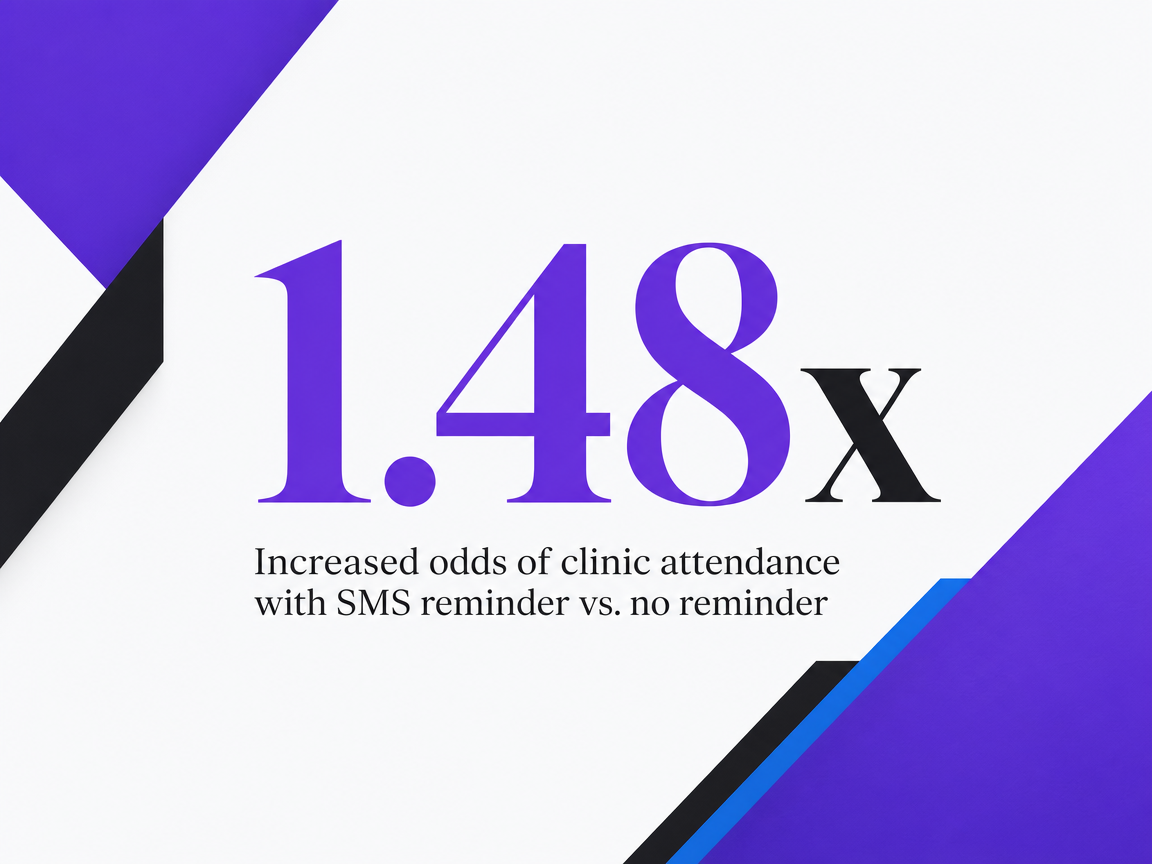 Increased odds of clinic attendance with SMS reminder vs. no reminder
Increased odds of clinic attendance with SMS reminder vs. no reminder
Frequently Asked Questions
References
- 1.How Effective Are Short Message Service Reminders at Increasing Clinic Attendance? A Meta-Analysis and Systematic Review.
- 2.Priorities to Accelerate Workflow Automation in Health Care.
- 3.Identifying Opportunities for Workflow Automation in Health Care.
- 4.Sales automation: The key to boosting revenue and reducing costs.
- 5.Differences in Mode Preferences, Response Rates, and Mode Effect for a Practice-Based Patient Experience Survey.
- 6.Appointment reminder systems are effective but not optimal.
- 7.An unconstrained future: How generative AI could reshape B2B sales.
- 8.Marketing Automation Platforms: Minimum Requirements.
- 9.Lead Nurturing Competencies.
- 10.Using text message reminders in health care services: A narrative literature review.