
Key Takeaways
- HubSpot Marketing Hub suits teams whose main gap is orchestration, unifying CRM, forms, and lifecycle stages so lean marketers avoid middleware and reconciliation work between sales and marketing.
- Customer.io fits teams with product usage or behavioral events, recomputing segments from event streams so marketers stop maintaining static lists and can react to real buyer signals.
- Vectoron addresses the content and channel execution gap upstream of email flows, using approval-gated AI strategists to produce stage-relevant assets that other nurture tools assume already exist.
- 6sense scores accounts using intent and technographic signals, helping teams above roughly $20M ARR concentrate sales effort on the highest-propensity 15% of pipeline rather than treating MQLs equally.
- Litmus operates as a deliverability and rendering layer beneath any nurture platform, catching inbox placement and engagement drift that open-rate dashboards obscure post Apple Mail Privacy Protection 5.
- Outreach closes the marketing-to-sales handoff by enforcing multi-channel cadences at the rep level, preserving nurture investment when the failure point is inconsistent SDR or AE follow-up.
The Real Bottleneck Isn't the Drip Builder
Forrester's nurture benchmark found that disciplined nurture programs generate 50% more sales-ready leads at 33% lower cost per lead than programs without one 1. This assumes segmentation reflecting actual buying stages, content mapped to those stages, and a data model clean enough to trigger the right message at the right moment. Software is the delivery mechanism, not the source of the lift.
For a marketing VP running a team of two to eight, the drip builder is rarely the constraint. The real bottleneck is the operational load behind it: producing enough stage-relevant content, maintaining accurate segmentation lists as the Ideal Customer Profile (ICP) shifts, interpreting behavioral signals to reroute leads, and finding time to test and optimize underperforming flows.
The right selection question is not which platform has the cleanest visual workflow editor. It is which platform absorbs the most of that ongoing execution work per marketer without compromising the team's creative judgment. The six categories that follow are grouped by the specific execution burden each is designed to remove.
How Lean Teams Should Evaluate Nurture Platforms
Forrester's competency work highlights that the differentiator between strong and weak nurture programs is the team's capacity for data evaluation and ongoing optimization, not tooling depth 2. This reframes the evaluation. A shortlist based on feature parity will look similar across vendors, but one built around execution burden will not.
Three criteria are more effective than a feature checklist:
- How much of the segmentation and content mapping work does the platform automate versus requiring manual effort from the marketer? The Demand Gen Report benchmark found that leaders differentiate themselves through multiple, coordinated campaigns across touches, which necessitates either more headcount or greater automation of mechanical steps 3.
- How does the platform measure performance beyond vanity metrics like open rates?
- What is the ramp-up cost in weeks, not just license fees?
AI capability is now integral to the first criterion. LinkedIn's 2026 B2B research indicates that 95% of B2B marketers use AI weekly, with 65% using it daily 7. This level of adoption makes AI-assisted drafting, subject-line generation, and segmentation suggestions a baseline expectation. Lean teams evaluating platforms in 2026 should view the absence of AI-assisted execution as a red flag.
The B2B Marketing Benchmark Report identifies lead quality and SQL generation as top marketer goals, anchoring the outcome side of the evaluation 9. A platform that increases MQLs but fails to lift the SQL rate does not meet the critical test for a budget-accountable VP.
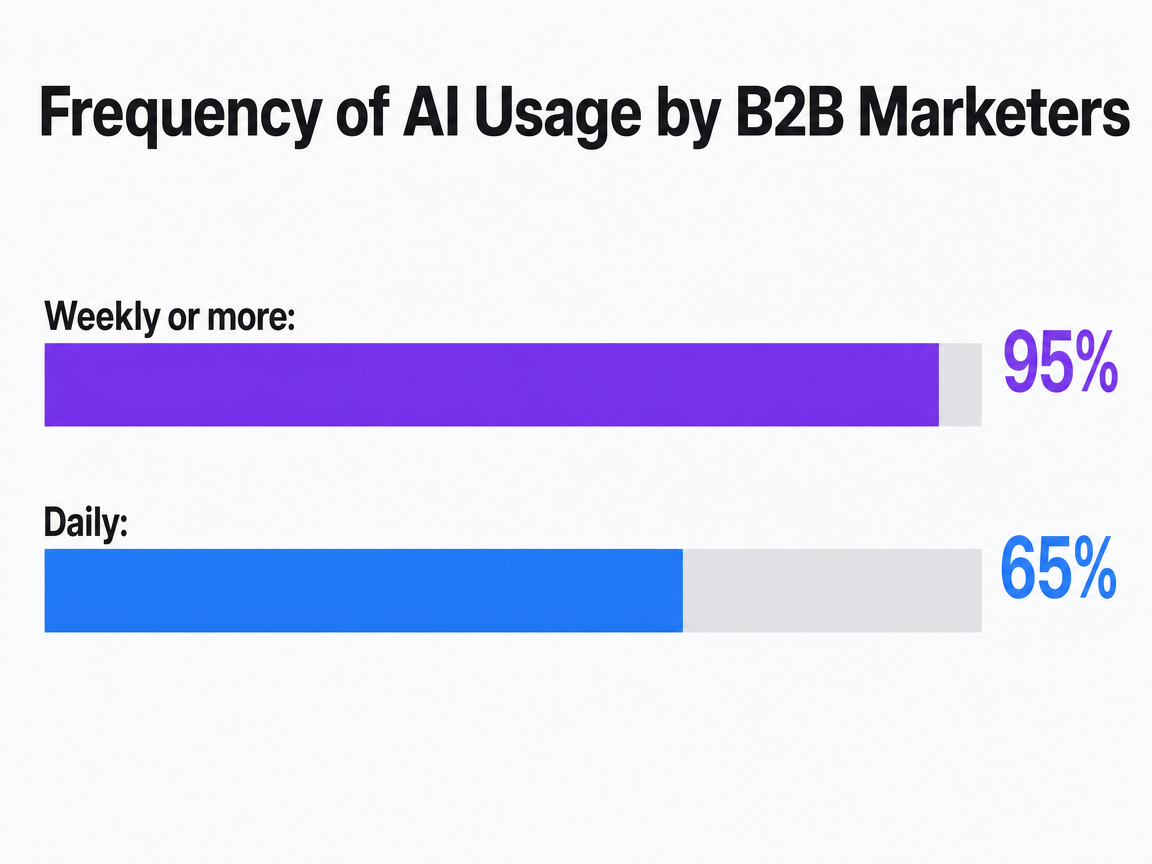 Frequency of AI Usage by B2B Marketers
Shows the percentage of B2B marketers using AI on a weekly and daily basis, indicating high adoption rates.
Trial Full-Funnel Lead Nurturing in Real Time
Experience measurable lead engagement and conversion impact within your own pipeline during a live one-week test.
Six Categories of Lead Nurturing Software
HubSpot Marketing Hub: The Orchestration Layer
HubSpot Marketing Hub excels at connecting CRM records, email flows, forms, landing pages, and lifecycle stage transitions. For a lean team, its value lies in eliminating the middleware layer often required with platforms like Marketo or Pardot. Segmentation lists, form logic, and lifecycle stage rules reside within the same object model used by the sales team, reducing reconciliation efforts for smaller marketing teams.
This orchestration is crucial because leading nurture organizations run multiple, coordinated campaigns across various touchpoints, as identified by the Demand Gen Report benchmark 3. HubSpot's workflow tool facilitates this coordination effectively. A marketer can enroll a contact in a nurture flow, pause enrollment if a sales rep books a meeting, and re-enroll if the deal stalls, all without requiring engineering support.
The platform rewards teams that already have well-defined stages. It doesn't guide VPs on which behavioral signals are most important or which content belongs in each stage. While its AI-assisted content and subject-line suggestions meet current industry standards 7, they don't replace a comprehensive content strategy. Reporting is strong for funnel throughput but less robust for multi-touch attribution across paid and organic channels.
Lean teams already using HubSpot for CRM and seeking a unified system for email, forms, and lifecycle management will achieve rapid time-to-value. Teams primarily constrained by behavioral signal detection or content production may find its capabilities limiting over time.
Customer.io: The Behavioral Signal Engine
While HubSpot organizes the funnel, Customer.io specializes in interpreting it. This platform is built around event-driven messaging, meaning a contact triggers a nurture path based on their actions, not just static list membership. For B2B teams with product-led growth, self-service trials, or usage-based signals in a data warehouse, this architecture eliminates a category of work that list-based platforms typically assign to marketers.
The practical difference is evident in segmentation maintenance. In list-based tools, someone must continuously update segment queries as the ICP evolves and new product events are instrumented. In Customer.io, segments are continuously recomputed from event streams, shifting the marketer's role from list hygiene to defining relevant events. This significantly reduces ongoing operational labor for lean teams.
However, content remains a critical factor. The AMA's 2025 summary of automated lead nurturing research noted that automation enhances the quality of sales conversations but doesn't universally boost conversion across all industries 10. A behavioral engine amplifies the effectiveness of the content and offer strategy it's fed. If a team consistently sends the same limited content into every triggered path, more precise triggering won't compensate for a thin content library.
Customer.io also assumes the team has, or can build, a clean event schema. Teams without a data engineer or analytics contractor often underestimate this setup cost. Once the infrastructure is in place, it offers the closest approximation of true stage-based nurture for a lean B2B team without requiring a dedicated marketing operations hire. It suits VPs whose primary execution gap is signal interpretation, rather than orchestration or content creation.
Vectoron: The Execution-Layer Platform
Vectoron operates differently from traditional sequence-automation tools. Instead of automating email flows, it automates the foundational work that feeds nurture programs: content production, SEO output, paid campaign adjustments, backlink acquisition, and social publishing, all managed through a single approval workflow. For lean B2B teams, it addresses the hidden cost of content and channel execution, which often causes other nurture platforms to underperform.
Its architecture employs six specialist AI strategists that analyze live business signals (qualified calls, bookings, cost per lead, pipeline movement) and present ranked recommendations via a Command Center. Nothing publishes without human sign-off. This approval-first design mitigates concerns about losing creative control and brand voice, a common barrier for VPs adopting AI-heavy tools. Each recommendation includes its underlying reasoning, allowing marketers to approve decisions, not just deliverables.
Specifically for nurture, Vectoron provides the stage-relevant content that list-based and event-driven tools assume already exists. Forrester's competency work emphasizes that the differentiator between strong and weak programs is data evaluation and ongoing optimization capacity, not just tooling depth 2. Vectoron shifts this capacity from relying on headcount to a governed automation loop.
The tradeoff is scope. Teams needing a traditional email sequence builder as their primary tool should integrate Vectoron with platforms like HubSpot or Customer.io, rather than expecting it to be a standalone replacement. Its value is realized when the constraint is producing sufficient quality content and coordinating channels around a nurture strategy, not when the flow builder itself is the primary issue. Vectoron offers a two-week trial, followed by a monthly cost of $599, comparable to the loaded cost of a single mid-level content contractor.
6sense: The Intent and Scoring Specialist
6sense addresses a distinct challenge: identifying which accounts warrant nurturing and with what intensity. It aggregates third-party intent data, anonymous website behavior, and technographic signals to provide account-level scoring that ranks buying committees by predicted stage. For lean B2B teams engaged in considered purchases with long sales cycles, this prioritization work is often overlooked due to the need for a dedicated analyst or extensive manual list-building.
The B2B Marketing Benchmark Report highlights lead quality and SQL generation as top marketer goals 9, precisely where an intent platform demonstrates its value. A nurture program that treats all MQLs identically will yield similar SQL rates to having no program at all. Conversely, a program that focuses human sales efforts on the top-scoring 15% of the pipeline, while automating the rest, can significantly increase SQL conversion without additional headcount.
The limitation is that 6sense is a scoring and identification layer, not an execution platform. It signals which accounts are becoming active but does not send emails, produce content, or run ads. Lean teams often underestimate the downstream work generated by scoring: once accounts are flagged, plays must be built and content produced to engage them effectively.
Another constraint is pricing. 6sense operates at an enterprise-tier cost, typically unsuitable for teams below a certain revenue threshold. For a lean Series A company, similar signal detection can often be achieved with lighter-weight enrichment tools and disciplined form design. For teams exceeding $20M in ARR with defined ICPs and high-value sales motions, the investment often proves worthwhile.
Litmus and the Deliverability-First Stack
Litmus doesn't build nurture flows; it ensures that existing flows reach the inbox and render correctly across various email clients. For lean teams, this might seem like a luxury until deliverability issues silently undermine the entire nurture program without clear failure signals.
The 2026 Litmus email trends report notes a significant shift in how nurture email performance is measured: marketers are moving away from open rates, which are skewed by Apple Mail Privacy Protection and bot activity, toward more reliable consent and engagement signals like clicks, replies, and conversion actions 5. This shift is crucial for lean teams because most nurture dashboards still prioritize open rates. A program can show increasing open rates while click and reply engagement quietly declines, with the team remaining unaware until pipeline generation slows.
Litmus addresses two related problems. Pre-send testing identifies rendering failures across platforms like Outlook, Gmail, and mobile clients before a nurture batch is deployed. Deliverability monitoring tracks inbox placement and sender reputation, which can degrade gradually and are nearly impossible to diagnose retrospectively without specialized instrumentation.
This category is not a nurture platform itself but a quality-assurance layer that supports any nurture platform a team uses. For teams sending thousands of nurture emails monthly, or running programs where sales confidence in marketing-sourced leads depends on email arrival, treating deliverability as a distinct competency—rather than just a setting within HubSpot or Customer.io—yields measurable benefits. Lean teams with lower send volumes can defer this layer until justified by increased volume.
Outreach: The Multi-Channel Sequencing Tool
Outreach bridges the gap between marketing nurture and sales engagement. It sequences email, phone, and LinkedIn touches at the individual sales rep level, making it a primary tool for outbound-focused B2B teams. For lean marketing organizations, its relevance to lead nurturing is specific but impactful: it manages the critical handoff from marketing-qualified interest to active sales pursuit, a point where significant nurture value often leaks.
A common failure occurs when marketing nurtures a lead to MQL status, hands it to sales, and the rep either follows up inconsistently or drops it. Outreach resolves this inconsistency by templating the sequence a rep follows post-handoff, enforcing cadence, and logging every touch back to the CRM. This preserves the marketing program's investment in generating the MQL, preventing value dissipation in the final stage.
The Demand Gen Report benchmark identified coordinated, multi-touch campaigns as a hallmark of strong nurture organizations 3. Outreach is highly effective at incorporating phone and LinkedIn touches that pure email nurture platforms cannot execute. Twilio's automation guidance is applicable here: start with one or two well-instrumented sequences and monitor them closely before launching a full outbound library 6.
The tradeoff is that Outreach is priced and designed as a sales tool. A marketing VP who purchases it without alignment from SDR or AE teams will not see nurture lift, as its value depends on rep adoption and manager enforcement. It is ideal for teams whose nurture problem is primarily a handoff issue, but not for those facing upstream challenges in content or segmentation.
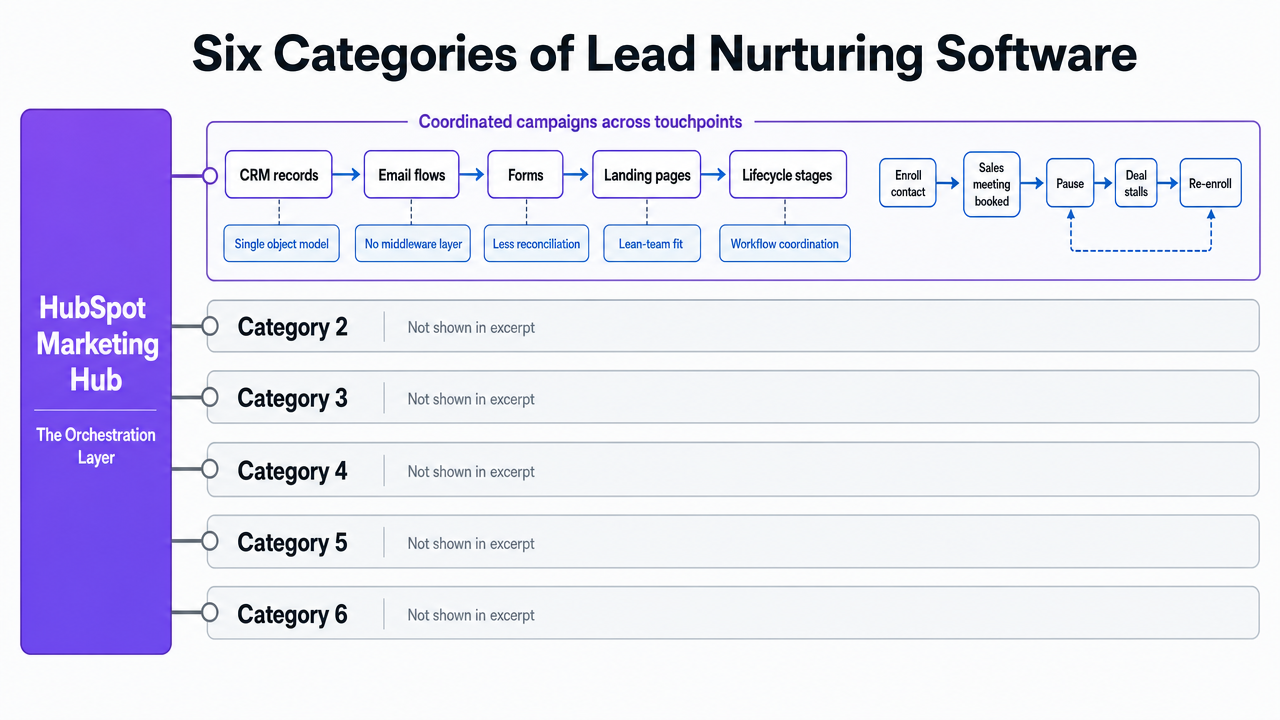 Visualize the six software categories and the specific execution gap each addresses, directly mirroring the section's comparison structure
Where Automation Doesn't Rescue Weak Programs
The American Marketing Association's 2025 summary of academic research on automated lead nurturing offers a crucial caveat: automation enhances lead interactions and improves the quality of sales conversations, but it does not guarantee higher conversion rates across all industries 10. This means automation amplifies the underlying program logic, rather than compensating for its weaknesses.
Three patterns indicate where a nurture platform will underperform its demo:
- Thin content depth: a team with only two case studies and one white paper cannot effectively populate a stage-based nurture matrix, regardless of trigger sophistication.
- Unclear stage definitions: if marketing and sales disagree on what constitutes a sales-ready lead, no scoring model will automatically resolve this.
- Measurement drift: programs tracking only sends and opens, without monitoring downstream SQL rates, will optimize for volume instead of pipeline quality.
Software purchases alone cannot fix these upstream issues. A lean team should audit its content coverage, stage definitions, and measurement infrastructure before committing to a license, not afterward.
See How Leading Teams Automate Lead Nurturing Without Expanding Headcount
Connect with a solutions specialist to benchmark your current lead management workflow and explore AI-driven strategies proven to increase qualified pipeline for multi-channel B2B organizations.
A Decision Framework: Match the Tool to the Execution Gap
The six categories discussed address different problems. Lean teams that choose the wrong category often blame the software when the real issue was an incorrect diagnosis. A more effective approach is to first identify the specific execution gap currently hindering pipeline, then select a tool to address it.
- If the constraint is orchestration—contacts falling out of lifecycle stages or sales and marketing misalignment on handoffs—HubSpot Marketing Hub offers the most relief.
- If the constraint is signal interpretation—product usage or behavioral events exist but don't trigger appropriate messages—Customer.io is a better fit.
- If the constraint is content supply—the nurture matrix has gaps and the team can't produce enough stage-relevant assets—an execution-layer platform like Vectoron addresses this upstream shortage.
- If the constraint is prioritization—all MQLs are treated equally and sales struggles to identify high-value accounts—6sense provides the necessary scoring layer, assuming the revenue base supports enterprise pricing.
- If the constraint is deliverability or measurement drift, Litmus integrates beneath the existing stack.
- If the constraint is the last-mile handoff, where marketing-sourced leads are lost due to inconsistent sales follow-up, Outreach resolves the cadence problem.
Twilio's automation guidance applies across all six categories: begin with one or two well-instrumented workflows, monitor them closely, and expand only after the initial flows demonstrate measurable SQL lift 6.
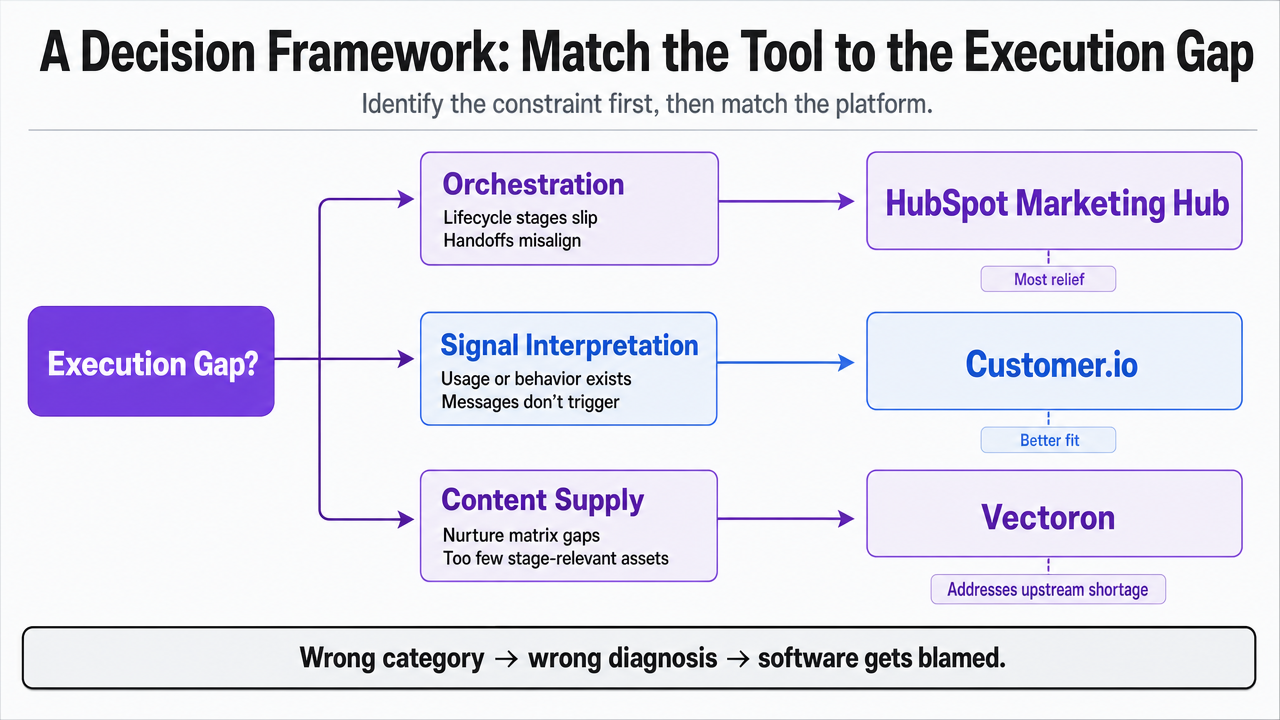 Provide a decision-flow visualization that mirrors the section's explicit if-then matching of constraint to platform, helping readers apply the framework
Total Cost of Ownership Beyond the License Fee
License fees typically account for only 20% to 40% of a nurture platform's actual cost to a lean team in its first year. The remaining costs include implementation hours, content production, integration engineering, and the ongoing operational labor that Forrester identifies as crucial for differentiating strong from weak programs 2. A platform listed at $1,500 per month can incur an additional $8,000 to $12,000 in first-quarter setup work before generating any pipeline-moving messages.
Three cost categories are consistently underestimated:
- Implementation: mapping lifecycle stages, migrating lists, wiring CRM sync, and testing enrollment logic typically requires 40 to 80 hours of marketer or contractor time.
- Content, which is the largest component: a stage-based nurture matrix for a considered B2B purchase needs eight to fifteen assets to run effectively without repetition. Peer-reviewed evidence consistently shows that campaign effectiveness correlates more with content investment than tool sophistication 11.
- Ongoing operations: segment maintenance, deliverability monitoring, and quarterly optimization cycles.
A budget-accountable VP should model Total Cost of Ownership (TCO) as license fees plus implementation, plus annualized content, plus operational hours. This total should then be compared against projected pipeline lift, rather than solely against competing license prices.
Frequently Asked Questions
References
- 1.The Lead Nurturing Framework.
- 2.Lead Nurturing Competencies.
- 3.2023 Lead Nurturing & Acceleration Benchmark Survey.
- 4.How Generative AI Can Boost Consumer Marketing.
- 5.The Top Email Marketing Trends for 2026.
- 6.Email Marketing Automation Best Practices in 2025.
- 7.6 B2B Marketing Insights for 2026: The Next Wave of AI Impact in B2B Marketing.
- 8.2026 State of AI and B2B Marketing report.
- 9.B2B Marketing Benchmark Report.
- 10.Does Automated Lead Nurturing Really Work? A New Study Challenges the Hype.
- 11.Sales and marketing automation in the post-Covid-19 scenario.