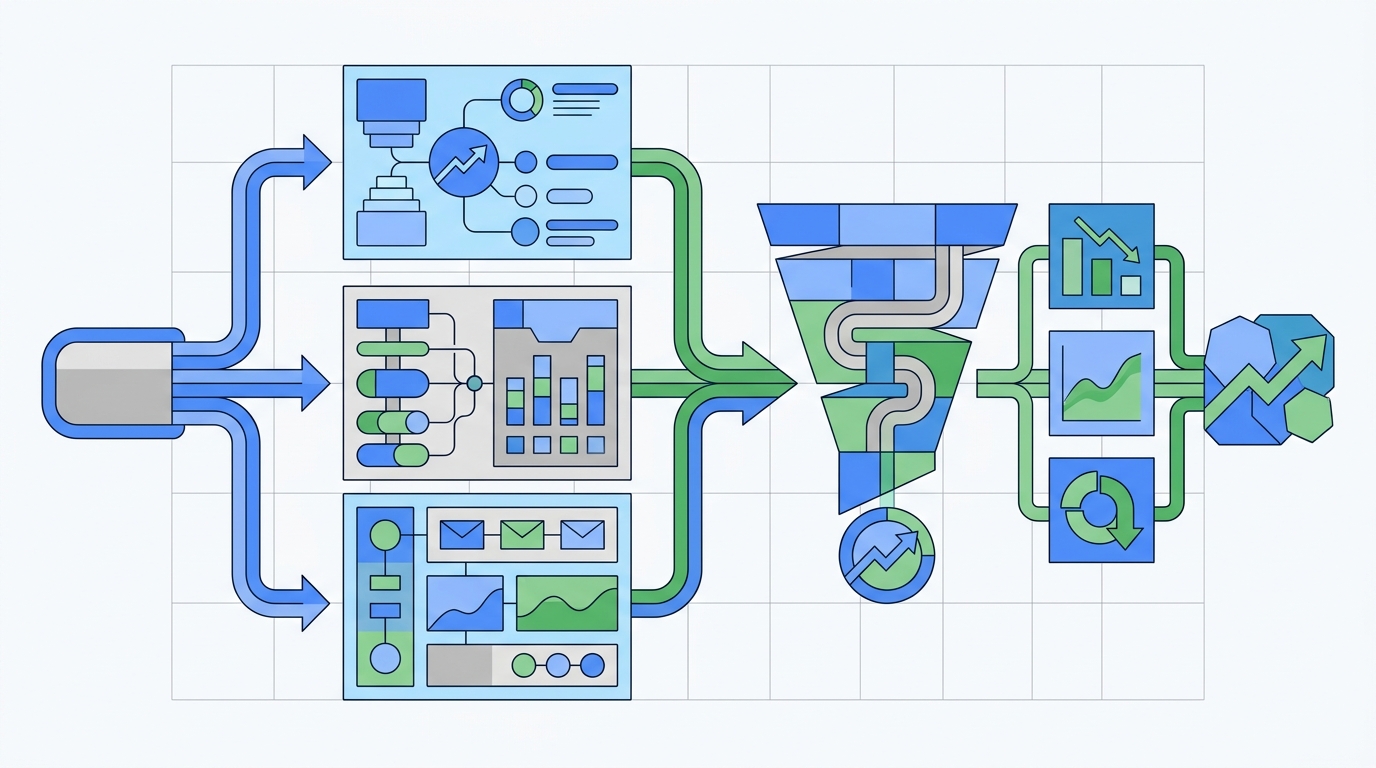
Key Takeaways
- Behavior-based lead scoring built on product and content telemetry cuts wasted sales effort by 20–40%, replacing demographic guesswork with signals that actually predict close 12.
- ABM orchestration that shares one account list across ads, email, and SDR sequencing has dropped CAC by 60% and compressed sales cycles by roughly 50% 19.
- Lifecycle nurture sequences anchored in behavioral segmentation rather than fixed drip calendars cut overhead 12.2%, lift sales productivity 14.5%, and shorten cycles 25% 8.
- AI personalization at the page and email level reaches its 40% ceiling only when a unified identity layer and tagged content library feed the variant logic 812.
- Automated content partnership outreach hit a 99% CAC cut in one cybersecurity case at under $200/mo versus $15,000/mo, but requires a defensible content library and ICP filter 4.
- Sales-cycle compression workflows — pricing-page revisit triggers, PQL handoffs, stalled-deal re-engagement — lower fully loaded cost per closed-won without adding SDR headcount 8.
- PLG expansion plays fired on validated product events move accounts up the LTV curve without re-paying acquisition cost, improving LTV:CAC even when headline CAC stays flat 7.
- Conversion-rate automation on forms — progressive profiling, enrichment APIs, and shorter field counts — has lifted demand-gen conversion 40% against flat media spend 1.
- An account-level execution layer collapses coordination across the prior eight workflows, preserving the 12.2% overhead drop and 14.5% productivity lift that stitched stacks erode 8.
The CAC Math Has Changed: Why Nine Specific Workflows Matter More Than Tool Count
Customer acquisition cost has climbed roughly 60% across the past five years, and the bottom-quartile B2B SaaS operator now spends $2.82 to bring in a single dollar of new ARR 10. The 2026 average B2B SaaS CAC sits near $1,200, with enterprise motions stretching well above that ceiling 3. Those numbers reframe the conversation. The growth director who hits payback targets next year is not the one with the longest martech stack — it is the one running a small set of workflows that compound across the funnel.
Paid channel inflation explains part of the pressure. Indexed against 2019, SaaS-relevant Google Ads CPC sits at 264 and LinkedIn ad cost at 189 8. Each new dollar buys less attention than the last. Automation is no longer a productivity story; it is the only way to hold CAC steady when the underlying media gets more expensive every quarter.
The nine examples that follow are graded on documented CAC impact, the funnel stage they target, and how cleanly they integrate with the workflows around them. Each one earns its place through a specific mechanic — a behavioral signal, a triggered sequence, a scoring threshold — rather than through generic claims about efficiency. The point is not to deploy all nine at once. The point is to know which two or three move the LTV:CAC ratio fastest given the program already in flight 7.
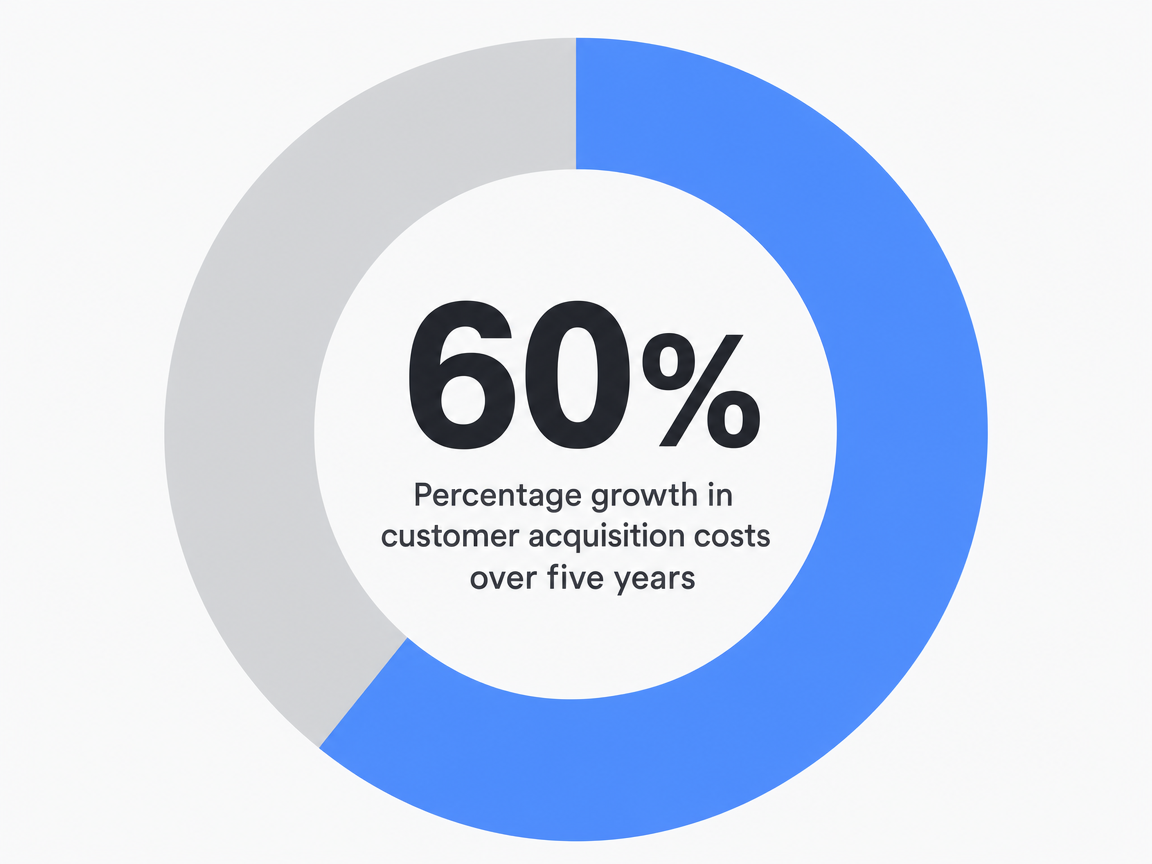 Percentage growth in customer acquisition costs over five years: 60%
Account-Level Execution Layers That Replace Stitched Coordination
Running the prior eight automations through eight separate point tools recreates the agency overhead each one was meant to remove. Lead scoring sits in the MAP. ABM orchestration runs through a separate intent platform. Personalization fires from a CDP layer. Partnership outreach lives in a workflow tool no one on the marketing team owns. Each handoff between systems is a place where data drift, attribution gaps, and reconciliation work consume the savings the automation was supposed to produce.
The execution-layer pattern collapses that coordination by running strategy, content production, and channel execution against a single account-level plan rather than a stack of isolated triggers. The economic argument is direct. Marketing automation already drops overhead by 12.2% and lifts sales productivity 14.5% when the workflows run cleanly 8. Those gains evaporate when half the marketing team's time goes to syncing audiences, debugging webhook failures, and reconciling lead status fields across platforms.
Two operational tests separate a real execution layer from a renamed point tool. The first is whether the same account list drives ad targeting, nurture branching, and SDR sequencing without manual reconciliation. The second is whether content output — articles, landing pages, email variants, ad copy — produces against the same ICP brief that defines the scoring model and the ABM tier list. When both tests pass, the nine automations behave as one program rather than nine pipelines, and the documented CAC reductions from each individual tactic stop competing for the same buyer touch.
Where the Documented Savings Actually Land: Stitched Stack vs Execution Layer
The table below maps each of the nine automations to the documented CAC lever it produces, then shows where that lever lands when the workflow runs through stitched point tools versus a single account-level execution layer. The dollar figures are restricted to the two anchored in the source map: the $1,200 average B2B SaaS CAC benchmark 3 and the $200-versus-$15,000 monthly partnership comparison from the cybersecurity outlier case 4.
| Function | Documented CAC Lever | Stitched Stack Outcome | Execution Layer Outcome |
|---|---|---|---|
| Lead scoring | 20–40% wasted effort cut 12 | Lands at the 20% floor on incomplete CRM data | Lands near the 40% ceiling with unified events |
| ABM orchestration | 60% CAC reduction 1; 42% in MarTech case 14 | Drift across ad, MAP, and SDR lists | One account list drives all three channels |
| Lifecycle nurture | 12.2% overhead drop, 25% cycle compression 8 | Manual list reconciliation erodes gains | Segmentation tied to scoring threshold |
| Content partnerships | <$200/mo vs $15,000/mo 4 | Outreach tool isolated from content engine | Output produced against the same ICP brief |
| Benchmark anchor | $1,200 average CAC 3 | Held flat by tool sprawl | Compounds downward across funnel |
Read the table as a placement question rather than a vendor comparison. The documented savings exist in either configuration; the stitched stack just spends them on integration work before they reach the CAC line.
What Not to Automate Yet: The Integration Tax and the ROI Gap
McKinsey's recent work on martech maturity surfaced an uncomfortable finding for any director planning a nine-workflow rollout: roughly half of surveyed marketing leaders cite stack complexity as the primary barrier to value, and none could articulate clear ROI on their existing investment beyond operational metrics 6. That gap is the integration tax made visible. Every additional automation layered onto a stack without unified data or a measurement loop adds coordination work that consumes the savings the tactic was supposed to produce.
Three workflows from this list should not move first. AI personalization without a resolved identity layer fires variants on incomplete profiles and lands at the 20% floor of the documented band rather than the 40% ceiling 12. Automated partnership outreach launched before a defensible content library exists accelerates volume into channels that do not convert. PLG expansion triggers built on engagement scores rather than validated closed-won events burn the signal they were meant to capture.
The decision rule is narrow. Automate only the workflow whose trigger data is already clean and whose outcome metric — SQL conversion, cycle days, expansion revenue — is already tracked end to end. Everything else waits until the measurement loop exists, or it joins the ROI gap McKinsey already documented.
Reduce SaaS CAC With Automated Marketing Execution
Experience measurable CAC reduction by automating real campaigns and publishing content during your 7-day free trial.
Behavior-Based Lead Scoring That Replaces Demographic Guesswork
Demographic scoring — title, company size, industry — was already weak when MQL volume was the metric that mattered. With CAC payback under direct CFO scrutiny, it has become a liability. A peer-reviewed B2B lead scoring model published in 2025 demonstrated that machine-learning prioritization based on behavioral signals materially improved which leads converted, redirecting sales effort away from the long tail that never closes 11. The mechanic is straightforward: the model weights observed actions over self-reported attributes, then routes only the leads above a threshold to a human SDR.
The signals that matter for SaaS sit in product and content telemetry, not in form fills. Pricing page revisits within a 14-day window, integration documentation views, changelog reads, and depth-of-scroll on technical comparison content carry far more predictive weight than industry dropdowns. Lead scoring built on these inputs prioritizes promising leads automatically and shortens the sales cycle by removing handoffs on accounts that are not ready 2.
The CAC math is downstream of that filtering. AI-assisted scoring and routing has been documented to cut wasted sales effort by 20% to 40%, which is the band most growth directors should plan against rather than the headline figures from outlier case studies 12. The 40% ceiling appears in programs with clean event tracking, a defined product-qualified threshold, and a feedback loop from closed-won data back into the model. The 20% floor is what teams hit when they bolt a scoring tool onto incomplete CRM data and skip the retraining cadence. Build the event schema first; the score is only as honest as the inputs feeding it.
ABM Orchestration Across Ads, Email, and Sales Sequencing
Account-based motions stop being a slide deck the moment ads, email, and SDR sequencing run off the same target list and the same intent signals. A documented ABM program targeting roughly 500 accounts produced an 8x conversion lift over the prior demand-gen baseline and dropped CAC by 60%, because spend stopped chasing the long tail and concentrated on accounts already showing buying behavior 1. The orchestration is what unlocks the number — display impressions warm the buying committee, triggered emails fire when a named account hits a pricing or integrations page, and SDR cadences activate only after a multi-touch threshold is crossed.
A separate MarTech SaaS case puts a more conservative band on the same pattern: 42% CAC reduction paired with a 28% lift in average contract value 14. The ACV movement matters more than the CAC line for payback math. When the same automation that filters out unfit accounts also routes sales effort to higher-tier ICPs, the LTV side of the ratio moves in the right direction at the same time the cost side compresses.
Cycle time is the third lever. ABM has been documented to cut sales cycles by roughly 50%, with 87% of B2B marketers reporting higher ROI than from traditional demand programs 9. Faster cycles mean fewer touches per closed-won, which is where the CAC savings actually accrue.
Operationally, the orchestration only works when three systems share one account list: the ad platform audience, the MAP nurture branch, and the SDR sequencer. Mismatched lists across those three is the failure mode that turns ABM back into expensive demand gen. Build the account list once, sync it on a fixed cadence, and tie sequence triggers to engagement at the account level rather than the lead level.
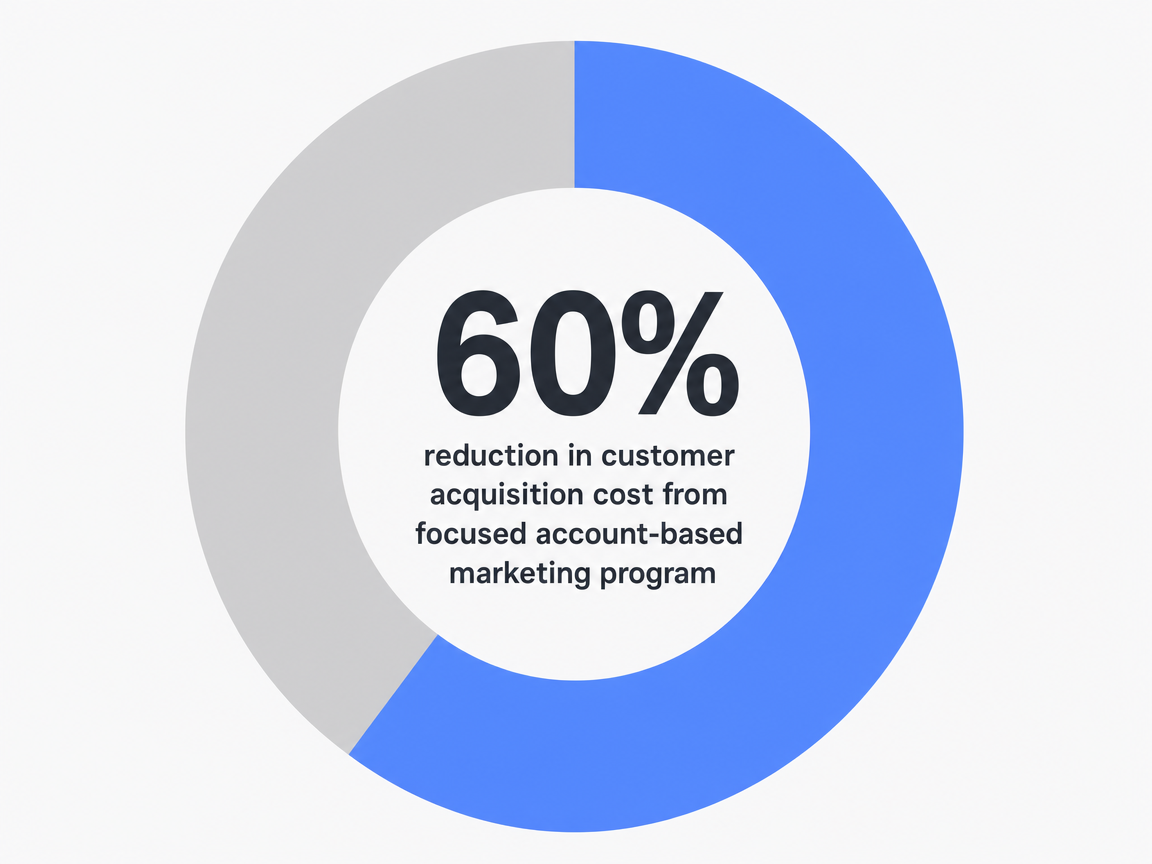 reduction in customer acquisition cost from focused account-based marketing program: 60%
Lifecycle Nurture Sequences Built on Segmentation, Not Drip Calendars
The default nurture program at most SaaS companies is a fixed seven-email cadence triggered off form submission. It runs the same payload to a VP of Engineering at a 2,000-seat enterprise and a solo founder evaluating the free tier. That uniformity is what drives unsubscribe rates up and pipeline velocity down. Lifecycle automation built on segmentation does the opposite — it treats the trigger as a behavioral state rather than a calendar position, and it pulls the next message from a content library indexed against that state.
The economic case sits in three documented numbers from the same automation playbook. Marketing overhead drops by 12.2% when nurture and segmentation move off manual list management. Sales productivity climbs 14.5% because reps inherit warmer hand-offs. The sales cycle compresses by roughly 25% as content meets the buyer at the stage they are actually in 8. Those numbers compound. A 25% shorter cycle multiplied by a 14.5% productivity lift means the same SDR seat closes meaningfully more pipeline at lower cost per deal.
A documented automation case study built on segmentation and scoring scaled demand output without a proportional headcount increase, with the gains showing up in lead quality and downstream revenue rather than in raw send volume 13. That distinction matters. Programs that measure nurture by open rate keep optimizing the wrong metric; programs that measure it by SQL conversion rate per segment learn which content moves which buyer.
The build order is stage definition first, segment definition second, content mapping third. Skip the first two and the automation becomes a faster drip calendar with the same conversion economics it had before.
AI Personalization at the Page and Email Level
Generic personalization tokens — first name in the subject line, company name in the headline — stopped moving conversion rates years ago. The personalization that actually compresses CAC is page-level and message-level: the pricing page that reorders feature blocks based on the visitor's prior content path, the email whose primary CTA shifts depending on whether the recipient has viewed integration docs in the last 72 hours, the in-product banner that surfaces a security-focused case study only to accounts whose first three sessions touched compliance content.
The documented band for this work is a 20% to 40% reduction in wasted sales effort and acquisition spend, depending on how clean the underlying data is and how tightly the personalization rules tie to deal-stage outcomes 12. The same range appears in broader automation tactic reviews, where AI-driven personalization is documented to cut CAC by 20% to 40% when paired with adequate event tracking 8. Programs that hit the upper end share three traits: a unified identity layer across web and email, a content library tagged against ICP segments rather than topic clusters, and a feedback signal from closed-won deals back into the model.
The 20% floor is what teams hit when personalization rules are bolted onto a CMS without consolidated data — the variants fire, but they fire on incomplete profiles. Build the identity resolution before the variant logic; otherwise the lift never compounds.
See How Top SaaS Teams Automate Marketing to Cut CAC by 30%
Get a tailored walkthrough of automation tactics proven to lower customer acquisition costs and drive scalable growth for SaaS and agency teams managing multiple channels.
Automated Content Partnership Outreach: The Outlier Case and Its Conditions
One documented case sets the ceiling for what content automation can do to CAC, and growth directors should understand both the number and the conditions before they bring it to a board meeting. A cybersecurity SaaS used automated partnership outreach to cut CAC by 99%, running 25 to 30 active content partnerships per month at under $200 in tooling cost versus a comparable manual program at roughly $15,000 per month, with output exceeding 400 articles per month 4. That is the outlier figure. It belongs in the conversation as a proof of what is mechanically possible, not as a forecast for the median program.
The mechanic underneath the result is more useful than the headline. Automated outreach systems crawl target publications, extract editorial contact data, draft personalized pitches against each publication's content gaps, and route responses into a sequencing layer — all without an SDR loop. The cost compression comes from removing the human hours, not from any single algorithmic breakthrough. Partner channel motions in adjacent SaaS programs have separately documented CAC reductions of 60% while sourcing 40% of new customers, which is the more defensible band for teams without a deep content engine already running 1.
Three conditions separate the 99% case from a stalled pilot. The program needs a defensible content asset library worth syndicating, a clean ICP filter applied to publication selection, and a measurement loop that ties partnership-sourced traffic to closed-won revenue. Without those, automation accelerates outreach volume into channels that do not convert. Run a four-week test against ten target publications before scaling the workflow horizontally.
Sales-Cycle Compression Workflows That Move SQLs Without More Reps
The fastest way to lower CAC is rarely a cheaper channel — it is a shorter cycle. When the same SDR seat closes the same deal in 45 days instead of 60, the fully loaded cost per closed-won drops without any change to media spend or headcount. Compression workflows are the automation patterns that produce that delta: meeting-booking logic that fires the moment a lead crosses the product-qualified threshold, sequence branches that escalate based on intent decay, and automated handoff packets that arrive in the rep's inbox already scored, segmented, and stage-tagged.
The documented numbers anchor the case. Marketing automation applied to handoff and follow-up has been shown to compress sales cycles by 25% while lifting sales productivity 14.5% 8. Layered with account-based sequencing, the cycle compression reaches roughly 50% against traditional demand baselines 9. Those are not additive — the ABM figure already assumes the underlying automation is in place — but either ceiling represents real CAC relief without an SDR hire.
Three triggers carry most of the weight. A pricing-page revisit inside an open opportunity should auto-route a meeting link to the AE. A product-qualified signal — typically a defined action depth inside a free trial — should bypass the standard nurture branch entirely and book a call within hours. A stalled-deal trigger, fired when no engagement appears for 14 days, should swap the rep cadence for a content re-engagement sequence rather than burning another manual touch. Build the triggers off events the CRM can verify; cycle compression evaporates when the automation acts on stale or duplicated data.
PLG-Triggered Expansion Plays From Product Signals
Self-serve and product-led motions give growth teams a signal layer that demand-gen programs cannot replicate: actual usage. The automation pattern that turns that signal into CAC relief is narrow — fire an expansion or upgrade play only when a defined product event crosses a threshold tied to closed-won behavior in the historical data. Seat count climbing past five inside a single workspace, a third API key generated, an admin invite to a billing role, or repeated use of a feature gated to the next tier all qualify. Generic engagement scores do not.
The economic logic is that expansion CAC is a fraction of new-logo CAC. Stripe's SaaS guidance puts B2B acquisition costs in a $300 to $5,000 range depending on motion, with enterprise tolerable only when LTV justifies the spend 7. Triggered expansion plays move accounts up the LTV curve without re-paying the acquisition tax, which is why the LTV:CAC ratio improves even when the headline CAC line stays flat.
Two operating rules keep the workflow honest. The trigger event must be validated against closed-won expansion data before the automation goes live, and the message must route through the account owner rather than a generic upgrade email. Otherwise the play burns the signal it was built on.
Conversion-Rate Automation on Landing Assets and Forms
Form length and field count remain the cheapest CAC lever most SaaS programs ignore. Reducing required fields, replacing dropdowns with progressive profiling, and stripping the form to email plus a single qualifying field has been documented to lift conversion rates by 40% on demand-gen pages 1. That lift compounds against every dollar already spent driving traffic to the asset — the media cost stays flat while the denominator on cost-per-lead falls.
The automation layer is what makes the lift sticky. Dynamic form logic pulls firmographic data from enrichment APIs after the email is captured, so the visitor sees three fields and the CRM still receives twelve. Behavioral triggers fire follow-up content based on which page the form was submitted from, not from a single global thank-you sequence. A pricing-page form submission should never route into the same nurture branch as a blog footer subscribe.
Two operational rules carry the weight. Test one variable at a time — field count, headline, or social proof block — because stacked changes obscure which lever moved the number. Tie the conversion event to downstream SQL rate, not to form-fill volume, since shorter forms can inflate the top of the funnel without improving pipeline quality.
Frequently Asked Questions
References
- 1.Proven Strategies to Lower B2B SaaS Customer Acquisition Costs ....
- 2.4 Smart ways to Reduce CAC for your B2B SaaS - SeriesX Marketing.
- 3.2026 SaaS CAC Benchmarks: Complete B2B Industry Guide.
- 4.SaaS Content Partnership Automation: 99% CAC Reduction.
- 5.2025 B2B SaaS Benchmarks Report - Maxio.
- 6.McKinsey: CMOs and CFOs must unite to solve marketing tech ROI ....
- 7.CAC SaaS: A guide for businesses | Stripe.
- 8.10 Ways To Lower Customer Acquisition Costs - Baremetrics.
- 9.SaaS ABM Strategy: Account-Based Marketing for B2B Growth.
- 10.Customer Acquisition Cost Benchmarks — 44 Statistics Every ....
- 11.The relevance of lead prioritization: a B2B lead scoring model based ....
- 12.Lower SaaS acquisition costs: 5 proven strategies.
- 13.Marketing Automation Case Study: ROI in Action | Televerde.
- 14.10 Account-Based Marketing Examples for SaaS Success - 42DM.