
Key Takeaways
- Platform selection should start with the operating model a marketing team wants to run, not a feature checklist, since Forrester's 2024 evaluation reorganized around 23 outcome-focused criteria 15.
- Four operating-model tests separate platforms: data foundation, decisioning depth, multi-channel orchestration, and revenue attribution that connects campaigns to closed-won pipeline a CFO can defend.
- A fifth test—execution depth—now matters most, measuring whether the platform produces content, paid variants, and landing pages under approval rather than just routing work 6.
- Weight the five tests against the constraint currently limiting pipeline: prioritize execution depth for creative throughput, attribution for reporting credibility, and orchestration for multi-location or multi-brand portfolios.
The selection question has changed
A decade of marketing automation platform reviews trained VPs to ask the wrong opening question: "Which platform has the best features?" This approach often led to extensive scorecards and vendor bake-offs, resulting in tech stacks that appeared robust on paper but underperformed against pipeline targets 17. Forrester's 2024 evaluation of B2B revenue marketing platforms now assesses vendors against 23 criteria focused on journey orchestration, AI-assisted optimization, data unification, and measurement 15. These are the capabilities that drive revenue, not just those that look impressive in a demo.
This reframing is crucial because the cost of a wrong selection has increased. Platforms now integrate data infrastructure, decision-making, channel execution, and reporting. The choice of a platform dictates how a marketing team operates for three to five years, impacting strategic growth rather than just email templates for the next quarter. Forrester emphasizes that marketers need an aligned technology strategy supporting a systematic approach to growth, not a collection of tools acquired by individual teams 3.
The relevant selection question is now: "Which operating model does the marketing organization want to run, and which platform effectively supports that model?" This article outlines four operating-model tests derived from Forrester and McKinsey research, adding a fifth dimension—execution depth—that is newly critical and reshaping the category 16.
Why feature checklists stopped predicting outcomes
The 36-criteria evaluation Forrester used in 2018 was appropriate for its time, helping buyers compare email engines, scoring engines, and CRM connectors that functioned similarly 17. However, these scorecards became ineffective at predicting pipeline movement as the underlying marketing work evolved. By 2024, Forrester's revenue marketing evaluation condensed to 23 criteria, reorienting around operational capabilities like journey orchestration, AI-assisted optimization, data unification, and measurement, rather than a mere feature inventory 15.
Three key forces rendered the checklist model obsolete. First, customer journeys became hybrid. McKinsey's B2B research indicates that buyers now expect coordinated interactions across in-person, remote, and digital channels, and teams that deliver this experience report significantly better revenue performance 11. A platform strong in email automation but unable to orchestrate paid search, outbound, and call tracking on a unified contact record fails to meet these new demands, regardless of its feature count.
Second, the economics of personalization shifted. McKinsey's analysis of personalization at scale links substantial reductions in customer acquisition costs and revenue uplift to integrated data, robust decision-making, and multi-channel coordination 10. These capabilities rely on architectural design, not just a deep feature list. A platform with numerous segmentation options but a fragmented data layer will underperform compared to one with fewer options but a unified customer profile.
Third, the scope of work expected from platforms expanded. Post-COVID research on sales and marketing automation reveals a transition from task-level automation to deeper customer insight and journey-level execution 6. This strains tools originally selected for narrower functions. Forrester's stack architecture work similarly argues that marketing leaders require a cohesive technology strategy for systematic growth, rather than a collection of best-in-class tools chosen by disparate teams 3.
Feature checklists describe a platform's isolated capabilities but fail to convey its performance within a specific operating model, which is the true value a VP of Marketing seeks.
Four operating-model tests that separate platforms
Data foundation: what the platform can actually see
A platform's potential is limited by its ability to consolidate data into a usable customer profile. Forrester's minimum requirements specify that a marketing automation platform must operate on an integrated database that stores contacts and records every interaction, with native capabilities to update records and sync with sales force automation and the website 14. Platforms that fail this test often do so subtly, through duplicate contacts, missing channel events, or scoring rules based on incomplete signals, which degrade pipeline quality long before issues appear on a dashboard.
The standard for data integration has advanced. McKinsey's framework for AI-driven personalization identifies data as a foundational element, asserting that real-time engagement necessitates an architecture that combines real-time signals, journey orchestration, and integrated front-end tools 9. A platform that ingests CRM records only once a night cannot deliver the immediate "next-best-action" a buyer expects after a website visit, a paid search click, or an inbound call.
Three diagnostic questions differentiate platforms in this area:
- Does the platform unify identity across paid media, organic, email, call tracking, and CRM into a single contact record?
- Does it ingest first-party event streams in near real-time, rather than in batches?
- Can it pass enriched signals back to sales force automation and the website to ensure subsequent interactions are informed by previous ones?
Forrester's revenue marketing evaluation considers data unification a core scoring criterion, indicating its importance in vendor assessment 15.
Decisioning depth and the economics of personalization
Decision-making is where data translates into revenue. McKinsey's research on personalization quantifies its benefits: effective personalization can reduce customer acquisition costs by up to 50%, increase revenues by 5% to 15%, and boost marketing ROI by 10% to 30% 10. These gains are realized by companies that integrate customer data, analytics, decisioning engines, and coordinated multi-channel campaigns, not merely by adding merge tags to emails. McKinsey's related work on sales automation reports efficiency gains of 10% to 15% and sales uplift potential of up to 10%, provided organizations have standardized processes and centralized support, rather than bolting automation onto ad-hoc workflows 8.
These findings highlight a shared operational reality. Platforms that achieve the highest returns possess a decisioning layer capable of acting on the data foundation discussed previously. This includes dynamic segmentation, behavioral and fit-based contact scoring, rule-based routing, and journey triggers that branch based on real-time contact actions. Forrester's minimum requirements list segmentation, automated nurture workflows, scoring, and lead routing as essential capabilities, recognizing that without them, the economic benefits of personalization are unattainable 14.
The key diagnostic for VPs is not whether a platform supports decisioning, but the extent of its depth. A platform that can initiate one of three nurture tracks based on industry differs significantly from one that can adjust send time, channel, offer, and creative for a single contact based on real-time signals. McKinsey explicitly states that organizational and architectural challenges—such as talent, data, and process—often constrain personalization more than the technology itself 9. Therefore, platform selection must be coupled with an honest assessment of whether the marketing operations function can effectively utilize the system. Investing in decisioning capacity that the team cannot operate yields the same result as having none.
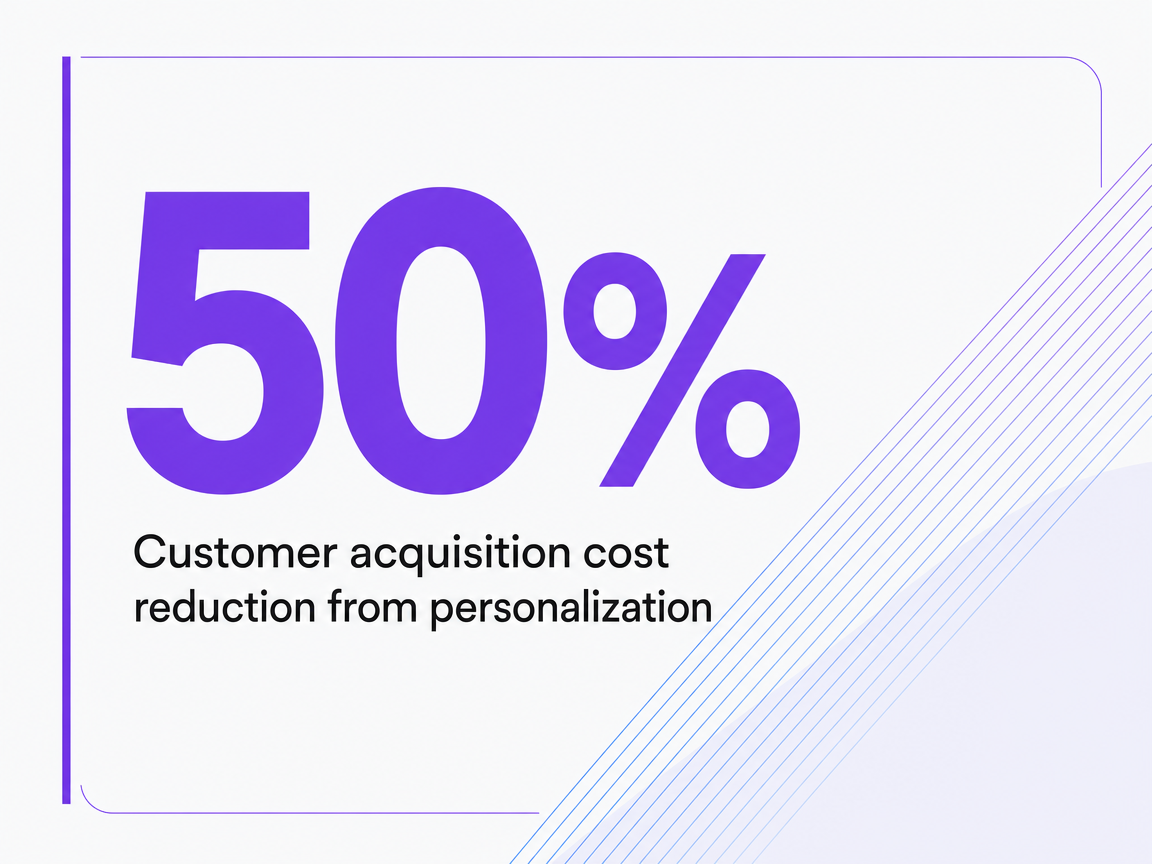 Customer acquisition cost reduction from personalization
Customer acquisition cost reduction from personalization
Multi-channel orchestration as a non-negotiable
Buyers no longer interact through a single channel. McKinsey's B2B sales research indicates that hybrid models, which coordinate interactions across in-person, remote, and digital channels, generate up to 50% more revenue than traditional approaches 11. This also shows that remote sales representatives using digital tools effectively can reach four times as many accounts as field-only counterparts. These figures apply to organizations genuinely implementing a hybrid model, not just those adding video-call options to existing field operations. For platform selection, this means cross-channel orchestration is a critical operational capability that drives these revenue increases; a platform unable to perform it forfeits this advantage.
Orchestration in this context means more than simply sending the same message across multiple channels. It involves a single decisioning layer that selects the optimal channel for the right contact at the precise moment—email for research, paid retargeting when engagement drops, an SDR task when a score crosses a threshold, or an inbound call routed with full context. Post-COVID academic work on automation similarly concludes that as automation matured, the primary challenge shifted from task automation to journey-level execution that maintains coherence across diverse digital touchpoints 6.
Forrester's 2024 revenue marketing evaluation includes journey orchestration as a key scoring axis because platforms that cannot orchestrate paid search, organic, email, outbound, and call tracking on the same contact record cannot deliver the hybrid experience buyers now expect 15. A concrete diagnostic for VPs is to trace a single contact's full journey on a shortlisted platform, including entry channel, scoring event, next-best-action across at least three channels, hand-off to sales, and return signal. Platforms capable of demonstrating this walkthrough with live data warrant deeper evaluation.
Revenue attribution and the measurement that survives a CFO review
The fourth test is where many platforms fall short when scrutinized by finance. Historically, marketing automation has measured success using metrics like MQLs, opens, and click-throughs. While useful operationally, these are not the metrics a CFO uses to approve budgets. Forrester's revenue marketing evaluation now prioritizes measurement as a core capability, focusing on pipeline contribution, influenced revenue, and account-level reporting, as these are the outputs by which the category is judged 15.
The minimum standard is clear: Forrester's requirements list expects platforms to provide reporting that links marketing activities to lead and opportunity outcomes, with sales views that ensure revenue teams see the same data as marketing 14. Practitioner guidance from ABM literature raises the bar further, advising buyers to confirm that tools
"allow you to report at the account level and track the contribution of each activity to the company's revenue goals"
before purchase 5. A platform that reports clicks but cannot connect a campaign to closed-won revenue will not withstand a CFO's review of marketing spend.
Three measurement capabilities distinguish platforms in this area:
- Multi-touch attribution that assigns credit across the entire customer journey, rather than solely to the last form fill;
- account-level reporting that aggregates contact-level activity into buying groups, essential for both multi-location organizations and B2B enterprises;
- and a closed-loop feedback mechanism from sales force automation back into the platform, ensuring that closed deals inform future scoring.
Without these, the financial justification for the platform relies on faith; with them, it is based on the same evidence used by the rest of the business to allocate capital.
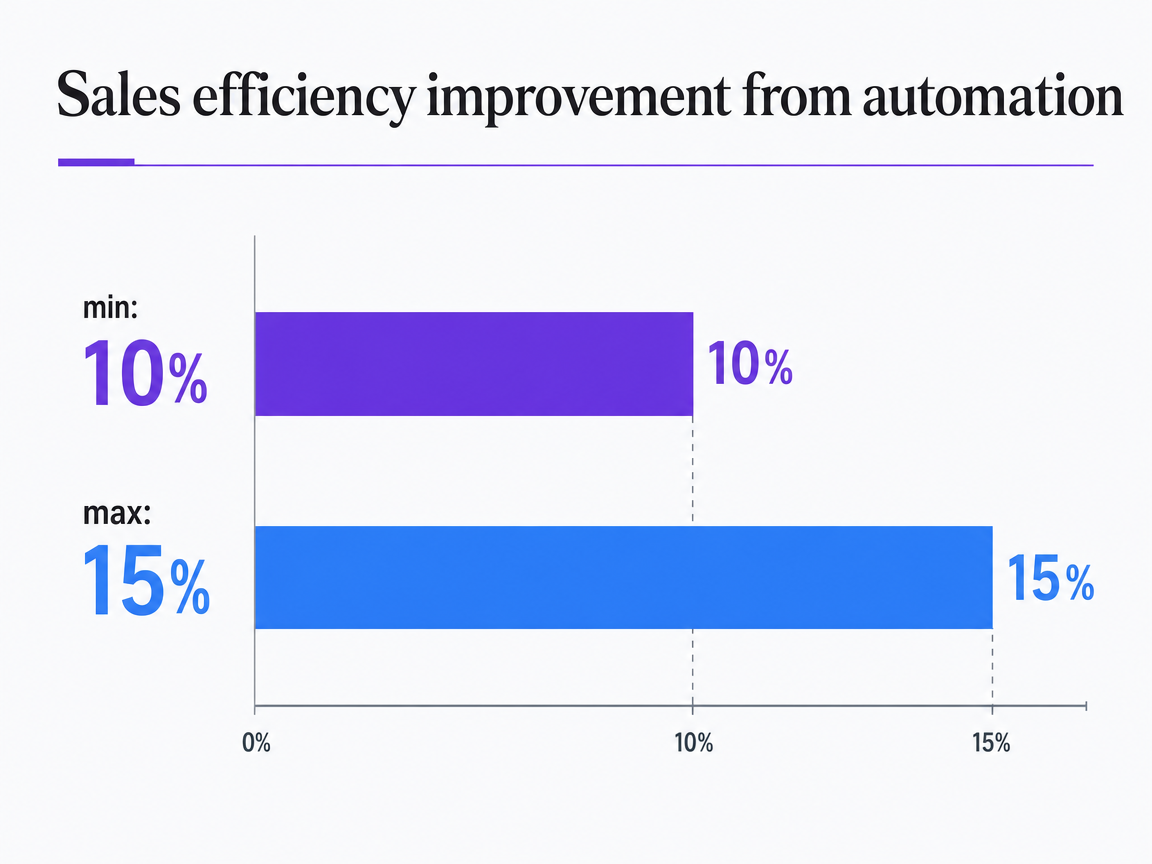 Sales efficiency improvement from automation
McKinsey reports that early adopters of sales automation see efficiency improvements of 10% to 15%.
Test Multi-Channel Automation With Live Campaigns
Experience real-time workflow automation and measure impact using your own content during a risk-free trial period.
The fifth test: how much execution the platform performs
The preceding four operating-model tests evaluate what a platform decides and routes. However, they do not measure what it actually produces. This gap is where the category is currently evolving, and it represents the most significant evaluation question for the next platform cycle.
The impetus for this shift is evident in market data. IDC estimated the AI market at $166.5 billion, with a projected compound annual growth rate of 26.9%. This growth is largely fueled by enterprise investment in automation that actively produces work, rather than merely organizing it 12. In intelligent automation contexts studied by IDC, AI-driven systems have achieved process and IT cost reductions of up to 72% in specific implementations where the platform assumes execution steps previously performed by analysts and operators 13. While these reductions are not universal, they illustrate the potential when automation moves beyond routing to actual production.
Traditional marketing automation platforms primarily route work. They trigger emails, create tasks in sales force automation, or move contacts into nurture tracks. However, the content, bid adjustments, landing page variants, outbound sequences, and call-handling scripts are typically still generated by an agency or an in-house team operating outside the platform. The fifth test assesses how much of this production the platform itself performs. Does it draft and deploy campaign content under approval? Does it generate and test paid search variants? Does it produce landing pages linked to the journeys it orchestrates? Does it analyze call recordings and adjust scoring rules without requiring a separate vendor?
Academic literature views this shift as the next stage of automation maturity. Post-COVID research on marketing automation describes its evolution from task-level triggers to deeper customer insight and journey-level execution, expanding the platform's expected scope of work 6. Complementary research on the customer journey similarly concludes that automation now nurtures and converts, not just notifies 7. McKinsey's personalization framework supports this direction by including design and distribution as core elements alongside data and decisioning, implying that content production and delivery are integral to the operating model, not merely adjacent to it 9.
For a VP, the diagnostic question is whether the platform's execution depth aligns with the team's headcount reality. A marketing organization managing ten campaigns per quarter with two writers and one paid media manager cannot achieve IDC-level cost reductions from a platform that only routes work; the production bottleneck remains. A platform that drafts, generates, tests, and deploys under human approval fundamentally alters this dynamic, shifting the binding constraint from creative throughput to approval bandwidth—a factor VPs can directly control. This dimension, absent from the 2018 Forrester Wave and emerging in the 2024 revenue marketing evaluation, will define the next selection cycle.
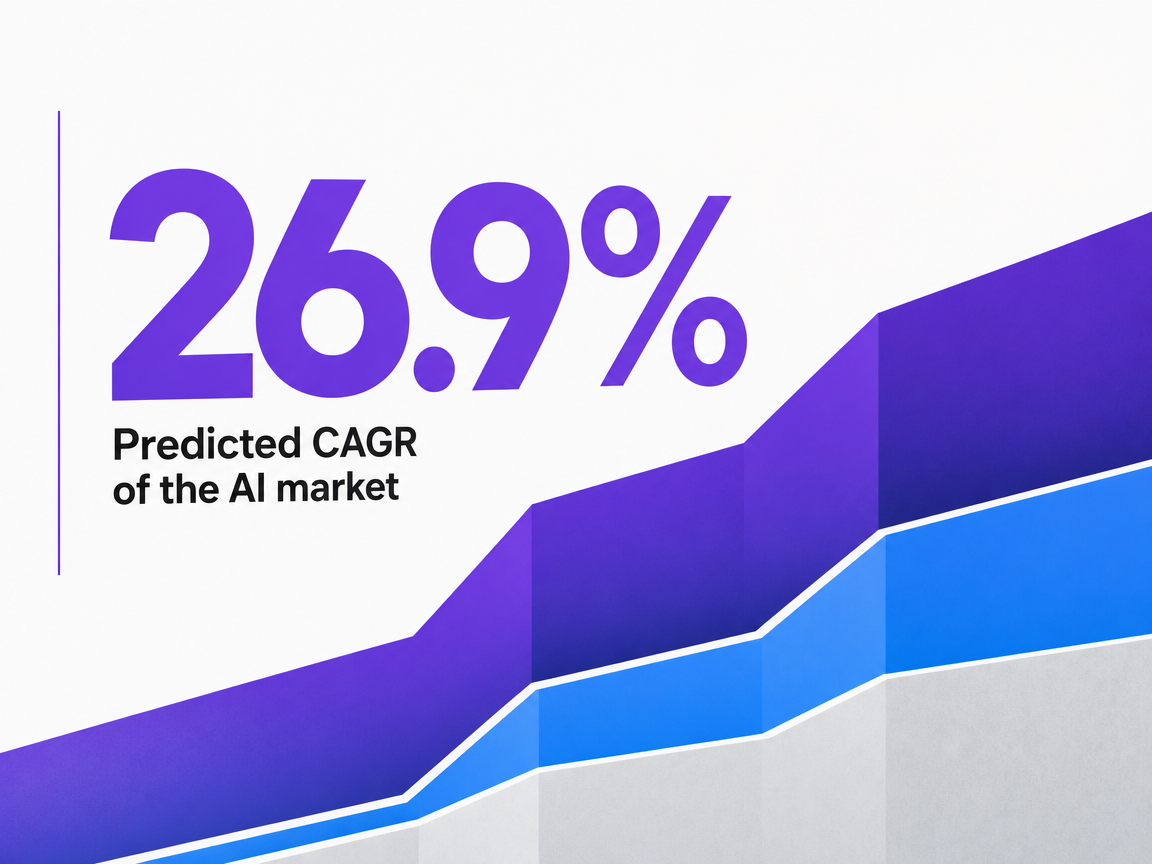 Predicted CAGR of the AI market
Predicted CAGR of the AI market
If you manage multiple locations or brands: the consolidation economics
The discussion shifts when considering multi-location or multi-brand operations, such as 40-location dental services organizations, behavioral health networks with eight brands, senior living portfolios across three states, or home services rollups acquiring new operators quarterly. In these environments, orchestration overhead is not linear; each additional location multiplies the number of campaigns, creative variants, local landing pages, call-tracking numbers, and attribution rules a platform must manage coherently.
This multiplication often causes traditional marketing automation platform deployments to fail. McKinsey's sales automation research explicitly states that documented efficiency gains of 10% to 15% and sales uplift of up to 10% are realized by organizations with standardized processes and centralized support 8. This contrasts sharply with a portfolio where each location manages its own promotions, intake scripts, and paid budgets. A multi-brand operator seeking these gains requires a platform that enforces standardization rather than merely tolerating variance.
Three operating models compete for this work, each with distinct cost structures and potential ceilings.
| Operating model | Primary cost drivers | Documented deltas |
|---|---|---|
| Traditional agency plus standalone MAP | Agency retainers per brand, MAP license, briefing and coordination overhead, separate creative production | Personalization economics capped by handoff friction; CAC reduction up to 50%, revenue lift 5–15%, marketing ROI lift 10–30% reachable only with integrated data and decisioning 10 |
| In-house team plus best-of-breed stack | Headcount across content, paid, SEO, and analytics; multiple license fees; integration engineering | Sales automation efficiency of 10–15% and sales uplift up to 10% available where processes are standardized across locations 8 |
| AI execution platform with approval workflow | Platform subscription (Vectoron lists $599/mo after a two-week trial); marketing leadership approval bandwidth | IDC-cited intelligent automation deployments report process and IT cost reductions of up to 72% in specific contexts where the platform takes over execution steps 13 |
This table is not a definitive judgment. Portfolio operators with established creative teams and unique brand identities may reasonably maintain agency relationships for high-touch work. The crucial point is that the cost structure is now a selectable variable, not a fixed input, and the platform decision determines the operational structure an organization will adopt.
See How AI-Driven Marketing Automation Accelerates Pipeline Without Adding Headcount
Request a live walkthrough of unified multi-channel execution—content, SEO, paid, and analytics—powered by specialist AI strategists and approval-first automation, purpose-built for agency and enterprise marketing teams.
Convergence or best-of-breed: reading the category honestly
Two opposing viewpoints frequently arise in buying committees. Forrester's perspective on platform convergence advocates for consolidation: disparate martech tools are merging into unified revenue marketing platforms that integrate data, orchestration, analytics, and execution 16. The resulting gains in efficiency, governance, and insight are particularly valuable for resource-constrained teams needing to achieve more with less. The 2024 Revenue Marketing Wave reinforces this by evaluating 23 criteria that previously spanned multiple distinct tools 15.
The counter-argument, though older, remains valid. Forrester's 2022 ABM technology research segments the market into platforms, data providers, customer data platforms, personalization solutions, and sales enablement tools, acknowledging that no single vendor excels in all five areas 2. Practitioner guidance similarly advises caution against large upfront platform investments before strategy and metrics are validated, recommending incremental purchases tied to proven results 5. A best-of-breed stack allows a marketing organization to select the strongest component for each function and replace individual pieces as the category evolves.
Both perspectives are valid. The choice between them is an operating-model decision, not an inherent category truth. Teams with mature integration engineering and standardized processes can successfully implement a best-of-breed approach without sacrificing personalization economics. However, teams lacking this capacity often lose potential benefits due to handoff friction, a trade-off highlighted by Forrester's stack architecture work when individual teams acquire tools without an aligned roadmap 3. Practically, convergence is gaining traction where execution and approval bandwidth are the primary constraints, while best-of-breed excels where specialized depth in a single channel yields disproportionate revenue. The platform decision should align with the specific constraint currently limiting pipeline growth.
A decision matrix VPs can bring to a buying committee
The platform selection conversation often culminates in a 30-minute review with the CRO, CFO, and IT integration lead. A robust decision matrix scores shortlisted platforms against the five tests outlined previously, weighted according to the marketing organization's actual operating model, not just the vendor's demo.
| Test | What to score | Evidence the platform must show |
|---|---|---|
| Data foundation | Identity unification across paid, organic, email, call tracking, and CRM; near-real-time event ingestion; bidirectional sync with sales force automation 14 | Live walkthrough of one contact record reflecting events from at least four channels within minutes, not overnight |
| Decisioning depth | Dynamic segmentation, behavior-plus-fit scoring, rule-based routing, journeys that branch on real-time signal 9 | A working journey that adjusts channel, timing, and offer on a single contact based on observed behavior |
| Multi-channel orchestration | Single decisioning layer choosing the next-best channel; coordinated hand-offs to sales 15 | End-to-end trace of one account across email, paid, outbound, and inbound call on the same contact record |
| Revenue attribution | Multi-touch attribution, account-level rollups, closed-loop feedback from SFA 5 | A report tying a named campaign to closed-won revenue, exportable for CFO review |
| Execution depth | What the platform produces and ships under approval — content, paid variants, landing pages, scoring updates 6 | Sample work product generated inside the platform during evaluation, not by a separate agency |
Weight these tests based on the constraint currently limiting pipeline. Teams struggling with creative throughput should prioritize execution depth; those needing reporting credibility should emphasize attribution; and portfolio operators managing 20+ locations should focus on orchestration. This matrix serves as a forcing mechanism for the committee, transforming vendor preferences into documented operating-model choices.
A crucial point for the discussion: the 2024 revenue marketing evaluation reorganized the category around the first four tests. AI execution platforms like Vectoron extend this logic into the fifth dimension, where production work and approval bandwidth become variables directly controllable by the marketing leader 15.
Frequently Asked Questions
References
- 1.Two Major Considerations for Tech-Enabling Your Account-Based Marketing.
- 2.New Tech: Account-Based Marketing, Q1 2022.
- 3.Envision The Future Of The Marketing Technology Stack.
- 4.How ABM Technology Is Evolving The Modern Marketing Landscape.
- 5.Account-Based Marketing Technology Stack, Software, Tools.
- 6.Sales and marketing automation in the post-Covid-19 scenario.
- 7.Marketing Automation: Towards Understand the Customer and Generate Sales.
- 8.Sales automation: The key to boosting revenue and reducing costs.
- 9.The next frontier of personalized marketing.
- 10.What is personalization?.
- 11.The future of B2B sales is hybrid.
- 12.Finding the GenAI Path to ROI.
- 13.IDC Requirements for Next Generation Intelligent Automation.
- 14.Marketing Automation Platforms: Minimum Requirements.
- 15.The Forrester Wave™: B2B Revenue Marketing Platforms, Q3 2024.
- 16.Converging Platforms For Greater Efficiency: The Rise Of Revenue Marketing Platforms.
- 17.The Forrester Wave™: B2B Marketing Automation Platforms, Q4 2018.
- 18.B2B Marketing Automation Platforms: A Marketer's Guide (Marketing Land Research Report).