
Key Takeaways
- The traditional pod model breaks when retainers demand schema rollouts, refresh cycles, and AI Overview optimization at volumes that outpace senior strategist capacity and hiring pipelines.
- An SEO AI agent differs from a tool by running the full loop—signal ingestion, opportunity ranking, drafting, approval, publish, and KPI feedback—under a single human supervision layer 4.
- Productivity gains of 5–15% 1only materialize when agencies rebuild delivery around the agent, with live data integration, consolidated approval gates, and formal KPI tracking 2.
- Heads of SEO should focus next on governance design, supervision ratios, and QBR measurement layers that connect agent throughput to outcome metrics rather than artifact counts.
The delivery math that broke the pod model
The traditional agency pod model, which assumed a stable ratio of senior strategists to mid-level SEOs and writers, is no longer viable. This model held when client deliverables were simple, such as a keyword audit, a few blog posts, and a monthly report. However, current retainers demand more complex tasks like topical cluster builds, schema rollouts, internal linking passes, URL refresh cycles, AI Overview optimization, and redirect maps for every developer release.
The volume of production per account has increased significantly, outpacing the growth of hiring pipelines. Agency heads of SEO are seeing senior strategists' utilization rates exceed 90%, while writer turnover frequently resets institutional knowledge. The obvious solution—hiring more pods—conflicts with margin targets and the limited availability of experienced technical SEOs in the labor market.
This context reframes the discussion around SEO AI agents. The critical question is not whether an AI can draft a meta description, but whether the delivery process can be restructured. This restructuring would allow ranked execution work to run in parallel under a single approval layer, freeing strategists to focus on priority-setting and client judgment. McKinsey's State of AI 2025 survey indicates that most organizations have not yet made this structural shift 2. Agencies that successfully implement this will redefine the industry's operational ratios.
What an SEO AI agent actually is (and what it isn't)
Agent versus tool: a structural distinction
The distinction between an AI SEO tool and an SEO AI agent is crucial for delivery models and headcount planning. A tool responds to a specific query, such as analyzing a URL, suggesting keywords, or rewriting a paragraph. The strategist remains in control, deciding inputs, interpreting outputs, and initiating actions. This approach scales linearly with the strategist's direct involvement.
In contrast, an SEO AI agent operates against a broader goal, like improving organic revenue for specific URLs or expanding topical coverage. It autonomously ingests live data, prioritizes opportunities, drafts content, routes it for approval, publishes after sign-off, and measures results. The strategist's role shifts to setting goals and reviewing the agent's queue. Forrester analysts observe that practitioners already use generative AI for tasks such as schema markup, redirect rules, robots.txt directives, and title tags 5. An agent integrates these task-level capabilities into an orchestrated sequence, maintaining memory of past actions, successes, and future strategies.
A simple test differentiates them: if a senior SEO must manually feed the system daily, it functions as a tool, not an agent.
Anatomy of the agent loop
McKinsey's framework for agentic AI describes coordinated agents that manage end-to-end workflows under human supervision, from data analysis to content activation, allowing humans to focus on strategy and creative direction 4. In SEO, this loop involves six stages, each requiring governance controls to prevent uncontrolled execution.
- Signal ingestion — the agent gathers data from Search Console, rank trackers, log files, analytics, CRM (for conversion-driving queries), and competitor activity. This forms the foundational input.
- Opportunity ranking — the agent evaluates potential actions—such as refreshing a decaying URL, building a new content cluster, fixing schema, or implementing an internal linking pass—based on their impact on business outcomes, not just traffic potential. This stage is where agents differentiate themselves from most tools.
- Drafting and on-page execution — the agent produces the necessary artifacts: content briefs, drafts, schema blocks, redirect maps, or meta updates.
- Human approval — a critical governance gate. No work is published without a strategist's review.
- Publish — approved work is deployed via the CMS or other technical channels.
- KPI feedback closes the loop. The agent monitors the impact of published work, attributes changes, and refines its ranking model for subsequent cycles.
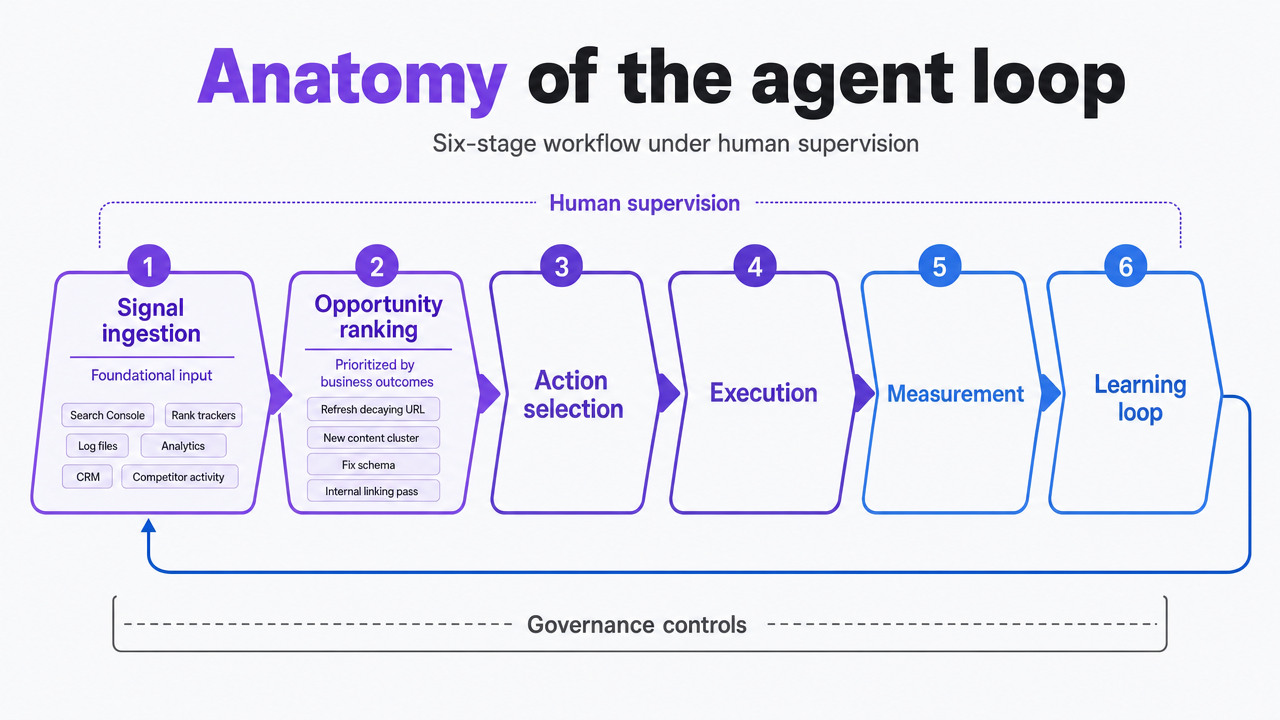 Visualize the six-stage agent loop described in this section, which is a cited process from McKinsey's agentic AI framework
Why most agencies under-realize the productivity gain
The discrepancy between AI's potential in marketing and its actual impact within agencies stems from workflow issues, not model limitations. Data from outside the SEO industry illustrates this clearly.
McKinsey's State of AI 2025 survey revealed that nearly two-thirds of organizations (approximately 66%) have not yet scaled AI enterprise-wide. Only 39% reported any measurable impact on enterprise EBIT, with most of that group seeing less than a 5% increase 2. While these figures represent broad enterprise behavior, not specific SEO agency benchmarks, the pattern holds: widespread access to capable AI models does not equate to significant financial impact.
The primary reason for this under-realization is that most agencies integrate AI into existing pod structures rather than redesigning their delivery loops around it. A typical process involves a strategist drafting a brief, pasting it into a generator, editing the output, running it through a separate optimization tool, copying findings into a deck, and then routing it through project managers to the client. In this scenario, the AI merely produces an artifact and exits, never completing a full loop. This limits productivity gains to individual tasks, preventing compounding benefits across the entire client portfolio.
A second failure mode is inadequate measurement. McKinsey's survey identified formal KPI tracking for AI solutions as a key practice correlated with value capture 2. Agencies that cannot quantify the agent's output—such as the number of drafts produced, approval rates without rework, published items, and their impact on organic sessions and assisted conversions—are not operating an agent. Instead, they are running a faster, more expensive version of their old pod model.
The third failure point is data integration. An SEO AI agent cannot effectively rank opportunities without live access to Search Console, rank data, log files, and conversion events. Forrester's concept of content intelligence emphasizes treating content as data—with metadata, interaction data, and outcome data flowing back into the system—to enable predictive and generative models to orchestrate experiences rather than just produce them 6. Agencies that prioritize this integration achieve ranked, executed, and measured throughput, while those that skip it only get drafts.
Ultimately, the productivity ceiling is determined not by the AI model itself, but by the efficiency of signal flow, the clarity of approval gates, and the robustness of the KPI feedback loop. These are the areas where most agencies have yet to invest sufficiently.
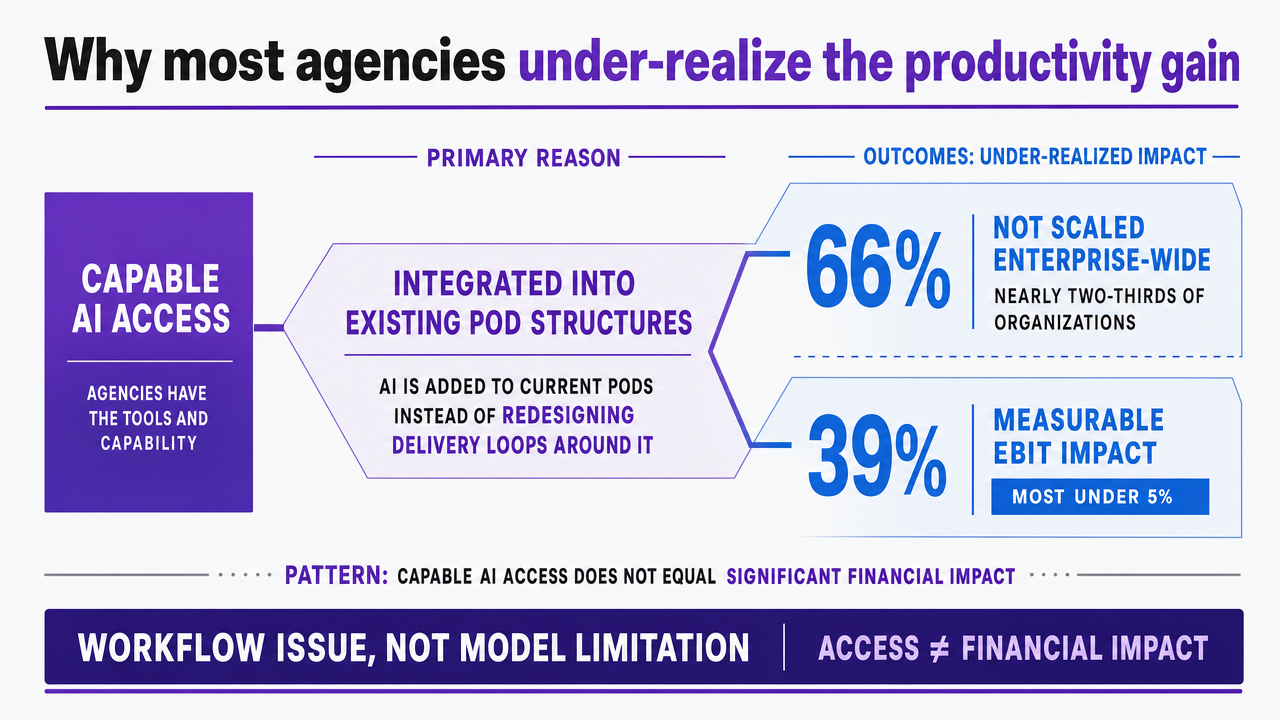 Show McKinsey 2025 stats cited in this section about enterprise AI scaling and EBIT impact
Test AI-powered SEO execution on live sites
Evaluate automated SEO workflows by publishing real content and measuring results before you commit.
Where the agent earns its keep inside delivery
Execution surfaces: schema, redirects, on-page, internal linking
The most immediate return on investment for an AI agent is in automating repetitive, pattern-heavy tasks that strategists often find tedious. These include schema generation, creating redirect maps after CMS migrations, rewriting title tags across thousands of URLs, and conducting quarterly internal linking passes within topical clusters. Forrester analysts have already noted the use of generative AI for schema markup, redirect rules, robots.txt directives, and title tags 5. An agent transforms these ad-hoc uses into recurring, queued production.
Schema generation is a prime example. Product, FAQ, HowTo, LocalBusiness, and Article schema follow strict syntax. An agent can accurately generate this at scale, validate it against Schema.org, and batch deploy after a strategist approves the type and property mapping.
Redirect maps are another key area. When a developer changes a sitemap, the agent can identify differences between old and new URLs, propose 301 mappings based on templates and topical similarity, and flag ambiguous cases for human review instead of making assumptions.
Internal linking, often under-automated, is the third. The agent analyzes the topical graph, scores anchor text and contextual link opportunities by relevance and authority flow, and generates a ranked list of insertions per URL. The strategist then approves the batch, tightening the site's graph without manual effort from a writer.
Content as data: briefs, drafts, refresh cycles
Forrester's content intelligence framework views every asset as structured data, encompassing metadata on topic, intent, audience, performance, and interaction signals. This allows predictive and generative models to act on this data 6. An SEO AI agent operating with this data layer functions differently from a content generator working from a blank prompt.
Brief production becomes a query against the existing content corpus rather than a manual research sprint. The agent identifies coverage gaps within a cluster, extracts SERP features and competitor angles, references brand performance on related terms, and outputs a brief with target entities, recommended H2s, and the intended conversion path. The strategist then refines the direction, not the formatting.
Drafts, whether created by writers or the agent, arrive with structured metadata that feeds back into the corpus, enriching future briefs. This continuous feedback loop improves the signal for subsequent content creation.
Refresh cycles demonstrate the full value of treating content as data. The agent monitors for ranking decay, declining CTR, outdated statistics, and topical drift across URLs. It generates a ranked refresh queue weekly, drafts updates, and routes them for approval. This transforms an annual audit of a large content library into continuous optimization, allowing the strategist to manage a queue rather than a spreadsheet.
Where ML pattern-matching beats analyst hours
Some SEO tasks, such as classification and anomaly detection, require processing data at a scale that overwhelms human attention. Machine learning, with its supervised and unsupervised methods, excels at clustering, classification, and pattern recognition in noisy datasets 7—a common challenge for agencies managing numerous client accounts.
Intent classification across tens of thousands of queries is one such application. Unsupervised clustering can group semantically similar queries, revealing clusters previously unknown to the strategist. Supervised classifiers then tag these clusters according to the agency's intent taxonomy. This process, which would take an analyst weeks per client, is significantly accelerated by ML.
Anomaly detection is another critical area. Sudden ranking drops, indexation failures, log file spikes, and template-level traffic losses can be flagged by the agent within hours, long before a client's weekly check-in. While the strategist still diagnoses the root cause, the agent drastically reduces detection time.
Other tasks, such as cannibalization mapping, duplicate content detection, and identifying template-pattern issues, also fall into this category. ML handles the pattern recognition, allowing the strategist to focus on expert judgment.
Delivery economics under agent supervision
This section focuses on the economic impact for heads of SEO managing multi-client pods, typically 30–60 accounts. At this scale, the structural shift enabled by agent supervision becomes most apparent.
McKinsey's research suggests generative AI can boost marketing productivity by 5–15% of total spending 1. This is a potential ceiling, achievable only by organizations that rebuild workflows around the technology. Agencies face the same challenge. The question is how the delivery model must change to approach this potential.
Comparing a 40-client SEO portfolio under a traditional pod versus an agent-supervised model reveals differences across five key variables. The following table uses ratios to highlight the structural shift enabled by agentic workflows:
| Delivery variable | Traditional pod model | Agent-supervised model |
|---|---|---|
| Deliverables per client per month | Fixed scope: 2–4 content units, quarterly audit | Variable scope: ranked queue, weekly refresh + execution batches |
| Strategist hours per client per month | 8–14 hours (production + QA + reporting) | 2–4 hours (priority review + approval + client narrative) |
| QA gates | Editor pass, strategist pass, account manager pass | Single consolidated approval gate per artifact type |
| Time-to-publish (brief to live) | 10–21 days | 2–5 days |
| Supervision ratio (clients per senior strategist) | 8–12 | 25–40 |
The supervision ratio is the primary driver of margin improvement. When a senior strategist's focus shifts from artifact production to reviewing a ranked approval queue, the same headcount can oversee three to four times more clients without the typical decline in quality that accompanies pod expansion. Achieving the 5–15% productivity gain depends on disciplined approval gates and a functional KPI feedback loop.
Two important caveats apply. First, the strategist hours assume robust data integration—Search Console, rank tracking, log files, and conversion data must be wired in. Without this, the agent merely generates artifacts, forcing strategists to manually re-validate context, which negates the efficiency gains. Second, the deliverables variable assumes client contracts allow for variable scope rather than fixed monthly outputs. Retainers based on deliverable counts, rather than outcome targets, undermine the agent's ranking value, as the queue becomes subservient to contractual obligations. Both these factors are negotiable but require proactive resolution.
Governance as the moat, not the footnote
Approval gates tied to delivery consequences
Governance, often perceived as a compliance issue, is fundamentally a margin issue. Effective approval gates enable a single senior strategist to oversee 30 or 40 accounts without the quality collapse that typically follows pod expansion. Without it, the agent's output can outpace the agency's ability to ensure quality.
NIST's AI Risk Management Framework emphasizes governance as a continuous process of identifying, measuring, and managing risk throughout the model lifecycle, with documented controls at each stage 8. For an SEO delivery loop, this means each agent output requires a specific gate, a named reviewer, and a recorded decision, rather than a blanket sign-off.
Three types of gates carry significant delivery consequences:
- Type-level approval applies to schema, redirect, and internal linking batches: the strategist approves the pattern once, the agent applies it across URLs, and exceptions are flagged.
- Artifact-level approval is for briefs, drafts, and refresh updates that involve client voice or claims.
- Publish-level approval is reserved for critical changes like canonical tags, hreflang, or sitewide template modifications—work that can severely impact accounts if mishandled.
Each gate exists to mitigate specific downstream costs: rework hours, client escalations, or ranking incidents. Governance designed to prevent these consequences is effective; governance treated merely as a policy document is not.
Trust, accuracy, and the client-facing defense
Client trust is a critical governance factor, operating independently of the agency's internal workflow. Pew's 2025 survey on AI attitudes found that 66% of U.S. adults and 70% of AI experts are highly concerned about inaccurate information from AI 10. This concern extends to the boardroom. When a CMO questions the agency's assurance that the agent hasn't fabricated statistics or misrepresented services, the answer cannot simply be the model's name.
A defensible answer lies in transparent processes:
- source attribution for every claim in a draft,
- fact-checking for numeric or regulatory statements before approval,
- version history for all published artifacts with the approving strategist named, and
- a clear retraction protocol for errors.
This is particularly vital in verticals with large retainers, such as legal, healthcare, financial services, and senior living, where unsubstantiated AI claims can become liabilities. Agencies that succeed in these sectors are not those with the most aggressive AI roadmaps, but those that can clearly demonstrate which human approved which artifact, based on which source, and on what date.
See How Agency SEOs Are Scaling Execution with AI-Driven Workflow Automation
Connect with our team to explore data-backed case studies on reducing SEO production time and cost across high-volume client portfolios—while maintaining full oversight and measurable quality improvements.
Measuring the agent: KPIs that hold up in QBRs
A KPI deck for a quarterly business review must differ from internal dashboards. Clients prioritize business impact, transparency regarding AI involvement, and a clear link between the agent's work and revenue. Traditional ranking metrics alone are no longer sufficient, especially given that Pew's 2025 survey found 65% of U.S. adults encounter AI summaries in search results, with only 20% finding them highly useful 9. A significant portion of the impression surface no longer behaves like a traditional blue link.
Four layers of KPIs withstand scrutiny:
- Outcome metrics are paramount: organic-attributed revenue or pipeline, qualified leads, and assisted conversions tied to the URLs the agent optimized. These are the CMO's primary concerns.
- Visibility metrics: share of voice within priority clusters, presence in AI Overviews and answer panels, and ranking distribution rather than single keyword positions. Forrester analysts argue that average position and search volume lose explanatory power in conversational search 5, making inclusion in AI-mediated surfaces a tracked outcome, not a footnote.
- Throughput metrics, addressing client questions about the agent's activity. This includes drafts produced, first-pass approval rates, rework hours per artifact, time-to-publish, and the count of shipped artifacts by type. McKinsey's State of AI 2025 report highlighted formal KPI tracking for AI solutions as a key practice for capturing value 2, and this layer embodies that discipline.
- Quality and trust metrics underpin the entire system. These include fact-check pass rates, source-attribution coverage, and post-publish incident counts—such as retractions, corrections, or ranking regressions traceable to an agent artifact. Presented alongside outcome metrics, these provide strategists with the data to defend the work when clients question the agent's accuracy.
Where strategists move when the agent takes execution
When an AI agent assumes responsibility for schema generation, redirect maps, brief production, and refresh queues, senior strategists' calendars are freed from these time-consuming tasks. This newly available time is then reallocated to critical, often under-resourced, strategic work.
Priority-setting becomes a primary focus. Strategists reviewing a ranked queue against client revenue goals will spend more time challenging the agent's scoring model—identifying over-weighted opportunities, surfacing missed ones, and tuning the ranking to align with future pipeline goals rather than past traffic. McKinsey's work on agentic AI frames this as a shift in the human role towards strategy and creative direction, with agents handling activation 4. For an SEO pod, this means fewer hours spent on documentation and more on understanding the client's business.
Client narrative development is the second shift. Quarterly reviews evolve from status updates into strategic discussions: explaining the rationale behind specific cluster focus, the timing of initiatives, the agent's output, the approval time invested, and the resulting pipeline impact. The strategist becomes the interpreter between the agent's throughput and the CMO's strategic questions.
The third area is judgment work that agents cannot perform. This includes entering new verticals, repositioning service lines, or managing crisis responses. These complex, nuanced tasks are where senior strategist expertise is invaluable.
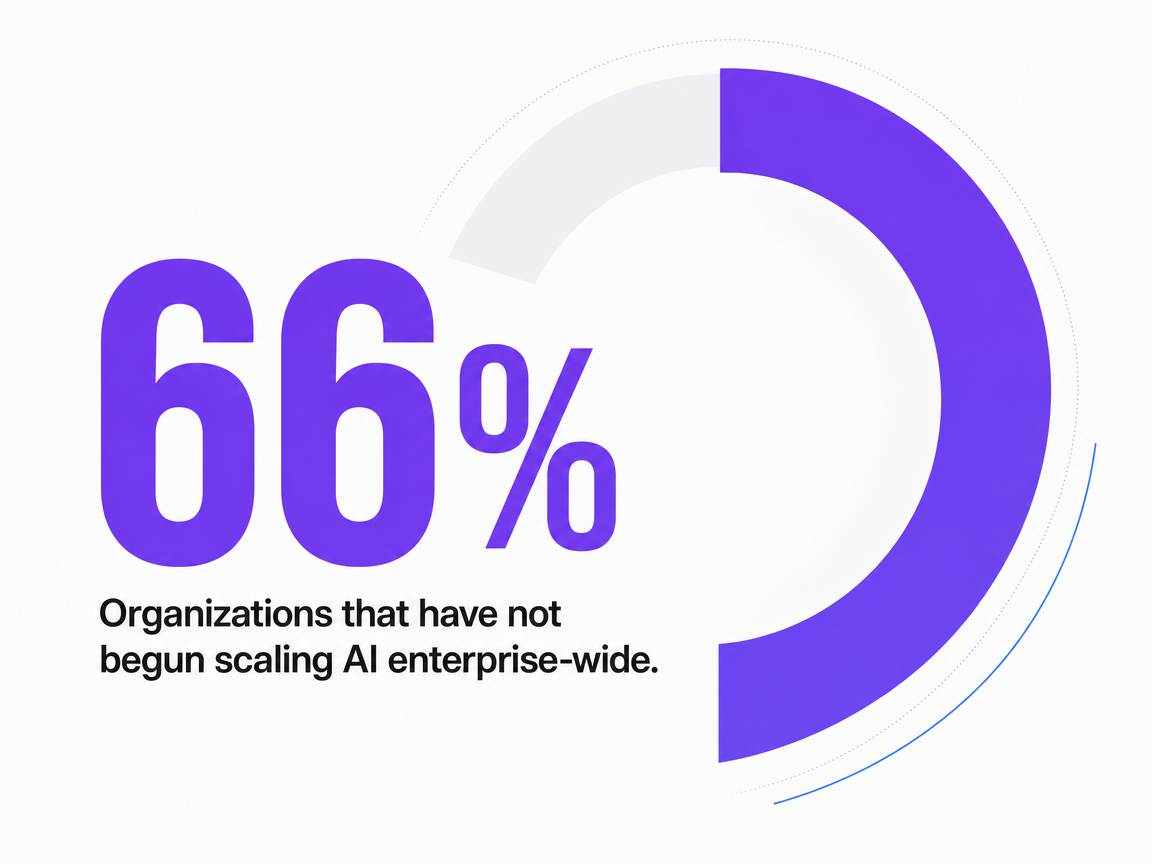 Organizations that have not begun scaling AI enterprise-wide
Organizations that have not begun scaling AI enterprise-wide
Frequently Asked Questions
References
- 1.The economic potential of generative AI: The next productivity frontier.
- 2.The State of AI: Global Survey 2025.
- 3.How generative AI can boost consumer marketing.
- 4.Reinventing marketing workflows with agentic AI.
- 5.Generative AI Has Answers, But SEO Practitioners Are Still Guessing.
- 6.Getting Smart On Content Intelligence.
- 7.Machine Learning: Algorithms, Real-World Applications and Research Directions.
- 8.AI Risk Management Framework | NIST.
- 9.Americans have mixed feelings about AI summaries in search results.
- 10.How Americans View AI and Its Impact on People and Society.
- 11.How Teens Use and View AI | Pew Research Center.