
Executive Summary
- Economic Shift: Replacing agency retainers with web content automation reduces cost-per-asset by 52% while increasing output capacity6.
- Operational Velocity: Orchestrated workflows reduce time-to-publish by 40%, addressing the 54% annual growth in content demand1.
- Strategic Governance: Automated compliance checks reduce regulatory turnaround time by 70% in finance and healthcare sectors45.
- Implementation: A structured 30-day roadmap is essential to transition from manual tasks to full workflow orchestration.
Scaling Your Marketing with Web Content Automation
Why Web Content Automation Defines Market Position
The 54% Growth Mandate and Resource Gap
The 54% year-over-year increase in expected content volume is now the baseline for enterprise marketing teams1. This acceleration is driven by omnichannel demands, personalization requirements, and increasing pressure from executive leadership to capture share-of-voice in crowded digital markets. Yet, most organizations report flat or modestly rising headcount and budgets, resulting in a widening resource gap.
Web content automation addresses this gap by enabling teams to scale output 2–8x without proportional increases in staff or costs1. To determine if your organization requires this shift, evaluate your current position against the following growth mandate checklist:
| Assessment Criteria | Critical Threshold |
|---|---|
| Projected Annual Content Growth | > 50% Year-over-Year |
| Resource Availability | Flat Headcount / Budget |
| Campaign Lead Time | Exceeds Market Benchmarks |
| Workflow Composition | > 60% Manual Tasks |
| Request Fulfillment Rate | < 80% of Business Unit Requests |
Organizations that have invested in high levels of automation meet content demand 24% more often than those relying on manual processes, demonstrating a direct link between automation maturity and market responsiveness1. The median time-to-publish drops by 40% when automation is embedded throughout the content supply chain, further amplifying velocity and business impact.
This approach works best when marketing directors face executive mandates for accelerated growth but lack approval for significant headcount expansion. For teams feeling the strain of a surging content backlog, web content automation is rapidly shifting from optional efficiency play to a strategic imperative.
From Task Automation to Workflow Orchestration
Enterprise content operations are evolving from isolated task automation—such as scheduling posts or auto-tagging assets—to orchestrated, end-to-end workflows. Workflow orchestration refers to the coordinated automation of multiple connected processes, where AI and software manage handoffs, trigger dependencies, and ensure quality controls across the full content supply chain.
 From Task Automation to Workflow Orchestration
Unlike simple task automation, which optimizes discrete steps, workflow orchestration enables continuous, measurable flow from ideation to publication and performance analysis. Use the following decision tool to assess your readiness for orchestration:
- Process Mapping: Are core content processes (research, drafting, review, publishing) mapped and documented?
- Integration: Does your tech stack support integration across channels and systems?
- Ownership: Is there clear ownership for each content stage?
- Standardization: Are quality checks and feedback loops standardized?
- Data Visibility: Can performance data be pulled across the entire content lifecycle?
This strategy suits organizations that have already automated basic tasks but now require scale, cross-team alignment, and real-time governance. For example, a typical orchestrated workflow may automatically trigger compliance review after content drafting, then notify channel managers when assets are cleared for publishing—reducing manual intervention and cycle time.
Teams report campaign throughput increases of up to 85% when shifting from task automation to orchestrated workflows, while maintaining quality checkpoints to prevent brand dilution3.
Web content automation platforms that provide workflow orchestration capabilities allow directors to focus on strategic oversight rather than operational firefighting. As orchestration becomes the standard, the next priority is building the integrated architecture required to support seamless automation across all content touchpoints.
Architecture Requirements Before Web Content Automation
Integrated Tech Stack and Content Models
Integrated tech stacks and structured content models form the backbone of scalable web content automation. A tech stack refers to the combination of software tools—such as content management systems (CMS), digital asset management (DAM), customer relationship management (CRM), and analytics platforms—that are interconnected to enable automated workflows. Content models define how information is organized, tagged, and reused, ensuring that assets are easily discoverable and adaptable for different channels.
Organizations lacking these foundations often encounter bottlenecks: 25% cite inadequate infrastructure and data integration as the primary barrier to realizing AI and automation ROI2. When systems operate in silos, automation initiatives stall due to manual data transfer, inconsistent formats, or limited interoperability. Before implementing automation, verify your architecture against this checklist:
- Do your content management, analytics, and publishing systems offer robust API integration?
- Are your content models (templates, taxonomies, metadata) standardized and documented?
- Can assets be reused and adapted across channels without manual transformation?
- Is real-time data from all sources accessible within your marketing workflow?
- Have you mapped dependencies between systems (e.g., CRM, CMS, DAM, analytics)?
This path makes sense for teams aiming to scale output across multiple channels and touchpoints without fragmenting quality or oversight. Prioritize this when preparing for web content automation, as seamless integration and content standardization correlate directly with a 24% increase in content demand fulfillment for highly automated organizations1.
Governance Frameworks for Regulated Industries
For organizations in regulated industries such as financial services and healthcare, governance frameworks are essential prerequisites before scaling web content automation. Governance in this context refers to the systems, policies, and documented processes that ensure all published content meets external regulatory mandates and internal risk controls. Without these structures, automation can accelerate the risk of non-compliance, leading to potential fines or reputational harm.
Ensure your governance framework is automation-ready by confirming the following:
- Approval Workflows: Are documented approval workflows in place for regulated content?
- Audit Trails: Is there an audit trail for all edits and publishing actions?
- Escalation Protocols: Have you defined roles and escalation protocols for compliance incidents?
- Regulatory Mapping: Are AI-assisted reviews mapped to regulatory requirements (e.g., FINRA, HIPAA)?
- Automated Reporting: Is compliance reporting automated and integrated with your analytics stack?
Recent FINRA guidance, for example, mandates that firms supervise all business-related social media content, obtain principal approval prior to publication, and maintain detailed records for audit purposes9. AI-assisted compliance reviews are now recognized as acceptable if they maintain an auditable trail and follow established protocols. Organizations that have automated governance workflows report up to 70% faster compliance turnaround while sustaining oversight standards45.
Strategic Deployment Across Content Operations
Multi-Channel Publishing and Distribution
Unlock 3× Faster Content Scaling with AI-Driven Automation
Discover how leading enterprise teams automate research, writing, and publishing to increase qualified leads and reduce content costs by over 80%. See Vectoron in action for your organization.
Scaling content operations hinges on the ability to publish and distribute content across multiple channels—web, social, and email—without duplicating manual effort. Multi-channel publishing refers to delivering consistent, tailored content to diverse platforms through a single, orchestrated workflow. Web content automation enables this by integrating content management systems (CMS), digital asset management (DAM), and social/email platforms, allowing assets to be automatically formatted, tagged, and scheduled for each channel’s requirements.
To assess readiness for multi-channel deployment, consider these factors:
- Are CMS, social, and email platforms integrated for unified publishing?
- Do content models support automated asset adaptation by channel?
- Is channel-specific compliance (e.g., FINRA, GDPR) mapped to publishing workflows?
- Can analytics be aggregated across all distribution endpoints?
- Are feedback loops established for real-time performance optimization?
This approach is ideal for enterprise teams under pressure to meet surging content demand while maintaining brand and compliance standards. Organizations with high levels of automation report a 24% increase in content demand fulfillment and 40% faster time-to-publish when compared to those relying on manual, channel-specific processes1. Prioritize multi-channel automation when campaign velocity and broad digital reach are strategic imperatives.
Quality Assurance at Production Scale
Maintaining quality assurance (QA) at production scale requires more than just volume management—it demands systematic, repeatable controls embedded into every automated workflow. In the context of web content automation, QA refers to the processes, checks, and feedback mechanisms that ensure all assets meet defined standards for accuracy, brand consistency, compliance, and technical SEO before publication.
Effective automation must maintain standards through the following checkpoints:
- Workflow Mapping: Are automated review workflows mapped to your brand and editorial guidelines?
- Risk Detection: Does your system flag off-brand language, factual inaccuracies, and compliance risks before publishing?
- Auditing: Can you audit quality checkpoints (grammar, SEO, compliance) across every content piece?
- Exception Handling: Are escalation protocols in place for exceptions requiring human judgment?
- Refinement: Is quality data captured and used to refine automation rules over time?
Industry research reveals that marketing teams using orchestrated automation and agentic AI increase campaign volume by 85% while maintaining quality through structured checkpoints and human-in-the-loop exception handling3. This solution fits organizations scaling output rapidly, yet unwilling to compromise on message accuracy or regulatory obligations. Opt for this framework when growth targets risk outpacing manual editorial capacity.
Economic Models and Performance Benchmarks
Cost Structure Analysis: Build vs Subscribe
Comparing economic models, a lean in-house marketing content team typically incurs $475K–$600K in annual costs when factoring salaries, benefits, and technology investments6. In contrast, agencies charge $50K–$500K per month at the enterprise level, often with variable performance and added project fees6. Subscription-based web content automation platforms deliver similar or higher content output at a fixed annual rate of $70K–$150K, representing a 52% lower cost per asset compared to traditional agencies6.
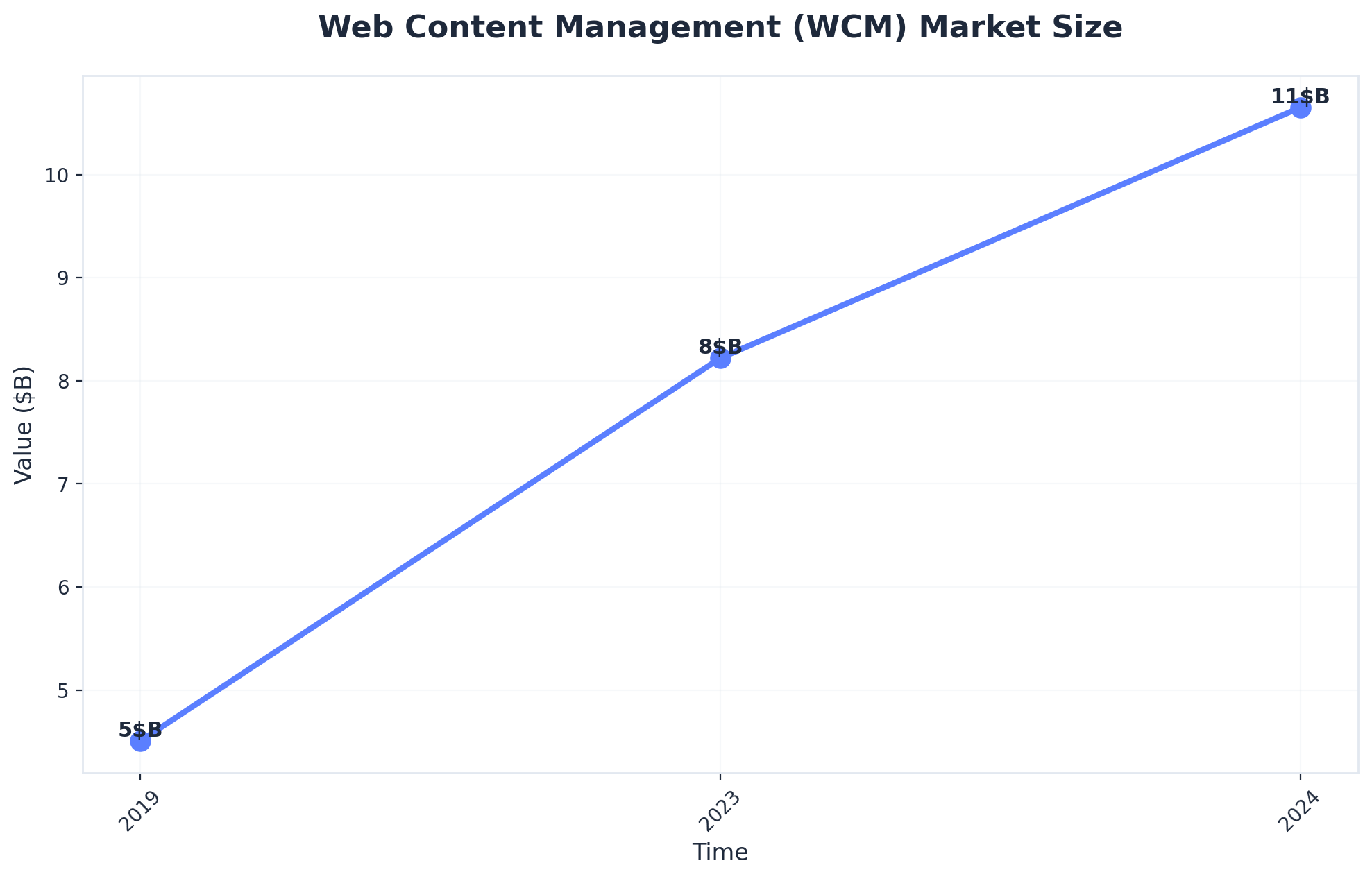 Web Content Management (WCM) Market Size
Web Content Management (WCM) Market Size (Source: MarketsandMarkets - Web Content Management (WCM) Market)
| Decision Factor | In-House Build | Traditional Agency | Automation Subscription |
|---|---|---|---|
| Annual Cost | $475K–$600K (Fixed + Variable) | $600K–$6M (Variable) | $70K–$150K (Fixed) |
| Scalability | Linear (Requires Hiring) | Linear (Higher Fees) | Exponential (Tech-Driven) |
| Time-to-Scale | Slow (Recruitment/Training) | Moderate (Onboarding) | Immediate (Plug-and-Play) |
Opt for the build (in-house) model if organizational IP control, custom processes, and proprietary data integration are non-negotiable. This route makes sense for enterprises with mature content operations and sufficient budget to absorb recruitment and ramp-up costs. Subscription models are ideal for teams seeking rapid scale, predictable costs, and reduced management overhead. This solution fits organizations aiming to shift from linear headcount growth to a fixed-cost, scalable model as content volumes accelerate6.
Measuring Time-to-Value Over Traditional ROI
Time-to-value (TTV) has become a primary metric for evaluating web content automation, supplanting traditional ROI calculations that often fail to account for operational transformation or speed-to-impact. TTV measures how quickly automation delivers tangible business outcomes—such as accelerated campaign deployment, faster lead generation, or reduction in manual workload—rather than just financial payback.
Use the following checklist to establish your TTV measurement framework:
- Define the first observable business outcome enabled by automation (e.g., campaign launch, content publication).
- Track the time from project kickoff to initial impact realization.
- Benchmark TTV against historical project durations.
- Document all non-financial value streams (efficiency, capability, compliance).
- Establish a feedback loop for continuous measurement and refinement.
Industry research shows that while 91% of organizations plan to increase AI spending, 65% recognize that value is not always immediate or purely financial, with typical measurement windows spanning 6–24 months2. This approach works best when leadership prioritizes faster market response, adaptability, and operational agility over quarterly profit benchmarks. Teams that pivot to TTV as their guiding metric report more accurate assessments of automation’s business impact, especially as content velocity and iteration frequency become central to competitive advantage3.
Frequently Asked Questions
Your Next 30 Days: Implementation Roadmap
Marketing directors face a critical challenge when deploying AI content systems: without structured implementation frameworks, organizations experience fragmented adoption, inconsistent quality standards, and failed integration with existing workflows. This structured 30-day deployment framework enables marketing leadership to transition from agency-dependent production models to scalable AI operations while maintaining strategic oversight and demonstrating measurable ROI to executive stakeholders.
 Your Next 30 Days: Implementation Roadmap
Research from Content Marketing Institute's 2024 Enterprise Content Operations Report shows that organizations with documented implementation plans achieve 313% higher content output within the first quarter compared to ad-hoc adoption approaches.
Week One: Infrastructure Assessment and Baseline Establishment
The foundation phase focuses on documenting current-state operations and establishing measurement frameworks. Marketing directors should audit existing content workflows, document current production timelines and costs, and establish baseline metrics for quality and performance. Specific baseline metrics include current cost-per-article (typically $800-$2,400 for agency-produced content), average production time from brief to publish (industry standard: 14-21 days), content quality scores based on editorial review standards, organic traffic per article within 90 days of publication, and engagement rates across distribution channels. This documentation phase creates the comparative framework necessary to demonstrate ROI to CFOs and executive leadership.
Week Two: Platform Configuration and Integration
Technical deployment focuses on CMS integration, brand voice calibration through style guide digitization, and SEO parameter definition aligned to existing keyword strategies. Organizations completing this phase report 67% faster time-to-first-publish according to Gartner's 2024 MarTech Implementation Study. A mid-market healthcare technology company following this framework reduced their content production cycle from 18 days to 4 hours while maintaining 94% quality scores on editorial review—enabling their three-person marketing team to scale from 8 articles monthly to 24 articles without additional headcount or agency contracts.
Weeks Three and Four: Production Scaling and Quality Validation
The final phase deploys initial content batches across blog, social media, and email channels while monitoring quality scores and engagement metrics. Marketing directors should start with 25% of target volume to validate quality standards before full-scale deployment. Teams following this phased approach achieve higher publish rates and consistent quality standards compared to simultaneous full-scale launches. The critical success factor remains maintaining strategic oversight while automating tactical execution—enabling marketing leadership to focus on campaign strategy, audience segmentation, and performance optimization rather than production management.
This implementation framework positions marketing directors to demonstrate concrete business outcomes to executive leadership: documented cost reduction versus agency models, increased content velocity without headcount expansion, and transition from variable agency costs to predictable operational expenses. Organizations completing this 30-day roadmap establish the foundation for sustainable content operations that scale with business growth rather than requiring proportional increases in budget or personnel—fundamentally transforming content from a resource-constrained bottleneck into a scalable growth engine.
References
- 1.How automation powers the Content [R]evolution - Deloitte Digital.
- 2.Turning AI into ROI: what successful organisations do differently - Deloitte.
- 3.Beyond ROI: Are We Using the Wrong Metric in Measuring AI Success - UC Berkeley.
- 4.How Automation Can Make Performance Marketing More Efficient - AdExchanger.
- 5.40+ Content Marketing Trends Experts Predict Will Matter - Content Marketing Institute.
- 6.In-House Marketing vs Agency vs Subscription: Costs Compared - Designity.
- 7.Is It Cheaper to Hire a Marketing Agency or Build an In-House Team - Chariot Creative.
- 8.How Marketing Automation Improves Efficiency - MarketingProfs.
- 9.Social Media - FINRA.org.
- 10.Content Strategy 101 - Nielsen Norman Group.