
Key Takeaways
- An auto SEO service is a production system that compresses the keyword-to-published-page cycle by automating deterministic stages while keeping human judgment on strategy, brand voice, and compliance.
- The category is not an AI writing tool — it spans six stages from keyword mapping through performance monitoring, with drafting being only one piece of the line.
- Throughput is bounded by editor hours per page, not drafting speed, so automation gains concentrate at the front (research, briefs) and back (on-page, linking, monitoring) of the production line.
- Governance stays human at strategy approval, editorial review, and substantiation, since FTC enforcement on unsupported AI claims 2and NIST synthetic content risks 17sit with the operator.
The production-line problem auto SEO services were built to solve
Most agency SEO leads do not have a strategy problem. They have a throughput problem. The keyword map is built, the topical clusters are scoped, the briefing template is approved, and then production stalls behind a writer queue that runs three to six weeks deep. Strategy outpaces the line that ships it.
That gap widens every quarter. Google rolls out roughly 500 to 600 algorithm updates per year, which makes batch publishing cycles a poor fit for how search actually moves 15. The deterministic parts of SEO — keyword grouping, intent classification, brief construction, on-page checks, internal link suggestions, ranking surveillance — repeat the same logic across thousands of pages. Those are the stages where labor cost compounds without proportional judgment value.
The discipline itself has always been mechanical at its core. Academic descriptions of SEO list the same load-bearing components in every era: keyword strategy, content alignment to search queries, structured titles and metadata, and link acquisition 13, 20. None of those tasks reward bespoke craft on the tenth or hundredth iteration. They reward consistency and cadence, which is exactly what early private-practice marketing literature flagged as the reason teams needed repeatable systems for keyword research and fresh content in the first place 11.
Auto SEO services emerged at the seam between strategic intent and production capacity. The category is not defined by AI writing — it is defined by what an agency operator removes from the editor queue without removing the parts that require human judgment. Reading the rest of this piece as a buyer is the wrong frame. Reading it as someone redesigning a production line is the right one.
A working definition: auto SEO as a production model, not a tool
An auto SEO service is a production system that compresses the keyword-to-published-page cycle by automating the deterministic stages of search optimization while keeping human judgment on strategy, brand, and compliance. The category gets misread as “an AI writer with a keyword plugin.” That framing collapses six distinct stages into one and hides where the actual leverage lives.
The deterministic stages are the ones that repeat the same logic across every page: parsing search intent against a query set, generating briefs from a template, drafting copy to that brief, applying on-page rules, suggesting internal links against a site graph, and monitoring ranking and engagement signals after publish. Academic descriptions of SEO have identified roughly this same set of mechanics for years — keyword strategy, content alignment to queries, structured metadata, and link work — which is why software can model them in the first place 13, 20.
Search engines themselves run on automation. Modern ranking systems use machine learning to analyze usage patterns, infer preferences, and personalize results 14. An auto SEO service is, in practical terms, a production layer that tries to match that environment with comparable cadence rather than batch human output.
Two boundaries matter for the definition. First, an AI writing tool is one stage of the production line, not the whole service. A service that only drafts copy leaves the editor queue intact at briefing, on-page review, internal linking, and monitoring. Second, an auto SEO service is not a strategy replacement. It does not decide which service lines to target, which audiences to prioritize, or which claims a regulated client can legally make.
The working definition agency operators should hold: a system that runs the repeatable stages of a content production line continuously, with human checkpoints retained at the stages where judgment is the value.
The six stages of an SEO production line and what gets automated at each
Keyword and intent mapping, brief generation, and drafting
The first three stages of an SEO production line are where most agency operators feel the queue back up. Keyword and intent mapping is the front end: pulling query sets, clustering them by intent, deduplicating against existing coverage, and ranking opportunities against client priorities. Software has handled the mechanical parts of this for years — pulling volumes, scoring difficulty, grouping semantic variants — because the work fits a rule set 13, 20. Auto SEO services extend that by classifying intent against a target page type and routing the cluster directly into a brief, rather than dropping a spreadsheet on a strategist's desk.
Brief generation is the stage where automation produces the largest visible time savings. A briefing template that previously took a strategist 45 to 90 minutes per page — query selection, competitor SERP analysis, heading structure, internal link targets, entity coverage — gets compressed into a generated draft a strategist edits. Harvard Professional Development's review of AI in marketing notes that routine tasks like writing copy and analyzing consumer data
“that once took hours can now be done in minutes”
16. Brief generation is the cleanest example of that compression because the inputs are structured.
Drafting is where automation gets oversold. Generating a first draft against a brief is mechanically solved; producing copy that holds brand voice, cites accurately, and reads at the right level for the audience is not. The honest read on this stage: drafting is automated, but the editor queue does not disappear. It shifts from writing to reviewing, and the ratio of editor hours per page becomes the new constraint.
On-page optimization, internal linking, and performance monitoring
The back half of the production line is where automation earns its keep, because the work is continuous rather than episodic. On-page optimization — title tag construction, meta description length, heading hierarchy, schema markup, image alt text, keyword placement against the target query — is rule-based. A service that applies those rules at publish time eliminates a checklist a human editor would otherwise run before pushing live.
Internal linking is the stage where automation moves from convenience to leverage. A site graph with a few hundred pages already exceeds what an editor can hold in working memory; at a few thousand, manual link suggestions become guesses. Auto SEO services that maintain a live internal link graph and propose anchor-text-aware links at draft time can compound topical authority across a cluster without a strategist hand-mapping every node.
Performance monitoring is the stage with the highest automation leverage, and the reason is structural. Google rolls out roughly 500 to 600 algorithm updates per year 15. A batch monitoring cadence — a strategist pulling Search Console once a month — cannot keep up with that update frequency. Continuous monitoring that flags ranking drops, indexation issues, and engagement deltas against a baseline is the stage where humans are objectively slower than software, not just more expensive.
Scoring the six stages against automation maturity produces a clear pattern:
- Keyword mapping rates high.
- Brief generation rates high.
- Drafting rates medium, because the output still requires editorial review.
- On-page application rates high.
- Internal linking rates high when a site graph exists and medium when it has to be built.
- Performance monitoring rates high, and arguably is the stage where manual work creates the most risk given the update cadence 15.
The takeaway for an agency operator is that auto SEO services concentrate their value at the front of the line (research, brief) and the back of the line (on-page, linking, monitoring). The middle — drafting and editorial judgment — is where the editor queue persists and where evaluation should focus.
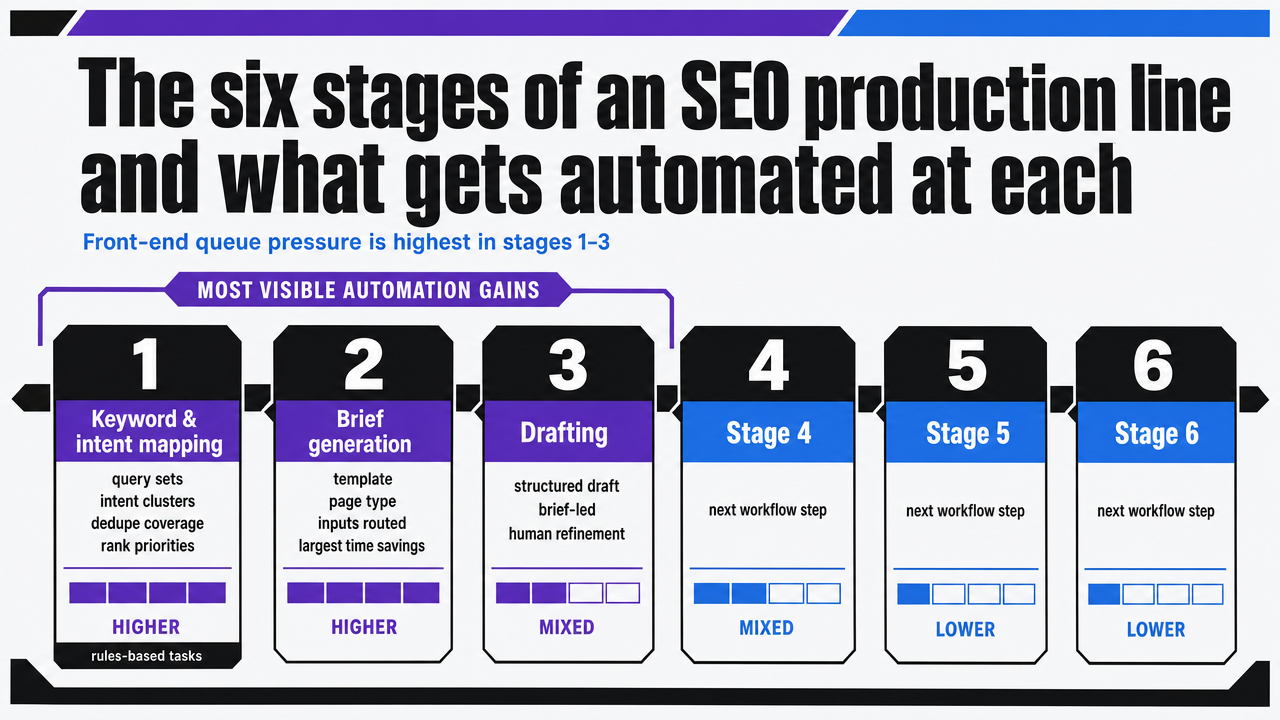 Visualize the six-stage production line described in the section with automation maturity ratings for each stage, directly mapping to the article's framework
Test Autonomous SEO Content Production Risk-Free
Deploy live, publishable SEO content in your own workflow and measure outcomes before committing long-term.
Throughput math: where automation actually changes editor-to-output ratios
The clearest way to evaluate an auto SEO service is to run the throughput math against the production line an agency already operates. The variable that matters is not pages drafted per hour. It is editor hours per published page, because that ratio sets the upper bound on how many pages a fixed team can ship per month.
In a manual production model, the line typically reads:
- 60 to 90 minutes of strategist time to build a brief,
- four to eight hours of writer time to draft to that brief, and
- 60 to 120 minutes of editor time to revise, fact-check, and approve.
The drafting block is the longest single span, which is why it gets the attention. The editor block is the one that actually constrains throughput, because editors are the chokepoint every page passes through regardless of who or what writes it.
Automation compresses the brief and draft blocks. Harvard Professional Development's review of AI in marketing notes that routine tasks like writing copy and analyzing consumer data
“that once took hours can now be done in minutes”
16. That compression is real, and it is also where most vendor pitches stop. The honest extension of the math: when drafting collapses from hours to minutes, the editor queue does not get faster on its own. It gets fed faster. Editor hours per page become the new visible constraint, and the ratio of editors to draft output determines whether the line ships or jams.
Two operational consequences follow. First, the leverage of an auto SEO service is bounded by editorial capacity, not by drafting speed. An agency that quadruples its draft output without adjusting its editor-to-output ratio will publish at roughly the same cadence with a longer review backlog. Second, the stages that compound across pages — internal linking against a live site graph, on-page rule application, post-publish monitoring — are where automation produces gains that do not reroute back through the editor queue. Those are the stages worth scoring first.
The throughput question for an agency operator is not “how many pages can this service draft.” It is “at our current editor-to-output ratio, what is the maximum number of pages we can review and approve per month, and which stages can automation remove from that ratio without adding new QA work behind it.” That framing changes which features matter during evaluation and which ones are theater.
What stays human: governance, FTC posture, and synthetic content risk
Automation does not remove accountability from a production line. It concentrates it. The agency operator who signs off on a publish queue still owns every claim that runs through it, which is why the governance question for an auto SEO service is not whether AI is involved but where human review is mandatory and what gets reviewed for what.
The federal posture has clarified faster than most vendor marketing acknowledges. NIST's AI Risk Management Framework gives organizations a voluntary structure for incorporating trustworthiness considerations into the design, development, use, and evaluation of AI systems 1. The framework is not SEO-specific, but its measurement, governance, and accountability functions map directly onto the stages of a content production line. Production systems that generate copy at scale need named owners, documented review steps, and measurable quality criteria. That is the layer auto SEO services either build into their workflow or push back onto the operator.
NIST's synthetic content guidance sharpens the point. The report warns that synthetic content can amplify the spread of misinformation and manipulate public opinion if left unchecked 17. For an agency publishing on behalf of regulated clients, the operational reading is that draft output cannot be the final output. Provenance, factual review, and source verification become checkpoints, not afterthoughts.
The FTC has moved on the marketing side of this same problem. A 2024 enforcement initiative warned that firms making unsupported AI claims may face action for deceptive or unfair practices 2. A year earlier, the agency authorized compulsory process for nonpublic investigations involving products and services that use or claim to be produced using AI, which streamlined its investigative tools for AI-related matters 3. A 2024 rulemaking proposed protections against impersonation using business logos, spoofed emails, and lookalike web addresses, which extends the risk surface for any service that generates or distributes synthetic content at scale 4.
Three checkpoints stay human regardless of how mature the automation gets:
- Strategy approval at the front of the line decides which claims, service lines, and audiences a client can legally pursue.
- Editorial review in the middle catches factual errors, off-brand voice, and regulated-claim violations before publish.
- Substantiation review at the back validates that performance claims made about the service itself, internally or to clients, can be defended under the FTC's deceptive-practices standard 2, 3.
Skipping any of those checkpoints is not a productivity gain. It is unpriced liability moving onto the operator's balance sheet.
The practical takeaway for evaluation: an auto SEO service should make it easier to enforce these checkpoints, not bypass them. Workflow features that route generated drafts through a named reviewer, log approval decisions, attach source citations to factual claims, and flag regulated-claim language before publish are the governance layer that distinguishes a defensible production model from a scaled risk multiplier.
See How Auto SEO Services Eliminate Content Bottlenecks for Agencies
Connect with a strategist to review AI-driven SEO workflows that automate campaign execution, accelerate content delivery, and support multi-domain strategies at scale.
If you manage multiple healthcare locations: the consolidation case
Why generic auto SEO output fails patient-facing pages
The audience for this section narrows. The reader running SEO across a multi-location healthcare footprint — orthopedics with twelve clinics, a dermatology group with thirty, a behavioral health network with eighty — faces a quality constraint that generic auto SEO services rarely solve on their own.
Patient-facing content has a measurable readability problem. A 2024 peer-reviewed study of patient-information websites found the average reading level was 10.5, against a recommended 6th-grade reading level, with only 2 sites in the study meeting that recommendation 7. Most patient education materials also score poorly for actionability, meaning even when reading level is adequate, the page does not tell a patient what to do next 10.
Generic auto SEO output collides with this directly. A drafting system tuned for keyword coverage and topical depth tends to lengthen sentences, stack clauses, and reach for clinical vocabulary because that vocabulary matches the SERP. The same draft that ranks can read at grade 11. A multi-location operator publishing 40 service-line pages per site across 30 sites without a readability constraint baked into the brief is shipping 1,200 pages that will rank against competitors with the same problem and convert poorly against patients who cannot parse them.
The fix is operational, not aesthetic. Readability targets belong in the brief, not the edit pass. Auto SEO services worth integrating into a healthcare production line treat grade level, sentence length, and actionability as constraints the draft must satisfy before it reaches review — the same way they treat title tag length or schema validity. Machine learning systems can match patient profiles to content features at scale, which is well-documented in healthcare personalization research 18, but only if the production layer is configured to optimize for comprehension as a measurable output rather than a downstream edit.
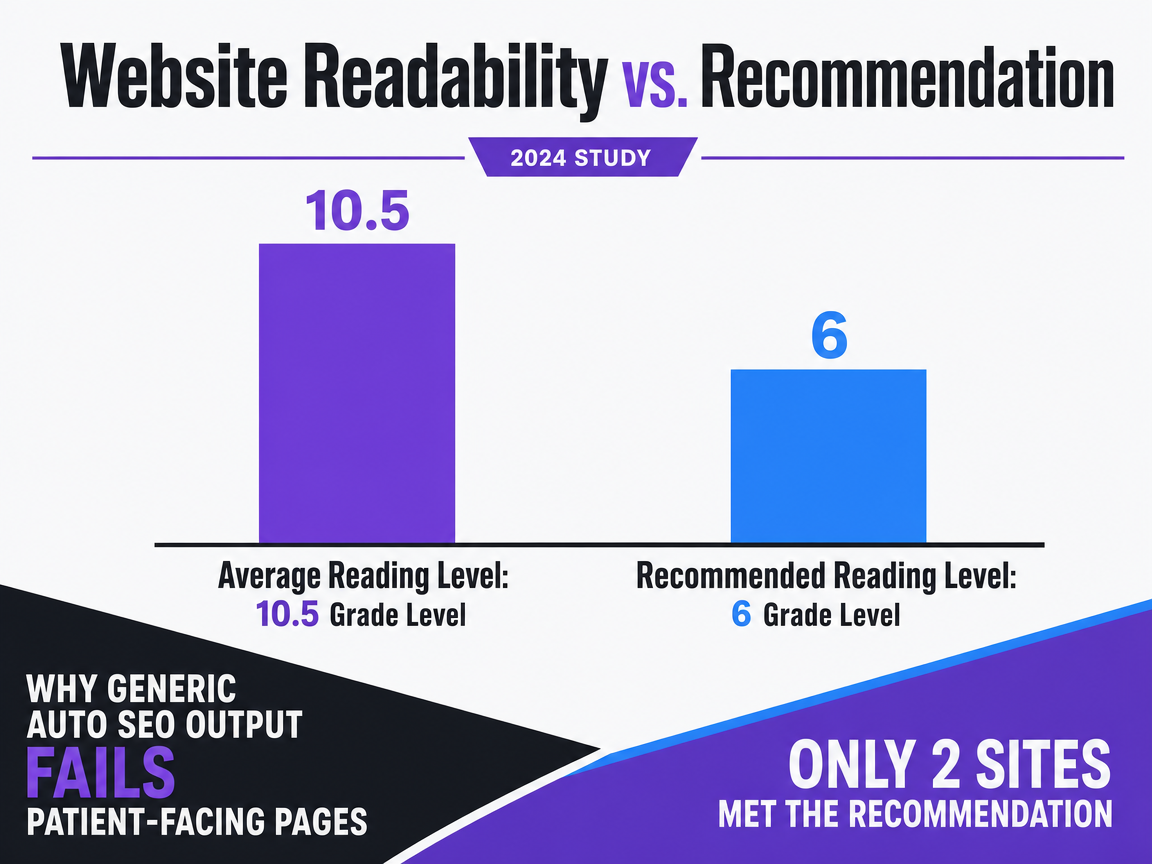 Website Readability vs. Recommendation
Comparison of the average reading level (10.5) of patient-information websites against the recommended 6th-grade reading level, based on a 2024 study. Only 2 sites in the study met the recommendation.
Per-site retainer vs. in-house scaling vs. auto SEO: a variables-only comparison
The economics of running SEO across a multi-location healthcare footprint shift based on which production model carries the marginal page. Three models dominate the market, and the variables that distinguish them are the ones an operator should price out before choosing.
The per-site agency retainer model charges per location and produces pages in batches tied to monthly scope. Editor hours per page sit with the agency, and the marginal cost of adding a location is roughly linear — another retainer, another onboarding, another point-of-contact. Time-to-publish runs in weeks because each site moves through a separate queue. Governance review happens at the agency, with the operator approving outputs they did not brief.
The in-house scaling model centralizes briefing and editorial standards but constrains throughput to headcount. Pages published per month per site is bounded by the writer and editor team the operator can hire and retain. The marginal cost of adding a location is non-linear: the first ten sites absorb into existing capacity, the eleventh forces a new hire. Governance review is tight because the team is in-house, but resource-constrained publishers consistently struggle to scale visibility without adding people 8.
The auto SEO production model compresses brief generation and drafting, so pages published per month per site rises against the same editor base 16. The marginal cost of adding a location approaches the cost of provisioning the site in the platform rather than hiring against it. Time-to-publish compresses from weeks to days for the deterministic stages, with continuous monitoring against Google's roughly 500 to 600 annual algorithm updates replacing batch reviews 15. Governance review stays human at strategy approval and pre-publish, but the review step is fed by a queue measured in days rather than a backlog measured in weeks.
| Variable | Per-site agency retainer | In-house team scaling | Auto SEO production model |
|---|---|---|---|
| Pages per month per site | Capped by retainer scope | Capped by headcount | Capped by editor review capacity |
| Editor hours per page | Held at agency | Held in-house | Shifted from writing to reviewing |
| Time-to-publish | Weeks | Weeks | Days for deterministic stages |
| Marginal cost of adding a location | Linear (new retainer) | Step-function (new hire) | Near-flat (provisioning) |
| Governance/compliance review | Distributed across agencies | Centralized in-house | Centralized, fed by faster queue |
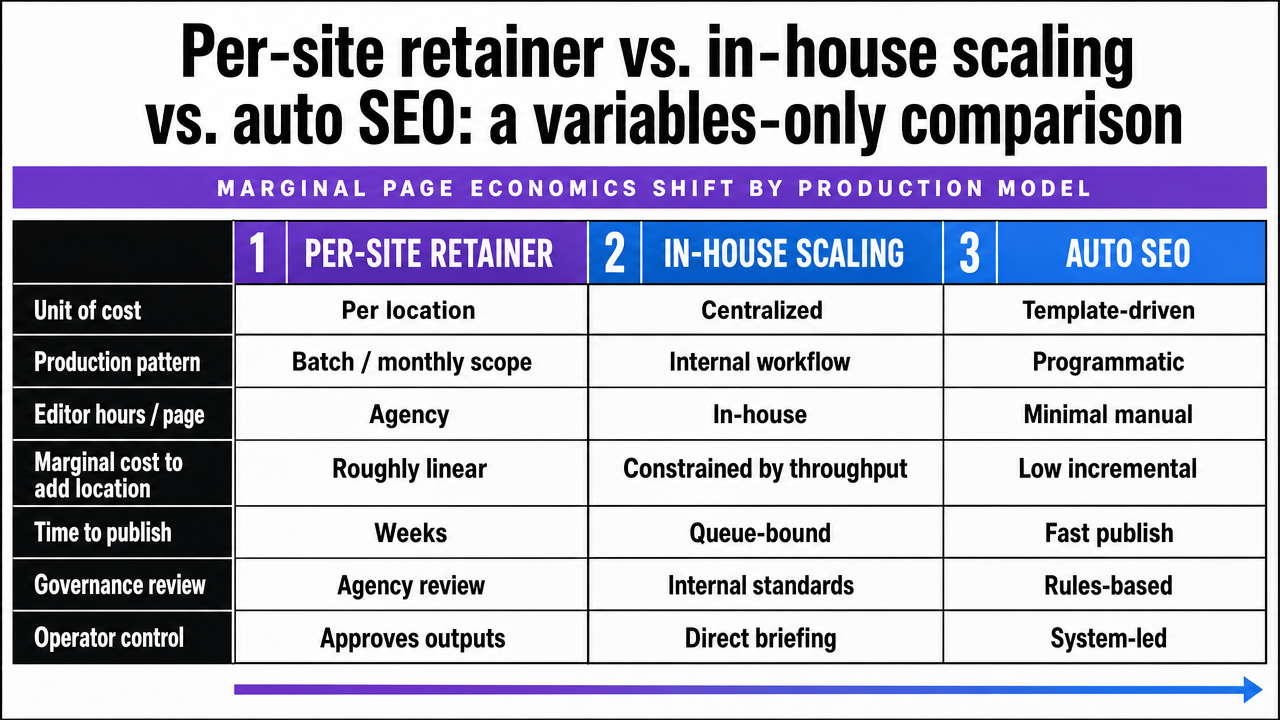 Visualize the three production model comparison from the section's table, making the operational tradeoffs scannable
Evaluating auto SEO services as an agency operator: build, buy, or integrate
The decision an agency SEO lead actually faces is not whether to use an auto SEO service. It is which layer of the production line to own and which layer to source. Three paths are live, and each carries a different failure mode.
Building in-house means assembling a stack of keyword tools, brief generators, on-page checkers, and internal link mappers into a workflow the agency operates. The upside is full control over briefing templates, brand voice rules, and governance checkpoints. The downside is engineering cost that does not bill to a client. Search engines themselves run on continuously updated machine learning systems that model user behavior and personalization signals 14, and matching that cadence with a homegrown stack means maintaining models, not just scripts. Resource-constrained operators consistently struggle to scale visibility work without adding headcount 8, and a build path moves headcount from editors to engineers without changing the ratio.
Buying a packaged auto SEO service shifts the engineering burden to a vendor but introduces two evaluation problems. The first is claim verification. The FTC's 2024 enforcement initiative warned that firms making unsupported AI claims may face action for deceptive or unfair practices 2, which means vendor performance claims should be treated as substantiation questions, not marketing copy. The second is fit at the stages that matter. A service that automates drafting but leaves keyword mapping, internal linking, and monitoring untouched solves the smallest part of the throughput problem.
Integrating means selecting a service that owns the deterministic stages end-to-end and wiring it into the agency's existing governance layer. Scoring criteria should map directly to the six-stage production line: which stages the service automates, where editorial review is enforced, how the system measures content marketing effectiveness as a function rather than a creative output 12, and how it handles continuous monitoring against Google's roughly 500 to 600 annual algorithm updates 15. Platforms built for this integration path, including Vectoron, are evaluated on whether they reduce editor hours per page without pushing new QA work back into the queue.
Frequently Asked Questions
References
- 1.AI Risk Management Framework.
- 2.FTC Announces Crackdown on Deceptive AI Claims and Schemes.
- 3.FTC Authorizes Compulsory Process for AI-related Products and Services.
- 4.FTC Proposes New Protections to Combat AI Impersonation of Individuals.
- 5.Department of Commerce Announces New Actions to Implement President Biden’s Executive Order on AI.
- 6.FACT SHEET - U.S. Department of Commerce & U.S. Department of State Launch the International Network of AI Safety Institutes at Inaugural Convening in San Francisco.
- 7.Search engine optimization and its association with readability and ....
- 8.Becoming visible with limited resources: Non-profit journalists ....
- 9.Lost in translation: Assessing the readability of online information on ....
- 10.A health literacy analysis of online patient-directed educational ....
- 11.Digital Marketing for Private Practice: How to Attract New Patients.
- 12.Evaluating the Effectiveness of Digital Content Marketing Under ....
- 13.Search engine optimization: What is it and why should we care?.
- 14.Search engine Performance optimization: methods and techniques.
- 15.Future Trends in Search Engine Marketing.
- 16.AI Will Shape the Future of Marketing.
- 17.Reducing Risks Posed by Synthetic Content.
- 18.Harnessing Machine Learning to Personalize Web-Based Health Care Content.
- 19.The Impact of Artificial Intelligence on Healthcare.
- 20.The Significant Role of SEO in Effective Web Marketing.