
Key Takeaways
- AI engines now drive 2-6% of B2B organic traffic while 65% of U.S. adults encounter AI summaries, creating influence that legacy session and last-click reporting cannot capture 1, 9.
- Citation share and answer saturation across four to six engines function as the new primary KPIs, replacing rank position as the optimization target inside zero-click answers 12.
- A defensible attribution chain layers an identity graph, first-click attribution with a lookback window matched to the sales cycle, and a data-driven model that reallocates fractional credit 3, 15.
- VPs preparing for the Q1 2026 budget review need a documented prompt set, calibrated attribution stack, and approval-governed execution loop in production before the line item is challenged 16.
The Accountability Gap Between Influence and Clicks
Marketing influence and marketing measurement have separated. Forrester's tracking shows AI engines now drive between 2% and 6% of total organic traffic in the B2B sector, a slice that is small in clicks but growing fast enough to dictate where category-defining conversations happen 1. The exposure side looks very different: 65% of U.S. adults at least sometimes encounter AI summaries in search results, and 45% see them extremely often or often 9. The gap between those two numbers is the accountability problem in one frame. Audiences are reading about a brand in an AI answer; analytics is recording silence.
That silence is what breaks the legacy organic scorecard. A VP who reports sessions, rankings, and last-click conversions is reporting on the shrinking portion of the journey that still produces a measurable referral, while the larger portion, where buyers form opinions inside ChatGPT, Perplexity, Google AI Overviews, and Copilot, runs unobserved. Forrester has called this directly: AI search is eroding the engagement metrics that B2B marketing has used to justify spend, and the accountability model built on those metrics no longer matches buyer behavior 10.
AI search monitoring tools exist to close that gap. They quantify how often a brand is cited, on which prompts, against which competitors, and on which platforms, then feed those signals into the same pipeline math that paid and traditional organic already use. The question for a VP is not whether AI search deserves a line item. The question is whether the current reporting stack can still substantiate organic ROI to a CFO when most of the influence no longer produces a click.
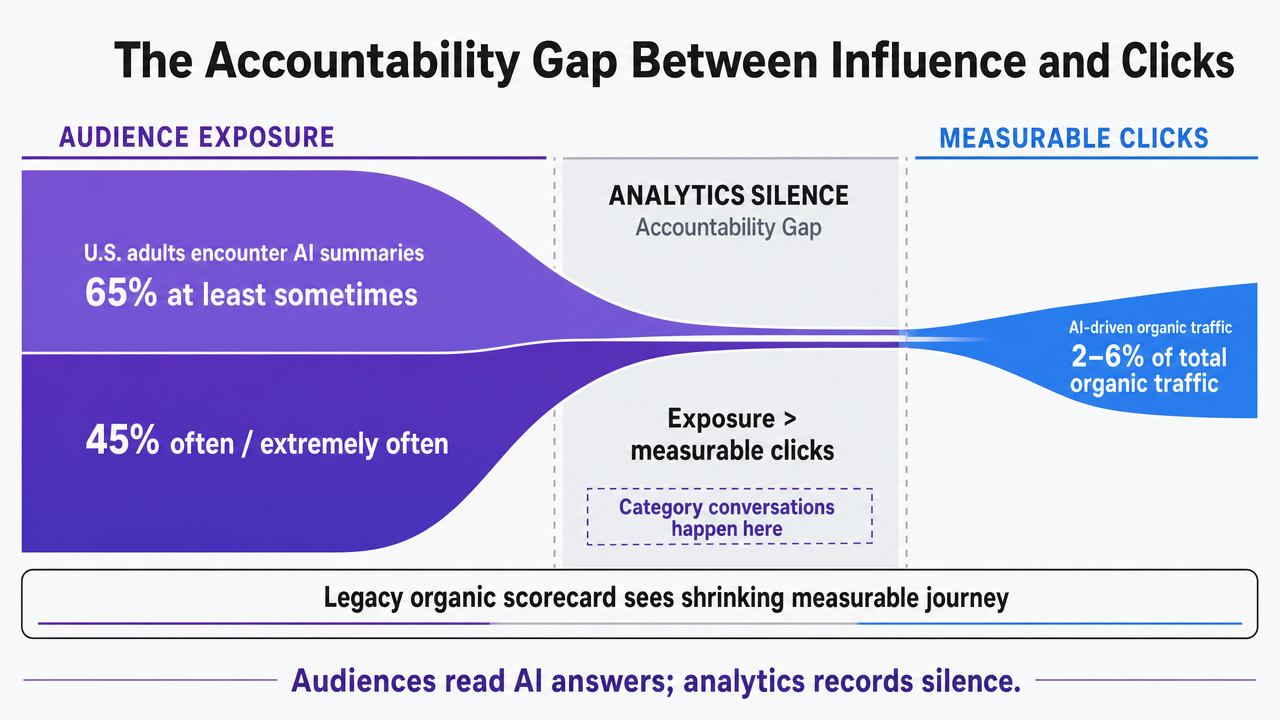 Contrast the small share of measurable AI-driven clicks against the much larger share of audiences exposed to AI summaries, making the accountability gap visually concrete
Why the Old Organic Scorecard Stopped Working
The legacy organic scorecard was built for a click economy. Sessions, keyword positions, bounce rates, and last-touch conversions all assume the buyer lands on the site before the brand gets credit. Answer engines have broken that assumption at the front of the funnel. Forrester's analysts put it plainly: AI search is driving traffic declines and eroding the engagement metrics B2B marketing has historically used to justify spend 10. The numbers a VP brings to a quarterly review are not wrong. They are increasingly incomplete.
The deeper issue is structural. Rank tracking measures position on a results page that fewer buyers scroll through once an AI summary answers the question above the fold. Session counts measure arrivals on a property that the buyer no longer needs to visit to compare three vendors. Last-click conversion credits the form fill but ignores the Perplexity answer that listed the brand among the two finalists a week earlier. Forrester's research team has framed the consequence directly, calling AI answer engines a visibility vacuum that turns traffic-replacement strategies into the wrong target 11. Replacing lost sessions with more sessions misses what actually changed: the influence event moved off the site.
Zero-click behavior compounds the gap. Forrester has argued that zero-click search will reshape B2B organic traffic and force marketers to rethink success metrics beyond site sessions, treating it as either a threat or an opportunity depending on whether the team can observe what happens inside the answer 8. Without monitoring, the team can only see the buyers who clicked through, a self-selecting minority that misrepresents the true reach of the content investment.
For a VP defending budget, this produces a quiet but expensive problem. Organic spend continues to generate brand presence in the queries that matter most, but the reporting stack credits a shrinking fraction of that presence. Year-over-year declines in sessions and last-click conversions read as program decay when the underlying signal is a channel migration. The fix is not better dashboards on the old metrics. It is a new layer of measurement that captures the influence event where it now occurs, then connects that event to pipeline through attribution logic the finance team will accept.
What AI Search Monitoring Actually Measures
Citation Share and Answer Saturation as Primary KPIs
Citation share is the count of times a brand appears inside AI-generated answers across a defined prompt set, expressed as a percentage of the total citations available on those prompts. Answer saturation measures how consistently the brand appears across the answer surface for category-defining queries, regardless of which engine produced the response. Forrester names both as the central optimization targets for AI search work, framing them as the metrics that replace position tracking inside zero-click answers 12.
Platform breadth is what makes these KPIs harder to game than ranking ever was. A monitoring program in 2024 that audited three engines, typically ChatGPT, Perplexity, and Google AI Overviews, now reasonably tracks six as Copilot, Gemini, Claude, and vertical answer surfaces enter the rotation. Partnerize's KPI guidance projects the operative count growing from three platforms in 2024 to six by 2030, a roughly 12% compounded expansion in the surface area a marketing team must observe 6. A brand can hold strong citation share on two engines and still lose the category if the other four answer with a competitor's name.
For a VP, the practical use of these KPIs is comparative. Citation share against a named competitor set, measured weekly on the prompts that map to revenue-generating queries, produces a trend line the CFO can read the same way as paid impression share. Answer saturation across platforms shows whether the content investment is reaching the full answer surface or concentrating on one engine. Together they convert AI visibility from an abstract concern into two numbers that move, can be benchmarked, and respond to the work the team approves and ships.
Assisted Conversions and Pipeline Attribution Signals
Citation share establishes that the brand is being seen inside answers. Assisted conversions establish that the seeing leads somewhere. Partnerize's KPI framework lists three measurements that translate AI visibility into pipeline terms: the count of AI citations across platforms, assisted conversions from AI-referred sessions, and revenue or pipeline attributed to AI search visibility 6. The middle metric is the bridge. It captures the buyer who read about the brand inside an AI answer, then arrived through a branded search, a direct visit, or a sales conversation days later.
Operationally, assisted conversions from AI sources require referral identification before they can be counted. Answer Engine Optimization guidance recommends regex-based tracking inside analytics platforms to isolate sessions originating from ChatGPT, Perplexity, Copilot, and similar engines, plus manual monitoring of the answer surfaces themselves to catch citations that never produce a click 5. The regex captures the visible referral; the manual audit captures the influence event that stayed inside the answer. Both feed the same KPI.
Pipeline attribution closes the loop. Once AI-referred sessions are flagged, they enter the same multi-touch model the team already runs for paid and organic. The team can then report assisted opportunities, assisted pipeline value, and assisted closed-won revenue with AI search as a named contributor rather than an unallocated lift in branded search. That reporting is what makes the line item defensible. A VP who can show that AI citation share on twenty category prompts correlates with assisted pipeline three to six weeks later has a substantiation chain a CFO will accept, not a dashboard metric divorced from revenue.
Measure Search Impact and Validate ROI Instantly
See live search monitoring data tied directly to marketing pipeline performance during your first week.
The Three-Layer Attribution Stack That Survives CFO Review
The substantiation chain a CFO will accept has three layers, and they have to be built in order. SegmentStream's analysis of AI search measurement names them explicitly: an identity graph at the base, first-click attribution in the middle, and a data-driven model on top 3. Each layer answers a different question:
Identity graph : Answers who.
First-click attribution : Answers where the journey started.
Data-driven model : Answers how much credit AI visibility deserves against every other touch in the path.
The identity graph stitches anonymous sessions, known leads, and closed-won accounts into a single buyer record across devices and visits. Without it, an AI-referred session on Monday and a demo request from the same buyer on Friday look like two unrelated events. With it, the Perplexity citation that started the journey gets carried forward into the opportunity record, where the revenue team can see it.
First-click attribution is what credits AI search at the front of the funnel. Adobe's attribution documentation describes the mechanic in standard terms: an attribution model distributes conversion credit across the hits in a group, with first-touch crediting the originating interaction inside a defined lookback window 15. For B2B journeys that run six weeks to nine months, the lookback window has to match the sales cycle, not the default thirty days most analytics tools ship with. A 90- or 180-day first-click window is what lets an AI citation in March receive credit for a closed deal in August.
The data-driven model sits on top and reallocates credit fractionally. It uses the patterns in the identity graph, plus the assisted conversion signals Partnerize lists as core AI visibility KPIs, to weight AI-referred touches against paid, email, and direct interactions across the full path 6. This is the layer that produces the number a CFO actually wants: AI search contributed X% of weighted pipeline this quarter, against Y% from paid search and Z% from outbound, with the underlying touch data available to audit.
The stack only holds if the layers are wired in sequence. A data-driven model without an identity graph allocates credit across fragmented sessions and produces noise. First-click attribution without a lookback window calibrated to the sales cycle systematically under-credits early-funnel AI exposure. The layers compound; skipping one breaks the chain.
For a VP preparing to defend organic spend in a 2026 budget review, the architecture matters more than the tool selection. The reporting line a CFO will accept reads roughly as: AI citation share on the prompts that map to revenue queries moved from 14% to 22% over the quarter, AI-referred sessions produced 380 assisted conversions, and the data-driven model attributed $1.2M in weighted pipeline to AI search visibility. Every number in that sentence traces back to a layer in the stack. Remove any layer and the sentence collapses into a feeling.
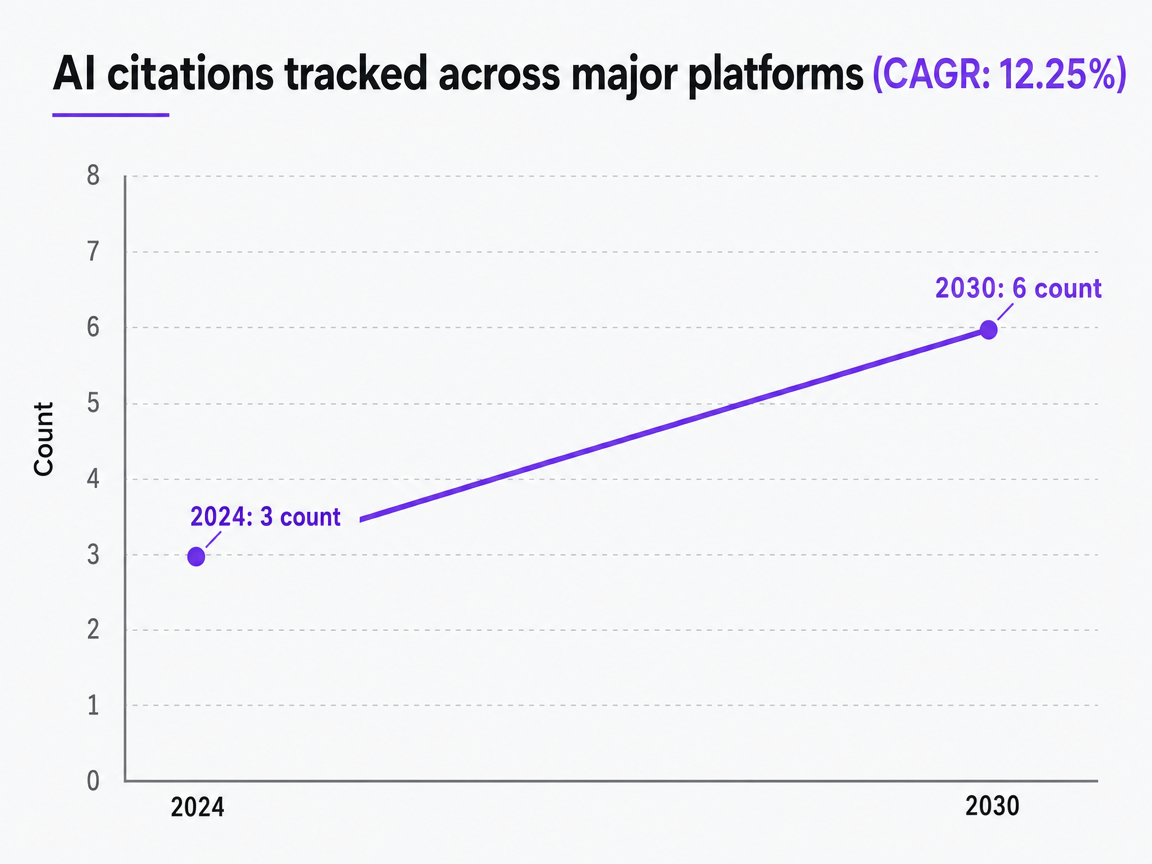 AI citations tracked across major platforms (CAGR: 12.25%)
Source: Partnerize: How to Turn AI Search Visibility Into Measurable Marketing ROI
Governing the Measurement System So the Numbers Hold Up
An attribution stack is only as defensible as the discipline behind it. The numbers a VP brings to a budget review will be challenged on inputs first, methodology second, and conclusions third, in that order. NIST's AI Risk Management Framework was written for a different audience, but its guidance translates cleanly: identify testing procedures and metrics to demonstrate whether the system is fit for purpose and functioning as claimed 14. Applied to AI search monitoring, that means the prompt set, the engines audited, the citation-counting rules, and the lookback windows all need to be documented, version-controlled, and reproducible before any pipeline number is reported.
The deeper governance argument comes from the same source. NIST frames trustworthy AI measurement as a design problem, not a reporting problem, requiring trustworthiness considerations to be built into how systems are evaluated and monitored over time 13. For a marketing team, the practical translation is a quarterly audit of the monitoring inputs: which prompts were added or retired, which engines changed their answer behavior, which citations were counted as brand mentions versus competitive context. Without that audit trail, citation share trends become a story the team tells rather than a measurement the finance team can verify.
Modeled measurement adds a second governance burden. Google's own guidance acknowledges that AI-powered measurement fills the gaps left by signal loss and privacy changes, modeling conversions when direct identifiers are missing 2. The model is useful precisely because deterministic tracking has limits, but a CFO will ask what the model assumes, how it was validated, and how often it is recalibrated. A VP who can answer those three questions defends the line item. A VP who cannot is reporting a black box.
If You Manage Multiple Locations: The Consolidation Math
The economics change when a VP owns marketing for ten, forty, or two hundred locations. At a single property, AI search monitoring is a discrete line item. Across a portfolio, it becomes a coordination problem that compounds with every vendor added to the stack. The default response to the visibility gap, bolting on tools as the gap widens, is what makes the math break.
A typical assembled stack to rebuild visibility reporting looks roughly like this:
- A rank tracker for residual keyword position data
- A dedicated AI citation monitor for ChatGPT, Perplexity, Copilot, and Gemini
- A referral analytics add-on configured with regex rules to flag AI sessions 5
- An attribution platform to run first-click and data-driven models against the right lookback window 15
- Either a content production vendor or a freelance pool to ship the answer-saturation work Forrester identifies as the optimization target 12
Each tool has its own approval surface, its own export format, and its own monthly reconciliation. The VP, or more often a senior manager, ends up rebuilding the same report by hand.
The consolidation argument is structural, not financial. The cost is coordination, measured in vendors, approval surfaces, and reports the team must reconcile each month.
| Operating model | Vendors | Approval surfaces | Monthly reports to reconcile | Specific pricing referenced |
|---|---|---|---|---|
| Bolted-on monitoring stack | 5+ (rank tracker, citation monitor, referral analytics, attribution tool, content vendor) | One per vendor | One export per tool, manually joined | None disclosed here |
| Unified execution workflow | 1 | 1 (Command Center) | 1 consolidated view | Vectoron published trial-to-paid: $599/mo after a two-week trial |
For a multi-location operator, the second row is what changes the conversation with the CFO. Forrester's 2026 framing positions AI visibility as a shared KPI across content, operations, and strategy rather than an SEO byproduct 16. Shared KPIs are difficult to govern across five vendors and one spreadsheet. They are tractable inside a single approval workflow where the monitoring signal, the ranked priority, the approved response, and the KPI feedback all live in one record per location.
Quantify Organic Search Impact With Real-Time AI Monitoring
See how enterprise-grade AI search monitoring connects keyword shifts to pipeline metrics—enabling your team to validate ROI, shorten reporting cycles, and centralize channel oversight without manual intervention.
Connecting Monitoring to Approval-Governed Execution
Monitoring outputs are only useful if they trigger work. A citation share dashboard that updates every Monday morning produces no ROI on its own; the ROI shows up when the dashboard reveals that a competitor took the lead citation on three category-defining prompts, that signal becomes a ranked priority, a writer drafts an updated comparison page, a VP approves it, and the response ships within the same week. Forrester's 2026 framing makes this loop explicit: B2B leaders are being pushed toward a more disciplined and evidence-driven approach to GenAI, which means monitoring data has to drive accountable execution, not just reporting cycles 7.
The loop has four parts and they need to be governed in order:
- The monitoring layer surfaces a citation gap, a saturation drop, or an assisted-conversion anomaly on a specific prompt set.
- The signal is ranked against the prompts that map to revenue queries so the team works on what moves pipeline, not what is easiest to fix.
- The proposed response, an updated page, a new comparison asset, a schema change, goes through human approval before anything publishes.
- The KPI feedback returns to the same record so the team can see whether citation share on that prompt actually moved within the next measurement window.
Generative tooling makes the production side of that loop tractable at the volume monitoring now demands. Marketing teams can create content, personalize experiences, and optimize campaigns faster and at greater scale than traditional approaches allow, which is what lets a small team respond to dozens of weekly citation signals instead of triaging them 4. Approval-first governance is what keeps speed from becoming a liability. Every shipped asset carries the strategic reasoning behind it and a named owner, which is the audit trail a CFO needs when asking why AI search visibility moved from 14% to 22% in a quarter.
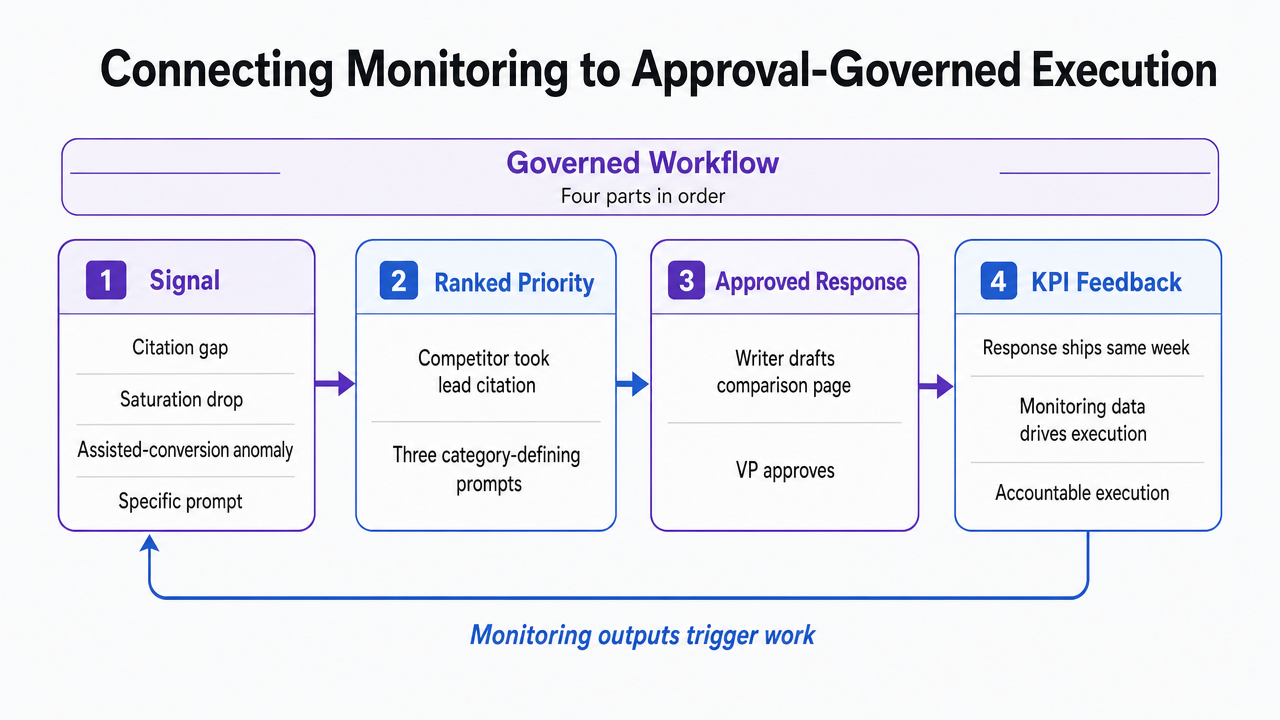 Diagram the four-part monitoring-to-execution loop described in this section (signal, ranked priority, approved response, KPI feedback) as a governed workflow
What VPs Should Build Before the 2026 Budget Cycle
The budget conversation in Q1 2026 will not be about whether AI search matters. It will be about whether the marketing team can prove its contribution with the same rigor finance applies to paid media. Forrester's 2026 outlook makes the timing concrete: visibility is being treated as a shared executive KPI rather than a search-team output, which means the reporting has to exist before the review, not after 16.
Three pieces need to be in production by the time the budget is defended:
- A documented prompt set tied to revenue queries, audited monthly across the four to six engines the team has chosen to monitor, with citation share and answer saturation reported as trend lines.
- An attribution stack with the lookback window calibrated to the actual sales cycle, AI-referred sessions flagged through regex rules, and assisted pipeline reported as a named contributor rather than a residual in branded search 5.
- An approval-governed execution loop that converts monitoring signals into ranked work, shipped responses, and KPI feedback inside the same record.
The VPs who walk into the 2026 review with those three pieces will defend organic spend on evidence. The ones who walk in with last year's session report will not. Vectoron is one example of a consolidated execution platform that runs the monitoring-to-approval loop in a single workflow, but the larger point holds regardless of vendor: the substantiation system has to be built before the budget is challenged, not assembled in response to the challenge.
Frequently Asked Questions
References
- 1.Forrester: AI search is reshaping B2B marketing.
- 2.ROI and AI-powered measurement strategies.
- 3.How to Measure the True ROI of AI Search.
- 4.Generative AI in Marketing.
- 5.Answer Engine Optimization: Stay Visible in AI Search (2026 Guide).
- 6.How to Turn AI Search Visibility Into Measurable Marketing ROI.
- 7.Forrester's B2B Marketing Predictions for 2026.
- 8.Will Zero-Click Search Kill My B2B Website?.
- 9.Americans have mixed feelings about AI summaries in search results.
- 10.AI Search Will Crack The Foundation Of B2B Marketing's Accountability Model.
- 11.Stop Replacing Traffic. Start Replacing Visibility..
- 12.Win Visibility In AI Search With Answer Engine Optimization.
- 13.AI Risk Management Framework | NIST.
- 14.Measure - AIRC - NIST AI Resource Center.
- 15.Attribution Components | Adobe Analytics.
- 16.Build Your AI Visibility Strategy At B2B Summit.