
Key Takeaways
- Treat content as structured data with typed objects, metadata, and APIs rather than pages, so one approved asset can feed web, location, schema, and API channels 1.
- Score platforms on content modeling, lifecycle workflow from creation to retirement, and measurable governance indicators like approval cycle time and redundancy rate 3, 4.
- AI belongs inside the object store with provenance tags, enforced human review, and NIST govern-map-measure-manage controls, not as a bolted-on drafting layer 5, 6.
- As a working evaluation heuristic, a content engineering platform is most warranted when several of the following apply: high volume, multiple channels, regulatory exposure, or distribution across locations and brands 1, 2, 4.
Why Content Behaves Like Infrastructure, Not Pages
The shift that matters for buyers evaluating a content engineering platform is a change in what content actually is. Pages are a presentation artifact. The underlying asset is structured data: modular components, metadata, taxonomies, and machine-readable descriptions that can be addressed by APIs and reused across channels 1. Digital.gov frames this as a "Create Once, Publish Everywhere" model that separates content from presentation 1. Once content is treated this way, the platform question stops looking like a CMS question and starts looking like an infrastructure question.
That reframing has operational consequences. A page lives and dies on one URL. A structured content object feeds a web template, a location landing page, a schema markup block, an email module, and an API consumer, and it carries its own ownership, review history, and retirement signal through a defined lifecycle 3. Governance stops being an editorial preference and becomes a measurable property of the system, with indicators such as reduced cost, shorter approval cycle time, and decreased redundancy 4.
AI accelerates both the upside and the exposure. Generative models can draft, translate, and reformat structured content at volumes editorial teams cannot match alone, which is exactly why provenance, human oversight, and documented risk management belong inside the platform rather than bolted on afterward 5, 6. The rest of this article evaluates platforms on that basis.
What a Content Engineering Platform Actually Is
Structured Content as the Foundation Layer
Strip away the dashboards and the AI chat panels, and what this article calls a content engineering platform is defined by what sits underneath: a content model. Digital.gov describes structured content as information organized like data, built from modular components, metadata, taxonomies, and machine-readable descriptions that systems can read, reuse, and recombine 1. A product description is not a paragraph on a page. It is a typed object with fields, relationships to other objects, and a schema that other systems can query.
That modeling layer is what makes the rest of the platform possible. When content exists as structured objects rather than rendered pages, the same canonical source can feed a service page, a location directory, a schema markup block, a help center article, and an outbound API consumer without being rewritten each time 1. Digital.gov frames the result as "Create Once, Publish Everywhere," with content separated from presentation so that channel formats change without disturbing the underlying asset 1.
Structured content also changes what AI can usefully do. Metadata and taxonomy give generative models and predictive systems context to work with, which improves relevance and makes outputs easier to audit 1. A platform that cannot define a content type, attach metadata, or expose objects through an API is not an infrastructure layer. It is a page editor with a pipeline attached.
How It Differs From a CMS or Standalone AI Writer
The three tools most often confused in a buying cycle are editorial AI writers, headless CMS platforms, and what this article defines as content engineering platforms. They solve different problems and should not be scored on the same rubric.
An editorial AI writer optimizes the drafting step. It produces text quickly, usually inside a document interface, and treats the output as a file to be copied into another system. A headless CMS optimizes delivery. It stores content as structured entries and exposes them through APIs so developers can render them anywhere 1. Neither category, on its own, carries the governance surface that enterprise and multi-location buyers typically need. In this article's working definition, a content engineering platform combines the structured content model with lifecycle workflow, approval gates, measurement, and AI oversight sitting on top of the same object store.
That difference shows up in what each tool measures. Governance indicators for a serious content operation include reduced cost, shorter approval cycle time, decreased redundancy, structured data with metadata, and documented APIs and data feeds 4. An editorial AI writer rarely reports on any of these. A headless CMS reports on delivery performance but not on review discipline or content retirement. In the framing this article uses, a content engineering platform is the category that treats all of them as first-class metrics tied to the same content objects 1, 4.
For evaluation purposes, the practical test is scope. If a tool only drafts, it is an editorial accelerator. If it only stores and serves, it is a repository. If it models content, enforces an approval workflow, tracks lifecycle events, and exposes measurable governance signals against the same objects, it fits the content engineering definition used here.
The Capability Stack Decision-Makers Should Score
Content Modeling, Metadata, and API Access
The first scoring dimension is whether the platform lets a team define content types, not just pages. A credible content model supports typed objects with named fields, relationships between objects, taxonomies that group them, and metadata that describes them well enough for other systems to query 1. Evaluators should ask to see the schema editor directly: what fields a content type can hold, how required fields are enforced, how taxonomies are maintained, and how metadata attaches to each object.
API access is the second half of this capability. Structured content only pays off when the same object can be read and written through a documented interface, so a web template, a location page, a schema markup block, and an external consumer all pull from one source 1. The practical test during a demo is to ask for the API documentation and a live example of a single content object rendering in two different channels. If the vendor cannot show that, the structured-content claim is cosmetic.
A third check is whether metadata is treated as a first-class input to AI features. Digital.gov notes that metadata and context help predictive systems produce more relevant outputs 1, which means a platform that generates text without reading the object's own taxonomy is losing the main advantage of the model underneath it.
Lifecycle Workflow: Create, Review, Publish, Audit, Retire
A content object is not finished at publish. It moves through a defined lifecycle:
- creation
- maintenance
- updating
- retirement
- analytics
- audits
- ownership
- formal review 3
A platform worth scoring handles each stage as a tracked state on the object itself, not as a convention that lives in a spreadsheet or a Slack channel.
The create and review stages are where approval discipline either exists or does not. Massachusetts guidance treats content management as part of service and experience management, with named owners, governance rules that prevent redundant content, and consistent language enforcement across the catalog 2. In platform terms, that translates into role-based review gates, visible owner fields on every object, and a record of who approved what and when.
Publish is the stage where API access matters again, because the same approved object should distribute to every channel it belongs to without re-entry. After publish, the measurement and audit stages take over. Mass.gov recommends recurring checks for broken links, accessibility issues, and outdated information as a standing operation rather than a one-time cleanup 2, and Digital.gov pairs that with analytics and audits that identify content to retire, consolidate, or update 3.
Retirement is the stage most platforms handle worst. A platform aligned with lifecycle guidance should let an owner mark an object for retirement, trigger a formal review, and remove or redirect it across every channel the object was feeding, with the decision logged against the object record 3. During a vendor demo, ask to see the full path from a published object to its retirement entry. If the demo cannot show it, the lifecycle claim is incomplete.
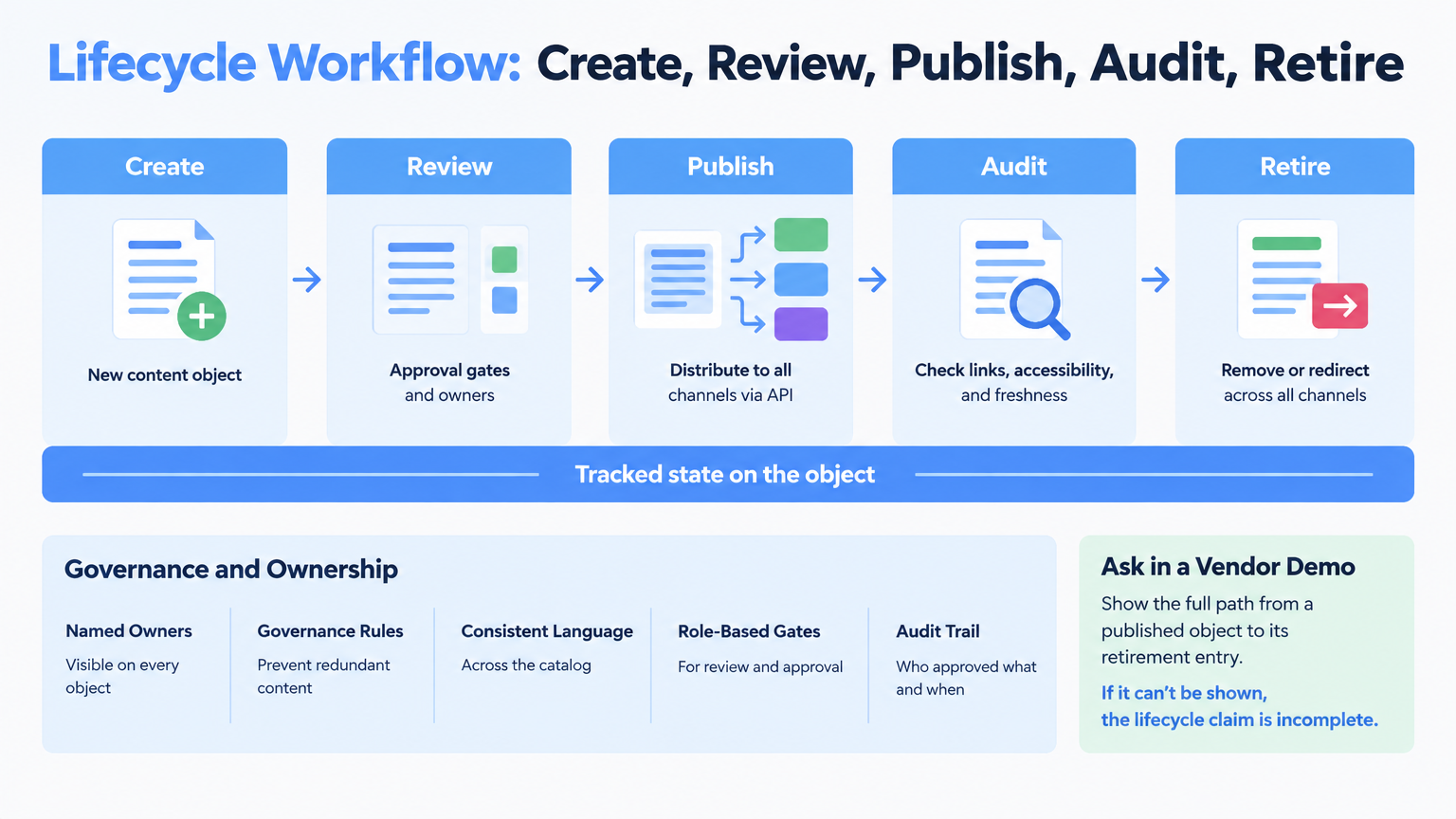 Content engineering platform lifecycle workflow: create, review, publish, audit, retire stages
A lifecycle visual anchors the workflow discussion and gives evaluators a concrete reference for scoring vendor coverage.
Measurement, Ownership, and Governance Indicators
Measurement is where the platform either earns the content engineering label or loses it. The Digital Services Governance Recommendations list a specific set of indicators that make a content operation accountable: reduced cost, shorter approval cycle time, decreased redundancy, structured data with metadata, and documented APIs and data feeds 4. Each one should map to a report inside the platform, not to a slide a vendor assembles for a quarterly review.
Ownership is the connective tissue that makes those indicators work. Digital.gov guidance on lifecycle quality assigns ownership to each content asset and uses that assignment to decide which metrics evaluate impact and who acts on them 3. In the platform, that means every content object carries a visible owner field, and governance reports filter by owner so a marketing operations lead can see where approval cycles are stalling and which assets are overdue for audit.
Redundancy reduction is the indicator that most often exposes weak platforms. Governance exists in part to prevent duplicated content and to enforce consistent language across the catalog 2, 4. A platform that cannot report on duplicate objects, overlapping taxonomies, or orphaned assets is not measuring the governance surface it claims to manage. During evaluation, request a redundancy or duplication report from live data. The quality of that single report is a reliable proxy for how seriously the platform treats governance.
AI as a Capability Layer, Not the Headline Feature
Where Generative AI Shows Up in Content Operations
Generative AI has moved from a side experiment to a standard input in content operations. McKinsey's 2025 global survey reports that 78% of respondents used AI in at least one business function, 71% regularly used generative AI, and 63% of generative-AI users self-reported creating text outputs 7. Those figures describe self-reported usage across functions, not proof that any specific platform produces measurable content gains, but they do define the surface area a content engineering platform must cover.
Inside the lifecycle, generative AI tends to attach to four stages. It drafts and reformats content during creation, translates and localizes during adaptation, extracts metadata and taxonomy tags during modeling, and summarizes analytics during audit. Each of those tasks acts on structured objects already defined in the platform, which is why the content model underneath matters more than the model prompting layer on top 1. A generation feature that cannot read an object's taxonomy, owner, or review state is working blind against the governance system it sits inside.
Scoring AI features starts with that integration test. Does the AI write into typed fields, carry metadata forward, respect the approval state of the object, and log its contribution? If it does not, it is a drafting toy next to the platform, not a capability of it.
The Governance Hinge: Human Review and Provenance
The single statistic that should shape how buyers evaluate AI inside a content engineering platform comes from the same McKinsey 2025 survey: among respondents in organizations already using generative AI, only 27% reported that all AI-generated content is reviewed before use 7. The population is self-selected adopters, and the measure is self-reported, which likely overstates review discipline rather than understating it. Even read generously, the figure means roughly three in four such respondents report that not all AI-generated outputs are reviewed.
That gap is the governance hinge. NIST's Generative AI Profile frames the response in operational terms: provenance tracking, documented accountability, and human oversight attached to systems that create or transform content 5. In a content engineering platform, those principles translate into concrete object-level behavior. Every AI contribution should be tagged with the model, prompt context, and timestamp that produced it. Every object touched by AI should carry a review state that blocks publication until a named human approver signs off. Every approval should be logged against the object record so an auditor can reconstruct who accepted what and when.
Provenance also feeds measurement. Once AI contributions are tagged, governance reports can separate AI-assisted objects from human-authored ones and track approval cycle time, revision rates, and retirement patterns across both. That separation is what turns the 27% figure from an industry statistic into a specific internal metric a marketing operations lead can move. A platform that offers generative features without provenance fields and enforced review gates is asking the buyer to adopt the risk profile the survey already described.
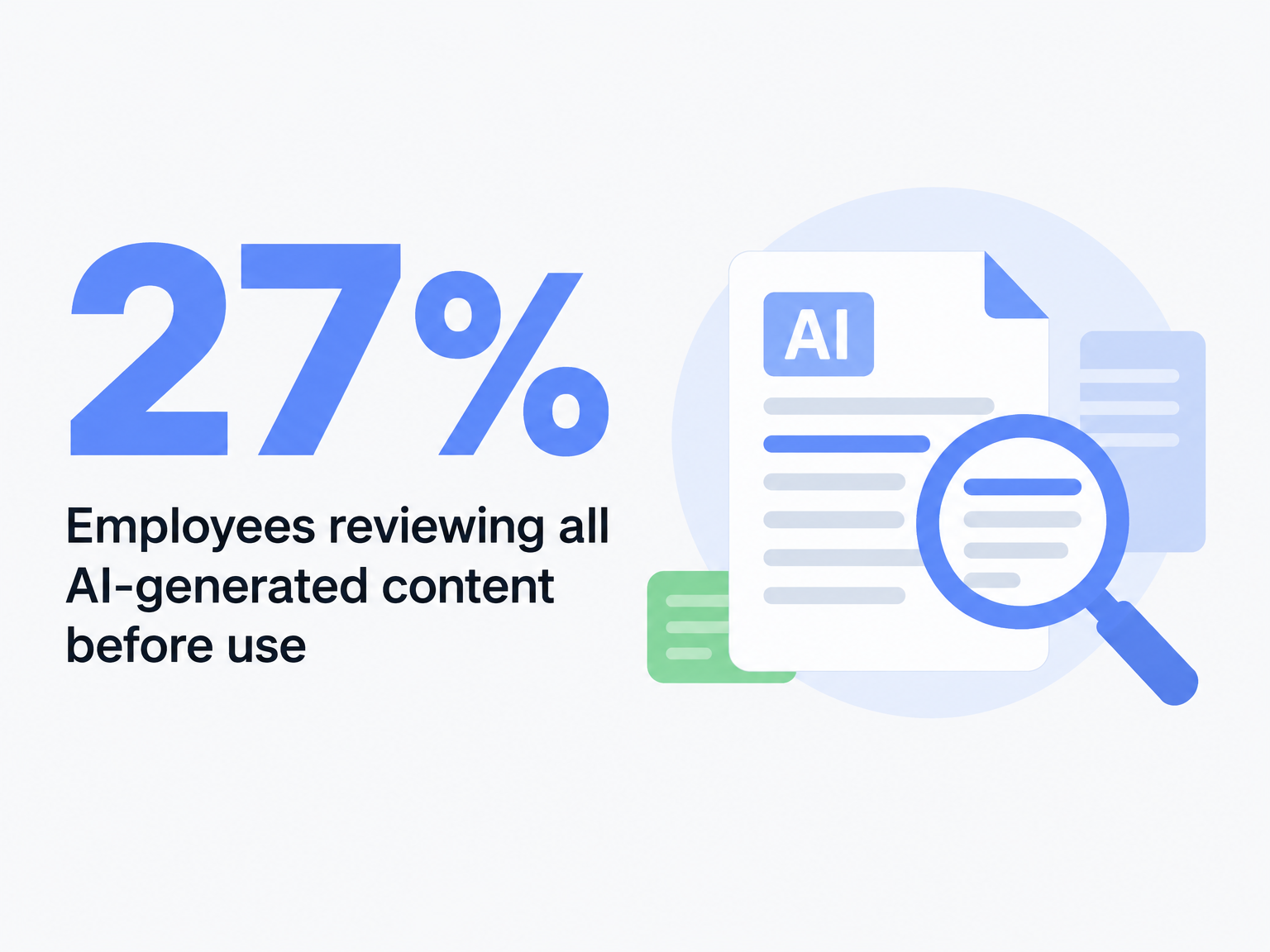 27% of employees review all AI-generated content before use
In McKinsey's 2025 global survey of AI adoption, only 27% of respondents in organizations using generative AI reported reviewing all AI-generated content before use 7. 7
Mapping Platform Choice to the NIST AI Risk Framework
The NIST AI Risk Management Framework organizes AI oversight into four functions: govern, map, measure, and manage 6. Those functions give evaluators a neutral structure for scoring how a content engineering platform handles the AI it ships with, rather than relying on vendor claims about safety or quality.
Govern : is about documented accountability. The platform should show named owners for AI features, written policies for acceptable use, and a record of model changes over time 6.
Map : is about scope. Evaluators should be able to list which content types AI can act on, which fields it can write, and which lifecycle stages it participates in, with the Generative AI Profile's risk categories (provenance, privacy, security, reliability, accountability, bias, human oversight) applied to each one 5.
Measure : is about observable signals. Review rates, revision rates, rejection rates, and incidents tied to AI-generated objects should surface as reports against the same object store the rest of the platform uses 6.
Manage is where the framework meets the approval workflow. When a measurement crosses a threshold, the platform should support a documented response: pausing a model, requiring stricter review, or retiring affected objects through the lifecycle controls already in place 3, 6. A vendor that cannot answer the govern-map-measure-manage questions with specific product behavior is offering AI as a marketing label, not a governed capability.
{{5-8 word headline for someone ready to 7-day free trial with full access to Professional plan features including content generation, publishing, and strategic deliverables — direct, no company names}}
{{One sentence under 20 words: what the reader gets by doing 7-day free trial with full access to Professional plan features including content generation, publishing, and strategic deliverables — concrete, no feature lists}}
A Fit Framework: When a Content Engineering Platform Is Warranted
Not every organization needs a content engineering platform. A small team publishing a handful of pages a month against a single channel can run on a traditional CMS and an editorial AI writer without hitting the limits that structured content solves. As a working evaluation heuristic proposed here, the fit question turns on four variables: output volume, channel count, regulatory exposure, and operational distribution across locations or brands.
Volume matters because the economics of structured content show up when the same object feeds many surfaces. If a team is drafting one page at a time and never reusing the underlying components, the modeling overhead outweighs the gain 1. Channel count sharpens the same logic. A platform earns its keep when a single approved object has to render in a web template, a location directory, a schema markup block, and an outbound API consumer without being rewritten each time 1.
Regulatory exposure changes the scoring entirely. In regulated industries, the governance surface stops being optional. Named ownership, review discipline, accessibility checks, and auditable approval records become baseline requirements rather than mature-stage upgrades 2, 3. The same applies when AI is in the drafting loop, where provenance and human oversight are specific operational controls the platform must support 5.
Distribution is the fourth variable. Organizations running content across many locations, brands, or practices need measurable governance indicators (reduced cost, shorter approval cycle time, decreased redundancy) that a fragmented stack cannot report on honestly 4. As an author-proposed rule of thumb, when several of these variables apply, a content engineering platform is likely warranted. If one or none apply, a CMS and a disciplined editorial workflow are usually enough.
If You Operate Across Many Locations, Brands, or Practices
For operators running content across many locations, brands, or practices, the economics of a content engineering platform shift from editorial convenience to measurable governance. A fragmented stack hides its cost in approval queues, duplicated assets, and audit gaps that only surface during a compliance review or a brand refresh. A structured platform exposes those costs as reportable indicators tied to the same object store 4.
The variables worth tracking map directly to supplied governance guidance rather than invented benchmarks. Approval cycle time, redundancy rate, cost per published object, and audit coverage are the four indicators that most reliably separate a working multi-location operation from one that only looks organized in a slide deck 4. Each one behaves differently under a fragmented stack than under a single structured source.
| Cost driver | Fragmented stack behavior | Content engineering platform behavior | Measurable indicator |
|---|---|---|---|
| Local page production | Each location drafts its own variant; duplicates proliferate | One structured object with local overrides renders across locations 1 | Redundancy rate 4 |
| Brand or compliance update | Manual edits propagate location by location | Update at the object; distribution flows through the API 1 | Approval cycle time 4 |
| Quality assurance | Ad hoc checks per site; broken links and outdated information accumulate | Scheduled audits for broken links, accessibility, and outdated content 2 | Audit coverage 2, 3 |
| Retirement and consolidation | Orphaned pages persist; ownership unclear | Named owner marks the object for retirement; removal logged across channels 3 | Reduced cost from consolidation 3, 4 |
The pattern that emerges is consolidation. A single approved object feeding many locations collapses the duplication tax that multi-brand operators pay by default, and the lifecycle controls make retirement an actual event rather than a backlog item 3. Operators evaluating platforms at this scale should ask for the redundancy report, the approval cycle report, and the retirement log pulled from live data. If any of the three cannot be produced, the governance surface the platform claims to manage is not yet instrumented.
Buying Signals, Red Flags, and the Path to a Demo
By the time a buyer is scheduling demos, the shortlist usually contains at least one vendor from each of the three categories the earlier sections separated. The job of the demo is to confirm which one is actually a content engineering platform under the surface. Three signals indicate the real thing:
- The vendor can render a single structured object into two different channels through a documented API during the call 1.
- The platform shows named owners, approval states, and lifecycle events on the object record itself, not in an attached document 3.
- Governance reports pull from live data, including a redundancy report, an approval cycle time report, and a retirement log tied to the same object store 2, 4.
The red flags are equally concrete:
- AI features that write free text without reading an object's taxonomy or review state are a drafting layer, not a governed capability 1, 5.
- A workflow where approval lives in email or a separate project tool breaks the audit chain the NIST framework expects 6.
- A vendor that cannot answer govern-map-measure-manage questions with specific product behavior is selling a label 6.
Walk into the demo with those requests written down, and the fit decision resolves itself in a single session.
See Real-World Content Engineering Metrics Before You Choose
Get hands-on access to multi-channel analytics, approval workflows, and content automation tools designed for scalable marketing operations—so you can evaluate platform fit using your own data and decision criteria.
Frequently Asked Questions
References
- 1.An introduction to structured content.
- 2.Starter kit: Content management is experience management.
- 3.Crafting quality content throughout its lifecycle.
- 4.Digital Services Governance Recommendations.
- 5.Artificial Intelligence Risk Management Framework: Generative Artificial Intelligence Profile.
- 6.AI Risk Management Framework.
- 7.The state of AI.
- 8.The state of AI in 2025: Agents, innovation, and transformation.