
Key Takeaways
- Google's June 2026 Search Generative AI performance reports made AI visibility first-party data, giving citation and impression metrics the same evidentiary weight as traditional click data 1.
- A defensible reporting model organizes AI search into three layers—input signals like entity salience, channel signals like citation rate and share of voice, and performance signals tied to pipeline 2.
- Zero-click AI citations belong in multi-touch attribution as a distinct exposure KPI class, weighted separately from clicks and reviewed quarterly against AI-referred conversion behavior 3, 7.
- VPs should track a stable set of 30 to 50 priority queries monthly across AI surfaces, then consolidate location-level reporting to recover analyst hours lost to vendor reconciliation 6.
The June 2026 Pivot: When AI Visibility Became First-Party Data
In June 2026, Google rolled out Search Generative AI performance reports inside Search Console, giving site owners dedicated views of impressions and page-level visibility within AI Overviews, AI Mode, and generative AI in Discover 1. This marked a significant shift. Previously, AI visibility tracking relied on third-party crawlers and inference models 5. With Google's native reports, this data gained the same evidentiary weight as traditional organic click data, integrating seamlessly into existing performance reporting and becoming a critical line item on organic performance dashboards.
This change means any organic performance narrative focusing solely on rank position and blue-link CTR is incomplete. The new reporting layer provides a more comprehensive view, allowing marketing leaders to integrate AI visibility into pipeline forecasts that resonate with finance teams.
What the Old SEO Dashboard Stopped Explaining
The standard Search Console Performance report, designed to track clicks, impressions, average position, and query-to-page relationships 9, became insufficient when users could complete research tasks via synthesized AI answers without visiting a website. Before Google's native generative reports, SEO teams attempted to estimate AI-driven impressions using heuristic filters and NLP categorization 5, but these outputs lacked the evidentiary standard required for executive-level reporting.
The new Search Generative AI performance reports provide page-level visibility within AI Overviews, AI Mode, and generative features in Discover, reported through the same interface as legacy data, with dimensions for pages, countries, devices, and dates 1. This highlights the limitations of the legacy dashboard:
- Rank position no longer fully describes top-of-page visibility when an AI Overview is present,
- CTR curves underrepresent visibility when queries are satisfied by synthesized answers, and
- Query-to-page analysis misses citations within conversational AI platforms like ChatGPT, Perplexity, Gemini, and Copilot 8.
A dashboard built solely on clicks and ranks now measures a diminishing portion of overall demand.
A New Reporting Model: Input, Channel, Performance
A robust replacement for the legacy SEO dashboard requires a structure that finance teams can consistently follow. The iPullRank framework organizes AI search reporting into three interconnected layers: input signals, channel signals, and performance signals 2. This layered approach allows marketing leaders to explain changes at each level without switching frameworks, providing a coherent narrative from content preparation to revenue impact.
Input Layer: Content Alignment and Entity Salience
The input layer assesses the quality of content for AI consumption. Key signals include passage relevance, which measures how cleanly a page answers specific questions in an extractable format, and entity salience, indicating how strongly a brand or product is associated with its target topics 2. These are leading indicators; improvements here often precede increases in citation rates.
Practical inputs include schema coverage, internal linking density, presence in third-party knowledge graphs, and the ratio of structured content suitable for direct extraction 7. A marketing leader needs a single input-health score to identify when the pipeline of citable content is diminishing, allowing for upstream corrections before channel metrics decline. This layer functions like a leading indicator for a sales pipeline, predicting future performance.
Channel Layer: Citation Rate, Share of Voice, Sentiment
The channel layer tracks how AI surfaces interact with content. Four metrics are crucial:
- Share of voice (percentage of AI responses mentioning the brand),
- Citation rate (frequency of the brand appearing as a named source or linked reference),
- Citation quality (prominence of the mention), and
- Citation sentiment (favorable, neutral, or critical framing) 2.
These metrics apply across various AI surfaces, including Google's AI Overviews and AI Mode, as well as ChatGPT, Perplexity, Gemini, and Copilot 8, 11. A comprehensive channel view aggregates these into a single share-of-voice number per priority topic. This layered structure ensures defensibility, as input metrics predict channel metrics, which then feed into the performance layer, connecting directly to revenue expectations.
Performance Layer: Traffic, Conversions, Pipeline
The performance layer links AI visibility to financial metrics: traffic, conversions, and engagement depth 2. AI referrer traffic from sources like chat.openai.com, perplexity.ai, and gemini.google.com should be segmented as a distinct channel in analytics, rather than being grouped into direct or referral traffic 7. This segmentation is crucial for attributing AI-driven pipeline accurately.
Conversion depth is particularly important here. While AI search referrals are growing, traditional organic traffic often converts at higher rates 7, 11. Separating these streams prevents obscuring where pipeline is truly forming. This layer answers the CFO's fundamental question about marketing spend's impact and provides insights into future expectations based on the preceding channel and input layers.
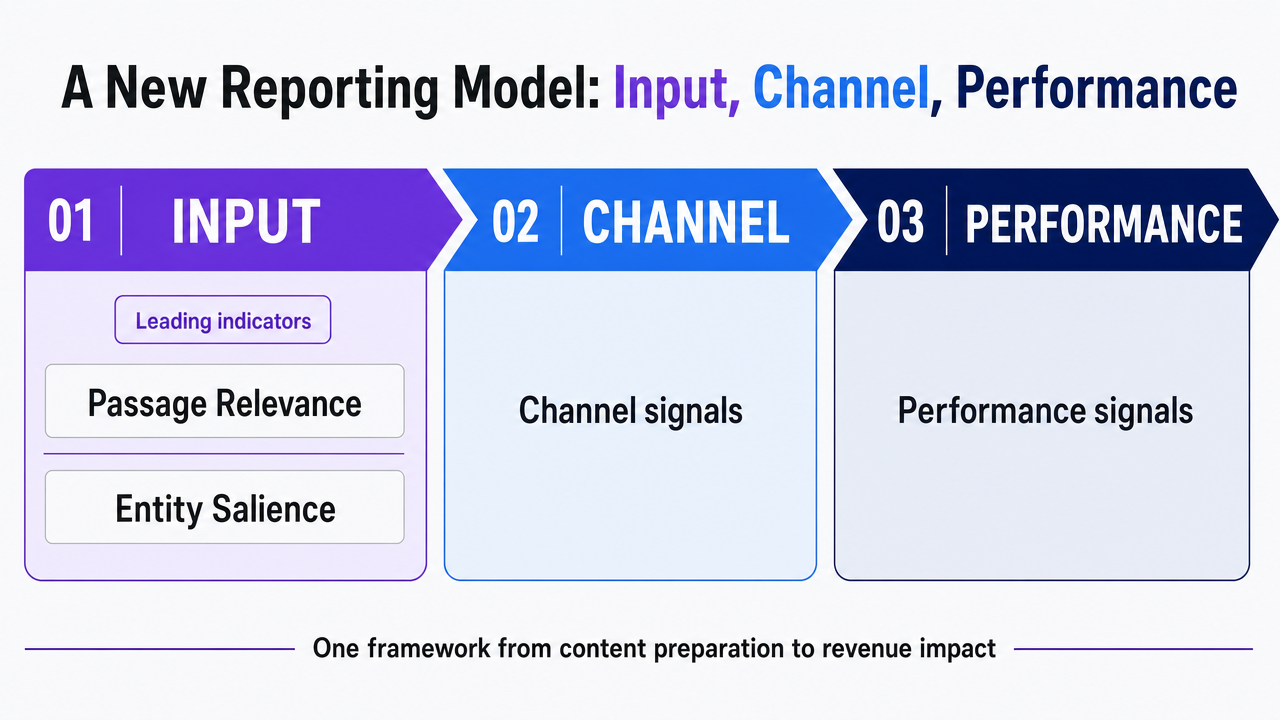 Visualize the three-layer AI search measurement framework (Input, Channel, Performance) that structures the entire section, sourced from iPullRank
See Real-Time SEO Impact With Full Access
Test live AI visibility tracking and measure organic pipeline shifts before making a commitment.
Wiring AI Citations Into Multi-Touch Attribution
An AI citation is an exposure within a synthesized answer, occurring before a potential site visit. This makes it distinct from a click and necessitates its inclusion in a multi-touch attribution model, which assigns credit to various touchpoints along the customer journey 3.
Integrating AI citations involves three tasks:
- Defining AI referrer traffic (e.g., from chat.openai.com, perplexity.ai, gemini.google.com) as its own channel in analytics 7;
- Incorporating citation events from AI visibility tools as unclicked touchpoints linked to priority topics; and
- Establishing a weighting rule for these exposures within the attribution model.
Enterprise reporting now considers AI citation frequency and share of voice as key performance indicators alongside revenue attribution 11. This allows marketing VPs to demonstrate the impact of AI visibility investments by connecting citation rates to branded search volume, direct traffic, and pipeline closure rates within the existing attribution framework.
To maintain accuracy, citation touchpoints should initially be weighted conservatively and reviewed quarterly against actual conversion behavior from AI-referred sessions. Additionally, AI-referred traffic must be reported separately from traditional organic traffic in the performance layer, as their conversion rates differ 7.
The Zero-Click Impression Problem and a Defensible Position
A citation within an AI Overview, even without a click, represents a valuable exposure. While some view AI citations as top-of-funnel influence for multi-touch models, others caution against inflating ROI claims without downstream tracking 2.
A defensible approach is to treat zero-click impressions as a distinct KPI class: exposure metrics, weighted separately from click-based touchpoints within the attribution model 3. Share of voice and citation rate should have their own dashboard row, with their movement narrated against changes in branded search volume, direct traffic to cited pages, and pipeline from segments exposed to tracked queries 2.
Three disciplines ensure this position is honest:
- Reporting AI-referred sessions separately from traditional organic due to differing conversion rates 7;
- Documenting and quarterly reviewing the weighting rule for citation touchpoints; and
- Explicitly noting data-completeness limitations across various AI surfaces (ChatGPT, Perplexity, Gemini, Copilot) as a required footnote 12.
This provides the CFO with a consistent, evolving method rather than false certainty.
Making Content Citable: What Actually Moves the Citation Rate
Citation rate is driven by content structure that enables generative systems to extract, attribute, and trust information. Three primary levers influence this: schema markup, passage-level extractability, and strong entity signals.
Schema markup is highly measurable. Analysis shows that FAQ, HowTo, and Article schema types are associated with a 73% boost in the likelihood of a page being included in AI Overviews, compared to similar pages without structured data 4. This applies when schema is appropriately deployed on relevant content templates.
Passage extractability is the second lever. Generative systems often pull short, self-contained answers. Therefore, a well-structured H2 followed by a concise two-to-three sentence answer is more citable than information embedded within a longer narrative paragraph 7. Content teams should audit priority pages and restructure sections that answer key questions into this extractable format.
Entity salience is the third lever. Consistent mentions across authoritative third-party publications, expert commentary by named authors, and internal linking that reinforces topic-brand associations all increase the likelihood of AI systems treating a domain as a credible source 4. This lever builds trust over time and provides lasting benefits.
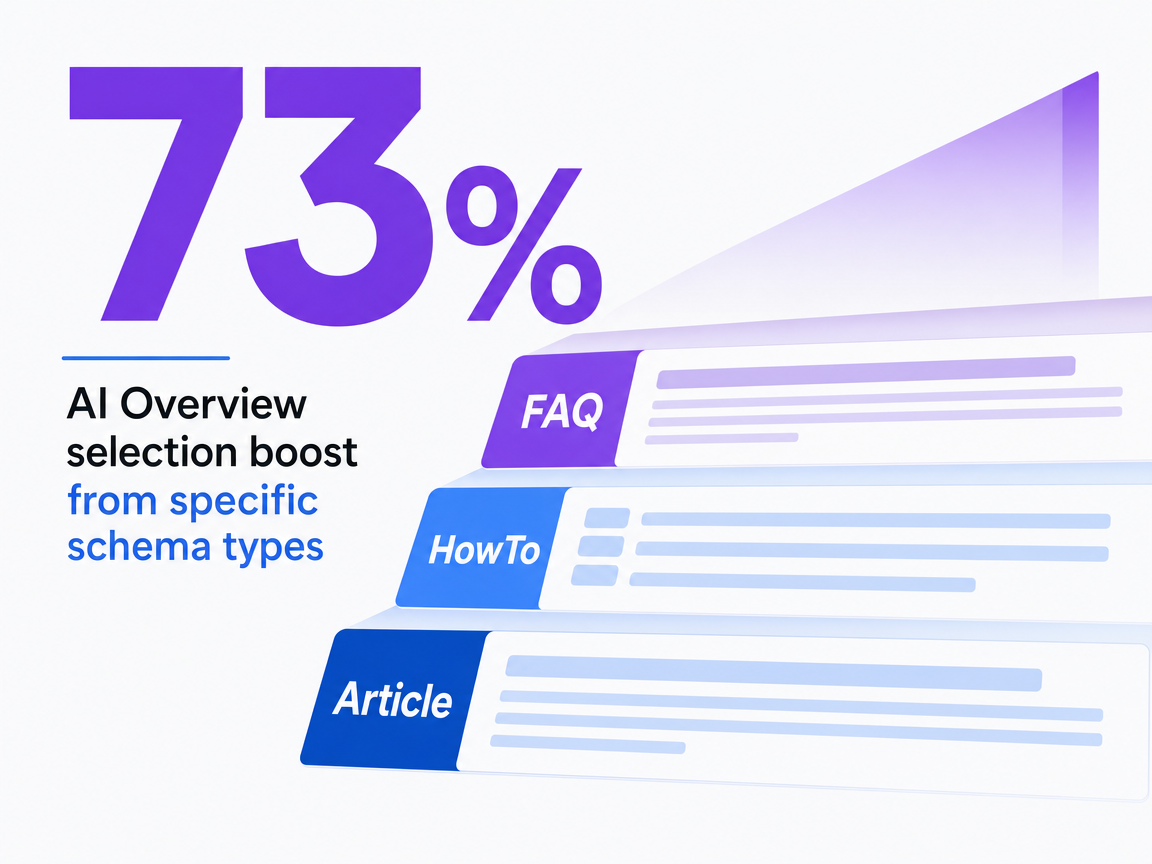 AI Overview selection boost from specific schema types
AI Overview selection boost from specific schema types
See How AI Visibility Tracking Delivers Real-Time SEO Impact Metrics—No Manual Reporting Required
Request a walkthrough of AI visibility tracking in action and discover how leading teams are replacing static SEO reports with automated, actionable insights across all channels.
A Monthly Cadence: 30 to 50 Priority Queries, Reviewed at the VP Level
Establishing a regular reporting cadence transforms AI visibility from a mere dashboard into a strategic management practice. Enterprise SEO guidance recommends tracking AI citation rates monthly across a fixed set of 30 to 50 priority queries 6. This number is manageable for review yet comprehensive enough to cover key topics driving pipeline for growth-stage or multi-location businesses.
Query selection is critical. The set should align with buyer questions preceding conversion, including comparative queries, category-defining questions, service-specific prompts, and location-modified variants. Once established, this set should remain stable for at least two quarters to ensure month-over-month movement reflects channel behavior rather than measurement drift.
The monthly review focuses on four metrics per query: share of voice, citation rate, citation sentiment, and citation quality 2. These are rolled up into topic clusters for VP review, with drill-down capabilities for material movements. The review connects movement in the channel layer to the input layer (e.g., a decline in citation rate linked to a schema or entity gap) and forward to the performance layer (pipeline impact) 11. This structure yields actionable outputs: one to three input-level changes for content and technical teams, prioritized by their expected effect on future channel metrics.
If You Manage Multiple Locations: The Consolidation Economics
For multi-location operators (e.g., DSO groups, home services franchises), managing AI visibility reporting presents a unique challenge. Each location multiplies the query set, citation surfaces, and vendor coordination. A VP overseeing 40 locations needs a consolidated AI visibility dashboard, not 40 individual ones, to avoid turning monthly reviews into reconciliation exercises.
The traditional approach often involves multiple vendors:
- An SEO agency for traditional reporting,
- A dedicated AI visibility tool,
- An attribution consultant, and
- An internal analytics engineer 8, 12.
Each operates on its own cadence and format, leading to fragmented reporting. The table below illustrates the cost structure, with the sourced input being the practice of tracking 30 to 50 priority queries monthly per domain 6.
| Cost line | Assembled stack | Unified workflow |
|---|---|---|
| SEO agency retainer | Monthly retainer × locations covered | Included |
| AI visibility tool license | Per-domain or per-query tier × 30–50 queries × locations 6 | Included |
| Attribution consulting | Project fee to wire citation events into MTA 3 | Included |
| Internal analyst hours | Hours per month reconciling four vendor outputs | Review hours only |
| Coordination overhead | Status meetings × vendors × weeks | Single review cadence |
The primary benefit of consolidation is not just license savings, but the recovery of analyst hours. When citation rate, share of voice, and pipeline attribution are presented in a single view, on a consistent schedule, across all locations, the operational efficiency gains are substantial. This often overlooked line item is where unified platforms like Vectoron offer significant value compared to an assembled stack of disparate tools.
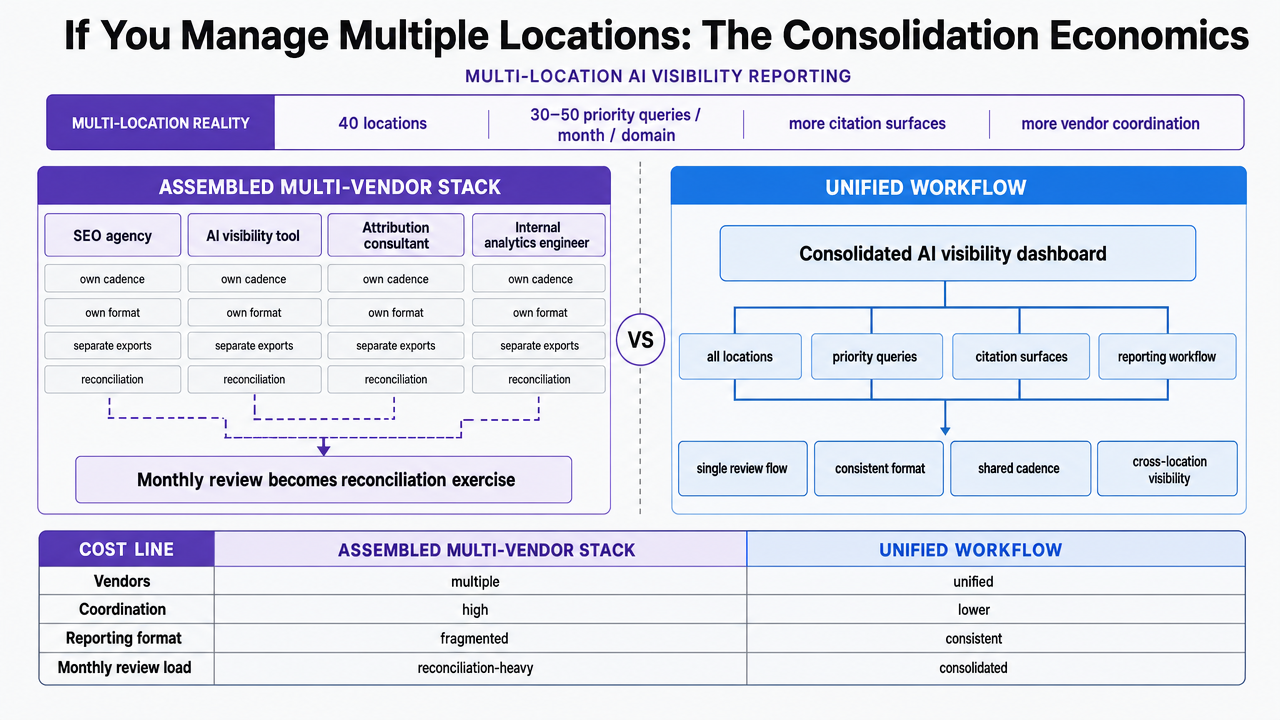 Visualize the comparison table already in the section, contrasting the assembled multi-vendor stack against a unified workflow for multi-location AI visibility reporting
What the New Dashboard Shows the CFO
The finance review demands a clear, concise view that answers three questions: organic influence's quarterly production, leading indicators for the next quarter, and the methodology behind the numbers. The replacement dashboard addresses these on a single page.
At the top, the performance layer reports pipeline and closed revenue from organic, with AI-referred sessions from chat.openai.com, perplexity.ai, gemini.google.com, and similar hostnames clearly segmented as their own channel 7. Below this, the channel layer displays share of voice, citation rate, citation quality, and citation sentiment across AI Overviews, AI Mode, ChatGPT, Perplexity, Gemini, and Copilot for the fixed set of 30 to 50 priority queries reviewed monthly 2, 6. At the base, an input-health score indicates whether the pipeline of citable content is thinning before channel metrics decline.
Two footnotes enhance defensibility: one stating the weighting rule for zero-click citation touchpoints within the multi-touch model 3, and another outlining data-completeness limitations across various AI surfaces 12. This comprehensive dashboard, consolidated by platforms like Vectoron, provides a marketing leader with a robust, line-by-line defensible reporting workflow for finance reviews.
Frequently Asked Questions
References
- 1.Introducing Search Generative AI performance reports in Search Console.
- 2.From Clicks to Citations: New AI Search Measurement Metrics.
- 3.Multi-Touch Attribution: What It Is & Best Practices.
- 4.E-E-A-T for AI Search: How to Build Authority That Gets Cited by AI.
- 5.Extracting AI Overview Impressions from Google Search Console: A Comprehensive Guide.
- 6.The Enterprise Guide to Winning in SEO & AI Search.
- 7.Generative search optimization in 2025: What the data says (and what smart brands are doing about it).
- 8.Top Tools for Tracking AI Visibility.
- 9.GSC Performance Report – 5 Actionable Insights.
- 10.Enterprise SEO Guide – Framework & Business Case for ROI.
- 11.Enterprise SEO: The Complete Strategy Guide for 2026.
- 12.The Best AI Visibility Tracking Tools (My Honest Reviews).