
Key Takeaways
- Named-account ABM programs organize work around buying groups rather than leads, and mature programs consistently outperform their own revenue forecasts across industries 5.
- Intent-driven paid media narrows spend to accounts already researching the category, measured by opportunities created inside named accounts rather than clicks or form fills.
- Interest-generation events feed pipeline only when engineered against a named-account list, with event teams now retooling programs for revenue contribution over awareness 1.
- Mid-funnel seminars, workshops, and lunch-and-learns move stalled opportunities forward when the invite list is built jointly with sales from open deals in a defined stage 4.
- Stimulus-offer content nurture educates mid-stage buyers with stage-triggered assets, measured on time-in-stage compression against a matched control rather than open rates.
- Sales-enablement offers arm the AE with ROI models, benchmark reports, and briefing decks to reopen stalled deals, requiring agreed criteria for opportunity inclusion 7.
- Executive dinners and roundtables target late-stage opportunities with content centered on customer references and financial justification, measured on closed-won lift versus matched controls 10.
- Customer-reference and financial-justification programs clear internal buyer friction—procurement, CFO sign-off, legal review—when marketing and sales agree in advance on qualifying opportunities 9.
- Omnichannel orchestration suppresses generic marketing against late-stage accounts and coordinates every touch so buying committees see a single narrative across channels 8.
Why Pipeline Zone Beats Channel When Choosing a Campaign
Most "best marketing campaigns" lists organize themselves by channel—paid social here, content marketing there, events in a separate bucket. That taxonomy is convenient for agencies selling services, but it's the wrong lens for a VP measured on pipeline contribution. A paid campaign aimed at cold buying committees does not do the same job as a paid campaign built to re-engage a stalled Q3 opportunity, even when the media type looks identical on a spend report.
Forrester's pipeline acceleration framework separates campaigns by the zone of the funnel they act on: rapid entry, intra-pipeline, and last mile 7. Each zone has its own selection criteria, its own tactic menu, and its own success metric. Rapid-entry work is judged on qualified opportunities created; intra-pipeline work on stage progression; last-mile work on closed-won revenue among stimulated deals versus controls 10.
That distinction changes portfolio design. A team running six top-of-funnel plays and one last-mile tactic will generate leads and stall deals in parallel. The nine campaign archetypes that follow are grouped by pipeline zone for that reason—so the mix can be balanced against where revenue is actually leaking, not against which channels the team happens to have vendors for.
The Three Acceleration Zones That Organize the Nine Campaigns
Forrester's pipeline acceleration model splits programs into three types by where they act on an opportunity: rapid entry pulls fresh interest into qualified pipeline, intra-pipeline moves opportunities that have stalled inside the funnel, and last mile pushes late-stage deals to closed-won 7. Each zone uses different selection criteria for which accounts or opportunities qualify, and each is measured against a different outcome—stage entry, stage progression, or revenue booked.
Cutting across those three zones is a second distinction that governs what a campaign actually does inside the touchpoint. Forrester separates acceleration tactics into stimulus offers, which educate a buyer enough to move forward on their own, and sales enablement offers, which arm the account executive with a reason and a resource to reopen a conversation 9. A webinar that reframes a business problem is a stimulus offer. A packaged ROI model delivered by the AE is a sales enablement offer. Both can appear in any zone, but the mix shifts as opportunities mature: rapid entry leans heavily on stimulus content, last mile leans on sales enablement assets that reduce late-stage risk.
That two-axis grid—zone by tactic type—is how the nine campaign archetypes below are organized. Three campaigns sit in rapid entry, three in intra-pipeline, and three in last mile. Within each zone, the mechanic named in the archetype signals whether marketing is educating the buyer directly or building an offer the sales team will carry. Reading the portfolio through both dimensions is what prevents the common failure mode Forrester flags: activity that produces motion without moving opportunities 9.
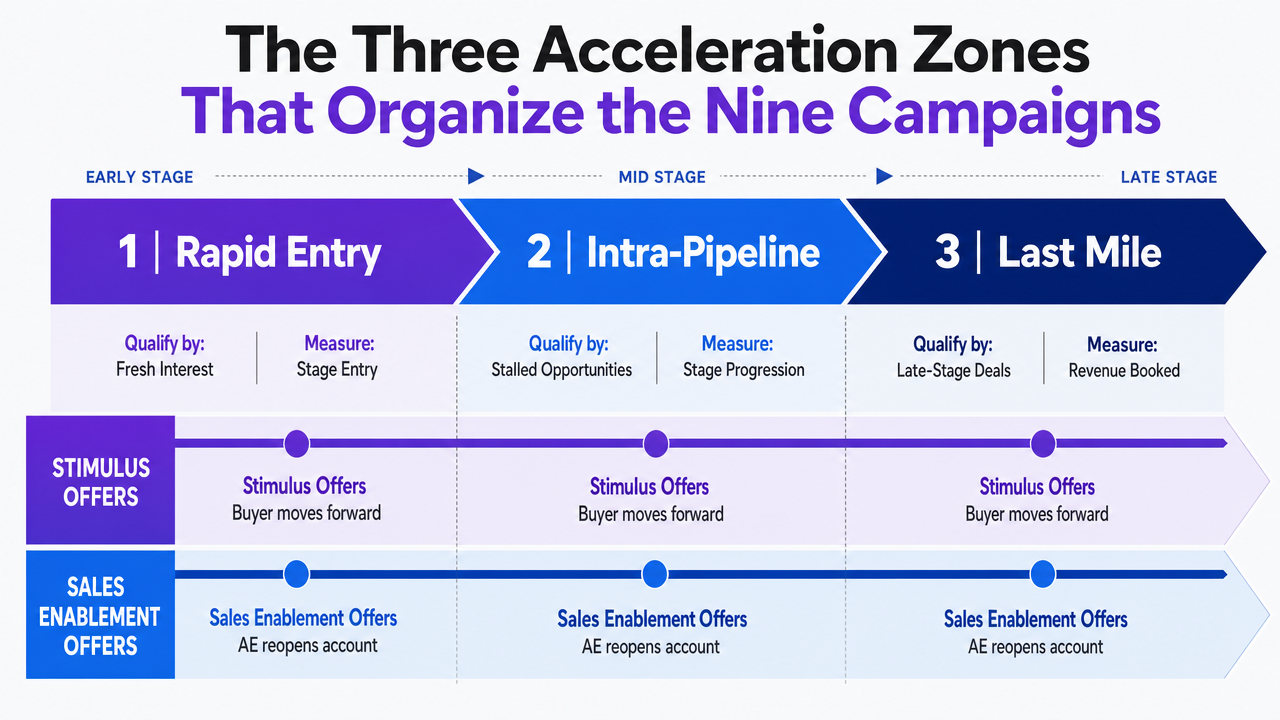 Visualize the two-axis framework (three pipeline zones by two tactic types) that organizes the nine campaign archetypes, directly supporting the section's framework explanation
Rapid Entry Campaigns: Turning New Interest Into Qualified Opportunities
Named-Account ABM Programs Built Around Buying Groups
Account-based marketing sits at the front of any pipeline portfolio because it changes the unit of work from a lead to a buying group. Forrester's foundational guide defines ABM as a coordinated program that starts with named-account selection, maps the individuals in each buying committee, and orchestrates stage-appropriate touches across marketing and sales 2. The mechanic is not a single tactic. It is a sequence: pick the accounts worth naming, identify the six to twelve humans who will actually influence the decision, and design interactions that fit where each account sits in its own buying process.
The revenue case for putting ABM at the top of the portfolio comes from program maturity data. Forrester's review of ABM outcomes found that organizations with longer-running, more mature ABM programs deliver revenue results that outperform their own forecasts—a pattern that holds across industries and program sizes 5. That finding matters for a VP defending portfolio choices to a CRO. New ABM pilots produce mixed results; programs in their third or fourth year, with tightened account lists and disciplined measurement, consistently beat prediction.
Rapid-entry ABM works because it collapses the timeline between first touch and qualified opportunity. Instead of waiting for inbound signals from a named account, the program treats the account as already in-market and coordinates outbound, digital, and field motions against the buying group 6. Measurement follows the same logic: opportunities created inside named accounts, weighted by target account tier, not raw MQL counts.
Intent-Driven Paid Media Aimed at Open Buying Committees
Intent-driven paid media is the second rapid-entry archetype, and it earns its slot by narrowing paid spend to accounts already showing research behavior. Rather than buying impressions against a broad ICP, the campaign layers third-party intent signals, technographic filters, and known-account lists to serve display, LinkedIn, and programmatic ads to committees currently evaluating the category. The buying object is opportunity creation inside a defined account set, not clicks or form fills against the open web.
The archetype fits the omnichannel orchestration argument McKinsey makes about modern B2B buying. Buying committees now move fluidly across digital self-serve, remote conversations, and field interactions, and paid media performs when it is one coordinated channel inside that mix rather than a standalone lead source 8. A committee member who sees a display retarget after a competitor comparison download and then receives a relevant outbound sequence from the AE is inside a designed motion, not a coincidence.
Measurement should follow the same discipline as ABM: opportunities sourced or influenced inside named accounts, cost per opportunity by account tier, and progression from first ad exposure to first sales conversation. Vanity metrics—CTR, CPM, form-fill counts—describe the media buy, not the pipeline outcome. A VP defending the line item to finance needs the pipeline number, and the campaign should be instrumented to produce it from day one.
Interest-Generation Events That Feed a Named-Account List
Events built for interest generation sit at the top of the funnel but earn their pipeline reputation only when they are engineered against a named-account list rather than an open registration page. Forrester's event pipeline framework separates interest-generation formats—category webinars, industry summits, virtual roundtables—from mid-funnel and last-mile formats, and it prescribes different attendee-selection logic for each 4. The rapid-entry variant is designed to pull in-market accounts into a first substantive conversation, not to maximize registration counts.
Forrester's 2024 event trends survey, based on responses from more than 200 event decision-makers, found that organizations are retooling event programs to contribute directly to pipeline and revenue rather than awareness alone 1. That shift is what makes the interest-generation event a pipeline campaign instead of a brand activity. The content is chosen to attract the right buying committees; the follow-up is designed with sales to convert attendance into qualified opportunities inside target accounts.
The operational tell of a well-designed interest-generation event is the registration list. If more than a small share of attendees fall outside the named-account list, the program is functioning as awareness, not rapid entry. Tightening the invite motion is the highest-leverage adjustment.
Test Real-World Campaign Execution With Full Access
Launch and measure actual marketing campaigns before making a commitment.
Intra-Pipeline Campaigns: Moving Stalled Opportunities Forward
Mid-Funnel Seminars, Workshops, and Lunch-and-Learns
Mid-funnel events exist to move opportunities that have entered the pipeline but stopped progressing. Forrester's event framework calls out local and regional seminars, workshops, and lunch-and-learns as among the most effective formats for the middle of the pipeline, precisely because they are small, tightly targeted, and content-heavy in ways that a top-of-funnel webinar cannot be 4. The right attendee list for one of these programs is not a marketing database segment—it is a joint list built with sales, drawn from open opportunities in a defined stage.
Event archetypes distribute across the pipeline in a predictable pattern:
- Interest-generation formats—category webinars and industry summits—sit at the top of the funnel and produce first conversations.
- Mid-funnel seminars, half-day workshops, and lunch-and-learns sit inside the pipeline and produce stage progression on named opportunities.
- Executive dinners and small roundtables sit at the last mile and produce closed-won outcomes on late-stage deals 4.
A team running only the first and third formats will feel the intra-pipeline gap in stalled stage-two and stage-three deals.
The measurement discipline follows the format. Attendance is a proxy; the pipeline number is stage movement inside the invited opportunity set within a defined window. If a workshop pulls sixty attendees but produces no forward stage motion on the opportunities that generated the invites, the program functioned as content, not intra-pipeline acceleration.
Stimulus-Offer Content Nurture for Mid-Stage Buyers
Stimulus-offer nurture is the intra-pipeline archetype built entirely out of content. Forrester defines a stimulus offer as an asset designed to educate a buyer enough to move the opportunity forward on their own, without waiting for a seller-driven push 9. In the middle of the pipeline, that means resources aimed at the specific objections and internal-selling problems buying committees hit between initial interest and serious evaluation: business-case templates, competitive teardown briefs, implementation reference architectures, peer benchmark reports.
What separates a stimulus program from a generic content newsletter is the trigger. The delivery is keyed to opportunity stage and last activity date inside CRM, not to a marketing cadence. An opportunity that has sat in stage two for thirty days receives a different asset than one that has sat in stage three for sixty. The buying committee identified during account planning receives assets mapped to each member's role—economic buyer, technical evaluator, end-user champion.
Measurement runs on stage progression and time-in-stage compression within the nurtured set versus a matched control. Open rates and downloads describe engagement with the asset. The pipeline number is whether stalled opportunities that received the stimulus moved forward faster than comparable opportunities that did not.
Sales-Enablement Offers That Re-Ignite Stalled Deals
Where the stimulus offer educates the buyer directly, the sales-enablement offer arms the account executive with a reason and a resource to reopen a conversation on a stalled deal. Forrester draws that distinction explicitly: acceleration activity should either give the buyer confidence to move forward or put the seller in a position to re-ignite the opportunity 9. Both belong in an intra-pipeline portfolio, but they answer to different owners and produce different artifacts.
Common sales-enablement offers include:
- Packaged ROI models tailored to the prospect's industry
- Custom benchmark reports built from the buyer's own inputs
- Executive-briefing decks aligned to a named committee member's priorities
- Pilot-scoping documents that lower the perceived risk of a first commitment
Each is a marketing-produced asset, but delivery is the seller's job. The campaign design specifies which stalled-opportunity criteria trigger which asset, and how quickly the AE is expected to use it.
Selection discipline is what keeps the program from becoming an on-demand content desk. Forrester's guidance is that intra-pipeline programs work only when marketing and sales agree on the criteria for opportunity inclusion and the observable outcomes that define success 7. Without that agreement, sales enablement collapses into ad-hoc requests, and the acceleration effect disappears into individual rep behavior rather than a measurable campaign.
Last-Mile Campaigns: Closing the Deals Already in Motion
Executive Dinners and Roundtables for Late-Stage Opportunities
Last-mile events exist for a narrow purpose: pushing late-stage opportunities over the line. Forrester's last-mile framework prescribes small, high-touch formats—executive dinners, private roundtables, onsite working sessions—built around a specific set of deals close to a decision 10. The invitee list is not a marketing segment. It is a short roster of economic buyers and executive sponsors attached to opportunities the sales team has flagged as winnable inside a defined quarter.
Content design at this stage shifts away from category education. Forrester's guidance is to center late-stage event content on customer experience and the financial aspects of the deal—reference conversations with existing customers at similar stages, cost-of-inaction framing, procurement and implementation questions surfaced by the buying committee 10. A dinner that recycles a top-of-funnel keynote deck wastes the format. The room is already sold on the category; the work is retiring the last objections.
Measurement is the discipline that separates a pipeline event from a hospitality expense. Forrester recommends tracking closed-won outcomes among event-stimulated opportunities against a matched control set of comparable deals that did not receive the touch 10. That comparison, run quarterly, is what a VP brings into a QBR to defend the line item. Attendance and post-event survey scores describe the evening. The pipeline number is whether the invited deals closed faster and at higher rates than the deals that did not get a seat at the table.
Customer-Reference and Financial-Justification Programs
The second last-mile archetype is a structured program that pairs late-stage opportunities with customer references and financial-justification assets. It sits on the sales-enablement side of Forrester's tactic split: the buyer has decided the category is worth solving, and the remaining friction is internal—procurement scrutiny, CFO sign-off, risk review by legal or IT 9. The campaign's job is to give the AE and the buyer's internal champion the artifacts that clear those hurdles.
The mechanics are specific. A customer-reference desk matches the prospect's industry, deal size, and use case against a curated list of willing customers, then coordinates a call within a target service-level window. A financial-justification program produces a business-case document built from the buyer's own inputs—current-state costs, expected volumes, implementation timeline—rather than a generic ROI calculator. Both assets travel with the seller, not on a marketing nurture track.
Selection criteria decide whether the program produces revenue or noise. Forrester's acceleration guidance is that marketing and sales must agree in advance on which opportunities qualify, who owns delivery, and what outcome defines success 7. Without that agreement, the reference desk becomes an on-demand favor line, and financial-justification requests pile up against deals that were never going to close. The measurable outcome is closed-won lift on the qualified subset within a defined window.
Omnichannel Orchestration as the Connective Layer
The third last-mile archetype is not a single tactic. It is the orchestration layer that keeps a late-stage buying committee inside a coherent experience across every channel it touches. McKinsey's research on next-generation B2B sales identifies omnichannel orchestration as one of three shifts organizations must make, because buyers now move between digital self-serve, remote conversations, and in-person interactions inside the same week and expect the thread to hold 8. When it breaks—when a CFO gets a display retarget for a top-of-funnel eBook while procurement is negotiating final terms—confidence in the vendor erodes at exactly the wrong moment.
Operationally, last-mile orchestration means suppressing generic marketing programs against active late-stage accounts, sequencing seller-delivered assets against buying-committee roles, and coordinating any concurrent touch—paid, email, event invite, direct mail—so the committee sees a single narrative rather than a channel patchwork. McKinsey frames the underlying capability as value creation across the mix, not activity coordination for its own sake 8. The touches that survive the cut are the ones that answer a specific question the committee is asking that week.
The pipeline metric is deal velocity through the final stages and win rate on orchestrated accounts against a matched set that received the standard marketing motion. That comparison is what a VP uses to defend the coordination overhead. Without it, orchestration reads as an operational cost. With it, orchestration is the mechanism that keeps the other eight campaigns from cannibalizing each other at the moment revenue is decided.
See How High-Performing Teams Orchestrate Campaigns That Consistently Build Pipeline
Get a walkthrough of data-backed campaign workflows and approval systems designed for agencies and enterprise brands seeking predictable, scalable pipeline growth—without additional headcount or agency complexity.
If You Manage Multiple Locations: The Coordination Math of a Nine-Campaign Portfolio
The reader shifts here. Everything above assumed a single-brand B2B marketing team. This section is for VPs running marketing across multi-location service organizations—law firm networks, DSO groups, behavioral health platforms, home services franchises, senior living portfolios—where the same nine campaign archetypes have to run against a portfolio of markets rather than a single ICP.
The coordination load does not scale linearly with locations. It scales with the product of locations, channels touched, and approval cycles required per campaign. A named-account ABM program running in one market involves one sales leader, one AE roster, one review loop. The same program across twenty markets involves twenty of each unless the execution model consolidates approvals. Add intent-driven paid media, interest-generation events, mid-funnel workshops, stimulus nurture, sales-enablement offers, executive dinners, reference programs, and orchestration on top, and the review surface multiplies at every layer.
| Campaign archetype | Channels touched | Approval cycles per location | External handoffs |
|---|---|---|---|
| Named-account ABM | Outbound, digital, field | Account list + creative + cadence | Data vendor, ad platform, agency |
| Intent-driven paid media | Display, LinkedIn, programmatic | Audience + creative + budget | Intent provider, media agency |
| Interest-generation events | Email, paid, field | Invite list + content + logistics | Event vendor, venue, agency |
| Stimulus-offer nurture | Email, CRM, content | Trigger rules + asset per stage | Content agency, marketing ops |
| Last-mile executive events | Field, direct outreach | Deal list + guest list + content | Venue, event vendor |
Forrester's acceleration guidance treats criteria-setting and cross-functional agreement as prerequisites for any program to produce measurable outcomes 7. In a multi-location portfolio, that agreement has to be reached once and enforced everywhere, or the program fragments into local variants that cannot be compared. Consolidating the approval loop—not the strategy, the loop—is the lever that keeps a nine-campaign portfolio viable without a proportional increase in marketing headcount.
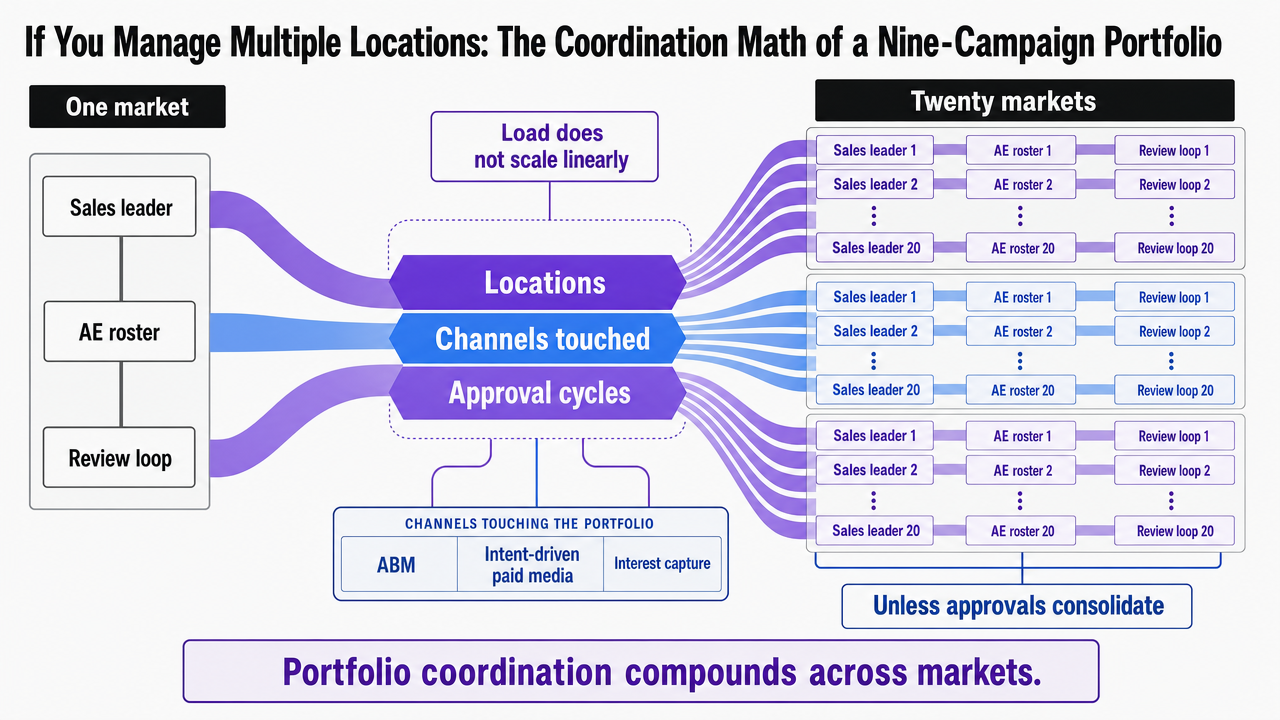 Reinforce the multi-location coordination challenge by visualizing how approval load compounds across locations, channels, and campaign archetypes, supporting the section's operating-model argument
The Tenth Pattern: AI-Coordinated Execution Across the Nine
The nine archetypes above assume a team capable of running them concurrently. Most cannot. Named-account ABM, intent-driven paid media, three event formats, two nurture programs, sales-enablement asset production, and cross-channel orchestration each carry their own briefing loop, vendor relationship, and measurement cadence. The portfolio breaks not on strategy but on execution capacity.
The emerging tenth pattern is AI-coordinated execution: a unified layer that reads live pipeline signals, ranks which opportunities qualify for which archetype, produces the assets, and routes every decision through a single approval workflow before anything ships. It does not replace the strategist. It removes the coordination overhead that consumes the strategist's week—the briefing cycles, status meetings, and vendor handoffs that scale with each archetype added to the mix.
Forrester's acceleration guidance is explicit that campaigns produce measurable outcomes only when marketing and sales agree on criteria and enforce them consistently 7. A consolidated execution layer is what makes that consistency operational across nine campaigns rather than aspirational across two. Platforms like Vectoron are built for that shape of work—approval-first, signal-driven, and coordinated across channels without adding headcount to run them.
Frequently Asked Questions
References
- 1.The Global State of B2B Events.
- 2.Account-Based Marketing (ABM): The Ultimate SiriusDecisions Guide.
- 3.Maximizing the Effectiveness of Events for Pipeline Acceleration.
- 4.Events: Their Use in Pipeline Acceleration Programs.
- 5.Does ABM Help Produce Better Revenue Results?.
- 6.ABM Won, But It's Not Done Changing The Game.
- 7.Getting Ready for Pipeline Acceleration.
- 8.Building next-generation B2B sales capabilities.
- 9.Pipeline Acceleration: What's to Be Done?.
- 10.Events and Last-Mile Pipeline Acceleration.