
Key Takeaways
- Traditional audits stop at page-level metrics like sessions and conversions, missing whether each URL justifies its maintenance hours or contributes to actual pipeline and closed-won deals 8.
- Assign every URL one of five dispositions—double down, refresh, consolidate, prune, or rebuild—to turn the audit into financial decisions rather than an inventory exercise, since roughly 20% of pages drive 80% of results 21.
- Score each URL from 0–100 using weighted inputs: pipeline influence (30%), organic performance (25%), direct conversion (20%), maintenance cost (15%), and brand risk (10%), adjusted to match sales cycle and channel mix.
- Integrate multi-touch attribution and call intelligence into the rubric so assisted conversions and qualified phone calls receive credit, since hybrid attribution models report 40% ROI gains and 15–30% lower CAC 16.
- Execute dispositions as standardized workflows with fixed time budgets, sequencing prune and consolidate first to free hours, then refresh top performers, and limit rebuilds to roughly 5% of the library per cycle.
- Translate audit findings into a CFO-ready reallocation memo showing hours freed, hours redeployed, and projected pipeline contribution, grounded in the return-minus-cost-over-cost formula and operational efficiency benchmarks 7, 12.
- Separate shared service pages from location-specific pages with a scope column, using dynamic number insertion to split call credit accurately and avoid double-counting across multi-location portfolios 19, 20.
- Shift from annual cleanups to a quarterly cadence with fixed weekly windows for inventory, scoring, execution, and re-measurement, compounding reclaimed maintenance hours every 90 days instead of yearly 5, 7.
Why most content audits miss the revenue question entirely
Most content audits produce a tidy spreadsheet but rarely lead to significant reallocation of resources. Pages are often tagged with basic information like word counts and meta descriptions, then filed away without impacting future content strategy. This happens because the metrics typically used, such as conversions (73%), email engagement (71%), website traffic (71%), website engagement (69%), and social media analytics (62%) 8, are surface-level. An inventory-style audit stops at the page level, failing to connect these signals to pipeline, qualified calls, or the true cost of maintenance. A page might show strong sessions and a good conversion rate, appearing healthy, yet never contribute to a closed-won deal.
A revenue-focused audit, however, treats every URL as a line item with a profit and loss decision attached. It applies the formula: return minus cost, divided by cost, times 100 10. This approach shifts the focus from "is this page good?" to identifying which assets justify their maintenance hours, which indirectly influence revenue through assisted conversions and call activity, and which should be eliminated to allow the team to concentrate on the 20% of pages driving most results 21.
The following sections detail a triage process where each URL is scored, assigned one of five dispositions, and routed into actionable work that provides a clear financial overview.
The five-disposition revenue triage
Every URL in a content library should conclude an audit with one of five labels: double down, refresh, consolidate, prune, or rebuild. This triage is essential because content libraries typically follow a predictable distribution, with approximately 20% of articles generating 80% of the results. The audit's primary goal is to accurately identify this top quintile and manage the rest of the content strategically 21.
Double down : Applies to pages already generating qualified pipeline. These pages should receive additional internal links, supporting cluster content, fresh examples, and updated calls to action. The objective is to amplify what is already successful, rather than leaving it static.
Refresh : For pages with strong intent signals but declining performance, such as slipping rankings, flat conversion rates, or outdated statistics. A refresh involves updating data, refining arguments, and realigning the page with current search intent without altering the URL or its core message 5.
Consolidate : Addresses topical overlap. For example, three short posts covering the same query, each ranking on page two, can be combined into one authoritative page. The original URLs are then 301 redirected to the new consolidated page. This disposition is highly effective for recovering crawl equity and internal link weight at a low production cost 5.
Prune : Involves removing pages that lack organic value, assisted conversion history, or strategic purpose. This is a definitive delete or noindex decision, made when the maintenance cost outweighs any potential return 4.
Rebuild : Reserved for high-intent topics where the existing page is fundamentally flawed due to outdated framing, an incorrect audience focus, or broken funnel logic. A rebuild starts from scratch at the same URL, preserving any existing backlinks while completely replacing the content.
Each disposition has a distinct cost profile and expected return. Categorizing every URL into one of these five buckets transforms the audit from a simple inventory exercise into a series of financial decisions that a finance team can readily understand.
Building the URL-scoring rubric
The effectiveness of a content disposition relies on the defensibility of its underlying score. Without a weighted rubric, the audit becomes a collection of subjective judgments that are difficult for a CFO to verify or a junior writer to replicate. The rubric's purpose is to synthesize diverse signals—such as organic sessions, assisted conversions, call influence, maintenance cost, and brand risk—into a single composite score for each URL.
Many teams already track essential surface metrics. For instance, B2B marketers commonly use conversions (73%), email engagement (71%), website traffic (71%), website engagement (69%), and social media analytics (62%) 8. The rubric does not replace these metrics but rather weights them, incorporates inputs that page-level analytics might miss, and provides a numerical answer to whether a URL justifies its maintenance hours.
A functional rubric for a content marketing audit assigns each URL a composite score from 0 to 100, based on five weighted inputs:
- Pipeline influence (30%) — This includes assisted conversions, last non-direct touch interactions, and CRM-linked deals where the URL appeared in the session path. This input is often overlooked because it requires integrating GA4 conversion data with CRM exports 18.
- Organic performance (25%) — This covers sessions, keywords ranking in the top 20, and click-through rates from Search Console. These are stable and easy-to-obtain inputs, but they primarily indicate demand capture rather than revenue 22.
- Direct conversion rate (20%) — This measures form fills, demo requests, and qualified call activity originating from the URL. In industries with high call volumes, call signals can carry as much weight as form submissions 19.
- Maintenance cost (15%) — This is the estimated quarterly hours required to keep the page accurate, on-brand, and technically sound. Pages in regulated industries like legal or healthcare, which are sensitive to statutes, typically cost more to maintain than evergreen explanatory content 5.
- Brand and compliance risk (10%) — This accounts for outdated claims, expired offers, or regulatory exposure. A high-traffic page with stale medical or legal information can be a liability rather than an asset 23.
These weights are starting points and can be adjusted. For example, a B2B SaaS team with a long sales cycle might increase pipeline influence to 40% and reduce the direct conversion rate. A multi-location dental group relying heavily on phone intake might keep direct conversion at 25% to reflect call volume. The key is to apply a consistent weighted equation to every URL to ensure a defensible rank order.
Two practical considerations: First, score in tiers (e.g., a 0–4 scale per input) rather than precise decimals. This produces a composite score that is stable enough for action without creating false precision. Second, test the rubric on a sample of 30 URLs before applying it to the entire library. This helps determine if the weights effectively differentiate top-performing content from the long tail, or if scores cluster in a narrow range, indicating the audit might not yield actionable insights 4.
Once composite scores are established, dispositions become clear. The top 20% of pages by score are candidates for "double down." Pages with high pipeline influence but low organic performance might be "refresh" candidates. Topical clusters with several mid-scoring URLs are targets for "consolidation." The bottom quintile, scoring low across all metrics, moves to "prune" or "rebuild," depending on backlink equity.
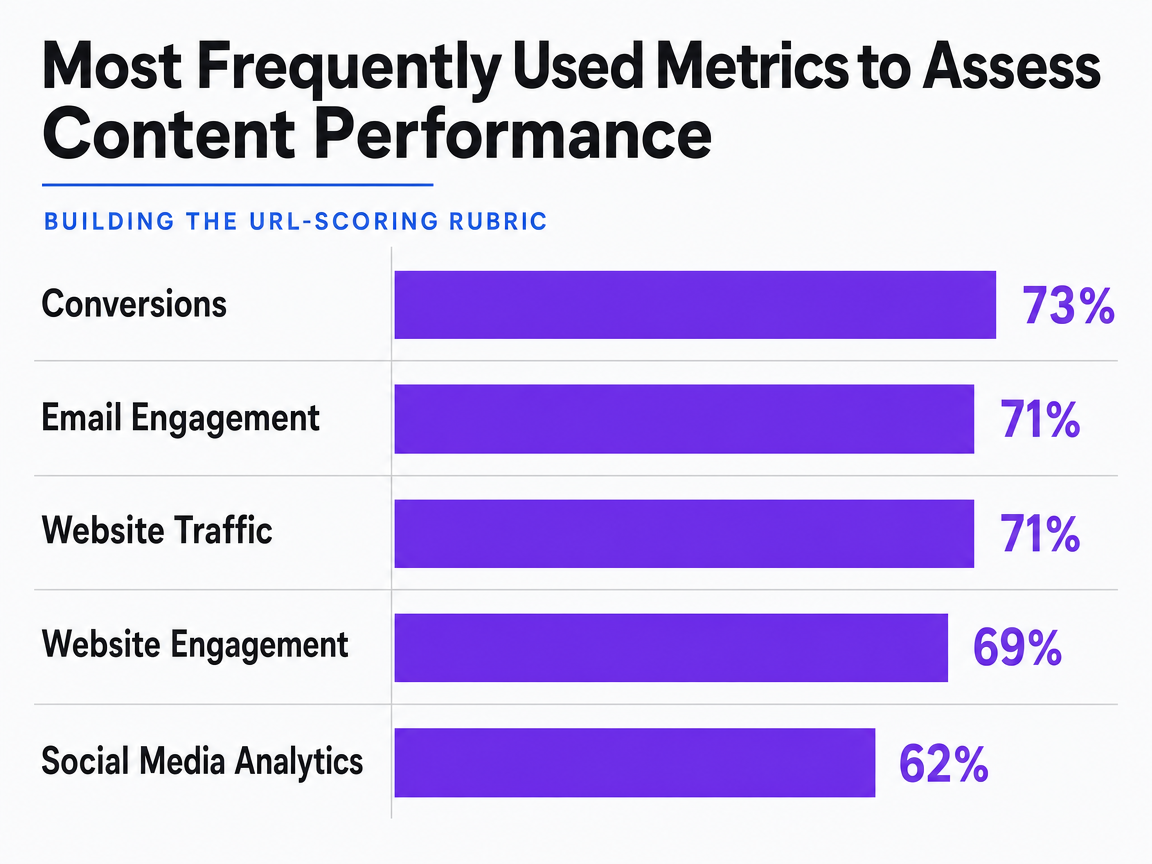 Most Frequently Used Metrics to Assess Content Performance
A breakdown of the top five metrics used by B2B marketers to evaluate the performance of their content, as reported in a 2024 survey.
Run a Real Content Audit in One Week
Assess content ROI using your live data and publish actionable improvements within seven days.
Feeding call intelligence and attribution into the score
The pipeline-influence input is a common point of failure in many audits. Teams often rely solely on GA4 conversions and form fills, overlooking deals closed because a prospect engaged with multiple content pieces, then called to book. In sectors like legal, dental, behavioral health, senior living, and home services, phone calls are a primary conversion channel. An audit that ignores this channel only assesses a fraction of the evidence.
To address this, two data streams must inform the rubric before dispositions are assigned: multi-touch attribution and call intelligence.
Attribution bridges the gap between last-click reporting and actual influence. Multi-touch attribution distributes credit across all prospect interactions leading to a conversion, providing a more accurate ROI measurement than single-touch models 15. This means a comparison post ranking well might not appear in last-click reports but consistently contributes to assisted conversions for closed-won deals. Without this signal, valuable pages might be pruned.
The financial benefits of accurate attribution are significant. Companies using hybrid attribution models—combining multi-touch with marketing mix modeling and incrementality testing—report a 40% improvement in ROI and a 15–30% reduction in customer acquisition cost compared to single-model approaches 16. This is the kind of lift a content audit can achieve by incorporating pipeline influence rather than relying solely on last-touch conversions. While a full Stage 4 algorithmic model might be excessive for most in-house teams, connecting CRM-stage data back to URL-level sessions is a crucial minimum input 18.
Call intelligence addresses the second blind spot. By linking inbound calls to the specific page or content cluster a caller engaged with, phone conversations become a scorable signal alongside form fills 19. AI call analysis further refines this by tagging qualified inquiries, billing questions, or missed opportunities. These tags allow the audit to credit a page for the qualified call volume it actually drives, not just the raw call count 20.
Practically, this means adding two columns to the scoring sheet: assisted-conversion count from the attribution model and qualified-call count from the call intelligence layer. A page with 800 monthly sessions, a 0.4% form-fill rate, and 14 qualified calls per month will score very differently from a page with the same sessions but no call activity. The former is likely a refresh candidate, while the latter might be pruned unless backlink equity suggests otherwise.
Teams without established attribution or call tracking infrastructure can still benefit from an audit, but the rubric should acknowledge the missing data. These URLs can be marked as "low confidence" and revisited in a subsequent quarterly cycle once the necessary data streams are integrated.
 ROI Improvement with Hybrid Attribution
ROI Improvement with Hybrid Attribution
Executing dispositions: refresh, consolidate, prune, rebuild
While scoring is relatively straightforward, execution often stalls because teams treat each disposition as a unique project instead of a standardized workflow with defined inputs, outputs, and time budgets. For example, 343 URLs from an audit don't need 343 individual plans; they need to be processed through four distinct production lines.
Refresh workflow. A refresh should ideally take two to four hours per URL. The brief is focused: replace outdated statistics with current sourced data, update screenshots and product references, re-evaluate search intent against current top-ranking results, and refine the introduction to align with SERP expectations 5. The URL, H1, and most internal links remain unchanged. If a refresh expands into a complete rewrite, it indicates a scoping error; such a page belongs in the rebuild queue.
Consolidation workflow. Before writing begins, a consolidation requires deciding which URL will be the canonical destination. The best practice is to choose the URL with the strongest backlink profile and cleanest slug, then 301 redirect the other URLs to it. The merged page incorporates unique sections from each source, with redundant passages removed. For instance, three short posts on "content marketing KPIs" typically consolidate into one focused 1,400-word page, not a 2,800-word one, by eliminating redundancy 5.
Prune workflow. Pruning is a two-step process. First, assess backlink equity: pages with referring domains should be 301 redirected to the most topically relevant page instead of being deleted. Second, all other pages receive a 410 or noindex, depending on whether the URL might be reused. Simply "unpublishing" creates orphaned pages that still consume crawl budget. A proper prune removes the page from sitemaps, internal navigation, and the CMS within the same sprint 3.
Rebuild workflow. Rebuilds are the most resource-intensive disposition and should be limited to approximately 5% of the audited library per quarter. The existing URL is retained to preserve backlinks, but everything else—outline, examples, CTAs, internal link structure—is developed from a blank brief, informed by current intent and the pipeline-influence data that justified saving the topic 2.
The sequencing of these actions is important. Pruning and consolidation should occur first to reduce the content surface area requiring maintenance. Refreshes follow, as they enhance the value of already performing pages. Rebuilds are last, undertaken once the team has freed up enough hours by eliminating low-performing content to execute them effectively.
Defending audit findings to a skeptical CFO
A finance leader is less interested in a content audit report and more in a reallocation memo. This translation must happen before the meeting, following a clear structure: hours freed, hours redeployed, and projected pipeline contribution from the redeployment.
Begin by quantifying the dispositions in terms of hours. If the audit pruned 84 URLs and consolidated 41 into 14, this represents a quantifiable reduction in recurring quarterly maintenance hours for editors and subject matter experts. These reclaimed hours then become the budget for refreshes and rebuilds, framing it as a reallocation rather than a request for additional headcount. This approach resonates with CFOs, as it aligns with their existing capital deployment strategies.
Next, ground the projection in the ROI formula already used by the organization: return minus cost, divided by cost, times 100 12. The audit's role is to make every input in this equation defensible at the URL level: the assisted-conversion data supporting the pipeline-influence score, the maintenance hours contributing to the cost figure, and the qualified-call volume informing the conversion estimate. When inputs are sourced and the math is transparent, the discussion shifts from "prove content works" to "which assumptions does finance want to stress-test?"
The third element is providing benchmark context. Most B2B teams investing in content prioritize improved operational efficiency as the top reported benefit, surpassing customer engagement or campaign ROI 7. This hierarchy is crucial in a CFO meeting. The audit's primary outcome is not a promise of new revenue, but a documented reduction in wasted maintenance hours and a credible plan to redirect those hours towards the top-performing pages. Revenue growth is seen as a consequence of efficiency, and presenting it in this sequence keeps the conversation grounded in verifiable numbers.
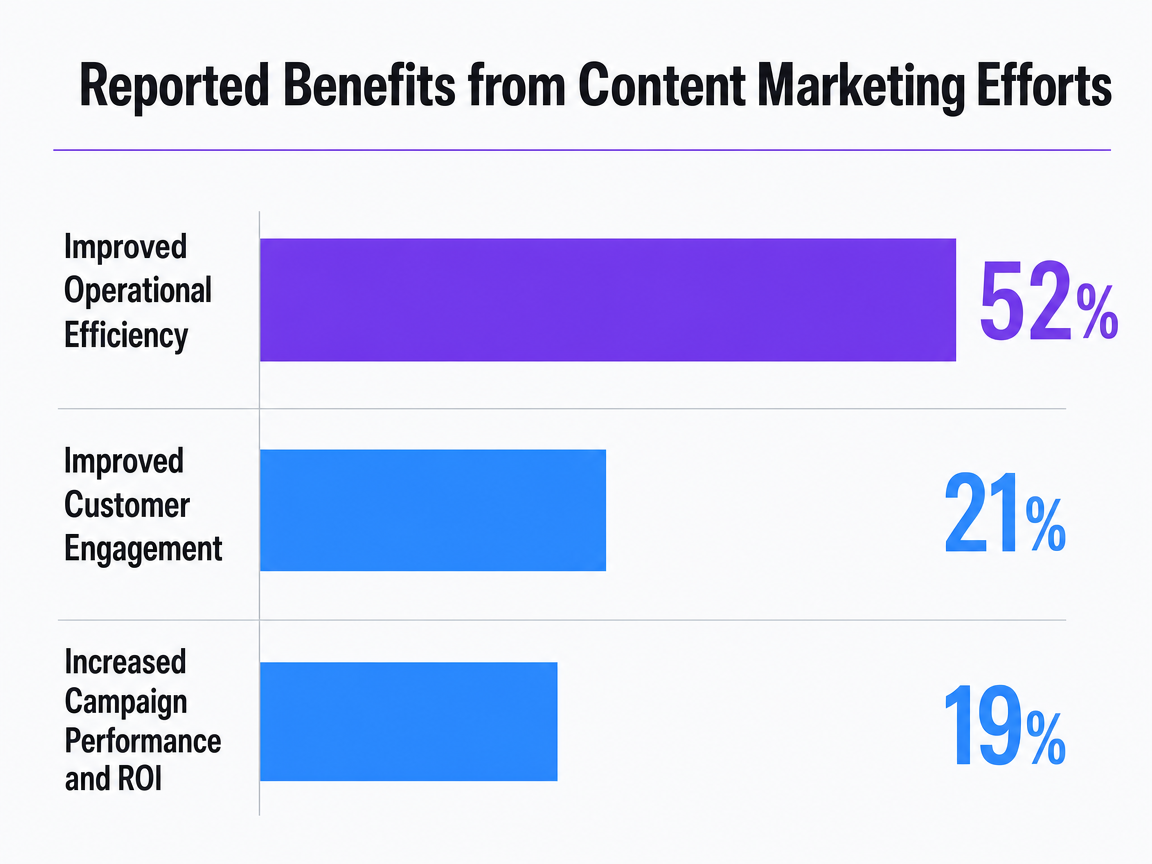 Reported Benefits from Content Marketing Efforts
A breakdown of benefits cited by B2B marketers from their content marketing investments, showing where teams are seeing results.
Pinpoint Your Content ROI Gaps with a Data-Driven Audit Framework
Request a walkthrough of advanced audit workflows that map content performance to actual pipeline impact, designed for teams managing multi-channel, high-volume content portfolios.
Auditing across multiple locations without double-counting
Multi-location businesses—such as dental service organizations with multiple practices, law firm networks with regional landing pages, senior living portfolios with numerous community sites, or home services franchises sharing a corporate domain—face a unique audit challenge. The same URL patterns often repeat across different geographies. The scoring rubric must differentiate shared service content from location-specific content without double-counting efforts.
The initial step involves categorizing pages into two groups during inventory: shared service pages (e.g., procedure explainers, practice-area overviews, service category pages at the corporate level) and location-specific pages (e.g., per-office landing pages, local team bios, location-bound case studies). Both stacks are scored using the same rubric, but inputs are handled differently. Shared pages aggregate organic sessions and assisted conversions across the entire portfolio. Location pages are scored based solely on their own catchment area; crediting a Cleveland office page for sessions driven by the Phoenix market would distort its contribution and disposition.
Call attribution is where double-counting can subtly occur. If a prospect reads a corporate "dental implants" explainer, clicks to the Plano location page, and then calls the Plano office, the call might be entirely credited to the last page seen by analytics—typically the location page. This makes the explainer appear to be dead weight. Dynamic number insertion, which changes the displayed phone number based on the referring page, can resolve this. When combined with call analysis that tags qualified inquiries, the audit can accurately split credit between the educational asset and the converting landing page 19, 20.
The economics of auditing also shift. In a single-domain audit, a team scores 500 URLs once. For a 500-URL audit across 12 locations, the team scores approximately 80–120 unique templates and applies the location-page score per market. This significantly compounds operational efficiency gains, as the same disposition decision can be propagated across 12 deployments 7. Pruning a redundant service page at the corporate level eliminates 12 maintenance obligations downstream. Refreshing one canonical procedure page boosts assisted-conversion data for every location driving traffic to it.
A crucial discipline for this process is maintaining a single source-of-truth scoring sheet with a "scope" column that labels each URL as shared, location, or hybrid. Without this column, pipeline-influence numbers can be double-counted, leading to recommendations to prune pages that are actually vital to the network.
Moving from annual cleanup to quarterly cadence
While most content ROI guides suggest annual or semi-annual audits 11, this cadence is often too slow for larger or more dynamic content libraries. For a 300-URL blog at a stable B2B company with a long sales cycle, an annual audit might suffice. However, for a 1,400-URL library at a multi-location dental group, or a 900-URL legal site where regulations can change rapidly, twice a year is insufficient. The pipeline data and call patterns that inform the audit evolve faster than an annual cycle can capture.
A quarterly cadence addresses three issues inherent in annual cleanups. First, it shortens the time between a page becoming stale and the team identifying it. Second, it generates enough data points throughout the year to track whether refreshes and consolidations actually improved composite scores, rather than relying on a single before-and-after snapshot. Third, it scopes each audit to be small enough that scoring, dispositioning, and execution can fit within a single sprint, preventing it from becoming a quarter-long diversion from ongoing publishing.
The operational benefits are substantial. B2B teams consistently report improved operational efficiency as the top benefit of content marketing (52%), significantly ahead of customer engagement (21%) and campaign performance/ROI (19%) 7. This indicates that the primary return from disciplined content operations is hours saved, which can then be reinvested. Quarterly audits translate this finding into a regular schedule. Each cycle reclaims maintenance hours from low-performing content and redirects them to top-performing assets, compounding efficiency every 90 days instead of annually.
A practical quarterly rhythm involves fixed windows:
- Weeks one and two are dedicated to pulling inventory and refreshing scoring data (analytics, attribution, call tags).
- Week three focuses on running the rubric and assigning dispositions.
- Weeks four through ten are for executing prune, consolidate, refresh, and rebuild queues in sequence.
- Weeks eleven and twelve involve re-measuring the URLs addressed in the previous cycle, completing a feedback loop that annual audits often miss 5.
AI-assisted execution plays a critical role in this cadence. Tasks like pulling per-URL analytics, scoring numerous pages, tagging call transcripts, and drafting refresh briefs are time-consuming and do not involve creative output. Automating data assembly and initial scoring allows the team to focus their quarterly cycle on disposition decisions and the actual rewriting—the work that directly impacts the pipeline-influence column in subsequent audits.
Frequently Asked Questions
References
- 1.What is a content audit? Best practices for optimizing business content.
- 2.What is a content audit and how to do it.
- 3.The Website Content Audit 101.
- 4.Follow Our Content Audit Process (Template Included).
- 5.The 8-Step Content Auditing Framework For SEO & Marketing.
- 6.Conducting a Content Audit - University Website Redesign.
- 7.B2B Content and Marketing Trends: Insights for 2026.
- 8.B2B Content Marketing Benchmarks, Budgets, and Trends: Outlook 2024.
- 9.B2B Marketing Benchmark Report.
- 10.How to Measure Content Marketing ROI: A Framework for Proving Value.
- 11.How To Measure Content Marketing ROI [Free Calculator].
- 12.Content Marketing ROI: How to Put a $ Value on Content.
- 13.Proving Marketing ROI: A Digital Marketing Framework.
- 14.Content Marketing ROI for Universities.
- 15.Multi-Touch Attribution: What It Is & Best Practices.
- 16.B2B Marketing Attribution Guide 2026: Models, Tools & ROI.
- 17.Benefits of Multi-Touch Attribution in B2B Marketing.
- 18.The Essential Guide to Multi-Touch Attribution in B2B.
- 19.How Call Tracking Improves Marketing ROI.
- 20.Maximising ROI: How AI Call Tracking is Helping Digital Marketing.
- 21.How to do a content marketing audit in GA4: 9-steps for SEO, Email & Conversions.
- 22.How to Perform an SEO Content Audit.
- 23.How to Conduct a Content Audit.