
Key Takeaways
- Choosing among an agency retainer, pure in-house team, or AI-augmented hybrid is the real decision behind a content marketing solutions search, not vendor selection 5.
- Structural specialization, systematic measurement, and sustained volume predict revenue outcomes more reliably than asset quality or headcount alone 1, 2.
- Cost per sourced opportunity, not retainer fees or salary lines, is the unit economic that exposes whether a model compounds or stalls 4, 8.
- Evaluate solutions on five criteria: real specialization, asset-to-pipeline measurement, sustained cost-per-asset, where approval gates sit, and whether volume math works without doubling spend 3.
The Operating Model Question Behind the Search
A VP typing "content marketing solutions" into a search bar is rarely shopping for another agency. The query signals something more structural: a decision about how content gets produced, measured, and tied to revenue inside a team that has already exhausted the obvious moves.
The pressure is well-documented. Deloitte's 2026 CMO Survey, drawing on responses from more than 300 marketing leaders, identifies C-suite scrutiny, constrained budgets, and AI adoption as the defining themes for the role 5. Marketing chiefs are being asked to expand pipeline contribution without expanding headcount. That math forces a reexamination of the production model itself, not just the vendor list.
Three operating models compete for that budget today: the traditional agency retainer, the pure in-house team, and an AI-augmented hybrid governed by human approval. Each carries a different cost-per-asset, a different ceiling on volume, and a different relationship to measurement. Picking among them is the actual decision behind the search.
The sections that follow treat content marketing solutions as an operating-model question. They draw on peer-reviewed effectiveness research 1, Northwestern's engagement-to-revenue work 2, and Forrester's analysis of where generative AI is reshaping B2B content production 3. The framing is built for operators who already understand the fundamentals and now need to decide what to fund, what to retire, and what to consolidate.
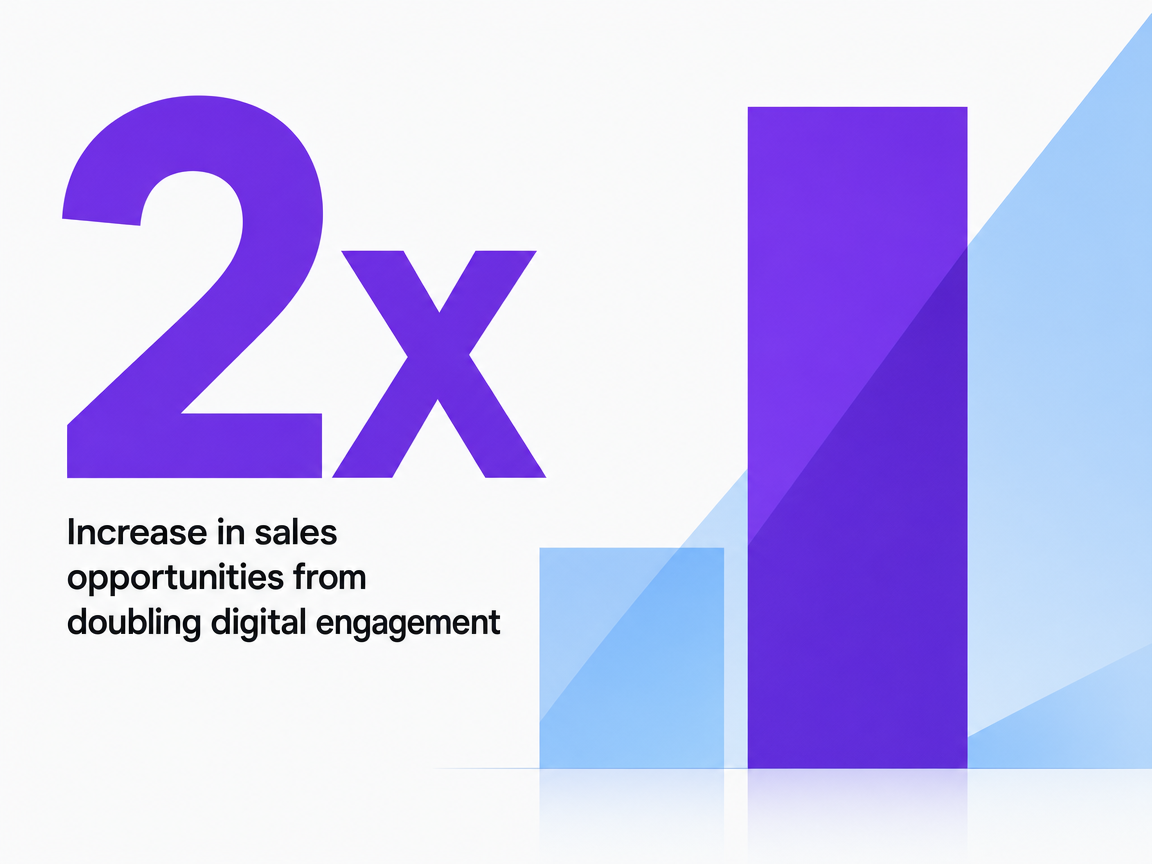 Increase in sales opportunities from doubling digital engagement
Increase in sales opportunities from doubling digital engagement
What Research Says Separates Revenue-Driving Programs
Strategic Specialization, Not Asset Volume Alone
The peer-reviewed effectiveness research on content marketing points to a counterintuitive finding: the teams producing the most assets are not the teams producing the most revenue. A study published in the Journal of Strategic Marketing analyzed the conditions under which content programs actually move business results and found that strategic clarity, structural specialization, and systematic measurement were stronger predictors of effectiveness than raw output 1.
Structural specialization means the team has dedicated roles for strategy, production, distribution, and analysis rather than asking three generalists to do everything. The same research found that enabling processes and systems, the unglamorous work of editorial calendars, approval workflows, and performance dashboards, correlated with better outcomes than headcount alone 1. A team of four with specialized roles and a measurement loop tends to outperform a team of eight without one.
This matters for the operating-model decision because each model handles specialization differently. Agency retainers buy access to specialists but ration their hours. Pure in-house teams own their specialists fully but can rarely afford the full set at growth-stage budgets. An AI-augmented hybrid changes the math by collapsing some production tasks into software, which frees the human roles to specialize more deeply in strategy and judgment.
The practical takeaway: a VP evaluating content marketing solutions should audit whether the model under consideration actually creates specialization or just relabels generalists. A retainer that promises a strategist, a writer, a designer, and an analyst but assigns one account manager to coordinate all four is not specialization. It is coordination overhead with a roster attached.
Engagement as the Leading Revenue Indicator
Northwestern University's Spiegel Research Center conducted one of the more rigorous attempts to connect content engagement to revenue at the enterprise-account level. Studying B2B accounts and the digital interactions associated with them, the researchers found that doubling the number of digital engagements with an enterprise roughly doubles the number of sales opportunities tied to that account 2. The relationship was approximately linear: 2x engagement, 2x opportunities.
The scope deserves attention before the finding gets generalized. The study examined enterprise-account-level B2B behavior, where multiple stakeholders consume content across long buying cycles. It measured cumulative engagement, including webinars, downloads, and content consumption, rather than single-session clicks. The 2x multiplier should not be read as a universal law for every content program, but it offers something rare in this space: empirical grounding for the claim that engagement volume is a leading indicator of pipeline.
What this implies for operating-model decisions is sharper than it first appears. If engagement scales with opportunities, then the binding constraint on revenue is not the quality of any single asset but the sustained ability to produce assets that compound engagement across the buying committee over time. A program that publishes a brilliant white paper every quarter loses to one that publishes useful material every week, assuming both meet a baseline quality threshold.
This is where most agency retainers and most small in-house teams hit a wall. The cost-per-asset is high enough that the volume needed to drive the multiplier is unaffordable. The Spiegel finding does not say content quality is irrelevant; the journalistic-quality criterion in the effectiveness research 1 still applies. It says that quality alone, without volume sustainability, leaves opportunity multiplication on the table. Engagement is the leading indicator. Volume is the lever. The operating model determines whether that lever is reachable.
Content Intelligence as a Measurement Capability
Measurement, as the effectiveness research frames it, is not a dashboard. It is a capability. Forrester defines content intelligence as
"the capture, correlation, and analysis of data about content and its consumption to inform buyer and customer insights, drive activation, and deliver more meaningful performance measurement"
4. The distinction matters because most teams confuse the artifact, the dashboard, with the underlying ability to treat content as structured data tied to pipeline.
Content intelligence requires that every asset carry metadata describing its topic, funnel stage, buyer role, intent signal, and downstream outcomes. That metadata then correlates with CRM data on opportunity creation, deal velocity, and revenue. Without that correlation layer, a team can report pageviews and time-on-page indefinitely without ever answering whether content is sourcing pipeline.
Forrester notes that generative AI is expanding what content intelligence can do at scale, particularly by enriching metadata automatically and surfacing patterns across thousands of assets that human analysts cannot manually process 4. This is the second place where AI changes the operating-model math. The first was production cost. The second is measurement depth.
A practical test: ask any content marketing solution under evaluation to show how a published asset connects, through metadata and CRM integration, to a sourced opportunity six months later. If the answer is a traffic report, the solution is not built for revenue measurement. If the answer is a clear data path from asset to account to opportunity to closed revenue, the measurement capability exists. That capability, more than any creative claim, determines whether content spend can be defended to a CFO.
Three Operating Models, Compared on Operator Terms
Traditional Agency Retainer
The retainer model buys access to a roster: a strategist, a writer or two, a designer, an SEO lead, sometimes an analyst. The pitch is specialization without the hire. The reality is that each specialist is rationed across a portfolio of clients, and coordination falls to an account manager whose primary job is briefing and approvals, not strategy.
Output tends to be predictable but capped. A typical mid-tier retainer produces a handful of long-form assets and supporting distribution per month, with most cycle time consumed by briefs, revisions, and stakeholder reviews rather than production itself. The cost-per-asset includes that overhead, which is why volume becomes the binding constraint long before quality does.
Measurement is the second pressure point. Agencies report on what they can see: rankings, traffic, engagement, sometimes form fills. Few have direct CRM access, and fewer still build the metadata layer that links published assets to sourced opportunities six months later. The peer-reviewed effectiveness research is direct on this: systematic measurement and structural specialization are stronger predictors of content outcomes than headcount 1. A retainer can supply the second only partially, and the first almost never without a separate analytics function on the client side.
Pure In-House Team
An in-house team solves the rationing problem. Specialists work on one brand, sit inside the data, and build institutional knowledge that no agency can replicate. The trade-off is headcount math. A growth-stage team of three to eight rarely affords a full set of specialists across strategy, production, distribution, SEO, design, and analytics. Generalists fill the gaps, which erodes the specialization advantage the model is meant to deliver.
The effectiveness research found that enabling processes and systems, the editorial calendars, approval workflows, and performance dashboards, correlated with better outcomes than raw team size 1. In-house teams tend to build those systems well because they own the outputs end-to-end. What they struggle with is volume sustainability at the cost-per-asset their salaries imply.
The budget pressure documented in Deloitte's 2026 CMO Survey, where C-suite scrutiny meets flat or constrained budgets, lands hardest on this model 5. A VP asked to double engagement output without doubling salary lines has limited moves. Freelancers extend capacity but reintroduce coordination overhead. Tools help at the margins. The structural ceiling on a pure in-house team is the cost-per-asset of fully loaded employees producing one piece at a time, which makes the volume that drives opportunity multiplication difficult to reach.
AI-Augmented Hybrid With Human Approval Gates
The third model uses AI to collapse the production tasks that consume the most hours in the other two, drafting, formatting, metadata tagging, distribution prep, while keeping human specialists on strategy, editorial judgment, and approval. Forrester's analysis of generative AI in B2B content frames the adoption pattern: early adopters use AI as a thought starter, research tool, and accelerator rather than a replacement for human oversight, and the teams that maintain strong editorial gates avoid the commoditization risk that flat AI output creates 3.
The shift changes two numbers at once. Cost-per-asset falls because production hours drop. Specialization deepens because the human roles spend more time on strategy and less on mechanical work. The effectiveness research identifies both of those, structural specialization and systematic measurement, as predictors of content outcomes 1, and the hybrid model is the first that makes both affordable at the same scale.
The operating differences across the three models become clearer when laid side by side. The comparison below scores each on five dimensions a VP actually budgets against: monthly output capacity, cost-per-asset trajectory, time-to-publish, measurement integration, and headcount required to sustain the model. The dimensions come from the operator literature on what predicts content marketing effectiveness 1.
| Dimension | Traditional Agency Retainer | Pure In-House Team | AI-Augmented Hybrid |
|---|---|---|---|
| Monthly output capacity | Capped by retainer hours | Capped by headcount | Scales with approval throughput |
| Cost per published asset | High; loaded with coordination overhead | High; loaded with salary and benefits | Lower; production hours collapse into software |
| Time-to-publish | Slow; brief-revision cycles dominate | Moderate; depends on team capacity | Fast; bottleneck moves to human review |
| Measurement integration | Partial; limited CRM access | Yes, when systems are built | Yes, when content intelligence is native |
| Headcount required | Client-side coordinator plus internal reviewers | Full specialist set, rarely affordable | Smaller specialist core focused on judgment |
The hybrid does not eliminate human roles. It reassigns them. The approval gate is the load-bearing element, and the next section examines where that oversight actually earns its cost.
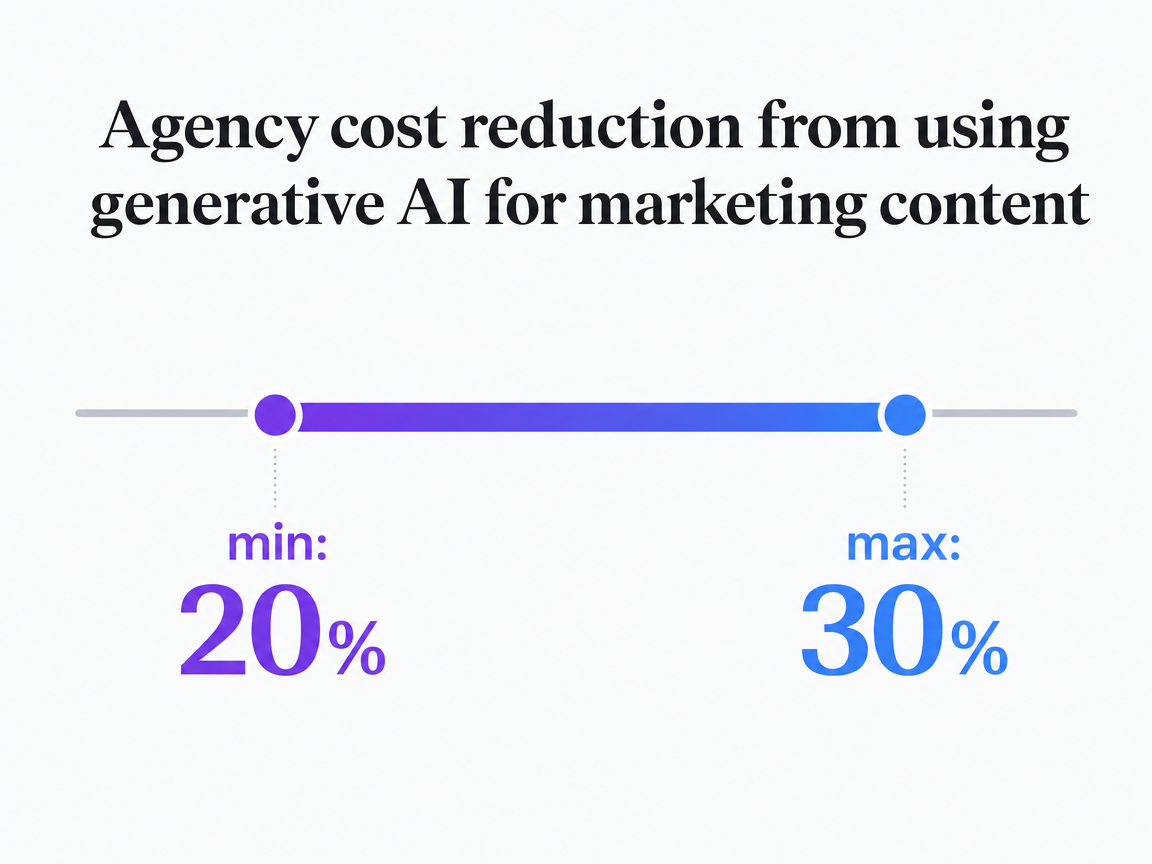 Agency cost reduction from using generative AI for marketing content
A BCG case study reported a company reduced agency costs by 20-30% by using generative AI for content creation.
Test Real-World Content Marketing Impact in Days
Experience measurable pipeline results by publishing live campaigns during your trial—no delays, no commitments required.
The Unit Economics of Content That Compounds
Revenue from content compounds only when the cost-per-asset is low enough to sustain the volume that drives the engagement multiplier. That is the math behind the operating-model decision, and it is where most program budgets quietly break.
Three numbers belong on the same page when a VP evaluates any content marketing solution.
- Cost per published asset, which captures production and coordination overhead.
- Cost per engaged session, which captures whether the asset reaches and holds the right audience.
- Cost per sourced opportunity, which captures whether engagement translates into pipeline a CRM can attribute.
Most retainer reports stop at the first. Most analytics dashboards stop at the second. The third is where the program's contribution to revenue actually lives, and it requires the metadata-to-CRM correlation that defines content intelligence as a capability rather than a report 4.
The AI shift moves the first number meaningfully. Deloitte's research on generative AI transformation in marketing finds that early adopters are seeing roughly a 12% return on their GenAI investments and are better positioned to meet rising content volume demands 8. That figure does not describe content programs in isolation, and it should not be read as a guarantee. It does describe the direction of the cost curve for teams that have integrated AI into production workflows with discipline. The adoption trajectory reinforces the direction: Deloitte's creator-economy survey reports that 94% of brands working with content creators are either using generative AI or plan to, which signals that the production cost baseline is resetting across the market 7.
What compounds is not the AI output itself. Forrester's analysis is direct that flat, undifferentiated AI content commoditizes quickly and loses value as more producers crowd into the same patterns 3. What compounds is the combination of a lower production cost, a sustained publishing cadence, and a measurement layer that ties each asset to opportunity creation. The peer-reviewed effectiveness research is consistent on this point: systematic measurement and structural specialization predict outcomes more reliably than headcount or asset count 1.
A practical reframing for budget conversations: stop comparing retainer fees to salary lines and start comparing cost per sourced opportunity across the models under consideration. A retainer that produces eight assets a month at a high blended cost may source fewer opportunities than a hybrid producing thirty at a lower blended cost, even if the second program's average asset quality is slightly lower. The Spiegel finding cited earlier explains why. Volume sustainability, priced honestly, is the unit economic that determines whether content compounds or stalls.
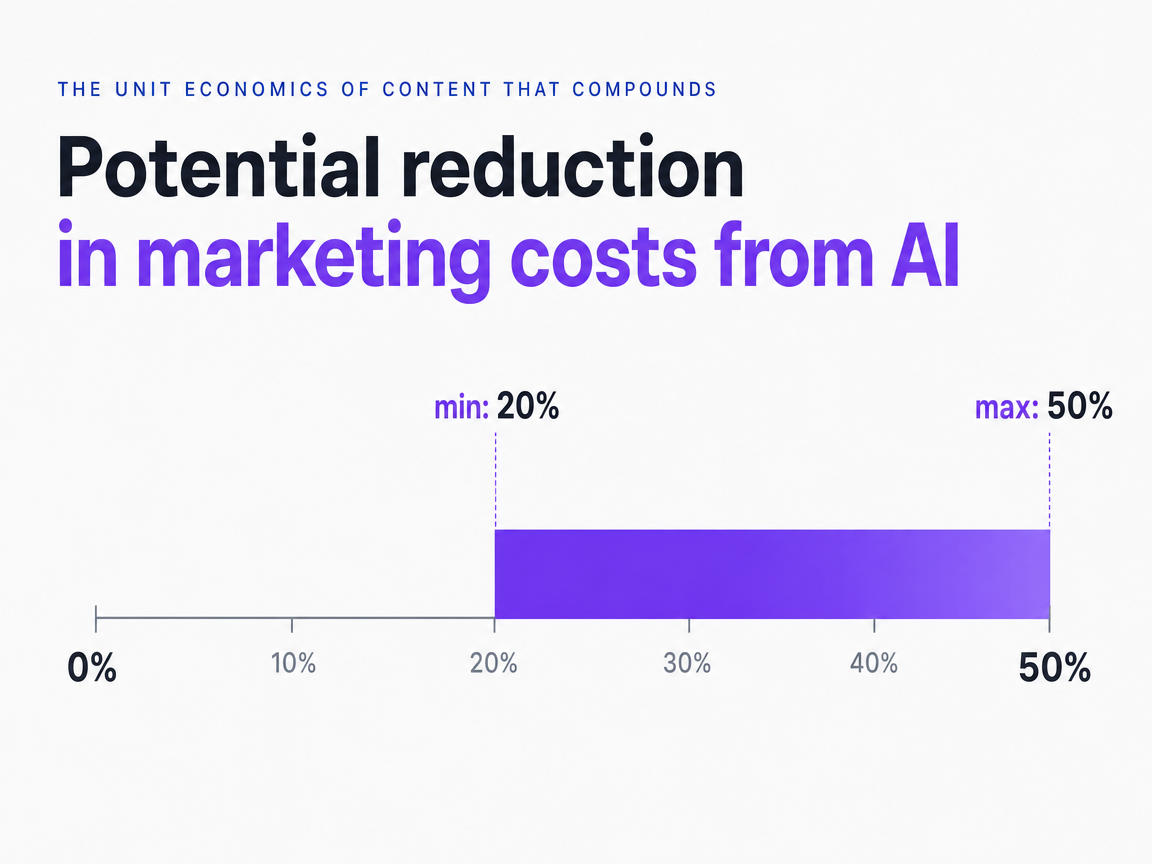 Potential reduction in marketing costs from AI
PwC guidance on AI adoption suggests potential cost reductions in certain marketing categories.
Human Oversight Where It Actually Earns Its Cost
The approval gate is not a compliance checkbox. It is the point where editorial judgment converts AI output from commodity to differentiated work. Forrester's analysis of generative AI in B2B content is direct that flat, undifferentiated AI material commoditizes quickly, and the teams that maintain strong human review are the ones that capture the speed advantage without losing brand position 3.
The question is where to place the gate so it earns its cost rather than recreating the briefing overhead the model was meant to retire. Three placements consistently pay back.
- The first is strategic framing: deciding what gets written, for which buyer role, against which pipeline hypothesis. AI is poor at this and humans are good at it.
- The second is editorial judgment at the draft stage, where a specialist trims claims, corrects tone, and approves the metadata that ties the asset to a measurable outcome.
- The third is post-publication review of what actually sourced opportunities, feeding judgment back into the next production cycle.
McKinsey's analysis of generative AI in marketing reinforces the same point with a sharper edge: AI at scale requires integrated data, workflows, and governance, and the failure mode is brand-safety and accuracy risk when oversight is removed 6. The cost of a missed gate is not theoretical. It is a published asset that misrepresents a regulated service or contradicts positioning the sales team is using in active deals.
The practical rule is narrow. Approval gates earn their cost when they make decisions humans are better at than software. They lose their cost when they re-introduce the brief-revision cycle the agency model was built around.
See How Top Brands Operationalize Content Marketing for Measurable Revenue Impact
Request a walkthrough of AI-powered workflows that synchronize content, SEO, and conversion metrics—enabling marketing leaders to scale qualified pipeline efficiently, without expanding headcount or managing multiple vendors.
If You Manage Multiple Locations: Consolidation Economics
A note on audience: this section narrows from the general VP reader to operators running content across multiple locations, practices, or branches. The economics shift enough that the general framework needs adjustment.
Multi-location operators in legal, dental, behavioral health, home services, and senior living face a content problem the single-brand SaaS reader does not. Each location needs locally relevant content, often gated by state regulation, payer mix, or service line. A 14-clinic behavioral health network producing one corporate blog post per week is not running a content program. It is running a press release operation that ranks for nothing local.
The production math compounds quickly. Thirty locations multiplied by even modest local content cadence, service pages, condition explainers, intake-question articles, neighborhood landing pages, produces volume that no retainer affordably covers and no in-house team of six can sustain. The peer-reviewed effectiveness research is clear that systematic measurement and structural specialization predict outcomes more reliably than headcount 1, and at multi-location scale, neither is reachable through traditional models without a budget the CFO will not approve.
The consolidation question is where the AI-augmented model earns the most ground. Deloitte's research on generative AI in marketing reports that early adopters are seeing roughly a 12% return on GenAI investments and are better positioned to meet rising content volume demands 8. That figure matters more at multi-location scale than at single-brand scale, because the volume demand is structurally higher.
Three variables a multi-location operator should price against current spend, rather than accept as quoted retainer numbers:
| Variable | What to measure |
|---|---|
| Cost per location per month | Total content spend divided by locations served, not by assets produced |
| Local pages published per location per quarter | Service, condition, and geographic pages with unique metadata |
| Sourced opportunities per location | CRM-attributed pipeline, segmented by location, not aggregated |
The trap most multi-location operators fall into is buying one corporate program and assuming local relevance will follow. It rarely does. The model that compounds is one where each location carries its own metadata layer, its own measurement view, and its own publishing cadence, governed by central editorial approval. That is a content intelligence problem as much as a production problem 4, and it is the place where consolidating fragmented agency relationships into a single AI-augmented operation tends to pay back fastest.
What to Evaluate Before Committing to a Solution
Five questions decide whether a content marketing solution will pay back the budget line attached to it. They are not the questions vendors prefer to answer, which is part of why they are useful.
- Does the solution build specialization or just rebrand generalists? The peer-reviewed effectiveness research treats structural specialization as a predictor of content outcomes, not a marketing claim 1. A roster that exists on a capabilities deck but collapses into one account manager in practice fails this test.
- Does the measurement layer connect published assets to sourced opportunities, or does it stop at traffic? Forrester's framing of content intelligence as the capture and correlation of content data with downstream outcomes is the standard worth applying 4. A traffic report is not a revenue measurement system.
- What is the cost per published asset at sustained cadence, not at launch? Pilots flatter every model. The number that matters is the blended cost six months in, when coordination overhead and revision cycles have settled.
- Where do human approval gates sit, and what do they decide? Strategic framing, editorial judgment, and post-publication review earn their cost. Reapproving the same brief three times does not.
- Can the model meet the volume the engagement-to-opportunity math requires without doubling spend? If the answer is no, the program will stall before it compounds.
Vectoron is built around that fifth question, with the first four as the operating constraints.
Frequently Asked Questions
References
- 1.Determinants of content marketing effectiveness: Conceptual framework and empirical findings.
- 2.How B2B Engagement Drives Revenue.
- 3.Generative AI Forces A Turning Point For B2B Content.
- 4.Getting Smart On Content Intelligence.
- 5.2026 CMO Survey | Deloitte US.
- 6.How generative AI can boost consumer marketing.
- 7.GenAI and the Creator Economy: How Creators Are Looking To Use GenAI.
- 8.Deloitte Digital's research on generative AI transformation in marketing.