
Key Takeaways
- Write a one-page accepted-lead spec covering required fields, service area, need, reachable contact data, duplicates, and consent, so vendor quotes are comparable and returns have a written basis.
- Ask each vendor where its leads come from and whether they are shared, then compare offers by cost per accepted lead, since a cheaper quote can become the costlier pipeline.
- Request records, not promises: source pages, seller-specific consent, retrievable consent records, buyer lists, and opt-out handling. Then spot-check sources monthly instead of relying on contract promises 9.
- Ask what outcome an AI-qualified score actually predicts, because high precision figures can be proxy metrics that never prove a lead became a sale 12.
- Run a capped, time-boxed pilot with source and status tags, a rejection log, and written go/no-go gates, so a poor fit shows up in weeks, not a year.
- Turn every pilot gate into a contract clause, including records on request, source disclosure, returns, audit rights, source pauses, data deletion, and short notice without auto-renewal, because verbal sales promises are hard to enforce.
Judge Providers by Proof, Not Promised Lead Counts
Every lead generation service will tell you how many leads it can send each month. That number tells you the least. It does not show whether your team can reach the person, whether they asked to hear from you, or whether three other companies already called them.
Use a different test. A provider is worth hiring only if it can show you three things for every lead:
- Where the lead came from and what the person agreed to.
- How many leads your team accepts and how many become customers.
- Who else received the same contact.
If a vendor cannot show all three, you are paying for a guess.
This guide breaks the choice into six steps. You will define an accepted lead, map how vendors source and price leads, demand proof, run a pilot, write the contract, and decide whether to rent leads or build your own. Business buying stays complex even with self-service tools 13, so a fixed method helps you compare vendors on the same terms.
Step 1: Write Down What Counts as an Accepted Lead
Run a quick test before you call any vendor. Pull five recent leads from your CRM and give them to two people on your team. Ask each person to mark every lead accept or reject and write one reason. If their answers or reasons don't match, you don't have a lead standard yet. A vendor will fill that gap with its own, looser one.
Fix this with a one-page accepted-lead spec. Keep it short enough that a sales rep can check a lead against it in under a minute. Cover six rules:
- Required fields. List the fields every lead must have, such as name, phone or email, ZIP code, and service requested. A missing field means reject.
- Service area. Name the ZIP codes, counties, or states you serve. A home-services lead outside your route costs the same as a good one.
- Need and timing. State what the person must want and when. A dental office might accept a new patient asking about implants and reject a general whitening question. A law firm might require a case type it handles.
- Reachable contact data. The phone number connects, or the email doesn't bounce.
- No duplicates. The person isn't already in your CRM and wasn't sent before by this or another source.
- Consent for your business. The person agreed to hear from your company by name, not from unnamed "partners." Step 3 covers which records prove this.
Send the spec to every vendor before you ask for a quote. That does two jobs. First, it makes quotes comparable. One vendor pricing a loose lead and another pricing a strict one are not selling the same product. Second, it gives you a written basis for returns. When a lead fails a rule, you point to that line on the page instead of arguing about "quality."
Ask each vendor to mark which rules it can meet and which it checks before delivery. If a vendor says yes to everything without asking about your service area, it probably hasn't read the page.
Step 2: Map How Each Vendor Sources and Prices Leads
Questions That Expose Where Leads Come From
Ask every vendor the same questions, and write down the answers word for word. Vague answers here may mean the vendor buys its leads from someone else and resells them, so treat them as a risk to investigate.
- Do you run the websites and ads that collect these leads, or do affiliates run them? What share comes from each?
- Which channels feed the leads: paid search, social ads, comparison pages, co-registration forms, or call centers?
- Can you send a live example of each source page or call script?
- Is each lead exclusive to us, or shared? If shared, how many buyers receive the same contact?
- How many minutes pass between a form submission and delivery to our CRM?
- Do you resell leads that we reject or return?
This scenario shows why the sharing question matters. A home-services company buys a shared lead for a water heater replacement. By the time its dispatcher calls, three competitors have already phoned the homeowner within the hour. The homeowner stops picking up. On paper, the company got a lead. In practice, it paid to be the fourth call.
Keep one answer sheet per vendor. In Step 3, you will check those answers against actual records.
Compare Pricing Models by Cost per Accepted Lead
Vendors package leads in four common ways. Each one puts the risk on a different side of the deal.
- Pay-per-lead. You pay for each lead delivered. It is easy to compare, but you absorb bad leads unless the contract allows returns.
- Retainer. You pay a flat monthly fee. Lead volume can swing while your cost stays the same.
- Appointment setting. You pay for booked calls or meetings. Ask what counts as booked and whether no-shows get credited.
- Exclusive versus shared. Exclusive leads go only to you. Shared leads cost less because other buyers get the same person.
Put every option in one table. Fill it with your own pilot data, not the vendor's sales deck.
| Row | Vendor A | Vendor B | Owned inbound |
|---|---|---|---|
| Monthly spend (S) | |||
| Leads delivered (L) | |||
| Leads accepted (A) | |||
| Customers closed (C) | |||
| Exclusivity (exclusive, or shared with N buyers) | |||
| Consent artifacts provided (Y/N) | |||
| Cost per lead = S ÷ L | |||
| Cost per accepted lead = S ÷ A | |||
| Cost per customer = S ÷ C | |||
| Acceptance rate = A ÷ L |
Research offers a related yardstick. A review of 44 lead-scoring studies published from 2005 to 2022 found that lead-conversion rate, defined as conversions divided by total leads (C ÷ L in this table's terms), was the most frequently used performance metric 11. Those studies used very different methods and data, so take the definition, not their results, as a benchmark.
Now run the math. Say Vendor A charges half of Vendor B's per-lead price. Your team accepts one in four of A's leads and three in four of B's. A then costs about 2 times B's per-lead price for each accepted lead, while B costs about 1.3 times. The cheaper quote becomes the more expensive pipeline.
Test Your Lead Generation Content Workflow
Create and publish real content during your seven-day trial as you assess the platform’s fit for lead generation.
Step 3: Demand Proof of Consent and Provenance
Five Records to Request Before You Sign
Ask for records, not promises. Each record below ties to a rule, regulator guidance, or enforcement concern. Use this as a checklist to verify with your lawyer, not as legal advice. In regulated fields like healthcare, law, or behavioral health, have counsel review the vendor's answers before you sign anything.
- A live sample source page with the exact disclosure text. The FTC says lead generators should tell the truth when they collect personal information. It also says they should not help partners break telemarketing rules 2. Read the page the way a consumer would. Does it say who will contact them, and why?
- Consent that names your business, one seller at a time. The FCC adopted a one-to-one consent rule for telemarketing robocalls and robotexts that was scheduled to take effect January 27, 2025, subject to an administrative condition. Under that rule, consent must follow a clear and conspicuous disclosure and cover one seller at a time, and it cannot be sold or transferred. Lead generators also cannot simply hold the proof of consent for the seller 1, 18. The framework has faced legal and implementation disputes 18, so confirm its current status with counsel. Either way, seller-specific consent is a sound practice. Ask the vendor to state in writing which rules it relies on.
- Consent records you can pull on demand. Starting October 15, 2024, sellers and telemarketers must keep records of the names and phone numbers of people who consented, plus a copy of the consent request 3. Consent records are generally kept for two years. Permission for prerecorded calls cannot come through a lead generator. It must come straight from the consumer 4. Your callers still owe TSR disclosures and must follow calling-hour limits and Do Not Call rules 5.
- A downstream buyer list and suppression process. FTC workshop materials describe concerns about unclear consent and the potential for consumers to be contacted by many downstream partners 17. Ask who else receives each lead and how an opt-out reaches all of them.
- Email opt-out handling. Opt-outs must be honored within 10 business days. Hiring a vendor to send email does not remove your own responsibility 19.
Run two more checks. If California residents are involved, confirm how the vendor honors requests to opt out of sale or sharing, including Global Privacy Control signals. Whether your arrangement counts as a "sale" depends on the facts and the contract 7. Then compare the vendor's form fields to your Step 1 spec. Collect only the data the process needs 6.
What Recent Enforcement Cases Say About Monitoring Vendors
In August 2025, the FTC announced settlements totaling $145 million with Assurance IQ and MediaAlpha. The agency alleged misleading health-insurance lead pages and the sale of consumers' personal information to telemarketers 15. Health insurance is a regulated market, but the failure point applies to any lead buyer. The trouble started on the collection page, long before anyone made a sales call.
A January 2024 case went further upstream. The FTC alleged that a California lead generator used more than 50 websites to collect personal information under misleading pretenses and then sold those leads to telemarketers. The proposed order included a $7 million judgment, suspended based on inability to pay 16. A buyer who only saw the delivered lead file would never have seen those sites.
The September 2025 Citizens Disability case speaks directly to buyers. The FTC alleged that lead-generation websites used sweepstakes, coupons, and service offers to collect consumer data. Along with a $1 million payment, the proposed order required the company to monitor its lead generators instead of relying on contract promises 9.
Turn that into a routine. Each month, pull a random sample of leads. Open each source page and match it to its consent record. Log any mismatch, then pause that source until the vendor fixes it.
Step 4: Test 'AI-Qualified' and Lead Score Claims
Ask any vendor that sells "AI-qualified" leads one question: qualified by what, and measured against what outcome? Write down the answer. If the vendor can't name the outcome, the label tells you nothing.
The second half of that question matters most. A recent academic review of AI-based business lead generation included a case study of a system called Scrapus. It reported about 89.7% precision and 86.5% recall, with an F1 score of about 0.88 12. Those numbers look strong. The authors say plainly that they are proxy metrics. They show how well the system sorted and matched records. They do not prove that any lead became a sale or a partnership 12. A vendor can quote a high accuracy figure and still send leads your team rejects.
Scoring models built on real sales data have limits too. One peer-reviewed study built a B2B lead-scoring model from a single software company's CRM records, covering January 2020 through April 2024. The researchers tested 15 classification algorithms, and Gradient Boosting performed best 10. That is a careful method. It is also one company with one sales cycle. A model trained on software buyers may not carry over to a dental practice, a law firm, or a roofing company. Your leads, your timeline, and your idea of a good lead are different.
So don't accept a single 1-to-100 "quality score" with no explanation. Ask the vendor to define each lead stage in plain words, such as raw, verified, and sales-ready. Ask which inputs move a lead from one stage to the next. Then check those stages against your Step 1 spec.
Use these questions on every vendor call:
- Training data. What data trained the model? Did it include US leads from businesses like yours?
- Refresh cadence. How often do you retrain the model, and what triggers an update?
- Spec mapping. Which of our accepted-lead rules does the score check? Which does it ignore?
- Outcome reporting. Do you report what share of scored leads buyers accept and close, broken out by score band?
- Metric meaning. If you quote precision or accuracy, what exactly was the model predicting?
If a vendor reports only model accuracy and never accepted or closed rates, treat its score as a sorting aid. Judge the vendor on your own pilot numbers.
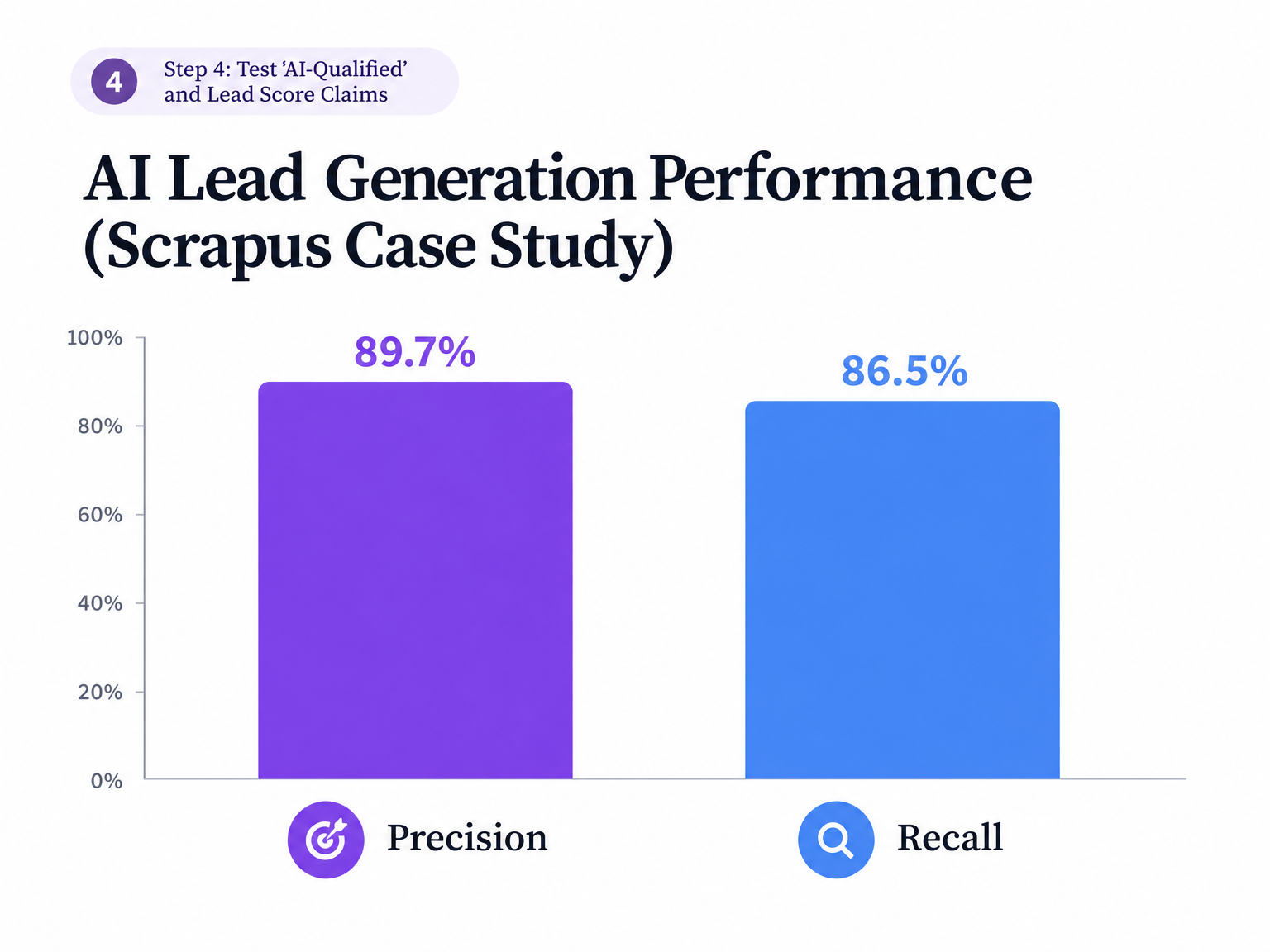 Bar chart of AI lead generation service metrics: 89.7% precision, 86.5% recall
Source: A review of AI-based business lead generation: Scrapus as a case study 12
Step 5: Run a Time-Boxed Pilot With a Rejection Log
Don't sign a 12-month deal based on a sales call. Buy a short, capped test first. Decide before it starts which result ends it.
Here is why that matters. In Forrester's survey of more than 16,000 global business buyers, 81% said they were dissatisfied with the provider they chose at the end of a successful purchase 14. The survey covers business buying across many categories, not lead services alone. It still shows how often a finished deal turns into regret. A pilot with written gates and an exit date lets you find that out in weeks instead of a year.
Set up the pilot with three limits:
- A fixed window. Set the window from your own sales cycle and lead volume. Many teams start with 30 days to look for acceptance patterns, and a longer sales cycle may need more time to show closes.
- A capped spend. Agree on a total the vendor cannot exceed. Delivery stops when you hit it.
- One intake path. Route every pilot lead into your CRM with two required fields. Source records the vendor and campaign. Status records new, contacted, accepted, rejected, or closed. Without those tags, you can't run the Step 2 formulas.
Next, keep a rejection log. A shared spreadsheet works. Use these columns:
| Column | What to record |
|---|---|
| Lead ID | The CRM record number |
| Source URL | The page or call script that captured the lead |
| Consent timestamp | The date and time the person agreed, taken from the vendor's record |
| Rejection reason | The Step 1 rule the lead failed |
| Time to first contact | Minutes from delivery to your first call or email |
Name one owner for the log. On a small team, that is often the office manager or sales lead who already works in the CRM. Block 30 minutes each week to review it, send rejected leads back to the vendor, and flag any source with repeat problems.
Write the go/no-go gates before day one. For example:
- Acceptance rate (A ÷ L) must clear a target you set from your own past leads.
- Cost per accepted lead (S ÷ A) must beat your current source.
- Every lead must carry a source URL and a consent timestamp.
If the vendor misses a gate, the pilot ends with no renewal.
Last, put credits in writing. If a lead fails a Step 1 rule and you report it within an agreed number of days, the vendor replaces it or credits you. You choose which, not the vendor. Leads your team was slow to contact don't qualify, since that delay is on your side.
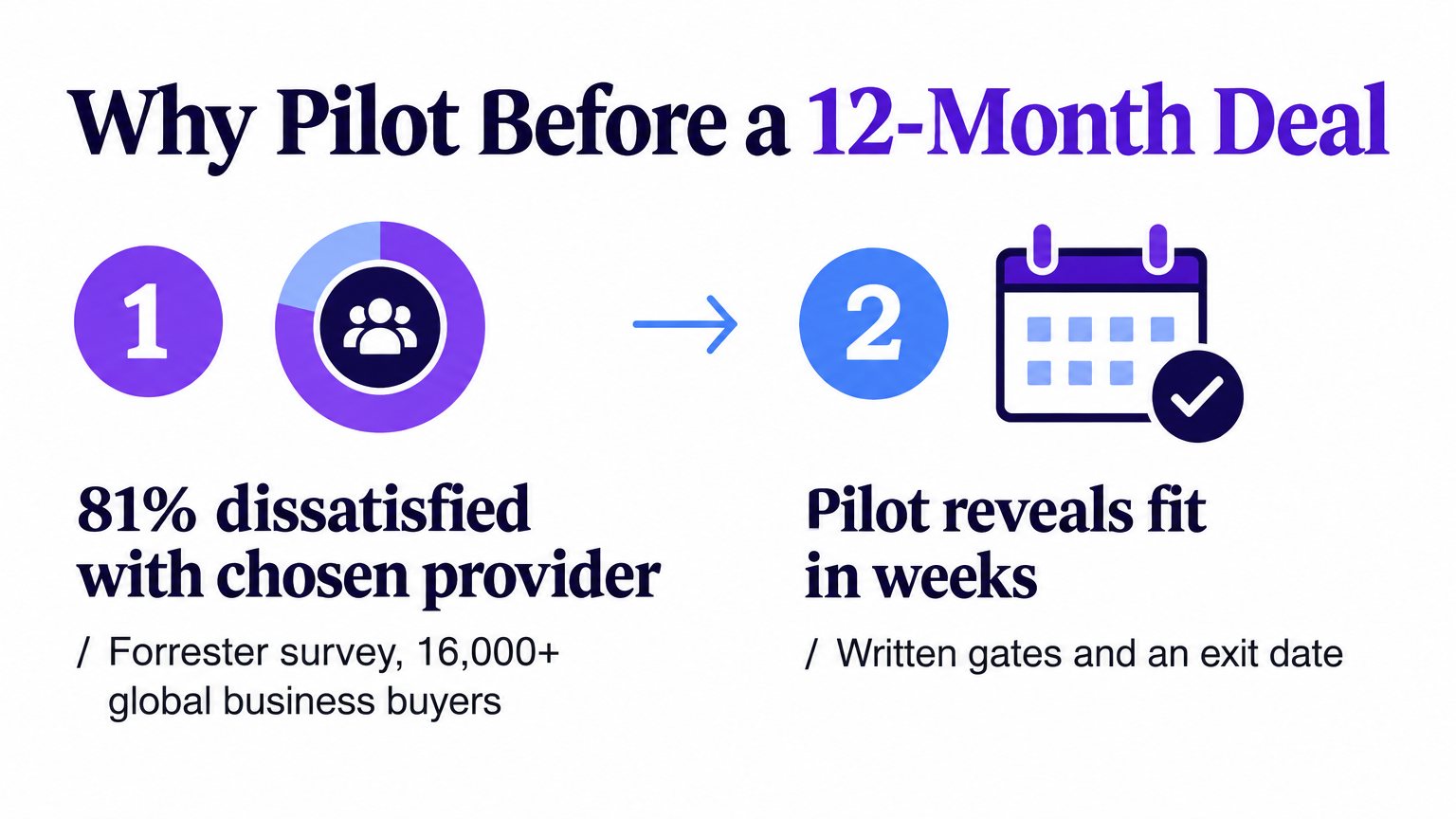 Step 5: Run a Time-Boxed Pilot With a Rejection Log infographic
Compare Lead Generation Services With Your Content Needs
See how Vectoron connects content strategy, SEO, and publishing in one platform, with approval controls you set for each website.
Step 6: Write the Contract Around Records, Remedies, and Exit
Verbal sales promises are hard to enforce, so put every commitment in the contract. Turn what you learned in the pilot into written clauses, and have your lawyer review the draft before anyone signs. In regulated fields, make that review a standard step.
Use this clause checklist:
- Records on request. The vendor delivers source pages, consent records, and timestamps for any lead within a set number of business days, such as five. This makes the records from Step 3 something you can actually get.
- Source and buyer disclosure. The vendor lists every site, affiliate, and call center that feeds your leads. It also names every other buyer who receives the same contact. Any new source needs your written approval first.
- Exclusivity defined. Spell out what "exclusive" means: no other buyer, for how long, and whether the vendor can resell leads you reject.
- Returns and credits. Tie returns to your rejection log and your Step 1 spec. Name the reporting window and state whether you get a replacement or a credit.
- Reporting cadence. Weekly or monthly reports show leads delivered by source, returns, and credits issued, in a file your CRM can import.
- Audit and spot-check rights. You can sample leads, open their source pages, and request the matching consent records at any time.
- Right to pause a source. You can stop any single source right away without ending the whole contract.
- Data deletion at exit. When the deal ends, the vendor deletes or returns your lead data and confirms that in writing.
- Short notice, no auto-renewal. Keep the termination notice short, such as 30 days. Require a signed renewal instead of a silent rollover.
Before you sign, check the final draft against your pilot tracker. Every go/no-go gate from the pilot needs a matching clause. If a gate has no clause, you lose that protection the day the pilot ends.
Rent Leads or Build an Owned Inbound Pipeline
Every lead in this guide so far is rented. You pay for each contact, and the supply stops the day you stop paying. The other option is an owned inbound pipeline. That means articles, search pages, and forms on your own site that people find and fill out themselves. Neither choice is always right, because each one solves a different problem.
Rent leads when you need one of these:
- Volume this month. A vetted vendor can start delivering soon after you sign.
- A market test. You can try a new service line or ZIP range before you build pages for it.
- Gap coverage. A seasonal dip or a new location can borrow demand while your own channels catch up.
Build owned inbound when you want control over the lead itself. The person fills out your form, on your page, under your disclosure, so you hold the consent record from the first click. No other buyer gets the same contact. A shared lead fans out to several companies at once, while a form on your site feeds one CRM: yours. A page that ranks also keeps bringing in leads next quarter without a new invoice.
The cost is time and steady work. Search traffic builds slowly, and pages need regular writing, editing, and updates. If no one on your team owns that work, the pipeline stalls.
Use the Owned inbound column in the Step 2 table to compare the two fairly. Put your content and production spend in S, count form fills as L, and run the same cost-per-accepted-lead and cost-per-customer math. You can also run both at once. Rented leads cover near-term targets while owned inbound grows into a larger share of your pipeline.
If you manage multiple locations or client sites, give each site its own column in that table. Blended totals hide which location's sources are paying off.
Pick the Provider That Can Show Its Work
The right lead generation service hands over its source pages, consent records, and buyer lists without a fight. Its leads also hold up against your spec, your pilot gates, and your contract. If a vendor can't show its work, move to the next one.
If you'd rather own more of your pipeline, Vectoron is software where AI strategists plan and produce content for your site. Your team sets the approval rules: fully autonomous, partial review, or approval required before anything ships. Contact the team to see whether it fits how you work.
Frequently Asked Questions
References
- 1.Targeting and Eliminating Unlawful Text Messages; Rules and Regulations Implementing the Telephone Consumer Protection Act of 1991.
- 2.If you're deceiving consumers, the FTC means business.
- 3.Mark your calendars, telemarketers and sellers! October 15 is Telemarketing Sales Rule record-keeping day.
- 4.Complying with the Telemarketing Sales Rule.
- 5.Telemarketing Sales Rule.
- 6.A Use and Obligations Approach to Protecting Privacy.
- 7.California Consumer Privacy Act (CCPA).
- 8.The Federal Trade Commission 2023 Privacy and Data Security Update.
- 9.Citizens Disability to Pay $1 Million over FTC Charges that It Made Tens of Millions of Illegal, Misleading Calls.
- 10.The relevance of lead prioritization: a B2B lead scoring model based on machine learning.
- 11.The state of lead scoring models and their impact on sales performance.
- 12.A review of AI-based business lead generation: Scrapus as a case study.
- 13.The State Of Business Buying, 2024.
- 14.The State Of Business Buying: Companies Still Struggle To Meet Buyer Expectations.
- 15.Assurance IQ and MediaAlpha to Pay a Total of $145 Million to Settle FTC Charges They Misled Consumers Seeking Health Insurance.
- 16.California-based Lead Generator Agrees to Settlement Banning It from Making or Assisting Others in Making Telemarketing Calls, Including Robocalls.
- 17.Understanding Data Collection, Brokerage, and Spam in the Lead Marketing Ecosystem.
- 18.Federal Communications Commission.
- 19.CAN-SPAM Act: A Compliance Guide for Business.
 Vectoron logo
Choose a Lead Generation Service That Can Execute the Work
See how Vectoron connects marketing strategy with content creation and publishing, while letting you set the approval rules for what goes live.