
Key Takeaways
- Per-link pricing hides the fully-loaded production cost of outreach labor, strategist time, QA, and reporting overhead, which is where agency margin quietly disappears 3.
- Cost-per-qualified-link, calculated only on placements clearing relevance, authority, and placement-quality filters, replaces production metrics with an investment metric clients can tie to organic revenue 8.
- At portfolio scale, outreach labor, strategist time, and QA stop scaling linearly under AI-assisted execution, while publisher placement fees remain the one input that does not compress.
- Repricing works when agencies enforce the qualified-link filter contractually, cross-validate attribution across at least two analytics sources 4, and bundle link building inside an integrated acquisition program 7.
The Per-Link Price Trap Draining Agency Margin
Most agency principals can quote a per-link price from memory. Fewer can quote the fully-loaded production cost, and almost none can quote the revenue that link contributed to a client's organic pipeline. That gap is where margin disappears.
The per-link frame made sense a decade ago, when outreach labor was cheap, placements were plentiful, and clients bought rankings on faith. It made less sense once cost inputs started climbing every quarter while clients started demanding revenue attribution. Peer-reviewed work on inbound marketing economics is direct on this point: SEO and backlinks generate internal costs from the company's own structure, and prior literature has often neglected that cost structure, which makes profitability analysis incomplete 3. Agencies inherit the same blind spot when they price links as a commodity.
The trap has three moving parts. Outreach labor inflates with every algorithm update and every round of platform saturation. Placement fees on relevant industry domains keep rising because those domains are the ones that actually work 6. And client scrutiny has shifted toward measurable financial outcomes, with frameworks like Forrester's SEO ROI model treating links as an investment that must clear a return threshold on traffic, conversions, and revenue 8.
This article reframes link building cost around the only unit that protects margin: cost per qualified link, tied to organic revenue contribution.
Why Cost-Per-Link Is the Wrong Unit of Analysis
The Hidden Internal Cost Structure Behind Every Placement
A $400 placement fee is not the cost of a link. It is the sticker price on the smallest visible input in a production chain that most agencies do not fully account for. The economic literature on inbound marketing is blunt about this: SEO and backlink activities generate internal costs from the company's own structure, and prior work has often neglected that cost structure, which makes profitability analysis incomplete 3. Agencies inherit the same accounting gap.
The fully-loaded cost of a placement splits into two categories. Hard costs are the visible line items: placement or sponsorship fees, guest-post content production, tooling subscriptions for prospecting and outreach, and any freelance writers or editors touching the asset. These are the numbers that appear on invoices and that most agencies track cleanly.
Soft costs are the inputs that quietly consume payroll. Strategist time spent selecting targets, briefing writers, and vetting placements. QA hours reviewing anchor text, link attributes, and destination page relevance. Client reporting cycles that translate raw referring domains into narrative updates. Attribution overhead spent reconciling analytics data before a monthly review. Account management time absorbing revisions when a client rejects a placement. None of these show up on a per-link invoice, but all of them consume margin.
When agencies price links against hard costs only, they systematically underprice the deliverable. The visible fee is often the smaller half of the true production cost.
From Rankings Sold to Revenue Attributed
The second problem with cost-per-link is what it measures on the output side. A per-link price implies that the deliverable is the link itself, which was defensible when clients bought rankings on faith. That contract has expired.
Forrester's SEO ROI framework treats organic search as a financial investment measured against increased traffic, improved conversion rates, and cost savings across the funnel 8. The unit of value is revenue contribution, not link count. Educational material on link building acknowledges the same shift, recommending that campaigns be evaluated on organic traffic growth and visibility rather than raw acquisition volume 9.
Agencies still selling rankings sold face a widening gap. Clients in high-scrutiny verticals, such as legal, healthcare, and multi-location service brands, now ask which links produced which sessions, which sessions produced which conversions, and which conversions produced which booked revenue. A per-link invoice cannot answer any of those questions.
The economic reframe is straightforward. Cost-per-link is a production metric. Cost-per-qualified-link tied to organic revenue contribution is an investment metric. The first tells an agency what it spent. The second tells the client what they earned. Only the second survives a procurement review or a CFO quarterly.
Agencies that keep pricing on the production metric absorb the margin hit every time cost inputs rise faster than clients will accept price increases. The reframe is not optional. It is the only frame that lets an agency defend its retainer when a client asks what the link building line item actually returned.
Defining a Qualified Link Before Pricing One
Relevance, Authority, and Placement Quality as Cost Filters
Pricing a link before defining what makes it worth acquiring is how agencies end up with referring-domain reports that clients cannot connect to revenue. The definition has to come first, because the definition is what turns raw acquisition volume into a cost filter.
Three attributes separate a qualified link from an inventory item. The first is relevance. Practitioner guidance in service-business marketing is explicit that links from relevant industry domains are the ones that actually move organic performance, and that acquiring them is a complicated process rather than a scalable outreach volume play 6. A link from an off-topic directory is not a cheaper version of a category-relevant placement. It is a different product, one that clients cannot monetize.
The second is authority. Educational material on link building defines the deliverable as acquiring hyperlinks that help search engines understand a site contains valuable and trustworthy information, which puts the burden on the linking domain's own signal quality 9. Adjacent research on backlink profiles in high-stakes search environments confirms that link counts and domain-level metrics remain a meaningful visibility signal 10.
The third is placement quality: editorial context, in-content position, followed status, and the destination page's topical fit. Placements failing any of the three attributes should be excluded from the qualified-link count that pricing is built on.
The Cost-Per-Qualified-Link Formula
With the qualification criteria set, the pricing math becomes an economics problem instead of an outreach problem. The formula agencies can apply to their own P&L is straightforward:
Cost-per-qualified-link = (Hard costs + Soft costs) ÷ Links that clear the relevance, authority, and placement-quality threshold
Hard costs carry the visible line items covered earlier: placement fees, guest-post content production, prospecting and outreach tooling, freelance writers, and editors. Soft costs carry the payroll inputs: strategist selection time, QA hours, client reporting cycles, attribution overhead, and account-management revisions. The denominator is the number of placements that survive the three-attribute filter, not the total placements secured.
The formula changes agency behavior in two ways. It punishes volume outreach that produces off-topic or low-authority placements, because those placements never enter the denominator while their production costs stay in the numerator. And it exposes the true unit economics of any campaign where 40 outreach hours produced eight placements but only three met the qualification bar.
The economic literature on inbound marketing supports this framing directly. SEO and backlink activities generate internal costs from the company's own structure, and profitability analysis is incomplete when that cost structure is neglected 3. Educational material on link building reinforces the output side, recommending campaigns be measured on organic traffic growth and visibility rather than raw acquisition counts 9.
Once agencies calculate cost-per-qualified-link honestly for a quarter, two numbers become visible: the real production cost per unit the client can monetize, and the margin available at current retainer pricing. Both numbers are usually worse than the per-link view suggested. That is the point. The formula is a diagnostic tool before it is a pricing tool.
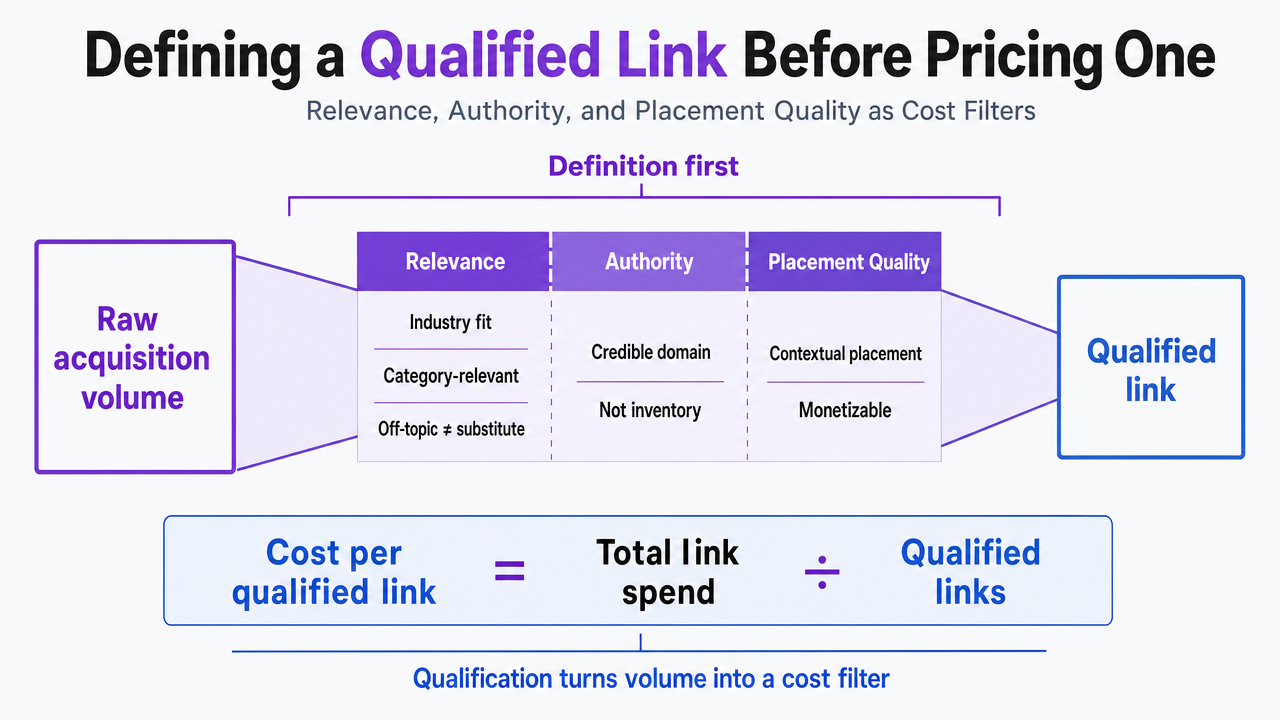 Visualize the three-attribute qualification filter and the cost-per-qualified-link formula, both of which are explicitly defined in this section
Test Efficient Link Building Workflows Risk-Free
Experience streamlined link acquisition at scale and measure real impact on campaign costs and delivery timelines.
Measurement Discipline as a Margin Lever
The cost-per-qualified-link formula is only as honest as the attribution data feeding its ROI defense. Most agencies do not stress-test that data before presenting it to clients, which is why quarterly reviews collapse when a client's finance team asks how the reported organic lift was calculated.
The measurement problem is not hypothetical. A peer-reviewed comparison of analytics services found substantial differences between Google Analytics and SimilarWeb estimates across traffic and engagement metrics, meaning the same link campaign can post materially different ROI numbers depending on which platform an agency reports from 4. The study measured platform-level disagreement on traffic and engagement estimates, not causal attribution, but the implication for agency reporting is direct: the choice of measurement stack changes the number a client sees.
Agencies that report link ROI on a single analytics source are exposed twice. First, when a client's internal team pulls a second source and finds a different traffic figure, the retainer conversation shifts from performance to credibility. Second, when the reported lift includes organic sessions that would have arrived without the link campaign, the cost-per-qualified-link math looks better than the underlying economics support.
Measurement discipline turns this exposure into a margin lever in three ways. Cross-source validation, using at least two independent analytics inputs before attributing a session lift to a link campaign, catches the platform disagreement documented in the comparison study 4. Baseline modeling, which isolates the organic trend a client would have posted without the campaign, prevents overclaiming. And qualified-link tagging at the placement level, tying each acquired link to a destination URL and tracked parameter, produces the session-to-conversion trace that Forrester's SEO ROI framework treats as the unit of financial defensibility 8.
Agencies that install these three habits report smaller headline numbers and defend them all the way to the CFO. Agencies that skip them post larger headline numbers and lose the account when the numbers are challenged. The margin difference is the retention curve.
Compliance Risk as a P&L Input
Compliance sits on most agency org charts as a legal question. On the P&L, it behaves like a cost input, and one that can zero out a quarter of link-building revenue in a single algorithmic update or disclosure complaint.
Two exposure categories matter for pricing. The first is Google's stance on paid link schemes, which treats undisclosed paid placements as manipulation of ranking signals. When Google acts on a pattern, the affected client loses organic visibility, the agency loses the retainer defense, and the placements the agency paid to secure become sunk costs that never enter the qualified-link denominator. The second is disclosure. The FTC's workshop record on deceptive interface practices calls for enforcement guidance on online disclosures and disguised ads, and the same disclosure logic applies when sponsored content or paid relationships are presented as editorial 1. An agency that treats sponsored placements as editorial links carries the disclosure risk on behalf of the client, whether the contract acknowledges it or not.
The P&L consequences are direct. Placement clawbacks turn hard costs into losses. Manual actions or algorithmic devaluations compress reported ROI, which triggers retainer renegotiations. Client churn after a penalty event removes the revenue that was supposed to amortize prior campaign investment. Each of these outcomes belongs in the cost model, not the appendix.
Agencies pricing link building around cost-per-qualified-link should treat compliance as a filter on the qualified-link definition itself. A placement that fails disclosure standards, or that sits on a domain built around paid link inventory, does not become qualified simply because it clears relevance and authority checks. Building the filter into the definition, rather than reviewing it after acquisition, keeps compliance losses out of the numerator and out of the client conversation.
Portfolio Economics: What Changes When Agencies Run Link Building Across Many Clients
If You Manage Link Building Across a Client Portfolio
The framing shifts here. Everything up to this point assumed a single-client view: one campaign, one qualified-link count, one attribution stack. Agencies running link building across a book of 15, 40, or 80 clients face a different economic problem, and the cost inputs behave differently at portfolio scale.
At single-client scope, strategist time and QA are variable inputs that grow with each new placement. At portfolio scope, they behave more like fixed overhead spread across every client, which means the marginal cost of adding a qualified link to any single account depends on how efficiently the operator utilizes strategist capacity across the whole book. The economic literature on inbound marketing treats these internal costs as a function of company structure, not a per-unit expense, which supports the portfolio lens directly 3.
The rest of this section reframes the cost model around that operator view: which inputs collapse under an AI-assisted execution model, and how a worked example changes when the denominator is 200 qualified links a month instead of 12.
Traditional Model vs. AI-Assisted Execution: Cost Input Comparison
The comparison below holds the qualified-link definition constant and varies only the production model. Dollar figures are intentionally omitted, since the economic literature is clear that these inputs are internal to each company's structure and cannot be generalized across agencies without distorting the analysis 3. Operators should plug in their own rates.
| Cost Input Category | Traditional Agency Model | AI-Assisted Execution Model |
|---|---|---|
| Outreach labor | Variable, scales linearly with placement volume (H hours × W wage × N clients) | Largely collapses to platform overhead plus review time; hours per placement drop toward a small constant |
| Content production (guest posts, digital PR assets) | Freelance or in-house writer cost per asset, multiplied by placement count | Production cost per asset falls; strategist edit and approval time becomes the binding constraint |
| Placement fees | Unchanged. Editorial and sponsored fees are external and set by publishers | Unchanged. External market cost persists regardless of production model |
| Strategist time (targeting, briefing, vetting) | Scales with client count; portfolio expansion requires new hires | Shifts to approval and exception handling; capacity per strategist increases materially |
| QA and client reporting | Variable per client per month; a common margin leak in growing portfolios | Reporting compiles from tracked execution data; QA concentrates on qualified-link filter enforcement |
| Tooling (prospecting, outreach, analytics) | Multiple point tools with per-seat pricing that scales with headcount | Consolidated platform cost; less per-seat inflation as the portfolio grows |
The pattern is not that every input drops. Placement fees do not, because publishers set them. The change is in which inputs stop scaling linearly with client count. Outreach labor, strategist time, and QA are the three categories where portfolio operators absorb the most margin compression under the traditional model, and they are the three where AI-assisted execution changes the slope of the cost curve.
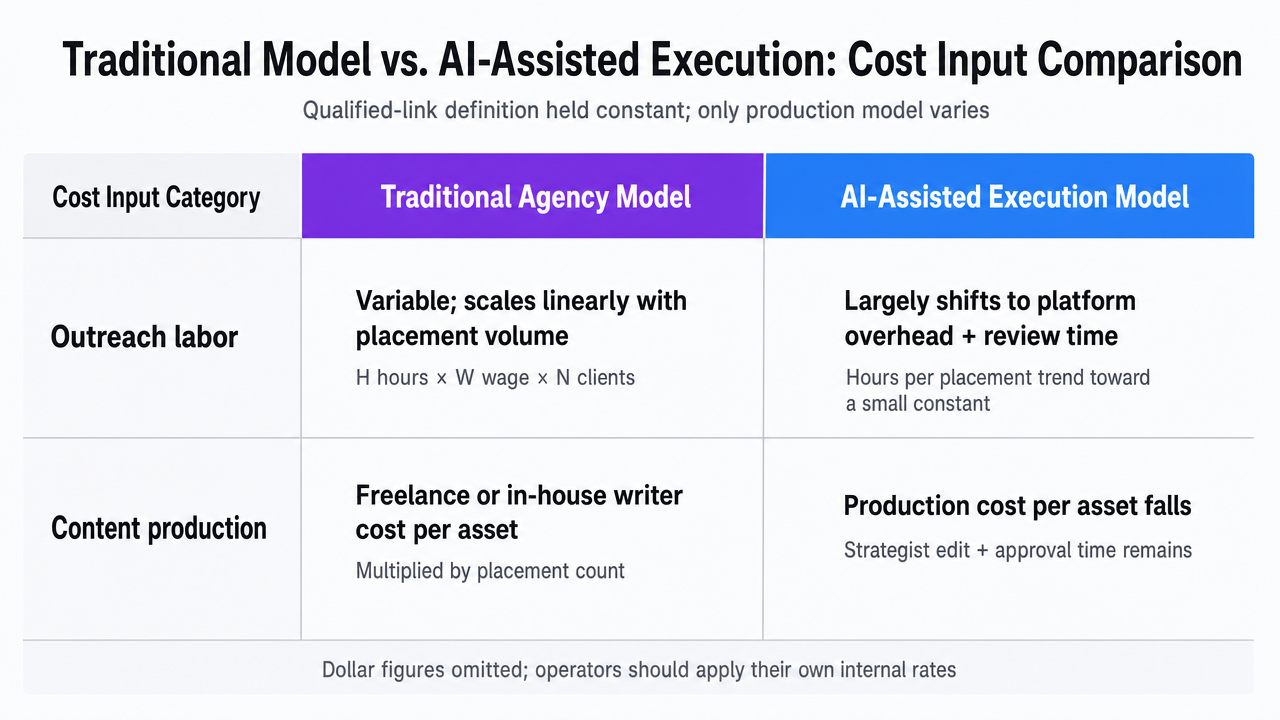 Render the section's comparison table as a side-by-side visual so readers can scan how each cost input behaves under each production model
A Worked Example With an Explicit Assumption Block
A worked example makes the portfolio math concrete. The assumptions below are illustrative and should be replaced with each operator's actual rates.
Assumption block: Portfolio of 20 clients. Target output of 6 qualified links per client per month, or 120 qualified links total. Assume outreach labor of H hours per placement attempt, a placement success rate of S, strategist oversight of T hours per client per month, and average placement fee of F per qualified link.
Under the traditional model, monthly production cost equals (120 ÷ S) × H hours of outreach labor, plus 20 × T strategist hours, plus 120 × F in placement fees, plus content production for each attempted placement. If S is 0.5, outreach labor alone runs on 240 placement attempts.
Under an AI-assisted model, the outreach labor line item and content production line item collapse toward platform overhead. Strategist hours per client fall because targeting, briefing, and reporting compile from tracked execution data. Placement fees stay identical at 120 × F. The qualified-link filter still governs the denominator, so the qualified-link count does not inflate.
The cost-per-qualified-link number that results is what the retainer needs to defend. Agencies running this math honestly usually find the traditional model prices out of the market before the AI-assisted model does.
See Real-World Link Building Cost Benchmarks for Agencies
Request a tailored analysis of current link building cost structures and efficiency metrics, designed for agencies optimizing delivery at scale—no generic estimates, just actionable data for your team.
Repricing Retainers Around Cost-Per-Qualified-Link
Once the qualified-link denominator and portfolio math are honest, the retainer needs to catch up. Most agency contracts still price link building as a per-link line item or a flat monthly allocation, both of which decouple price from the economic unit the client actually monetizes.
Three repricing structures survive scrutiny in a CFO review. The first is a qualified-link tier: the retainer commits to a defined number of placements that clear the relevance, authority, and placement-quality filter, with unqualified attempts absorbed by the agency rather than billed as delivery. This structure aligns cost-per-qualified-link with revenue and makes the filter part of the contract, not a reporting footnote.
The second is an outcome-linked component tied to organic sessions or conversions attributable to acquired links. Forrester's SEO ROI framework treats increased traffic, improved conversion rates, and cost savings as the measurable benefits an SEO program should defend 8. A retainer with a base fee plus an outcome trigger captures margin when the campaign performs and disciplines the agency when it does not.
The third is a bundled acquisition retainer that prices link building inside an integrated program. Process-evaluation evidence shows link building rarely operates alone in effective campaigns; it sits alongside SEO audit, content strategy, and promotion 7. Bundling protects margin on the link component when placement fees rise, because the retainer defends the full acquisition system rather than a single input.
Repricing existing clients works best as a renewal conversation anchored on the qualified-link filter, not a mid-term price increase. Agencies that lead with the definition, then show the current cost-per-qualified-link, then propose the new structure, close renewals at higher margin more often than agencies that lead with the price change.
What Profitable Link Building Looks Like Next Quarter
Profitable link building next quarter looks nothing like the per-link scoreboard most agencies still report on. It looks like a P&L line where the qualified-link filter is enforced before acquisition, the cost-per-qualified-link is calculated against fully-loaded production inputs, and the retainer defends organic revenue contribution rather than referring-domain counts.
Three moves separate the agencies that will hold margin from the ones that will keep absorbing input inflation. Install the qualified-link definition as a contractual filter, not a reporting habit. Cross-validate attribution across at least two analytics sources before defending ROI, since platform-level disagreement is now documented rather than debated 4. And treat link building as one input inside an integrated acquisition program, which is how effective campaigns actually operate in the field 7.
The agencies that make these moves stop competing on per-link price and start competing on production economics. Vectoron exists to compress the outreach labor and reporting overhead that make the traditional model unprofitable at portfolio scale, so principals can defend retainers on the numbers that matter.
Frequently Asked Questions
References
- 1.Dark Patterns Workshop Transcript.
- 2.Search engine optimization and its association with readability and accessibility of diabetic retinopathy websites.
- 3.Digital inbound marketing: Measuring the economic performance of inbound marketing actions.
- 4.Measuring user interactions with websites: A comparison of two analytics services.
- 5.The Quality of Infectious Disease Hospital Websites in Poland ....
- 6.Digital Marketing for Private Practice: How to Attract New Patients.
- 7.Process Evaluation of the 'No Money No Time' Healthy Eating Intervention ....
- 8.You Can Quantify The ROI Of SEO.
- 9.Why SEO Link Building Is Still the Most Powerful Ranking Factor for ....
- 10.Understanding the landscape of web-based medical misinformation ....