
Key Takeaways
- Price social media retainers as a three-layer stack — labor, media, and tooling — because each layer moves on a different curve and hides margin risk when bundled into one number.
- Labor sets the floor and stays sticky at $50–$150 per hour 5, while media pass-through has risen 18–25% since 2024 6and tooling has dropped to $27–$265 monthly 2, flipping which layer compresses margin.
- Shift the retainer unit from post volume to oversight hours, and write CPM repricing triggers, peak-season optimization rates, and onboarding fees of $1,000–$3,000 3into the contract before signing.
- Focus next on portfolio-level utilization of senior oversight time and on repricing production through AI-assisted tooling, holding the retainer steady while margin moves to the agency side of the invoice.
Why the Retainer Number Stopped Telling the Whole Story
Ask ten agency owners what social media management costs and the answers cluster into a familiar band: somewhere between $2,000 and $25,000+ per month, depending on client size and platform mix 3. That range is technically accurate and operationally useless. It hides the fact that the retainer is now a container for three cost layers moving in opposite directions.
Labor is holding steady. Hourly rates still sit at $50–$150 for most agency-grade practitioners 5. Media, meanwhile, has compressed margin from the outside — platform ad costs have risen 18–25% since 2024 6. Tooling has moved in the other direction, with AI-assisted production platforms available from $27 per month and reshaping what a production hour actually costs 2.
An agency pricing a $4,000 retainer in 2022 was selling a different product than an agency pricing $4,000 today. The labor line is the same, but the media pass-through absorbs more client budget before a single post is scheduled, and the tooling layer now includes options that didn't exist eighteen months ago.
The rest of this piece treats social media management cost as a three-layer stack — labor, media, tooling — and benchmarks each one against 2026 delivery-model economics. The goal is a defensible cost model, not a headline retainer number.
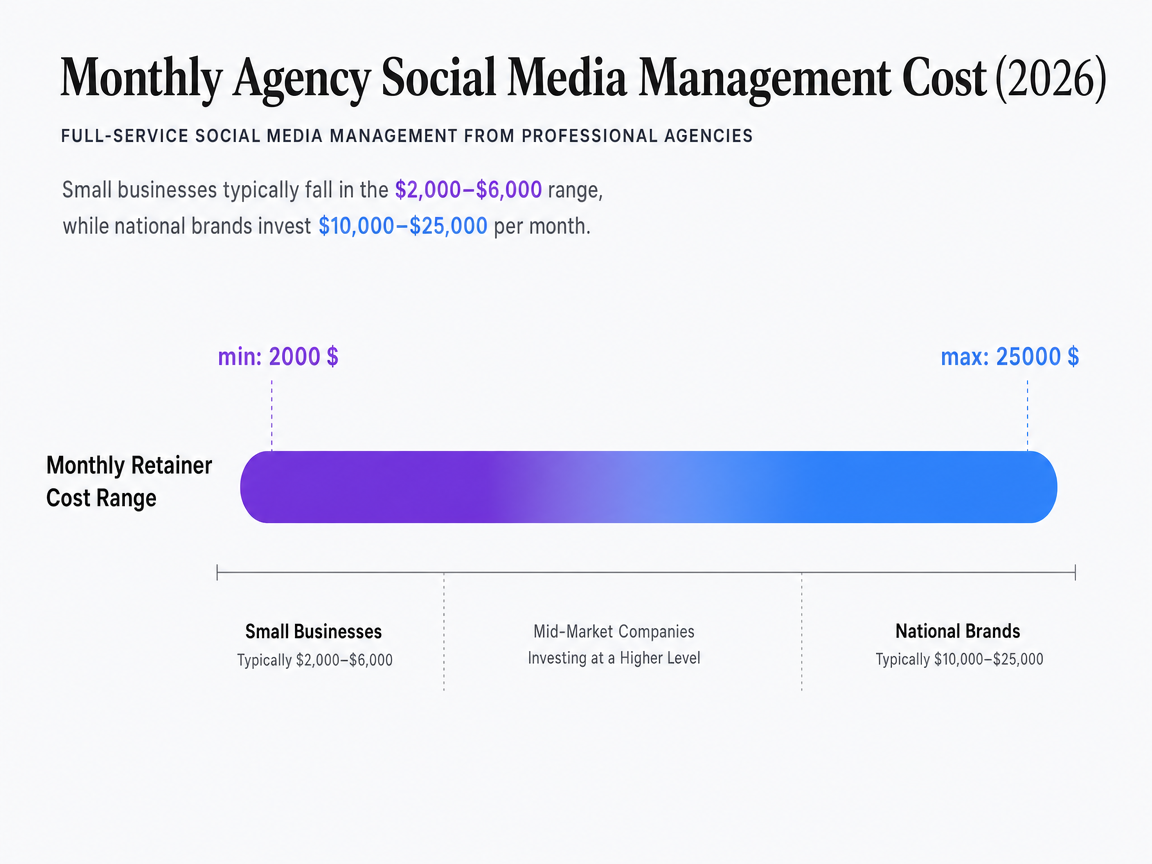 Monthly Agency Social Media Management Cost (2026)
Full-service social media management pricing from professional agencies in 2026, with small businesses typically in the $2,000–$6,000 range and national brands at $10,000–$25,000 per month.
The Three-Layer Cost Stack: Labor, Media, Tooling
Treating social media management cost as a single retainer number obscures where margin actually lives. A cleaner model separates the delivery economics into three layers, each with its own supply curve and its own risk profile.
Labor : Covers strategy, content production, community management, and reporting — the hours an agency bills against.
Media : Covers paid social pass-through, boosted posts, and creator or influencer fees the client funds.
Tooling : Covers the scheduling, listening, analytics, and AI-assisted production stack that sits underneath both.
The three sub-sections that follow benchmark each layer against 2026 market data and identify which one an agency actually controls when pricing a retainer. Labor sets the floor, media compresses the middle, and tooling is where the delivery model is being repriced fastest.
Labor: The Line Item That Determines Your Floor
Labor is the layer an agency owns outright, which makes it the layer that sets the floor on every retainer. Industry benchmarks put agency-grade hourly rates at $35–$150 per hour, with the wider ranges reflecting differences in strategy depth, seniority, and platform mix 1. A tighter cut of the market places most practitioners at $50–$150 per hour once strategy and reporting are included 5. That upper ceiling is where senior strategists, paid-social leads, and analytics specialists actually bill.
Subcontracted labor follows a cleaner tier structure:
- Entry-level freelance social media managers work at $500–$1,000 per month
- Mid-career operators at $1,000–$3,000
- Senior practitioners at $3,000–$5,000+ 4
Those tiers are useful as a cost-of-goods anchor when an agency decides whether to staff a client internally or route production to a bench.
Running the math against a $4,000 retainer clarifies the pressure. A senior freelancer at the top of the mid-career band ($3,000/month) consumes 75% of the retainer before tooling, media oversight, or agency margin is accounted for. Push the same account to a $150/hr in-house strategist and the retainer covers roughly 26 billable hours — enough for strategy, light community management, and reporting, but not full production at multi-platform cadence.
The operational point: labor cost is not the retainer's biggest variable, but it is the least compressible one. Media pass-through can be repriced quarterly and tooling can be swapped, but a senior strategist billing at $150/hr is billing at $150/hr. Agencies that price without mapping labor hours to scope tend to discover the gap in month three, when community-management volume exceeds the hours the retainer actually funded.
Media: The Pass-Through That Now Compresses Your Margin
Media spend is the layer an agency doesn't own but still has to price around. Paid social sits on top of the retainer as a pass-through, and until 2024 that pass-through was mostly a coordination cost — plan the campaign, run the buy, report the results. It has since become the layer most likely to erode gross margin without warning.
Platform ad costs have risen roughly 18–25% across major networks since 2024 6. That increase does not show up on the labor invoice; it shows up in client conversations about why last quarter's budget delivered fewer impressions than the quarter before. Agencies that priced management fees as a percentage of media spend caught the upside. Agencies on flat retainers absorbed the coordination overhead — more optimization cycles, more reporting nuance, more client reassurance — with no corresponding revenue lift.
Seasonal volatility compounds the pressure. Cyber Monday 2024 pushed Meta CPMs to $17.70, 138% above typical rates for the platform 7. A retailer client running the same holiday budget as the prior year effectively bought less than half the impressions during peak days. The agency did not cause the spike, but the agency owns the conversation about it — and often owns the make-good hours that follow.
The operational adjustment is a contractual one. Retainers that include paid social oversight should specify:
- A media-budget band
- A repricing trigger when CPMs exceed a stated threshold
- A separate hourly rate for optimization work during declared volatility windows
Outcome benchmarks like a $18.68 average CPA 8are useful as reference points in those clauses, not as guarantees.
Media compresses margin because it moves faster than the retainer cycle. Labor gets repriced annually; media reprices every auction. Agencies that treat the pass-through as a static line item are pricing yesterday's CPM into next quarter's contract.
Test Real-Time Social Media Management Efficiency
Experience live campaign execution and cost tracking with unrestricted platform access during your trial period.
Tooling: The Layer That Just Repriced Production
Tooling used to be a rounding error on the delivery P&L. A scheduler, a listening tool, a design subscription, and maybe an analytics add-on ran a few hundred dollars per client per month and rarely showed up in a pricing conversation. That line item is now the layer moving fastest, and it is moving in the direction agencies benefit from.
Software-led delivery stacks run $27–$265 per month, with most B2B teams clustering in the $95–$265 band once AI-assisted production is included 2. At the low end, that covers scheduling and basic analytics. At the upper end, it covers content generation, first-draft copy, image production, and platform-specific formatting — work that previously consumed junior production hours at $50–$150 5.
The repricing is not that tools replace strategists. It is that the ratio of production hours to oversight hours has flipped. An account that once required 25 hours of drafting and 5 hours of review can now require 5 hours of generation-and-editing and 5 hours of strategic review — the same senior time, a fraction of the junior time. Multi-platform scope, which used to be the argument for higher retainers because users touch an average of 6.6 networks monthly 12, is now a scaling problem tooling handles cleanly.
The agencies pricing this correctly are not passing tooling savings to clients. They are holding the retainer, absorbing the production layer into software, and repricing the labor line as oversight rather than output. The margin gain sits on the agency side of the invoice, which is where it should sit — clients are buying judgment, not keystrokes.
Benchmarking the Retainer Bands Against Real Delivery Cost
The published ranges only become useful when they are stacked side by side against the delivery model producing them:
- Tool-led execution runs $27–$265 per month
- Freelance retainers span $500–$7,000
- Full-service agency engagements land between $2,000 and $25,000+ 2
Those three bands are not competing for the same client — they describe three different products, each with a different oversight profile.
Inside the agency band, the distribution is wider than most operators price against. Lower-tier retainers focused on posting cadence and light engagement benchmark at $750–$1,550 per month 10. Mid-market and national brand engagements sit at $10,000–$25,000, with small-business retainers concentrating in the $2,000–$6,000 window 3. An agency selling a $3,500 retainer is competing on the same shelf as a $1,200 posting service and a $12,000 strategic engagement — three different value propositions the market lumps into one search query.
Onboarding is the second calibration point most agencies underprice. Setup fees typically run $1,000–$3,000 for strategy work, audits, brand voice development, and platform configuration 3, with the broader market accommodating $500–$3,000 depending on scope 11. That is not a rounding fee. Onboarding is roughly one month of a mid-tier retainer, and agencies that fold it into month one are financing their own strategic work at zero margin.
Reading the bands as a diagnostic:
- An agency retainer priced below $2,000 is competing against freelancers on cost per output, not against agencies on strategic depth.
- A retainer above $10,000 is being measured against outcomes, not deliverables.
- The middle band — $2,000 to $6,000 — is where scope discipline matters most, because clients in that range expect agency-grade strategy at freelancer-adjacent economics, and the delivery model has to close that gap without eroding margin.
A Cost-Stack Comparison Across Four Delivery Models
Stacking the delivery models side by side clarifies where the retainer dollar actually goes. The table below models a $4,000 monthly client engagement across four production configurations, using only sourced ranges. Media spend is treated as a client-funded pass-through and excluded from the agency's cost base.
| Delivery model | Monthly labor cost | Tooling cost | Onboarding (one-time) | Gross margin at $4,000 retainer |
|---|---|---|---|---|
| In-house pod (junior producer + senior strategist) | ~$2,500–$3,500 at blended $50–$150/hr 1, 5 | $95–$265 2 | $1,000–$3,000 3 | Thin: ~$235–$1,405 before overhead |
| Freelance-led delivery (mid-career lead) | $1,000–$3,000 4 | $27–$265 2 | $500–$3,000 11 | Moderate: ~$735–$2,973 |
| Standard agency retainer (internal team, full scope) | ~$2,800–$3,600 at $50–$150/hr 5 | $95–$265 2 | $1,000–$3,000 3 | Thin: ~$135–$1,105 before overhead |
| AI-assisted execution (senior oversight only) | Variable — oversight hours only at $50–$150/hr 5 | $27–$265 2 | $500–$3,000 11 | Wide: dependent on oversight-hour count |
The in-house pod and standard agency rows look similar because they are — the labor stack is the same, just wrapped in different overhead assumptions. At a $4,000 retainer, both models leave a narrow band of gross margin once a mid-career producer and a senior strategist are billing against the account. Add two rounds of client revisions or an unplanned community-management spike, and the margin compresses further.
The freelance row looks healthier on paper, but the seniority tier decides everything. A $1,000/month entry-level freelancer at the low end of the mid-career band 4leaves headroom; a $3,000/month senior practitioner at the top of that band consumes 75% of the retainer before tooling is layered in. Freelance-led delivery is a margin story only when scope stays disciplined.
The AI-assisted row is intentionally left variable. The tooling cost is bounded — $27–$265 per month covers the production stack 2— but the labor line depends entirely on how many senior oversight hours the account actually consumes. An account that runs on 8 hours of senior review at $150/hr costs $1,200 in labor; the same account at 20 hours costs $3,000. The margin structure inverts: instead of producing hours to fill a retainer, the agency prices judgment against a fixed production layer.
Onboarding sits outside the monthly math and shouldn't be netted against it. A $1,000–$3,000 setup fee 3funds the strategy work that determines whether month two runs at 12 oversight hours or 25. Agencies that skip it are lending working capital to their own delivery process.
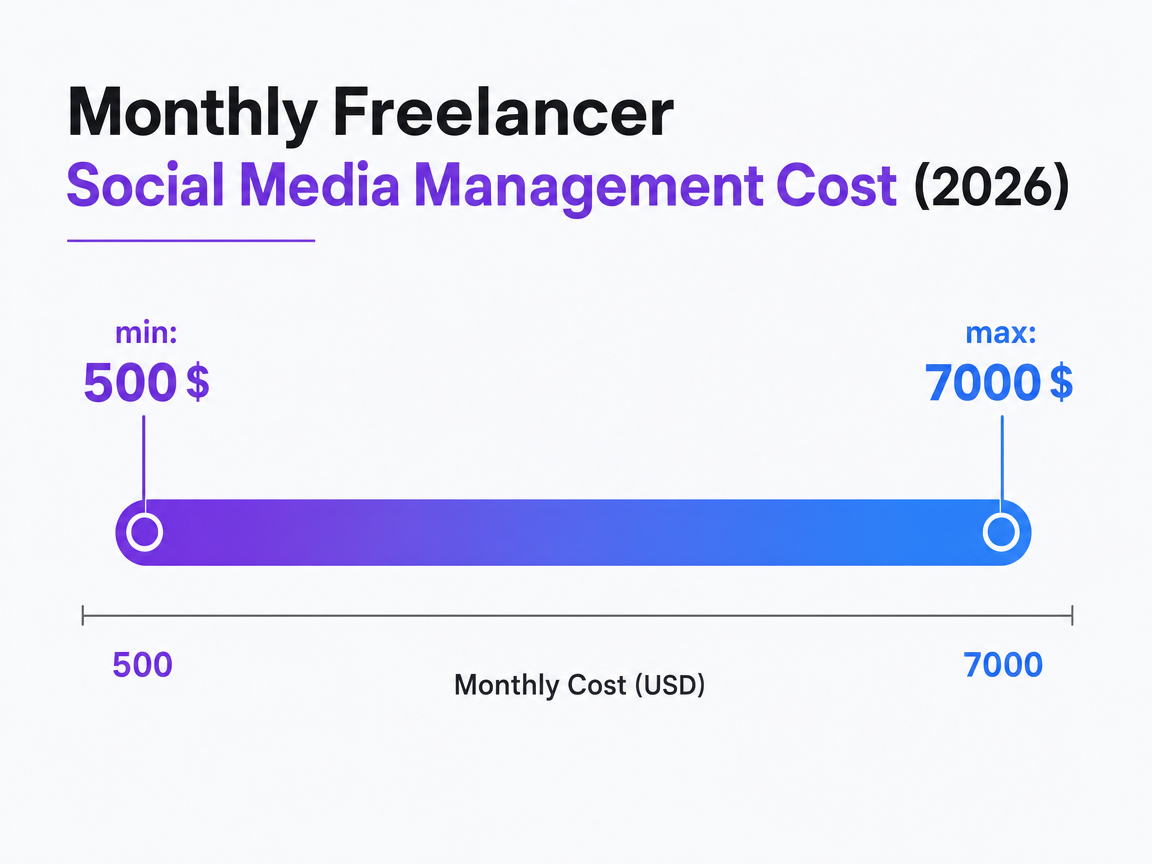 Monthly Freelancer Social Media Management Cost (2026)
Typical monthly cost range for hiring a freelance social media manager in 2026.
Pricing by Scope of Oversight, Not Volume of Posts
The legacy retainer question — how many posts per week across how many platforms — was a proxy for labor hours when labor was the largest cost in the stack. It no longer is. When AI-assisted production drops the drafting-hour count and platform ad auctions absorb an unpredictable share of client budget, post volume becomes the wrong unit to price against. Oversight hours are the unit that actually correlates to what an agency delivers.
Pricing by scope of oversight means the retainer is denominated in senior review time, strategic decisions, and approval cycles — not deliverable counts. A $4,000 engagement priced this way funds, for example, 20 hours of senior strategist time at $150/hr 5, a defined tooling stack, and a stated number of approval touchpoints per week. Production volume flexes underneath that ceiling. If a client wants twelve posts one week and four the next, the oversight budget doesn't move.
The scope contract shifts accordingly. Instead of listing eight Instagram posts, four LinkedIn posts, and two TikToks, it specifies:
- The platforms covered
- The review cadence
- The categories of content approved (organic, paid, community response, crisis)
- The number of strategic pivots included per quarter
Multi-platform scope still commands a premium because users touch an average of 6.6 networks monthly 12, but the premium is priced as additional oversight hours, not additional deliverables.
The client conversation gets easier, not harder. Agencies stop defending why a post count dropped when a campaign strategy changed, and start defending the judgment behind the change. That is the billable expertise clients in the $2,000–$6,000 band 3actually retain an agency for — and the one AI-assisted production cannot replicate.
See How Leading Agencies Quantify and Control Social Media Management Costs
Connect with our team for a custom, data-backed breakdown of social media management cost structures—benchmark your agency’s spend, identify efficiency gaps, and explore automation strategies tailored to multi-channel delivery at scale.
Seasonal Volatility and the Pricing Clauses Most Agencies Skip
Most social media retainers are written as if the auction runs at a flat rate for twelve months. It doesn't. Meta CPMs hit $17.70 on Cyber Monday 2024, 138% above typical platform rates 7, and comparable spikes recur around Black Friday, Q4 retail windows, and category-specific event peaks. An agency that quoted a client's holiday campaign against Q2 benchmarks is delivering the same optimization work against materially worse economics.
Three clauses close the gap:
- A stated CPM band that triggers a repricing conversation when platform costs exceed a defined threshold.
- A separate hourly rate for optimization work during declared volatility windows — the same $50–$150 range that governs regular strategy hours 5, scoped explicitly to peak-season buys.
- A media-budget floor that keeps campaigns from starving during periods when the same dollar buys half the impressions.
Agencies skip these clauses because they read like friction during the sales cycle. They become the entire conversation in December, when a retail client's cost-per-acquisition drifts and the agency owns the explanation without owning the auction. Writing the volatility clause once, at contract signing, is cheaper than negotiating it in the middle of a peak-season underperformance review.
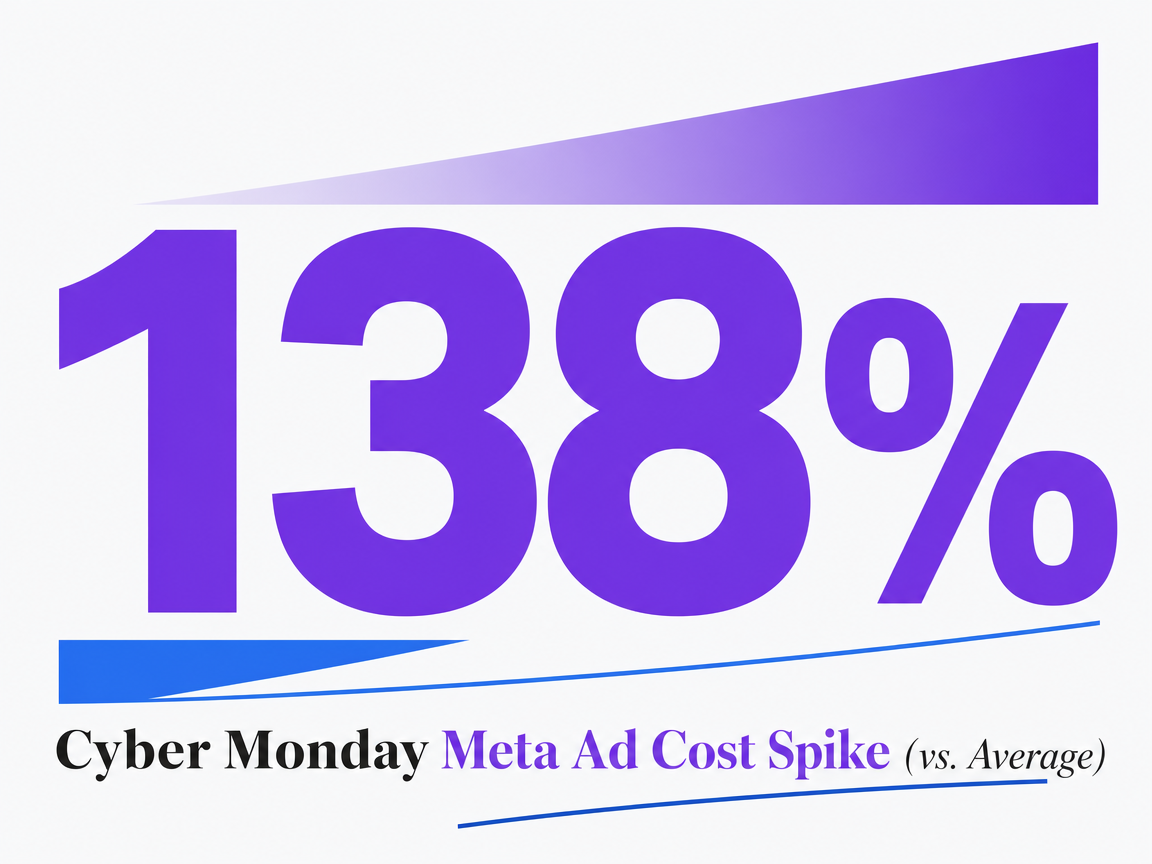 Cyber Monday Meta Ad Cost Spike (vs. Average)
Cyber Monday Meta Ad Cost Spike (vs. Average)
Outcome-Based Pricing: When CPA Benchmarks Belong in the Contract
Outcome-based pricing is not a philosophy question. It is a math question about who owns the auction risk. When an agency ties a portion of its fee to a cost-per-acquisition target, it is agreeing to absorb variance in a market where the average CPA already sits at $18.68 across industries 8and platform ad costs have moved 18–25% since 2024 6. The contract only holds if the CPA target is indexed to the auction, not to the retainer.
Three conditions determine whether the model is defensible:
- The client has enough historical conversion data to establish a baseline CPA, not an aspirational one.
- The offer, landing experience, and conversion instrumentation sit inside the agency's scope of control — an outcome fee tied to a checkout the agency can't touch is a lottery ticket.
- The contract includes a CPA band, not a fixed number, with repricing tied to the same volatility triggers that govern seasonal media clauses.
The model favors accounts already priced at the $10,000–$25,000 mid-market tier 3, where the retainer base absorbs enough overhead that the variable component becomes upside rather than survival. Below that, outcome-based pricing tends to convert margin into media pass-through risk — the agency wins the pitch and loses the quarter.
If You Manage a Portfolio of Client Accounts
A scope shift worth naming: the sections above priced a single retainer. Portfolio economics — running twenty, forty, or eighty accounts across a bench — repricing follows different rules, because fixed costs distribute across the roster and variance in one account compounds across the book.
Two portfolio-level levers matter more than the per-account math:
- Oversight-hour utilization across senior staff. A strategist billing at $150/hr 5against twelve accounts at 8 oversight hours each fills a full-time load at gross revenue that scales linearly with the tooling stack underneath.
- Media-band segmentation. Accounts inside the $2,000–$6,000 small-business tier 3absorb seasonal volatility differently than mid-market accounts in the $10,000–$25,000 band 3, and blending them under one retainer template guarantees one cohort subsidizes the other.
The portfolio move most agencies underprice is the sub-$500 client. Roughly 24% of small businesses budget under $500 per month for social media marketing 9— a segment worth productizing into a fixed-scope offering rather than declining outright, provided the delivery layer is standardized and oversight hours are capped per account.
Where AI-Assisted Execution Fits in the Cost Model
AI-assisted execution is not a discount lever. It is a repricing of the production layer, and the agencies treating it that way are the ones widening margin instead of racing competitors to the bottom of the retainer band.
The math is straightforward. Tooling stacks that include AI-assisted content generation run $27–$265 per month 2, replacing junior production hours that previously billed at $50–$150 5. What remains on the labor line is senior judgment: strategic direction, approval decisions, brand voice enforcement, and the analytical work that determines whether the next campaign shifts platforms or budget. Clients paying $2,000–$25,000+ 3are not paying for keystrokes — they are paying for the operator deciding which keystrokes ship.
Approval-first platforms like Vectoron sit inside this repriced production layer, keeping human sign-off as the billable expertise while automation handles the drafting and coordination underneath. The retainer holds. The margin moves.
Frequently Asked Questions
References
- 1.Social Media Management Pricing in 2026.
- 2.Social Media Management Pricing: Tools, Freelancers, & Agencies.
- 3.Social Media Management Pricing 2026.
- 4.How to price your social media management services.
- 5.Social Media Management Pricing: What It Really Costs in 2026.
- 6.Social Media Marketing Costs 2026: Complete Pricing Guide.
- 7.The true cost of social media ads in 2025.
- 8.Social Advertising Benchmarks for 2026.
- 9.How Much Do Small Businesses Spend on Social Media Marketing.
- 10.Social Media Management Pricing in 2026 - LYFE Marketing.
- 11.Social Media Marketing Packages: What's Actually Included.
- 12.Social Media Statistics Details - Undiscovered Maine.