
Key Takeaways
- Flat-headcount growth comes from a different operating model: fewer primary assets engineered for derivative reuse, AI execution routed through approval gates, and measurement tied to sourced revenue 1.
- Cap net-new pillar assets at four to eight per year, attach a documented derivative plan with named owners before each one ships, and retire formats that go uncited in deals 5.
- Governed AI beats a senior hire or agency retainer on scaling math because it concentrates oversight at the approval gate while output scales with the asset map rather than a person or contract 6.
- Start the next ninety days by naming two or three buying committees, shipping one pillar with its seven derivatives end to end, then wiring approval gates to pipeline metrics 3.
The operating model shift behind flat-headcount growth
The B2B marketing teams growing pipeline on flat headcount are not working harder than their peers. They are running a different operating model. The work has moved from briefing-and-handoff cycles to a governed system that produces fewer, richer assets, engineers derivatives off them, and routes AI-assisted execution through human approval gates tied to sourced revenue.
Forrester frames this directly. In its "more from less" position, "more" refers to value, not volume, and "less" refers to both volume and creation resources 1. That reframing matters because the dominant failure mode in B2B content is producing additional assets that do not influence buying decisions. Adding a senior content hire or a second agency retainer compounds that failure if the underlying model still rewards output count over reuse, modularity, and pipeline contribution.
The shift has three load-bearing parts:
- The first is asset architecture: a small set of primary assets engineered for derivative reuse across channels and journey stages 5.
- The second is execution: generative AI embedded inside business processes with KPI tracking, which McKinsey's 2025 survey links directly to realized value rather than pilot activity 7.
- The third is measurement: structuring content for reasoning engines and zero-click surfaces, where influence on target accounts and reuse by sales matter more than raw traffic 2.
What follows is a working blueprint for VPs who already run marketing and need to defend a flat-headcount plan to a CFO. The argument is not that teams should do more with less. It is that the operating model itself is the unit of leverage.
Primary assets and engineered derivatives
Why volume is the wrong scaling metric
Most content plans still measure success by publishing cadence. Posts per week, ebooks per quarter, webinars per half. That metric rewards activity, not influence, and it is the single biggest reason teams hit a headcount wall. Each additional asset requires a brief, a draft, a review cycle, design, distribution, and a measurement attempt. Adding people to absorb that load scales the cost of production, not the value of the output.
Forrester's position on this is direct: in the "more from less" math, "more" refers to value, not volume, and "less" refers to both volume and creation resources 1. The implication for a VP defending a flat plan is uncomfortable. If the content calendar still measures throughput, the operating model is built to require headcount growth. Cutting the calendar is not austerity; it is a redesign.
The replacement metric is engagement from target accounts and reuse by sales, not visits or impressions 2. A single primary asset that influences twenty buying committees inside named accounts outperforms forty blog posts that drive unattributed traffic. The math only works if the team commits to fewer net-new assets, deeper investment in each one, and a deliberate derivative plan attached before the primary asset ships. Volume is a lagging symptom of an unfocused strategy, not a growth lever.
Building the primary-and-derivative asset map
A primary asset is a research-grade piece of work that earns the right to be referenced repeatedly: an original benchmark report, a category point of view, a structured customer study, or a buyer-decision framework. Forrester's reuse model treats one such core asset as the fuel for derivative content across many channels, which the firm explicitly ties to increased production scale and ROI without proportional headcount 5. The leverage comes from planning the derivatives before the primary asset is written, not after it ships.
A workable map starts with the primary asset at the center and radiates derivatives outward by audience role and journey stage. From a single category benchmark, a team can engineer:
- an executive brief for CFO conversations,
- a sales one-pager mapped to the top three objections,
- a five-touch email sequence for nurture,
- a LinkedIn carousel for the analyst's personal feed,
- a webinar abstract with three pre-recorded segments,
- a cluster of SEO-targeted explainer pages that link back to the primary,
- and a sales call talk track with three data points sellers can quote in discovery.
Each derivative inherits the primary's research foundation, which is why authority compounds instead of diluting.
Forrester's customer-centric guidance reinforces the structure: design the primary asset, then engineer derivative content for multiple channels and stages with an insights feedback loop based on consistent metrics 10. That feedback loop is what separates reuse from reposting. Teams should track which derivatives generate sales-qualified conversations, which get cited inside deals, and which die on arrival, then retire the dead formats rather than refilling them.
The production discipline is simple in concept and hard in practice. No primary asset enters the calendar without a documented derivative plan, owner per derivative, and a target channel for each. The plan caps net-new primary assets at a number the team can actually invest in deeply, typically four to eight per year for a mid-market B2B team, and treats the derivative pipeline as the volume engine. That is how content output expands while headcount stays flat.
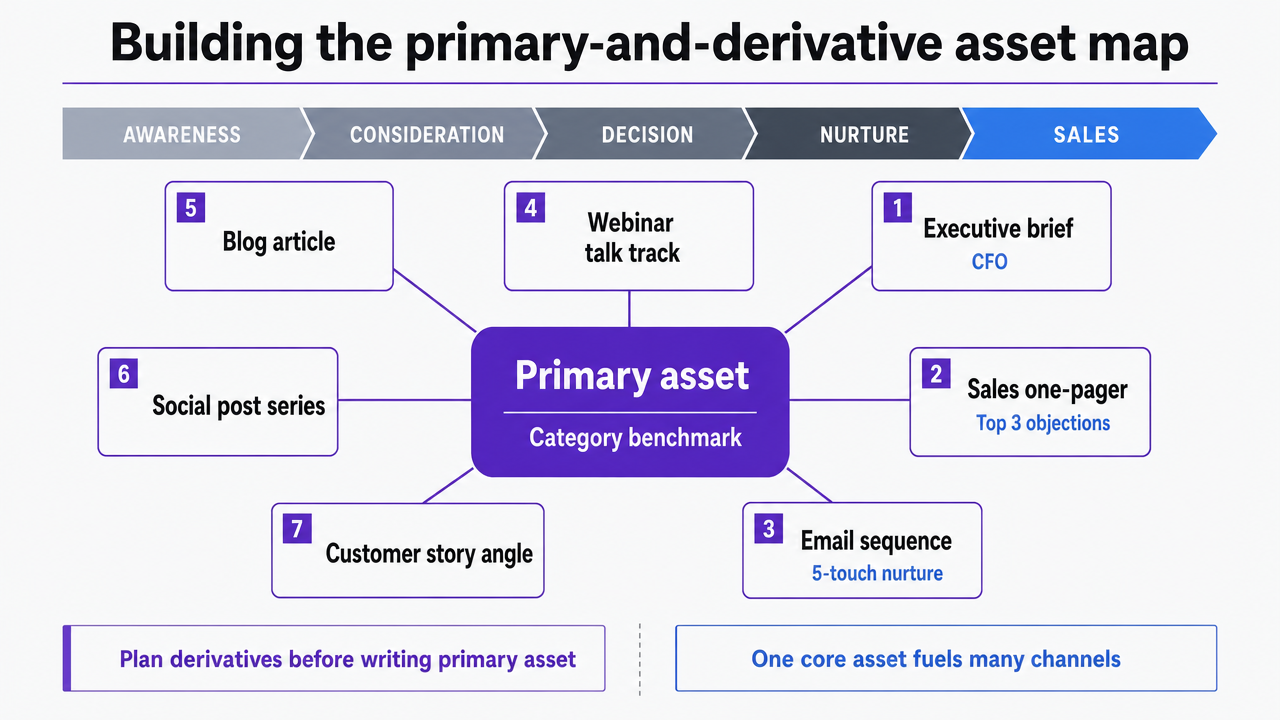 Visualize the primary-and-derivative content model described in this section, showing how one pillar asset radiates into seven specific derivatives across audience roles and journey stages
AI as a governed execution layer, not a side tool
Where the productivity actually comes from
The teams capturing real leverage from generative AI are not using it to write more blog posts. They are using it to compress the slowest parts of the production cycle: research synthesis, derivative drafting, variant generation, localization, and the dozens of small editorial tasks that consume senior time without producing strategic output. The productivity gain is structural, not creative.
McKinsey estimates that generative AI can increase the productivity of the marketing function by 5 to 15 percent of total marketing spend, and identifies marketing and sales as part of the top four functions capturing roughly 75 percent of generative AI's total value across the economy 6. For a VP managing an eight-figure marketing budget, the lower bound of that range is already larger than a senior content hire. The figure is a modeled estimate of potential, not a guaranteed result, and it depends on how deeply the technology gets embedded in actual workflows rather than tested on the side.
That distinction is where most teams lose the productivity. McKinsey's 2025 global survey links realized AI value specifically to embedding AI into business processes and tracking KPIs against those workflows, not to the volume of pilots or licenses purchased 7. Translation for a content operation: a writer using a chatbot to brainstorm headlines produces marginal gains. A production pipeline where AI drafts the seven derivatives off an approved primary asset, generates message variants for testing, and updates SEO clusters when the source data refreshes produces compounding gains.
The same McKinsey work on marketing applications adds the boundary condition. Generative AI dramatically increases the speed and scale of content creation and testing, but without governance it introduces brand, legal, and accuracy risk that erodes the productivity it created 8. The execution layer is the answer to both halves of that sentence.
Four gates that keep AI output usable
A governed AI execution layer is not a chat interface bolted onto an existing workflow. It is a pipeline with four gates, each one designed to convert raw model output into something a B2B buyer and a sales team will actually use.
- The first gate is signal intake. The system pulls from live business data the team already trusts: qualified pipeline by segment, content engagement by named account, search and reasoning-engine visibility, sales-call themes, and CRM-stage velocity. McKinsey's 2024 analysis on accelerating generative AI adoption emphasizes that measurable benefits arrive when AI is wired into existing data infrastructure rather than fed prompts in isolation 9. Garbage in, plausible-sounding garbage out.
- The second gate is ranked recommendation. Instead of producing finished assets on demand, the system surfaces a prioritized list of what to produce or update, with the strategic reasoning attached. A VP can see why a particular derivative is being recommended for a specific account segment before approving the work. This is the step that separates an execution layer from a content generator.
- The third gate is human approval. Every primary asset, derivative, and message variant routes through an editor or strategist who can reject, revise, or release. Forrester's own guidance on responsible generative AI use in content operations recommends experimenting with AI for first drafts while maintaining human review to scale responsibly 1. The approval gate is what makes the productivity figure defensible to a CFO and to legal.
- The fourth gate is automated execution and KPI tracking. Once approved, work publishes to the right channels and the system measures impact against the pipeline metrics defined upstream, then feeds those results back into the recommendation engine. That feedback loop is what McKinsey's survey ties to realized value 7. Without it, AI produces output. With it, AI produces leverage.
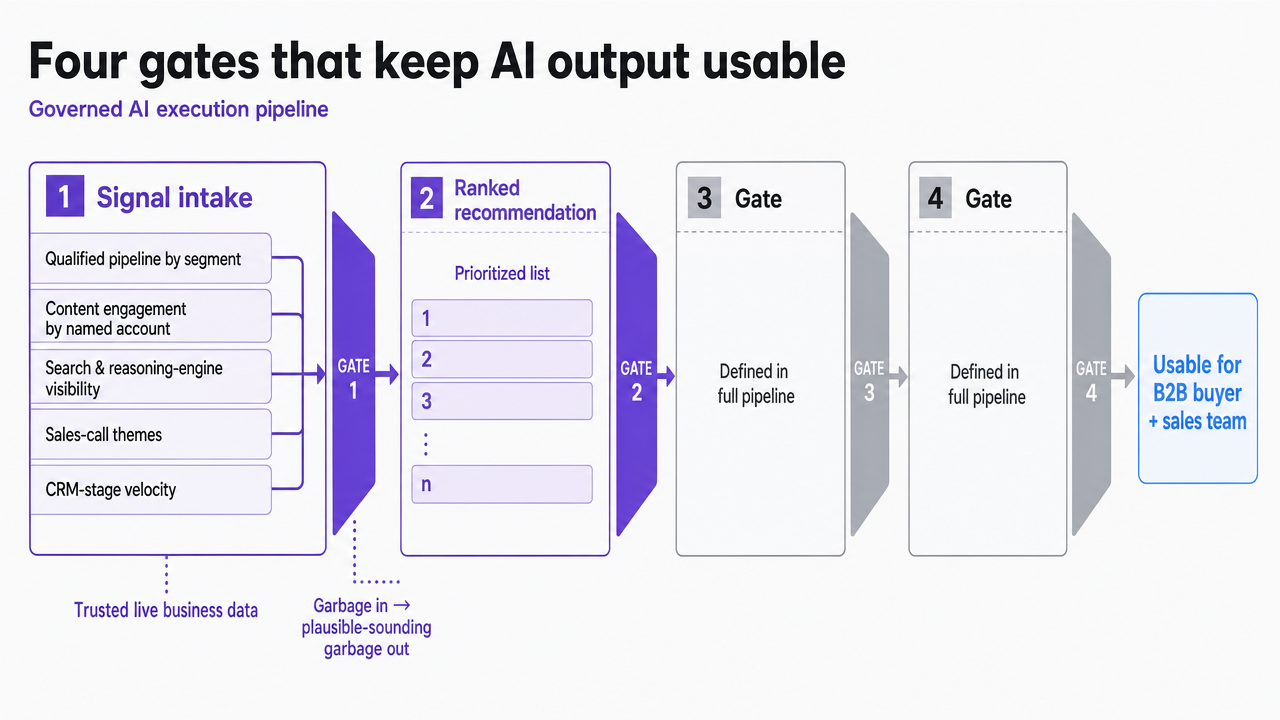 Visualize the four-gate governed AI execution pipeline described in this section as a left-to-right process flow
Test AI-driven B2B content workflows risk-free now
Experience hands-on execution of scalable B2B content strategies with full publishing capabilities during your free trial.
Three scaling paths on flat headcount
When pipeline targets rise and headcount does not, a VP of Marketing has three realistic ways to absorb the gap: hire a senior content strategist, retain an agency, or deploy a governed AI execution layer. Each path has a different cost structure, oversight model, and ceiling. The comparison below is not a recommendation. It is the decision lens the CFO will want before approving any of them.
| Dimension | Senior content hire | Agency retainer | Governed AI execution layer |
|---|---|---|---|
| Time-to-output | 60–120 days (recruit, onboard, ramp) | 30–60 days (scoping, briefing cycles) | Days, once data and approval gates are wired |
| Ongoing cost structure | Fully loaded salary plus benefits, fixed | Monthly retainer plus scope creep, variable | Platform cost plus internal editorial time, fixed |
| Oversight model | Direct management, single point of failure | Account manager intermediary, brief-driven | Approval-gated, every output reviewed before release |
| Productivity ceiling | One person's bandwidth | Capped by retainer hours | Scales with the derivative map, not the team |
| Productivity reference | — | — | 5–15% of marketing spend modeled by McKinsey 6 |
The McKinsey range is a modeled estimate of potential productivity uplift from generative AI across the marketing function, not a guaranteed outcome from any specific tool 6. For an eight-figure budget, the lower bound exceeds the fully loaded cost of a senior hire. For a smaller budget, the comparison tightens, and the deciding variable becomes oversight: a hire and an agency both add coordination overhead, while a governed execution layer concentrates oversight at the approval gate.
The path that wins on flat headcount is the one that converts marginal output into compounding leverage. A hire scales linearly with the person. An agency scales with the contract. An execution layer scales with the asset map and the approval discipline already covered in the previous section. That is the argument to bring to the CFO conversation.
Writing for reasoning engines and zero-click surfaces
Discovery is no longer a ranked list of ten blue links. It is an AI summary, a sales rep's prompt to a chatbot, an analyst's research assistant pulling cited passages from across the open web. For B2B content, that means the unit of value is not the page view. It is whether a reasoning engine surfaces the argument inside a buyer's decision context, and whether a seller can quote it without rewriting.
Forrester puts the instruction plainly: write for reasoning, not just ranking, and make content modular and multipurpose so it can extend reach without being rebuilt from scratch 2. Two structural choices follow. First, every primary asset should carry self-contained reasoning units, meaning short passages that state a claim, the evidence behind it, and the implication for a buyer role, in that order. A reasoning engine can lift one of those units into a summary without distorting the argument, and a sales rep can paste it into an email without editing.
Second, authority signals have to be explicit. Original data, named frameworks, and clearly attributed quotes outperform unsourced assertions in AI-mediated retrieval, because the engines weight provenance. That is why a primary asset built on a proprietary benchmark or a customer-decision framework compounds, while a recycled trend roundup decays.
The measurement consequence is direct. Traffic underrepresents influence in zero-click environments 2. The metrics that matter are engagement from target accounts, citation by reasoning engines, and reuse by sales inside live deals. Build the structure for those outcomes, not for a ranking dashboard.
Audience definition that prevents wasted production
Most wasted production traces back to a single failure: the team built for a persona, not a buying decision. Personas describe who the buyer is. Decisions describe what the buyer has to resolve, with whom, under what pressure, and against which alternatives. A primary asset built off the second framing earns reuse across a buying committee. One built off the first ends up in a content library no seller opens.
Forrester's Buyer Audience Framework presses on this distinction. It maps functional, emotional, behavioral, and decisioning attributes for the roles inside a buying committee, then aligns content to the specific journeys those roles are running 3. The decisioning layer is the one most content plans skip, and it is the one that determines whether a derivative gets cited inside a deal or ignored. A CFO evaluating a platform purchase is not consuming the same argument as the VP who championed it, even when both sit in the same account.
The discipline for a flat-headcount team is to cut the audience list before expanding it. Two or three priority buying committees, defined by the decisions they own and the alternatives they weigh, will absorb every primary asset the team can realistically produce in a year 10. Anything outside that list does not get written. That is the production cap that protects the model.
See How Leading Teams Scale B2B Content Without Adding Headcount
Request a data-driven walkthrough of AI-powered content workflows proven to increase qualified pipeline and conversion rates—without expanding your internal team or managing multiple vendors.
Sales alignment as a content amplifier
Content that sellers actually use inside live deals is the highest-leverage output a flat-headcount team can produce. It compounds twice: once when a buyer engages it, and again when a rep quotes it in a discovery call, an objection-handling email, or a procurement-stage proof point. The teams running this well treat sales not as a downstream consumer of marketing assets but as a planning input.
Forrester's guidance on the relationship is specific. B2B marketers should take a cross-functional approach and connect content and messaging with the way sales engages buyers, which improves both relevance and utilization without adding marketing staff 4. The practical translation is a quarterly intake from sales that feeds the primary-asset roadmap: the three objections slowing deals, the two competitor framings that need a counter, and the one decisioning question buyers keep raising in late-stage calls. Those inputs become the brief for the next primary asset, not a separate enablement project.
Two operating moves protect the alignment:
- First, every derivative carries a named seller use case, such as the email a rep sends after a first call or the one-pager attached to a procurement packet.
- Second, the feedback loop runs on deal data, tracking which assets get cited in won deals and which never leave the library 10. Assets that go unused get retired, not refreshed.
That discipline is what turns sales alignment into an amplifier instead of another internal review cycle.
Tying measurement to sourced and influenced revenue
A flat-headcount content operation cannot defend itself on traffic charts. The reporting line that survives a CFO review is the one that connects specific assets to sourced and influenced pipeline, then to closed revenue. Everything else is activity.
The structural problem is that traditional web metrics underrepresent influence in AI-mediated and zero-click environments, where buyers consume content through summaries, sales conversations, and peer forwards rather than landing-page visits 2. A primary asset can shape a buying committee's framing without ever generating a measurable session. The reporting model has to account for that gap or it will systematically undervalue the work driving the most pipeline.
Three measurement layers replace the traffic dashboard:
- The first is engagement from named target accounts, tracked at the account level rather than the visitor level, so a single CFO reading a brief twice counts more than a thousand unattributed visits 2.
- The second is sales utilization, meaning which assets get attached to opportunities, cited in call notes, or forwarded inside deals. Forrester's customer-centric framework treats this insights feedback loop as a core component of a scalable content engine, not a reporting afterthought 10.
- The third is sourced and influenced revenue by primary asset, which closes the loop between the four-to-eight pillar assets the team commits to each year and the pipeline they touched.
The discipline that holds the model together is retirement. Assets that do not appear in won deals or target-account engagement after a defined window get cut, not refreshed. That is what keeps a flat-headcount team from accumulating a library no one opens.
What to build first if you run marketing right now
The work in the first ninety days is sequencing, not scope. A flat-headcount team trying to install all four parts of the model at once will install none of them.
- Start with the audience cut. Name the two or three buying committees that will absorb every primary asset for the next year, and document the decisions each committee owns 3. That list is the production cap.
- Next, retire the calendar. Pick one primary asset already in flight, attach a documented derivative plan with named owners and channels, and ship it through the new model end to end 5. One pillar with seven working derivatives proves the math faster than a quarterly roadmap.
- Then wire the approval gates. Define what routes through human review, what data feeds the recommendation engine, and which pipeline metrics close the loop 7. Platforms like Vectoron exist to run that approval-gated execution layer, but the operating discipline matters more than the tool selected to enforce it.
Frequently Asked Questions
References
- 1.The Definition Of “More From Less” In B2B Content Strategy And Operations.
- 2.Standing Out In A Zero-Click World Starts With Stronger Collaboration.
- 3.The B2B Content Guide: The Building Blocks Of Content Strategy.
- 4.The B2B Content Guide: Make Sales Your Ally In Content Marketing.
- 5.From One To Many: How To Maximize B2B Content Reuse.
- 6.The economic potential of generative AI: The next productivity frontier.
- 7.The State of AI: Global Survey 2025.
- 8.AI-powered marketing and sales reach new heights with generative AI.
- 9.The state of AI in early 2024.
- 10.A Guide To Creating Compelling Customer-Centric Content.