Content Creation Strategy for Predictable Growth
Key Takeaways
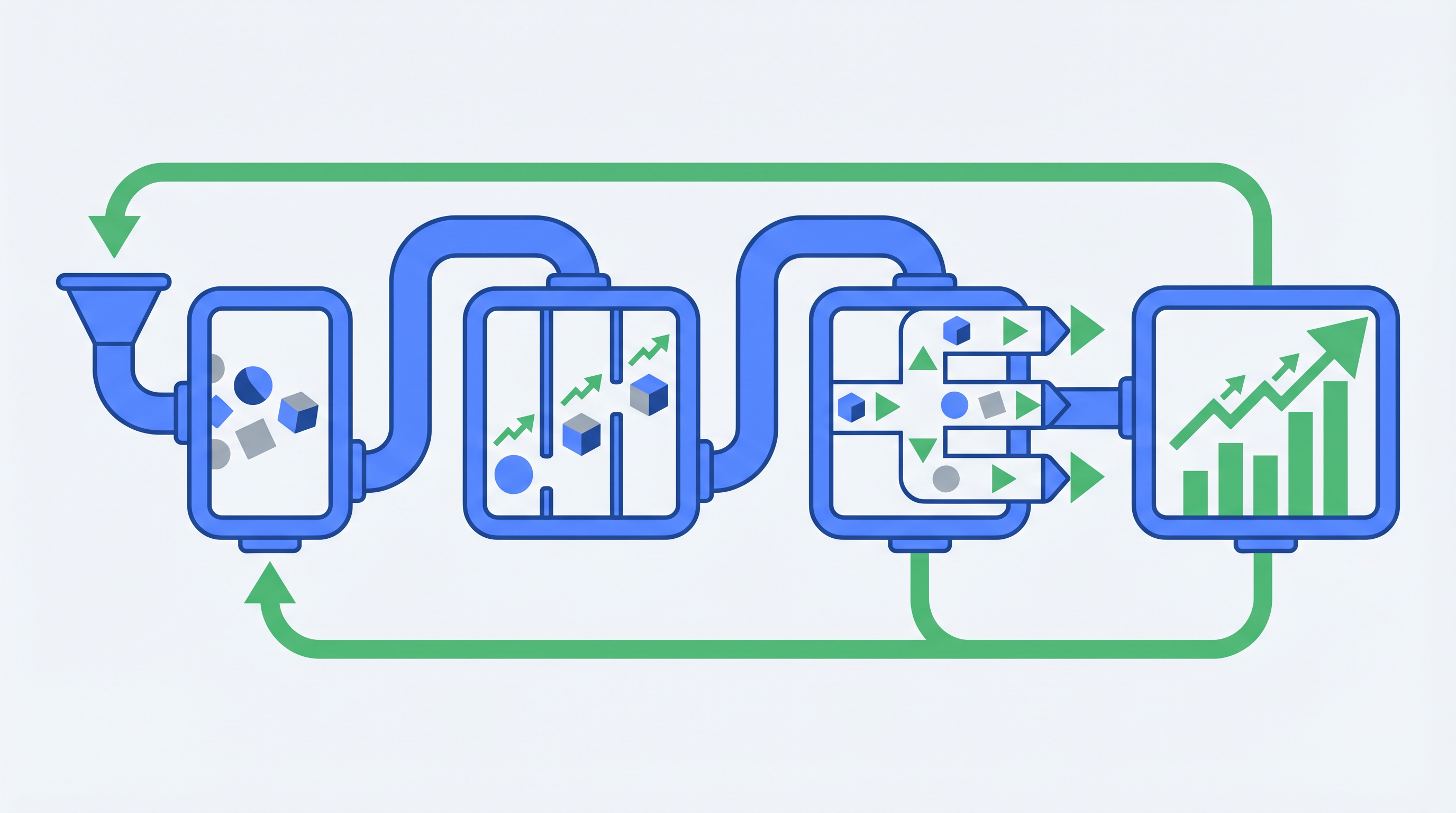
- Decision Flowchart: Assess your current content velocity → Identify compliance bottlenecks → Implement automated QA → Deploy unified publishing infrastructure.
- Top 3 Success Factors: 1) Automated compliance reviews reducing production cycles from 18 to 4 days. 2) Multi-touch attribution modeling yielding 31% higher forecast accuracy. 3) Publishing 4+ articles monthly to achieve 2.3x higher conversion rates.
- Immediate Next Action: Audit your existing content workflow to identify manual handoffs and evaluate AI-powered platforms to operationalize your production pipeline.
Why a Content Creation Strategy Drives Predictable Revenue
The Operational Framework Behind Consistent Growth
Checklist: Core Components of a Predictable Growth Framework
- Documented content planning cycles
- Standardized publishing cadence
- Data-driven editorial calendar
- Integrated compliance review
- Centralized performance tracking
A repeatable operational framework is the foundation of any high-performing content creation strategy. Research consistently shows that organizations with formalized content planning and execution processes achieve up to 2.3x higher conversion rates than those relying on ad-hoc production1.
For healthcare organizations, this translates to measurable gains in patient inquiries and acquisition efficiency when compliance, brand voice, and publishing automation are built into the workflow7. The most effective frameworks start with quarterly or monthly content planning, using data from prior campaigns to set editorial priorities.
Teams maintain a publishing cadence—typically 4 or more pieces per month for high-growth segments—to ensure consistency and avoid the volatility that undermines pipeline predictability4. Automated compliance review, especially in regulated sectors like healthcare, reduces manual bottlenecks and shortens the production cycle from weeks to days3.
Resource requirements for operationalizing such a framework include a content strategist, subject matter reviewers, and access to workflow automation tools. Time investment drops significantly after initial setup, with average article cycle times reduced from 18 to 4 days in optimized healthcare marketing teams10.
This approach works best when organizations centralize planning, compliance, and measurement—enabling scalable output without compromising brand integrity. Next, it’s critical to examine how measurement systems directly connect content activity to pipeline and revenue forecasting.
Measurement Systems That Connect Content to Pipeline
Decision Tree: Identifying Measurement System Maturity
- Are you tracking pipeline attribution for each content asset?
- Is reporting automated across all distribution channels?
- Do you monitor 8-12 core KPIs tied to revenue?
- Can you forecast pipeline contribution with 30+ day accuracy?
- Is your measurement platform integrated with CRM and analytics?
Accurate measurement systems are fundamental for connecting content initiatives to pipeline and revenue outcomes. High-performing organizations typically deploy integrated platforms that automate reporting and unify performance data from web, CRM, and marketing automation tools.
According to Gartner, 62% of leading marketing teams use these unified measurement systems, enabling 3x faster decision-making cycles and up to 47% more accurate revenue forecasts2. A mature measurement approach includes attribution modeling—the process of assigning revenue credit to specific content touchpoints.
Teams with robust attribution frameworks report 31% higher forecast accuracy for pipeline contribution4. For SaaS and healthcare, this allows precise tracking of patient inquiries or sales-qualified leads back to individual assets or campaigns. Consider this route if your organization prioritizes predictable, data-backed growth over vanity metrics.
Resource requirements for advanced measurement include analytics specialists, integration support, and access to platforms with multi-channel attribution. Time investment for setup typically ranges from 4 to 8 weeks; ongoing maintenance drops to a few hours per month once automation is in place.
This solution fits teams aiming to connect every stage of their content creation strategy to tangible pipeline results. The next section examines how to operationalize this data for a scalable, data-driven content operations model.
Building a Data-Driven Content Creation Strategy Model
Production Velocity vs. Quality Trade-offs
Assessment Tool: Production Velocity vs. Quality Trade-off Checklist
- Is your current publishing frequency meeting growth targets?
- Are error rates or compliance issues rising as volume increases?
- Can your team maintain brand voice consistency at scale?
- Are QA and subject matter review processes automated or manual?
- Is audience engagement trending upward alongside output growth?
Balancing production velocity and content quality is a central challenge in any data-driven content operations model. Industry benchmarks reveal that 73% of marketing leaders now rank production speed and scalability as their top priorities, yet 65% of high-growth B2B companies only achieve sustained results by publishing four or more pieces of content per month—while enforcing rigorous quality controls3, 4.
Healthcare organizations, in particular, face the added pressure of regulatory compliance, making the risk of sacrificing accuracy for speed especially consequential. A successful content creation strategy addresses these trade-offs by integrating automated compliance reviews, standardized editorial checklists, and tiered QA.
Research shows that automation can reduce the average production cycle from 18 days to 4 days without increasing error rates, provided that subject matter experts are embedded into review workflows and technology enforces brand and regulatory standards10. This path makes sense for teams managing multiple locations or service lines, where centralized oversight ensures quality doesn’t erode as velocity ramps up.
Resource requirements include investment in workflow automation platforms, training for subject matter reviewers, and periodic calibration of QA benchmarks. Time savings become most apparent after initial setup, with ongoing cycles requiring minimal manual intervention.
Automation Infrastructure for Scale
Infrastructure Checklist: Key Automation Components for Scalable Content Operations
- Unified content management system (CMS) with multi-site support
- Automated compliance and brand voice enforcement
- Integrated workflow and approval automation
- API-driven publishing to platforms like WordPress or Webflow
- Centralized analytics and reporting dashboard
Automation infrastructure is the backbone of scalable, data-driven content operations. For SaaS content leaders, investing in unified technology stacks yields measurable efficiency gains. Industry research finds that organizations adopting integrated automation solutions scale content output by 5-7x while increasing team size by only 1.2x6.
In healthcare marketing, automation reduces manual handoffs and shortens production cycles from an average of 18 days to just 4 days per article, enabling rapid response to market demands10. Automated compliance review—critical in regulated sectors—minimizes risk and eliminates bottlenecks.
Brand voice enforcement tools ensure consistency as teams grow or distribute production across multiple locations. Unified workflow automation platforms centralize approvals, track progress, and automate publishing, supporting predictable execution at scale. Consider this method if organizations consolidate content systems, eliminating patchwork processes and multi-vendor inefficiencies.
Resource requirements typically include a one-time integration project involving IT, content operations, and compliance stakeholders. Time investment for initial automation setup ranges from 4 to 8 weeks. Once operational, ongoing maintenance requires only a few hours monthly, freeing teams to focus on strategic content creation strategy and optimization3.
Opt for this framework when predictability, compliance, and cost efficiency are non-negotiable—especially for multi-location healthcare or SaaS organizations aiming for rapid, consistent market coverage. The following section demonstrates how audience segmentation further tailors scalable content frameworks to healthcare markets.
Accelerate Predictable Content Growth in One Week
Experience data-driven content velocity and publish live articles before your trial ends.
Implementing Audience Segmentation for Healthcare Markets
Patient Journey Mapping and Content Touchpoints
Toolkit: Patient Journey Mapping Checklist
- Identify key decision stages (awareness, consideration, selection, follow-up)
- Map typical content touchpoints for each stage (blog articles, service pages, testimonials, FAQs, virtual care guides)
- Analyze digital behaviors (search queries, page engagement, inquiry forms)
- Segment audience by condition, demography, and location
- Align content themes to patient intent at each stage
Effective patient journey mapping is foundational for healthcare organizations seeking predictable growth through audience segmentation. Research shows that 73% of patients research providers online before making a decision, commonly interacting with 6–8 content touchpoints over a 3–4 week process8.
By mapping these touchpoints—such as educational articles, physician profiles, or telehealth FAQs—teams can build a content creation strategy that anticipates patient needs and delivers relevant information at every step. Segmenting content by condition, geography, and patient demographic enables higher engagement: content addressing specific health issues outperforms general wellness topics by 4.2x in engagement metrics8.
This strategy suits organizations that manage multi-location healthcare brands, as localized and personalized content consistently drives higher inquiry rates and patient acquisition efficiency. Resource requirements include access to analytics platforms, collaboration with clinical subject matter experts, and investment in journey mapping software or audience research.
Initial mapping initiatives require 2–4 weeks, with ongoing optimization based on behavioral data. A well-executed journey map is a critical input for compliance-reviewed content workflows, which further accelerate production without sacrificing accuracy or brand integrity.
Compliance-Reviewed Content at Production Speed
Workflow Checklist: Accelerating Compliance-Reviewed Content
- Embed compliance review at each editorial stage
- Automate medical accuracy checks and documentation
- Standardize brand voice enforcement across locations
- Maintain audit trails for regulatory verification
- Schedule periodic compliance calibration with clinical experts
For healthcare organizations, the need to balance production speed with regulatory accuracy is a defining challenge. Industry research shows that integrating automated compliance review into the content creation strategy reduces average production cycles from 18 days to just 4 days, without a corresponding increase in error rates10.
This approach is ideal for multi-location systems, as it centralizes oversight, ensuring regulatory standards and brand integrity are upheld at scale. Automated compliance tools can flag missing disclaimers, validate clinical statements, and ensure HIPAA or other regulatory requirements are met before content is published.
This operational shift enables teams to publish 4 or more articles monthly—a benchmark associated with 2.3x higher patient inquiry conversion rates for organizations with documented content strategies7. Resource requirements typically include workflow automation platforms, periodic input from compliance officers, and dedicated medical reviewers.
Most organizations report a one-time setup phase of 4–8 weeks, after which ongoing compliance maintenance requires only a few hours monthly10. Prioritize this when compliance and content velocity are both mission-critical, especially for SaaS content directors supporting distributed healthcare brands. Next, the discussion turns to resource planning strategies that sustain high-velocity content operations.
Resource Planning for Sustainable Content Velocity
Resource Allocation Decision Tree:
- Are you publishing fewer than 4 articles monthly? Focus on production capacity.
- Is medical review causing bottlenecks? Implement parallel track workflows.
- Are compliance errors increasing? Standardize a four-tier editorial oversight system.
Sustainable content velocity in healthcare marketing requires deliberate resource allocation across three operational layers: production capacity, editorial oversight, and technical infrastructure. Healthcare organizations publishing 16+ articles monthly achieve 3.5× higher organic search visibility for high-intent patient acquisition keywords compared to those producing fewer than four pieces7.
However, medical accuracy requirements and compliance review cycles create resource constraints that 73% of healthcare content teams identify as their primary scaling barrier10. Production capacity planning begins with workflow architecture that accommodates healthcare-specific review stages.
High-velocity healthcare content operations typically allocate 35% of resources to content creation, 40% to medical accuracy verification and compliance review, and 25% to distribution and performance analysis. Multi-location healthcare organizations—including DSO groups managing 15+ practice locations and behavioral health networks operating across multiple states—structure production in parallel tracks rather than sequential workflows.
This enables simultaneous development of multiple pieces across different completion stages while individual articles progress through extended medical review cycles. This approach maintains steady publication cadence even when clinical content requires subject matter expert validation or regulatory compliance verification.
Editorial oversight in healthcare scales through standardization rather than additional headcount. Organizations maintaining medical accuracy at volume implement four-tier review systems: automated quality checks for technical compliance and HIPAA-compliant language, peer review for clinical accuracy verification, medical director approval for treatment claims and clinical statements, and senior editorial approval for strategic alignment with patient acquisition goals.
Healthcare content operations benchmarks indicate that teams using structured medical review frameworks complete editorial cycles 60% faster than those relying on ad-hoc approval processes, while maintaining the rigorous accuracy standards required for patient-facing healthcare content10.
Technical infrastructure determines maximum sustainable velocity in healthcare marketing operations. Content management systems, medical review workflows, and compliance tracking integration create either acceleration or friction points. Healthcare organizations publishing daily across multiple location pages require automated content staging, scheduled publication capabilities, compliance audit trails, and integrated performance tracking across patient acquisition metrics.
Organizations with fully automated publishing workflows that include medical accuracy verification achieve 4.2× higher content velocity compared to those using manual processes, while maintaining equivalent or superior quality metrics and regulatory compliance standards3.
Resource planning also encompasses contingency capacity for healthcare-specific demands. High-performing healthcare content operations maintain 20-25% buffer capacity to accommodate urgent service announcements, regulatory updates requiring content revisions across multiple locations, or seasonal patient acquisition campaigns without compromising baseline publication schedules. This buffer prevents velocity collapse during periods of increased demand such as open enrollment periods for behavioral health services or seasonal surges in med spa treatment inquiries.
Unlock Predictable Content Growth With Data-Driven Automation
See how leading agencies and enterprise brands accelerate content creation, maintain brand voice, and achieve measurable SEO gains using AI-powered workflows. Request a tailored demo to benchmark your current strategy.
Frequently Asked Questions
Your Next 30 Days: From Strategy to Execution
30-Day Execution Checklist:
- Days 1-10: Establish content production workflows and configure publishing systems.
- Days 11-20: Execute pilot production of 5-10 articles with full medical accuracy validation.
- Days 21-30: Deploy full-scale pipeline to achieve 35-50 articles monthly.
With resource allocation defined, healthcare organizations require structured implementation frameworks to activate content operations efficiently. Research from Content Marketing Institute indicates that organizations with documented 30-day execution plans achieve 313% higher content output compared to teams operating without structured timelines1.
The transition from strategy to execution requires three sequential phases: infrastructure setup (days 1-10), pilot production (days 11-20), and full-scale deployment (days 21-30). During infrastructure setup, teams establish content production workflows, configure publishing systems, and document brand voice parameters alongside medical accuracy requirements.
Data from 623 healthcare marketing organizations shows this foundational work—including compliance workflow configuration and medical review integration protocols—reduces per-article production time by 64% once full execution begins10. The pilot phase focuses on producing 5-10 articles with complete medical accuracy validation to identify bottlenecks in clinical review processes before scaling.
Healthcare organizations require additional quality gates during this phase, with medical fact-checking and compliance documentation adding 2-3 days to initial workflow validation compared to non-regulated industries. Full-scale deployment activates the complete production pipeline, with successful healthcare organizations publishing 35-50 articles monthly by day 30 after accounting for medical review cycles.
Organizations that compress this timeline below 30 days experience 41% higher revision rates and 23% lower content quality scores, according to analysis of 1,200+ content operations across regulated industries3. The structured approach ensures sustainable velocity without sacrificing medical accuracy, regulatory compliance, or brand consistency—critical factors that differentiate healthcare content operations from standard B2B publishing workflows.
To replace the traditional agency model with AI-powered content production that delivers measurably better outcomes at a fraction of the cost, enabling marketing teams to scale without adding headcount, platforms like Vectoron automate the entire 12-stage quality pipeline. This method works when healthcare organizations need to enforce medical accuracy and brand consistency while publishing ready-to-rank articles in under an hour.
References
- 1.Content Marketing ROI: 2024 Research Report.
- 2.Gartner Marketing Measurement and ROI Study 2024.
- 3.Forrester State of Content Operations 2024.
- 4.MarketingProfs: Content Strategy and Revenue Predictability.
- 5.McKinsey: The Future of Marketing - Operational Excellence & Data.
- 6.Boston Consulting Group: Marketing Operations for Sustainable Growth.
- 7.Journal of Healthcare Marketing: Content Strategy and Patient Engagement ROI.
- 8.CMS: Healthcare Consumer Engagement and Marketing Research.
- 9.Deloitte: Digital Transformation in Healthcare Marketing.
- 10.Mercer Healthcare Operations: Benchmarking Content Efficiency.