
Key Takeaways
- AI production has shifted from experiment to operating layer, with high performers rewiring workflows around generation and QA rather than bolting tools onto existing writer desks 8.
- Personalization only protects margin when variants are cheap and the agency charges for segmentation judgment, not for staffing more writers against more personas 23.
- Short-form video pays off as a repurposing system that turns one recorded asset into dozens of cut-downs, not as net-new creative billed by the edit 12.
- Marketing automation is now table stakes at 96% agency adoption, so differentiation moves upstream to how cleanly assets reach the routing and reporting layer 22.
- Owned thought leadership doubles as inbound pipeline and working portfolio, and becomes affordable on a fixed cadence once AI absorbs drafting and repurposing 5.
Production is becoming a utility. Strategy is becoming the margin.
The agency P&L is quietly rearranging itself. The work that used to justify headcount — drafting, formatting, resizing, scheduling, reporting — is collapsing into software. The work that used to be assumed — judgment, positioning, client trust, regulated-vertical fluency — is what clients now actually pay for.
Look at where the money and the behavior are moving. Roughly 46% of B2B marketers expect their content budgets to rise in 2025, while only 8% expect a cut 5. Demand is up. At the same time, 88% of marketers report using AI tools daily 22, and McKinsey estimates generative AI could lift marketing productivity by 5–15% of total marketing spend 2. More scope, cheaper production, flat or shrinking client patience for line-item creative fees.
That math has a direction. Production is becoming a utility — a metered, near-fixed-cost layer that any competitor can buy. Margin is migrating to the parts of the work that do not scale linearly with labor: strategy, prioritization, approval, and the relationship that lets a client trust an agency to ship without a six-person review chain.
The five trends covered next — AI-driven production, personalization, short-form video, automation, and owned thought leadership — are usually treated as a menu. They are not. They are five faces of the same operating shift. The agencies pulling ahead are wiring them into one approval-driven workflow, not running five parallel pilots. The rest of this piece looks at each through that lens: what it costs to deliver, and where the margin actually lands.
Why these five trends, and why together
Statista's 2025 ranking of content marketing priorities puts the field in order:
- Artificial Intelligence at 81%
- Content Personalization at 77%
- Data Storytelling at 76%
- User-Generated Content at 76% 23
Those four sit at the top of what content leaders say they are actually investing in next year. Short-form video and marketing automation round out the picture from adjacent benchmarks — short-form social video produced the highest ROI for 55% of respondents in a LinkedIn survey 12, and 96% of agency marketers have used or plan to use a marketing automation platform 22.
That gives the five trends covered here a real foundation: AI production, personalization, short-form video, automation, and owned thought leadership. They are not picked because they sound current. They are picked because content leaders are funding them and, in several cases, reporting measurable returns.
The more useful observation is what the ranking obscures. Treated as a checklist, these look like five separate budget lines. Treated as a system, they describe one workflow: AI generates and adapts assets, personalization decides which variant goes to whom, short-form video extends reach per asset, automation routes and measures delivery, and owned thought leadership supplies the strategic raw material that makes the other four worth producing.
For an agency operator, that distinction matters. Funding five trends as five initiatives means five tool contracts, five owners, and five reporting layers. Funding them as one production system is what changes the cost curve. The sections that follow take each trend through that operator lens — what it costs to deliver, and what it does to margin when an account scales.
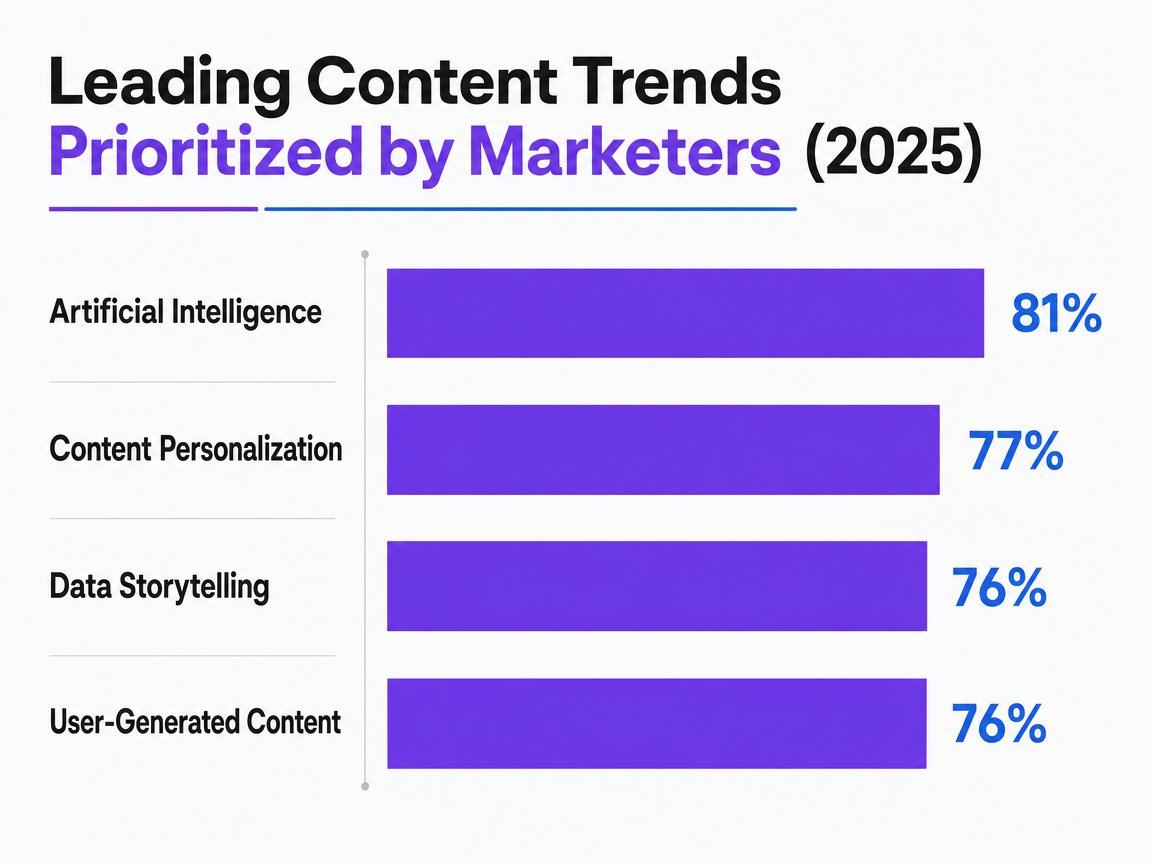 Leading Content Trends Prioritized by Marketers (2025)
Statista data shows the top content creation and promotion trends marketers are prioritizing for 2025.
AI moves from experiment to production line
The performance gap is the story, not the adoption rate
Adoption numbers for generative AI in marketing have stopped being interesting on their own. Roughly 73% of marketing teams now use generative AI in some form 9, and among agency marketers specifically, 88% report using AI tools daily 22. At those penetration levels, asking whether to use AI is the wrong question. The useful question is what the people using it well are doing that the rest are not.
Gartner's split is the cleanest answer in the public record. Across all surveyed CMOs, 27% report no or limited adoption of generative AI. Among high performers, 84% use generative AI for creative development, and over half use it for strategy work 8. That 27%-versus-84% gap is not really about access to tools — the tools cost the same for everyone. It is about how the work is organized around them.
For an agency operator, the implication runs through the P&L. Laggards tend to bolt AI onto a writer's desktop: a faster draft, a quicker headline, a tidier outline. Output goes up modestly, but the unit cost of a deliverable barely moves because every asset still passes through the same human-shaped pipeline. High performers treat AI as the production line itself — generation, variant creation, formatting, and first-pass QA happen inside the workflow, and humans enter at the points where judgment actually compounds: brief, strategy, and final approval.
That distinction shows up in margin behavior. When AI sits inside the workflow rather than on top of it, the marginal cost of an additional asset on an existing account falls sharply. Scope expansions stop requiring proportional staffing. The agencies closing the Gartner gap are the ones rewriting the production process, not the ones buying better software.
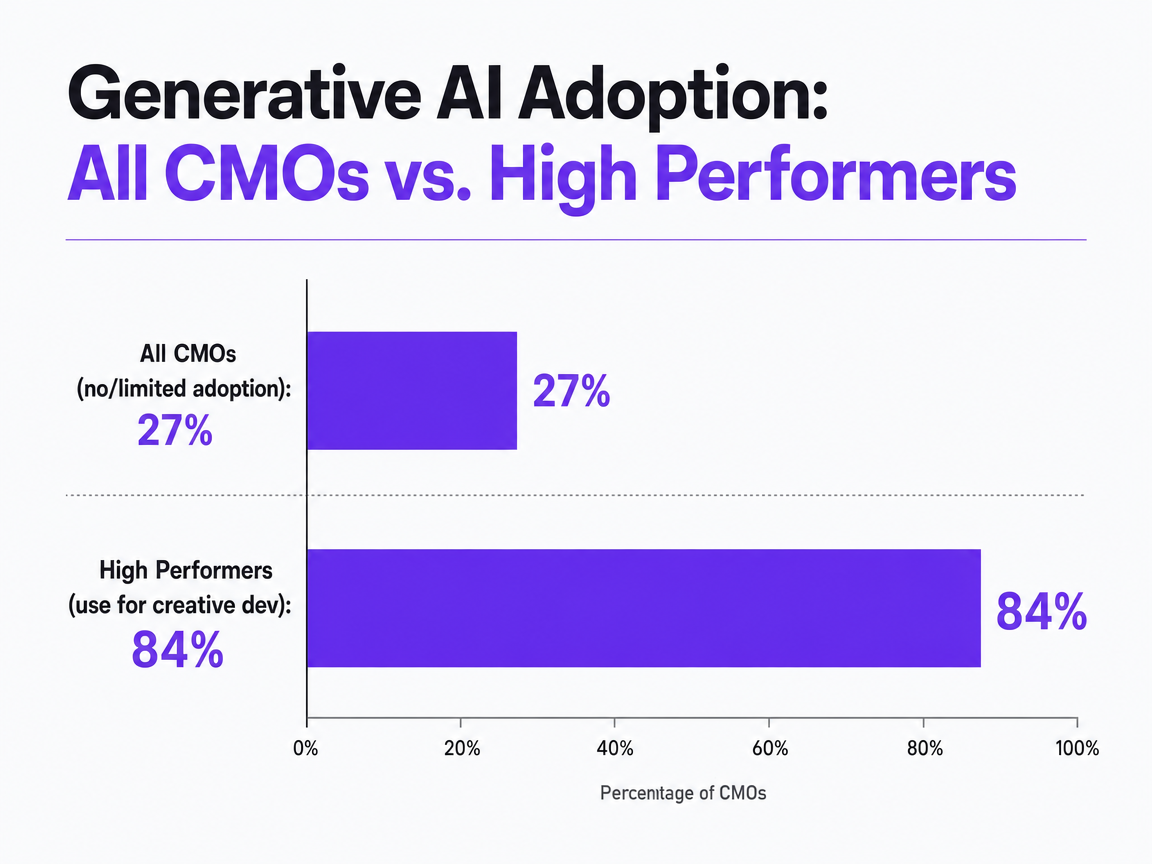 Generative AI Adoption: All CMOs vs. High Performers
Gartner research shows 27% of all CMOs have no or limited adoption of generative AI, while 84% of high-performing CMOs use it for creative development.
What AI does not fix for agencies
The same research that documents AI's gains is candid about its limits. McKinsey's analysis of generative AI in marketing flags governance risk: without strong oversight, AI adoption can create brand and operational exposure that erases the productivity gain it was meant to deliver 2. Industry guides on AI agency stacks reach a similar conclusion, warning explicitly against bypassing human review for client-facing content because quality and risk both degrade in fully automated pipelines 24. The CMI benchmark adds a related concern — many teams still lack standards for measuring AI's impact on content performance, which makes it hard to know whether output gains are translating into client outcomes 3.
For agencies, this maps to three things AI does not solve:
- It does not build the client relationship that gets the agency hired and re-signed.
- It does not make strategic calls in regulated verticals — legal, behavioral health, dental, healthcare — where a wrong word triggers compliance or reputational consequences.
- It does not generate the strategic point of view that differentiates one agency's recommendation from another's.
Those are not weaknesses to apologize for. They are where agency margin actually lives. An AI production line that drafts, formats, and routes at speed only matters if a human is making the call on what to ship, to whom, and why. The agencies pulling ahead on the Gartner curve are not the ones automating judgment. They are the ones automating everything that surrounds judgment so the judgment itself gets more reps, on more accounts, without more headcount.
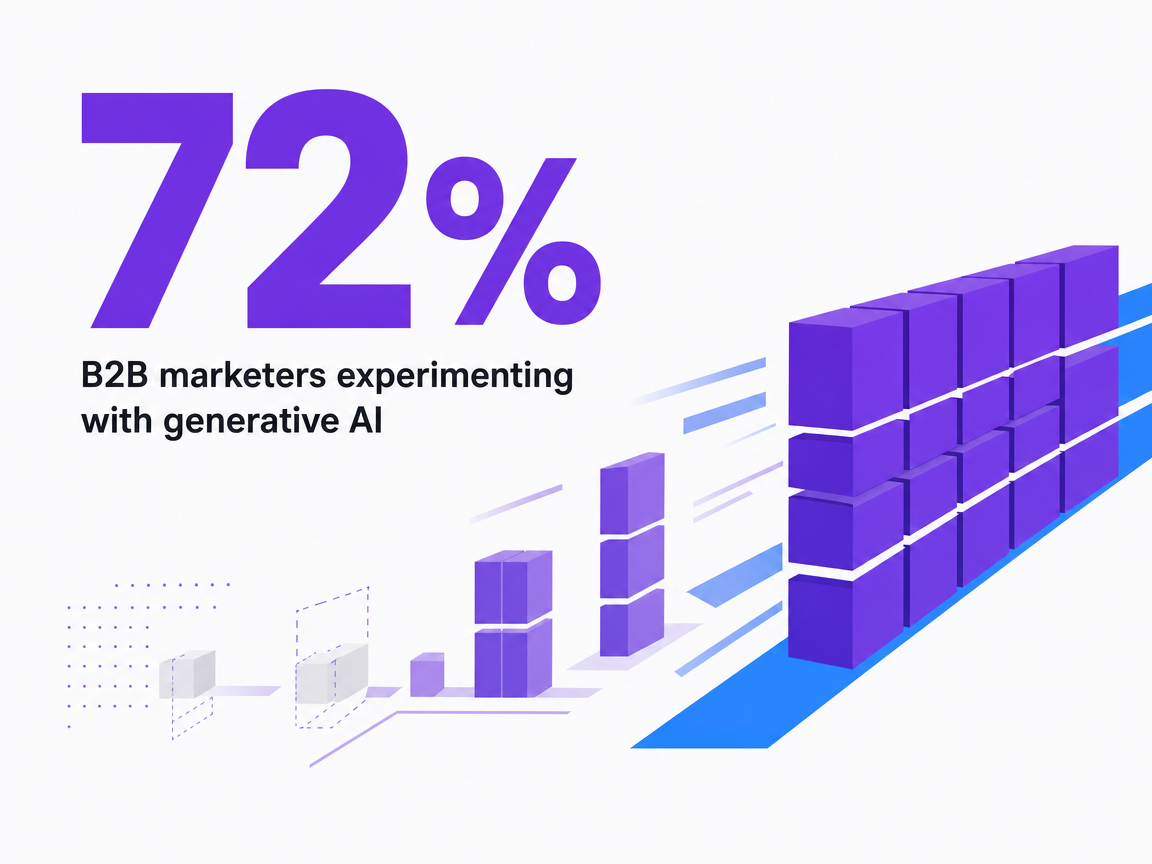 B2B marketers experimenting with generative AI
B2B marketers experimenting with generative AI
Test AI-driven content workflows with real campaigns
See measurable impact by publishing actual content and tracking performance during your free trial period.
Personalization as a unit-economics problem
Personalization is the second-highest content priority for 2025, with 77% of content leaders ranking it a top investment area 23. The demand side is unambiguous. Deloitte reports that the share of brands treating personalization as a core experience strategy has risen 50% since 2022, and that 80% of consumers prefer brands offering personalized experiences 10, 11. Clients have read the same research and are asking agencies to deliver it.
The trap is that agencies often answer that ask with labor. More segments mean more variants. More variants mean more briefs, more rounds of copy, more QA, more trafficking. Without a different production model, every additional persona an agency promises to serve adds hours that have to come from somewhere, usually from margin.
AI changes the input cost on the variant side. Among marketers working with AI, 88% report that the technology has helped them personalize the customer journey across channels 24. That figure matters less as a headline than as an operating fact: the marginal cost of producing a tenth email variant, a fifth landing-page version, or a regionalized blog intro is approaching the cost of producing the first one. The bottleneck shifts upstream, to the data and the rules that decide which variant goes to whom.
For agency operators, that reframes the conversation with clients. Personalization sold as more creative output is a margin sink. Personalization sold as a system — integrated first-party data, a defined variant library, automated routing, and human approval on the segmentation logic — is a retainer expansion that does not require proportional staffing. The unit economics only work when the variants are cheap and the judgment about who sees what is where the agency earns its fee.
Short-form video as repurposing leverage, not creative work
Short-form video keeps showing up at the top of B2B performance data:
- A March 2024 LinkedIn survey found that short-form social videos delivered the highest ROI for 55% of respondents 12, 13.
- 89% of businesses report using video in their marketing 14.
- Clips under 60 seconds are the format expected to see the most growth, with the highest projected ROI among video types 20.
Clients have seen the same charts and are asking for more of it.
The temptation is to staff up. Hire an editor, add a producer, scope a monthly shoot day, and bill the client for the line item. That model works once. By the third or fourth account, the production calendar becomes the bottleneck, and the agency is back to selling hours.
The more durable read is that short-form video is a repurposing problem, not a creative one. A single recorded interview, webinar, or executive briefing can yield twenty to forty cut-downs across LinkedIn, YouTube Shorts, and email. AI-assisted editing now compresses what used to be hours of work into minutes — transcript-driven trimming, automatic captioning, aspect-ratio reformatting, and B-roll selection happen inside the tool 14. The shoot is the expensive event. Everything downstream of it is becoming a workflow.
There is a real caution embedded in the same coverage. Analysts have warned that over-indexing on short clips can erode the deeper thought leadership that gets agencies and their clients taken seriously 12. The operator move is not to chase format. It is to treat each long-form asset as raw material with a published repurposing plan attached — how many clips, for which channels, on what cadence — and to price the package, not the edit.
Automation as the backbone, not the differentiator
Where automation budget is actually going
The category is no longer a differentiator. It is a baseline. Research and Markets puts the global marketing automation market at $7.39 billion in 2025, rising to $8.08 billion in 2026 and reaching $11.06 billion by 2030 at an 8.2% CAGR 15. Among agency marketers specifically, 96% have used or plan to use a marketing automation platform 22. At those penetration levels, owning an automation stack is table stakes — the agencies that have one no longer win business because of it, and the ones that lack one struggle to stay in the conversation.
What the spend is actually buying is reporting infrastructure. Roughly 45% of agencies rely on marketing automation platforms to demonstrate ROI to clients, and 42% use automation to measure performance 16. The retainer conversation has shifted from creative deliverables to performance attribution, and automation is what makes that conversation defensible.
For operators, the read is that automation budget is best treated as infrastructure cost, not a competitive lever. The differentiation has moved upstream. Two agencies can run the same automation platform and produce very different margins depending on how the work flows into it — whether AI-generated assets, personalized variants, and short-form clips reach the automation layer ready to route, or whether human handoffs and rework still bottleneck every send. The platform is the rail. Margin lives in how cleanly the trains arrive.
If you manage a multi-account portfolio: how delivery models change cost behavior
For agency operators running a book of accounts rather than a single brand, the question is not whether each trend works in isolation. It is how the chosen delivery model behaves as accounts scale, scope expands, and clients ask for more variants, more channels, and more reporting without proportional fee increases.
Three models dominate the current market:
- The traditional headcount-driven agency staffs strategists, writers, designers, and producers against scope.
- The hybrid model layers freelance capacity onto a smaller core team.
- The AI-team-plus-approval-workflow model wires generation, personalization, automation, and reporting into one production system with humans at the approval points.
McKinsey's analysis of generative AI in marketing puts the productivity range at 5–15% of total marketing spend 2, with the upper end concentrated in organizations that have rewired workflows rather than bolted AI onto existing ones.
| Delivery model | Production cost behavior | Capacity ceiling | Margin pattern as accounts scale |
|---|---|---|---|
| Headcount-driven | Largely variable; rises with scope | Set by hiring pace and utilization | Margin compresses as scope grows faster than billing |
| Hybrid (freelance + staff) | Mixed; freelance variable, core fixed | Set by vendor management bandwidth | Margin stabilizes but coordination cost rises |
| AI team + approval workflow | Largely fixed at platform layer | Set by approval throughput, not labor | Margin expands as variants and channels are added |
The directional point holds across the sourced data. When 45% of agencies already lean on automation to prove ROI 16and the automation market is on an 8.2% CAGR through 2030 15, the infrastructure spend is locked in regardless of model. What varies is whether production labor scales with that infrastructure or sits underneath it as a fixed utility. Operators evaluating Q1 capacity should price each model against the accounts they actually expect to add, not against current scope.
See How Leading Agencies Are Automating Content Production at Scale
Learn how data-driven, AI-powered workflows are enabling agencies to scale multi-channel content delivery, reduce operational overhead, and maintain approval control—based on the latest industry benchmarks.
Owned content and thought leadership as the agency's own growth engine
The data on owned content carries a tension worth sitting with. Roughly 46% of B2B marketers expect content budgets to rise in 2025, against only 8% planning cuts 5. Yet a majority of those same respondents rate their content marketing as only moderately effective 6. Demand is climbing. Confidence in the work is not.
That gap is the opportunity, and most agencies miss it twice. They miss it for clients by producing volume without a defensible point of view. And they miss it for themselves by treating their own marketing as whatever fits between billable hours.
The agencies winning new business in 2025 are publishing original research, sector-specific analysis, and operator-grade commentary on the verticals they serve. That kind of owned content does two things at once. It compounds inbound pipeline for the agency, lowering the cost of acquiring the next account. And it serves as a working portfolio — a prospect reading a piece of regulated-vertical analysis is also auditing whether the agency can think clearly about their category.
The production economics matter here too. When AI handles drafting, formatting, and repurposing, the marginal cost of publishing a research note, a case breakdown, or a long-form briefing drops to a level where it can run on a fixed cadence without eating client capacity. The judgment — what to study, what position to take, which findings to publish — stays human. That is exactly the work that earns moderate-effectiveness ratings when it is absent and category authority when it is present.
For operators, the read is to treat the agency's own content as a P&L line, not an overflow task. Fund it on the same workflow that delivers client work, and it becomes the cheapest lead channel the agency owns.
The consolidated production stack
Pulling the five trends together yields a single picture, not a checklist:
- AI handles drafting, variant generation, and first-pass QA.
- Personalization logic decides which variant routes to which segment.
- Short-form video extends the reach of each long-form asset through systematic repurposing.
- Automation carries delivery and reporting.
- Owned thought leadership supplies the strategic point of view that makes the rest of it worth publishing.
The agencies pulling ahead are wiring these into one approval-driven workflow rather than buying five tools and five owners.
The numbers behind that consolidation hold up. McKinsey puts the productivity gain from generative AI in marketing at 5–15% of total marketing spend, with the upper end concentrated in organizations that have rewired workflows rather than layered AI on top of them 2. Gartner's high-performer cohort uses generative AI for creative development at 84%, against 27% of all CMOs reporting no or limited adoption 8. The agencies closing that gap are not buying different software. They are running a different process.
For an operator entering Q1 planning, the practical move is to stop scoping trends as line items and start scoping them as one production system. Price the platform, price the approval throughput, and price the strategic capacity that sits above both. Production becomes the utility. Judgment becomes the margin. Vectoron is one model for that consolidated stack — an AI marketing team with specialist strategists running content, SEO, social, and reporting inside a single approval workflow — and the broader category of approval-first AI execution is where the structural shift is heading.
Frequently Asked Questions
References
- 1.The State of AI: Global Survey 2025.
- 2.How generative AI can boost consumer marketing.
- 3.B2B Content Marketing Benchmarks, Budgets, and Trends: Outlook for 2024.
- 4.B2B Content Marketing: 2025 Benchmarks, Budgets & Trends.
- 5.B2B Content Marketing Benchmarks, Budgets, and Trends: Outlook for 2025 (Takeaway Report).
- 6.B2B Content Marketing Benchmarks, Budgets, and Trends: Outlook for 2025.
- 7.Top Content Marketing Statistics – Forbes Advisor.
- 8.27% of CMOs remain reluctant to adopt generative AI: Gartner.
- 9.A survey by Gartner found that 73% of marketing teams use generative AI.
- 10.Personalizing brand experiences: Personalizing growth.
- 11.Unlocking Customer Growth: Driving High Value Actions with Personalization in Retail Media.
- 12.Short-form video is the top content in B2B marketing, but there's more to consider in your strategy.
- 13.The combination of social media and video is powerful in B2B marketing.
- 14.55+ Video Marketing Statistics to Drive Your Strategy in 2025.
- 15.Marketing Automation Market Report 2026.
- 16.Ultimate Marketing Automation Statistics Overview.
- 17.Marketing Trends 2024.
- 18.Global Ad Spend Outlook 2024/25.
- 19.IPA EffWorks Global 2021 – Summary.
- 20.How to increase your ROI with short-form video in B2B marketing.
- 21.49 Top Email Marketing Statistics – Forbes Advisor.
- 22.AI Adoption in Marketing Agencies: 2026 State Report.
- 23.What Awaits Content Marketing in 2025, According to Statista.
- 24.AI Marketing Agency Tools: Complete 2025 Guide.