
Key Takeaways
- Team size no longer predicts content output; the binding constraint has shifted from writing capacity to how senior strategist hours flow through review, QA, and approval gates.
- Replace cost-per-article with throughput-per-strategist, which counts published, on-brand assets a single strategist can shepherd through approval gates each month 9.
- Keep AI inside its capability frontier on clustering, outlines, drafts, and variants; keep senior strategists on angle, source vetting, and final judgment to avoid the 13% quality penalty 7, 8.
- Focus next on redesigning the production loop: encode brand voice as a checkable artifact, batch strategist approvals, and redeploy junior writers toward structured QA rather than drafting 10.
Why headcount stopped predicting content output
Content output used to track team size with reasonable accuracy. A managing editor with four writers shipped roughly four times what a single writer could produce. That ratio has broken. Marketers who use generative AI report meaningful productivity gains, with 85% saying the tools have slightly or significantly increased their output 5. The conversion rate between a strategist's hours and finished, on-brand assets has changed.
This shift is not theoretical. McKinsey's 2025 global AI survey found that organizations capturing real financial returns from AI are redesigning workflows around AI, setting growth and innovation as objectives, not just efficiency 9. The same survey reports that 80% of companies treat efficiency as the goal, yet only a minority can attribute more than 5% of EBIT to AI 9. The gap between adoption and impact is an operating model problem.
For in-house content managers staring at flat headcount and rising output expectations, the implication is direct. Hiring another writer no longer moves the throughput curve the way it did five years ago. What moves it is the production system itself: how senior strategists allocate their hours, where AI takes the first pass, and how approval gates protect brand voice without bottlenecking velocity.
The diagnostic: where in-house teams actually stall
Adoption is no longer the bottleneck
The narrative that content teams need to "get serious about AI" is roughly two years out of date. The American Marketing Association's 2024 survey of more than 1,000 marketers found that nearly 90% have used generative AI at work, 71% use it weekly or more, and close to 20% use it daily 5. Among those users, 85% report that AI has slightly or significantly increased their productivity 5. Tool access has saturated the function.
That changes the diagnostic question. A content director who asks whether the team should use AI is asking a question the market answered eighteen months ago. The harder question, and the one separating teams that compound output from teams that plateau, is what the AI is plugged into. Most marketers are using generative tools the way an individual contributor uses a faster keyboard: one prompt, one draft, one document, repeated across a calendar.
Individual productivity gains do not aggregate into team-level throughput unless the surrounding workflow absorbs them. A senior strategist who drafts twice as fast still hits the same review queue, the same legal check, the same managing-editor bottleneck. The AMA data describes personal lift, not operating leverage 5. The differentiator has moved from whether the team uses AI to how the team's production system metabolizes what AI produces.
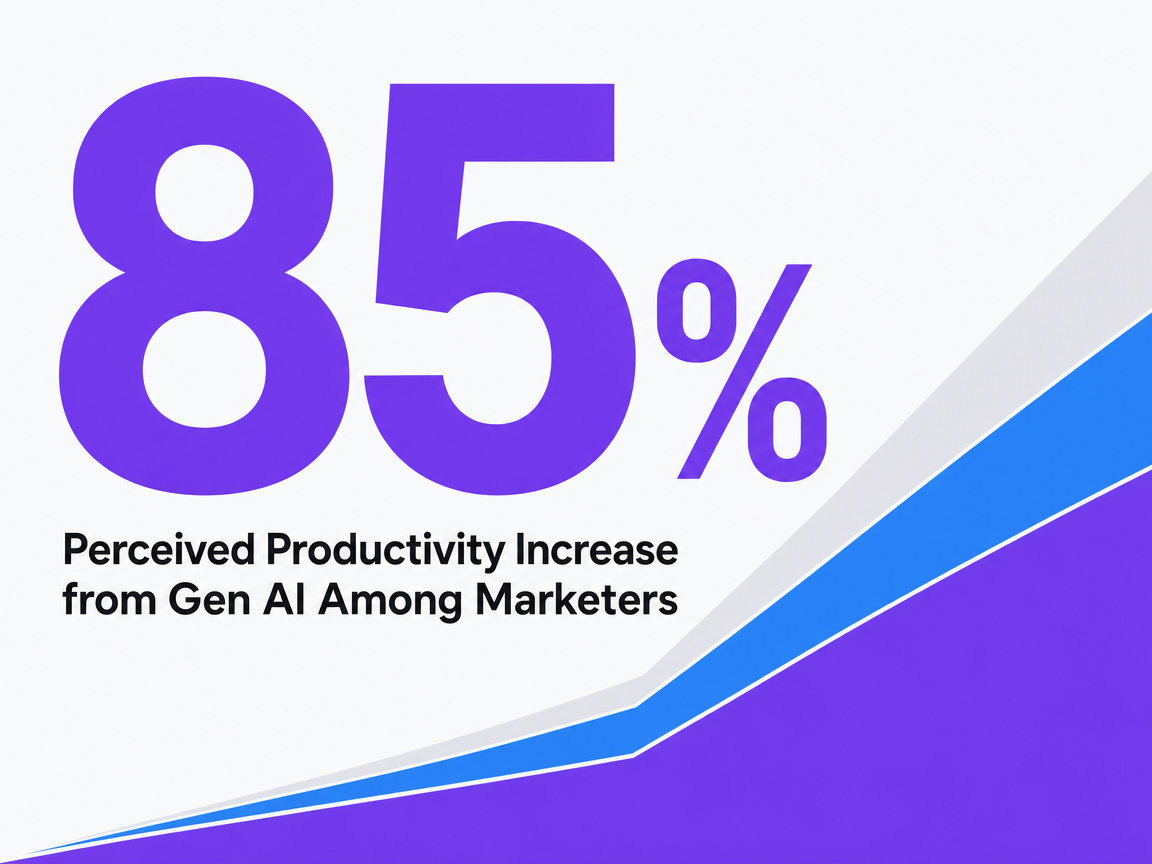 Perceived Productivity Increase from Gen AI Among Marketers
Perceived Productivity Increase from Gen AI Among Marketers
The execution gap behind the adoption numbers
The gap between using AI and getting paid for using AI is wide and well documented. McKinsey's 2025 global survey found that while a majority of organizations now run AI in at least one function, only a minority can attribute more than 5% of EBIT to it 9. Eighty percent set efficiency as the goal of their AI work, yet the companies seeing real value tend to set growth or innovation objectives and redesign workflows around AI rather than pasting it onto existing ones 9.
Content teams sit squarely inside that pattern. A managing editor who routes AI drafts through the same brief-revise-approve cycle that was built for human writers will see modest gains on draft time and almost nothing on cycle time. The bottleneck migrates. First it was writing capacity. Now it is review capacity, SEO QA, and the calendar-coordination tax that no one tracks but everyone pays.
Three stall points show up repeatedly in in-house programs:
- Drafts arrive faster than senior strategists can shape them.
- Brand voice drifts because no one defined the voice as a checkable artifact.
- The production calendar still assumes one writer per piece, so parallelization never materializes.
The diagnostic is not whether the team adopted AI. It is whether the team rebuilt the pipeline that AI now feeds.
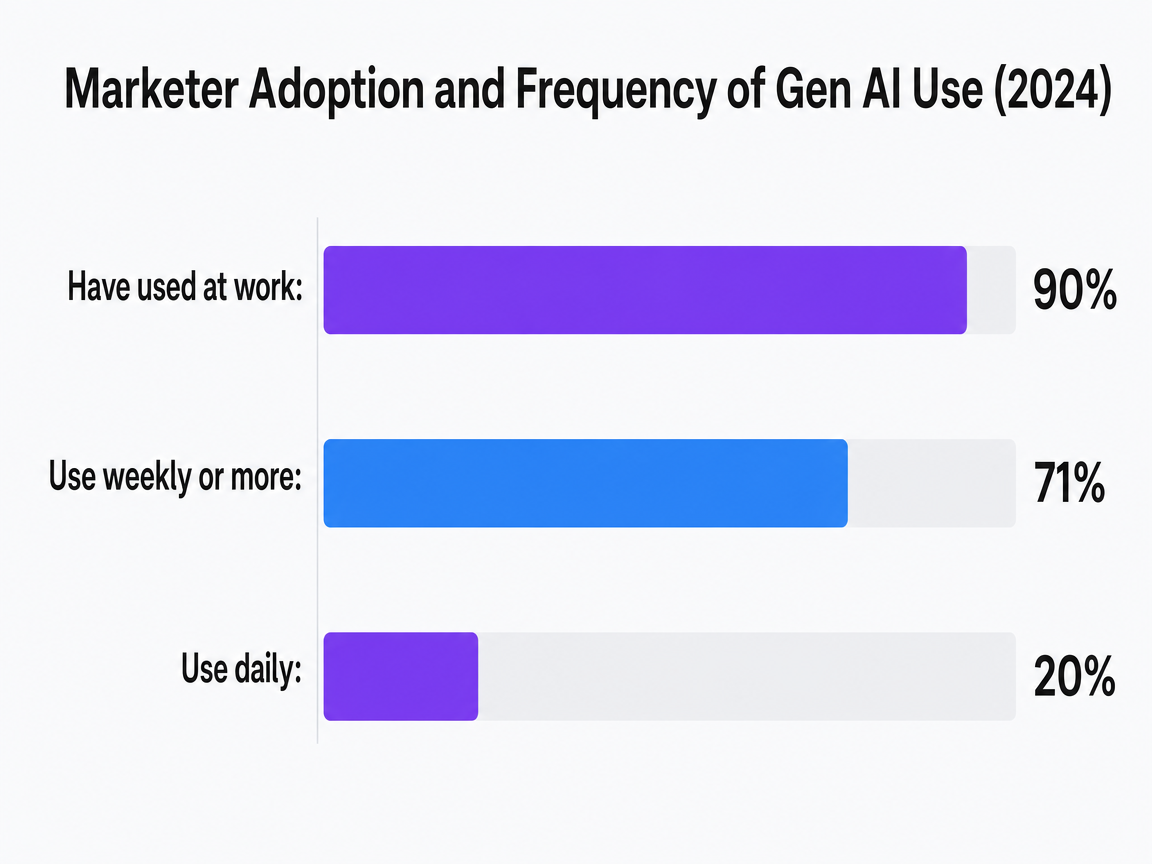 Marketer Adoption and Frequency of Gen AI Use (2024)
An American Marketing Association survey found that nearly 90% of marketers have used generative AI at work, with 71% using it weekly or more and nearly 20% using it daily.
Throughput-per-strategist: the operating KPI to replace cost-per-article
Cost-per-article was a useful metric when a writer's time was the binding constraint. Once drafting time compresses by two-thirds or more, the unit economics shift to the senior strategist's calendar. The right operating KPI for an in-house team scaling without hiring is throughput-per-strategist: the number of published, on-brand, on-strategy assets a single senior strategist can shepherd through the pipeline per month.
Cost-per-article rewards the wrong behavior. It pushes managers toward cheaper drafts and ignores the review, SEO QA, and brand-voice checks that determine whether a piece ships at all. A team can drive cost-per-article toward zero with raw model output and still publish nothing the brand will stand behind. The metric measures input efficiency, not finished work.
Throughput-per-strategist forces a different question. Given one senior strategist, a defined brand voice, and AI handling first drafts and variants, how many assets can clear the approval gate in a month without quality regression? McKinsey's 2025 survey is direct on this point: the organizations capturing real returns from AI redesign workflows around it and set growth objectives, not just efficiency targets 9. Throughput-per-strategist is the workflow-redesign metric. It rises only when AI absorbs drafting, when review is batched rather than continuous, and when brand voice is encoded as a checkable artifact instead of a tacit standard.
The metric also exposes the real ceiling. Adding another writer no longer helps if the strategist queue is full. Adding another strategist, or freeing existing strategist hours from drafting, does.
Accelerate content output with real campaign publishing
Test-drive faster content workflows and measure live performance in your actual channels during your free trial.
Designing around the jagged frontier
What AI should own, and what it shouldn't
The most useful framing for task-level workflow design comes from an experiment that gave Boston Consulting Group consultants access to a frontier large language model and measured their performance on a battery of realistic tasks. Consultants working on tasks inside the model's capability frontier outperformed a control group by close to 40%. Consultants working on tasks just outside that frontier underperformed the control group by 19 percentage points 7. The boundary is not a vague preference. It is the difference between a multiplier and a liability.
For a content team, the frontier maps cleanly onto the production pipeline. AI sits comfortably inside the boundary for keyword clustering, brief construction, outline generation, first-pass drafting, headline variants, meta descriptions, internal link suggestions, and reformatting one asset into adjacent channel formats. These are pattern-recognition and recombination tasks where the model has seen the shape of the work tens of millions of times.
The frontier ends where the work depends on tacit judgment the model cannot observe. Original point of view, primary-source synthesis, expert nuance in a regulated vertical, competitive positioning calls, and final-stage editorial judgment on whether a piece earns the brand's name all sit outside the boundary. Pushing AI into those tasks is where the 19-point performance drop appears 7.
The operational consequence is that task assignment cannot be left to individual contributors deciding what to prompt for. A senior strategist or managing editor needs to draw the line explicitly, per asset type, and encode it into the production checklist. Otherwise the team randomly walks across the frontier and absorbs both gains and losses in roughly equal measure.
Why senior strategists stay in the loop
The case for keeping senior strategists on every asset is empirical, not sentimental. In the Harvard Business School study of marketing specialists, software developers, and web analysts using AI to write investing articles, ideation time dropped from 63 minutes to 23, and writing time from 87 minutes to 22 8. The compression is real. But non-experts working with AI still produced articles that scored roughly 13% lower in quality than expert-created work 8. AI lifted the floor without raising the ceiling.
That quality gap is the operational reason an in-house content program cannot replace senior strategists with AI plus less-experienced operators. The model can produce fluent prose at speed. It cannot supply the domain judgment that distinguishes a piece a director of marketing at a target account will forward from one she will close. In regulated verticals, where a single inaccurate claim creates legal exposure, the gap widens further.
The practical design follows directly. A senior strategist owns the brief, the angle, the source selection, and the final read. AI handles the time-expensive middle: outline expansion, first draft, variant generation, formatting. Junior writers or editors handle structured QA against a written voice standard rather than rewriting from scratch.
This split converts the strategist's hours from a drafting bottleneck into a judgment layer applied at scale. The team ships more, the brand voice holds, and the 13-point quality penalty stays off the published page 8.
Throughput economics under three operating models
The clearest way to see why throughput-per-strategist matters is to walk a single piece through three production models using the time data from the Harvard Business School study. In that experiment, ideation dropped from 63 minutes to 23 minutes with AI assistance, and writing dropped from 87 minutes to 22 minutes 8. Those are per-asset figures, measured on professionals producing investing articles, not generalized agency benchmarks.
Under the traditional brief-and-write model, a senior strategist spends roughly 150 minutes per asset on ideation and drafting before review even begins. Across a 40-hour week with realistic context-switching and meetings, that ceiling lands somewhere in the range of eight to ten finished pieces per month per strategist, with the strategist functioning primarily as a writer.
Under AI-assisted drafting, the same strategist compresses ideation and writing toward the 45-minute combined figure the HBS study reports 8. The drafting bottleneck releases. The strategist's calendar shifts from producing prose to shaping angles, sourcing primary material, and applying domain judgment. Throughput rises, but only as far as the next constraint allows, which is usually review and SEO QA.
Under approval-gated AI execution, drafting time stays compressed and the review layer is structured rather than ad hoc. Voice standards are encoded as checks. Junior editors run QA against those checks. The strategist applies final judgment in batched sessions. The same strategist's hours now cover a multiple of the traditional output.
One number governs this math. Non-experts working with AI produced articles roughly 13% lower in quality than expert-created work 8. Strip the senior strategist out of the loop to push throughput further, and the curve bends back down on the quality axis. The economics work only when AI absorbs drafting and the strategist keeps the judgment layer.
The approval-gated production loop
Signal intake and strategist prioritization
The loop starts with signal, not with a calendar. A production system that scales pulls topics from live inputs: search performance data, sales-call themes, product release notes, support-ticket clusters, and competitive movement. The senior strategist's first job is triage. Given a list of candidate topics and a fixed publish slot count, which assets carry the highest expected return against the brand's current pipeline?
This is the stage where AI saves the most strategist hours without touching brand voice. Clustering keyword exports, summarizing call transcripts, and surfacing topical gaps are pattern tasks that sit comfortably inside the model's capability frontier 7. The strategist arrives at the prioritization meeting with a ranked shortlist instead of building one from scratch.
The output of this stage is a brief, not a draft. A defensible brief names the asset, the primary search intent, the angle the brand is taking, the source material the strategist expects to cite, and the success metric. McKinsey's 2025 survey notes that high performers redesign workflows around AI and tie initiatives to growth objectives, not only efficiency 9. Prioritization is where that growth orientation enters the pipeline. Skip it, and the team accelerates production of assets no one ranked.
Drafting, approval gates, and brand voice control
With a brief in hand, drafting becomes a parallel operation rather than a serial one. AI generates the outline expansion, the first draft, and the variant set: headline options, meta description, social pull-quotes, an email teaser. The Harvard Business School study quantifies the compression: ideation dropped from 63 minutes to 23, and writing from 87 minutes to 22, when professionals used AI on comparable article work 8. That time is now available for the parts of the asset only a senior strategist can supply.
The approval gate is where brand voice stops being a memo and starts being a checkable artifact. A working voice standard names sentence-level patterns the brand uses and avoids, vocabulary preferences, citation expectations, and structural rules per asset type. Junior editors run the draft against that standard before it reaches the strategist. The strategist's read is for angle, accuracy, and judgment, not for comma placement.
This is also where the 13% quality gap matters operationally. Non-experts using AI produced work that scored roughly 13% below expert-created work in the HBS study 8. The gate exists to keep that gap off the published page. Drafts that fail voice or accuracy checks return to AI revision with specific corrections rather than to a human rewrite. The strategist approves once, batched with similar assets, instead of being pulled into continuous review.
Publish, measure, and feed the next cycle
Publishing is the cheap part. The discipline is in what the team captures on the way out and on the way back. Each approved asset ships with its brief, its target metric, and its assigned segment of the editorial calendar attached as structured metadata. That metadata becomes the audit trail for what the team committed to and what actually moved.
Measurement runs against the success metric named in the brief, not against generic traffic dashboards. An asset built to capture a specific bottom-funnel query is judged on rankings and assisted conversions for that query, on a defined window. An asset built to feed sales enablement is judged on usage by the sales team and influenced opportunities. McKinsey's 2025 survey is direct that the organizations capturing real returns tie AI work to growth outcomes, not efficiency alone 9.
The performance data then feeds back into signal intake. Topics that overperformed get expansion briefs. Topics that underperformed get a postmortem before the next prioritization meeting. The loop closes, and the next cycle starts with sharper inputs than the last one.
Scale Content Operations: Increase Output, Preserve Quality—No Extra Hires Required
See how digital marketing teams are using AI-driven workflows to accelerate content velocity and SEO performance—while maintaining full editorial control and brand standards.
Redeploying the team you already have
The reflexive read on AI-assisted content production is that it shrinks teams. The labor data tells a more specific story. MIT Sloan's analysis of US firms from 2010 to 2023 found that when AI can perform most of the tasks in a job, employment in that role falls by about 14%, but when AI automates only a subset of tasks, employment in the role grows by roughly 3% over five years 10. Content marketing roles sit firmly in the second category. AI absorbs drafting and variant generation, not angle selection, source vetting, or final judgment.
That distinction governs the redeployment plan. Junior writers move toward structured editorial QA, brief refinement, and channel adaptation, where the work is checking AI output against a written voice standard rather than producing prose from scratch. Mid-level writers shift toward subject-matter interviews, primary-source research, and SEO strategy work that the model cannot do without a human in the room. The managing editor's calendar opens up for portfolio decisions: which topics deserve expansion, which underperformers get retired, which channels need format experiments.
The Harvard Division of Continuing Education observation applies here. Routine content tasks that once took hours now take minutes, which frees marketers for more strategic work 4. Redeployment is what converts that freed time into compounding output instead of slack.
What separates teams that compound from teams that plateau
Two content teams running the same tools, the same headcount, and the same calendar can produce wildly different results twelve months out. The variable is not talent or budget. It is whether the team treated AI as a faster keyboard or rebuilt the pipeline around it.
Teams that plateau hold three patterns in common:
- They route AI drafts through a brief-revise-approve cycle designed for human writers.
- They define brand voice as a memo rather than a checkable artifact.
- They measure cost-per-article while their senior strategists stay buried in drafting.
McKinsey's 2025 survey describes this directly: 80% of organizations set efficiency as the AI objective, yet only a minority can attribute more than 5% of EBIT to it 9.
Teams that compound do the inverse. Senior strategists own angle, source vetting, and final judgment. AI absorbs outline, draft, and variants. Junior editors run structured QA against a written voice standard. Approvals are batched. The success metric travels with each asset from brief to postmortem.
The compounding effect comes from the loop, not any single stage. Each cycle sharpens prioritization, tightens the voice standard, and frees more strategist hours. Vectoron is built for teams running this operating model rather than retrofitting AI onto the old one.
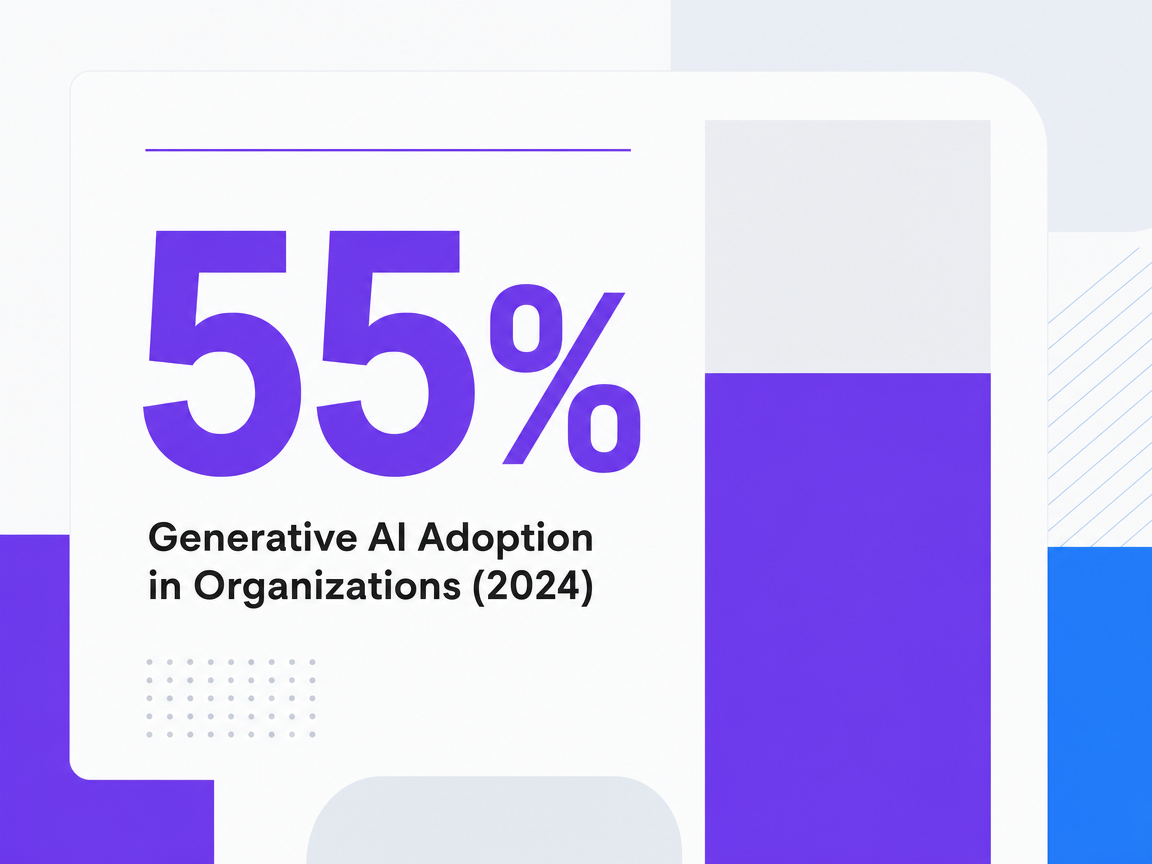 Generative AI Adoption in Organizations (2024)
Generative AI Adoption in Organizations (2024)
Frequently Asked Questions
References
- 1.The economic potential of generative AI: The next productivity frontier.
- 2.How generative AI can boost consumer marketing.
- 3.The state of AI in early 2024: Gen AI adoption spikes and the talent need grows.
- 4.AI Will Shape the Future of Marketing.
- 5.Generative AI Takes Off with Marketers.
- 6.How Top Brands Use AI for Content Marketing.
- 7.How generative AI can boost highly skilled workers' productivity.
- 8.Gen AI Boosts Productivity, But Can't Turn Novices Into Experts.
- 9.The State of AI: Global Survey 2025.
- 10.How artificial intelligence impacts the US labor market.
- 11.The state of AI in 2023: Generative AI's breakout year.