
Key Takeaways
- Account management overhead leaks through non-billable coordination work—status reports, approval chases, and briefing cycles—not through content production, which is where most AI vendor pitches misread the actual bottleneck.
- Applied to the AM coordination slice, McKinsey's 5–15% marketing productivity band reclaims roughly 0.6–2.7 hours per account per week, compounding to two FTEs of capacity across a 20-account portfolio 4.
- Approval-first automation—where AI drafts, routes, and captures audit trails but a named human signs off before anything ships—is what makes coordination gains defensible in regulated verticals 2.
- Sequence rollout as governance first, narrow pilots second, utilization tracking third; start with status reporting or approval routing, roll by pod rather than account, and redeploy reclaimed hours into strategy and retention work.
Where account management capacity actually leaks
The overhead problem inside a client services team rarely shows up on a timesheet as a single line item. It leaks in small increments: a Monday status deck rebuilt from four channel updates, a Tuesday chase email to a paid media lead, a Wednesday internal sync to reconcile what the SEO team said with what the client heard, a Thursday round of QA on a deliverable that already went through two rounds. None of it is billable. All of it consumes account manager hours that were priced into the retainer as capacity for strategy, not coordination.
Marketing and sales functions are already among the most active generative AI users, with early deployments concentrated in drafting, summarization, and personalized outreach 3. That adoption pattern matters because summarization and drafting are exactly the mechanics behind status reports, meeting notes, and client update emails—the tasks that quietly absorb account team capacity.
Before evaluating any tool, the useful question is not which AI platform to buy. It is which non-billable tasks are consuming the most AM hours per account per week, and which of those tasks are coordination work rather than judgment work.
The category shift: from AI content tools to AI coordination tools
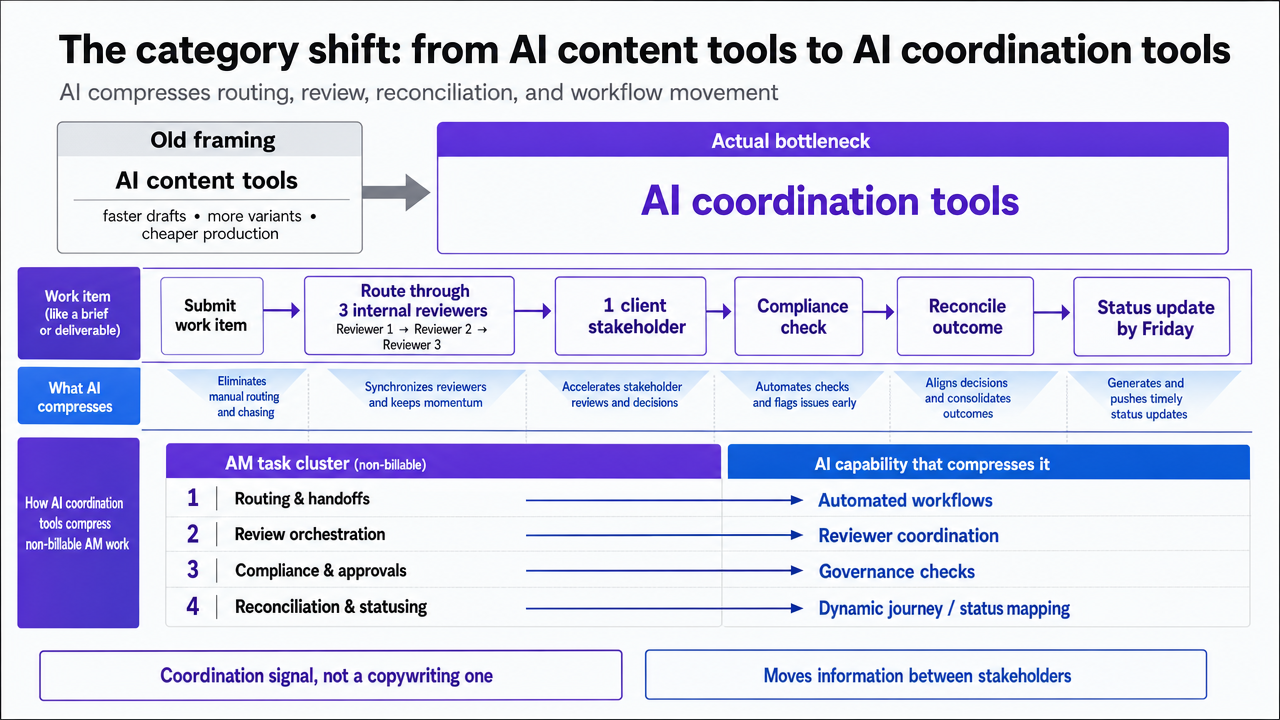
Most vendor pitches to agencies still frame AI as a content engine: faster drafts, more variants, cheaper production. That framing misreads where account management overhead lives. The bottleneck in a client services team is not writing a paragraph. It is routing that paragraph through three internal reviewers, one client stakeholder, and a compliance check, then reconciling the outcome into a status update by Friday.
Marketing and sales leaders surveyed on where they expect generative AI to matter most consistently name automated marketing workflows and dynamic customer-journey mapping among the highest-anticipated applications, alongside lead identification and personalized outreach 7. That is a coordination signal, not a copywriting one. The tasks leaders expect AI to compress are the ones that move information between people and systems.
Four non-billable task clusters carry the bulk of AM overhead, and each maps to a different AI capability:
- Status reporting compresses under summarization—pulling channel data, meeting notes, and delivery logs into a client-ready narrative.
- Production coordination compresses under orchestration—routing briefs, assets, and revisions across specialists without a human dispatcher.
- Approval routing compresses under structured workflow automation—sequencing reviewers, capturing sign-off, and preserving an audit trail.
- Signal-to-brief conversion compresses under retrieval and drafting—turning performance data and client feedback into a working brief without a discovery call.
The reframe matters because the two categories imply different buying criteria. AI content tools get evaluated on output quality per prompt. AI coordination tools get evaluated on cycle time removed, handoffs eliminated, and account hours reclaimed. An agency shopping for the first will find dozens of options and still watch its AM utilization erode. An agency shopping for the second is redesigning the operating model, which is where the overhead actually sits.
Account management economics: what a 5–15% productivity band actually buys
McKinsey estimates that generative AI could raise marketing productivity by 5–15% of total marketing spend, based on cross-industry modeling of function-level task exposure rather than agency-specific measurement 4. That range is the ceiling most agencies will hear cited in vendor decks. It is also the range that gets misread most often, because it describes productivity of the marketing function as a whole—brand teams, in-house creative, media buyers, agencies, and martech—not the account management layer specifically.
For a client services leader, the useful translation is narrower. If a mid-sized account absorbs roughly 12–18 hours of non-billable AM coordination per week (a variable each agency should replace with its own tracked figure), a 5–15% productivity band applied to that slice reclaims somewhere between 0.6 and 2.7 hours per account per week. Across a portfolio of 20 accounts, that is 12–54 reclaimed AM hours weekly—capacity that can absorb portfolio growth, extend strategic work, or lift utilization without new headcount.
Two adjacent benchmarks help set the outer edge of what is possible in specific overhead categories. McKinsey research on sales organizations estimates that about one-fifth of current sales-team functions could be automated, an analog worth citing carefully because the underlying study measured sales reps, not account managers—the tasks rhyme (pipeline updates, CRM hygiene, meeting prep) but the roles are not identical 6. A separate McKinsey case in consumer marketing documented an AI-enabled customer support workflow that cut time to first response by more than 80% and average resolution time by four minutes 5. That case measured support agents responding to customer queries, which is structurally similar to account teams triaging client requests but not the same population.
Read together, these three benchmarks bracket the reasonable expectation: a 5–15% lift across the function, up to ~20% automation of the most task-heavy activities, and outsized compression in response-loop metrics where AI directly touches the communication cycle. Agencies that model AM economics against these labeled ranges—rather than a single headline number—get a defensible answer to the CFO question about what an AI workflow investment actually buys.
The overhead consolidation table: mapping AM hours to reclaimed capacity
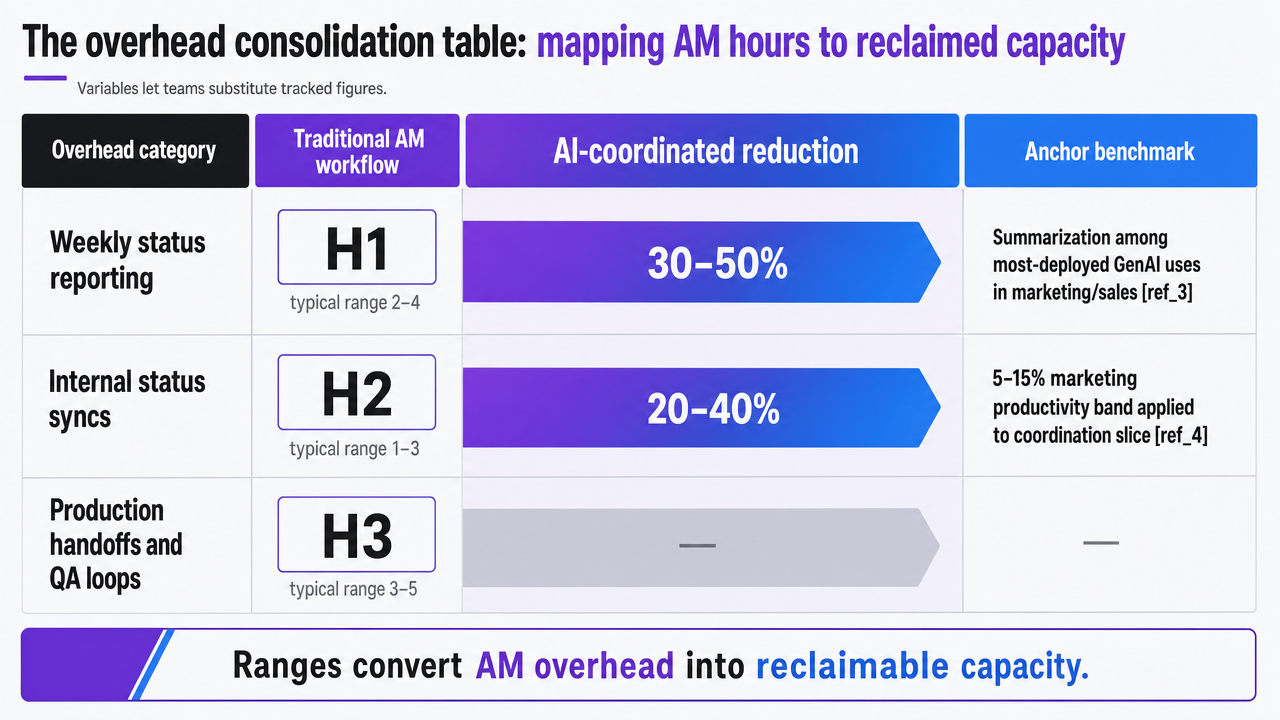
The table below turns the productivity ranges into an account-level worksheet. Each row names a non-billable coordination task, the AI capability that compresses it, and a directional reduction band drawn from the sourced benchmarks. The hour columns use variables (H1–H5) so a client services leader can substitute their own tracked figures rather than accept a vendor's assumed baseline.
| Overhead category | Traditional AM workflow (hours/account/week) | AI-coordinated reduction band | Anchor benchmark |
|---|---|---|---|
| Weekly status reporting | H1 (typical range 2–4) | 30–50% | Summarization is among the most-deployed GenAI uses in marketing/sales functions 3 |
| Internal status syncs | H2 (typical range 1–3) | 20–40% | 5–15% marketing productivity band applied to the coordination slice 4 |
| Production handoffs and QA loops | H3 (typical range 3–5) | 15–25% | ~20% of sales-team functions automatable; analog for coordination tasks 6 |
| Approval routing and sign-off | H4 (typical range 1–2) | 20–35% | Automated workflows are the highest-anticipated GenAI application in marketing 7 |
| Client update emails and chase threads | H5 (typical range 2–4) | 40–60% | Response-loop compression documented in AI-enabled support workflows 5 |
A client services leader with H1–H5 summing to 12 hours per account per week, applied against the midpoints of each band, reclaims roughly 3.5 hours per account. Across 20 accounts, that is 70 AM hours weekly—closer to two full-time equivalents of capacity that can absorb retention work, strategy hours, or new-account onboarding without added headcount. The reduction bands are directional, not guaranteed, and each row assumes the AI capability is deployed against that specific task rather than layered as a generic assistant.
Test AI-powered workflow automation with live campaigns
Experience real-time workflow automation and publish actual client updates during your trial—no limitations or demo content.
Status reporting and client communication automation
Status reporting is where the cleanest overhead reduction shows up, because the underlying task is structurally suited to what generative AI does well: pull structured and unstructured inputs from multiple sources, summarize them against a template, and surface anomalies. Marketing and sales functions are already among the heaviest users of GenAI for drafting and summarization work, which is exactly the mechanic behind a weekly client update 3.
The concrete workflow shift looks like this. Instead of an account manager spending Monday morning stitching together paid media pacing, SEO ranking movement, content delivery status, and open QA items into a slide or email, a coordination layer pulls those inputs on a schedule, drafts the narrative against the account's reporting template, flags variances that need commentary, and routes the draft to the AM for review. The account manager edits judgment calls—why a campaign shifted, what the client should do next—rather than assembling the underlying record.
The ceiling on client communication compression is documented in a McKinsey consumer-marketing case where an AI-enabled customer support workflow cut time to first response by more than 80% and reduced average resolution time by four minutes 5. That case measured support agents handling customer queries, not account managers handling client requests, so the number is a benchmark for response-loop mechanics rather than a promise for AM workflows. The structural similarity is real, though: both involve triaging an inbound message, retrieving relevant context, and drafting a response that a human approves.
Applied to client communication, the practical target is not eliminating the account manager from the loop. It is collapsing the drafting and context-gathering steps so the AM spends response time on judgment rather than on retrieval. A client who normally waits until Tuesday for an answer to a Friday question gets a same-day acknowledgment with the relevant data attached, and the AM's Monday queue shrinks by the volume of routine updates that no longer need manual assembly. Response-time compression is the most visible client-facing signal that the coordination layer is working, and it is the metric a client services leader can put on a QBR slide without needing a productivity study to defend it.
Production coordination and approval routing
Production coordination is the second-largest overhead sink in most client services teams, and it is the one that vendor pitches most often miss. The work is not writing the asset. It is knowing which specialist owns the next step, when it is due, what version the client last approved, and whether the compliance reviewer has cleared the legal disclaimer. An account manager who spends 90 minutes on Wednesday reconciling a Slack thread, a Google Doc, and an email chain to answer 'where is the campaign brief' is doing dispatch work, not judgment work.
Automated marketing workflows and dynamic customer-journey mapping rank among the most anticipated generative AI applications named by marketing and sales leaders, ahead of many customer-facing use cases 7. The anticipation reflects where the pain sits: leaders expect AI to route work between systems and specialists, not just draft the deliverables at the endpoints.
A coordination layer applied to production replaces the AM-as-dispatcher pattern with three mechanics: the layer holds a live view of every asset in flight, pushes work to the next owner when upstream conditions are met, and surfaces exceptions—missed SLAs, blocked reviewers, version conflicts—for human decision. The AM stops asking 'what is the status' and starts answering 'what should we do about this exception.'
Approval routing is the twin task, and it has more structural leverage than most agencies recognize. A typical multi-channel deliverable moves through internal creative review, account team QA, client stakeholder sign-off, and in regulated verticals a compliance check. Each handoff is a queue, and each queue introduces latency measured in days, not minutes. Workflow automation sequences those reviewers in the correct order, captures each sign-off with a timestamp and comment thread attached to the asset, and blocks downstream steps until upstream approvals close. The audit trail is a byproduct, which matters in verticals where the agency has to prove who approved what.
The operational payoff is measured in cycle time, not asset count. A campaign that previously took nine business days from brief to publish because it sat in three approval queues for two days each compresses toward five days when the routing is automated and exceptions are the only work a human touches. That compression is what shows up on the client's calendar, and it is the coordination gain that a Director of Client Services can put in front of a retention conversation without inventing numbers.
Signal-to-brief conversion: cutting briefing cycles at the source
Briefing is where account management overhead compounds invisibly. A single campaign brief often requires a discovery call, a follow-up email for missing data, an internal draft, a review pass with the strategist, and a client sign-off before any specialist touches the work. Four to six touchpoints, spread across three to five days, produce a document that mostly restates information already sitting in the account's performance dashboards, past deliverables, and call notes.
Signal-to-brief conversion collapses that cycle by treating the brief as a retrieval and drafting problem rather than a discovery problem. A coordination layer pulls the relevant signals—campaign performance against target, recent client feedback, competitive movement, delivery history—and drafts a working brief against the agency's template. The account manager edits the strategic framing rather than assembling the source material. Drafting and summarization are already among the most-deployed generative AI uses inside marketing and sales functions, which is the exact mechanic the brief conversion depends on 3.
The economic argument is narrower than the productivity headlines suggest. McKinsey's estimate that generative AI could raise marketing productivity by 5–15% of total marketing spend was modeled at the function level, not the briefing task specifically 4. Applied to brief generation, the practical gain shows up as one or two removed touchpoints per campaign—the discovery call that becomes a review call, the data-gathering email chain that never gets sent. For an account running six to eight briefs a month, that compression returns hours to strategy work and shortens the interval between a client request and the first specialist action, which is the metric a Director of Client Services can defend without borrowing a vendor's chart.
Approval-first automation: the guardrail model for regulated verticals
Forrester's 2026 analysis of AI inside US marketing agencies flags a counterweight to the productivity story: an agency and brand focus on cost efficiency can come at the expense of creativity and client trust when automation runs ahead of oversight 1. That caveat is most acute in regulated verticals—law firms, behavioral health providers, dental groups, healthcare systems—where a compliance miss is not a QA embarrassment but a legal exposure the client will trace back to the agency.
Approval-first automation is the operating model that keeps the coordination gains without inheriting that exposure. The mechanic is narrow: AI reads signals, drafts recommendations, and routes work, but no asset publishes and no external communication ships until a named human signs off. The automation handles retrieval, drafting, sequencing, and audit-trail capture. The human handles judgment—brand voice, legal risk, strategic framing, client relationship.
Three design choices separate a durable approval-first setup from a checkbox one. First, the approver has to see the reasoning behind each recommendation, not just the output; a compliance reviewer cannot sign off on a claim they cannot trace. Second, the audit trail has to be a byproduct of the workflow, not a separate documentation task—every recommendation, edit, and sign-off timestamped and attached to the asset. Third, exceptions have to escalate to humans by default; when the coordination layer is uncertain, the answer is a review queue, not a best guess.
Deloitte's work on AI in professional services frames the same principle from the client-service angle: moving AI from theory to practice depends on governance and practical integration into project delivery, not on the raw capability of the underlying models 2. For a Director of Client Services in a regulated vertical, that translation is direct. The approval-first model is what makes the 5–15% productivity band defensible to a compliance officer, and it is what lets the agency answer the audit question—who approved this, when, and on what basis—with a log rather than a hunt through email threads.
See How Leading Agencies Cut Account Management Hours with AI Workflow Tools
Connect with an expert to benchmark your current workflow against AI-powered automation models and discover data-driven strategies to reduce status meeting frequency and coordination bottlenecks.
Implementation sequence: governance, pilots, and utilization tracking
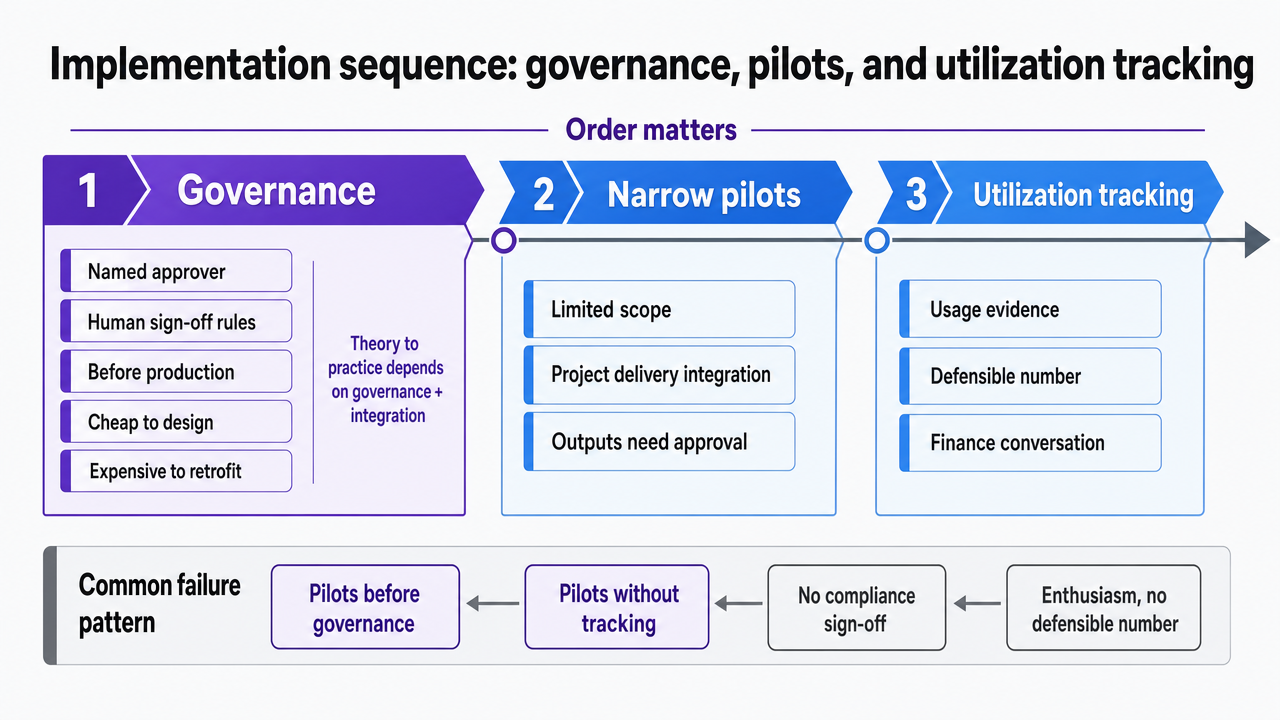
A workable rollout follows three phases, in this order: governance first, narrow pilots second, utilization tracking third. Reversing the sequence is the most common failure pattern, because a pilot without governance produces outputs no compliance officer will sign off on, and a pilot without utilization tracking produces enthusiasm without a defensible number for the finance conversation.
- Governance comes first because it is cheap to design before tools are in production and expensive to retrofit after. Deloitte's framing of AI in professional services is direct on this point: moving from theory to practice depends on governance and integration into project delivery, not on model capability alone 2. Practically, that means naming an approver for each workflow, defining which outputs require human sign-off before they touch a client, and writing the exception rule that sends unclear cases to a review queue rather than a best guess.
- Pilots come second, and they should be narrow by design. One overhead category, one pod of accounts, one measurement window of six to eight weeks. Status reporting is the cleanest starting point because the input data is already structured and the output has a fixed template. Approval routing is the second-cleanest because cycle time is easy to measure before and after.
- Utilization tracking closes the loop. Reclaimed AM hours only count if they get redeployed—into strategy work, retention conversations, or portfolio growth—and if the shift shows up in the utilization report the CFO already reads. Without that tracking, the productivity gain disappears into slack time and the pilot cannot be defended for expansion.
If you manage a portfolio of accounts: rolling coordination gains across the book
The audience shifts here from a single-account view to portfolio operators—group account directors, client services VPs, and agency principals responsible for a book of 15 to 60 accounts across pods. The coordination gains that show up on one account compound differently when rolled across a portfolio, and the sequencing decisions look different too.
Three patterns hold up across portfolio rollouts:
- Standardize the overhead category before standardizing the tool. If status reporting looks different on every account, the coordination layer inherits that variance and the reduction band collapses. A shared reporting template across the book is a prerequisite, not a nice-to-have.
- Roll by pod, not by account. A pod that runs five accounts on the same workflow produces a cleaner utilization signal than five isolated pilots, and the AM team learns the exception patterns faster.
- Hold one senior reviewer accountable for cross-pod governance so approval standards do not drift between teams.
Portfolio-level measurement is where the finance conversation gets won. Reclaimed AM hours per pod, cycle-time reduction across the book, and utilization redeployed into retention or new-business work are the three numbers a client services VP can defend against the 5–15% marketing productivity band McKinsey modeled at the function level 4.
The structural pressure ahead: what shifting client spend means for agencies
McKinsey's economic potential analysis contains a line most agency leaders have not fully absorbed: as generative AI raises the quality and lowers the cost of owned content, marketing functions may shift spend away from external channels and agencies toward higher-quality in-house production 9. The pressure that follows is not about whether agencies use AI. It is about whether the agency operating model still justifies its share of client budget when the client can produce a credible draft internally by Wednesday afternoon.
The defensible response is a repricing of what the agency actually sells. If the deliverable is a paragraph, the margin compresses toward the model cost. If the deliverable is coordinated execution across channels—signal reading, strategic prioritization, approval-governed production, and KPI attribution—the value sits in the operating layer, not the output. Forrester's 2026 read on US marketing agencies flags this directly: agencies focused narrowly on productivity and cost efficiency risk sacrificing the creativity and client trust that make the retainer defensible in the first place 1.
A Director of Client Services planning the next 18 months has two decisions to make. First, which parts of the current scope will be commoditized by a competent in-house team with AI drafting tools, and which parts require the coordination, judgment, and audit trail an agency provides. Second, how quickly can the operating model shift so the reclaimed AM capacity funds strategy work, retention, and new-vertical expansion rather than absorbing headcount cuts. Platforms built on approval-first automation, including Vectoron, are one route to that shift; the underlying decision belongs to the agency.
Frequently Asked Questions
References
- 1.The State Of AI Inside US Marketing Agencies, 2026.
- 2.Machines with purpose.
- 3.The state of AI in 2023: Generative AI's breakout year.
- 4.The economic potential of generative AI: The next productivity frontier.
- 5.How generative AI can boost consumer marketing.
- 6.AI-powered marketing and sales reach new heights with generative AI.
- 7.What's the future of generative AI? An early view in 15 charts.
- 8.An unconstrained future: How generative AI could reshape B2B sales.
- 9.The economic potential of generative AI.