
Key Takeaways
- Sales call transcripts and win/loss interviews expose real buyer objections and competitor mentions, turning documented friction into mid-funnel articles tied to revenue conversations rather than guesswork.
- Support ticket tags and customer advisory notes capture problems in the customer's own vocabulary, producing a frequency-ranked list of pain points that maps directly onto search behavior 9.
- Search data plus SERP inspection reveals both demand and angle, letting managers position articles against thin listicles, ignored People Also Ask questions, or video-dominated results.
- Proprietary research and internal data cuts create defensible assets competitors cannot copy, and a single study can seed 20 scheduled posts plus video, social, and webinar spin-offs 8.
- Performance analytics and content decay reports flag pages losing rankings or converting poorly, turning the top fifty organic pages into a rolling backlog of high-yield updates.
- Community conversations and practitioner forums surface unfiltered peer debates, giving content managers real disagreement to anchor articles instead of relying on internal opinion.
- Curated demand signals from peer publications work as benchmarking, not imitation, validating that a proposed topic has a defensible angle before production hours are committed 11, 12.
- Internal subject matter expert interviews unlock knowledge marketing rarely sees, generating original quotes and mental models that raise the credibility floor of the entire calendar.
- Format conversions turn a published article into checklists, decks, videos, tables, or infographics, extending reach across channels without triggering a new research cycle.
- AI-assisted mining and clustering compresses the hours between signal and scored topic by ranking objections, tags, and SERP gaps, while editors retain final approval 4.
Why editorial pipelines stall before the calendar fills
Most content pipelines do not fail because managers run out of ideas. They fail because the ideas that arrive are unranked, unowned, and disconnected from the signals that make them worth publishing. A backlog of forty half-formed topics in a shared document is not a pipeline. It is a queue waiting for a decision-maker.
Peer-reviewed research on content marketing effectiveness identifies relevance, consistency, and integration with other marketing activities as the empirical drivers of results 2. Each of those three failure points shows up early. Relevance breaks when ideation is severed from customer signals. Consistency breaks when the calendar has no dated commitments. Integration breaks when topics never connect to search, sales, or product data.
The managers running the highest-throughput teams treat ideation as a governed input system with defined sources, a scoring layer, and a routing step into a dated calendar with named owners 3. The ten sources below feed that system. The rubric later in this article decides which ones enter production.
Treat ideation as a supply chain, not a brainstorm
A brainstorm produces options. A supply chain produces throughput. The difference matters when a two-to-six person team is on the hook for 8 to 40 published pieces a month, because inspiration does not scale on a schedule and calendars do not wait for the muse.
Peer-reviewed evidence points to three drivers of content marketing effectiveness: relevance to the audience, consistency of output, and integration with the rest of the marketing program 2. Each driver has a supply chain equivalent:
- Relevance depends on the quality of upstream inputs, meaning the signals feeding ideation.
- Consistency depends on inventory, meaning a ranked backlog deep enough to survive a slow week.
- Integration depends on routing, meaning approved topics flowing into a dated calendar with named owners and channel plans 3.
Framed this way, the ten sources in the next section are not tricks. They are inbound feeds. Some produce raw material quickly and cheaply. Others produce defensible, hard-to-copy assets that take longer to refine. A functioning pipeline draws from both, then applies a scoring layer before anything enters production. That scoring layer is what separates a governed system from a running document of unranked ideas.
Ten idea supply lines that feed a governed pipeline
Sales call transcripts and win/loss interviews
Recorded sales calls are the closest a content team can get to a real-time transcript of buyer objections, competitor comparisons, and unresolved questions. Each recurring objection is a candidate article. Each competitor named in a discovery call is a comparison post waiting to be scoped. Each win/loss interview surfaces the specific claim that tipped a decision, which is the raw material for a decision-support piece.
Forbes frames the qualifier well: thought leadership content earns its place when it helps the audience make a more informed decision, prevent an error, or identify something previously unconsidered 5. Sales conversations produce exactly that kind of input because the objections have already been stress-tested by real buyers. A content manager who reviews ten calls a month, tags recurring themes, and routes the top three into the ideation queue will rarely run short of mid-funnel topics tied to revenue conversations rather than to guesswork.
Support ticket tags and customer advisory notes
Support tickets and customer advisory board notes describe problems in the customer's own language, at the moment friction is highest. That vocabulary is the same vocabulary buyers type into search bars months later. A tag taxonomy applied consistently to tickets, such as onboarding, integration, reporting, or billing confusion, produces a ranked list of pain points sorted by frequency.
Audience-centric planning starts with understanding customer needs, behaviors, and demographics before drafting ideas 10. Ticket data operationalizes that principle without a survey. The problem-solution framing recommended for content ideation, identifying a common problem in the niche and publishing the solution, maps directly onto the top five ticket tags each quarter 9. Content managers who share a monthly ticket-tag report with the support lead close the loop between what customers ask and what the calendar answers.
Search data and SERP feature gaps
Keyword tools produce volume. SERP inspection produces angle. The pipeline value is in the second step. A query with steady demand and a first page dominated by thin listicles is an opening for a research-backed guide. A query where the People Also Ask box surfaces sub-questions the ranking pages ignore is an opening for a structured FAQ-driven article. A query where video results outrank text is a signal to script before writing.
Empirical research on content marketing effectiveness identifies relevance and integration with other marketing activities as core drivers 2. Search data delivers both. It confirms that a topic is being sought and lets the content team position the article against what searchers already see. Managers who log SERP feature gaps alongside volume in the ideation sheet convert keyword lists into topics with a defensible angle, rather than into duplicates of what already ranks.
Proprietary research and internal data cuts
A single primary research study is the highest-leverage input a content team can commission. It produces a defensible asset that competitors cannot copy, and every statistic inside it becomes a downstream content unit. Hinge Marketing illustrates the compounding effect directly: 20 statistics can easily turn into 20 scheduled posts, and the same study can also fuel native video, social snippets, webinars, and speaking engagements 8.
Internal data cuts work the same way at lower cost. Anonymized usage patterns, benchmark medians across a customer base, or year-over-year shifts in a category the company already tracks can seed a quarterly research post plus a series of shorter statistic-driven articles. Thought leadership examples from major B2B brands consistently lean on proprietary data and forward-looking analysis rather than generic explainers 7. Managers who build a repurposing tree for each study before it publishes turn one research investment into a quarter of pipeline inventory.
Performance analytics and content decay reports
Published articles are the cheapest source of new ideas a team already owns. A quarterly decay report flags pages losing rankings, pages with high impressions but low click-through, and pages with strong click-through but weak conversion. Each pattern points to a different update: refreshed evidence, sharper title and meta, or a stronger call-to-action section.
Editorial calendar guidance stresses monitoring performance and staying flexible enough to incorporate new findings 3. Applied to ideation, that means reserving a fixed share of monthly slots for updates and expansions rather than net-new drafts. Managers who treat the top fifty organic pages as a rolling backlog convert small edits into ranking gains without spending net-new production hours on speculative topics.
Community conversations and practitioner forums
Practitioner communities, Slack groups, subreddit threads, and niche LinkedIn discussions surface the questions professionals ask peers rather than vendors. The language is unfiltered, the disagreements are visible, and the recurring debates map to unresolved areas where a well-argued article can take a defensible position.
Content idea inventories explicitly recommend reusing community conversations and events as source material, alongside interviews, surveys, and reviews 9. A content manager who spends thirty minutes a week scanning three targeted communities, tagging recurring debates, and pulling representative quotes builds a running list of topics anchored to real practitioner disagreement rather than to internal opinion.
Curated demand signals from peer publications
What already resonates in a category is a proxy demand signal. Content Marketing Institute's year-end roundups highlight the topics practitioners returned to most, spanning strategy, measurement, and AI integration 11. Grow and Convert's curated list of top articles emphasizes deeper themes like promotion, hiring, conversion rate optimization, and blog analytics 12. Read together, these lists show which angles hold attention beyond a single publishing cycle.
The application is not imitation. It is benchmarking. A proposed topic that overlaps a proven winner but adds a fresh dataset, a contrarian argument, or a tighter audience cut has a defensible reason to enter the calendar. A proposed topic that has no analog on any curated list warrants a harder look at whether demand actually exists before production hours are committed.
Subject matter expert interviews inside the company
Product managers, implementation leads, and senior client-facing staff carry knowledge that never reaches the marketing team unless someone books the time. A thirty-minute recorded interview, transcribed and tagged, yields quotes, examples, and mental models that no external source can match.
Interviews are one of the standard content formats recommended for ongoing pipelines, alongside guides, curated resource pages, surveys, reviews, and infographics 9. Content managers who schedule two internal interviews per month, with a shared brief that asks for the three questions clients ask most and the three answers the expert wishes clients understood earlier, generate original material that raises the credibility floor of the entire calendar.
Format conversions of existing assets
A published article is not a finished asset. It is a raw text that can be converted into a checklist, a curated resource page, a slide deck, a short video script, a comparison table, or an infographic. Each conversion targets a different audience segment and a different distribution channel without triggering a new research cycle.
Editorial idea inventories list guides, curated resource pages, quotes, interviews, surveys, reviews, and infographics as distinct formats worth maintaining 9. Editorial calendars gain resilience when a portion of each week's slots is filled by conversions of existing high-performers rather than by fresh drafts 3. Managers who log a conversion plan at publish time, rather than three months later, capture the reuse before the source article's momentum fades.
AI-assisted mining and clustering of the nine sources above
AI is not an idea source. It is a mining and clustering layer applied to the nine sources above. Northwestern's Spiegel Research Center frames the honest use case: AI supports efficiency, personalization, and measurable results, while human strategists retain narrative control and quality judgment 4. The distinction matters because AI that fabricates topics untethered from real signals produces backlog, not pipeline.
Applied correctly, AI reads sales transcripts and returns ranked objection clusters. It scans support ticket tags and flags rising themes. It groups keyword lists by intent and surfaces SERP gaps. It reads a research study and drafts a repurposing tree. Each output is a candidate list a human editor reviews, scores, and either approves or discards. Content managers who treat AI as an analyst working across the other nine feeds compress the hours between signal and scored topic without ceding the editorial decisions that determine quality.
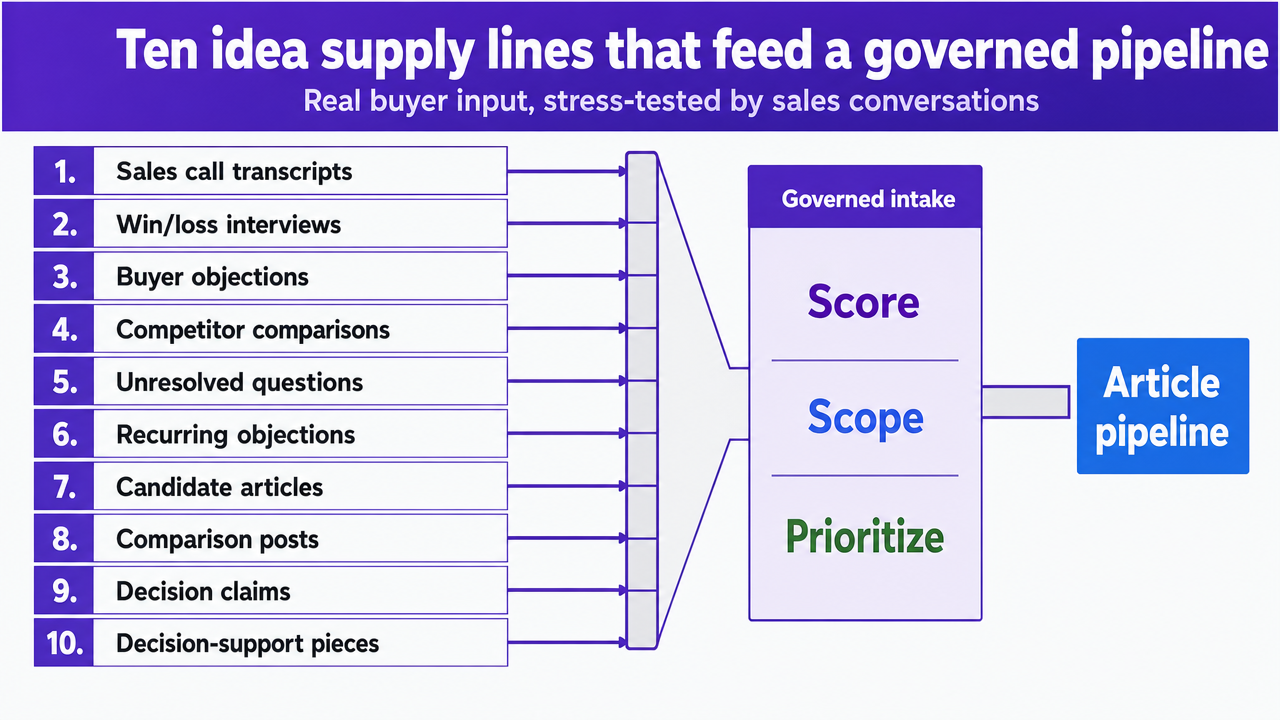 Visualize the ten distinct ideation feeds described in the section as a governed intake system flowing into a single scoring layer, reinforcing the supply-chain framing rather than a brainstorm
Test AI-powered article ideation and publishing now
Generate, approve, and publish production-ready articles to validate workflow efficiency before making a commitment.
A working rubric for ranking topics before they enter the calendar
Ten feeds produce more candidates than any team can publish. A rubric decides which ones move. Five dimensions, each scored 1 to 5, give the pipeline a defensible ranking without turning ideation into a committee exercise: audience fit, search opportunity, evidence access, production cost, and business impact. Peer-reviewed research points to relevance, consistency, and integration with other marketing activities as the drivers of content marketing effectiveness, and the five dimensions map directly to those drivers 2.
The qualifying gate sits above the score. Forbes frames the test as a single question applied to every candidate: does the topic help the audience make a more informed decision, prevent an error, or identify something previously unconsidered 5? A topic that fails that question does not enter the rubric. A topic that passes gets scored, and the top-ranked candidates flow into the dated calendar.
Worked example: a comparison post drawn from recurring sales objections scores 5 on audience fit because the objection is documented, 4 on search opportunity because competitor comparison queries have steady volume, 4 on evidence access because transcripts already exist, 3 on production cost because legal review adds time, and 5 on business impact because the topic sits mid-funnel. Total 21 out of 25. It moves. A generic industry trends post with no proprietary data and diffuse search intent scores 11. It does not.
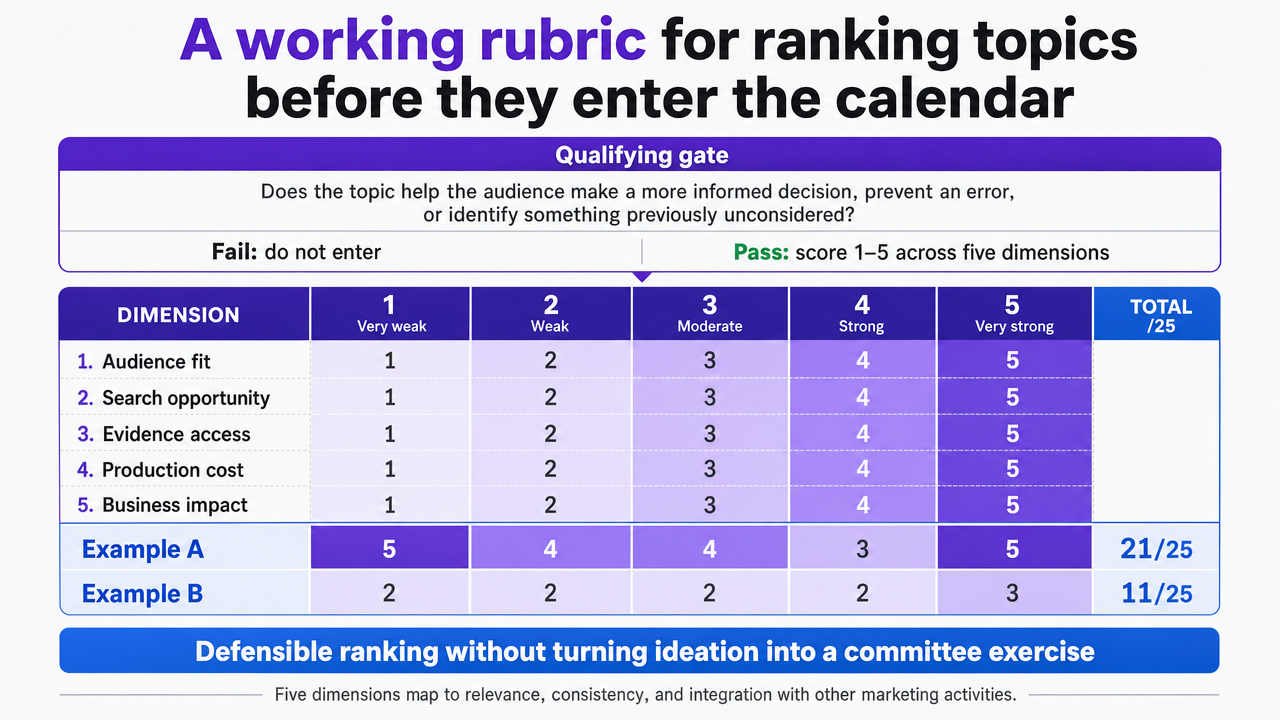 Show the five-dimension scoring rubric with the worked example scores cited in the section prose (5, 4, 4, 3, 5 = 21/25 vs. 11/25), making the ranking framework legible at a glance
The quality gate: innovation, education, credibility, visibility
The rubric ranks. A separate gate decides whether a topic clears the bar for the brand's voice in the first place. Sapio Research frames that gate through four elements: innovation, education, credibility, and visibility 6. Applied to ideation, each element becomes a pass-fail check before scoring begins.
Innovation : asks whether the article says something the top-ranking pages do not.
Education : asks whether a defined reader learns to do something new.
Credibility : asks whether the evidence, whether proprietary data, interviews, or documented cases, can withstand a skeptical reader.
Visibility : asks whether the topic sits where the audience actually reads, not where the team prefers to publish.
LinkedIn's guidance reinforces the standard: settling for anything below very good weakens the entire program, so the gate exists to keep marginal topics out before production hours are spent 13.
Routing approved ideas into a dated calendar with owners
A ranked topic that lacks a publish date and a named owner is still just a note. Routing is the step that converts an approved candidate into a scheduled artifact with accountability attached. Editorial calendar guidance is explicit on the mechanics: assign specific dates, balance the mix across formats and funnel stages, and monitor performance so slots can be rebalanced as data comes in 3. The dated commitment is what forces prioritization tradeoffs to happen weekly rather than quarterly.
Three fields carry the routing load:
- The owner names the single person accountable for the draft landing on the date, not the committee that reviewed it.
- The format, whether a research-backed guide, a comparison, an interview, or a curated resource page, is set at routing so the writer is not choosing the shape mid-draft 9.
- The channel plan lists where the article will be distributed at launch, which closes the integration gap that peer-reviewed research flags as a driver of effectiveness 2.
Expand Your Content Pipeline With Data-Driven Topic Generation
Connect with a strategist to see how AI-powered workflows can automate article ideation, streamline approvals, and help your team scale content velocity—all while maintaining editorial control.
Pipeline throughput: brief-and-handoff cycle vs. approval-first execution
Cycle time is where most pipelines lose their advantage. A traditional brief-and-handoff cycle moves an approved topic through a briefing document, an agency or freelancer queue, a first draft, an internal review round, a revision round, a legal or subject matter check, and a final publish handoff. Each step adds a decision point, and each decision point adds latency the calendar has to absorb 3.
An approval-first execution model compresses the same route by front-loading the decisions. Scoring, format, owner, evidence access, and channel plan are set at routing, so downstream steps are production tasks rather than fresh negotiations. Peer-reviewed research identifies integration with other marketing activities as a driver of effectiveness, and integration is easier when the plan is fixed before drafting begins 2. Northwestern's Spiegel Research Center frames the honest role of AI in this compression: efficiency and measurement gains, with human strategists retaining narrative control 4. Applied to throughput, that means AI handles mining, clustering, and first-pass drafting against a locked brief, while the content manager reviews at fewer, higher-leverage checkpoints. Platforms built on that pattern, including Vectoron, route every recommendation through a single approval step before execution, which is what lets a two-to-six person team publish on a dated calendar without adding headcount.
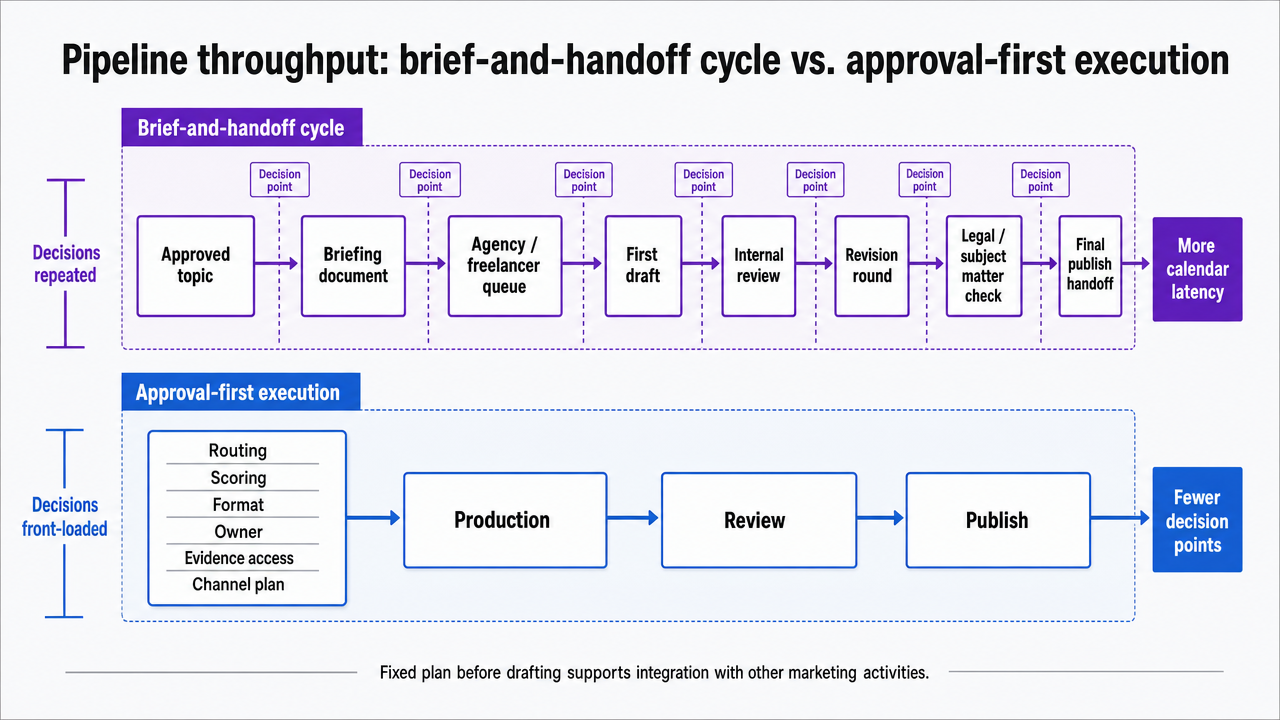 Contrast the two operating models described in the section as parallel process flows, making the compression of decision points in the approval-first model visually obvious
If you manage a portfolio of brands or business units
Scope shift: this section applies to content managers running ideation across multiple brands, product lines, or business units rather than a single blog. The pipeline mechanics stay the same, but the inputs multiply and the risk of duplicated effort rises fast.
Two adjustments matter most:
- Run one ideation feed per brand but a shared rubric across all of them, so scoring stays comparable when a shared executive reviews the calendar. Peer-reviewed research on content effectiveness points to relevance, consistency, and integration as the drivers that hold across contexts 2, and a single rubric is what keeps those drivers legible at the portfolio level.
- Tag every approved topic with its brand, funnel stage, and format at routing, so a comparison post produced for one unit can be adapted for another without a second research cycle 9.
Portfolio managers who audit for cross-brand reuse monthly recover production hours the calendar would otherwise burn on parallel drafts.
Common pipeline failure modes and how to diagnose them
Three failure patterns account for most stalled pipelines. Each has a visible symptom and a specific diagnostic.
- Backlog without ranking shows up as a shared document with fifty candidates and no scores. The diagnostic is a single question applied to the top ten: which of these helps the reader make a better decision, prevent an error, or surface something previously unconsidered 5? Topics that cannot answer that question are noise, not inventory.
- Topics without owners show up as slipped publish dates and revision loops that never close. Editorial calendar discipline assigns a named person to each dated slot, not a team 3. If the current calendar lists departments instead of people, ownership is the failure.
- Publish-and-forget shows up when performance data never re-enters ideation. Peer-reviewed research identifies integration with other marketing activities as a driver of effectiveness 2. A pipeline that ignores its own analytics severs that loop and rebuilds the same weak topics each quarter.
Frequently Asked Questions
References
- 1.Content Marketing | Marketing | Research Starters.
- 2.Determinants of content marketing effectiveness: Conceptual and empirical evidence.
- 3.Master Content Planning With Editorial Calendar Templates.
- 4.Content Marketing and AI – Best Practices.
- 5.What's The Best B2B Thought-Leadership Content?.
- 6.Thought Leadership Vs Content: The Ultimate Guide.
- 7.10 Thought Leadership Examples That Drove Real B2B Results.
- 8.27 Content Distribution Ideas to Promote Primary Research.
- 9.50 Content Ideas for Content Marketing.
- 10.Content Marketing Ideas for Successful Business Growth.
- 11.10 Content Marketing Articles Readers (Like You) Loved This Year.
- 12.Best Content Marketing Articles.
- 13.Why B2B Thought Leadership Matters and How to Get It Right.