
Key Takeaways
- Content demand grew 1.5x while teams met only 55% of it 5, so the 45-point gap should be treated as a design constraint, not a hiring problem.
- Anchor every asset to one of three pipeline workflows—new lead nurture, re-engagement, or sales handoff 10—and shelve anything that doesn't map to a specific pipeline metric.
- Define strategy, intake, production, and publishing artifacts before automating; high-automation brands see 29% greater revenue impact and are 24% more likely to meet demand 3.
- Reallocate spend from headcount toward AI coordination in the middle of the content chain, then focus next 90 days on selection, governance, and a three-metric dashboard.
The 45-Point Gap Between Content Demand and Team Capacity
The core problem facing in-house demand gen managers is not ambition, but arithmetic. Deloitte Digital's generative AI research found that content demand grew 1.5x in 2023, yet marketing teams only met 55% of that demand 5. This 45-point gap between business expectations and team output should drive planning conversations, rather than vanity metrics or wish lists.
This gap exists despite content marketing becoming increasingly critical. NYT Licensing reports that 71% of B2B marketers say content marketing has become more important to their organization in the last year 7. Demand gen managers, often leading small teams of two to six, are expected to feed more channels, support more sales plays, and prove pipeline contribution without additional headcount.
Hiring to close this gap is often not an option. Forrester's 2024 Budget Planning Survey revealed that only 35% of B2B marketing decision-makers anticipated a budget increase greater than 5% 6. Attempting to add a mid-level writer or expand an agency retainer with a minimal budget increase is mathematically unfeasible.
The practical solution is to treat this 45-point gap as a design constraint. This article outlines a strategy to close it by narrowing scope, standardizing production, and applying automation to the middle of the content chain, rather than pushing for more output at the beginning or end.
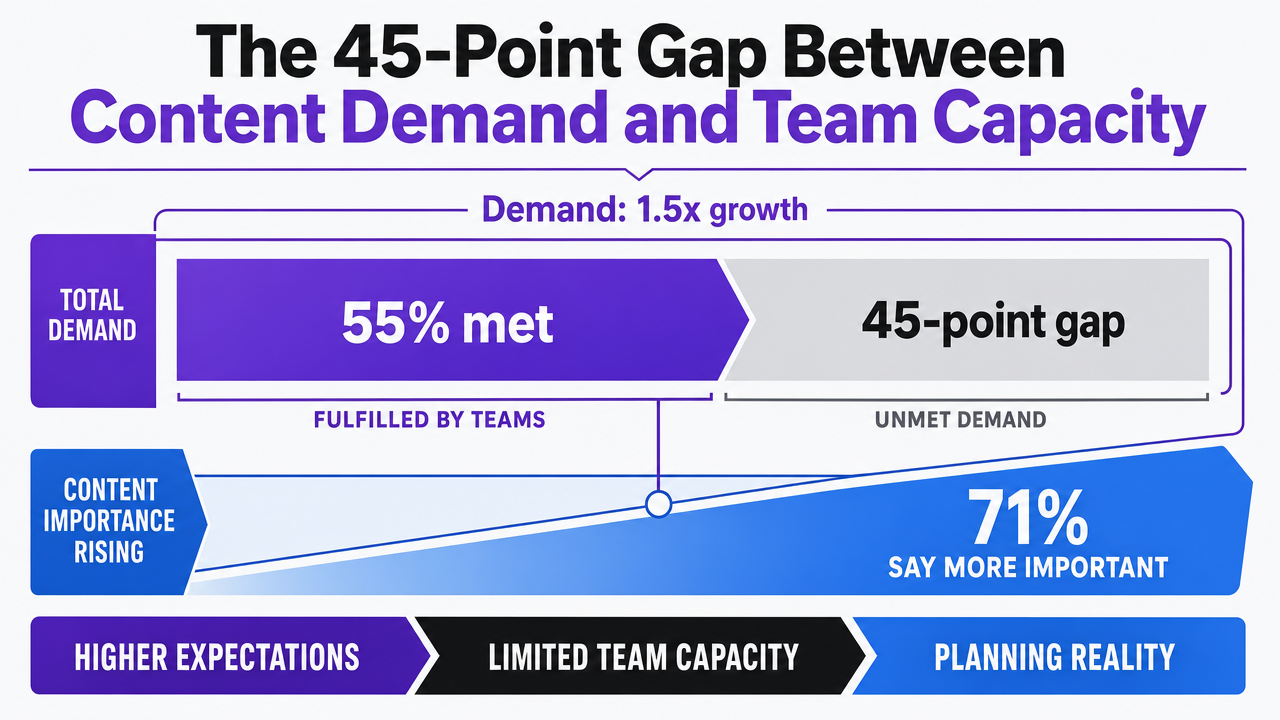 Visualize the demand-versus-capacity gap that frames the entire article, using the two data points cited in this section
Why More Output Is Not the Fix
The Real Constraint Is Selection, Not Volume
The impulse to close a capacity gap by simply publishing more assets often misidentifies the true bottleneck. CMI's 2024 benchmark, based on 894 B2B respondents, found that 57% of marketers struggle with creating the right content for their audience, while 58% cite a lack of resources as a leading non-creation challenge 1. These figures highlight that teams are simultaneously unsure what to produce and lack the capacity to produce it, meaning increased output without improved selection leads to waste.
The same survey indicates that 48% struggle to align content with the buyer's journey and 45% struggle to align content across sales and marketing 1. These are fundamentally selection problems, not production issues. A demand gen manager who publishes twelve blog posts a quarter that no seller uses in a deal has not built pipeline, but rather a unused portfolio.
Narrowing the content brief is the most cost-effective lever. Before standardizing workflows or purchasing tools, every asset in the pipeline should be filtered: does this asset move a specific pipeline metric for a specific audience that is currently stuck? Assets that fail this filter should be shelved, not queued.
Budget Reality for Constrained Operators
Forrester's 2024 Budget Planning Survey found that only 35% of B2B marketing decision-makers expected a budget increase greater than 5% for the year 6. The majority, 65%, are planning with flat or marginally growing budgets, which is the reality for most in-house demand gen managers.
Within these budget constraints, benchmarks help frame decisions. B2B marketing spend commonly ranges from 7% to 8% of revenue, with tech sectors leaning towards 9% to 10%, and 15% to 20% allocated for testing new tactics 12. Within this envelope, staff and agency fees directly compete with software, paid media, and content production. A new hire or expanded retainer doesn't magically appear; it displaces existing funded initiatives.
This trade-off is the crucial planning conversation. Reallocating existing spend towards tooling that amplifies each team member's output often yields more incremental capacity than spending the same amount on a single new hire. This article operates under the assumption of the 35% budget-growth ceiling 6 and the 7% to 8% revenue baseline 12 as fixed inputs.
Anchoring Strategy to Three Pipeline States
New Lead Nurture, Re-engagement, and Sales Handoff
The TOFU/MOFU/BOFU funnel is a classification system, not an operational guide. It categorizes assets by abstract intent stages, leaving demand gen managers to guess which pipeline metric each asset should influence. For a lean team, a more effective framework stems from the operational side of marketing automation, focusing on three primary workflows: new lead nurture, re-engagement for cold prospects, and sales handoff triggers 10.
Each workflow has a distinct objective. New lead nurture aims to convert a raw form-fill into a sales-accepted lead by educating on category fit and early disqualification of poor matches, thereby improving the MQL-to-SQL rate. Re-engagement draws dormant contacts back into active consideration by presenting new evidence, use cases, or shifts in their business context, increasing sourced pipeline from the existing database rather than relying on paid acquisition. Sales handoff triggers equip representatives with the precise asset a prospect needs at the moment of intent, compressing cycle time and boosting influenced pipeline on deals already in progress.
Anchoring content strategy to these three states enforces a discipline that the traditional funnel model lacks. Every asset in the queue must align with one of these three workflows and the specific pipeline metric it impacts. Assets that do not map to a workflow or a metric are candidates for shelving, not scheduling. For a team of two to six, this filter alone can reduce the production list by a third without impacting pipeline output.
The Content Assets Each State Actually Requires
The asset list for each workflow is typically shorter than most content calendars suggest. New lead nurture requires a category-defining explainer, two or three use-case pages tailored to the highest-fit segments, and a comparison asset that honestly addresses competitors. This constitutes a five-to-seven asset library, not a sprawling quarterly editorial calendar.
Re-engagement demands different materials. A dormant contact doesn't need another introductory explainer; they need a compelling reason why the current moment is different. A quarterly refresh of the top 20 organic pages, a benchmark or data release that provides sales with a reason to reach out, and a customer proof piece linked to a recognizable outcome typically cover most re-engagement triggers. The CMI benchmark shows short articles at 94% usage, video at 84%, and case studies at 78% across B2B teams 2, aligning with the actual consumption patterns for re-engagement.
Sales handoff assets are often the most underdeveloped category in lean organizations. A 12-question sales enablement FAQ, an objection-handling one-pager for each competitor, and a technical-buyer deep-dive covering security or integration are usually sufficient to unblock late-stage deals. These assets are frequently requested by reps and produced reactively; building them proactively transforms recurring one-off requests into a maintained library, saving the team hours each week.
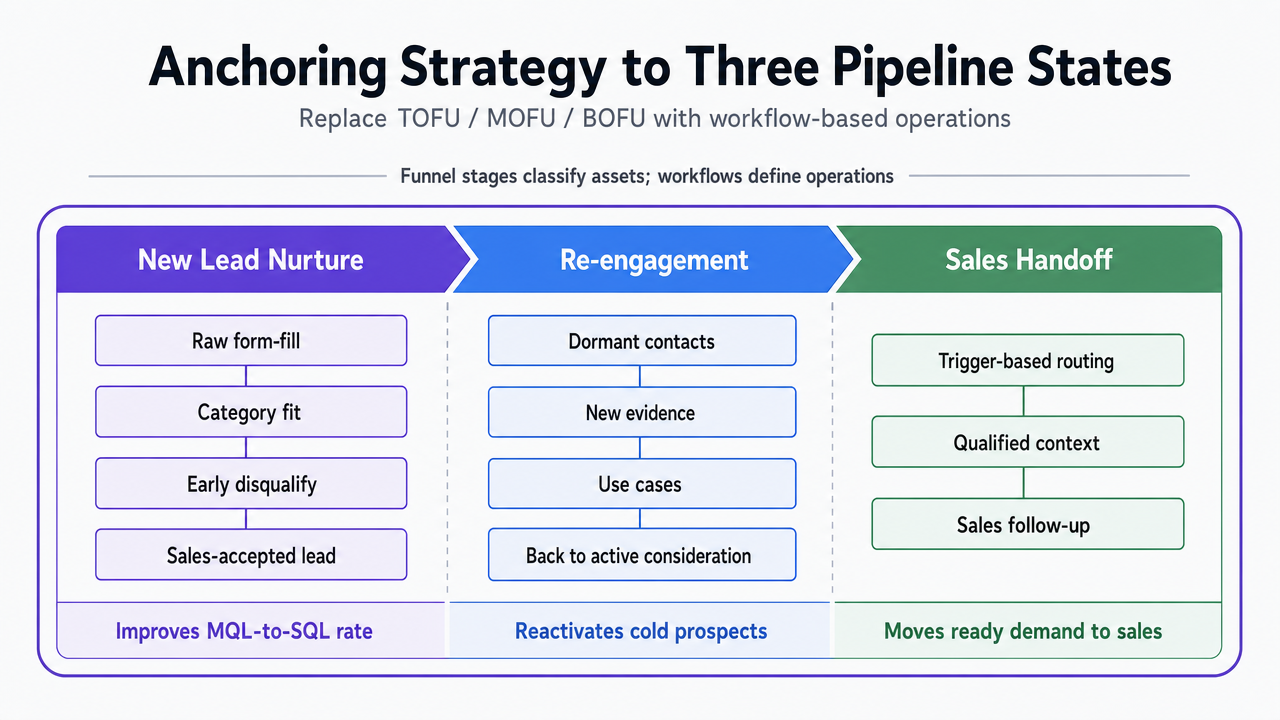 Visualize the three-workflow operating model that replaces TOFU/MOFU/BOFU, since this section defines the framework explicitly
Test a complete B2B content strategy workflow
Experience measurable content output on live campaigns with no commitment during your trial.
Treating Content as a Supply Chain
Establish Before Automate
Deloitte Digital's content supply chain research is clear on sequencing: automating a flawed process will not resolve inefficiencies; it will amplify them 4. This is a critical insight for demand gen managers evaluating AI tools under budget pressure. Investing in a generation engine without a defined workflow simply leads to faster mediocrity.
The establishment phase is unglamorous but cost-effective. It involves four key artifacts:
- A written content strategy linked to the three pipeline workflows,
- A documented intake process specifying the requestor, pipeline metric, and audience for each asset,
- A production workflow detailing drafting, editing, and approval roles, and
- A publishing checklist covering metadata, tracking, and distribution.
None of these require software and can be built in a shared document within a week.
Only after these four artifacts are in place should automation be introduced. The benefits of this sequencing are measurable. Deloitte's research on content automation found that brands with high levels of content automation experienced a 29% greater revenue impact from content marketing and were 24% more likely to meet their content demands than industry peers 3. These gains are realized by teams that automate a defined process, not those that use tooling to mask an undefined one.
Governance as a Scaling Lever, Not a Compliance Chore
In most content discussions, governance is often perceived as a legal issue. For a lean team leveraging AI, it's a matter of speed. CMI's 2024 benchmark found that 72% of B2B marketers now use generative AI, yet 61% of organizations lack guidelines for its use 1. Adoption has outpaced policy, leading to rework, inconsistent voice, and reviewers becoming bottlenecks due to the absence of clear rules.
An effective governance document doesn't need to be lengthy. It should specify which content types can be AI-drafted end-to-end, which require a human first draft, which claims need sourcing before publication, and who approves at each stage. It defines fact-checking standards for statistics, disclosure standards for AI-assisted assets, and the escalation path for flagged risks. Ten pages can cover most B2B contexts.
The value of governance lies in what it removes rather than what it adds. When a junior writer knows a category-explainer draft doesn't need legal review but a competitor-comparison page does, the queue shortens. When an approver knows sourcing standards were met, review time decreases. Governance enables a team of four to produce at the pace of eight without compromising quality.
AI-Assisted Drafting Versus AI-Coordinated Production
Where Adoption Has Outpaced Operational Readiness
Generative AI adoption in marketing is rapidly increasing. Deloitte Digital's research found that 26% of marketers already use generative AI, with another 45% planning to adopt by the end of 2024 5. Within a year, the proportion of teams using genAI for content will jump from roughly a quarter to over two-thirds. A demand gen manager planning for 2024 outputs must account for a market where most peers have adopted these tools.
However, adoption does not automatically equate to advantage. CMI's benchmark of 894 B2B respondents shows little difference in genAI usage between top-performing and average teams 2. This suggests that the tools themselves are not the sole differentiator for successful content programs. When everyone has access to the same drafting engines, the competitive edge shifts elsewhere.
For a lean in-house team, AI-assisted drafting has become a baseline expectation. Producing a first draft in half the time is now standard, not exceptional. While the capacity gains from drafting speed are real, they are capped and universally available to competitors.
The Middle of the Chain Is Where Leverage Lives
If drafting is a commodity, coordination is the competitive advantage. Most teams apply AI to the beginning and end of the content chain: ideation first, then drafting. However, the middle of the chain—where an approved brief becomes a routed draft, a fact-checked source list, a metadata-complete published asset, and a tracked pipeline event—is where small teams accumulate significant hours. This middle section is where AI-coordinated production truly proves its worth.
Evidence supports this focus. Deloitte's content automation research found that brands with high levels of content automation saw a 29% greater revenue impact from content marketing and were 24% more likely to meet their content demands than industry peers 3. These gains are not from faster typing, but from eliminating handoffs, standardizing intake, streamlining approvals, and linking published assets to measurement events without manual data transfer across multiple systems.
Coordination also addresses challenges that drafting alone cannot. Only 31% of B2B marketers believe their organization has the right technology to manage content across the organization 2, and 45% plan to invest in new content management technology in 2024 2. This investment shift towards the middle of the chain indicates where the most significant inefficiencies lie. For a team of two to six, the highest-return AI investment is one that reduces coordination work for every existing team member, not one that merely shortens a single writing task.
What Lean Teams Should Stop Doing
Most B2B content advice tends to increase workload. For a team of two to six facing a 45-point demand gap, a more valuable approach is to identify what to remove from the queue.
Annual long-form reports are a prime candidate for elimination. CMI's benchmark indicates a market shift away from heavy PDF reports towards webinar or video series that deliver the same data in a format sales teams can readily reuse 1. A 40-page report that takes a quarter to produce and receives minimal internal citations offers poorer economics than a four-episode video series derived from the same research, even before considering distribution.
Channels without attributable pipeline should be the second cut. LinkedIn usage is increasing among B2B teams, while X usage is declining 2. Lean teams should follow the pipeline rather than maintaining a presence on every platform out of habit. If a channel hasn't sourced or influenced a deal in two quarters, it doesn't need a content plan; it needs to be retired.
Net-new production at the expense of refreshing existing content is the third area to reconsider. B2B content benchmarks highlight refresh ROI and pillar page lift as some of the highest-return activities for a mature content library 11. A quarterly refresh of the top 20 organic pages typically outperforms the same effort spent launching new posts that start with zero authority. Breaking the habit of constantly publishing new content often creates space for work that genuinely improves rankings and pipeline.
See How Leading Teams Scale B2B Content Output Without Expanding Headcount
Get a walkthrough of AI-powered workflows enabling marketing leaders to increase organic lead volume and content velocity—while maintaining oversight and budget discipline.
Reallocating Spend Instead of Adding Headcount
Budget discussions for in-house demand gen managers rarely begin with new funds, but rather with reallocating existing resources. Forrester's 2024 Budget Planning Survey shows only 35% of B2B marketing decision-makers expected a budget increase greater than 5% 6, while 45% of organizations plan to invest in new content management technology within the same period 2. Money is shifting within the existing budget, not expanding it.
The trade-off a demand gen manager controls typically involves three options:
- A new mid-level content marketer,
- An expanded agency retainer, or
- Reallocation towards AI-assisted production tooling that amplifies the output of every existing team member.
The first two add a single unit of capacity. The third changes the multiplier for the four to six units already on payroll. Deloitte's content automation research quantifies this difference: brands with high levels of content automation saw a 29% greater revenue impact from content marketing and were 24% more likely to meet their content demands than industry peers 3.
| Reallocation option | What it adds | Constraint it inherits |
|---|---|---|
| Mid-level content hire | One writer's throughput | Fully-loaded salary competes with tooling and paid media inside the 7–8% of revenue benchmark 12 |
| Expanded agency retainer | External capacity with briefing overhead | Recurring fee, briefing cycles, limited institutional memory |
| AI-assisted production tooling | Multiplier on existing team output | Requires defined workflows before automation 4 |
This reallocation only yields benefits when the underlying workflow is already defined. Applying tooling to an undefined intake process merely accelerates mediocrity, underscoring why the "establish-before-automate" sequence 4 is a prerequisite for this shift in spending, not a minor detail.
Measuring Contribution to Closed Revenue
Content's revenue contribution is now more defensible than it was two years ago. CMI's 2024 benchmark found that 58% of B2B marketers reported content helped generate sales or revenue in the past year, an increase from 42% the prior year 1. This 16-point jump signals that CFOs are increasingly receptive to a revenue narrative for content, provided the supporting data is robust.
Robust data means identifying the pipeline metric each asset is designed to influence before production begins, then reporting against that metric regularly.
- For new lead nurture assets, the key metric is the MQL-to-SQL conversion rate for contacts who consumed the asset.
- For re-engagement assets, it's the sourced pipeline from previously dormant contacts.
- For sales handoff assets, it's influenced pipeline and cycle time for deals where a rep utilized the asset.
This approach simplifies measurement to three numbers, three workflows, and one dashboard.
The primary measurement gap for most lean teams is technological, not intentional. Only 31% of B2B marketers state their organization has the right technology to manage content across the organization 2. Addressing this technological gap is a prerequisite for a credible revenue story, not an optional enhancement.
A 90-Day Plan for a Team of Two to Six
The first 30 days are dedicated to selection and documentation. Audit every in-flight asset against the three-workflow filter, shelving anything that doesn't align with new lead nurture, re-engagement, or sales handoff 10. Simultaneously, create the four foundational artifacts identified by Deloitte's supply chain research: strategy, intake process, production workflow, and publishing checklist 4. No tooling decisions should be made during this initial period.
Days 31 to 60 focus on governance and the sales handoff library. A concise ten-page AI use policy will close the 61% "no-guidelines" gap CMI observed across 894 B2B respondents 1, clarifying what requires escalation and what doesn't for reviewers. During this same window, build the often-underdeveloped handoff assets: a 12-question sales enablement FAQ, one objection-handling one-pager per named competitor, and a technical-buyer deep-dive.
Days 61 to 90 involve implementing coordination automation based on the now-defined workflow and establishing the three-metric dashboard: MQL-to-SQL for nurture, sourced pipeline for re-engagement, and influenced pipeline and cycle time for handoff. Vectoron is ideal for teams seeking approval-first coordination across these workflows without adding headcount.
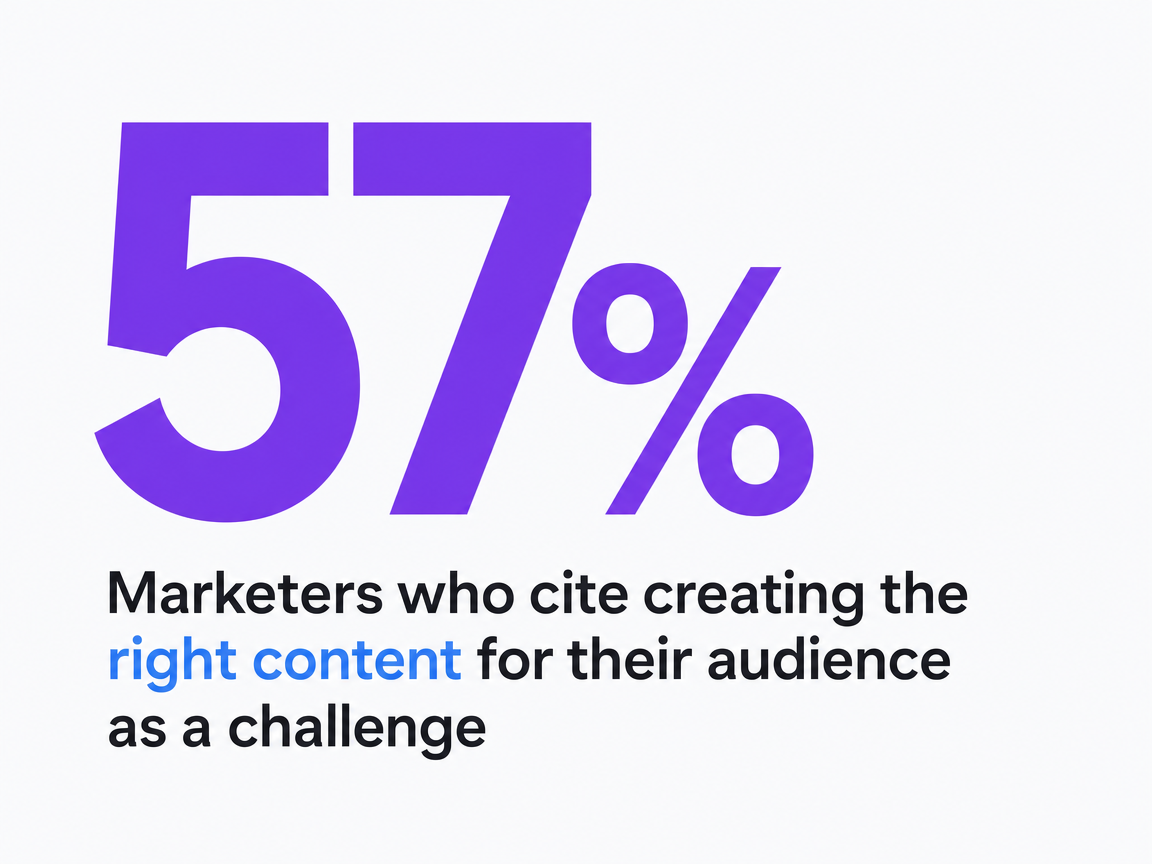 Marketers who cite creating the right content for their audience as a challenge
Marketers who cite creating the right content for their audience as a challenge
Frequently Asked Questions
References
- 1.B2B Content Marketing Benchmarks, Budgets, and Trends: Outlook for 2024 [Research].
- 2.B2B Content Marketing Benchmarks, Budgets, and Trends: Outlook for 2024 [Research] (MarketingProfs summary).
- 3.Marketing content automation.
- 4.Automation and the content supply chain.
- 5.Generative AI's Transformation of Content Marketing.
- 6.B2B CMOs Don't Expect 2025 Growth To Come From Budget Increases.
- 7.21 B2B Content Marketing Statistics to Know in 2024.
- 8.B2B Content Marketing Statistics: 6 Signals to Guide 2026 Decisions.
- 9.2025 Digital Media Trends.
- 10.B2B Marketing Automation: Frequently Asked Questions.
- 11.B2B SEO + Content Engine Benchmarks 2024.
- 12.Planning your 2026 Marketing Budget: What's Changed Since The....
- 13.Success In Revenue Operations 2026 Budget Planning.