
Key Takeaways
- Treat the outline as a production spec that locks intent, structure, and evidence upstream, so drafting becomes execution rather than exploration and revision loops shrink.
- Build every outline around five fields—intent line, disciplined title and H1, descriptive H2 stack, and evidence slots—so scope and sourcing are settled before drafting begins.
- Structure sections for the four scanning patterns using front-loaded H2s, section-level inverted pyramid, and mechanical rules on paragraph length and lists 10, 6.
- Enforce one H1, nested H2s, and properly placed H3s at the template level, since assistive tech and search indexers rely on the same heading tree 13, 3.
- Let one outline drive three downstream systems—writer brief, on-page SEO surfaces including schema hooks, and reviewer QA—so a single artifact populates every handoff without a second document.
- Audit outlines for five recurring defects: generic label headings, stuffed titles, thin crawler-driven sections, missing evidence slots, and undefined intent lines—each visible before drafting.
- Collapse strategist brief and writer outline into one artifact, reducing handoffs to two reviewer decisions per post and freeing throughput without adding writers.
- For multi-brand portfolios, keep the outline skeleton fixed and vary only the intent line and searcher-language phrasing, since relevance is query- and market-specific 11, 2.
The outline as production spec, not writing warm-up
Most blog post outlines fail the same way: they are treated as a writer's personal scratchpad, then discarded once the draft exists. That framing quietly caps a content team's throughput. When an outline is only a warm-up, every downstream decision — intent, hierarchy, evidence, review criteria — gets re-litigated inside the draft, where changes are expensive and slow.
A production-grade outline flips that sequence. It functions as a spec that locks intent and structure before a single paragraph is written, so drafting becomes execution rather than exploration. Google's own guidance on helpful, people-first content emphasizes originality, substantial coverage, and clear signals of purpose 1— none of which can be judged inside a half-finished draft, but all of which can be pre-committed inside an outline.
The operational payoff shows up in three places. Writers stop guessing at scope. On-page structure — title, H2 stack, schema hooks — is decided upstream instead of retrofitted during editing. Reviewers evaluate against a pre-agreed contract rather than personal taste. Research on content marketing effectiveness underscores that strategic fit and contextual planning are the determinants that move outcomes, not surface polish 15.
The rest of this guide treats the outline as team infrastructure: what it must contain, how it maps to reader behavior and search structure, and how it compresses the production loop.
What a scalable outline actually contains
Intent line: the one-sentence contract before any H2s
Every scalable outline opens with a single declarative sentence naming the reader, the question being answered, and the decision or action the post should enable. That sentence is the contract. It settles scope before a writer picks headings and before a reviewer forms an opinion.
Google's ranking framework rewards content that demonstrates meaning, relevance, and quality against a specific query 11. An intent line forces those three variables into the open at the outline stage rather than leaving them implied. If the sentence cannot be written, the topic is not ready to draft.
Peer-reviewed work on content marketing effectiveness reaches a similar conclusion from the operator side: strategic fit and contextual variables are the determinants that move outcomes, not surface craft 15. The intent line is where fit gets encoded. Content managers who require it before approving any H2 stack cut most scope drift out of the revision cycle, because writers and reviewers are arguing against the same one-sentence spec.
Title and H1 discipline: searcher language, not internal jargon
The title and H1 are the two fields most often written last and least often written well. Google's guidance is direct: title text should be descriptive and concise, and keyword stuffing should be avoided 4. The outline is where that discipline is enforced, not the CMS field the writer fills in at publish time.
Search Essentials adds the operative rule for both fields — use the words people would actually use to look for the content in titles and main headings 2. Internal jargon fails this test quietly. A B2B team writing about "content velocity enablement" may be describing the same thing readers search for as "how to publish blog posts faster," but only one phrasing earns the click.
Scalable outlines treat the title as a working field, not a decorative one. A useful format: draft the title against the intent line, check that the primary noun phrase from the intent line appears in the first half of the title, and confirm the H1 either matches the title or restates the same searcher-language phrase. Two fields, one rule, no rewrites at publish time.
The H2 stack: descriptive headings that carry meaning without the paragraph
H2s do the load-bearing work in a scalable outline. A reader who scans only the H2 stack should be able to reconstruct the argument of the post. That test — reading the headings without any body copy and still understanding the piece — is the sharpest quality check available to a reviewer working at volume.
The Australian Style Manual gives the operational rule: put the most important thing first, use headings to signpost information, and place keywords in the first two or three words of each heading 8. That single instruction eliminates the most common failure mode in blog outlines, which is opening with content-free labels like "Introduction," "Overview," "Background," or "Deep Dive." CMS plain-language guidance reaches the same conclusion by different logic: delete fluff and make every heading meaningful 6.
The contrast is easy to audit inside an existing outline. A heading like "Overview of content planning" carries no meaning without the paragraph beneath it. A heading like "Content planning starts with a single intent line" carries the claim on its own and puts the searcher-language phrase in the first three words. The second version survives the H2-stack-only test. The first does not. Writers reviewing their own outlines can apply this rule in under a minute per heading, which is exactly the kind of pre-drafting decision that removes revision work later.
Evidence slots: where citations sit inside the outline
Evidence belongs in the outline, not in the draft. A scalable outline assigns each H2 at least one evidence slot: the specific claim that needs support and the source that supplies it. Writers are not asked to hunt for citations mid-draft, and reviewers are not asked to guess whether a paragraph is opinion or sourced fact.
Google's helpful content guidance frames the reason plainly — original information and substantial coverage are what the framework rewards, and both require the writer to know upfront which claims must be sourced 1. When evidence slots are missing from an outline, drafts default to assertion. When they are present, drafts default to argument.
Operationally, an evidence slot is three fields inside each section brief: the claim, the source, and the one-line quote or figure that will anchor it. That structure also front-loads schema decisions, since sourced claims and structured facts are what Google's structured data guidance is built to describe on the page 5. The outline becomes the audit trail before the draft exists.
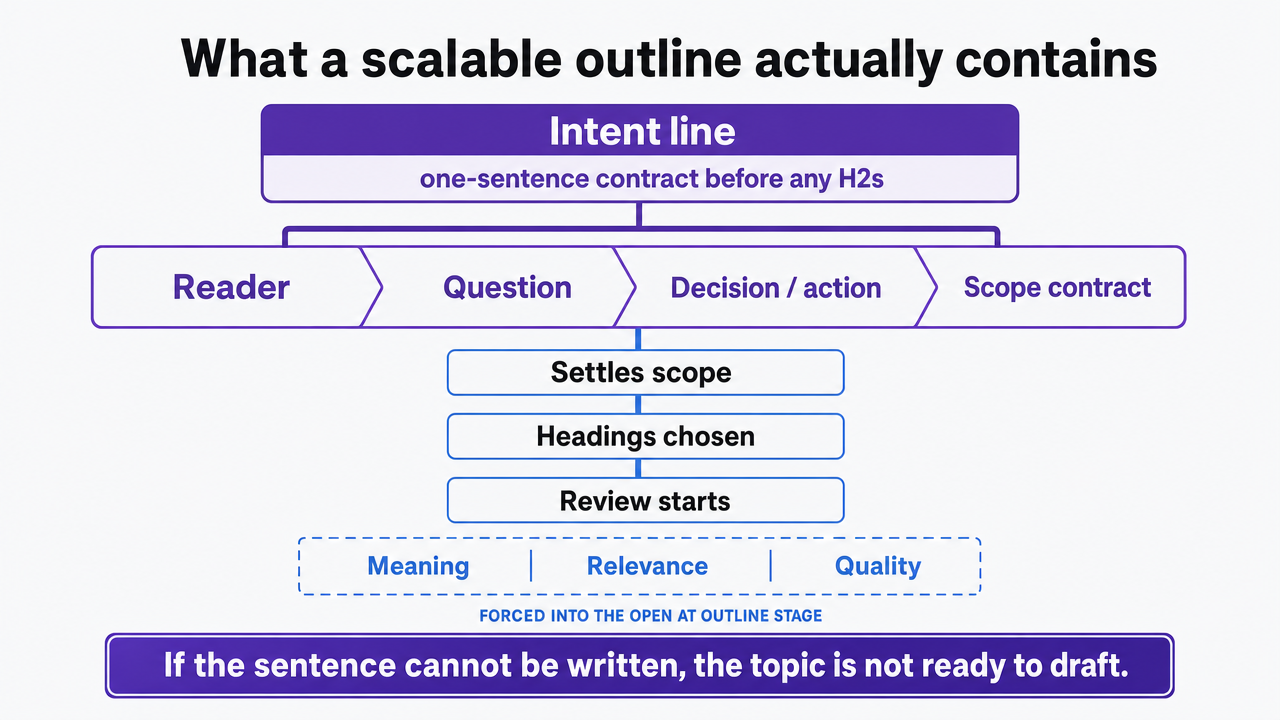 Visualize the four required fields of a scalable outline as a structured framework diagram, directly supporting the section that defines each component
Structuring for how readers actually scan the page
Four scanning patterns that dictate section breaks
Readers do not read blog posts. They scan them, and eyetracking research identifies four dominant patterns that shape how information is absorbed on the page:
- the F-pattern
- the spotted pattern
- the layer-cake pattern
- the commitment pattern 10
Each pattern implies a different structural decision inside the outline.
The F-pattern rewards front-loaded H2s and first-sentence-first paragraphs, because the eye travels across the top and drops down the left edge. The spotted pattern rewards visually distinct anchors — bolded phrases, numbers, named entities — that let a skimming reader lock onto specific answers without reading the surrounding prose. The layer-cake pattern is the one most directly served by a strong H2 stack: readers hop from heading to heading, treating the body copy as optional context. The commitment pattern applies to the small subset of readers already sold on the topic; those readers reward long, well-organized sections that reward deeper reading.
An outline built for only one pattern loses the other three. A scalable outline builds section breaks that serve all four at once: descriptive H2s for layer-cake scanners, first-sentence claims for F-pattern eyes, bolded or numbered anchors for spotted scanners, and enough substance under each heading to hold the committed reader.
Inverted pyramid inside every section, not just the intro
The inverted pyramid is usually taught as an opening move: put the answer at the top of the post, then support it. Applied at scale, it is a section-level rule, not a page-level one. Every H2 gets the same treatment as the intro.
NN/g's guidance is explicit — users scan with meaningful subheadings, one idea per paragraph, and the inverted pyramid style 9. A section that opens with background context, then arrives at its point in the third paragraph, forfeits the scanner. A section that opens with the claim and then supplies the evidence beneath it keeps both the scanner and the committed reader.
Inside an outline, the rule becomes mechanical: the first sentence of every section brief is the claim that section proves. If a writer cannot state that claim in one sentence, the section is not scoped tightly enough to draft. Reviewers can enforce the rule by reading only the first sentence of each section during QA — if the article still makes sense, the pyramid is intact.
Paragraph length, lists, and one-idea rules writers can execute without judgment calls
Scannability rules only scale when they remove judgment calls from the writer. Vague guidance like "keep paragraphs short" produces inconsistent drafts. Specific guidance produces uniform ones. CMS puts numbers on the rule: keep sentences as short as possible, and cap paragraphs at two or three sentences 6. That is a spec, not a suggestion, and it belongs in the outline template rather than a style guide the writer may or may not open.
MCC's plain-language guidance adds the other half of the rule — use lists and tables to simplify complex material, and keep sections short 12. Any outline section that requires more than three parallel points should be flagged for a bulleted list in the outline itself, not left for the writer to decide mid-draft.
The one-idea-per-paragraph rule closes the loop 9. Writers do not choose whether a paragraph breaks; the outline tells them. A section brief with four distinct claims maps to four paragraphs, not one dense block. Encoded this way, scannability stops being a matter of taste and becomes a set of pre-made decisions the writer executes.
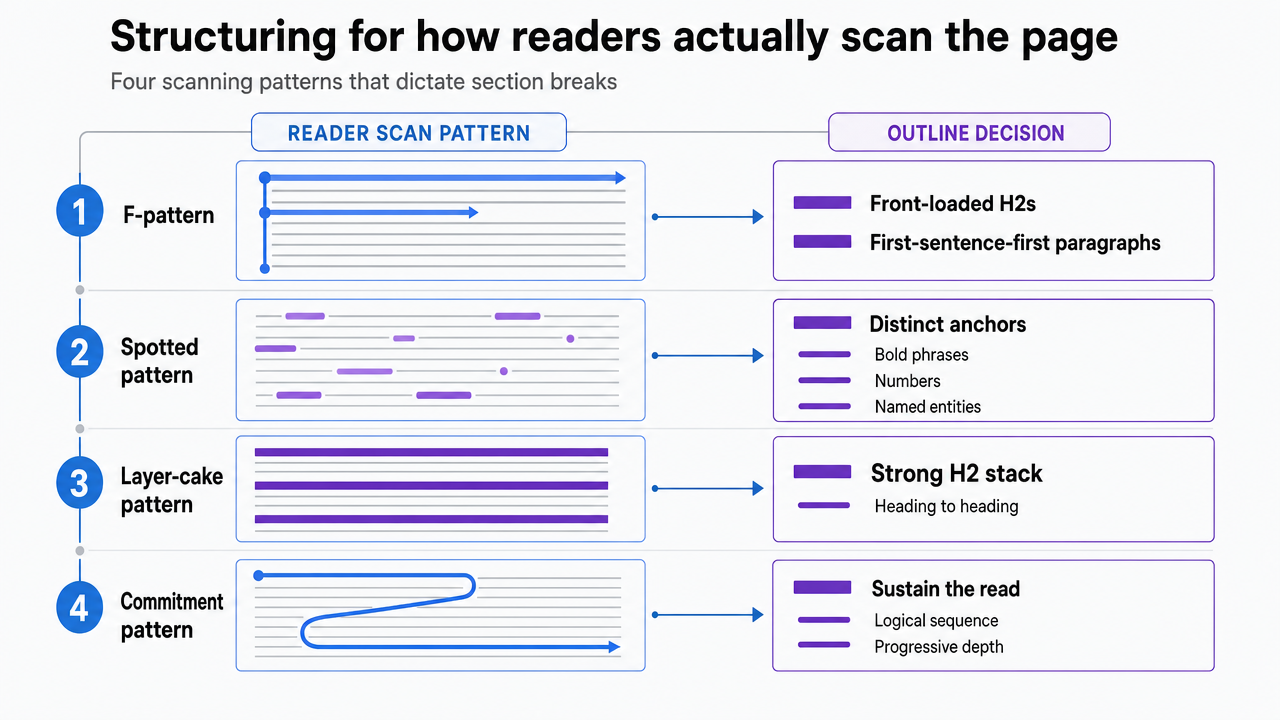 Illustrate the four eyetracking scanning patterns cited in the section, showing how each pattern maps to a different structural decision in the outline
Test AI-driven blog outlines at scale now
Rapidly outline, draft, and publish live blog content to benchmark workflow speed and quality improvements in practice.
Heading hierarchy that serves both crawlers and assistive tech
Heading hierarchy is where accessibility and search structure become the same problem. A blog post has one H1, followed by H2s that break the argument into sections, followed by H3s that break those sections into named sub-claims. Skipped levels, multiple H1s, and decorative headings styled to look like H2s all break that tree, and they break it for the same two audiences at once: assistive technology parsing the page and search systems trying to understand it.
W3C accessibility guidance treats headings as the structural spine screen readers use to navigate a page — a broken hierarchy means a reader relying on assistive tech cannot jump between sections predictably 13. WCAG reinforces the same rule from the compliance side: information and relationships conveyed through presentation must be programmatically determinable, not just visually implied 14. A bolded paragraph that looks like a heading is invisible to any system reading the underlying structure.
The search consequence lands in the same place. Google Search works in three stages — crawling, indexing, and serving — and clear heading structure is what lets the indexer identify what each section is about 3. A scalable outline enforces the tree at the template level: one H1 field, an H2 stack, and H3s nested only under their parent H2. Reviewers audit the outline, not the draft, and the hierarchy ships correctly on the first pass.
One outline, three downstream systems
Writer brief: what the outline hands the drafter
A completed outline is the writer brief. There is no second document. Handed off, it contains:
- the intent line
- the title and H1
- the H2 stack in final searcher-language phrasing
- each section's first-sentence claim
- the evidence slots with source and quote
- any list or table calls flagged at the outline stage
That structure eliminates the two questions writers ask most often mid-draft: what is this section supposed to argue, and where does the support come from. Both are pre-answered. Drafting narrows to prose execution against a spec that already reflects meaning, relevance, and quality decisions 11, instead of surfacing those decisions inside a half-finished draft where they cost a rewrite.
On-page SEO: title link, H2 stack, and schema hooks
The same outline drives the on-page SEO surfaces without a second pass. The title field in the outline becomes the title link Google renders in results, which is why the descriptive, concise, no-stuffing rule has to be enforced at the outline stage rather than at publish 4. The H1 restates the same searcher-language phrase, and the H2 stack — already written to put keywords in the first two or three words of each heading 8— becomes the section structure crawlers use to understand what each part of the page is about.
Schema hooks fall out of the same fields. An outline with a dedicated FAQ block maps directly to FAQPage schema. Step-by-step H2s in a how-to map to HowTo schema. The sourced claims inside each evidence slot support Article-level metadata. Google's structured data guidance treats schema as an on-page description of what is already there 5— which means the more disciplined the outline, the less work schema implementation requires. One artifact, three surfaces populated.
Reviewer QA: pre-answered decisions and the checklist that replaces taste
Reviewers are the bottleneck most content operations under-diagnose. When the outline is a spec, review stops being a taste exercise and becomes a checklist pass against pre-agreed decisions. The reviewer is not asking whether the H2 phrasing is good; the outline settled that. They are checking whether the draft executed the outline.
The checklist writes itself from the outline fields:
- Does the intro deliver on the intent line?
- Does each section open with the first-sentence claim from its brief?
- Are the evidence slots filled with the source and quote specified?
- Do paragraphs hold to the two-or-three-sentence cap 6?
- Is the heading tree intact, with one H1 and properly nested H2s and H3s?
Reviewers working from that checklist finish faster and produce more consistent notes across writers. Disagreements move upstream, where they belong — to the outline template itself — rather than surfacing as one-off edits on every draft. That is what compresses the revision loop at scale.
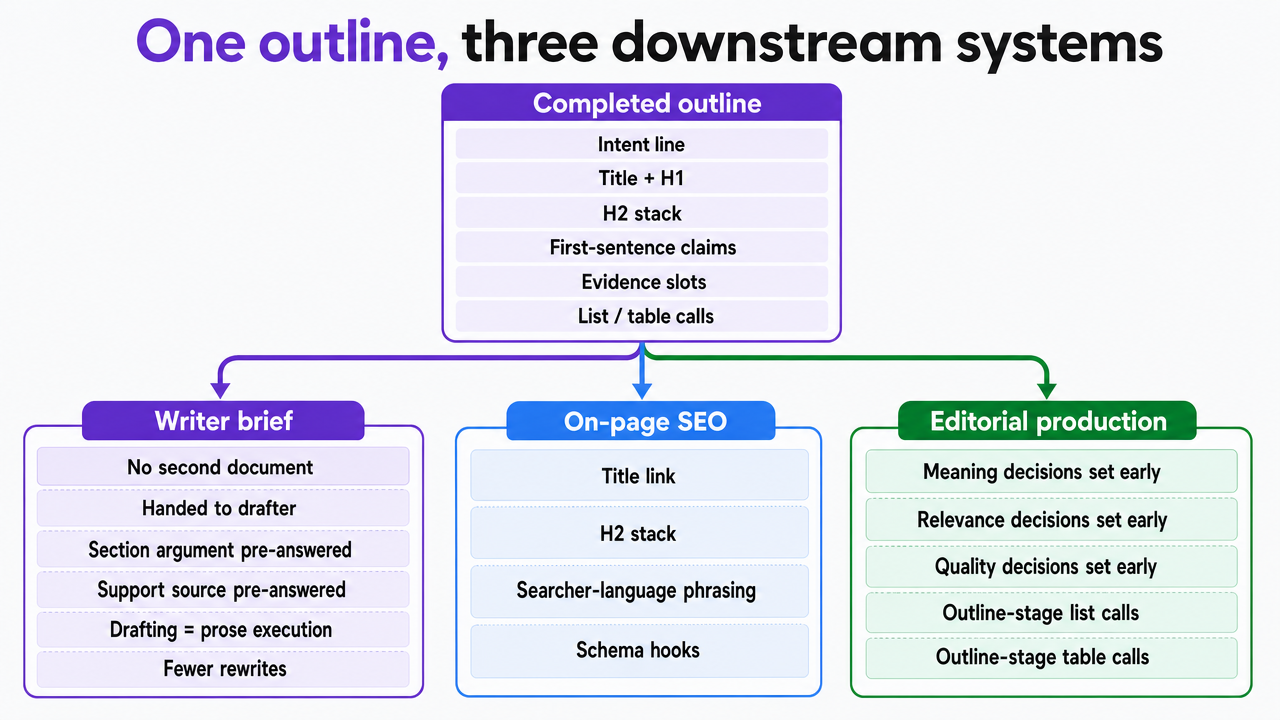 Show how a single outline artifact feeds three parallel downstream workflows, matching the section's operating-model claim
Anti-patterns to audit out of existing outlines
Most underperforming outlines share the same five defects, and each one is visible before a single word of the draft is written. Content managers running an audit can work through them in order.
Generic label headings are the most common. "Introduction," "Overview," "Background," and "Conclusion" carry no meaning without the paragraph beneath them, which is the exact failure CMS plain-language guidance names when it tells writers to delete fluff and make every heading meaningful 6. Replace each label with a claim that puts the searcher-language phrase in the first two or three words.
Keyword-stuffed titles are the second. Titles that repeat the primary phrase two or three times to hedge for search violate Google's direct instruction to keep title text descriptive and concise 4. One clean phrasing beats three padded ones.
Thin sections built for crawlers rather than readers are the third. Google's helpful content framework treats originality and substantial coverage as the criteria that matter, not heading count 1. Any H2 that exists only to hit a related keyword should be merged or cut at the outline stage.
Missing evidence slots are the fourth defect, and undefined intent lines are the fifth. Both surface as revision loops once drafting starts. Audit the outline, not the draft.
Streamline Content Outline Approval Without Slowing Down Production
See how enterprise teams and agencies accelerate blog outline workflows with unified approval processes and AI-powered coordination—eliminating bottlenecks and maintaining brand consistency at scale.
The outline-to-output operating model
Standardizing the outline changes the shape of the production loop. A traditional flow has four handoffs: strategist writes a brief, writer builds an outline, writer drafts, editor reviews. Each handoff is a place where scope shifts and revision work accumulates. When the outline is the brief, the first two steps collapse into one artifact that carries intent, structure, evidence, and QA criteria into drafting without a second document.
That compression is where throughput gains land. Writers stop rebuilding scope from a Google Doc brief. Editors stop discovering structural problems in finished prose. Schema decisions travel with the outline instead of surfacing at publish. Research on content marketing effectiveness points to strategic fit and contextual planning as the determinants that move outcomes 15, which is exactly what a standardized outline encodes upstream.
The operating model is simple to run: one outline template, one review pass at the outline stage, one review pass on the draft against the outline. Two reviewer decisions replace the four or five that unstandardized workflows generate per post. Multiplied across a publishing calendar, that is where a team ships more without adding writers.
If you manage a multi-brand or multi-location content portfolio
The rules above assume a single brand voice and one editorial calendar. Portfolio operators — multi-location service brands, franchise systems, and agencies running parallel content programs across clients — face a different problem: the same outline template has to travel across brands without collapsing the differences that make each one rank.
The template stays fixed. What varies is the intent line and the searcher-language phrasing inside the H2 stack. A dental group operating across twelve markets writes twelve different intent lines against the same outline skeleton, because meaning and relevance are query-specific 11, and the words readers use to find a Denver practice are not the words they use in Tampa 2. The heading tree, evidence slots, and scannability rules do not change brand to brand.
Portfolio-level QA gets easier, not harder, under this model. Reviewers audit one template and then check each brand's outline against it. Peer-reviewed evidence on content marketing effectiveness points to contextual fit as the determinant that moves outcomes 15— which is exactly what a fixed structure plus a variable intent line encodes at scale. Vectoron's approval workflow was designed for this shape of portfolio review.
Frequently Asked Questions
References
- 1.Creating helpful, reliable, people-first content.
- 2.Google Search Essentials (formerly Webmaster Guidelines).
- 3.In-Depth Guide to How Google Search Works.
- 4.Influencing your title links in search results.
- 5.Intro to How Structured Data Markup Works.
- 6.Guidelines for effective writing.
- 7.Plain Language Materials & Resources.
- 8.Quick guide: plain language.
- 9.How Users Read on the Web.
- 10.Text Scanning Patterns: Eyetracking Evidence.
- 11.How Does Google Determine Ranking Results.
- 12.Writing in Plain Language.
- 13.Headings.
- 14.Info and Relationships.
- 15.Determinants of content marketing effectiveness: Conceptual and empirical evidence.