
Key Takeaways
- A four-layer architecture separating strategy, production, localization, and measurement replaces bespoke briefs and lets one strategist govern many accounts without sacrificing quality.
- Channel-siloed retainers are eroding as over 40% of B2B organizations dissolve channel marketing functions in favor of buying-group and opportunity-type planning 2.
- A strict Program-Campaign-Tactic-Asset hierarchy with rollup measurement connects activity to business impact and eliminates the monthly rebuild of client reports 9, 11.
- Focus next on locking strategy artifacts to a quarterly cadence, gating AI-drafted production with strategist approval, and routing field requests through localization guardrails 1, 3, 7.
Overcoming the Agency Production Ceiling
Many agencies struggle not with strategy, but with throughput. A senior strategist typically manages three to four active accounts before administrative tasks like status meetings, brief revisions, and quality assurance consume their calendar. Exceeding this limit often leads to a decline in quality, which clients eventually notice.
The common response is to hire more staff—account managers, producers, channel specialists. However, this often results in headcount growth outpacing profit margins, negatively impacting the P&L.
The root cause lies in agencies planning campaigns as unique creative exercises, a method that no longer scales. Forrester advocates for a disciplined, buyer-centric "plan on a page" that aligns objectives, priorities, and success definitions before any tactics are chosen 1. Few agencies consistently apply this discipline across their client portfolios, leading to separate briefs, templates, and reporting for each account.
This fragmented approach creates a production ceiling. It's not a talent shortage but an architectural gap. The following sections detail a four-layer campaign architecture designed to centralize, template, and govern campaign elements effectively.
The Decline of Channel-Siloed Planning
The channel-first campaign model emerged when buyer journeys were predictable, allowing agencies to justify separate pods for SEO, paid media, social, and content, each with its own planning cycle. This era is drawing to a close.
Forrester predicts that over 40% of B2B organizations will eliminate their channel marketing functions by 2023, integrating them into broader partner ecosystem and demand structures focused on buying groups and customer health, rather than channel-specific P&Ls 2. This shift among B2B clients directly impacts agencies: as client-side channel pods disappear, so do the corresponding channel-siloed retainers.
Forrester's guidance for B2B marketing leaders emphasizes moving away from purely lead-focused efforts towards opportunity types and buying-group support 3. Campaigns conceived as "a paid campaign" or "a content campaign" no longer align with how buyers make decisions. The effective unit becomes an integrated program encompassing reputation, demand, engagement, and enablement 4.
For agency operations, this shift means increased planning overhead. Each siloed channel plan requires its own kickoff, reporting, and QA process. Multiplied across a client portfolio, strategists' calendars become filled with parallel workstreams that fail to provide a unified view of client outcomes. The proposed architecture replaces these parallel silos with a single, hierarchical structure applicable across the entire portfolio.
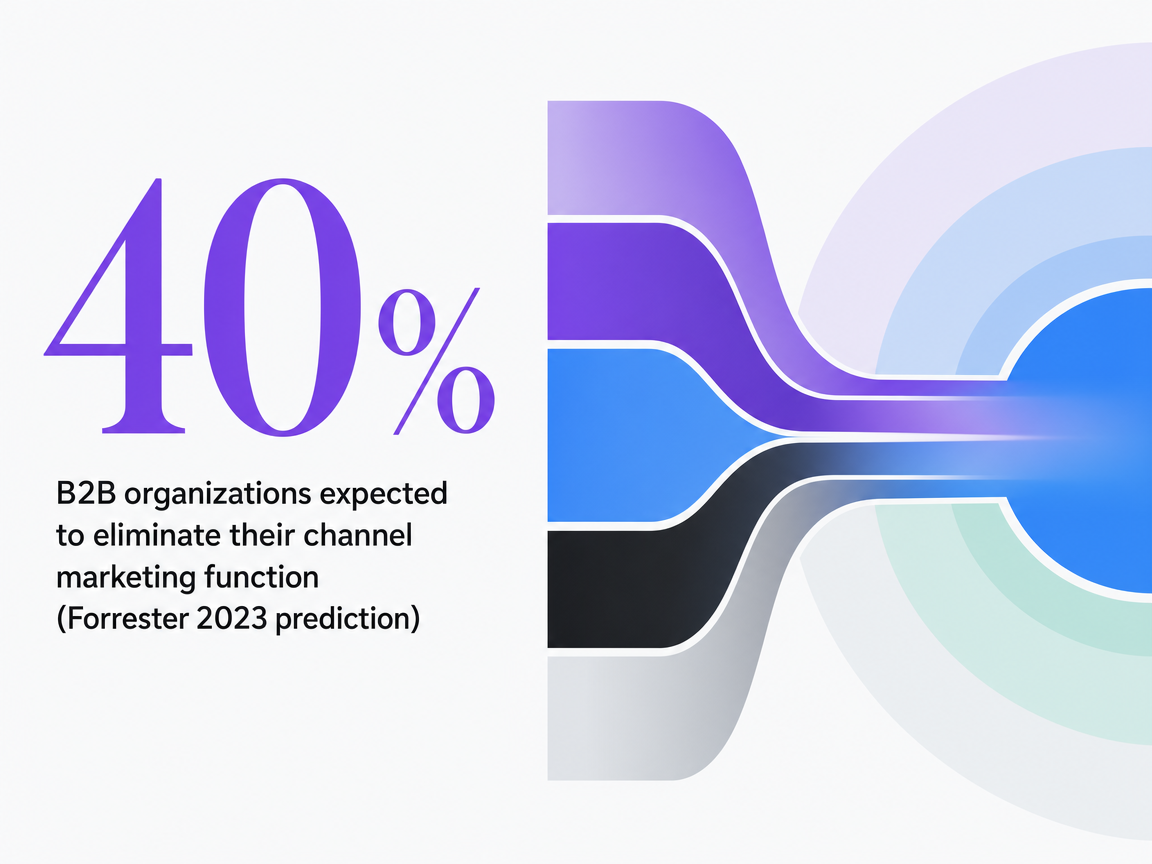 B2B organizations expected to eliminate their channel marketing function (Forrester 2023 prediction)
B2B organizations expected to eliminate their channel marketing function (Forrester 2023 prediction)
A Four-Layer Campaign Architecture for Scalability
Differentiating Strategy, Production, Localization, and Measurement
To significantly increase a strategist's account capacity, agencies must stop treating each campaign as an indivisible unit. A scalable architecture disaggregates campaign planning into four distinct layers, each with a unique owner, cadence, and level of reusability.
The strategy layer defines the buyer, opportunity type, and integrated program design. It is centralized and updated quarterly, aligning with Forrester's recommendation to establish objectives and success definitions before tactical execution 1. One strategist can manage strategy artifacts for numerous accounts because these elements evolve slowly.
The production layer encompasses assets, sequences, and channel outputs. This layer is highly templated and AI-assisted, structured around McKinsey's stages of data, decisioning, design, distribution, and measurement 6. This is where high-volume work occurs and where headcount pressures have historically been most acute.
The localization layer handles market-specific, office-specific, or practice-specific content. Forrester emphasizes that this layer must adhere to the core go-to-market strategy, rather than accommodating ad hoc field requests 3.
The measurement layer operates vertically across the other three, consolidating tactic-level results into comprehensive campaign and program views within a shared hierarchy 9. This separation of layers is crucial for the effective implementation of the campaign schema.
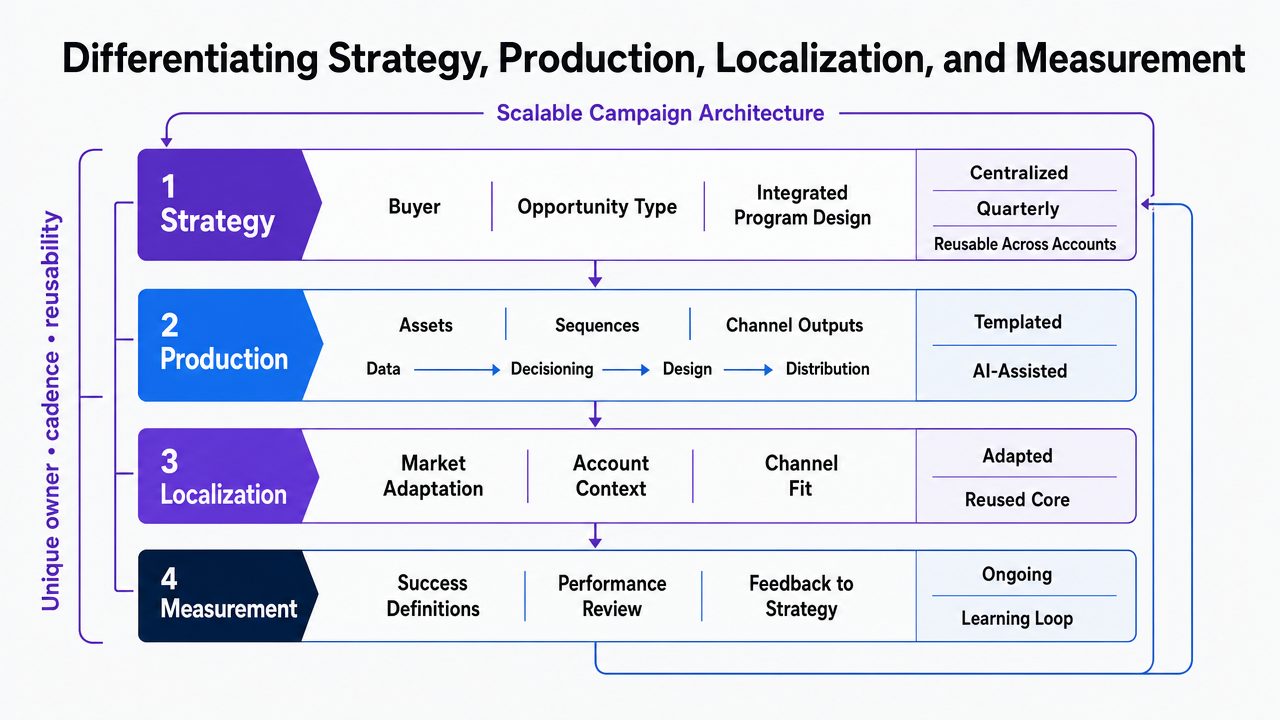 Process infographic visualizing the four-layer campaign architecture described in this section
The Campaign Hierarchy Schema: Program, Campaign, Tactic, Asset
Underpinning the four layers is a strict parent-child hierarchy: Program, Campaign, Tactic, and Asset. Forrester describes this structure as essential for guiding planning, resource allocation, and cross-team communication in complex multi-channel initiatives 11. Without it, agencies often resort to disconnected spreadsheets.
A program is a durable strategic container, linked to a specific buying group, opportunity type, or integrated demand theme that spans multiple quarters. Programs focused on reputation, demand, engagement, and enablement provide the natural framework for the strategy layer 4.
A campaign resides within a program, defined by a specific audience, offer, and time window. Forrester's guidance stresses that campaigns should be built around clear audiences and goals, with structured logistics rather than improvised approaches 9.
A tactic is a single channel expression of a campaign, such as a paid media flight, an email sequence, a content cluster, or a webinar. Tactics are where the bulk of production hours are expended.
An asset is the most granular deliverable: an ad unit, a landing page, a script, or a social media post.
The rollup functionality is as critical as the taxonomy. Forrester asserts that a consistent measurement structure based on a campaign hierarchy is vital for connecting activities to business impact and extracting insights across a portfolio 9. When every asset is linked to its parent tactic, every tactic to its parent campaign, and every campaign to its parent program, a strategist can answer client questions at any level without re-creating reports. This inherent scalability is a key benefit of the architecture.
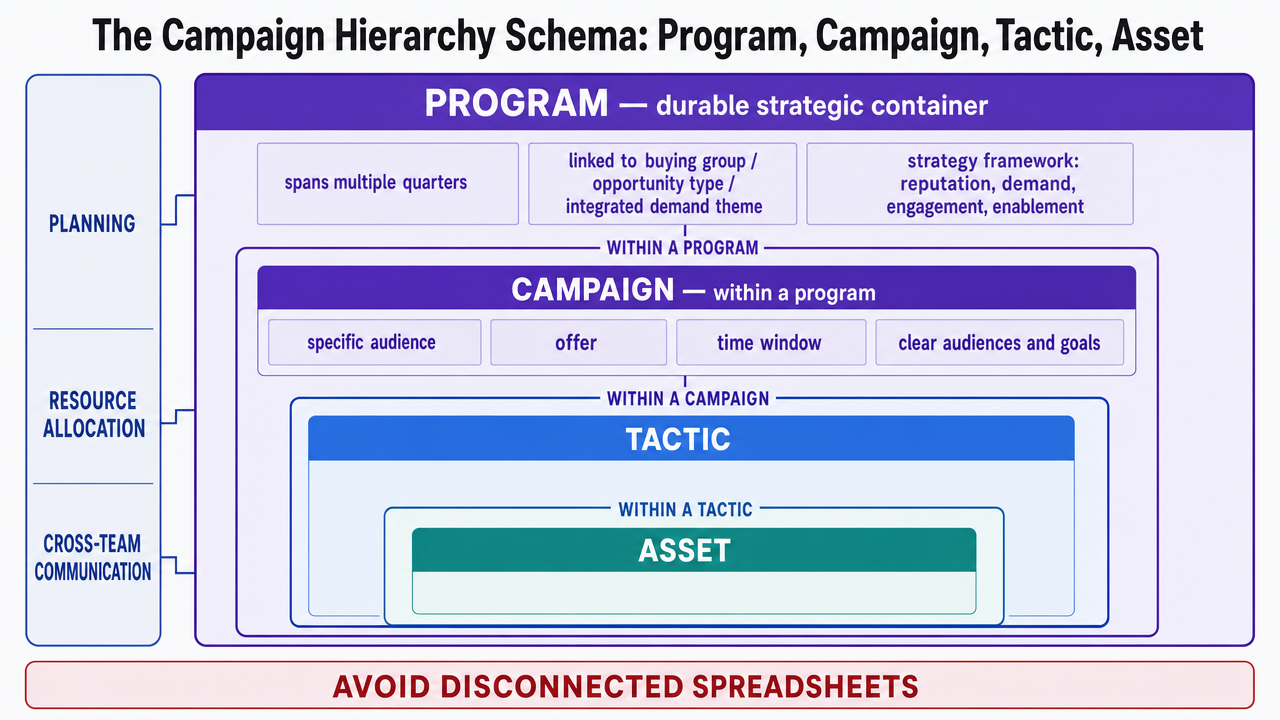 Process infographic showing the parent-child campaign hierarchy explicitly described in this section
The Strategy Layer: Buyer-Centric and Reusable
The strategy layer offers the greatest leverage for agencies, yet it often receives the least disciplined attention. A senior strategist creating a new strategy deck for every campaign is performing production work, not strategic leadership.
This layer comprises a core set of enduring artifacts: the buying group definition, the key opportunity types, the integrated program design, and the "plan-on-a-page" that links objectives to success metrics. Forrester's B2B marketing planning guidance explicitly states that marketers should define objectives first and use a plan-on-a-page to guide initiatives before discussing tactics 1. This artifact serves as the anchor, from which all downstream elements derive.
"Buyer-centric" is paramount. Forrester's planning guide advocates for shifting focus from pure lead generation to opportunity types and buying-group support 3. For an agency, this means the strategy artifact describes a buying group, the opportunity it represents, and the integrated reputation, demand, engagement, and enablement efforts required to influence it 4, rather than simply detailing a "Q2 paid campaign."
Reuse is fundamental to scaling this layer. A buying group definition for a dental support organization, for example, will remain largely consistent across accounts serving similar practices. Opportunity types often recur across law firms with similar service lines, and home services operators in the same trade share many commonalities. One strategist can maintain a library of buying-group templates and opportunity-type patterns, then instantiate them for individual clients instead of rewriting the underlying logic each time.
Cadence is as important as content. Strategy artifacts are updated quarterly, not per campaign, while tactics might update weekly. Confusing these cadences leads to strategists constantly refreshing positioning language for every paid flight, which wastes senior time on tasks that should have been finalized earlier. Locking the strategy layer to a quarterly rhythm frees the production layer to operate at speed.
Test Effective Campaign Planning at Full Scale
Experience streamlined, multi-channel campaign launches using your actual client deliverables during your free trial.
The Production Layer: Approval-Gated AI Execution
Integrating Data, Decisioning, Design, Distribution, and Measurement
Production is often a major drain on agency headcount. It's also where the campaign hierarchy transforms from a theoretical diagram into a practical workflow. McKinsey's framework for personalized marketing at scale outlines five stages: data, decisioning, design, distribution, and measurement 6. Each stage corresponds to a concrete agency artifact that can be templated, AI-assisted, or both.
Data forms the signal layer. For an agency portfolio, this involves aggregating qualified calls, booked appointments, cost per lead, pipeline movement, and content engagement from each client's systems into a unified schema. Without this shared data foundation, effective decisioning is impossible.
Decisioning is the ranking logic that determines what to communicate, to whom, and when, leveraging real-time signals to orchestrate the customer journey 6. Within an agency, decisioning becomes the queue that informs a strategist which account requires a new landing page, which paid flight is underperforming, or which content cluster warrants expansion.
Design constitutes the asset template layer. Ad units, landing pages, email sequences, and content briefs exist as reusable structures with client-specific placeholders. Generative AI populates these slots, and strategists approve the output.
Distribution involves channel routing. The same campaign asset is deployed across paid, organic, email, and social channels via predefined rules, eliminating the need for separate coordination meetings for each deployment.
Measurement completes the loop. McKinsey emphasizes that measurement should be integrated within the production framework, not an afterthought, to enable incrementality testing and standardized metrics for validating outcomes 6. Results roll up through the campaign hierarchy 9, providing sharper signals for the next decisioning cycle. This continuous loop replaces the traditional linear brief-and-handoff process.
The Role of Generative AI in Campaign Production
Generative AI is best utilized within the design and decisioning stages, with human approval required at every publishing point. Deloitte's analysis of the lead-to-quote process indicates that generative AI can enhance personalization, accelerate conversions, and shorten sales cycles when applied to specific use cases like automated content creation, sales collateral generation, and next-best-offer recommendations 7. These are production tasks, not strategic ones.
Governance is critical. Deloitte warns that hallucinations, compliance risks, and brand-voice inconsistencies become significant threats without human oversight 7. For agencies serving regulated industries like law or healthcare, an ungoverned generative pipeline is a liability, not an efficiency gain.
Approval-gated execution addresses this tension. AI drafts landing page variants, ranks paid creative tests, and assembles email sequences. A strategist then reviews, edits, and approves before anything goes live. This shifts the strategist's role from creating first drafts to evaluating fifth drafts, where their senior judgment provides true value. This reallocation of effort allows one strategist to manage more accounts without compromising quality.
The Localization Layer for Multi-Location Clients
Establishing Localization Guardrails
This section is particularly relevant for agencies managing multi-location clients, such as dental support organizations with numerous practices, home services franchises with regional operators, senior living groups with individual community marketing directors, or law firms with office-specific managing partners. The challenge of localization differs from strategy or production and often consumes strategist hours in ways not reflected in project briefs.
A common scenario involves a regional operator requesting a custom landing page for an unapproved promotion, a practice director insisting on their headshot in every ad, or a franchise owner claiming their market is unique and requires bespoke messaging. Individually, these requests seem minor, but collectively, they erode account margins.
Forrester's planning guidance is clear: brands should minimize localization waste by adhering to the core go-to-market strategy instead of treating every field request as a new creative project 3. This translates into establishing localization guardrails. The strategy layer defines what can vary by location (e.g., address, phone, service hours, provider names, pre-approved market-specific offers) and what must remain consistent (e.g., brand voice, campaign architecture, offer structure, measurement definitions). Requests falling within these guardrails are routed to templated production. Those outside are directed to a governed exception queue with a client-side approver, bypassing the strategist's inbox.
This approach transforms field activation into an assembly process, rather than a creative one.
Omnichannel Decisioning vs. Parallel Channel Silos
Localization guardrails are effective only if the underlying channels share a unified decisioning core. Wharton distinguishes between multichannel marketing, which builds separate operations for each platform, and omnichannel marketing, which centers on the customer and coordinates channels from a single view 12. Applying the multichannel model to a multi-location client results in parallel silos for each location and channel. A 40-practice dental group could end up with 40 paid accounts, 40 content calendars, and 40 local social feeds that never reconcile.
McKinsey's omnichannel model replaces these parallel silos with a decisioning engine that interprets signals, prioritizes next actions, and routes execution across channels for each location 5. For an agency, this engine prevents 40 practices from requiring 40 strategists. Location-specific signals feed into a shared engine, which then determines which practices need a new landing page test, reallocated paid budget, or a push for review responses. Assets from the shared template library populate location-specific slots. One strategist oversees this queue, rather than managing 40 parallel plans.
Governance: The Safety Layer for Scaled Planning
Scaling a portfolio without robust governance inevitably leads to faster mistakes. The previous sections intentionally consolidated approval, oversight, and compliance points because governance is not a checklist within each layer, but a separate control plane spanning all four.
Forrester's research on strategic campaign alignment highlights that integrated governance enables organizations to plan, develop, and execute with a focus on overarching marketing goals across reputation, demand, engagement, and enablement programs 10. For an agency, this translates into three key controls:
- A single approval registry that logs every publishing decision, the approver, and the associated strategy artifact.
- Role-scoped permissions that prevent AI-generated drafts from going live until a named strategist signs off, addressing Deloitte's concerns about hallucinations, compliance, and brand-voice drift 7.
- An exception queue for anything outside the localization guardrails, routed to a client-side approver on a fixed cadence, rather than the strategist's inbox.
The primary benefit is auditability. If a regulator, legal counsel, or client CMO questions a specific ad in a particular market, the answer is a linked record, not a frantic search through Slack. This audit trail makes the architecture defensible at scale, beyond just its efficiency.
Reduce Campaign Planning Overhead Without Compromising Output
Connect with our team to see how leading agencies are automating cross-channel campaign execution while maintaining full oversight and client alignment—measurably improving delivery speed and margins at scale.
Operator Economics: Strategist Account Capacity
This architecture is only valuable if it fundamentally alters the number of accounts a strategist can manage. The factors determining account load—hours spent per campaign in production, hours spent per location on localization, and the number of approval touchpoints—remain constant across agencies. The operating model, however, dictates the coefficient for each.
No specific dollar benchmarks are provided here, as they were not in the source research. The table below uses ranges that readers should customize with internal data from timesheets, project systems, and margin reports.
| Operating model | Accounts per strategist | Production hours per campaign | Localization overhead per location | Approval touchpoints per publish |
|---|---|---|---|---|
| Traditional brief-and-handoff | 3–4 | High (bespoke briefs, sequential handoffs) | High (ad hoc field requests) | Many (channel-by-channel) |
| Templated production | 5–8 | Medium (asset templates, shared briefs) | Medium (partial guardrails) | Fewer (batched review) |
| Approval-gated AI execution | 10–15 | Low (AI drafts, strategist edits) | Low (localization guardrails, exception queue) | One per publish gate |
These ranges compound. Forrester's guidance on campaign implementation links throughput gains to structured logistics and hierarchy-based measurement, rather than simply increased effort 9. When production hours decrease due to templated assets, and localization overhead is reduced by routing field requests away from strategists, their calendars free up for higher-value judgment work. This is the source of the increased account-load capacity. Agencies should plug in their own real hours per campaign and per location to recalculate their specific ceiling.
Measurement Rollup and the Plan-on-a-Page Loop
Measurement is the ultimate test of this architecture's effectiveness. If the hierarchy is properly implemented, results should roll up seamlessly from asset to tactic, campaign, and program, allowing a single report to answer client questions at any level. If the hierarchy is merely superficial, strategists will find themselves rebuilding reports monthly.
Forrester emphasizes that a consistent measurement structure, built on a campaign hierarchy, is essential for linking activities to business impact and extracting insights across a portfolio 9. This capability closes the loop: tactic-level performance informs campaign-level analysis, which in turn feeds program-level judgments about reputation, demand, engagement, and enablement efforts 4. These program-level insights then inform the next revision of the plan-on-a-page.
The plan-on-a-page is a dynamic artifact, not static. Forrester's planning guidance positions it as the anchor for objectives, priorities, and success definitions 1. Each quarter, the measurement rollup updates the underlying assumptions. Opportunity types that generated pipeline are retained, while unresponsive buying groups are retired or redefined. The strategy layer evolves based on data from the measurement layer, not solely on recent client requests.
McKinsey explicitly states that measurement should be integrated within the personalization framework, not an add-on, incorporating incrementality testing and standardized metrics to validate actual outcomes 6. For an agency portfolio, this discipline distinguishes between merely reporting activity and reporting tangible results. The loop flows in one direction: the hierarchy captures signals, these signals update the plan, and the updated plan directs the subsequent production cycle.
Implementing the Architecture: A 90-Day Rebuild
Adopting a four-layer architecture is not an overnight process. A realistic timeframe for an agency to transition from bespoke briefs to a shared hierarchy, without interrupting client delivery, is 90 days.
- Days 1-30: Strategy Layer. The senior team defines two or three recurring buying groups and opportunity types across the portfolio. They then draft the "plan-on-a-page" templates, which align with Forrester's planning guidance 1. Program-level containers are established for reputation, demand, engagement, and enablement work 4. During this phase, client-facing production remains unchanged.
- Days 31-60: Production Layer. Asset templates, decisioning rules, and channel routing are integrated with the campaign hierarchy 11, and approval gates are implemented before any publishing point 7. One pilot account begins operating under the new architecture, while others continue with legacy workflows.
- Days 61-90: Rollout and Refinement. The pilot is extended across the portfolio, and the measurement rollup system is activated 9. Localization guardrails are implemented for multi-location accounts 3. By day 90, the strategist's calendar should reflect the increased account capacity enabled by the new architecture.
Frequently Asked Questions
References
- 1.B2B Marketing Planning.
- 2.Predictions 2023: B2B Firms Up Their Focus On Customer Needs.
- 3.Planning Guide 2023: B2B Marketing Executives.
- 4.How To Elevate Your B2B Marketing Program.
- 5.What is omnichannel marketing?.
- 6.The next frontier of personalized marketing.
- 7.Generative AI in Marketing and Sales.
- 8.The Future of Advertising: Four Scenarios.
- 9.Is Your Marketing Campaign Impactful, Manageable, And Measurable?.
- 10.Unlocking Go-To-Market Momentum Through Strategic Campaign Alignment.
- 11.Use The Campaign Hierarchy To Design Your Campaign Architecture And Guide Planning.
- 12.What Is Omnichannel Marketing?.