
Key Takeaways
- A content calendar is an editorial operating system that handles planning, coordination, governance, prioritization, measurement, and institutional memory rather than simply tracking publish dates and titles.
- The distinction between a basic publishing schedule and a governance surface lies in fields like persona, KPI, review steps, and post-publication results embedded directly alongside each item.
- Treating the calendar as a decision pipeline across seven stages, and tracking decisions-per-week instead of posts shipped, reveals bottlenecks and true editorial throughput.
- For multi-location or portfolio teams, a shared governance calendar routes work across location, channel, and approval owner, with duplication rate serving as the measurable coordination health metric.
Six Core Functions of a Content Calendar
A content calendar serves multiple critical functions beyond simply tracking dates. Effective calendars act as an operating system for editorial teams, handling six key areas simultaneously. In-house managers often find their calendars are missing several of these functions, leading to busy but unproductive publishing efforts.
The first function is planning: this involves mapping topics, formats, and publishing rhythms across various channels like blogs, social media, email, and campaigns well in advance 3. The second is coordination, which clarifies tasks, assigns responsibilities, and sets deadlines to prevent conflicts among writers, designers, and reviewers 2. The third is governance: the calendar acts as an editorial control surface, integrating owners, review steps, target personas, and documented strategy directly alongside the content itself 4. Tendo Communications emphasizes this, calling the calendar
"an essential governance tool"
for timely execution of content strategy 1.
The fourth function is prioritization. A robust calendar necessitates making trade-offs, deciding which topics to develop, defer, or eliminate, given finite resources and competing campaigns 9. The fifth is measurement: calendar entries include Key Performance Indicators (KPIs) and are evaluated post-publication against metrics like traffic, leads, and conversion data, informing future planning cycles 11. The sixth is institutional memory: the calendar records publishing history, ownership, performance successes, and failures, allowing decisions to build upon previous insights rather than restarting each quarter 7.
Calendars that only manage one or two of these functions typically operate as mere posting queues. Those that integrate all six transform into a comprehensive operating system for the editorial process.
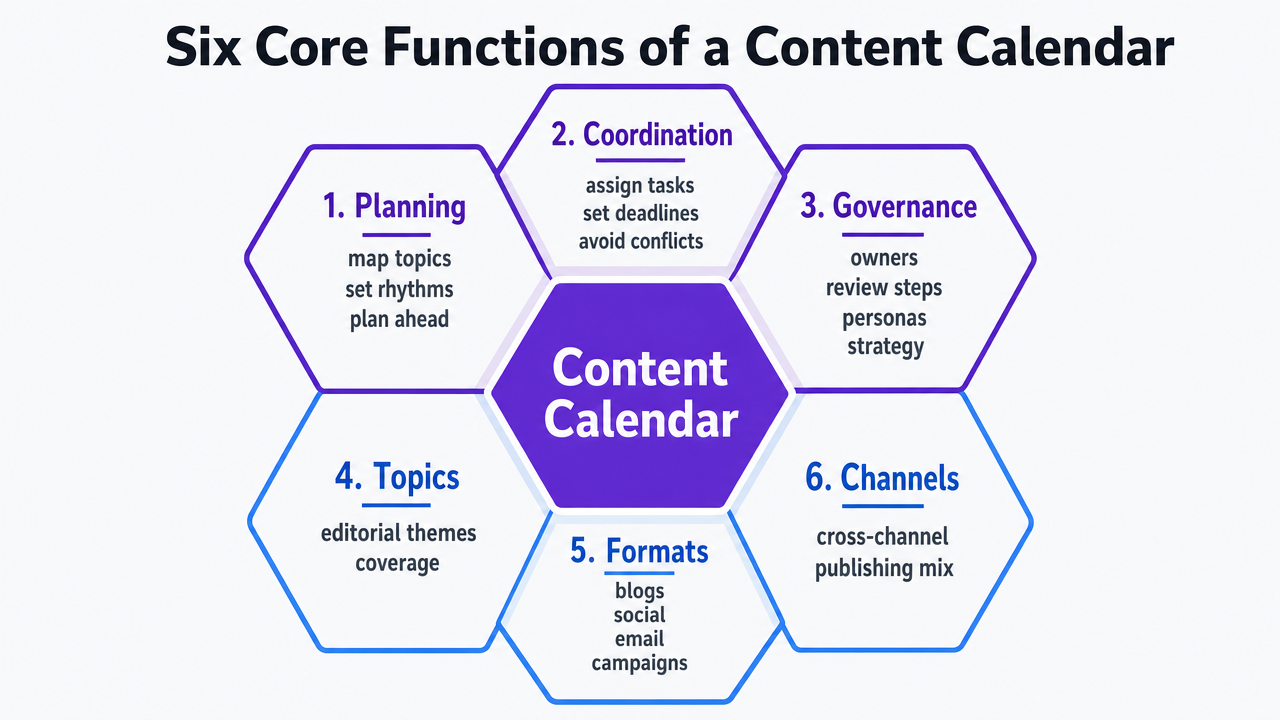 Visualize the six core functions listed in the section as a hexagonal framework, directly matching the six named functions in the prose
Publishing Schedule vs. Governance Surface
Limitations of a Basic Publishing Schedule
A basic publishing schedule primarily tracks three elements: dates, post titles, and channels. Its scope is limited to answering when and where content goes live, without addressing the why, for whom, or against what benchmarks. Teams relying solely on a schedule might know their next twenty posts but struggle to articulate which persona each serves or which KPI it aims to impact.
In contrast, a governance calendar offers a richer dataset. NYT Licensing's guidance describes it as a visual workflow that plans strategy across daily, weekly, and monthly horizons, incorporating due dates, responsible owners, review steps, personas, KPIs, and documented strategy within the same artifact 4. This comprehensive approach ensures that strategic questions are addressed proactively.
The distinction is fundamental. A schedule merely reports intent, while a governance surface embeds the decisions that validate that intent. When a calendar only contains publish dates and titles, every strategic query (e.g., "Is this the right topic?", "Who approves it?", "What defines success?") must be re-debated in separate communications. By integrating these fields into the calendar, such questions are resolved before content creation begins.
To assess this gap, simply count the fields in your current calendar beyond date, title, and channel. Fewer than five indicates a team is operating with a basic schedule rather than a governance tool.
Essential Governance Fields Often Overlooked
Even calendars that move beyond basic schedules often fall short by omitting crucial governance fields. While owner and due date are common additions, fields like persona, KPI, review status, and post-publication performance data are frequently missing. Each omission represents a strategic decision deferred to ad-hoc conversations instead of being formally recorded.
Persona. : Without a persona field linked to each content item, topic selection can become arbitrary, often driven by the most vocal stakeholder. NYT Licensing's guidance emphasizes persona, alongside KPI and documented strategy, as core calendar elements, not optional metadata 4.
KPI or target metric. : Content without a defined success metric cannot be evaluated effectively. This becomes problematic during quarterly reviews when the impact of published content is unclear. Pepperland's ROI framework advocates for integrating target metrics directly into the editorial calendar, linking content plans to traffic, leads, and revenue outcomes, rather than tracking them separately 11.
Review steps and approval owners. : A dedicated review column that specifies who needs to sign off (e.g., legal, subject-matter expert, brand team) makes potential bottlenecks visible. Without it, drafts can accumulate in shared drives, awaiting notification to unassigned reviewers.
Post-publication performance. : A complete governance calendar closes the feedback loop by recording performance data directly back into the original entry. Camphouse's campaign calendar guidance highlights regular reviews and adjustments based on performance as integral to the calendar's function 8.
Teams that incorporate these four fields often discover that their perceived capacity was overestimated, as the calendar reveals hidden rework, unclear ownership, and unmeasured content.
The Decision Pipeline Processed by a Calendar
Seven Stages of Editorial Flow: From Idea to Measurement
When viewed functionally, a content calendar transforms from a static grid into a dynamic pipeline. Every item entering the calendar progresses through seven distinct stages before becoming a measured asset:
- Idea generation determines what enters the queue.
- Research assesses the topic's substance and search demand to justify development.
- Creation defines the format, angle, and length.
- Editing ensures brand and accuracy standards are met, or sends the draft back for revisions.
- Scheduling dictates the sequence and channel fit.
- Promotion outlines how the content will be distributed post-publication.
- Performance tracking evaluates whether the content continues to engage or requires retirement, refreshment, or replication 7.
The calendar's primary role is to visualize this pipeline, highlighting items stuck at specific stages and identifying potential bottlenecks in ownership. Each stage represents a critical decision point, not just a task.
Framing these as decisions rather than checkboxes alters the calendar's data capture. Instead of a single "status" field, advanced calendars include stage-level metadata: current owner, entry date into the stage, and exit criteria. sem-wizard's workflow guidance emphasizes the calendar as a dynamic document that adapts to business needs, implying the pipeline itself is the core artifact, not just the schedule 7.
Once the pipeline is transparent, bottlenecks become evident. Editing backlogs, unassigned research, or promotional gaps appear as quantifiable queue lengths at specific stages, replacing vague complaints about "velocity."
![Visualize the seven-stage editorial pipeline cited from sem-wizard [ref_7], matching the exact stages named in the section](https://res.cloudinary.com/dyvtnnynh/image/upload/v1782882039/content_images/vectoron_ai/content_calendar/kcspk9ridecfc2p862ec.png) Visualize the seven-stage editorial pipeline cited from sem-wizard [ref_7], matching the exact stages named in the section
Visualize the seven-stage editorial pipeline cited from sem-wizard [ref_7], matching the exact stages named in the section
Decisions-Per-Week: A Superior Velocity Metric
Many editorial teams gauge velocity by the number of posts published, a metric that often inflates perceived productivity and obscures the actual work involved. A team publishing four posts weekly might be processing forty editorial decisions—including approvals, kill/keep choices, format adjustments, and promotion sequencing—or as few as twelve. This disparity means two teams with identical post counts can have vastly different throughputs when the underlying decisions are considered.
Measuring decisions-per-week reorients the calendar's optimization focus. An idea killed after keyword research is a decision. A draft returned for a second edit is a decision. A published piece flagged for refresh six weeks later is also a decision. Each action moves an item forward, backward, or out of the pipeline.
Counting these decisions quickly reveals two common patterns:
- Teams with high post counts but low decision counts often publish content with minimal filtering, indicating the calendar acts as a conveyor belt rather than a strategic filter.
- Conversely, teams with low post counts but high decision counts may be caught in review loops, with content cycling through editing multiple times.
Neither scenario is healthy, and neither is visible when only "posts shipped" is tracked.
A practical step is to integrate a weekly decision log into the calendar. Track entries into research, content kills, returned edits, publishes, and post-publication actions. Monitor the ratio of decisions to publishes. Teams using governance calendars, like those described by NYT Licensing—which include owners, KPIs, and review steps—can generate this metric directly from the calendar, eliminating the need for a separate tracking system 4.
Test a Live Content Calendar Workflow Now
Experience streamlined content scheduling and approval using your actual campaigns, risk-free for seven days.
Balancing Rigidity and Responsiveness in Planning
A common debate in editorial operations centers on how far in advance to build the content calendar. Some teams plan quarterly, locking topics, owners, and campaign tie-ins eight to twelve weeks ahead. Others maintain a flexible calendar beyond two weeks, arguing that overly prescriptive plans quickly become irrelevant due to trends, product releases, or algorithm changes. Both approaches have merits, and sem-wizard's workflow guidance suggests a middle ground, viewing the calendar as a dynamic document that evolves with business needs rather than being static 7.
A practical solution involves dividing the planning horizon into three zones:
- The fixed zone covers the next two to three weeks, where every item has an owner, brief, KPI, and publish slot, with strict entry criteria.
- The committed zone spans weeks four through eight, with topics and owners set, but flexibility for formats, angles, and promotion plans.
- The directional zone extends beyond week nine, anchoring campaign milestones, product launches, and seasonal events, with individual content pieces as placeholders.
Camphouse's campaign calendar guidance supports this layered planning, emphasizing regular review and adjustment of details rather than treating the schedule as immutable 8.
This three-zone structure resolves the tension between long-term strategy and short-term agility. Long-range planning accommodates campaign anchors, seasonal demand, and product integrations requiring lead time. Short-range flexibility allows for rapid responses to trends, competitor actions, and performance signals from recent publications. Teams that consolidate all planning into a single horizon, whether entirely rigid or entirely loose, inevitably face inefficiencies.
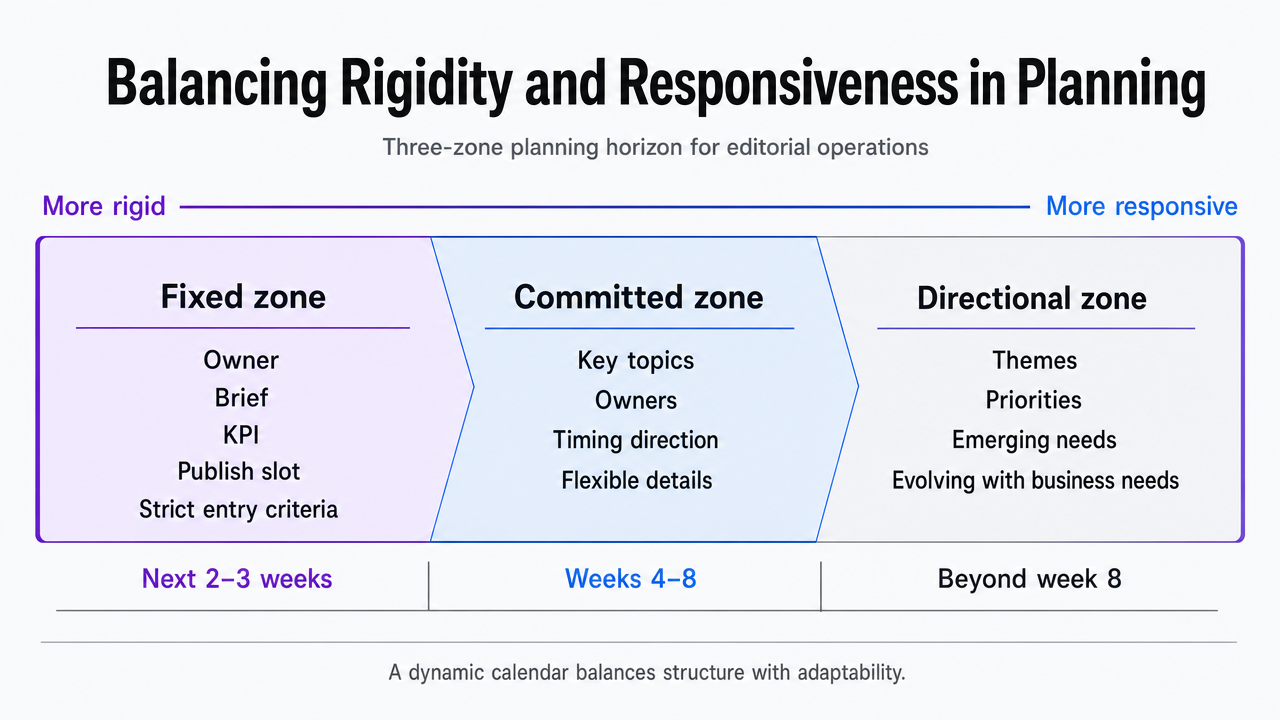 Visualize the three-zone planning horizon framework described in the section (fixed, committed, directional zones)
Integrating Performance Data with the Calendar
Connecting Content to Traffic, Leads, and Conversions
A calendar focused solely on publish dates cannot answer the critical question from leadership: which content drives measurable results? Pepperland's ROI framework positions the editorial calendar as the central tool for this analysis, advocating for content plans to be directly linked to their intended metrics—traffic, leads, and the associated revenue calculations 11. By including a target metric field for each calendar entry, quarterly reviews shift from retrospective storytelling to an objective assessment of planned versus actual outcomes.
Higher education institutions face similar measurement challenges. Carnegie's guidance for university content teams identifies website traffic, engagement, lead conversion, enrollment rates, and brand metrics as key outcomes that content plans should support 12. While specific metrics vary by industry (e.g., enrollment for universities, consultations for law firms), the principle remains consistent: the calendar is where topic-level intent is tied to a measurable outcome before publication.
In-house managers can transform their calendar into a source of truth for content ROI discussions by adding two fields to each row: "target metric" and "post-publication result." This eliminates the need to export performance questions to separate analytics reports.
Cadence and Audience Expectations
Cadence is another performance driver controlled by the calendar, influencing engagement independently of individual post quality. Consistent posting schedules build audience anticipation, increasing engagement with existing content 13. The calendar ensures cadence is a deliberate strategy, not an accident. It formalizes commitments, such as Tuesday and Thursday blog posts, a Monday newsletter, and daily social updates, making any deviation immediately visible.
Consistency is distinct from volume. A calendar can more effectively enforce a modest, reliable cadence than an overly ambitious one that frequently misses targets. The crucial metric is the ratio of planned to actual publishes over a rolling eight-week period. Teams tracking this ratio within the calendar itself tend to restore cadence more quickly after disruptions compared to those relying on memory.
Managing Content Across Multiple Locations, Brands, or Portfolios
The Calendar as a Cross-Location Coordination Layer
While much of this discussion assumes a single editorial team for one brand, this section addresses in-house managers overseeing content across multiple locations, regional brands, or portfolio properties. Examples include dental groups with numerous practices, law firms with regional offices, senior living operators managing community-specific pages, or home services franchisors coordinating local pages with a national brand.
At this scale, the calendar evolves beyond a simple topic list to become a routing layer. Camphouse's campaign calendar guidance already reflects this, describing the calendar as a unified view that integrates multiple platforms (social, email, content) and outlines timelines from conceptualization to post-launch analysis for coordinated teams 8. eMarketing Platform's marketing calendar model extends this logic to the enterprise, framing it as a centralized, visual roadmap for plotting marketing activities across the portfolio, building campaigns around shared key dates, and regularly reviewing performance 6.
For multi-location operators, a single governance calendar routes decisions across three dimensions:
- Location (or brand)
- Channel (blog, social, email, paid campaign)
- Approval owner (regional marketing lead, brand compliance, legal)
Each row specifies its target location, publishing channel, and required sign-off. This approach makes content duplication across locations visible, rather than accidental. Shared-topic content, such as national blog articles or brand campaigns, can be created once and localized, avoiding redundant efforts by each office.
Decision-Throughput for Multi-Location Economics
Quantifying multi-location calendar work in terms of decision throughput offers a more concrete measure than speculative dollar figures. Each location generates a weekly stream of editorial decisions—topic proposals, local event tie-ins, promotion timing, approval requests. The key question is whether these decisions are processed once within a shared calendar or repeatedly in parallel across locations that operate in silos.
The variables driving this efficiency are quantifiable without external benchmarks and can be extracted from an existing calendar:
| Variable | What it measures | Where it lives in the calendar |
|---|---|---|
| Locations (L) | Number of offices, practices, or brand units publishing content | Location tag on each row |
| Decisions per location per week (D) | Entries into research, kills, edits returned, publishes, refresh flags | Weekly decision log per location |
| Shared-topic rate (S) | Percent of decisions covering topics applicable to more than one location | Topic tag matched across location rows |
| Review cycles (R) | Average approval passes before publish, by location | Review-status field with timestamps |
| Duplication rate (Dup) | Percent of shared-topic decisions processed independently rather than reused | Cross-reference between location rows on the same topic |
The throughput calculation: total weekly decisions equal L × D. However, decisions that could be consolidated equal L × D × S × Dup. The last term, Dup, is what a shared governance calendar aims to reduce. Camphouse's recommendation to integrate multiple platforms into a single view with regular reviews and adjustments directly targets a lower Dup rate, ensuring shared topics are adapted rather than reinvented 8. Similarly, eMarketing Platform's centralized-roadmap logic consolidates planning work by building campaigns around shared key dates across the portfolio 6.
For portfolio managers, the impact is measurable without complex spreadsheets. Track the Dup rate weekly. A shared calendar that reduces this rate from 60% to 15% is effectively coordinating. If it remains above 50%, the calendar functions as a collection of separate location tabs, not a unified governance layer.
See How Centralized Content Calendars Streamline Multi-Channel Execution
Connect with our team to explore data-driven workflows that reduce manual coordination, accelerate approvals, and keep all marketing assets aligned without expanding your content team.
Tool Selection: Spreadsheets, Platforms, or Hybrid Approaches
The choice of content calendar tools often divides editorial teams as much as planning horizons. Michigan State University's communications guidance offers a pragmatic view: shared Outlook or Google calendars and spreadsheets can effectively manage editorial workloads for many teams, emphasizing that specialized paid platforms are not a prerequisite for a living document approach 14. This perspective separates governance maturity from software expenditure. A spreadsheet with columns for owner, persona, KPI, review status, and post-publication results can provide more robust governance than a premium platform used merely as a publishing queue.
The practical differentiator is decision volume, not team size. A single-brand team processing forty to sixty editorial decisions weekly can manage governance effectively with a well-structured spreadsheet. However, when decisions span multiple channels with diverse approval owners—such as legal review for one item, brand review for another, and regional sign-off for a third—spreadsheet cell comments become unscalable, and dedicated platforms begin to justify their cost. Camphouse's guidance on integrating social, email, and content into a single calendar view directly addresses this level of coordination complexity 8.
Most mature teams adopt a hybrid approach. A dedicated platform serves as the pipeline of record, tracking stage, owner, KPI, and performance data. Concurrently, a lightweight shared calendar provides a two-week overview for stakeholders who don't regularly interact with the primary tool. A common pitfall is when the platform becomes an unused inbox, with critical decisions still occurring in a separate spreadsheet. In such cases, the spreadsheet, not the platform, is the de facto governance layer.
Future Connections for Modern Calendars
While the calendar acts as a governance layer, it is not the final one. Once owners, KPIs, personas, and review steps are integrated into a single artifact, the next logical step is to connect it with systems that can interpret and act on this information. Analytics is a primary connection: performance data should flow back into the original calendar entry, enabling refresh or retirement decisions to be made from the same interface where the topic was initially planned 11. Persona and audience research form another link: calendars with persona fields can serve as routing logic, directing specific content to relevant audience segments 4. Approval workflows represent a third connection, transforming the review-step column from a mere note into an actionable queue for designated owners.
Beyond the calendar lies orchestration: a unified system where strategy, production, and publishing operate through a single approval loop, rather than disparate tools. Vectoron's Command Center exemplifies this by routing ranked recommendations through a single approval surface before any content is deployed. The calendar remains the foundational record, but the orchestration layer translates its decisions into executed work, enabling scaling without increasing headcount.
Frequently Asked Questions
References
- 1.Content Calendar - Tendo Communications.
- 2.Content Calendar: Definition, Examples, and Applications.
- 3.What Is a Content Calendar? Free Template, Examples & Planning Tips.
- 4.Designing Your Content Marketing Editorial Calendar for Success.
- 5.How Using a Content Calendar Makes Your Social Content Better.
- 6.A Guide to Building a High-Impact Marketing Calendar.
- 7.How to Build a Content Calendar That Boosts Your Marketing Success.
- 8.A Guide to Building a Marketing Campaign Calendar.
- 9.The Benefits Of Using A Content Calendar For Your Marketing Strategy.
- 10.Your Step-by-Step Guide to Social Media Strategy and Content Calendars.
- 11.Content Marketing ROI: How to Track Your Blog's Performance.
- 12.Content Marketing ROI for Universities.
- 13.Boosting Your Engagement: Social Media Tips That Work.
- 14.Editorial Calendars.