
Key Takeaways
- Content velocity is capped by handoff friction, not headcount; adding writers multiplies drafts while briefs, reviews, and approvals remain the actual queues that stall publication.
- A durable content operating model rests on five interdependent building blocks—strategy, people, process, infrastructure, and measurement—and weakness in any one shifts cost downstream rather than eliminating it 2.
- Compress coordination overhead with AI orchestration across intake, briefing, versioning, and publishing mechanics, but keep strategic review and final approval human-owned to protect judgment and accountability 8.
- Redesign in sequence: standardize the brief, instrument approval cycle time, then route repeatable production work to orchestration—so the publishing calendar keeps running while the underlying system improves.
Why Handoff Friction, Not Headcount, Caps Content Velocity
Most content teams interpret velocity problems as staffing issues. Publishing calendars slip, SEO backlogs grow, and the immediate solution seems to be adding writers or freelancers. However, new writers primarily add drafts, and drafts are not the bottleneck. The real constraint is the number of handoffs a piece of content undergoes before publication.
Forrester's research on content operations highlights that many organizations lack essential infrastructure for planning, calendaring, workflow, distribution, asset management, and analytics 2. This deficiency necessitates manual coordination at every stage, turning each missing connection into a handoff, and each handoff into a queue. Writers wait for briefs, briefs wait for strategy, drafts wait for legal, and approved content waits for publishing. The work stalls not due to a lack of talent, but because the operational model funnels every decision through human intervention.
McKinsey describes this pattern in operational terms: scalable workflows effectively separate manual tasks from automated ones and integrate cross-team collaboration directly into the process 8. Teams that fail to make this distinction encounter a ceiling where output increases linearly with headcount, while quality declines disproportionately with volume.
The following sections detail an operating model designed to eliminate these queues.
What a Content Operating Model Actually Is
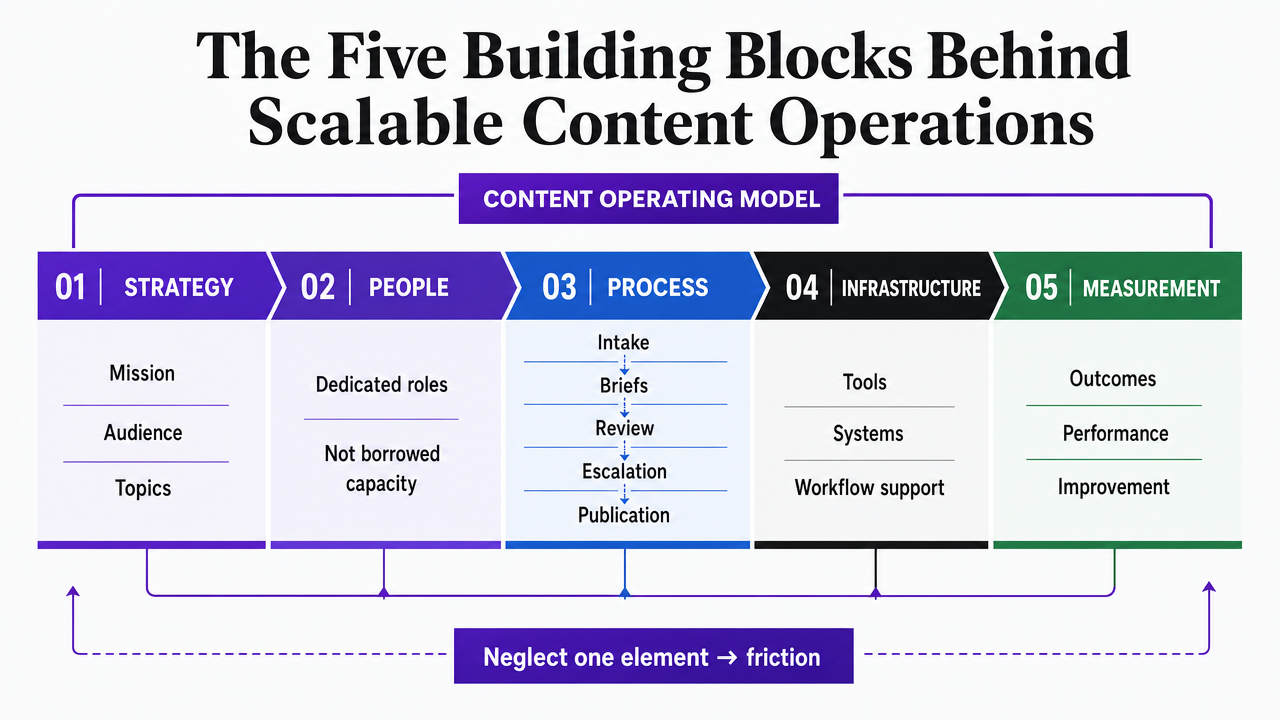
The Five Building Blocks Behind Scalable Content Operations
A content operating model serves as the framework that transforms individual editorial efforts into consistent, repeatable output. Forrester identifies five core components: strategy, people, process, infrastructure, and measurement 2. Each component represents a deliberate design choice, not merely a hiring decision. Teams that neglect any of these elements inevitably face friction, which they might later attribute to capacity issues.
- Strategy — Strategy defines the editorial mission, target audience segments, and specific topics to be covered.
- People — The "people" aspect involves assigning dedicated roles rather than relying on borrowed capacity from other departments.
- Process — Process outlines the journey of a topic from conception to publication, including intake forms, brief templates, review sequences, and escalation procedures.
- Infrastructure — Infrastructure encompasses the tools that automate coordination, such as calendaring, workflow routing, digital asset management, distribution platforms, and analytics.
- Measurement — Measurement completes the cycle by establishing quantifiable metrics for quality, throughput, and impact.
Forrester's findings indicate that many organizations lack critical infrastructure for planning, calendaring, workflow, distribution, asset management, and analytics 2. When any of these five building blocks is weak, other areas compensate through meetings, spreadsheets, and informal communication. For instance, a poorly designed brief template forces senior editors to rewrite drafts, a missing asset library compels writers to recreate existing content, and vague measurement leads to debates over prioritization.
These building blocks are interdependent; neglecting one does not save time but merely shifts the cost to a subsequent stage.
Operations, Not Tools: McKinsey's Definition of Marketing Operations at Scale
New tools rarely resolve issues stemming from a flawed operating model; they often just automate inefficient steps faster. McKinsey's definition of digital marketing operations extends beyond mere software, encompassing the capabilities, processes, structures, and technologies that enable a team to cost-effectively scale targeting, personalization, and optimization across various digital channels 6. Tools are thus one of four key inputs.
For content managers, this implies that a new CMS, AI writing application, or project tracker alone will not boost output. McKinsey's recommendations emphasize centers of excellence, standardized processes, and the automation of repetitive tasks that currently consume human hours 6. Standardization is paramount because automation can only streamline what has already been clearly defined. A brief template that varies by writer cannot be automated, nor can a review sequence that changes with each stakeholder. Forrester's related work on lifecycle-aligned operations reinforces this point: planning, production, promotion, and performance must function as a cohesive flow, not as isolated stages 4.
Therefore, scaling content is fundamentally an operations challenge before it becomes a technology challenge.
A Maturity Diagnostic for the Content Engine
Before redesigning a content flow, teams must accurately assess its current weaknesses. Forrester's Content Engine Maturity Model provides a useful framework: evaluate operations across planning, creation, activation, and measurement, scoring each phase on quality, scale, efficiency, utilization, and impact 3. The individual scores are less important than the overall pattern they reveal.
Forrester's research among B2B organizations found that fewer than 35% consider themselves advanced in all phases of the content lifecycle 3. This figure, specific to self-reported B2B content operations, highlights a gap in the connective tissue. Most teams excel in one or two phases but improvise the rest, leading to inconsistent output despite strong individual pieces.
A practical diagnostic involves asking four questions per phase:
- Planning: Is topic selection linked to a documented audience and pipeline model, or driven by meeting requests?
- Creation: Is the brief sufficiently detailed for a competent writer to draft without a kickoff call?
- Activation: Does distribution begin on publish day with a pre-built channel plan, or is it determined afterward?
- Measurement: Can the team identify the top ten performing pieces from the last quarter and explain their success?
Teams that can answer cleanly for three or four phases typically face a scale problem. Those that can only answer for one or two phases have a design problem. These require distinct solutions, and misdiagnosing the latter as the former is a common reason for redesign failures.
Test a Scalable Content Workflow in Real Time
Experience measurable output gains using your live campaigns and actual production needs for seven days.
The Seven-Stage Flow: Intake to Measure
Intake and Brief: Where Strategy Gets Encoded
Intake is often an underinvested stage, leading to problems in later stages. When requests arrive via informal channels like Slack or meeting notes, the strategic context that should guide the content remains uncaptured. This forces every subsequent reviewer to re-litigate decisions that should have been finalized before a writer even began drafting.
An effective intake form captures the target audience segment, the pipeline stage the content supports, the primary keyword or query cluster, the internal expert to be consulted, the distribution channels, and the success metrics to be checked at 30 and 90 days. Forrester's operations research emphasizes that planning, calendaring, and workflow infrastructure are frequently missing in content organizations, leading to manual coordination at every subsequent stage 2.
The brief translates the intake information into actionable direction. A brief that enables a competent writer to proceed without a kickoff call includes the angle, required evidence sources, structural outline, tone reference, and relevant internal links. McKinsey's guidance on decomposing marketing workflows applies here: detailing granular activities within ideation and content production makes each task assignable, whether to a person or an AI agent 1. A vague brief cannot be efficiently assigned to either.
Draft, Review, and Approve: The Governance Layer
Drafting is the most visible stage but the least indicative of overall throughput. A team could double its drafting speed yet publish at the same rate if review and approval processes are disorganized. The governance layer, not the drafting itself, dictates the pace.
Effective review separates three distinct concerns often combined into a single pass:
- Editorial review focuses on structure, argument, and voice.
- Subject-matter review verifies factual accuracy with internal experts.
- Compliance or brand review checks claims, disclaimers, and category positioning.
When these three reviews occur sequentially with clear entry criteria, each reviewer receives a draft that is already refined on previous dimensions. When they run in parallel without sequencing, reviewers may contradict each other, leaving the writer to resolve conflicts.
Approval is where governance either strengthens or breaks down. Forrester's insights on AI-scaled production highlight that generic content is now abundant, requiring operating models to demonstrate expertise and credibility for differentiation, which places greater importance on the approval gate 5. A named approver per content type, a defined turnaround window, and a fallback approver for absences are crucial design decisions to prevent this gate from becoming a bottleneck.
The purpose of the governance layer is not to slow down work, but to make inefficiencies visible so they can be addressed. An eight-day review cycle is a design problem; an invisibly eight-day review cycle is a cultural one.
Publish, Distribute, and Measure: Closing the Loop
Publishing is a mechanical step that consumes a disproportionate amount of senior time when not standardized. Tasks like formatting, metadata entry, image sizing, schema markup, and internal link insertion are repeatable with defined inputs and outputs. McKinsey's operating model research asserts that workflows scale only when manual work is clearly separated from automated tasks, allowing mechanical work to be orchestrated and judgment-based work to be protected 8. Content operations that neglect this segmentation force editors to perform formatting instead of editing.
Distribution should commence on publish day, not afterward. A pre-built channel plan, attached to the brief, specifies which content pieces are syndicated to email, adapted for social media, used for sales enablement, or integrated into paid campaigns. Forrester's planning framework treats promotion and performance as integral to production, connecting all four into a single flow rather than sequential functions 4. Teams that view distribution as an afterthought often publish into obscurity.
Measurement completes the loop by informing the next intake cycle. Publishing without measurement is merely production; measurement without a feedback mechanism into planning is just reporting. The seven stages truly form an operating model only when the data from stage seven influences decisions made in stage one.
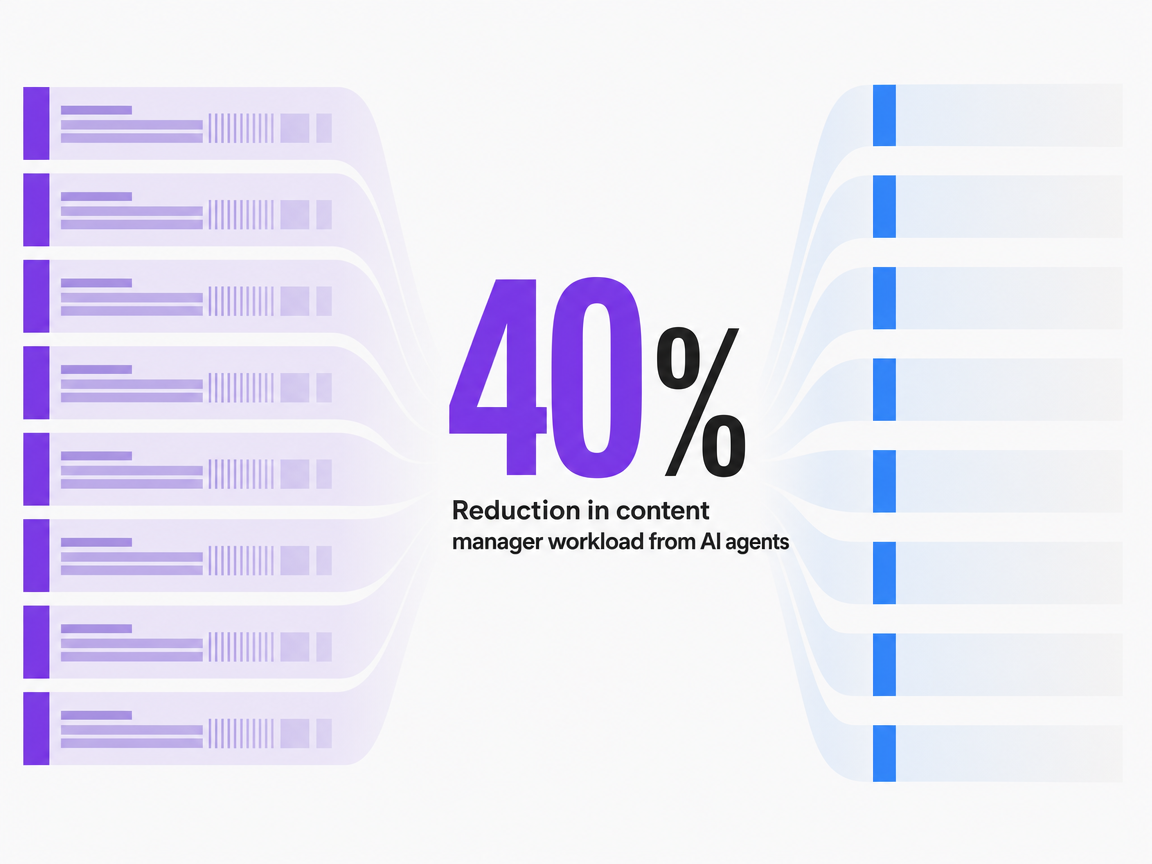 Reduction in content manager workload from AI agents
Reduction in content manager workload from AI agents
Where AI Orchestration Compresses the Flow
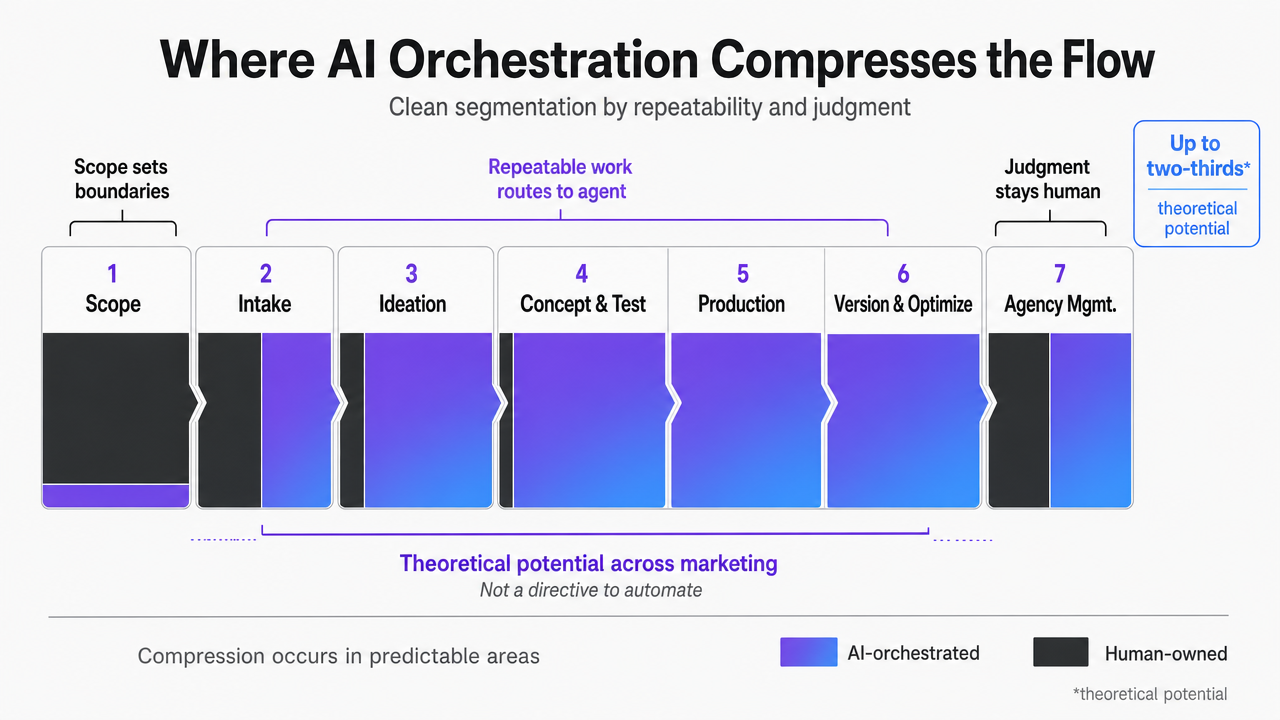
The initial question of scope is critical, as it defines the design boundaries. McKinsey's analysis suggests that up to two-thirds of current marketing activities, including ideation, concept creation and testing, content production, versioning, optimization, and agency management, can be powered by agentic AI 1. This figure represents the theoretical potential for AI orchestration across the marketing function, not a directive to immediately automate two-thirds of a team's work. Its significance lies in reframing the design challenge: the question is not whether to automate, but which activities within each stage are sufficiently repeatable to be routed through an agent without compromising judgment.
When applied to the seven-stage flow, compression occurs in predictable areas:
- Intake is compressed when an AI agent parses a request, cross-references it with the editorial charter, and pre-fills brief fields based on prior work.
- Briefing is streamlined when an agent compiles keyword clusters, competitive analysis, internal expert history, and existing asset inventory into a document for a human editor to finalize.
- Drafting is accelerated when writers, human or AI, begin with a structured outline rather than a blank page.
- Versioning for channel variants sees significant compression: an approved core piece can be orchestrated into an email, social media sequence, sales one-pager, and paid ad through automated versioning, eliminating manual rework.
Two stages should resist compression and remain human-centric. Strategic review, where an editor assesses the argument's validity and angle, remains a human task. Final approval, where a named owner assumes accountability for published content, also stays human. McKinsey's operating model guidance explicitly states that workflows scale only when manual and automated work are distinctly segmented, not blended 8. Blended workflows often yield the worst outcomes: agents make inappropriate judgment calls, and humans perform unnecessary formatting tasks.
The primary target for compression is coordination overhead, not creative craft.
Governance for High-Trust Verticals: Legal, Healthcare, and Regulated Services
Regulated industries necessitate a different approach to approval processes. A published claim regarding a medical procedure, legal outcome, or treatment protocol carries liability that a marketing correction cannot easily undo. This reality does not negate the need for scaled production; rather, it emphasizes the importance of integrating governance directly into the workflow, rather than adding it as an afterthought.
Forrester's perspective on AI-scaled content is particularly relevant here: generic content is now inexpensive, and the operating model must demonstrate expertise, empathy, and credibility to maintain trust with high-stakes audiences 5. In legal and healthcare contexts, this translates to named clinical or attorney reviewers for each content category, documented review criteria aligned with regulatory standards, and an audit trail detailing who approved which claim on what date. The three review concerns—editorial, subject-matter, and compliance—remain, but subject-matter review carries the most weight and cannot be abbreviated.
Deloitte's research on generative AI in life sciences and healthcare indicates that AI-enabled content processes can coexist with stringent risk management when applied to tasks like tagging, asset management, and granular effectiveness measurement, rather than substituting for clinical judgment 7. This distinction defines the design boundary. AI agents can tag libraries of approved claims, retrieve supporting evidence, and flag draft language that deviates from approved phrasing. However, agents do not sign off on medical accuracy; a licensed reviewer does, and the workflow routes to that reviewer based on content type, not availability.
The operational benefit is increased speed coupled with defensibility. A governed pipeline with named, timed, and logged approval gates publishes faster than an ungoverned one, because the ambiguities that typically stall regulated work are addressed within the process itself, rather than in each individual draft.
See How Top Brands Orchestrate Scalable Content Workflows Across Channels
Connect with our team to benchmark your current content creation process flow and discover data-driven frameworks for managing multi-channel approvals, prioritization, and production at scale.
If You Manage Multiple Locations: Consolidating Handoff Friction Across Sites
This section shifts focus from single-team content operations to multi-location entities, such as DSO groups, behavioral health networks, home services franchises, senior living portfolios, and law firms with regional offices. The scaling dynamics change due to different friction points.
In a single-team model, a weak brief template might cost one editor a few extra hours weekly. In a portfolio model, the same flawed template is replicated across every site, compounding the extra hours per location. A ten-site operator with an ungoverned intake process is not dealing with one broken workflow, but ten parallel ones, each with its own local reviewer, shortcuts, and deviations from brand standards. McKinsey's operations research on scaling is clear: cost-effective scale comes from centers of excellence and standardized processes, not from replicating local capacity at each site 6.
The opportunity for consolidation lies in stages where local divergence is unnecessary, while preserving local judgment where it is essential. The table below illustrates this separation.
| Stage | Typical Manual Owner | Cycle Time Driver | Consolidation Opportunity |
|---|---|---|---|
| Intake | Local marketing lead per site | Requests routed through informal channels | Centralized intake form; local context as fields, not as separate workflows |
| Brief | Regional manager or agency contact | Rewritten from scratch per location | Shared brief library; location variables injected at the field level |
| Draft | Local writer or freelancer per site | Parallel drafting of near-identical topics | One core draft; orchestrated location versioning |
| Review | Site-level editor | Inconsistent standards across sites | Central editorial review; local subject-matter review only |
| Approve | Local operator or franchisee | Availability of named approver | Central brand approval; local sign-off scoped to compliance-sensitive claims |
| Publish | Site webmaster or vendor | Manual formatting per CMS instance | Templated publishing; metadata and schema applied by rule |
| Measure | Corporate analytics, if any | Data pulled per site, reconciled quarterly | Unified measurement layer feeding one intake cycle |
The principle is to centralize operational infrastructure while keeping local market judgment decentralized. Forrester's lifecycle framework supports this separation: planning, production, promotion, and performance function as a single flow, not as four replicated functions per site 4. Portfolios that maintain distributed drafting and formatting negate the efficiencies gained elsewhere.
The Measurement Layer Most Teams Skip
Many content dashboards effectively measure the wrong things. Metrics like sessions, pageviews, and time on page describe traffic patterns, not the health of the content operation. Forrester's Content Engine Maturity Model employs different criteria—quality, scale, efficiency, utilization, and impact—because these five dimensions distinguish a true content operation from mere content output 3. Teams that overlook the operational layer end up optimizing individual pieces while the underlying system remains opaque.
Four metrics are particularly diagnostic:
- Throughput measures published pieces per week against planned pieces, revealing the gap between capacity and commitment.
- Approval cycle time tracks the median days from draft submission to final sign-off, isolating governance delays that drafting improvements cannot fix.
- Reuse ratio quantifies the number of downstream assets (e.g., emails, social posts, sales collateral) generated from each approved core piece, indicating how effectively the promotion plan, which Forrester links to production, is being executed 4.
- Content-attributed pipeline measures the sourced or influenced opportunity value per published piece, connecting the operation directly to revenue rather than just traffic.
Deloitte's work on granular content measurement suggests an additional layer: tagging assets by attributes like topic, format, and claim type allows effectiveness to be measured at the attribute level, not just at the URL level 7. This granularity transforms measurement from a quarterly report into actionable input for the next intake cycle.
Sequencing the Redesign Without Halting Publication
Redesigning an operating model while maintaining publication schedules is a common challenge that often prevents teams from starting. The solution lies in strategic sequencing, not scope reduction. Three sequential steps can transform the flow without a complete freeze.
- Standardize the brief before addressing any other aspect. Applying a single template to the next four weeks of scheduled work will reveal where the process truly breaks down, and downstream stages will benefit from increased clarity without requiring new tools.
- Instrument approval cycle time. Measuring the median days between draft submission and sign-off, per content type, isolates the governance drag that no drafting improvement can resolve.
- Segment repeatable production work from judgment-based work and route the repeatable half to orchestration, beginning with versioning and publishing mechanics, where McKinsey's principle of clean segmentation applies most directly 8.
The calendar continues to run because none of these three steps halt drafting; they modify the underlying infrastructure. Teams that attempt to redesign every stage simultaneously often get bogged down in internal alignment issues. Teams that follow this sequence can publish throughout the transition and compound their gains.
Frequently Asked Questions
References
- 1.Reinventing marketing workflows with agentic AI.
- 2.Five Keys to Successful Content Operations.
- 3.Assessing Your B2B Content Strategy And Operations.
- 4.2022 Planning Assumptions: Content Strategy & Operations.
- 5.To Survive The Content Apocalypse, Reinvent Your Content Operating Model Now.
- 6.How Digital Marketing Operations Can Transform Business.
- 7.Generative AI in customer engagement (life sciences/healthcare context).
- 8.Digital service excellence – Scaling the next-generation operating model.