
Key Takeaways
- Predictable content output depends on a governed five-stage loop—Signal Intake, Prioritization, Production, Approval, and Performance—where each stage produces one named artifact owned by one decision-maker.
- AI belongs inside decomposed task chains, not as a bolted-on drafting tool; agents handle pattern detection, scoring, and reusable production tasks while humans retain judgment and final approvals 1.
- Compliance velocity holds when FTC substantiation and HIPAA PHI review are bundled into a single approval gate with a defined review window, rather than scattered as comments across the draft 3, 4.
- Weekly output becomes a forecast when teams measure cycle time, set WIP limits per stage, and enforce approval SLAs—then divide the tightest stage's WIP limit by its average cycle time.
Why Content Output Stalls Without a Governed Loop
Most in-house content teams do not have a production problem. They have a routing problem. Briefs sit in Slack threads. Drafts wait on a subject-matter expert who is in surgery, in court, or on a job site. Legal sends back a note that reopens the intro. The calendar slips a week, then two, and the quarterly output number becomes a story rather than a forecast.
The pattern is consistent across growth-stage marketing teams: work in progress accumulates faster than approvals can clear it. Adding a writer rarely fixes this. Adding an AI drafting tool often makes it worse, because faster drafts pile up against the same unclear approval path.
Forrester frames the shift plainly. AI "commoditizes execution by making speed, scale, and optimization abundant," which pushes the real work of marketing toward orchestration rather than production 7. McKinsey reaches a similar conclusion from the workflow side, arguing that priority workflows should be decomposed into task chains before agents or humans are assigned to any step 1.
Predictable output starts with a governed loop: defined stages, named decision rights, and one place where approvals are made. The rest of this article maps that loop stage by stage.
The Five-Stage Map at a Glance
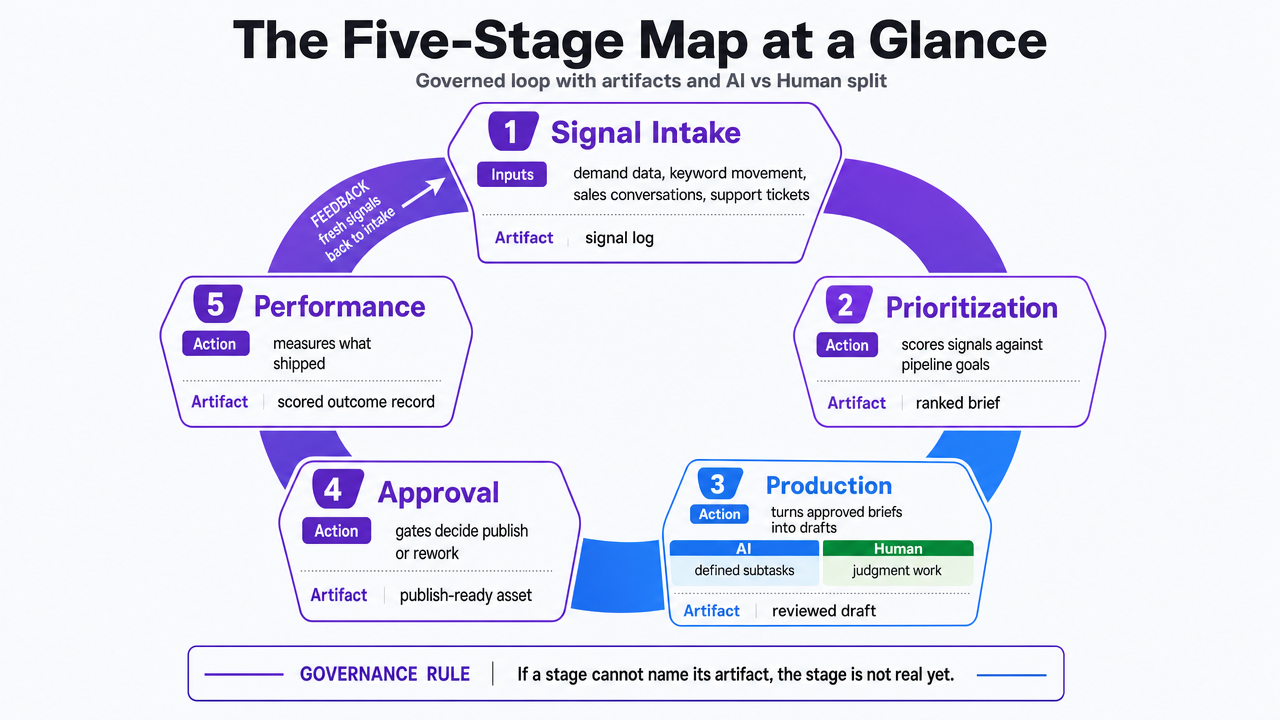
The map has five stages arranged as a loop, not a line. Signal Intake collects demand data, keyword movement, sales conversations, and support tickets. Prioritization scores those signals against pipeline goals and produces a ranked queue. Production turns approved briefs into drafts, with AI agents handling defined subtasks and humans handling judgment work. Approval routes drafts through the gates that decide publish or rework. Performance measures what shipped and feeds fresh signals back into intake.
Each stage produces one artifact:
- Signal Intake produces a signal log.
- Prioritization produces a ranked brief.
- Production produces a reviewed draft.
- Approval produces a publish-ready asset.
- Performance produces a scored outcome record.
If a stage cannot name its artifact, the stage is not real yet.
McKinsey's guidance on agentic workflows makes the design principle explicit: priority workflows should be broken into the full chain of key activities before agents or humans are assigned to any step 1. That decomposition is what allows the same map to accommodate a blog post, a location page, a service comparison, or a compliance-heavy explainer without inventing a new process each time.
The AI-versus-human split shifts by stage. Intake and prioritization lean on AI for pattern detection and scoring, with human review of the ranked queue. Production is a mixed pipeline. Approval is human-led with AI-assisted checks. Performance is AI-led with human interpretation. The infographic below shows the loop, the artifact leaving each stage, and where the split sits.
Stage One: Signal Intake
What Counts as a Signal
A signal is any observable piece of demand data that could justify a piece of content. Not every input qualifies. Search-query movement inside Google Search Console counts. A recurring objection logged in the sales CRM counts. A support-ticket pattern that hits the help desk more than twice in a week counts. A brand mention in a subreddit thread with fifty upvotes counts. A stray idea in a Monday meeting does not, until it has evidence attached.
McKinsey's guidance on agentic workflows anchors this discipline. Priority workflows should be broken into the full chain of activities before any agent or human is assigned to a step 1. Intake is the first link in that chain, and its job is filtering, not collecting. Everything downstream inherits whatever noise gets through here.
The Intake Artifact and Who Owns It
Intake produces one artifact: a signal log. Each row carries a source, a date, a raw observation, a suggested audience, and an evidence score. AI agents can populate the log by pulling from search consoles, call transcripts, review platforms, and social listening tools, then tagging entries by topic cluster and pipeline stage. McKinsey describes this pattern as scaled creativity supported by content factories that integrate planning, production, and performance data 2.
The content marketing manager owns the log. Ownership means one person decides what enters the ranked queue and what gets archived. Sales, support, and product can nominate signals. They do not approve them. Without a single owner, the log becomes a wishlist, and prioritization inherits a backlog it cannot score. A signal without evidence is a request, and requests belong in a separate channel.
Stage Two: Prioritization and the Command Center
Scoring Signals Against Pipeline Goals
Prioritization is where the signal log becomes a ranked brief. A score is assigned to each entry based on four inputs:
- pipeline stage served
- search-demand size
- competitive gap
- production cost
Entries below a threshold drop out. Entries above it get a slot in the queue.
Scoring is where AI earns its keep. Agents can pull search volume, cluster related queries, cross-reference the CRM for deal-stage relevance, and flag topics that already have thin coverage on the site. McKinsey's workflow decomposition logic applies directly here: the scoring chain is a sequence of discrete tasks, and each task can be handled by an agent, a human, or a hybrid step 1.
The scoring model itself is an artifact. It should be written down, versioned, and reviewed quarterly. When leadership asks why one topic ships before another, the answer is a number and its inputs, not a preference.
Decision Rights at the Prioritization Gate
The prioritization gate has one approver. In most in-house teams, that is the content marketing manager. In larger organizations, it is the manager with the VP of Marketing signing off on the top of the queue once a week. Everyone else nominates, comments, or reviews. No one else approves.
Forrester's argument matters at this gate. AI commoditizes execution, which shifts the scarce work toward orchestration and judgment 7. Prioritization is orchestration. It decides what the production pipeline touches next, which means it decides where the team's cycle time goes.
The artifact leaving this gate is a ranked brief with a target audience, primary keyword, pipeline stage, evidence sources, and a definition of done. If the brief cannot answer those five questions, it goes back to intake. Production never receives ambiguity.
Map, approve, and publish content in days
Experience a fully governed content production process from planning to live publication in your real channels.
Stage Three: Production With an AI Oversight Sub-Layer
Task Decomposition and Agent Assignment
Production is where most teams collapse the process into a single task called "write the draft." That framing hides the six or seven discrete jobs inside it. A ranked brief triggers:
- outline construction
- source gathering
- first-draft assembly
- internal-linking pass
- on-page SEO pass
- fact-check pass
Each is a task, not a step in one person's head.
McKinsey's guidance is specific on this point. Priority workflows should be decomposed into the full chain of activities, and agents should be assigned to the tasks that match reusable archetypes rather than to entire jobs 1. Outline construction from an approved brief is a strong agent task. Source gathering from a defined evidence list is a strong agent task. Voice-matched prose in a regulated vertical is a human task, or a hybrid with a human editor closing the loop.
The assignment itself is an artifact. A production runbook lists each task, the agent or human responsible, the input required, and the definition of done. Without that runbook, agent output arrives as a whole draft that the editor has to reverse-engineer before improving.
Applying NIST AI RMF Inside the Draft Pipeline
Agent output needs oversight the same way any production system needs quality control. NIST's AI Risk Management Framework organizes that oversight into four practices that map cleanly onto a content pipeline:
- inventory the agents in use
- map their inputs and outputs
- measure their performance against defined criteria
- monitor drift over time 8
Applied to production, this means every agent has a named owner, a known prompt or configuration version, a sample review cadence, and a rejection log.
The scope question is where the map gets honest. Forrester's forecast for agency economics finds that intelligent automation "have shown potential to automate 25% of agency roles," while generative AI is expected to augment the majority of remaining roles rather than replace them 6. That figure describes agency role structures, not marketing headcount broadly, but the design implication carries into in-house production: roughly a quarter of the work inside the production stage is a candidate for full delegation to agents, and most of the rest is candidate for augmentation with a human still owning judgment.
The oversight sub-layer is what keeps that split honest. Without inventory and monitoring, the delegated slice quietly expands, quality drifts, and the editor becomes a rewriter.
Stage Four: Approval Gates and Consolidated Governance
The Four Gates That Decide Publish or Rework
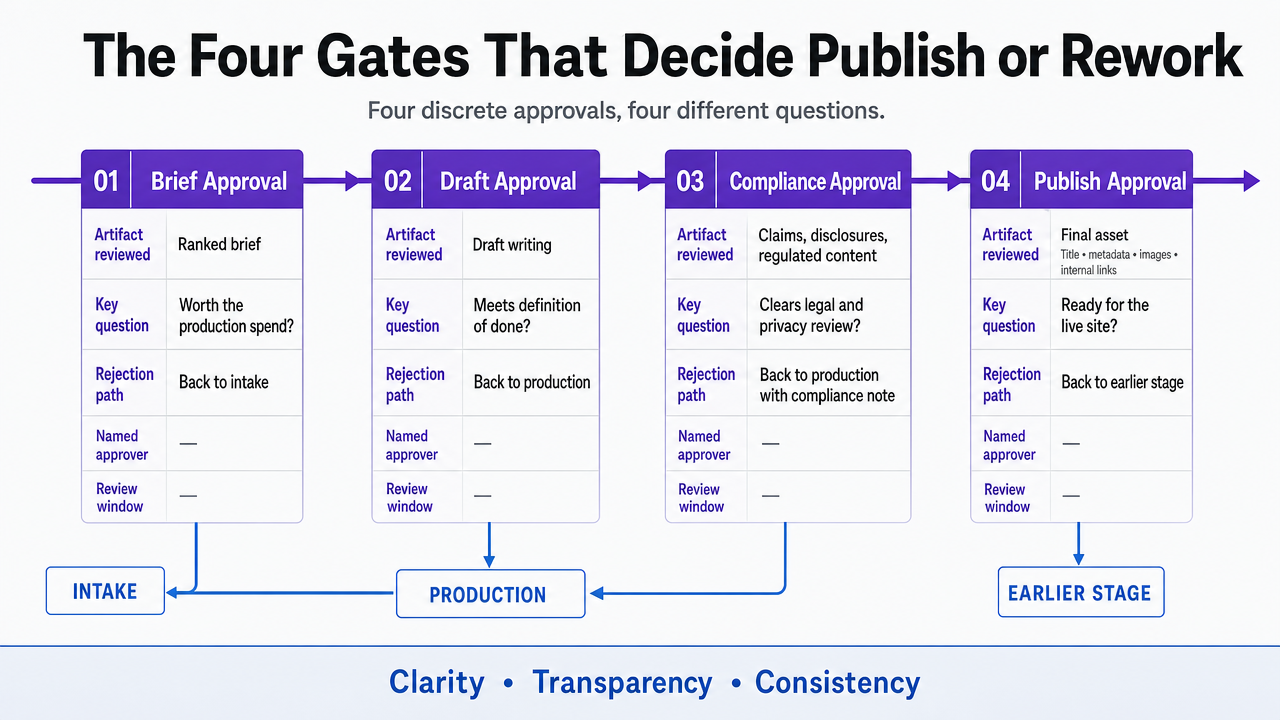
Approval is not a single meeting. It is four discrete gates, each reviewing a different artifact against a different question.
- Brief approval asks whether the ranked brief is worth the production spend.
- Draft approval asks whether the writing meets the definition of done in the brief.
- Compliance approval asks whether the claims, disclosures, and any regulated content clear legal and privacy review.
- Publish approval asks whether the final asset, including title, metadata, images, and internal links, is ready for the live site.
Each gate has a named approver, a review window, and a rejection path back to a specific earlier stage. A draft that fails compliance does not return to intake. It returns to production with a compliance note attached.
HHS states plainly that a content governance plan "will provide clarity and transparency, promote consistency of content, maximize team efficiency, and help with quality control" 5.
Four gates, four artifacts, four approvers is the smallest structure that delivers those four outcomes.
FTC Substantiation and HIPAA PHI Review Inside the Approval Stage
Compliance approval is where high-stakes verticals earn or lose their production velocity. Two rules dominate the checkpoint for the audience this map is built for.
The FTC requires that endorsements reflect the honest opinions and experiences of the endorser, and that any material connection between the endorser and the advertiser be clearly and conspicuously disclosed 3. For a law firm case-result page, a dental practice testimonial, or a home services review roundup, the compliance approver checks three things:
- the claim has substantiation on file
- the disclosure sits where a reader will see it
- the endorsement language matches what the endorser actually said
HIPAA sits alongside the FTC check for any healthcare-adjacent content. HHS requires covered entities to implement appropriate administrative, technical, and physical safeguards for protected health information, which extends to public communications and marketing content 4. The compliance approver checks whether any patient story, image, or quoted outcome carries identifiable information, and whether a signed authorization is on file when it does.
Both checks belong to one gate, not scattered through the pipeline. Bundling them into compliance approval keeps the earlier gates focused on strategy and craft, and gives legal or a designated compliance reviewer a single review window rather than intermittent tags across a two-week production cycle.
Governance Artifacts the Map Should Produce
The approval stage should leave behind more than a published page. Five artifacts make the governance layer legible to leadership and auditable over time.
- A roles-and-decision-rights document names every approver by role, the gate they own, and the review window.
- A change-management log records what changed on any live asset, when, and why.
- A review-cadence schedule sets how often evergreen pages are reviewed for accuracy.
- A substantiation file stores the evidence behind every claim.
- A misinformation-response protocol defines who acts, and how fast, when something inaccurate ships or gets flagged externally.
HHS lists these categories as the working parts of a governance plan for exactly this reason: without them, quality control depends on memory 5. With them, the approval stage produces a paper trail that a new hire, a new agency partner, or a new AI agent can read on day one.
Stage Five: The Performance Loop That Feeds Intake
Performance is where the map earns its name as a loop. A published asset without a scored outcome record is a one-way street, and one-way streets produce the same guesses next quarter.
The scored outcome record is the artifact this stage produces. It carries the asset, its pipeline stage, the primary keyword, the ranked-brief score assigned at prioritization, and the observed result across three windows: 14 days, 60 days, and 180 days. Traffic, ranked positions, conversions to the next pipeline stage, and any qualified sales conversations that referenced the asset all land in the record. AI agents can assemble most of it automatically, pulling from analytics, search consoles, and CRM stages.
McKinsey describes this closing move as scaled creativity supported by content factories that tie planning and production back into performance data 2. The mechanical version is simpler: the observed result becomes a new signal. A top-quartile asset feeds intake as a candidate for expansion, refresh, or a paired asset one step down the funnel. A bottom-quartile asset feeds intake as evidence that the scoring model missed something, which triggers a review of the model itself.
The loop closes when the performance record changes what enters production next. If nothing about last quarter's outcomes shapes this quarter's queue, the map is running open.
See How Leading Teams Standardize Content Workflows for Predictable Output
Request a walkthrough of centralized process mapping that accelerates production and approval cycles—enabling your team to increase content throughput and maintain quality standards at scale.
Turning the Map Into a Weekly Output Forecast
Cycle Time, WIP Limits, and Approval SLAs
A map without numbers is a diagram. Three measurements convert it into a forecast.
Cycle time : The elapsed time from a brief entering production to its scored outcome record. Not draft time. Not editor time. Total time, gate to gate. Most in-house teams discover their real cycle time is two to three times what their calendar assumes, because the calendar counts writing days and ignores waiting days.
Work-in-progress limits : Cap how many briefs can sit in each stage at once. A production stage with three writers and no WIP limit will accept twelve open briefs, then deliver none of them on time. A WIP limit of four forces the queue to stay in prioritization, where triage is cheap, rather than in production, where context-switching is expensive.
Approval SLAs : Assign a maximum review window to each gate. Brief approval within one business day. Draft approval within two. Compliance approval within three. Publish approval within one. Forrester's point about AI commoditizing execution lands here: when drafting is fast, approval latency becomes the bottleneck 7.
A Simple Forecasting Formula
Weekly output equals the WIP limit of the tightest stage divided by that stage's average cycle time in weeks. If production carries a WIP limit of six briefs and the average brief clears the stage in two weeks, the pipeline delivers three finished assets per week, no more, until either the WIP limit rises or cycle time falls.
The formula makes trade-offs explicit. Raising the WIP limit without lowering cycle time creates a larger backlog, not more output. Lowering cycle time by tightening approval SLAs raises output without new headcount. McKinsey's content-factory framing depends on this closed loop between planning, production, and measurement to hold 2.
Once the numbers are on paper, the forecast stops being a promise and starts being a lever leadership can move.
If Content Runs Across Multiple Locations or Practices
A note for a narrower audience: operators running content across multiple offices, clinics, franchises, or practice groups. The map above still applies, but the economics shift when the same production loop feeds five, twenty, or eighty locations.
The failure mode at scale is per-location briefing. Each office wants its own intake, its own priorities, and its own reviewer. That structure multiplies approval cycles by the number of locations and turns a two-week production stage into a six-week one. Cycle time does not compound linearly. It compounds against every gate.
The consolidation move is to run one signal intake and one prioritization queue at the network level, then branch only at the production stage where location-specific inserts, provider names, service menus, or state-level compliance actually differ. Forrester's finding that intelligent automation has shown potential to automate 25% of agency roles applies most directly to this pattern: the repetitive location-variant work is the slice that agents handle cleanly, while network-level strategy and per-location judgment stay with humans 6.
The variables to model before consolidating:
- number of locations
- briefs per location per month
- average approval cycles per brief
- the cycle-time reduction expected once intake and prioritization move to the network layer
Those four numbers produce a defensible before-and-after picture without inventing dollar figures. If the same brief template can serve twelve locations with a location-variant pass, the network runs one map. If every location insists on a bespoke brief, the network runs twelve maps and forecasts none of them.
Common Failure Modes When Teams Skip the Map
Three patterns show up repeatedly when teams try to scale content without a governed loop.
- The phantom pipeline. Briefs exist in a spreadsheet, drafts exist in Google Docs, and approvals exist in email. Nothing carries a stage, an owner, or a next action. Cycle time cannot be measured because no one knows when a brief entered production. The team feels busy and ships less.
- Bolted-on AI. A drafting tool gets added without a runbook, so agent output arrives as full drafts that editors reverse-engineer. McKinsey's task-decomposition principle is skipped, and speed at the keyboard becomes latency at the editor's desk 1.
- Compliance-by-tag. FTC substantiation and HIPAA review get raised as comments inside the draft rather than gated at a single approval window, which turns a two-week cycle into a rolling negotiation.
Each failure has the same root: no artifact, no owner, no gate. The map exists to prevent exactly that.
Frequently Asked Questions
References
- 1.Reinventing marketing workflows with agentic AI.
- 2.The future of marketing in the age of AI.
- 3.FTC’s Endorsement Guides: What People Are Asking.
- 4.HIPAA Privacy Rule: Guidance for Professionals.
- 5.Section 7: Establish Content Governance - Health Literacy Online.
- 6.Predictions 2024: AI Accelerates Agencies' Shift To Solutions.
- 7.AI Forces A Redesign Of How Marketing And Agencies Work.
- 8.Artificial Intelligence Risk Management Framework (AI RMF 1.0).