
Key Takeaways
- Redesign the workflow before adding any AI tool, because value emerges only when roles and handoffs are restructured around the technology, not when AI is bolted onto existing queues 6.
- Standardize the brief so one strategist can direct many drafts, capturing angle, sources, and voice upfront to eliminate repeated negotiations during review.
- Map tasks to the AI capability frontier, since generative AI boosted performance nearly 40 percent inside its range but reduced it 13 to 24 points outside 5.
- Move AI to the first-draft seat and writers to the editor seat, a shift MIT found made professional writing 40 percent faster and 18 percent higher quality 3.
- Build a prompt library, style guide, and voice guardrails as shared, versioned assets so output quality does not diverge across individual writers 1.
- Train the team on the five dimensions of GenAI literacy—technical competence, prompt optimization, content evaluation, innovative application, and ethical awareness—to unlock real performance gains 9.
- Prioritize topics by audience fit before chasing volume, because aligning content with customer information needs drives results more than raw production output 10.
- Repurpose one asset into a distribution set rather than a single publish, using AI to generate format derivatives while editors verify claims against the original source.
- Install a human-in-the-loop review for regulated and high-stakes content, using automated checks, subject-matter reviewers, and compliance reviewers to protect against factual and legal exposure 7.
- Measure the production system with cycle time, first-pass acceptance, cost per publish-ready asset, and rework rate to turn scaling into a tuning conversation instead of a hiring one.
- For multi-location brands, centralize the editorial engine and let AI handle per-location transformation, so headcount stays fixed while pages scale with locations 2.
The scaling problem is a workflow problem, not a headcount problem
Most content teams encounter a similar challenge: editorial calendars expand, SEO backlogs grow, and the default solution is often to hire more writers or freelancers. This approach addresses the symptom rather than the root cause. Leading teams now view content as a production system with defined inputs, review stages, and measurable outputs, rather than solely a staffing issue.
The economic benefits of this reframe are significant. McKinsey estimates that generative AI could automate 60 to 70 percent of current work activities, with marketing and sales identified as high-impact areas for these gains 2. This doesn't imply fewer writers, but rather a restructuring of tasks — outlining, drafting, summarizing, formatting, and optimizing — around AI assistance. Human effort can then focus on brief quality, subject-matter accuracy, and editorial judgment.
The following tips outline systemic changes and tactical execution strategies. Each tip highlights the workflow shift, the resulting role changes, and the governance required to maintain accuracy and brand consistency.
Redesign the workflow before adding any AI tool
Integrating a writing assistant into an existing process is a common pitfall that leads to wasted AI budget. These tools often get stuck in the same brief-to-draft-to-edit-to-publish handoffs that already cause delays, resulting in faster first drafts that still face review bottlenecks. MIT Sloan research on organizational AI adoption indicates that value emerges only when workflows and roles are redesigned to incorporate the technology, not when AI is merely appended to isolated tasks 6.
The redesign process begins by mapping the entire content flow: topic selection, brief creation, drafting, SME review, SEO optimization, legal/compliance checks, publishing, and measurement. Most teams identify several points where work queues, requires re-briefing, or bounces between individuals with incomplete perspectives. These queues, not drafting speed, are the primary constraint on output.
An integrated workflow consolidates these queues into a single approval loop. Strategic inputs drive AI production, human editors conduct reviews within the same system where drafts are generated, and publishing and measurement data feed back into the topic pipeline to inform future briefs. This approach clearly defines roles: strategists manage inputs and priorities, editors oversee quality gates, and AI handles the connective production work 6.
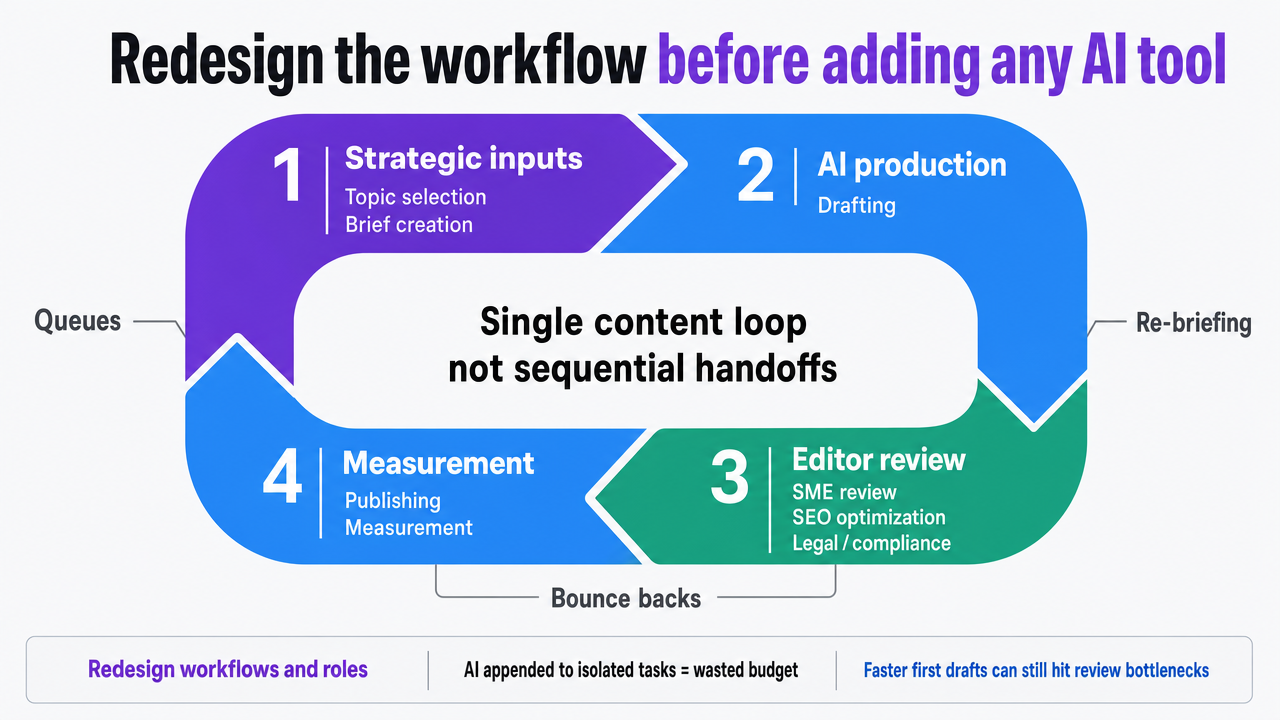 Visualize the consolidated content workflow described in this section, showing how strategic inputs, AI production, editor review, and measurement feed into a single loop rather than sequential handoffs
Standardize the brief so one strategist can direct many drafts
Output limitations often stem from brief quality rather than writer speed. When briefs lack clear angles, sources, or examples of the target voice, every subsequent draft—whether human or AI-generated—suffers. Standardizing the brief empowers a single strategist to become a force multiplier. A senior editorial mind can guide dozens of drafts monthly because the strategic thinking is captured upfront, eliminating the need for repeated negotiations during each review cycle.
Columbia University's editorial guidelines exemplify this at an institutional level. Their guide provides distributed contributors with specific instructions on clarity, tone, user-centered structure, and accessibility, enabling consistent web content production without extensive central rewrites 8. This principle applies equally within a content team. A standardized brief template should include:
- search intent
- reader profile
- primary claim
- required evidence with linked sources
- internal examples of on-brand voice
- SEO structure
- a list of phrases to avoid
Each field should have a default answer and an option for overrides.
This shift subtly but significantly redefines roles. Strategists dedicate more time to refining brief inputs and less to repairing drafts. Editors work from a clear contract, eliminating the need to infer intent from a completed paragraph. Research on content marketing effectiveness confirms that aligning content with reader information needs drives better results than simply increasing asset volume, making upfront specification a key lever for scaling 10.
Map tasks to the AI capability frontier
Not all content tasks benefit equally from AI assistance. A Harvard-BCG experiment, summarized by MIT Sloan, found that generative AI boosted consultant performance by nearly 40 percent on tasks within its capable range, but decreased performance by 13 to 24 percentage points on tasks outside that range 5. This boundary, termed a "jagged frontier," doesn't always align with intuition; some seemingly complex tasks fall within AI's capabilities, while some simple ones do not. For content teams aiming to scale, identifying where each task lies relative to this frontier is a critical decision.
This mapping exercise is practical. A strategist categorizes the current task inventory—including topic research, outline generation, first drafts, SEO titles and meta descriptions, internal link suggestions, product-page copy, thought-leadership essays, executive quotes, primary research summaries, and legal disclaimers—into three groups:
- "Inside the frontier" tasks are those where AI drafts and a human edits.
- "Edge cases" involve AI supporting research or structure, but a human writes the content.
- "Outside the frontier" tasks require a human draft before AI assistance, such as original opinion pieces, direct SME interviews, and claims related to regulated advice 5.
This mapping is dynamic. As models improve and prompt libraries mature, an edge case from one quarter might become an inside-frontier task the next. Regular reviews (e.g., quarterly) ensure the workflow remains optimized, preventing both underutilization of AI where it excels and overuse where quality might silently degrade.
Move AI to the first-draft seat and human writers to the editor seat
The most significant operational change in a scaled content system is the re-assignment of the first draft. Traditionally, a writer would draft against a brief and hand off a near-final piece to an editor for minor adjustments. In a redesigned workflow, AI generates the initial draft based on the standardized brief. The human writer then steps in as the editor, focusing on restructuring arguments, refining claims, replacing generic examples with specific ones, and eliminating filler.
Evidence for this handoff's productivity comes from an MIT randomized controlled experiment. Workers using ChatGPT for professional writing tasks completed them 40 percent faster and produced output rated 18 percent higher in quality by independent evaluators, with the greatest improvements seen among initially lower-performing workers 3. This study focused on discrete professional writing tasks, not extensive investigative work or original research. Interpreted narrowly, it suggests AI-assisted drafting for defined writing jobs boosts both speed and perceived quality—precisely what content teams aim to achieve.
The primary challenge for most teams lies in this role transition. Writers, accustomed to producing original prose, may resist being repositioned as editors. Similarly, editors who previously managed writers now manage prompts, first-pass outputs, and structural rewrites. Two operational adjustments facilitate this transition:
- Redefine job titles and success metrics: an editor's output is measured by publish-ready pieces per week and quality scores against a rubric, not by words written.
- Empower editors to reject AI drafts and regenerate them with a revised brief without escalation, ensuring a tight review loop and preventing editors from silently fixing flawed drafts.
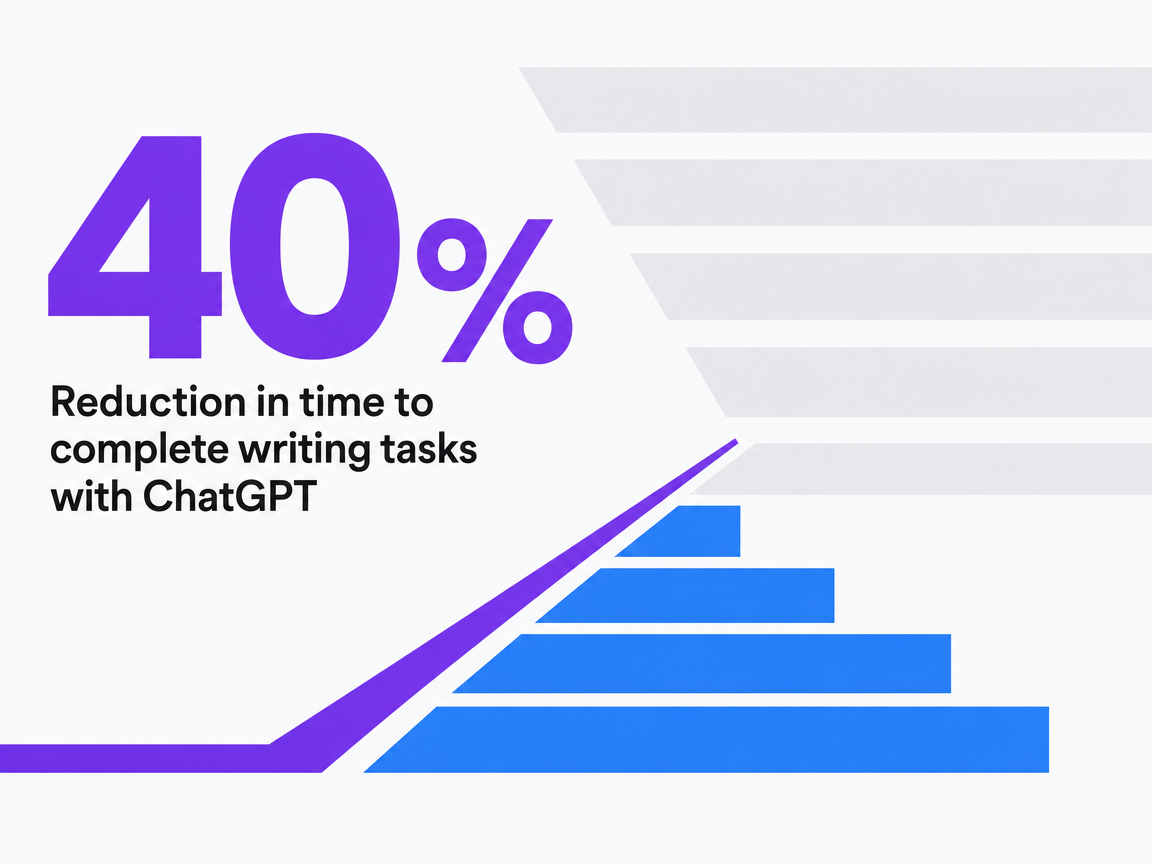 Reduction in time to complete writing tasks with ChatGPT
Reduction in time to complete writing tasks with ChatGPT
Test AI-driven content velocity in real time
Experience measurable content output gains by publishing live articles during your trial—track actual results before you commit.
Build a prompt library, style guide, and voice guardrails as shared assets
A prompt entered from memory into a chat window is a private, inconsistent artifact. If each writer uses a different prompt, the team's output quality will diverge. Scaling requires the opposite: prompts, style rules, and voice examples treated as shared production assets, versioned like code, and updated as models and briefs evolve.
Three key artifacts are essential:
- A prompt library should contain tested prompts for recurring tasks—outline generation, first drafts from briefs, meta descriptions, FAQ blocks, executive summaries—with documented input variables and known failure modes.
- A style guide translates brand voice into concrete rules, including sentence length ranges, banned phrases, preferred verbs, citation formats, and annotated examples of on-brand and off-brand paragraphs.
- Voice guardrails are embedded within the prompts as system instructions, ensuring consistency in every generation.
Medill's 2025 guidance on AI in content marketing reinforces this pattern: efficiency and creativity gains come from AI use combined with active human oversight of brand voice and strategic direction, not from open-ended prompting 1. Ownership is crucial. A senior editor should manage the prompt library and style guide, review changes weekly, and retire prompts that no longer produce publish-ready output.
Train the team on the five dimensions of GenAI literacy
A prompt library and redesigned workflow are effective only if the team operating them understands AI's true capabilities. Research on generative AI literacy identifies five dimensions that predict improved job performance with AI: basic technical competence, prompt optimization, content evaluation, innovative application, and ethical/compliance awareness 9. Teams that treat AI adoption merely as a licensing decision often overlook these dimensions, leading to plateaued output quality.
Each dimension corresponds to a specific content-team skill:
Technical competence : involves model selection, understanding context windows, and knowing when to switch tools.
Prompt optimization : is the ability to craft instructions that yield publish-adjacent drafts on the first attempt.
Content evaluation : is the editor's core skill: assessing an AI draft against a rubric to identify hallucinations, off-voice phrasing, or shallow reasoning.
Innovative application : is the strategist's contribution—identifying new tasks within AI's frontier, such as competitive gap analysis or large-scale on-page optimization.
Ethical and compliance awareness : governs disclosure, sourcing, and any claims related to regulated advice 9.
A quarterly assessment of these five dimensions, coupled with targeted training, is more effective than generic "AI training days." It also provides managers with a clear framework to determine who should manage the prompt library, lead SME reviews, or require coaching before working with first drafts.
Prioritize topics by audience fit before chasing volume
Producing high volume without proper prioritization results in a larger archive, not better outcomes. Research on content marketing effectiveness highlights that aligning content with customer information needs is a stronger determinant of success than raw production volume 10. A team that doubles output on irrelevant topics merely expands its indexing footprint and maintenance load without impacting key metrics.
An effective prioritization system relies on three inputs:
- A scored map of audience segments and the specific questions they ask at each stage of the buying cycle.
- A search-and-conversion dataset that links keyword opportunity to historical revenue or pipeline contribution, beyond just traffic potential.
- A coverage audit that identifies existing pages that already adequately address a topic, preventing cannibalization.
Topics that pass all three filters move to the brief queue; others are deferred or retired.
This shift places greater responsibility on the strategist. With AI assisting production, topic selection becomes the most valuable editorial resource. A senior strategist who spends significant time deciding what not to write is performing the highest-leverage work for the team 10.
Repurpose one asset into a distribution set, not a single publish
A single publication is an inefficient use of a thoroughly briefed, source-checked, and editor-approved asset. The strategic work is complete, claims are verified, and the voice is established. Limiting this investment to one URL leaves significant leverage untapped. Scaling teams treat every long-form asset as a source for a distribution set: a pillar page, a summary post, an email breakdown, a slide-format LinkedIn carousel, a video script, and several social snippets extracting key claims.
AI facilitates this mechanical transformation. The pillar draft feeds into a prompt library entry for each format, each with its own length, structure, and voice constraints derived from the style guide 1. The human editor reviews these derivatives against the same rubric used for the original source, ensuring that headline claims remain accurate and citations point to the correct sources.
This changes the content calendar. A weekly publish evolves into a weekly release with multiple scheduled touchpoints. Distribution planning becomes an integral part of the brief, ensuring the pillar content is created with its derivatives already mapped out.
Install a human-in-the-loop review for regulated and high-stakes content
Content involving medical advice, legal outcomes, financial claims, or patient safety requires a distinct review process from a top-of-funnel blog post. A single hallucinated statistic in a healthcare service page or a misstated statute in a legal explainer can lead to regulatory exposure and loss of trust. Guidelines for evaluating AI workflows in digital health recommend a designated evaluation leader or multidisciplinary review team to regularly assess system outputs for accuracy, safety, and alignment with user needs 7. This structure is directly applicable to regulated marketing verticals.
This review layer comprises three components:
- An automated self-check flags unsourced claims, banned phrases, and statistics without linked citations before human review 7.
- A subject-matter reviewer—such as a licensed clinician, attorney, or credentialed practitioner—verifies factual accuracy for content exceeding a defined risk threshold.
- A compliance reviewer checks disclosures, disclaimers, and jurisdiction-specific requirements.
Healthcare marketing research emphasizes that effective communication in regulated fields relies on rigorous investigation of audience needs and clear, accurate service descriptions, not just production speed 4. This review layer intentionally slows down publish times for high-risk content, a necessary trade-off.
See How Leading Teams Scale Content Output Without Expanding Headcount
Request a walkthrough of streamlined, AI-driven content workflows proven to increase publishing velocity and SEO impact—optimized for agencies and multi-location brands handling high-volume demands.
Measure the production system, not just the pieces
Most content dashboards track individual outputs like pageviews, keyword rankings, or backlinks. These metrics describe individual pieces but don't indicate whether the production system itself is becoming faster, more cost-effective, or more accurate over time. A scaled team needs a second layer of measurement focused on the workflow.
Four system metrics are crucial:
- Cycle time from approved brief to publish (measured weekly and segmented by content type)
- First-pass acceptance rate (the percentage of AI drafts that reach publication without a structural rewrite)
- Cost per publish-ready asset (including tool spend and editor hours)
- Rework rate on published pieces (which reveals issues in the review layer)
Research on AI workflow evaluation in high-stakes domains recommends this pattern: a designated review function that regularly assesses outputs against defined criteria and feeds findings back into the system 7.
These metrics guide different solutions. An increasing cycle time points to a review queue problem. A declining first-pass acceptance rate suggests brief quality drift or an outdated prompt library. Together, these measurements transform scaling from a hiring discussion into a system tuning conversation.
If you manage multiple locations: centralize the editorial engine
This section addresses multi-location service brands (e.g., legal, dental, senior living, home services, healthcare) operating numerous locations. The typical staffing model involves a writer or agency retainer per region, or marketing coordinators drafting service pages. Both models scale headcount linearly with locations and lead to voice inconsistency.
The alternative is a centralized editorial engine that produces location-specific pages from a single, governed workflow. One senior strategist manages the topic map and brief templates. One editor oversees the style guide and review rubric. AI handles the location-by-location transformation: swapping service names, injecting local landmarks and jurisdictions, adjusting practitioner credentials, and generating market-specific FAQ variants. This approach compresses unit economics, replacing variable per-location writing costs with a fixed central team and AI-assisted production that scales with locations, not staff.
This strategy is supported by productivity research. McKinsey's estimate that generative AI can automate 60 to 70 percent of work activities, with marketing being a high-impact area, sets the upper bound for shifting per-location drafting 2. Standardized editorial guidance is key to this shift; Columbia's model demonstrates how a single guide enables consistent content from distributed contributors 8. The operational takeaway: staff the center, not the perimeter, and measure the system by pages published per location per month against a fixed editorial headcount.
Where AI-assisted content still underperforms
An effective scaling plan acknowledges tasks where AI drafts should not lead. Three categories consistently appear in the failure logs of teams using large-scale AI-assisted operations:
- Original opinion and thought leadership tied to a named executive's viewpoint often fall outside AI's frontier; drafts tend to be plausible but generic, which defeats the purpose of a byline.
- Primary research write-ups fail because models cannot verify underlying datasets and may smooth over ambiguities that a human analyst would identify.
- Content making claims that trigger regulatory review—such as clinical outcomes, legal advice, or financial performance—is another area where MIT Sloan research showed performance drops of 13 to 24 percentage points when AI was pushed beyond its capable range 5.
The operational implication is not to ban AI from these categories but to reverse the sequence. A human writes the first draft, and AI then assists with structure, tightening, and format derivatives. Medill's 2025 guidance reinforces this: human oversight of brand voice and strategic direction is essential to prevent AI-assisted output from becoming generic 1.
Putting the nine tips into a 90-day rollout
These nine tips can be implemented sequentially. A 90-day rollout ensures workflow redesign precedes tool integration.
- Days 1-30: Map the current content flow, standardize the brief template, and categorize tasks against the AI capability frontier 5.
- Days 31-60: Develop the prompt library and style guide, transition writers to editor roles, and evaluate the first cohort of drafts using a scored rubric 1.
- Days 61-90: Implement the four system metrics—cycle time, first-pass acceptance, cost per publish-ready asset, and rework rate—and integrate findings into the brief template weekly 7.
For teams seeking to compress this sequence into a single, governed workflow with approval checkpoints between AI-drafted assets and published pages, platforms like Vectoron offer integrated solutions for the production loop, review gate, and measurement layer.
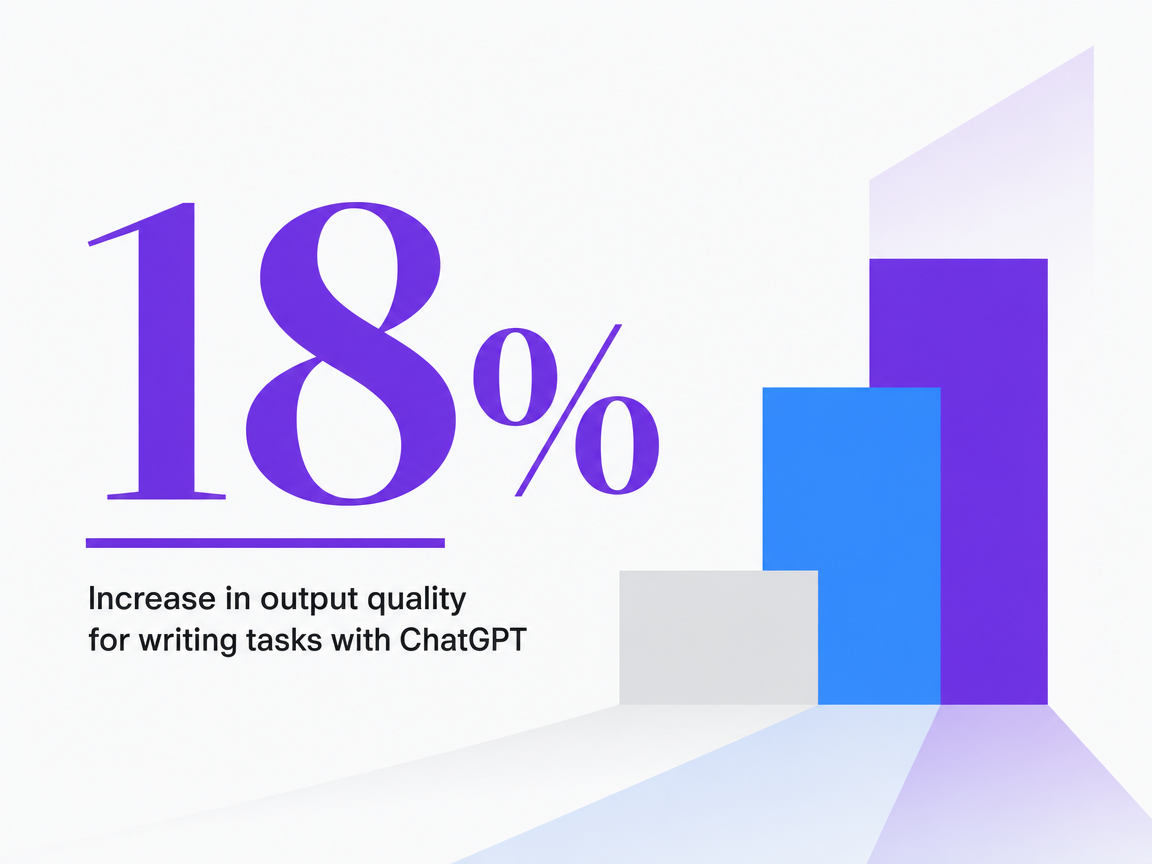 Increase in output quality for writing tasks with ChatGPT
Increase in output quality for writing tasks with ChatGPT
Frequently Asked Questions
References
- 1.Content Marketing and AI – Best Practices.
- 2.The economic potential of generative AI: The next productivity frontier.
- 3.Study finds ChatGPT boosts worker productivity for some writing tasks.
- 4.The impact of marketing strategies in healthcare systems.
- 5.How generative AI can boost highly skilled workers' productivity.
- 6.How AI is reshaping workflows and redefining jobs.
- 7.Rethinking AI Workflows: Guidelines for Scientific Evaluation in Digital Health (PMC version).
- 8.Editorial Guidelines | Columbia Sites.
- 9.Generative Artificial Intelligence Literacy: Scale Development and Its ....
- 10.Determinants of content marketing effectiveness: Conceptual framework and empirical findings.