
Key Takeaways
- Treat content production as an engineering system with defined owners, SLAs, and decision gates at each of the five stages: intake, brief, production, review, and publish-measure-retire.
- Separate content strategy from operations and assign them to different owners—a content lead sets direction while a managing editor enforces throughput, standardization, and approval discipline.
- When AI compresses drafting time, the bottleneck shifts to the review and approval layer; scaling output requires reallocating capacity to editors and gate enforcement, not hiring more writers.
- Build governance, accessibility, and measurement into the brief stage—declared AI use, source verification, WCAG 2.2 criteria 7, and outcome telemetry—so quality and ROI are workflow outputs rather than afterthoughts.
Why Content Operations Has Become an Engineering Problem
Content teams that doubled output in 2024 did so by treating production as a system with measurable inputs, defined ownership, and standardized handoffs—mirroring how engineering organizations manage software delivery. This shift is evident in the language used by public-sector and enterprise practitioners. Georgia.gov defines content operations as
"the behind-the-scenes work of managing content activities as effectively and efficiently as possible,"
emphasizing repeatable processes involving people, process, and technology 2. APQC identifies standard workflows, moving content from creation through archival, as the clearest differentiator for scalable teams 4.
The impetus for this reframe is quantitative. Two-thirds of organizations utilizing enterprise AI report measurable productivity and efficiency gains, with content-heavy functions being early beneficiaries 13. McKinsey's 2025 global survey highlights content generation and personalization as marketing use cases delivering attributable ROI 14. This means in-house content managers' throughput expectations are no longer dictated by individual writer capacity but by the output of a governed pipeline, where human judgment is focused on critical tasks and standardization handles the rest.
Strategy vs. Operations: The Distinction That Determines Whether a Workflow Scales
Content strategy and content operations are distinct disciplines, and their conflation often hinders workflow scalability when increased output is demanded. Digital.gov clarifies that strategy involves the planning, creation, delivery, and governance of content to meet user needs and organizational goals 1. It defines what content is produced, for whom, and why. Operations, as framed by Georgia.gov, encompasses the underlying machinery of people, process, and technology that ensures consistent content delivery 2. It dictates how work progresses from idea to published asset reliably, without reliance on individual heroics.
Practically, a brilliant strategy without operational infrastructure leads to inconsistent results and writer burnout. Conversely, a highly efficient operation lacking strategy produces high volumes of unread content. Scalable teams develop both layers concurrently, assigning them to different owners. Strategy typically resides with a content lead or director responsible for editorial priorities, audience segmentation, and topic coverage. Operations are managed by a managing editor or production lead, focusing on throughput, standardization, and gate enforcement.
This division is reflected in job descriptions. A California state content role, for instance, explicitly assigns responsibility for developing, evaluating, and optimizing both content strategy and publishing processes to enhance efficiency and scalability 3. This indicates that workflow ownership is a defined operational role, not an ancillary task for an editor with spare capacity. Designating a clear owner is crucial for maintaining workflow integrity under pressure.
The Five-Stage Workflow Map: Owners, SLAs, and Decision Gates
Strategy and Demand Intake
A scalable workflow begins with a controlled intake process. Demand intake consolidates topic ideas, keyword opportunities, sales requests, and product launches into a prioritized queue. The content lead owns this stage, accountable for producing a ranked list of approved topics, each with an assigned audience segment, funnel stage, and target publish window. APQC identifies standardized entry into the content lifecycle as a primary factor distinguishing scalable operations from those that fail under volume 4.
A practical Service Level Agreement (SLA) for this stage is a weekly intake review with a 72-hour turnaround for accept-or-reject decisions. The decision gate is binary: a topic either enters the brief queue with a slot assignment or is declined with a documented reason. Topics lacking a named owner, a primary keyword, and a defined audience segment do not proceed.
Brief Standardization
The brief is pivotal for workflow scalability. A standardized brief template minimizes variance in downstream production. When every brief includes consistent fields—primary keyword, search intent, target audience, angle, required sources, internal link targets, word count, format, and success metric—producers require less clarification, and reviewers spend less time restructuring. North Carolina's accessibility checklist similarly emphasizes the operational benefit of an editorial calendar with a named content owner for every page 11.
The managing editor is responsible for brief production, with a 48-hour SLA from approved topic to producer-ready brief. The decision gate involves a brief QA check against the template; any blank field sends the brief back for completion. Skipping this gate leads to increased rework during review cycles, where missing context necessitates structural rewrites instead of simple line edits.
AI-Assisted Production
Production is where AI most significantly accelerates the writing portion of the workflow. The American Marketing Association's 2024 survey of generative AI users found that 85% reported productivity gains, with about half noting improvements in both content quality and quantity 12. While these figures reflect self-reported gains from early adopters, they indicate a clear trend: AI-assisted drafting is becoming a baseline practice.
The writer or content producer owns this stage, working from the standardized brief and utilizing AI tools for first-draft generation, research synthesis, and structural scaffolding. The SLA varies by content type, but a benchmark for a standard 1,500-word article is a 3-to-5-day window from brief assignment to draft submission. The decision gate is a self-check against the brief: ensuring keyword coverage, proper source citations, met format requirements, and human review and revision of AI-generated content. Drafts failing this self-check do not enter the review queue.
Review and Approval Gates
Review is where human judgment is concentrated and workflow throughput is often constrained. A two-tier review structure is effective for most in-house operations: a managing editor performs the substantive edit (structural integrity, argument clarity, source verification, brand voice), and a content lead or brand owner provides final approval before publishing. CalStateLA's research on AI-integrated marketing workflows highlights the necessity of human oversight for managing bias, quality control, and brand consistency as AI handles more drafting 15.
The managing editor's SLA for substantive edits is 48 hours; the approval SLA for final sign-off is 24 hours. Both gates are documented: substantive edits return drafts to producers with tracked changes and a clear pass/revise decision, and final approvals are logged with a timestamp and approver name. This approval discipline is critical in AI-assisted workflows due to the increased volume entering review. Without enforced SLAs and clear criteria, the review layer becomes a bottleneck, a dynamic further explored in the production math section.
Publish, Measure, and Retire
Approved content moves to publishing via a CMS workflow that manages formatting, metadata, internal linking, and scheduling. The web producer or publishing coordinator owns this stage, with a 24-hour SLA from approval to live. Measurement begins immediately, tracking organic traffic, ranking position, time on page, conversion events, and assisted pipeline, all tagged to the article from day one. North Carolina's checklist recommends assigning a content owner for each page and using an editorial calendar for regular review 11.
Retirement is often overlooked, leading to accumulated technical debt. Each article requires a scheduled review—every six or twelve months—where the content lead decides whether to refresh, consolidate, or retire it. Without this gate, the content library accumulates outdated pages that degrade domain quality and confuse search intent signals.
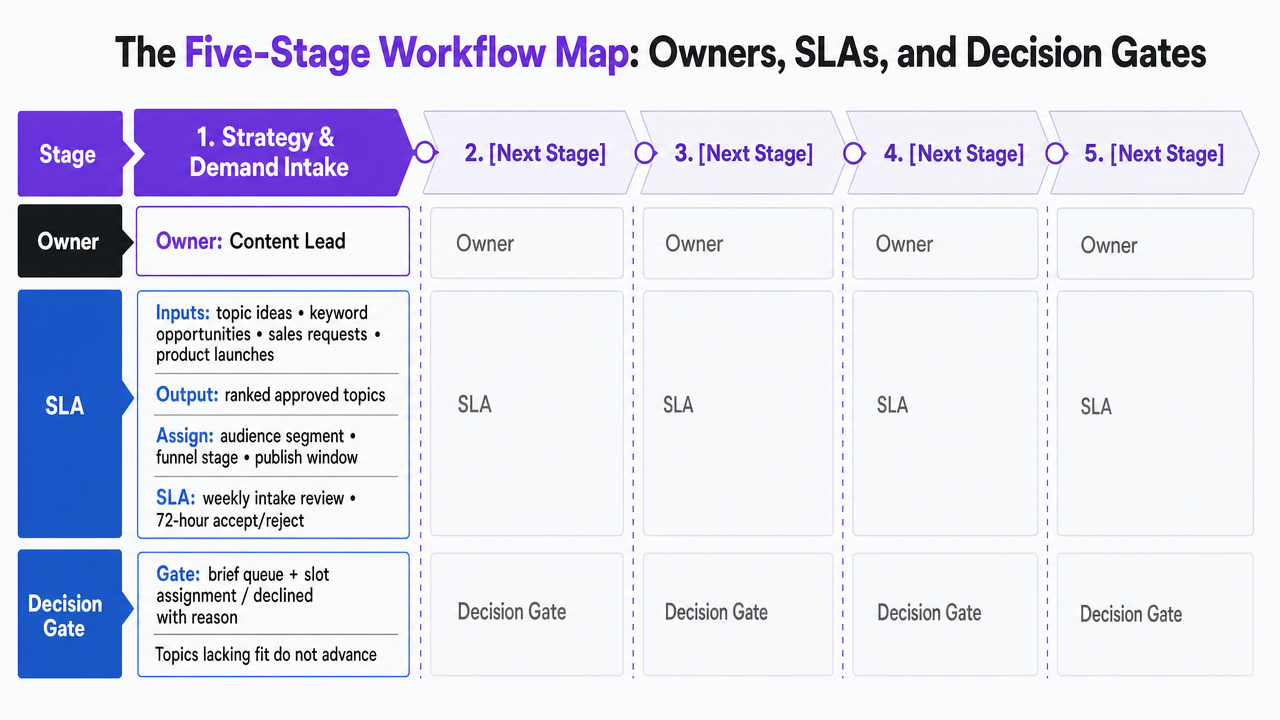 Visualize the five sequential workflow stages with their owners and SLAs, directly mapping to the subsections that follow
Test a centralized workflow for real campaigns
Validate content operations and publish live assets before any commitment, using your actual campaigns and channels.
The Production Math: Where the Bottleneck Moves When AI Enters the Pipeline
Headcount-flat scaling becomes tangible when the math is analyzed stage by stage. A typical in-house writer without AI assistance produces about four publish-ready 1,500-word articles per month, factoring in research, drafting, revision, and context-switching. CalStateLA's research on AI-integrated marketing workflows shows early adopters reducing campaign development time by half and content production costs by up to 50% 15. This suggests AI-assisted capacity can range from eight to twelve articles per writer per month, depending on content complexity and brief reusability.
The key metric to observe is not just increased output, but where the workflow constraint shifts. A team of three writers producing four articles each yields twelve articles monthly, manageable by a single managing editor and content lead within standard SLAs. However, the same three writers operating at AI-assisted capacity could push 24 to 36 articles into the review queue. At this volume, the 48-hour substantive edit SLA and 24-hour approval SLA become the limiting factors, not draft production.
This explains why approval-layer governance is more critical in AI-assisted operations. Adding more writers won't increase throughput once the review tier is saturated; instead, adding a second managing editor or restructuring the approval gate is necessary. Teams that miss this shift hire more writers, leading to draft backlogs and a perception that AI failed. Teams that recognize it reallocate freed writer hours to strategic research, brief quality, and topic-cluster planning—upstream inputs that ensure the increased volume contributes to search rankings and pipeline. AI doesn't eliminate bottlenecks; it shifts them to where human judgment is most scarce.
Governance as a Workflow Input, Not a Compliance Afterthought
AI Provenance and Risk Controls
Governance should be integrated into content workflows proactively, not reactively after issues arise like hallucinated statistics or unverified claims. Properly designed AI provenance controls are implemented at the brief stage. NIST's AI Risk Management Framework provides a vocabulary for content leaders to identify generative AI risks and align controls with documented risk management goals 5. This framework treats AI use as a managed process with logged decisions, rather than an individual tool choice.
Three provenance controls are essential for every AI-assisted brief:
- A declared use disclosure specifying which tools are permitted for which tasks (e.g., ideation, outlining, drafting, summarization) and which are not.
- Source verification requirements: any statistic, study, or quote in an AI-assisted draft must be traceable to a named source the producer has personally reviewed, not an AI-generated citation.
- A logged human review step where the producer attests to having read and revised the draft end-to-end.
NIST's public working group on generative AI emphasizes the need for human-readable accountability trails for machine-generated content 6. Implementing these controls ensures drafts meet legal and accuracy standards from the outset.
Accessibility and Format Decisions at the Brief Stage
Accessibility must be addressed in the brief, not as a post-publication remediation task. WCAG 2.2 introduced nine new Success Criteria to the 2.1 baseline, covering aspects like heading structure, link clarity, contrast, focus indicators, and target sizes 7. These criteria are more easily incorporated during drafting than retrofitted. The brief is the appropriate place to specify heading hierarchy, alt-text requirements for visuals, and link-text conventions, as these decisions influence the writer's structural approach from the beginning.
Format selection also belongs at this stage. Massachusetts guidance for content teams stresses that format should align with user experience and accessibility needs, not producer convenience 9. Digital.gov further argues that strict governance preventing new PDF publication is the only sustainable way to avoid remediation backlogs 10. For in-house teams, the operational rule is HTML-first by default, reserving PDFs for documents genuinely requiring printing or archiving, and ensuring these PDFs meet Section 508 standards from inception 8. North Carolina's checklist reinforces this by linking every page to a content owner responsible for ongoing review 11. Deciding accessibility at the brief stage prevents the rework cycles that consume review-tier capacity downstream.
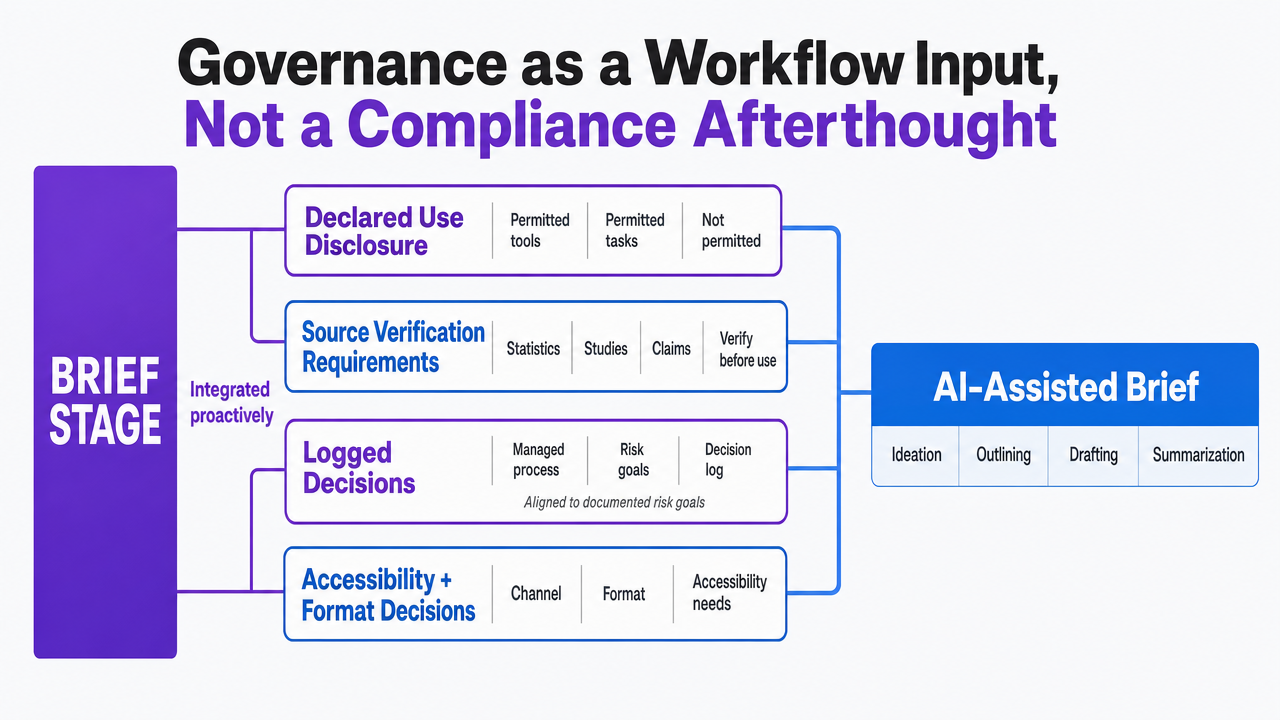 Visualize the three governance controls (AI provenance) and the accessibility/format decision layer cited in the section, both anchored to the brief stage
The Workflow Stack, Classified by Function
Instead of focusing on specific tools, a more enduring way to evaluate the workflow stack is by function: the purpose of each layer, its owner, and the signals it generates. Deloitte's enterprise AI research indicates that two-thirds (66%) of organizations achieve measurable productivity and efficiency gains from AI adoption, with content-heavy functions being key beneficiaries 13. For in-house managers, the question is whether all five functional layers are adequately staffed, instrumented, and interconnected.
The orchestration layer serves as the control plane, managing work movement between stages, queueing, SLA enforcement, and identifying bottlenecks. For smaller operations, this might be a project management tool combined with a shared editorial calendar; larger operations often use purpose-built content orchestration platforms with approval routing.
The production layer is where drafts are created, incorporating AI-assisted drafting, research synthesis, and outlining tools to accelerate writing. The review layer provides the environment for substantive edits and approvals, featuring tracked changes, comment threads, version history, and clear pass/revise decisions logged for each draft. McKinsey's 2025 global survey confirms that content generation and personalization are marketing use cases yielding attributable ROI 14, underscoring why the review layer gains importance as production speed increases.
The governance layer enforces policy, provenance, and accessibility controls specified in the brief, including declared AI use, source verification rules, WCAG conformance, and default formats. The measurement layer completes the loop by providing traffic, ranking, conversion, and pipeline telemetry linked to each published asset. Teams that categorize their stack this way quickly identify gaps—such as missing measurement integration or an orchestration layer reliant on spreadsheets—avoiding repeated lessons learned.
See How Leading Brands Streamline Content Workflows at Scale
Get a walkthrough of centralized approval and orchestration tools proven to reduce manual coordination, accelerate production cycles, and maintain consistent quality across high-volume content teams.
Role Redesign: What Writers, Editors, and Managing Editors Actually Do Now
Pre-AI-assisted production role descriptions assumed writers primarily focused on drafting. This is no longer the case. Harvard's executive education analysis of AI in marketing highlights accelerating adoption across campaign workflows and a corresponding need to upskill staff as repetitive tasks are automated 16. This redesign isn't about layoffs but a reallocation of time across roles.
Writers now dedicate less time to generating first drafts and more to critical upstream inputs: source research, interview synthesis, primary data gathering, and structural decisions that AI tools still struggle with without strong human direction. Their work shifts towards brief refinement and substantive revision of AI-generated material. CalStateLA's research on team-based AI workflows specifically notes the increased need for human oversight to manage bias, quality control, and brand consistency as generative tools take on more drafting responsibilities 15.
Managing editors experience the most significant role redesign. Their responsibilities evolve beyond episodic line editing to include queue management, SLA enforcement, and substantive review at higher volumes. The California state content role formalizes this expanded scope, assigning responsibility for refining publishing processes, coordinating contributors, and optimizing workflows for scalability 3. Content leads increasingly focus on strategy, topic-cluster planning, and approval-gate decisions where brand judgment is non-delegable. This represents a shift in how hours are distributed across the same headcount, illustrating how scaling without hiring is achieved.
Instrumenting the Workflow: What to Measure Before Executives Ask
Executives typically ask three questions about content investment: output volume, revenue contribution, and budget allocation. Workflows unable to answer these questions via a dashboard risk losing funding, regardless of content quality. APQC's standardization research emphasizes that lifecycle workflows, from intake to archival, require defined controls at every stage to maintain coherence at scale 4. Measurement serves as the control layer that makes the entire workflow transparent.
Four metric categories are essential for the dashboard:
- Throughput metrics track briefs assigned, drafts submitted, articles approved, and articles published per cycle, broken down by content type.
- Cycle-time metrics measure the duration between each stage gate—intake to brief, brief to draft, draft to approval, approval to live—making bottlenecks visible.
- Quality metrics combine revision rate per draft, approval rejection rate, and post-publish editorial corrections, indicating whether AI-assisted drafts meet review standards or increase editor workload.
- Outcome metrics link back to business results, including organic traffic, ranking position, conversion events, and pipeline attribution for each published asset.
McKinsey's 2025 survey identifies content generation and personalization as marketing use cases contributing measurable EBIT 14, meaning executives now expect content teams to report on financial impact, not just traffic. Content managers who instrument their pipeline proactively can provide data-driven answers during budget reviews. Platforms like Vectoron's Command Center consolidate this instrumentation—approval routing, SLA tracking, and outcome telemetry—making the dashboard a natural output of the workflow rather than a separate reporting project.
Frequently Asked Questions
References
- 1.Content strategy.
- 2.Your Content Operations - Digital Services & Solutions - Georgia.gov.
- 3.Job Description - CalCareers.
- 4.Standardize Content Management Structures and Workflows - APQC.
- 5.AI Risk Management Framework | NIST.
- 6.Biden-Harris Administration Announces New NIST Public Working Group on Artificial Intelligence.
- 7.W3C WCAG 2.2 Now Available - Access-Board.gov.
- 8.Create Accessible PDFs - Section508.gov.
- 9.Choosing the best format for your digital content: PDF or webpage?.
- 10.Reduce, remove, remediate: PDFs and government websites.
- 11.Digital Accessibility Checklist Success criteria.
- 12.Generative AI Takes Off with Marketers.
- 13.The State of AI in the Enterprise.
- 14.The State of AI: Global Survey 2025.
- 15.Integrating Generative AI into Team-Based Marketing Workflows.
- 16.AI Will Shape the Future of Marketing.