
Key Takeaways
- Linear content pipelines fail in regulated verticals because they treat compliance as the final gate, forcing rework after drafting, design, and editorial cycles have already been spent 12.
- Four intake questions—PHI use, testimonials, protected-class imagery, and attorney claims—route every asset into either a three-step fast lane or a multi-approver path that runs parallel to drafting.
- Each decision node maps to a specific regulator with published rules: HHS for HIPAA authorization 2, CMS for Medicare Advantage timing 3, SEC for testimonials 4, HUD for housing imagery 5, and state bars for attorney claims 10.
- Operators managing multiple locations should instrument the flowchart with named owners, per-node SLAs, and asset-level audit trails so one workflow governs every site and produces a queryable record.
Why Linear Content Pipelines Break in Regulated Verticals
The standard content pipeline—plan, write, edit, publish—treats compliance as the final gate. In behavioral health intake pages, DSO location pages, senior living community pages, Medicare Advantage member materials, and PI firm case result pages, that ordering is the reason production stalls. By the time a reviewer flags a patient reference that lacks HIPAA authorization, a testimonial missing SEC disclosures, or senior living imagery that reads as familial-status steering, the asset has already consumed drafting, design, and editorial cycles.
Rework compounds after drafting, not before it.
Every regulator behind these verticals has already published the routing logic teams need. HHS requires written authorization for nearly all uses of protected health information in marketing communications 2. CMS mandates structured review and submission timing for Medicare Advantage and Part D materials before beneficiary distribution 3. The SEC's modernized marketing rule sets specific conditions for testimonials, endorsements, and performance claims used by investment advisers 4. HUD prohibits discriminatory advertising in the sale or rental of housing, including imagery and language choices 5. State bar rules govern truthfulness and solicitation in attorney advertising 10.
Linear pipelines treat these as post-draft edits. An approval-first flowchart treats them as routing questions asked before a brief is written—so PHI, testimonials, protected-class imagery, and attorney claims determine which path an asset takes, who reviews it, and in what order. Compliance stops being the bottleneck at the end. It becomes the switch at the front 12.
The Approval-First Flowchart: Core Decision Nodes
Pre-Brief Compliance Intake: The Highest-Leverage Stage
The stage with the highest return on time is the one most teams skip: a structured intake before the brief is written. Pre-brief compliance intake asks a small set of routing questions about the asset's purpose, data inputs, imagery direction, and claim structure, then attaches those answers to the brief itself. The brief becomes a routing document, not just a creative one.
Skipping this stage is what turns a two-week production timeline into six weeks. A behavioral health intake page that references a specific patient's story cannot be salvaged in final legal review if HIPAA authorization was never collected 2. A Medicare Advantage explainer built without checking MCMG submission timing may miss its release window entirely 3. An adviser landing page that features a client quote without disclosure planning triggers a redesign under the SEC's testimonial conditions 4. A senior living community page shot with only one family type on set forces a photography reshoot after fair housing review flags the imagery 5.
Intake surfaces these constraints while they are still cheap to solve. The strategist writing the brief knows whether authorization forms are needed, whether disclosures must be drafted in parallel, whether the shoot list needs revising, and which reviewers will sign off before publication.
Intake is not a form for the compliance team's benefit. It is the mechanism that keeps compliance out of the terminal review slot 12.
The Four Routing Questions That Govern Every Asset
Four questions, asked at intake, route nearly every content asset in regulated verticals. Each maps to a specific regulator, and each has a defined downstream review path.
- Does the asset use or reference protected health information ? If a draft names a patient, describes a specific case, uses identifiable imagery, or repurposes clinical data tied to an individual, HHS requires written authorization before that PHI can be used for marketing 2. The routing outcome: attach an authorization workflow to the brief, or reframe the asset to use de-identified or composite content.
- Does the asset include a testimonial, endorsement, or performance claim? The SEC's modernized marketing rule sets specific disclosure, oversight, and disqualification conditions for testimonials and endorsements used by investment advisers, and constrains how hypothetical performance can be presented 4. The routing outcome: draft required disclosures alongside the copy, log the promoter relationship, and route to compliance before design finalizes.
- Does the asset depict protected classes or housing? HUD prohibits discrimination in the sale or rental of housing, and enforcement extends to advertising imagery, language, and targeting 5. The routing outcome: fair housing review of the shoot list, headline copy, and audience targeting parameters before production spend commits.
- Does the asset make an attorney claim or solicit legal services? California Rule 7.2 permits attorney advertising across written, recorded, and electronic media, but only subject to truthfulness and solicitation rules 7.1 and 7.3 10. The routing outcome: substantiation review of any result, credential, or specialization claim, plus solicitation-rule review of any direct-outreach component.
A "no" to all four sends the asset down the fast lane. A "yes" to any one triggers the corresponding review track, running in parallel with drafting rather than after it.
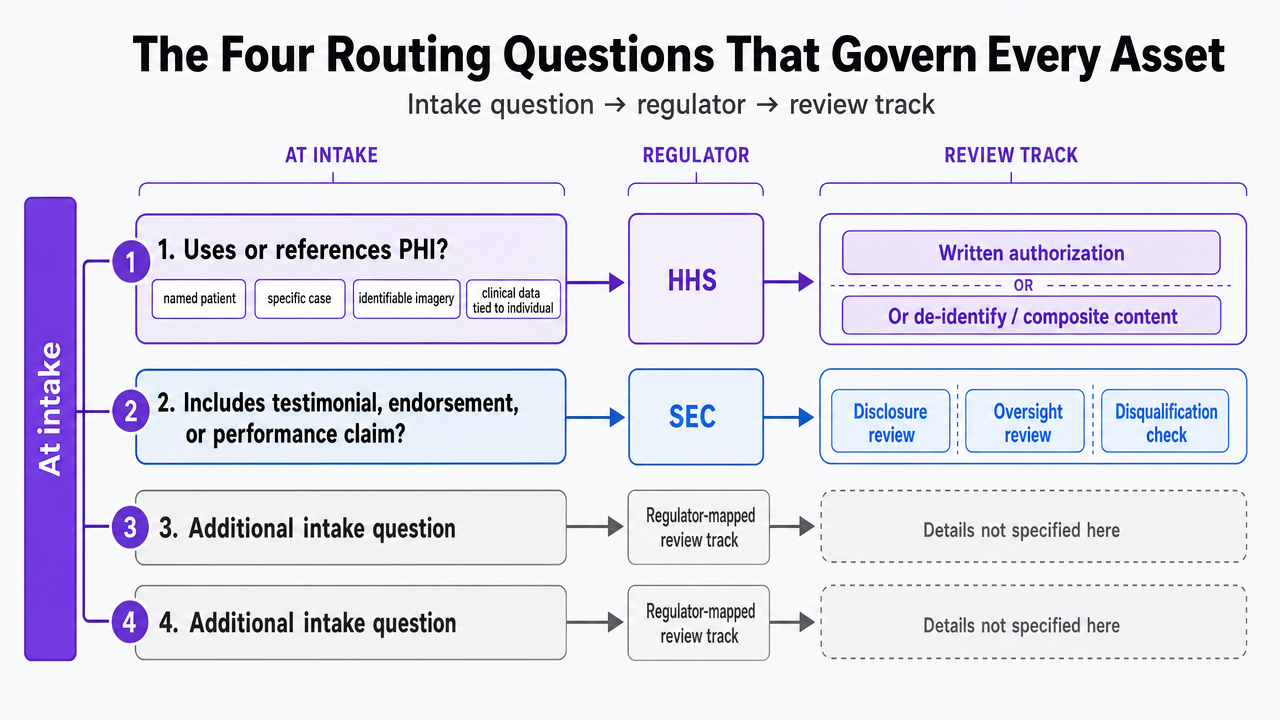 Visualize the four intake questions and their corresponding regulator-mapped review tracks, which is the central operating logic of the article
Risk-Tiered Routing: Three-Step Path vs. Multi-Approver Path
The four intake questions sort assets into two operating lanes. Treating them as one queue is what forces compliance to become the terminal step—because reviewers cannot tell which drafts need deep scrutiny and which do not.
Low-risk, three-step path. Assets that answer "no" to all four routing questions—generic educational articles, condition explainers written without patient identifiers, service pages with substantiated but non-comparative claims, community blog posts about non-protected topics—move through a compressed path: strategist brief, editorial review, publish. Two approvers, one review pass, no external compliance queue. This is the lane where AI-assisted drafting produces the largest velocity gains, because the review load stays proportional to the risk.
High-risk, multi-approver path. Any "yes" answer routes the asset to a documented review chain with named approvers per trigger. A behavioral health story referencing a real patient adds a privacy officer to verify HIPAA authorization is on file 2. An adviser page featuring a testimonial adds a compliance reviewer to confirm SEC disclosure and oversight conditions are met, plus a check on any hypothetical performance framing 8. A senior living community page adds a fair housing reviewer to evaluate imagery, familial status treatment, and whether the community qualifies for the Fair Housing Act's senior housing exemption 9. A law firm case result page adds bar-rule review of substantiation and disclaimers 10.
The multi-approver path is slower by design, but it runs in parallel with drafting. Authorization collection, disclosure drafting, imagery re-selection, and substantiation gathering happen while the draft is still in progress—not after it lands in a reviewer's queue with a publish date attached. The lanes are not equal in speed. They are equal in that neither creates surprise rework.
Mapping Regulators to Decision Nodes
HHS and HIPAA: The PHI Authorization Gate
The PHI node is the sharpest gate in the flowchart because HHS has drawn a bright line: with narrow exceptions, the Privacy Rule requires an individual's written authorization before protected health information is used or disclosed for marketing 1. HHS's own FAQ language goes further, stating that authorization is required for uses or disclosures of PHI for all marketing communications 2.
That single rule reshapes three common asset types. Behavioral health intake pages that quote a client story need signed authorization on file before the quote enters a draft, not before it goes live. Dental case studies that pair before-and-after imagery with treatment details require authorization tied to the specific marketing use, not a general consent buried in the new-patient packet. Healthcare provider blog posts that reference identifiable clinical scenarios need de-identification review or authorization documentation attached to the brief.
The decision node has two exits. If PHI is present, the asset routes to a privacy officer review track that runs parallel to drafting, with the authorization form or de-identification memo required before publish 7. If PHI is absent, the asset skips the privacy queue entirely. Teams that combine both flows into one review lane are the teams reporting six-week turnarounds on content that should ship in ten days.
CMS: Medicare Advantage Submission and Timing Checkpoints
CMS treats Medicare Advantage and Part D marketing as a scheduled activity, not an on-demand one. The Medicare Communications and Marketing Guidelines set requirements for content, submission, and timing of beneficiary-facing materials under 42 CFR Parts 422 and 423 3. The consolidated Medicare Marketing Guidelines page reinforces that these requirements define what is permitted, required, or prohibited across MA, MAPD, standalone PDP, and 1876 cost plans 6.
Two checkpoints matter for the flowchart. First, materials classification: the same asset can fall on either side of the marketing-versus-communications line depending on content choices, and that classification determines whether submission is required. Second, submission windows: annual enrollment materials, mid-year updates, and VBID-specific communications each carry their own timing constraints, with CY 2025 VBID guidelines adding standardized outreach expectations for plans in that model 11.
The routing rule is straightforward. Any asset touching MA, Part D, or VBID plans enters a CMS review track at intake, with the classification decision made before drafting begins. Missing that window forces a delay to the next allowable release date, which for annual enrollment content can mean losing a full selling season.
SEC: Testimonials, Endorsements, and Hypothetical Performance
The SEC's modernized marketing rule merged the prior advertising and cash solicitation rules into a single framework governing how investment advisers present themselves in any medium, including digital ads and social posts 4. The final rule text specifies that the amendments create a merged rule replacing both prior regimes 8.
Three elements drive the decision node. Testimonials and endorsements are permitted only when the adviser satisfies disclosure, oversight, and disqualification conditions—meaning promoter relationships must be logged, required disclosures must be drafted, and disqualifying events must be checked before the quote appears in copy 4. Hypothetical performance is constrained to audiences with the resources and expertise to assess it, which rules out most public-facing landing pages by default 8. Third-party ratings carry their own presentation requirements around fairness and balance.
The routing outcome for adviser content is precise. If a draft includes a client quote, a hypothetical return chart, or a "top adviser" badge, the asset enters compliance review at intake with the disclosure language drafted alongside the copy. Design finalizes only after compliance signs off on the paired disclosures, because retrofitting disclosures into a completed layout is where the rework budget disappears.
HUD: Fair Housing Imagery and Senior Living Exemptions
HUD's position on advertising is direct: it is illegal to discriminate in the sale or rental of housing, and that prohibition extends to advertising imagery, language, and targeting 5. For senior living operators, the Fair Housing Act adds a specific carve-out—the Act exempts qualifying senior housing facilities from familial status liability, but only when the community meets the statutory criteria 9.
The decision node handles both directions. Community pages, shoot lists, and targeted ad creative route to a fair housing review that evaluates whether depicted residents, headline copy, and audience parameters could be read as steering. For communities claiming the senior housing exemption, review also confirms the community qualifies and that the exemption is documented before the marketing leans into age-specific messaging.
The operational payoff sits upstream. A shoot list reviewed at intake avoids the reshoot that a completed campaign triggers when imagery reads as familial status steering. Fair housing review is cheap when it edits a shot list and expensive when it edits a finished asset.
State Bar: Attorney Advertising Truthfulness and Solicitation
State bar rules govern the outer boundary of attorney advertising, and California's Rule 7.2 sets a representative framework: lawyers may advertise services through any written, recorded, or electronic means, subject to the truthfulness requirements of Rule 7.1 and the solicitation limits of Rule 7.3 10. The permission is broad. The constraints are specific.
The decision node splits on two triggers. Any substantive claim—case results, specialization language, credentials, comparative statements—routes to a substantiation review that verifies the claim, documents the source, and drafts any required disclaimers before the copy is locked. Any direct-outreach component—prospecting emails, targeted social messages, intake-form follow-ups—routes to a solicitation-rule review that checks whether the outreach reaches a prohibited audience or requires prescribed labeling.
For multi-office firms and PI shops running high-volume case result pages, this node is where velocity is won or lost. Substantiation logs maintained during drafting turn bar-rule review into a verification step. Substantiation gathered after publication turns it into a takedown request.
Test Approval-First Content Workflows With Real Output
Experience the full approval-based content process and publish live content before making a commitment.
Stage-by-Stage Workflow Table
The workflow table below consolidates the flowchart into an operator reference: which stage triggers which decision node, who owns the sign-off, which regulator sets the rule, and what typically forces rework when the stage is skipped or run out of sequence.
| Stage | Decision Node | Responsible Role | Source of the Rule | Typical Rework Trigger |
|---|---|---|---|---|
| Pre-brief compliance intake | PHI present, testimonial used, protected-class imagery, attorney claim | Content strategist with compliance liaison | Aggregate: HHS 1, SEC 4, HUD 5, State Bar 10; framework support 12 | Intake skipped; constraints surface after drafting |
| Brief and routing assignment | Risk tier: fast lane vs. multi-approver | Editorial lead | Legal framework requiring documented review 12 | Asset queued in wrong lane; approvers not notified in parallel |
| Authorization and de-identification workflow | PHI use tied to identifiable individual | Privacy officer | HHS HIPAA marketing guidance 1 | Patient story drafted before written authorization is on file |
| CMS classification and submission | Marketing vs. communications; MA, Part D, or VBID trigger | Regulatory affairs | CMS MCMG under 42 CFR Parts 422 and 423 3 | Missed submission window forces delay to next allowable release |
| Testimonial, endorsement, and performance review | Client quote, hypothetical return, third-party rating | Adviser compliance reviewer | SEC modernized marketing rule 4 | Disclosures retrofitted into finished layout after design lock |
| Fair housing review | Residents depicted, headline copy, audience targeting parameters | Fair housing reviewer | HUD Fair Housing rights and obligations 5 | Reshoot ordered after imagery reads as familial status steering |
| Bar-rule substantiation review | Case result, credential, specialization, or direct outreach | Firm ethics counsel | State Bar of California Rule 7.2 10 | Substantiation gathered post-publish; takedown or correction issued |
| Editorial and brand review | Voice, accuracy, source strength | Managing editor | Internal editorial standard | Fact drift discovered at final legal review, not at draft |
| Final sign-off and publish | All prior gates cleared and logged | Content owner with named approvers | Aggregate regulatory record 12 | Publish executed without audit trail of prior approvals |
Two patterns show up in the rework column. Every trigger involves a decision that could have been made earlier at lower cost, and every trigger corresponds to a regulator that has already published the rule in writing. The table is the artifact that keeps those two facts operational rather than aspirational.
Where AI Drafting Enters the Flow, and Where It Cannot
AI drafting belongs inside the flowchart, not bolted onto the side of it. The correct entry point is the drafting stage, after intake has classified the asset, assigned the routing lane, and attached the constraints the draft has to respect. An AI strategist writing a dental service page already knows whether a patient reference is allowed, whether comparative claims need substantiation, and which disclaimers must be paired with the copy—because intake set those parameters before generation began.
That placement produces the velocity gain. It also defines the gates AI cannot cross.
Written authorization for PHI use is a human signature event; the privacy officer confirming a form is on file cannot be replaced by a model output 2. CMS classification and submission decisions for Medicare Advantage materials sit with regulatory affairs, because misclassifying a marketing piece as a communication carries statutory consequences 3. SEC testimonial oversight, disclosure sign-off, and the disqualification check on promoters require a named compliance reviewer, not an inference 4. Fair housing judgment on imagery and attorney substantiation of case results remain human sign-offs. AI accelerates the drafting lane. The approval gates stay staffed.
See a Live Approval-First Workflow for Multi-Channel Content Execution
Request a walkthrough of a centralized, approval-driven content process that accelerates production, strengthens governance, and aligns strategy across teams—purpose-built for agencies and enterprise marketing operations.
If You Manage Multiple Locations: One Workflow, Many Sites
The flowchart's return scales with location count. A DSO running 40 practice pages, a senior living operator with 22 communities, a PI firm with 9 offices, and a home services brand with 60 metro landing pages all face the same structural problem: without a single governing workflow, each location reinvents review, and each reinvention is where compliance drift enters.
One approval workflow, applied across every site, changes the math. The four routing questions from intake—PHI use, testimonial or endorsement, protected-class imagery, attorney claim—get asked once per asset regardless of how many locations publish it. A dental service page templated across 40 practices runs through PHI review one time, not 40. A senior living community-tour page reviewed against fair housing imagery standards clears the shoot list at the portfolio level, then instances to each community with location-specific fields only 5. A PI firm's case result template gets substantiation review once for the claim structure; per-office instances only re-verify the local facts and disclaimers 10.
Templated review does not mean identical output. Location-specific variables—provider names, community amenities, attorney bar admissions, service-area language—stay editable in the instance, while the governed elements stay locked to the approved template. Fair housing exemption status, for operators claiming it, is documented per community rather than assumed across the portfolio 9. HIPAA authorization workflows tie to the specific patient reference in the local instance, not the master template 2.
The audit trail is the compounding asset. One workflow produces one log across every location, which is what turns a portfolio review from a per-site scramble into a query.
Instrumenting the Flowchart: Owners, SLAs, and Audit Trails
A flowchart on a slide is a diagram. A flowchart wired to owners, service levels, and audit logs is an operating system. The difference shows up in how fast rework gets caught and whether a regulator asking for evidence gets an answer in minutes or a scramble.
Three instruments turn the diagram into infrastructure.
Named owners at every node. Each decision point—PHI intake, CMS classification, testimonial disclosure sign-off, fair housing imagery review, bar-rule substantiation—needs a role, a backup, and an escalation path. "Compliance" is not an owner. A privacy officer is. A regulatory affairs lead is. A firm ethics counsel is. When ownership is ambiguous, assets pool at whichever reviewer opens their queue first, and the parallel-review design collapses back into a linear one.
ND service levels per lane. Fast-lane assets clear editorial in a defined window; multi-approver assets carry per-node SLAs so a testimonial disclosure draft, a fair housing imagery check, or a CMS classification decision each has a target turnaround rather than an open-ended "in review" status 3. SLAs make the queue observable. Missed SLAs surface where staffing or intake quality is the actual constraint.
An audit trail tied to the asset, not the reviewer's inbox. Every gate produces a logged artifact: the signed HIPAA authorization on file 2, the CMS submission confirmation and classification decision 3, the SEC disclosure sign-off with the promoter relationship documented 4, the fair housing review of the shoot list and targeting parameters 5, the bar-rule substantiation record for each result or credential claim 10. When a regulator, an internal auditor, or an insurer asks for evidence, the record is queryable rather than reconstructed 12.
Instrumented this way, the flowchart stops being a policy document and starts being the record of how the content function actually runs.
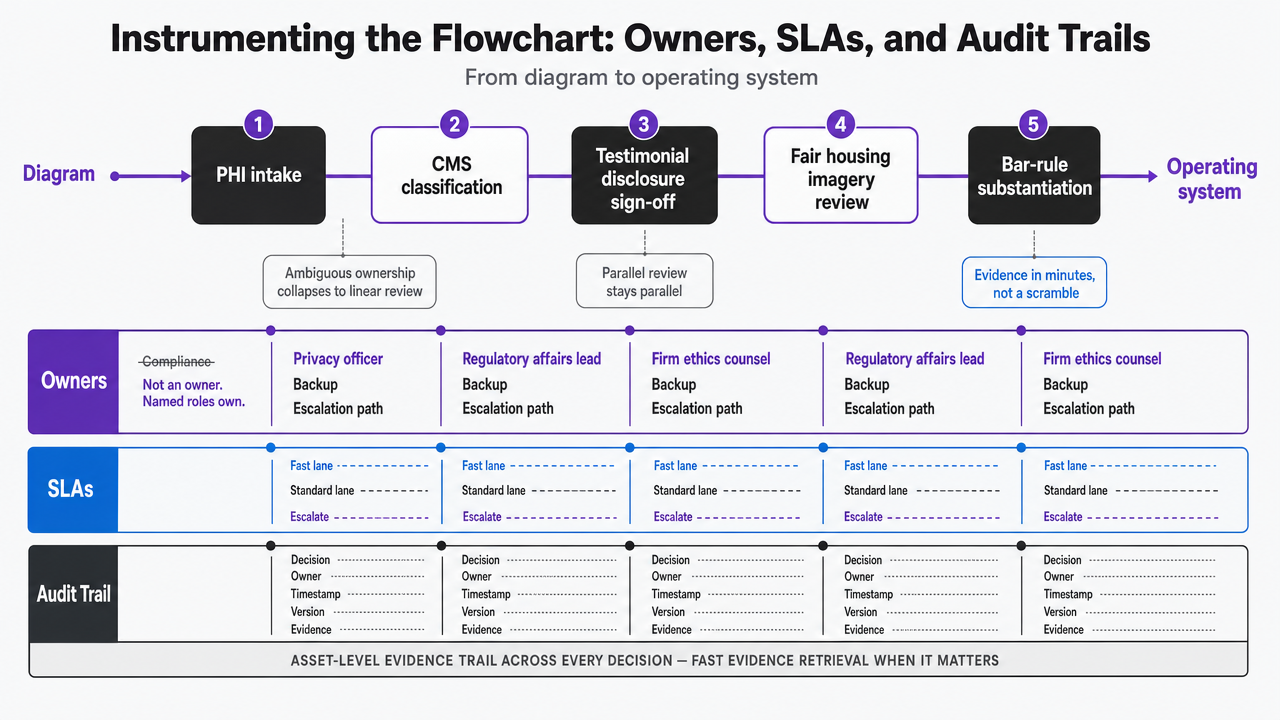 Show the three instruments (named owners, per-lane SLAs, asset-level audit trail) that convert the flowchart from a diagram into an operating system, directly supporting the section's cited framework
Frequently Asked Questions
References
- 1.Marketing | HHS.gov.
- 2.Marketing – HIPAA Privacy Rule FAQs.
- 3.Medicare Communications and Marketing Guidelines (MCMG).
- 4.SEC Adopts Modernized Marketing Rule for Investment Advisers.
- 5.Fair Housing: Rights and Obligations.
- 6.Medicare Marketing Guidelines - CMS.
- 7.What are the HIPAA Marketing Rules?.
- 8.Investment Adviser Marketing – Final Rule.
- 9.Fair Housing – Equal Opportunity for All.
- 10.Rule 7.2 Advertising (Redline Comparison to the ABA Model Rule).
- 11.CY 2025 VBID Model Communications and Marketing Guidelines.
- 12.Understanding the Legal Framework of Digital Marketing Compliance with an MLS.