
Key Takeaways
- A content development workflow operates as a decision graph with four human approval gates—strategy, brief, draft, and publish—connected by automated research, drafting, formatting, and distribution between them.
- The brief gate carries the highest leverage, since precision in angle, sources, and voice constraints determines whether downstream drafting requires surgical edits or structural rework.
- Organizations that redesign processes around AI pull ahead of those that bolt tools onto unchanged pipelines, because throughput is dictated by handoffs and gate clarity, not typing speed 6.
- Teams should focus next on embedding provenance and testing inside the gates, redefining roles around judgment, and measuring fully-loaded cost per published asset rather than headcount.
Why Editorial Pipelines Are Breaking Under Volume Pressure
Content demand is outpacing the systems built to produce it. Deloitte Digital's research on generative AI in marketing reports a 54% year-over-year increase in the volume of content marketing teams are being asked to produce, alongside 26% of marketers already using generative AI in production and another 45% planning to adopt it 5. This figure reflects internal demand signals rather than total market consumption, indicating that existing pipelines cannot meet current quotas without structural change.
Editorial calendars designed for limited output fail under increased throughput. Briefing cycles stretch, reviews queue, and brand voice drifts as freelancers fill gaps. The bottleneck is rarely talent; it is the number of sequential human handoffs required for each asset.
The solution is not faster typing, but a workflow redesigned around fewer, higher-leverage human decisions, with automated execution running between them. This article details what that workflow looks like in practice.
The Workflow as a Decision Graph, Not a Stage List
What a Modern Content Workflow Actually Looks Like
A content development workflow is the repeatable system that moves an idea through research, briefing, drafting, review, publishing, distribution, and measurement, with defined owners and approval points at each handoff. While this definition remains constant, the ratio of human work to machine work within this system has changed.
In a workflow built for current production demands, humans no longer touch every task, but rather every decision. A content marketing manager approves the strategy, the brief, the draft, and the publish-ready asset. Between these four moments, the workflow automates research queries, outline generation, copy drafting, SEO application, CMS formatting, and distribution queuing. The workflow's structure resembles a decision graph: nodes where a human commits to a direction, and edges where automated execution carries that direction forward until the next node.
This structure aligns with McKinsey's State of AI 2025, which identifies organizations that embed AI deeply into processes rather than layering it onto existing steps 6.
Why Linear Stage Diagrams Hide the Real Bottlenecks
The standard editorial diagram—ideate, brief, draft, edit, publish, promote, measure—is a useful teaching tool but a poor diagnostic one. It treats each stage as roughly equal in cost and time. In practice, the cost is concentrated in the handoffs, not the stages.
A draft slows down not because writing is difficult, but because the brief was ambiguous, the subject matter expert (SME) review queue is long, or the managing editor is occupied with another asset. The bottleneck exists between the boxes, not within them. NYU's editorial workflow guide emphasizes that the workflow formalizes review and decision-making, not task labeling 3.
Mapping the workflow as a decision graph directly exposes the handoff cost. Every human-required interaction for reading, commenting, and routing creates a queue. Every node where a human decides acts as a gate. Reducing queues and clarifying gates constitutes the redesign, rather than adding or renaming stages.
The Four Human Approval Gates
Gate One: Strategy Approval
The strategy gate is where a content marketing manager commits to what content will be produced and why. The output is a ranked list of topics, formats, and target outcomes tied to a measurable goal, such as rankings on a keyword cluster, pipeline contribution from a specific persona, or retention lift on a product line.
Before this gate, automated processes pull keyword opportunities, competitor coverage gaps, search trend data, and internal performance signals from analytics and CRM systems. This research is summarized into ranked recommendations with supporting reasoning. The manager reviews the ranking, adjusts priorities based on business context the system cannot perceive, and approves the quarterly or monthly content slate.
This decision is strategic, not editorial. The manager approves which problems the content operation will solve and in what order. Ambiguity at this stage propagates as rework through every subsequent gate.
Gate Two: Brief Approval
The brief gate converts an approved topic into a production-ready specification. A precise brief includes:
- the target keyword,
- search intent,
- audience scope,
- angle,
- primary sources,
- required evidence,
- internal links,
- calls to action,
- word count, and
- brand voice constraints.
Between the strategy gate and this one, the workflow performs SERP analysis, identifies top-ranking competitor structures, extracts questions from search queries, and drafts a brief skeleton with a proposed outline, sources, and angle. The manager reviews the draft brief, refines the angle, adds missing context, and approves it.
This gate represents the highest-leverage decision in the entire workflow. A precise brief significantly reduces downstream review cycles, while an ambiguous one guarantees them. Editorial teams that effectively compress their review burden typically do so here, not at the draft stage. The brief is where judgment compounds; the draft is where its value is realized.
Gate Three: Draft Approval
At the draft gate, the manager or a designated editor reviews the full asset against the approved brief. By this stage, the draft has been written, fact-checked against cited sources, optimized for the target keyword cluster, formatted for the CMS, and passed through a voice and readability check.
The reviewer does not edit line by line. Instead, they check five key aspects:
- alignment with search intent,
- brand voice consistency,
- claim support,
- correctness of calls to action, and
- advancement of the strategic goal approved at gate one.
Edits at this stage are surgical, not structural.
If structural rework is needed, the failure almost always traces back to a vague brief. Teams that track rework reasons by gate quickly identify where their workflow is inefficient. The draft gate serves as a diagnostic instrument in addition to an approval step.
Gate Four: Publish Approval
The publish gate is the final sign-off before the asset goes live and is intentionally lightweight. The content's substance has already been reviewed at gate three. This stage focuses on checking the publishing surface: metadata, schema, canonical tags, images and alt text, correct rendering of internal links, tracking parameters, and distribution queue loading.
Automated processes between gate three and gate four handle mechanical tasks such as CMS staging, link insertion, image compression, schema generation, and pre-drafts for social media and email. The manager confirms the asset is technically clean and approves its publication.
Treating publish as a separate gate is crucial because production errors at this stage are highly visible externally and easily preventable. A broken canonical tag or missing tracking parameter can negate a month of upstream work. This gate exists to catch minor failures that can have significant consequences.
Mapping the Full Gate Sequence
Together, the four gates form a decision graph: Strategy → automated research → Brief → automated drafting → Draft → automated formatting → Publish → automated distribution. This involves four human commitments interspersed with four stretches of machine execution.
This structure distinguishes organizations that redesign key processes around AI from those that use AI superficially, as noted in McKinsey's 2025 global survey of AI adoption 6. The redesigners are not merely acquiring better drafting tools; they are restructuring where humans make decisions and where machines execute. This gate sequence defines the operational shape of that restructuring and underpins the entire workflow.
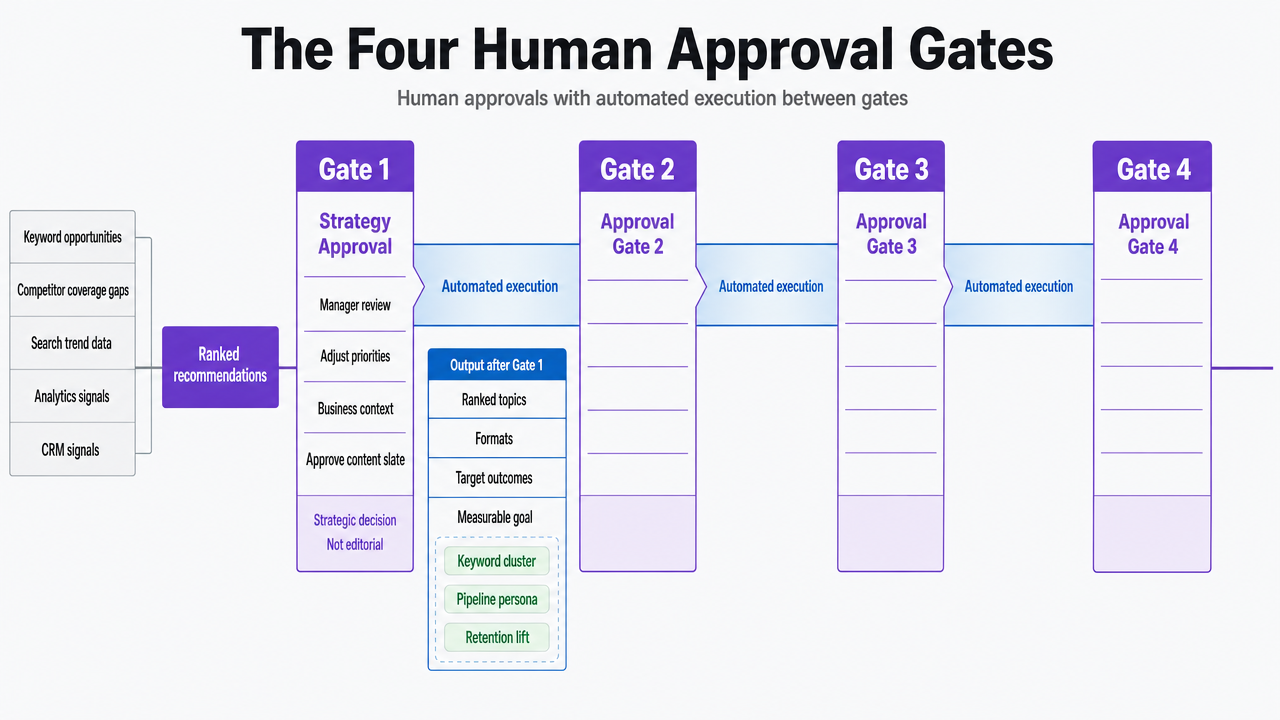 Visualize the four human approval gates and the automated execution stretches between them, which is the central operating model of the article
Accelerate Your Content Workflow in One Week
Experience a measurable increase in published content velocity with no disruption to your existing approval process.
What Runs Automatically Between the Gates
Research, Ideation, and Outline Generation
Between the strategy gate and the brief gate, the workflow conducts extensive automated research. This includes keyword expansion, SERP scraping, competitor outline parsing, internal analytics pulls, sales call transcript mining, and topic clustering, all without human intervention. The output is a structured input pack, not a finished brief, containing:
- ranked keyword opportunities with difficulty and intent tags,
- a competitor coverage matrix,
- top questions from "People Also Ask" and forum data, and
- a proposed outline with source candidates.
This automated process frees strategists from time-consuming manual research, allowing them to focus on decision-making. McKinsey's analysis of generative AI value concentration highlights marketing and sales as functions capturing approximately 75% of the technology's economic potential, with content drafting and ideation explicitly mentioned 9. Research and outline generation is where this value first compounds in a content operation.
Drafting, Optimization, and Formatting
The period between the brief gate and the draft gate involves the most intensive automated work. The system drafts content based on the approved brief, pulls supporting evidence from named sources, inserts citations, applies the brand voice profile, optimizes for target keywords and entities, generates supporting elements like FAQ blocks and schema markup, and formats the asset for the destination CMS.
The quality of the output at this stage is highly dependent on the precision of the upstream brief. A brief that specifies angle, sources, evidence requirements, and voice constraints yields a draft requiring minimal, surgical edits. A vague brief, conversely, results in a draft needing significant rewriting. Drafting automation amplifies the quality of prior decisions rather than acting as a quality control itself.
Formatting and optimization tasks—such as meta descriptions, image alt text, internal link candidates, and readability passes—run in parallel rather than sequentially, significantly reducing cycle time.
Distribution, Repurposing, and Measurement
After the publish gate, the workflow continues without further human approval until performance data necessitates a new decision. Distribution queues send the asset to email, social, and syndication channels according to schedule. Repurposing routines transform long-form assets into short-form variants—social posts, newsletter blurbs, sales enablement snippets—using the approved source as the canonical input.
Measurement runs continuously, with rankings, organic traffic, engagement, conversion contribution, and pipeline influence feeding back into the analytics layer for the next strategy gate, closing the loop. McKinsey's research on collaborative and workflow tooling estimates productivity gains of 20 to 25 percent for interaction workers when structured systems replace ad hoc coordination 10. In content operations, much of this gain is realized after publication, where measurement and repurposing were often neglected under deadline pressure.
The Redesign Gap Separating Output Leaders From Tool Tourists
The distinction among AI-adopting organizations is more significant than headline adoption numbers suggest. McKinsey's 2025 global survey of AI adoption across industries indicates that roughly one-third of organizations are redesigning key processes around AI, while another third use AI superficially with limited process change 6. The remaining organizations have not adopted AI operationally. Within content operations, the middle group is common and often stagnant: tools are licensed, prompts circulate, individual writers are faster, but overall output remains largely unchanged.
This stagnation is mechanical. Bolting a drafting tool onto an unchanged editorial pipeline only accelerates one step in a workflow whose throughput is dictated by handoffs, not typing speed. The brief still queues behind the same managing editor, SME review still takes a week, and CMS upload still falls to one coordinator. Faster drafts merely accumulate against unchanged gates.
Output leaders distinguish themselves with fewer review layers, clearer gate ownership, and explicit definitions of work that runs without human intervention. The difference between these groups is not a tooling gap, but a workflow design gap. This gap is the most reliable predictor of whether an AI investment will result in more content or simply more meetings about content.
Governance as Workflow Infrastructure
Provenance, Testing, and Review Controls Inside the Gates
Governance in content operations fails when it is an external review committee. It succeeds when integrated into the existing workflow gates. The NIST AI Risk Management Framework emphasizes incorporating trustworthiness into the design, development, use, and evaluation of AI systems, rather than reviewing it post-factum 1. For a content workflow, this means provenance, testing, and review controls are embedded within the four gates.
Provenance is attached at the brief gate, with every claim including its source, retrieval date, and path to the underlying document. Testing occurs between the brief and draft gates, involving factual checks against cited sources, voice and policy checks against brand standards, and a hallucination pass to flag untraceable assertions. Review controls activate at the draft gate, where the editor sees the citation chain and flagged items, not just the prose. NIST's GenAI Profile formalizes this pattern, naming content provenance and pre-deployment testing as core controls 2. This approach to governance adds minutes to a draft review, not weeks to a publishing calendar.
If the Team Publishes in Regulated Verticals
For operators in regulated verticals such as legal, healthcare, behavioral health, dental, and senior living, where published content carries regulatory exposure, the gate structure remains the same, but the contents of each gate are adapted.
The brief gate includes a regulatory scope field—e.g., HIPAA, state bar advertising rules, FTC endorsement guidelines—and designates the approver responsible for sign-off. The draft gate adds a compliance reviewer alongside the editorial reviewer, both working from the same citation chain. A peer-reviewed evaluation of data governance frameworks found no significant difference in the effectiveness of ISO standards, GDPR, and HIPAA in protecting sensitive data, suggesting that implementation quality matters more than the specific framework adopted 8. This implies that regulated content teams should prioritize investing in gate-level controls to effectively implement their chosen framework for every asset.
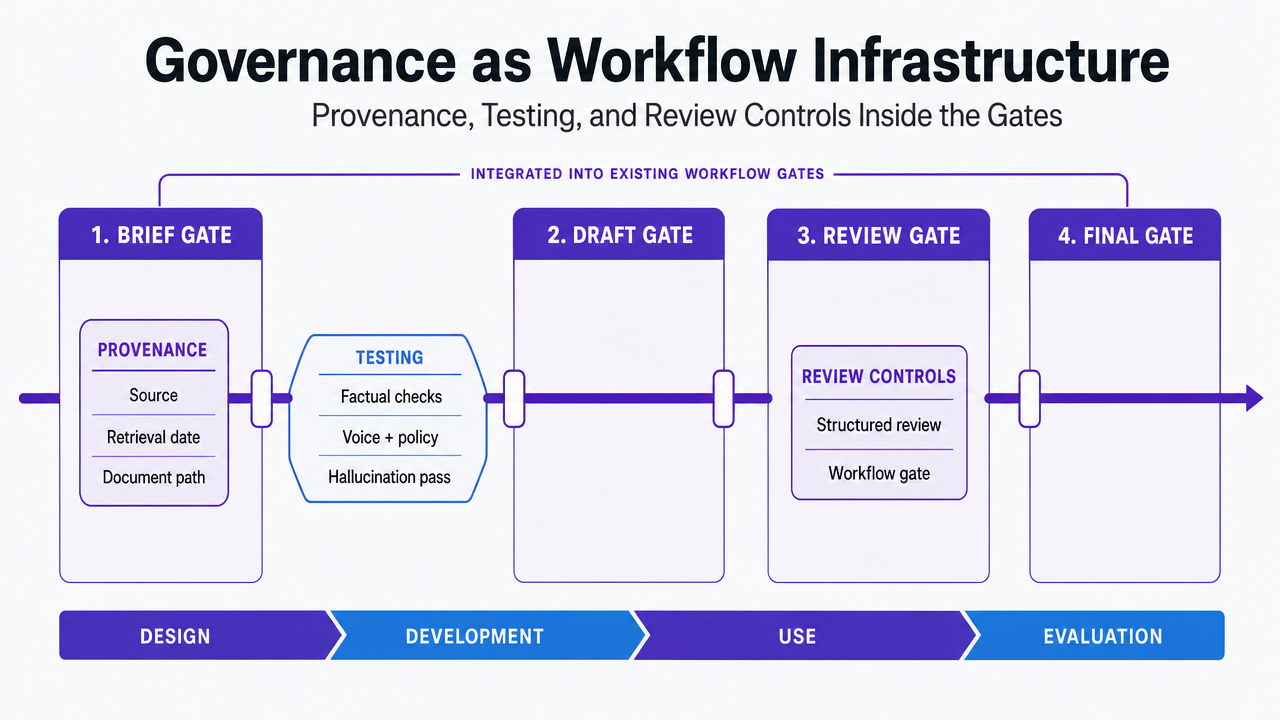 Show how governance controls (provenance, testing, review) are embedded inside the existing gates rather than added as a separate layer, supporting the NIST-aligned governance section
See How Leading Teams Streamline Content Development Workflows
Connect with experts to benchmark your current workflow against AI-driven models that cut production time, reduce approval cycles, and maintain enterprise-grade quality at scale.
Redefining Human Roles Around Judgment
The described workflow redesign does not eliminate roles but changes their focus. Deloitte's enterprise AI research identifies insufficient worker skills as the largest barrier to AI integration and notes a deliberate shift in advanced organizations toward streamlined end-to-end AI execution with human work concentrated on judgment and oversight 7. In content operations, this shift is evident in three key roles.
The content marketing manager transitions from production traffic cop to gate owner. Time previously spent assigning briefs, chasing reviews, and pasting drafts into the CMS is reallocated to ranking strategic bets, refining briefs, and reviewing flagged items at the draft gate. The role becomes more analytical and less administrative.
The writer or editor shifts from first-draft producer to substantive reviewer. Their work involves examining citation chains, identifying subtle voice deviations, and rewriting sections where the brief was insufficient. Output per editor increases because line-by-line drafting is no longer the primary bottleneck.
The SEO and analytics specialist evolves from a post-hoc reporter to an upstream input owner, feeding ranked opportunities and performance signals into the strategy gate. For each of these roles, judgment, not throughput, becomes the primary measure of performance.
What Marketing Can Borrow From Academic Editorial Practice
Journal publishing has long formalized the concept that the workflow itself is the quality control, a principle marketing teams are now beginning to adopt. NYU's editorial workflow guide views publishing as a structured sequence of review and decision points, not merely a list of tasks 3. A peer-reviewed study of commercial academic publishers found that editorial process structure is where peer-review innovation truly resides 4. Both observations are directly applicable to marketing.
Three practices are particularly valuable to import:
- Every asset should carry a citation chain from the brief forward, rather than being assembled at the end.
- Reviews should be scoped to specific questions—e.g., does it address search intent, are claims supported, does it match brand voice—instead of open-ended line editing.
- Decisions should be logged at each gate to trace rework reasons upstream.
This results in a workflow that functions more like a manuscript pipeline, where quality is engineered into the handoffs rather than merely inspected at the end.
The Economics of Headcount Versus Workflow Redesign
Content marketing managers often perform incorrect financial calculations. The question presented to finance typically frames costs in terms of headcount, freelancers, or agency retainers needed to meet new output targets. This approach assumes a fixed workflow and treats labor as the only variable, which is why most expansion budgets yield sub-linear output gains.
The correct comparison is the marginal cost of one more asset under the current workflow versus the marginal cost under a redesigned workflow. Adding a writer increases drafting capacity but does not change brief queue depth, review cycle time, or CMS handoff costs. The new writer's output encounters the same gates as the existing team's, meaning total throughput increases less than predicted by headcount additions. Redesigning the workflow around the four approval gates, conversely, lowers the per-asset cost for every existing role by automating the work between gates that previously consumed their time.
McKinsey's analysis of generative AI's economic potential attributes approximately 75% of the technology's value to four functions, explicitly naming marketing and sales, alongside content drafting and ideation use cases 9. This value is not reflected in a per-writer line item; it appears as a lower fully-loaded cost per published asset, which is the metric a content operation should prioritize in its budgeting.
Frequently Asked Questions
References
- 1.AI Risk Management Framework | NIST.
- 2.Artificial Intelligence Risk Management Framework: Generative Artificial Intelligence Profile.
- 3.Journal Publishing: Editorial Workflows.
- 4.Innovating editorial practices: academic publishers at work.
- 5.Deloitte Digital's latest research forecasts generative AI's transformation of content marketing.
- 6.The State of AI: Global Survey 2025.
- 7.The State of AI in the Enterprise - 2026 AI report.
- 8.Evaluating the effectiveness of data governance frameworks ....
- 9.The economic potential of generative AI: The next productivity frontier.
- 10.The social economy: Unlocking value and productivity through social technologies.