
Key Takeaways
- Treat ideation as a workflow architecture problem, not a creativity gap—generative AI produces plenty of ideas, but routing, ranking, and approval determine whether output translates into pipeline.
- Move deliberately through the maturity model: personal AI sidecars give way to shared prompt libraries, then to embedded ideation where signals, prompts, and provenance live inside the workflow 4.
- Protect brand voice and defensibility with versioned prompts, source-grounded generation, fact-check and IP gates, homogenization audits, and provenance labeling that acknowledges reader expectations around disclosure 6, 7.
- Prove throughput by tracking ranked idea supply, approval rate, hours to publish, and downstream contribution together, so volume gains stay tied to pipeline rather than vanity output 9.
The Ceiling Lean Teams Hit When Ideation Stays Ad-Hoc
A content manager can quickly generate numerous blog title candidates with AI. However, the real challenge lies in determining which ideas align with pipeline goals, pass editorial review, maintain brand voice during production, and avoid being lost in a backlog. While nearly 90% of marketers use generative AI tools, with 85% reporting increased productivity and about half noting improvements in both content quantity and quality, value capture remains a hurdle, especially for lean teams 3.
For small teams managing a high volume of content across various channels, ad-hoc AI use often leads to a flood of unorganized ideas. These ideas reside in personal chat histories, prompts are recreated weekly, ranking is subjective, and approvals are handled informally. This approach quickly limits throughput, causes brand voice inconsistencies, and fails to deliver qualified leads, highlighting a lack of structured ideation.
Why Ideation is a Workflow Problem, Not a Creativity Problem
Many lean teams mistakenly view ideation as a creative bottleneck. However, generative AI can produce more ideas in minutes than a small team can execute in a quarter. The true constraint has shifted from idea generation to the subsequent steps of routing, ranking, and approving ideas for production. This is a workflow challenge that requires defined inputs, clear ranking criteria, standardized prompts, and a structured approval process.
Research indicates that AI often functions as a personal productivity tool rather than an integrated part of a team's workflow. Significant gains only emerge when AI is treated as a collaborative partner within established processes 4. This shift from experimentation to captured value is also observed at the enterprise level 9. For content managers, this means idea supply is no longer the primary KPI, prompt quality becomes a shared asset, and the approval queue becomes a focal point for design attention. Ideation, therefore, is fundamentally about architecture.
A Maturity Model for Embedding AI into Ideation
Stage One: AI as a Personal Productivity Sidecar
In this initial stage, AI tools are used individually and informally. A content manager might use a chatbot for outlines, while a writer uses another tool to refine paragraphs. There is no sharing, logging, or version control of these AI interactions. This pattern is common, with AI primarily serving as a personal productivity enhancer rather than a core team workflow tool 4. While individual output may improve, these gains do not compound across the team.
Key indicators of this stage include:
- Prompts being rewritten from memory
- Inconsistent content structures between writers working on the same topic due to varied AI queries
- A loss of prompt knowledge when team members are absent
Ideation velocity depends on individual effort rather than a systematic approach. While this is a common starting point, it should not be the final destination.
Stage Two: Shared Prompt Libraries and Team Practice
Stage two involves treating prompts as shared assets rather than personal notes. A centralized prompt library, accessible to all writers, is established. Prompts are categorized by their function (e.g., "blog outline for bottom-of-funnel comparison"), include an owner, and a last-reviewed date. This formalizes AI use through shared prompt libraries and integrates AI-generated drafts more explicitly into the workflow 4. Reviewers are aware when they are evaluating AI-assisted content.
Operationally, this means writers working on similar topics will produce consistent structures by using the same prompts. Onboarding new freelancers becomes quicker, and brand voice adjustments can be made by editing a single prompt rather than correcting multiple writers. However, AI still operates outside the main content pipeline at this stage; ideas are generated individually and manually added to the editorial calendar. The library improves consistency but does not yet automate workflow routing.
Stage Three: AI as an Embedded Ideation Teammate
At stage three, AI becomes an integral layer within the workflow, functioning as a collaborative partner across ideation, drafting, and review 4. The AI system queries relevant signals such as search performance, sales call transcripts, and product release notes. Idea candidates arrive pre-ranked against pipeline criteria, eliminating ad-hoc brainstorms. Prompts are integrated directly into the system that generates drafts, and each generation includes provenance details like prompt version, sources used, and reviewer approval.
Human oversight remains crucial but shifts its focus. Judgment is concentrated at the ranking and approval gates, allowing editors to efficiently review numerous data-driven recommendations. This stage emphasizes that human oversight is essential even with deep AI integration 4. Most lean teams are currently between stage one and two, and identifying the current stage is key to planning the next steps.
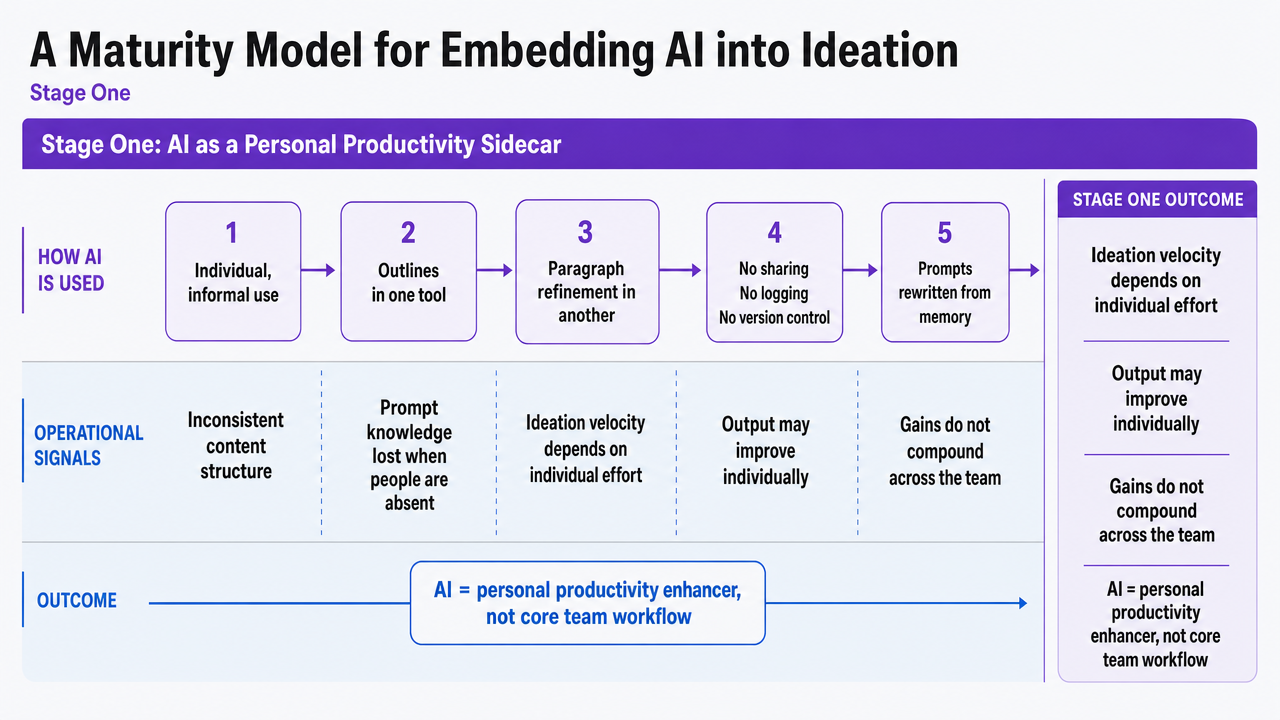 Visualize the three-stage maturity model described in the section, showing progression from personal AI use to embedded teammate
Accelerate Content Ideation and Publish Instantly
Test rapid topic generation and deploy live content during your trial—evaluate true team velocity before you commit.
Architecting the Ideation Pipeline
Signal Capture: Routing Search Data, Sales Calls, and Product Updates
An effective ideation pipeline requires raw material, which often exists in disconnected silos within lean teams. This includes:
- Search Console queries
- Sales call transcripts from platforms like Gong or Chorus
- Product release notes from Jira
- Support ticket themes in Zendesk
Signal capture involves consolidating these inputs into a single, readable feed for the ideation layer. The method of routing is less important than the act of routing itself; a shared table with weekly imports or an instrumented setup pulling various data points into a single feed can work.
The goal is to ensure that ideas are not generated in a vacuum. When the AI or writer creates content candidates, the prompts draw from current market and pipeline insights. This shift allows routine tasks like data mining and drafting to be completed in minutes rather than hours, once AI is applied to structured inputs 2. The efficiency gain comes from the routing mechanism, not just the chatbot.
Idea Generation and Ranking Against Pipeline-Relevant Criteria
Once signals are centralized, idea generation becomes a straightforward process. A well-crafted prompt, applied to a week's worth of routed inputs, can yield dozens of candidate ideas, such as blog angles based on rising queries, LinkedIn posts derived from sales objections, or email sequences aligned with new features. The critical step is ranking these ideas. Without a clear rubric, ideas are subject to editor preference, which is not scalable.
A robust rubric scores each idea against predefined criteria important to the VP of Marketing, including:
- Search opportunity (query volume, current rank, difficulty)
- Pipeline relevance (alignment with deal stages)
- Production cost (drafting hours, required assets)
- Strategic fit (reinforcing positioning)
The AI model can perform this scoring, presenting the editor with a ranked list and supporting rationale, rather than an unorganized brainstorm dump. This approach allows for increased content production without sacrificing quality, ensuring consistent output and relevance across channels 5.
The Approval Gate: Where Human Judgment Stays on the Critical Path
Even with ranked candidates, human approval is essential before content goes into production. The approval gate is where the content manager decides which ideas proceed, which are deferred, and which are discarded. This gate is crucial for enforcing brand voice, editorial judgment, and strategic priorities.
An effective approval gate has three characteristics:
- Each candidate arrives with its ranking rationale, enabling quick review
- All decisions are logged to identify patterns and optimize processes
- No content moves to drafting without explicit sign-off
Human oversight remains essential even at the most integrated stages of AI use 4. This gate is where judgment is concentrated, after generation and ranking have been automated. An approval-first workflow also mitigates the risk of content convergence, where similar models and signals produce increasingly similar outputs, by ensuring reasoning, not just titles, is reviewed.
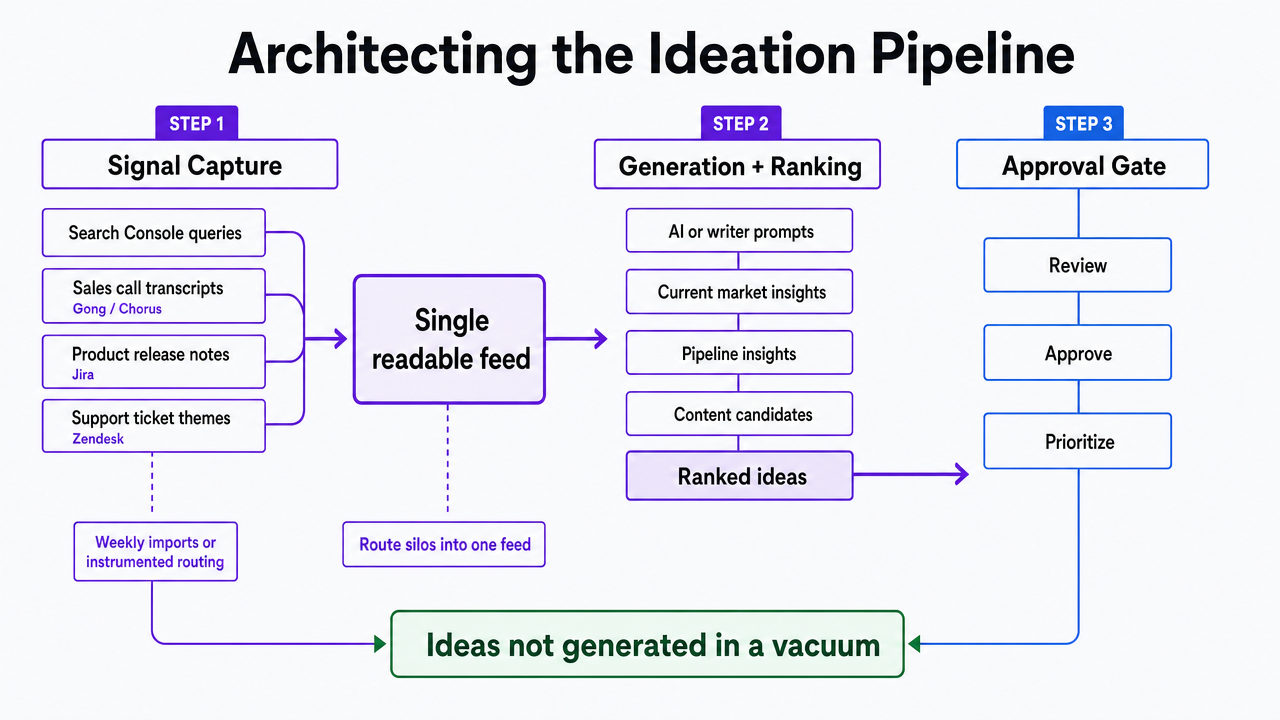 Show the three-step ideation pipeline workflow (signal capture, generation and ranking, approval gate) described across the subsections
Prompt Discipline That Protects Brand Voice
Brand voice can erode through inconsistent prompting. When writers hastily use generic prompts like "write a LinkedIn post about our new feature," the resulting content, though competent, often lacks distinct brand identity. Repeating this across multiple writers leads to an inconsistent brand voice over time.
Prompt discipline counters this by treating prompts as versioned artifacts, similar to style guide entries. They are named, owned, regularly reviewed, and paired with reference material to ensure the AI generates content that aligns with the brand's specific voice. A disciplined prompt includes:
- A precise role and audience specification
- Voice constraints stated as rules
- Reference exemplars (short passages of previous brand work)
- Explicit exclusions (phrases or structural elements the brand avoids)
The risk of homogenization is significant; similar models with similar prompts can lead to convergent outputs. Experimental research on AI-assisted social media content highlights trade-offs in perceived authenticity and participation patterns 1. Using brand-specific exemplars helps anchor AI generation to a unique voice. The editor's role shifts to auditing prompts, ensuring that any necessary corrections are made upstream to prevent future drift in output.
Governance Guardrails for AI-Assisted Ideation
Governance ensures an AI-assisted ideation pipeline is defensible against scrutiny from legal, PR, or leadership. The NIST Generative AI Profile identifies key risks for content teams, including confabulation, information integrity, intellectual property exposure, and homogenized outputs 6. Each risk requires specific guardrails within the ideation workflow.
Four controls address most exposures:
- Source-grounding, where prompts draw from routed signals and named reference material to reduce confabulated claims
- A fact-check gate for any content containing statistics, quotes, or named entities, with reviewer logging
- An IP check to flag prompts referencing competitor or copyrighted content
- A homogenization audit where editors periodically compare outputs to detect drift toward a shared mean 6
Disclosure is also critical. A Pew survey found that 76% of U.S. adults consider it important to distinguish AI-generated from human-made content, and 53% believe AI will negatively impact creative thinking 7. Content managers should adopt provenance labeling for AI-assisted work as a default, logging the level of AI involvement for auditability. Transparency carries less risk than silence.
Accelerate Content Ideation Without Increasing Team Size
See how leading marketing teams use AI-powered workflows to scale high-volume content ideation and production—maintaining velocity, consistency, and brand alignment across all channels.
Change Management: Getting Writers to Trust the System
An ideation pipeline can fail if writers do not trust it. A Pew survey revealed that about half of U.S. workers are concerned about AI's workplace impact, with 32% expecting fewer job opportunities 8. Introducing a ranked idea queue and prompt library can be perceived by cautious writers as a step towards job displacement.
To mitigate this friction, three strategies are effective:
- Clearly state what the system does not replace (editorial judgment, voice ownership, and approval decisions remain human)
- Demonstrate the time savings, showing how the pipeline compresses recurring tasks to free up writers for interviews, structural edits, and original reporting
- Grant writers standing edit rights for the prompt library, allowing them to improve the system directly
Adoption is fostered through ownership, as writers who contribute to and see improvements in the system are more likely to embrace it as essential infrastructure.
Measuring Throughput Without Gaming Vanity Metrics
Simply reporting an increase in published content volume is insufficient. A content manager who reports a rise in posts from 22 to 40 per quarter must be able to demonstrate which of these pieces generated pipeline. If this link is unclear, increased output can be dismissed as busywork.
A robust measurement framework tracks four metrics:
- Ranked idea supply per week (candidates that cleared the rubric)
- Approval rate at the gate (indicating calibration of the ranking model)
- Hours to publish per piece (from approval to live, where AI-assisted workflows show efficiency)
- Downstream contribution (organic sessions, qualified leads, or influenced pipeline attributed to each piece over 60-90 days)
Reporting these metrics together prevents gaming one number at the expense of another. For instance, increasing published volume by lowering approval standards would be exposed by a declining approval rate and downstream contribution.
Organizations that successfully capture value from AI measure it against business outcomes, not just adoption or output 9. For lean content teams, this means connecting ideation throughput directly to the pipeline signals that informed the ranking rubric, thereby completing the feedback loop initiated at the signal-capture stage.
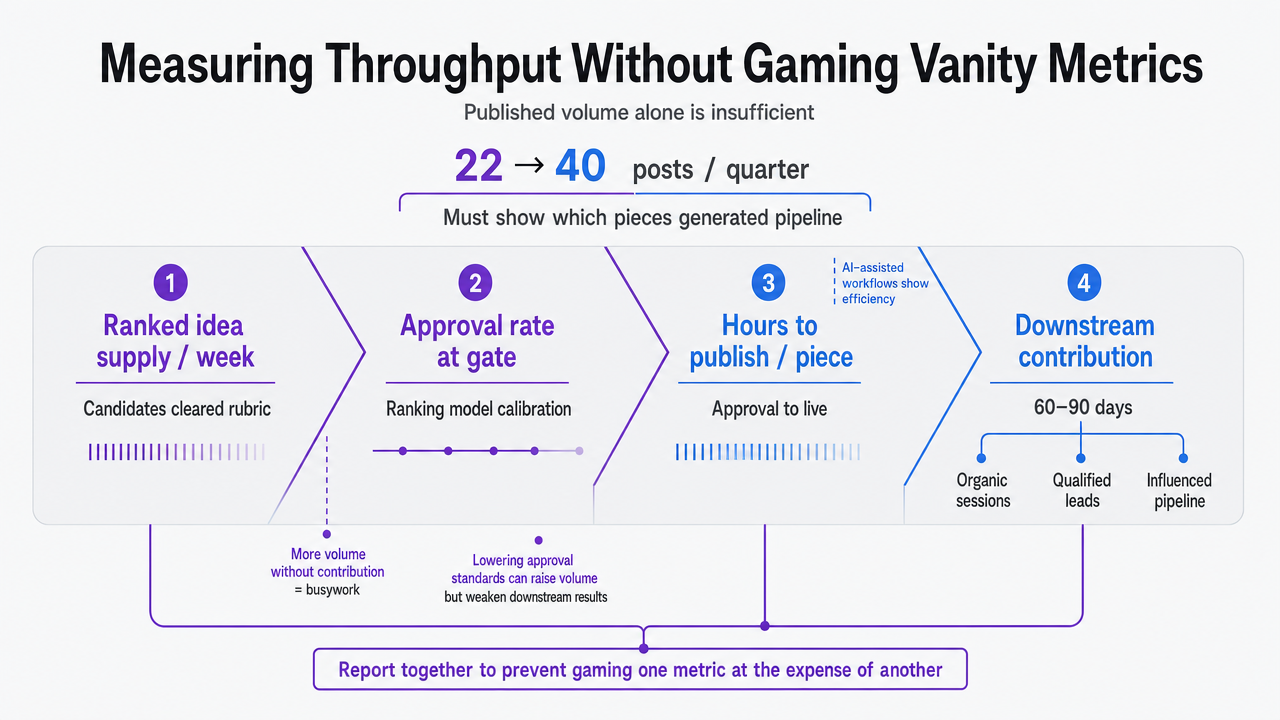 Visualize the four interconnected throughput metrics framework described in the section
If the Team Runs Content for Multiple Brands or Business Units
Content managers whose lean teams serve multiple brands or business units face a variant of the architecture problem, with an added constraint: prompt libraries and signal feeds cannot be universally shared without compromising individual brand voices. The solution is a partitioned pipeline. Signal capture routes inputs into brand-specific feeds, ensuring that trends from one brand do not influence ideas for another. Prompt libraries are forked per brand at the voice layer, using exemplars from each brand's archive, while the ranking rubric and governance controls remain shared. NIST flags homogenized outputs as a risk when similar models are queried, a risk that intensifies when one team manages multiple brands through a single interface 6.
The approval gate remains singular, with one editor managing a single, brand-tagged queue. This preserves throughput gains while preventing brand voice bleed across different properties.
Frequently Asked Questions
References
- 1.The impact of generative AI on social media: an experimental study.
- 2.AI Will Shape the Future of Marketing.
- 3.Generative AI Takes Off with Marketers.
- 4.Integrating Generative AI into Team-Based Marketing Workflows.
- 5.How Top Brands Use AI for Content Marketing.
- 6.Artificial Intelligence Risk Management Framework: Generative Artificial Intelligence Profile.
- 7.How Americans View AI and Its Impact on People and Society.
- 8.U.S. Workers Are More Worried Than Hopeful About Future AI Use in the Workplace.
- 9.The State of AI: Global Survey 2025.
- 10.AI Risk Management Framework.