
Key Takeaways
- Production cadence, not creative inspiration, separates dominant healthcare content programs; systems with dedicated teams report 45% higher patient volume growth than those relying on agencies 13.
- Educational explainer clusters anchored to service lines compound search visibility when published consistently, accumulating 40-80 internally linked pages per condition over 18 months.
- Provider-led short-form video scales efficiently because one shoot day yields 12-18 pre-procedure clips, addressing the anxiety-driven questions text alone cannot resolve.
- Review-driven local SEO swings demand sharply at the location level, with 4.5-star providers receiving 34% more appointment requests than those rated below 3.5 stars 11.
- Topical authority architecture pairs a pillar page with 30-80 cluster pages per service line, capturing patients who consult multiple sources before booking 10.
- Patient journey email nurture tied to first-party data lifts bookings 28% through personalization and drives 5.2x conversion among multi-channel engagers 12.
- Multi-channel orchestration concentrates eight content surfaces around one topic in a 30-day window, capturing the 5.2x conversion lift retainers rarely deliver 12.
- AI-assisted production at portfolio scale shifts pricing from per-asset retainers to fixed platform plus clinical review hours, the only non-automatable constraint on cadence.
Why Production Cadence Beats Creative Inspiration
Healthcare marketing leaders often find that a competitor's faster publishing calendar, rather than superior ideas, leads to market dominance. Deloitte's 2024 outlook reveals that 72% of healthcare executives now consider content marketing a core patient acquisition strategy. Systems with dedicated content teams report 45% higher patient volume growth compared to those relying on external agencies 13. While the strategic importance is clear, an execution gap often remains.
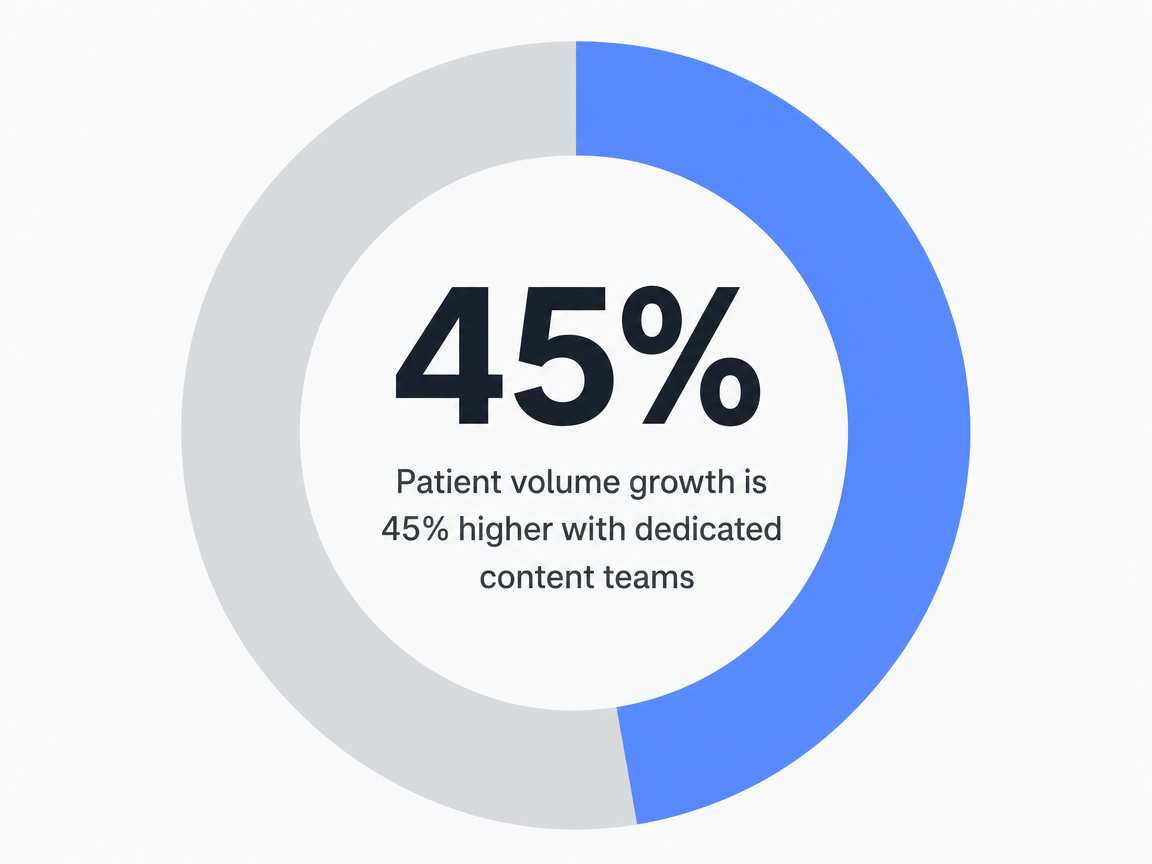 Patient volume growth is 45% higher with dedicated content teams: 45%
This gap is evident in content production cadence. A healthcare operator with 25 locations and four service lines needs a consistent output of approximately 200 medically reviewed assets per quarter. These assets must be distributed across location pages, provider profiles, condition guides, and email sequences, following a tight schedule to build search rankings before competitors. Traditional agency retainers, often designed for single-brand storytelling, struggle to support this volume. This can lead to bottlenecks in clinical review, fragmented vendor efforts, or neglected locations lacking dedicated marketing support.
The following patterns are not creative concepts but repeatable production templates with observed executions, outcome data, and explicit replication strategies. Each pattern addresses the critical question for budget allocation: what does it cost to implement this weekly, across all markets and service lines, without the production cadence failing after a few months?
Educational Explainer Clusters Anchored to Service Lines
What Cleveland Clinic and Boston Children's Ship Weekly
Cleveland Clinic Health Essentials and Boston Children's Thriving exemplify this pattern. Both publish multiple condition-level explainers weekly, each tagged to a service line, written or reviewed by a named clinician, and structured around common patient search queries. These articles address symptom triggers, when to seek care, what a first appointment entails, and recovery timelines. They function as digital conversations patients want to have before booking an appointment.
Research supports this approach. McKinsey's analysis of consumer health media indicates that organizations producing medically validated content along the patient journey are best positioned to convert demand into appointments 2. Similarly, NIH peer-reviewed work highlights that consistently published informative blogs and articles maintain provider relevance during the patient research phase that precedes most healthcare decisions 1.
The key differentiator for Cleveland Clinic and Boston Children's is their consistent publishing schedule. This cadence allows a single condition cluster, such as pediatric concussion or atrial fibrillation, to accumulate 40 to 80 internally linked pages over 18 months. This density is crucial for compounding organic search visibility. The pattern's success lies in its unbroken publishing schedule, not in the exceptional quality of any single article.
Replication Math Across Four Service Lines
For operators managing four service lines across 25 locations, the economics of this pattern challenge traditional retainer models. A robust cluster for a single service line (e.g., cardiology, orthopedics, women's health, primary care) requires 30 to 50 condition-level explainers in the first year to establish topical authority in search. Multiplying this by four service lines means a year-one production target of 120 to 200 medically reviewed articles at the system level, before accounting for location-specific variations.
Location variants significantly increase the volume. Each core explainer typically generates lighter location pages, provider bios linked to relevant conditions, and FAQ blocks tailored to local insurance acceptance and ZIP-code routing. A conservative variant ratio of 1.5x across 25 locations transforms a 40-article cardiology cluster into approximately 100 published assets per service line annually.
Clinical review, not writing capacity, is the primary bottleneck. Most retainers price per article but often omit the review hours, leaving operators to cover physician time at internal labor rates. This cadence problem extends to other content patterns: each expands the asset count, and all rely on the same clinician pool for approval.
Provider-Led Short-Form Video for Service-Line Visibility
The 60-Second Pre-Procedure Explainer Pattern
NYU Langone and Mayo Clinic effectively utilize this pattern: a named clinician on camera, speaking for 45 to 75 seconds, addressing a specific pre-procedure question. Examples include "What does an MRI feel like?" or "How long does the IV stay in after a colonoscopy?" Each clip is distributed across YouTube, the service-line page, relevant condition explainers, and the location's social media profile, maximizing its reach without channel-specific reworks.
The scalability of this pattern lies in its production logic. A single shoot day with one orthopedic surgeon can yield 12 to 18 finished clips covering an entire set of pre-operative questions. This content aligns with established search behavior: 68% of healthcare decisions begin with online search, and 54% of patients consult multiple sources before booking 10. Short videos serve as a crucial source, effectively addressing anxiety-related questions that text alone cannot.
For an operator with 25 locations and four service lines, this translates to approximately four shoot days per quarter, batched by service line, producing 50 to 70 clips that supplement the existing explainer clusters.
Testimonials, Consent, and the Volume Tradeoff
Patient testimonials, while effective for conversion, do not scale as easily due to regulatory requirements. HHS guidance specifies that communications using identifiable patient information for marketing generally require prior written authorization, citing former-patient outreach about new services as a prime example 5. Each testimonial asset necessitates a release-form workflow, unlike clinician explainers.
This workflow is a significant constraint on cadence. A shoot day for clinician explainers can produce over a dozen clips. In contrast, a testimonial shoot depends on patient willingness, specific authorized use, scheduling around clinical timelines, and legal review of the final product. Operators scaling this pattern typically limit testimonial production to one or two pieces per location per quarter, focusing on high-margin service lines.
Practically, clinician-led explainers handle the bulk of content volume across all service lines and locations, while testimonials are reserved for high-value procedural service lines like cardiology or orthopedics, where a single converted patient justifies the consent overhead. Integrating both types into the content calendar ensures monthly quotas are met.
Test Data-Driven Content Marketing for Patient Growth
Publish live healthcare content and measure real patient acquisition results during your free trial period.
Review-Driven Local SEO at the Location Level
Patient reviews are unique content assets that significantly influence the final selection step. Health Affairs research indicates that 86% of patients report online reviews heavily influence their provider choice, and providers with an average rating above 4.5 stars receive 34% more appointment requests than those below 3.5 stars 11. This difference in rating can represent a substantial portion of a location's potential inbound demand.
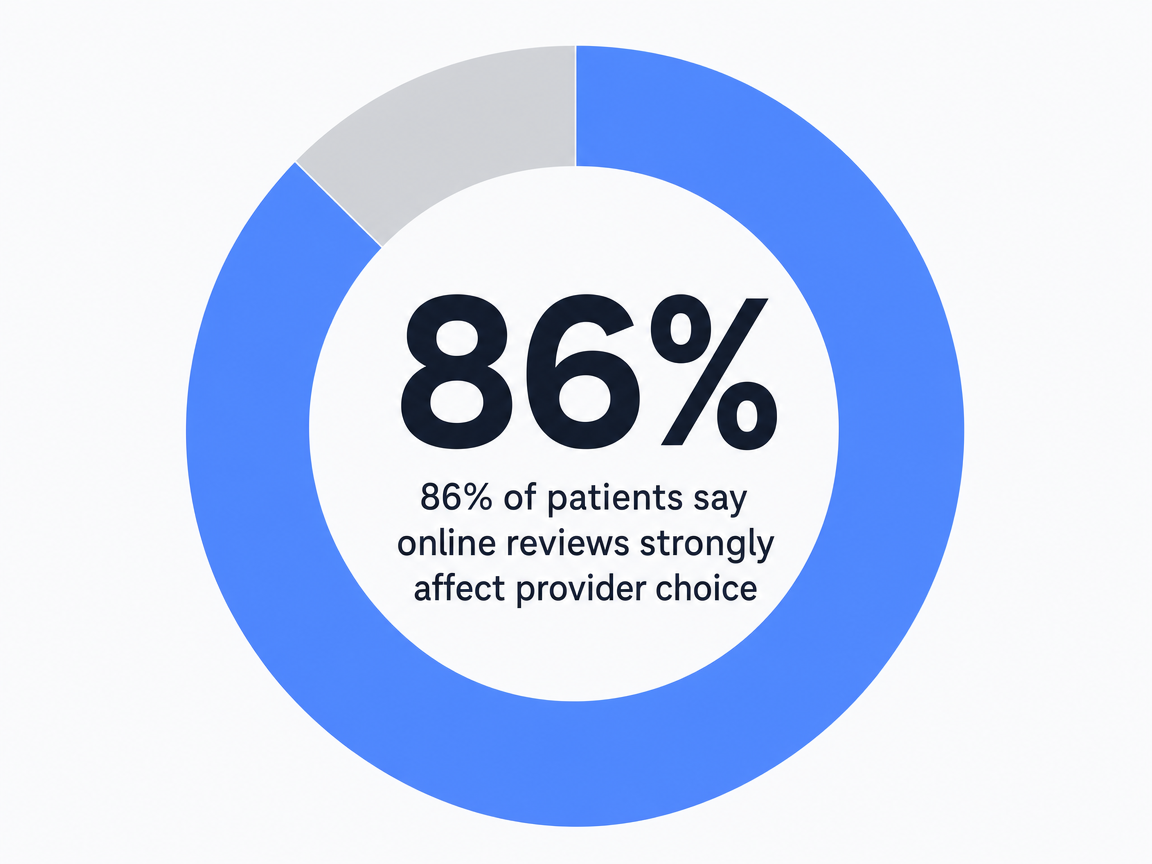 86% of patients say online reviews strongly affect provider choice: 86%
A scalable pattern involves a post-visit content workflow that simultaneously feeds two systems. After-visit summaries, which the federal Patient Engagement Playbook recommends structuring with clear action steps and visual layouts, are ideal for prompting reviews, as patients are already engaged in follow-up actions 3. A single after-visit template can facilitate portal enrollment, review requests, and condition-specific educational links within one justified communication.
For a 25-location operator, the effort is template-based rather than volume-based. Each location requires a Google Business Profile populated with service-line categories, location-specific Q&A content, weekly photo or post updates linked to existing explainer clusters, and a system-level review response library. This library ensures consistent, HIPAA-compliant replies across all locations. Response cadence is more critical than cleverness: locations responding to reviews within 48 hours maintain noticeably higher average ratings than those that batch responses monthly.
A common failure is uneven performance. A 25-location footprint often has a few high-performing locations, a majority in the middle range, and some underperformers that negatively impact service-line search visibility across the entire metro area. Centralized review operations can mitigate this variance, whereas per-location agency retainers often fall short due to the small scale per site and the consistent nature of the work.
Topical Authority Architecture for a Single Service Line
Topical authority transforms a content calendar into a strong search position. The architecture involves a central pillar page covering the service line at a system level, supported by 30 to 80 cluster pages addressing every condition, procedure, and patient decision question. Each cluster page links to the pillar and laterally to related topics, creating an internal authority graph that signals deep expertise in a specific clinical domain.
Search data supports this architecture. NIH research on patient decision-making shows that 68% of healthcare decisions start with online search, and 54% of patients consult multiple sources before scheduling an appointment 10. Patients researching conditions like atrial fibrillation typically consume multiple articles—symptom overviews, diagnostic processes, medication explainers, procedure walkthroughs, and recovery guides—often across different sessions and devices. A pillar-cluster architecture ensures that all these queries are addressed by the same provider's content.
Implementing this pattern at scale incurs a structural cost often underestimated by retainers. A well-built single service line cluster requires a content brief library mapping each cluster page to its target query, supporting pillar section, lateral links, and the clinician responsible for medical review. McKinsey's analysis emphasizes that medically validated content is essential for converting research-stage demand 2, making the clinical review layer mandatory and not easily parallelized beyond the available clinician bench.
Topical authority develops over quarters, not weeks. Halting production prematurely forfeits the rankings that would accumulate over 9 to 18 months. CFOs should recognize that cutting cluster output to save budget often resets the authority curve, delaying payback by a full year.
Patient Journey Email Nurture Tied to First-Party Data
Email acts as connective tissue, integrating other content patterns. Explainer clusters, provider videos, review prompts, and multi-source research sessions all generate first-party signals that email can leverage at scale. McKinsey's patient engagement research quantifies this benefit: personalized email content boosts appointment bookings by 28% compared to generic messages, and patients engaging with healthcare content across three or more channels convert at 5.2 times the rate of single-channel engagers 12. The 28% increase reflects direct personalization, while the 5.2x multiplier highlights email's role in guiding content readers to multiple touchpoints without incurring repeated impression costs.
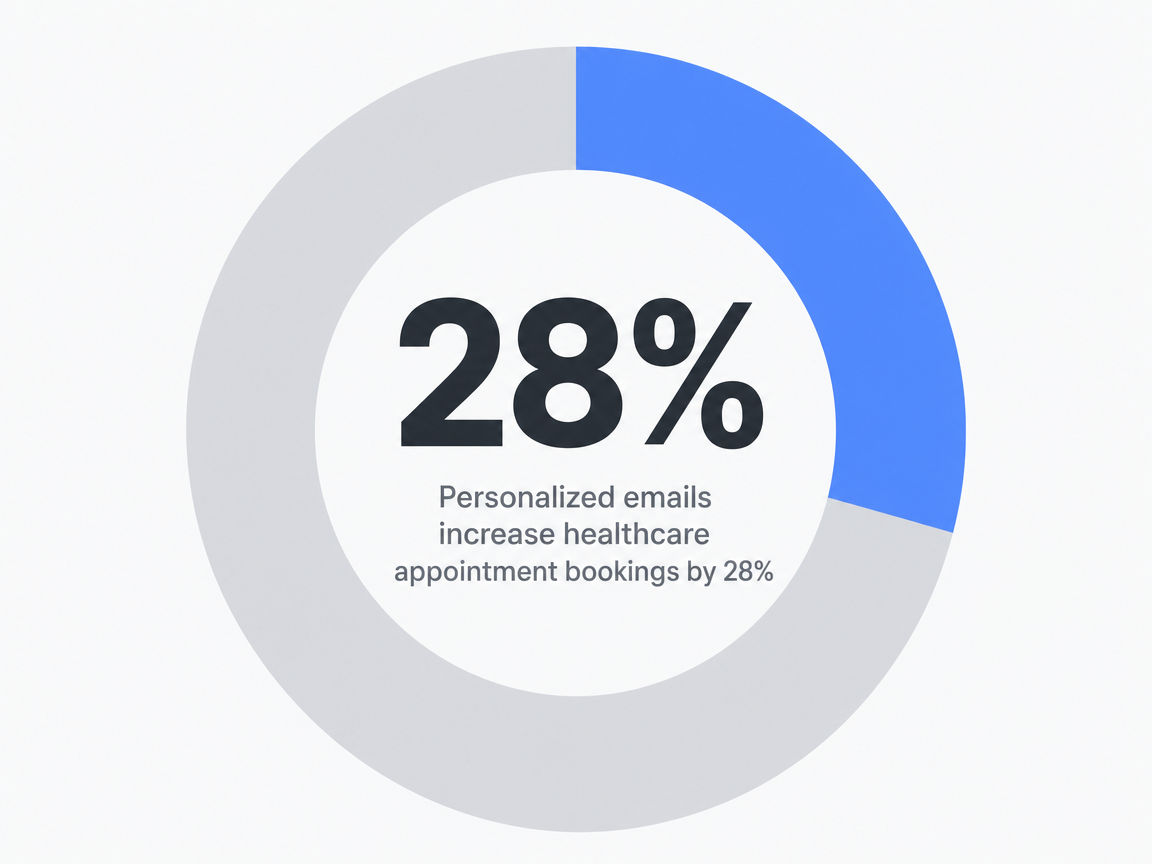 Personalized emails increase healthcare appointment bookings by 28%: 28%
The effective production pattern is more focused than typical monthly newsletters. It involves journey-triggered sequences tailored to a subscriber's engaged condition or service line. Examples include a four-email sequence after a knee-pain explainer download, a three-email sequence after a maternity tour signup, or a different cadence for portal-enrolled patients receiving condition-specific education. Each sequence reuses assets from explainer clusters and provider videos, making the marginal production cost primarily orchestration time rather than new content creation.
First-party data ensures defensible personalization. Subscribers originate from gated calculators, condition-specific guide downloads, abandoned appointment requests, and portal enrollments, all providing explicit interest signals tied to a service line. This interest signal is the segmentation key. A subscriber who downloaded an atrial fibrillation guide receives relevant AFib ablation explainers, not an orthopedics newsletter, aligning with the personalization rewarded by McKinsey's data.
For a 25-location operator, the orchestration footprint includes one ESP, a consent and preference layer, and 12 to 20 active sequences mapped to the four service lines and their highest-volume conditions. Reporting links back to the explainer cluster, identifying which guides drive the highest sequence completion, which sequences lead to the most appointment requests, and which service lines show the clearest attribution from initial download to booked visit. Sequences failing to meet minimum booking-rate thresholds are retired.
See How Leading Healthcare Brands Scale Content for Patient Acquisition
Connect with our team to review real-world content marketing workflows that deliver compliant, measurable patient growth at scale—without agency overhead or bottlenecks.
Multi-Channel Orchestration Around a Single Topic
Orchestration transforms multiple production lines into a single compounding asset. This involves selecting a high-intent topic, such as bariatric surgery candidacy, and deploying a full distribution stack within a 30-day window. This includes a pillar page update, three to five new cluster pages, a 60-second surgeon explainer cut into four social variants, a BMI-and-eligibility calculator behind an email gate, a four-step nurture sequence for calculator submissions, retargeting creative from the same shoot, FAQ schema for the cluster, and a post-consult review prompt via the after-visit summary. This approach integrates eight content surfaces around one topic with a single clinical review pass.
The benefit of this coordination is evident in data: McKinsey's research found that patients engaging with healthcare content across three or more channels convert at 5.2 times the rate of single-channel engagers 12. Single-channel publishing misses most of this potential lift, as does staggering content across six months, which prevents patients from encountering multiple touchpoints within an active research window.
Orchestration prioritizes the calendar over individual channels. For example, the bariatric topic ships in October, joint replacement in November, and maternity tours in December. Each topic blocks a clinician shoot day, a writer sprint for the cluster, an ESP build for the sequence, and a paid-media flight for retargeting. Topics that miss their assigned month are deferred to a later quarter, as maintaining the cadence for subsequent topics is crucial for the overall calendar's integrity.
For a 25-location operator, the practical limit is roughly one orchestrated topic per service line per quarter, totaling 16 fully orchestrated launches annually. This is not a creative limit but a clinical-review capacity limit, which should guide budget discussions. Retainers priced per-deliverable often overlook orchestration overhead, meaning the 5.2x conversion lift is often cited in pitches but rarely realized in actual production schedules.
AI-Assisted Production at Portfolio Scale
If You Manage Multiple Locations: Asset Volume vs. Pricing Model
For operators with four service lines across 25 locations, the preceding patterns create a quarterly production load that traditional retainers are not designed to handle. Combining explainer clusters, location variants, clinician video clips, review-response libraries, orchestrated topic launches, and journey-triggered email sequences results in 180 to 220 medically reviewed assets per quarter. The math is clear: 4 service lines × 2 quarterly cluster pieces × 25 locations × a 1.5x variant ratio yields approximately 200 cluster-related assets quarterly, before accounting for video, email, or schema work.
Forrester's 2024 analysis of healthcare content strategy highlights the value of this production load. Top-quartile healthcare organizations invest 3.2 times more in content production than median performers and achieve 2.1 times higher patient acquisition efficiency 15. This investment difference reflects the gap between systems that consistently deploy the full pattern stack and those that only execute a few patterns well. Gartner's research aligns, showing leading organizations allocating 28-35% of marketing spend to content production and distribution, resulting in 1.6 times higher patient volume growth 14.
AI-assisted production fundamentally alters the pricing model. While dollar figures vary by market, the table below illustrates the structural difference between retainer pricing and a platform-plus-clinician-review model.
| Content Pattern | Quarterly Asset Volume (25-location, 4 service lines) | Retainer Pricing Structure | In-House + AI-Assisted Pricing Structure |
|---|---|---|---|
| Explainer clusters + location variants | ~100-150 assets | Per-asset fee × volume | Fixed platform + clinical review hours |
| Clinician short-form video | 50-70 clips (4 shoot days) | Per-shoot-day + per-edit | Per-shoot-day + AI-assisted editing |
| Review responses + GBP posts | 25 locations × weekly cadence | Per-location-per-month retainer | Fixed platform + centralized response library |
| Orchestrated topic launches | 4 launches (1 per service line) | Per-deliverable across channels | Fixed platform + clinical review hours |
| Journey email sequences | 12-20 active sequences | Per-sequence build + per-send | Fixed platform + orchestration time |
The retainer column scales linearly with asset and location count. The platform column primarily scales with clinical review hours, which is the only non-automatable input and the binding constraint discussed in the next section.
Where Cadence Compounds and Where Governance Holds the Line
AI-assisted production enhances cadence, not creative output. Generative AI in healthcare marketing is proven to personalize content at scale, including condition-specific health tips and educational articles, keeping providers visible during the patient research phase 4. Automation is most effective for high-volume, low-variance tasks: drafting cluster pages from brief libraries, creating location variants, generating FAQ schema, assembling email sequences from existing modules, and producing initial cuts of provider video transcripts for social media. This automation allows the 200-asset quarterly target to be met without disrupting the calendar.
Clinical review remains the critical control point. McKinsey's emphasis on medically validated content as a prerequisite for converting research-stage demand applies to every AI-generated draft 2. Effective governance involves a clinician bench scaled to review hours, not writing hours, supported by a brief library that ensures drafts are substantively complete upon arrival, and a published-asset audit trail that withstands compliance scrutiny.
Vectoron is an example of a platform in this category, combining AI-drafted production with a clinical review workflow. The key selection criterion is not a broad feature list, but how effectively the platform shortens the review time without compromising the thoroughness of the review.
Frequently Asked Questions
References
- 1.The impact of marketing strategies in healthcare systems - PMC - NIH.
- 2.Health media: How consumer content informs the future of healthcare.
- 3.Patient Engagement Playbook - HealthIT.gov.
- 4.Generative Artificial Intelligence Use in Healthcare - PMC - NIH.
- 5.Marketing | HHS.gov.
- 6.Marketing in the Health Care Sector: Disrupted Exchanges and New Opportunities.
- 7.Health Tourism Facility Use of Digital Marketing and AI.
- 8.Healthcare Marketing Definition and Job Outlook - Florida Tech.
- 9.Advertising in health and medicine: using mass media to communicate with patients - PMC.
- 10.Patient Search Behavior and Healthcare Decision-Making: A Longitudinal Analysis.
- 11.Digital Trust and Online Reviews in Healthcare Provider Selection.
- 12.The Future of Patient Engagement: Digital-First Healthcare Marketing.
- 13.Deloitte 2024 Global Health Care Outlook: Content Strategy and Digital Patient Engagement.
- 14.Gartner: Healthcare Digital Marketing Strategies and Content Planning Framework.
- 15.Forrester 2024: Healthcare Content Strategy as Competitive Differentiation.