
Key Takeaways
- Content demand has outpaced in-house capacity, but adding writers or agencies at $550–$2,000 per piece 2only narrows the gap without fixing the underlying production workflow.
- Teams that simply bolt AI onto legacy processes hit a ceiling around 10% efficiency 4; high performers redesign workflows around AI to pursue both growth and efficiency 17.
- A five-role pod—strategist, production lead, SEO, distribution, measurement—with an approval-first gate makes editor judgment the throughput limit instead of writer hours, preserving quality and brand voice.
- Dashboards should lead with sales-sourced revenue 8across Spiegel's attention, engagement, attribution, and return layers 7, with a 90-day plan moving teams from access to measurable CFO-ready return.
The demand-capacity gap is now a workflow problem, not a headcount problem
Marketing content demand grew roughly 1.5 times in 2023, but in-house teams met that demand only 55% of the time, according to Deloitte Digital research on enterprise marketing operations 22. This shortfall isn't due to lazy teams or insufficient briefs; it's a production line built for a slower era struggling to keep pace with a faster one.
The traditional response—hiring more writers or agencies—no longer aligns with the economics. Per-piece content investment ranges from $550 to $2,000 2, and 54% of businesses planned higher content spend in 2024 6. Adding capacity at this unit cost only slightly narrows the gap without addressing the underlying workflow issues.
High-performing teams are approaching this gap as a design challenge. McKinsey's 2025 global AI survey found that these teams are more likely to redesign workflows around AI rather than simply adding tools to existing processes. They pursue growth alongside efficiency, rather than focusing solely on efficiency 17. This distinction is crucial for content leads tasked with increasing output without a larger payroll.
This content marketing guide advocates for a similar approach. The most effective way for a fixed team to achieve higher pipeline-attributed output is through a production line where AI handles repeatable tasks, specialists apply judgment, and an approval gate ensures quality. The following sections detail how to build this system, identify where time savings occur, and outline metrics that resonate with CFOs.
The productivity paradox within most content teams
Widespread AI access, limited measurable return
AI tool adoption is nearly universal. A Content Marketing Institute and MarketingProfs B2B survey found that 72% of marketers use generative AI tools 1. An Orbit Media survey reported 95% adoption among bloggers and content marketers, up from 65% two years prior 4. Similarly, a SurveyMonkey study indicated 88% of marketers use AI daily 3. These diverse studies consistently show that AI access is now standard for content teams.
Despite widespread adoption, the measurable returns have lagged. An MIT Sloan Management Review article estimates that approximately 85% of the workforce lacks an AI use case tied to measurable business value 14. This highlights a paradox: most teams have AI tools, but few can link them to specific improvements in dollars, leads, or pipeline figures.
For content leads, this implies that the critical question isn't whether the team uses AI, but whether their work would be significantly different if AI licenses were revoked. If the answer is "not much," the team likely falls within the 85% 14, and simply adding more tools or headcount won't change this. The subsequent sections explain why.
Why a 10% efficiency gain is the ceiling for unredesigned teams
Orbit Media's research suggests an estimated 10% efficiency gain in content production from AI tools as currently deployed 4. This figure represents the realistic maximum for teams that integrate AI without changing their underlying processes. While a writer might draft faster or an editor might clean up content quicker, the overall production cadence remains the same because upstream and downstream processes are unchanged.
A 10% gain, while not insignificant, is insufficient to close the demand-capacity gap or justify a CFO conversation. This ceiling can also be counterproductive. When AI is merely added to a legacy production line, the time saved is often absorbed by existing review cycles, brief revisions, and publishing bottlenecks. Throughput barely increases, even if individual tasks are completed faster.
McKinsey's 2025 global AI survey highlights a different approach among high performers. They don't stop at individual productivity tools; they redesign the entire workflow to pursue both growth and efficiency. Roughly half intend to use AI to transform their businesses, not just trim them 17. This distinction marks the difference between a modest 10% gain and a significant leap in production capability.
Controlled time-on-task evidence
While many AI productivity claims come from self-reported surveys, a Harvard Business School field experiment provided concrete data on time savings for specific tasks. Conceiving an article took 23 minutes with AI assistance versus 63 minutes without. Writing the article took 22 minutes with AI versus 87 minutes without 12. The study also found that "adjacent experts"—marketing specialists writing analytics-focused pieces, for example—produced work nearly indistinguishable from native specialists when AI was involved.
Two key insights from this study are crucial. First, the gains are concentrated in conceptualization and drafting, not in judgment-heavy tasks like positioning, fact-checking, or final editorial decisions. Second, AI did not turn novices into experts; the productivity curve significantly improved for individuals who already possessed domain fluency 12. Simply giving an AI tool to a junior writer without subject expertise will not yield these results.
For content leads, the operational implication is clear: the 40-minute and 65-minute reductions per article are achievable, but only for the measured steps and when the user has sufficient context to guide the AI. This explains why the 10% production gain from the Orbit Media survey 4 coexists with the larger HBS numbers: most teams capture easy drafting time savings but neglect conception time, as briefs, research, and angle selection still rely on manual review.
To close this gap, AI should be applied to upstream steps—such as outline pressure-testing, source synthesis, and generating angle variants—where the experiment showed the largest absolute savings. The output should then be routed to a human editor responsible for final decisions.
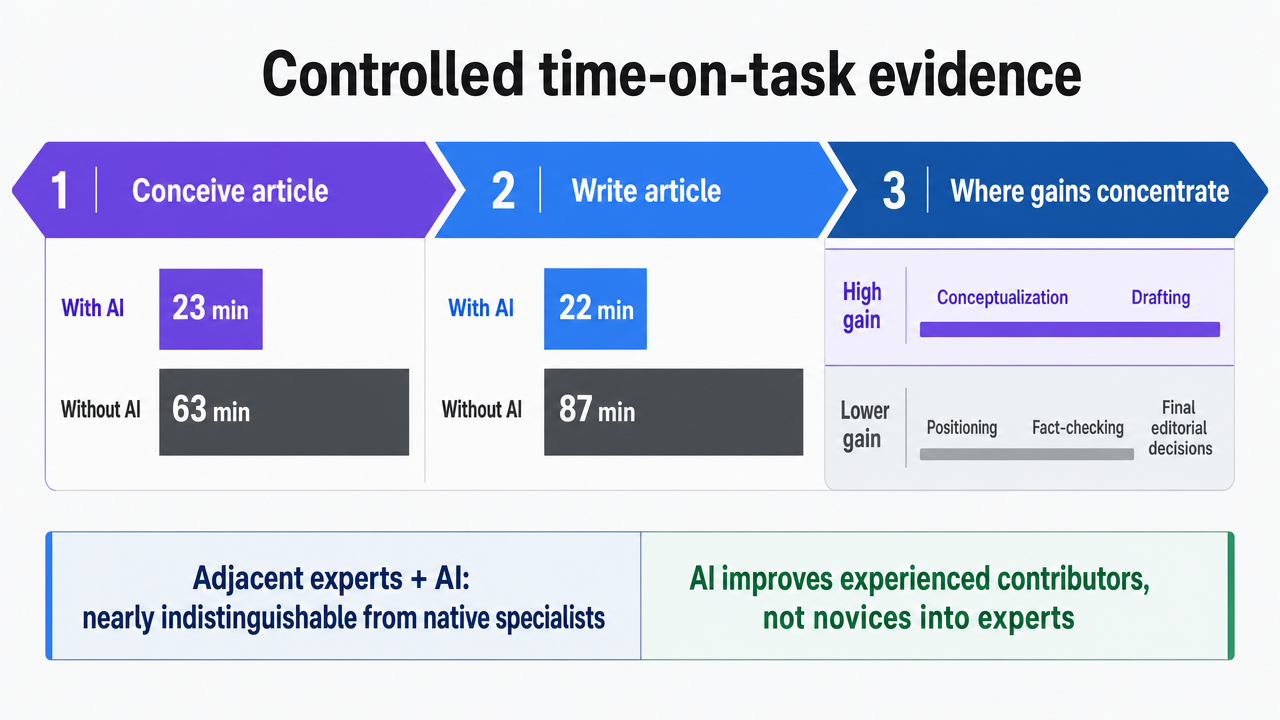 Visualize the Harvard Business School field experiment data showing concrete time savings from AI assistance on article conception and writing tasks, which is the core evidence anchor for this section
Test AI-driven content workflows in real scenarios
Validate production speed and quality by publishing live content with full workflow access, risk-free for 7 days.
Redesigning the production line around specialist pods
Five roles, one approval gate
The scalable unit in a modern content operation is not an individual writer, but a pod: a small, cross-functional group comprising five distinct roles that collectively manage a content program from initial signal to publication.
These roles are:
- A content strategist, who defines the editorial thesis, audience model, and calendar logic.
- A production lead, who manages drafts, briefs, and AI workflows for conception and writing.
- An SEO strategist, responsible for query coverage, internal linking, and technical optimization.
- A distribution lead, who handles repurposing across channels and secondary placements.
- A measurement analyst, who maintains the dashboard linking published work to pipeline.
These are roles, not necessarily individual headcount. A team of three can cover all five if AI automates repeatable tasks within each role and an editor manages the approval gate. The MIT Sloan Management Review framework for scaling AI describes this progression: moving from individual productivity tools to embedded role-level AI, and eventually to end-to-end process automation, including campaign creation 13.
The approval gate is essential. Every artifact—brief, outline, draft, optimized version, distribution plan, measurement readout—must pass through a human editor before publication. This gate distinguishes a pod from an automated content factory and prevents the production of undifferentiated AI content, a risk highlighted by the Content Marketing Institute 1.
Structured this way, the production line transforms from a queue of writers into a sequence of specialist decisions, each accelerated by AI and approved by a brand-aware human.
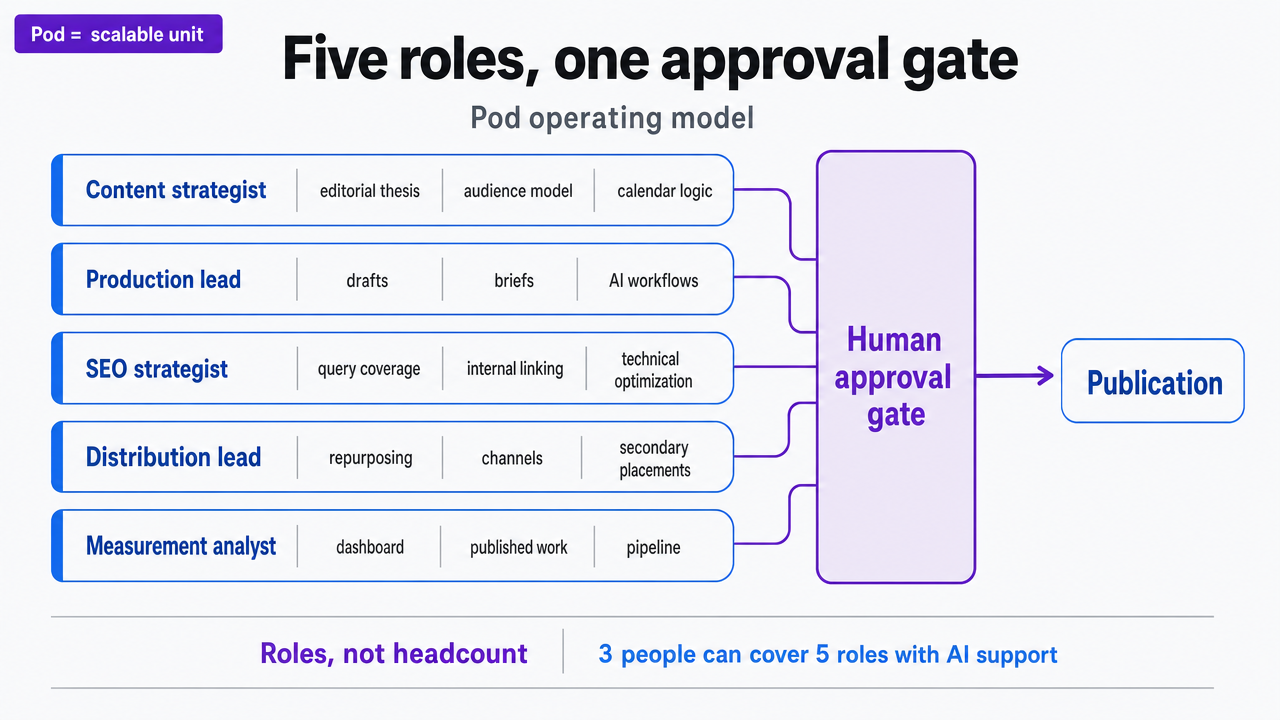 Visualize the five specialist pod roles and the single human approval gate workflow described in this section, which explains the operating model rather than presenting statistics
Approval-first AI execution as the unit of scale
Approval-first execution reverses the typical AI workflow. Instead of a writer drafting with AI and then editing the output, the pod uses AI as the production layer and the editor as the ultimate publisher. The AI executes, and the human approves.
This sequence is a key differentiator, as identified by McKinsey's 2025 global AI survey. While 80% of respondents aim for efficiency with AI, high performers also target growth and redesign workflows around AI, rather than simply bolting tools onto existing steps 17. This redesign incorporates an approval gate where a briefing meeting might have been.
Operationally, this gate produces three shippable artifacts: a ranked priority list, a reviewed draft, and an approved distribution plan. Each includes the underlying reasoning, so the editor approves a recommendation, not just a paragraph. Harvard Business Review's framework for integrating generative AI in marketing emphasizes balancing automation, customization, and human oversight, rather than pursuing automation alone 11.
The practical effect is that the pod's throughput is no longer limited by writer hours but by editor judgment hours. This represents a significantly higher ceiling, which teams should design their processes to leverage.
Where AI earns its keep across the pod
Not all steps in the production line benefit equally from AI. A SurveyMonkey study on marketing AI shows where marketers deploy these tools:
- 51% for content optimization
- 50% for content creation
- 45% for brainstorming
- 40% for research 3
This pattern aligns with how time savings are distributed across the workflow.
Within the pod, these use cases map to specific roles. The strategist uses AI for research synthesis and brainstorming variants (the 40% and 45% buckets), focusing on improving angle quality. The production lead uses AI for drafting and the optimize-create overlap, where the conception and writing time reductions from the HBS experiment are realized. The SEO strategist leverages AI for the 51% optimization slice, including query expansion, on-page checks, and internal link suggestions. The distribution lead uses AI to repurpose content into channel-specific variants, addressing a major scaling barrier identified by the Content Marketing Institute, where 48% of B2B marketers cite lack of repurposing as a constraint 1.
The measurement analyst role sees the least AI application, with human judgment being paramount. Attribution models, dashboard interpretation, and financial discussions remain human-led. AI can summarize data, but it cannot defend a number to a CFO.
The key takeaway for content leads is to integrate AI into the four upstream areas identified by data, while keeping downstream measurement and strategic tasks in human hands.
Measurement that survives a CFO review
Attention, engagement, attribution, return
A dashboard focused solely on published content count and page views will not withstand a CFO review. The Spiegel Research Center at Northwestern proposes a four-layer measurement framework that is more robust: attention, engagement, attribution, and return 7. Each layer addresses a different question and builds upon the previous one.
Attention : Measures whether a piece was read at all, using metrics like bounce rate, dwell time, and scroll depth.
Engagement : Tracks whether the read led to a behavior, such as a click-through, share, comment, or return visit.
Attribution : Connects engaged readers to downstream actions like form fills, demo requests, or sales conversations influenced by the content.
Return : Quantifies the financial impact, including customer acquisition cost, pipeline value, and revenue directly tied to the program 7.
Maintaining distinct layers is crucial. A content lead reporting only attention metrics will be asked why traffic doesn't translate to pipeline. One reporting only return will struggle to diagnose dips in pipeline. The four-layer framework provides a structure for explaining performance, such as "attention held, engagement dropped, attribution stayed flat, return is on a lag." This is a defensible explanation, unlike simply stating, "We published twelve pieces."
Sales as the dominant content KPI
The KPI most relevant to finance is often already a primary metric for marketers. A HubSpot statistics compendium indicates that over 41% of marketers measure content marketing success through sales, alongside web traffic and lead generation 8. Sales is the most common dominant KPI, surpassing engagement, subscribers, or share of voice.
This insight should guide the construction of the pod's dashboard. The headline number should be sales-sourced or sales-influenced by content, with attention and engagement serving as leading indicators rather than primary success metrics. The measurement analyst's role is to validate this linkage: identifying which assets influenced which deals, at what stage, and with what weight. The Spiegel framework's attribution layer directly supports this 7.
For content leads preparing for budget discussions, the practical approach is to lead with sales-attributed numbers, use attention and engagement signals to explain them, and reserve volume metrics solely for capacity discussions. Finance approves programs that drive pipeline, and the dashboard should reflect this priority.
Operator economics for portfolio brands with multiple locations
For multi-location service brands—such as dental support organizations, home services franchises, law firm networks, or senior living portfolios—the economics of content production shift significantly. Content demand scales with the number of locations, but the underlying assets (service pages, local landing pages, evergreen explainers, review-response templates) often repeat with controlled variations. This repetition is where AI-assisted production offers substantial economic advantages.
Consider a portfolio operator with 25 locations, aiming for four content pieces per location per month, totaling 1,200 pieces annually. Using an agency-only model, at the Forbes Advisor's benchmark range of $550 to $2,000 per piece 2, costs would range from $660,000 to $2.4 million annually. An in-house path involves fully loaded writer FTEs, plus tooling and editorial overhead. The AI-assisted in-house path maintains the same headcount but benefits from the 5 to 15 percent marketing productivity uplift McKinsey attributes to generative AI 20, compounded by the per-article time reductions documented in the Harvard Business School field experiment 12.
| Model (25 locations, 4 pieces/location/month) | Annual unit cost driver | Sourced anchor |
|---|---|---|
| Agency-only | 1,200 pieces × $550–$2,000 per piece | $660K–$2.4M 2 |
| In-house writer FTEs (no AI redesign) | N × fully loaded writer FTE + tooling | Variable; capped at ~10% efficiency gain 4 |
| AI-assisted in-house pod | Same FTE base × 5–15% productivity uplift | 20; time-on-task delta 12 |
This table serves as an input sheet, not a guaranteed return. Finance teams should evaluate it against their specific loaded labor costs, local content variation needs, and the quality governance emphasized by the Content Marketing Institute as a differentiator in an AI-saturated market 1. The point is not that AI automatically replaces agency spending, but that at a portfolio scale, the agency line item is particularly susceptible to redesign.
Scale Content Production Without Expanding Your Team: See Data-Driven Solutions in Action
Request a demo to explore how leading marketing teams automate multi-channel content workflows—achieving higher output and measurable SEO gains while maintaining full control over approvals and brand standards.
Governance, quality, and the limits of automation
The Content Marketing Institute's B2B benchmark survey, while noting 72% AI adoption, also highlighted a significant risk: the expectation of a flood of undifferentiated AI content. The survey predicted that winning teams would be those setting standards, not just quotas 1. Governance is key to ensuring a pod's output remains on the winning side of this distinction.
Three primary guardrails are essential:
- A documented voice-and-claims standard against which every AI draft is checked before reaching the editor.
- A sourcing rule requiring factual assertions, statistics, and named studies to be traceable to a primary source, with AI used only to surface candidates.
- A domain-expertise requirement at the approval gate. The Harvard Business School field experiment showed that AI elevated adjacent experts to near-specialist quality but did not bridge the gap for novices 12. Routing AI output through a junior reviewer without subject fluency negates this benefit.
It's crucial to recognize that AI accelerates production, not judgment. Harvard Business Review's framework for generative AI in marketing advocates for balancing automation, customization, and human oversight, warning that removing marketers from strategic decisions erodes the differentiation content programs are meant to build 11. The pod design incorporates this as a constraint: drafting, optimizing, and repurposing are AI-driven, while positioning, claims, and the final decision to publish remain human responsibilities.
A 90-day plan to move from access to measurable return
Ninety days is sufficient time to redesign a content production line and demonstrate its financial value, but it requires a structured approach. The following plan divides the work into three 30-day blocks, each with a tangible deliverable for a content lead.
- Days 1–30: Baseline and pod assembly. Audit current production: measure time per piece by stage, cost per piece against the $550–$2,000 benchmark 2, and the sales-attributed influence of published assets over the last two quarters. Define the five pod roles—strategist, production lead, SEO strategist, distribution lead, measurement analyst—and assign them to existing headcount. Document the voice-and-claims standard and the approval gate. The output of this block is a written operating model, not new content.
- Days 31–60: Workflow redesign on two asset classes. Select one high-volume format (e.g., service or solution pages) and one high-judgment format (e.g., analyst-grade explainers). Reroute conception and drafting through AI, while positioning, claims, and the publish decision remain with the editor. Track time-on-task against the Harvard Business School field-experiment baseline of 23 minutes for conception and 22 minutes for writing with AI assistance 12. The redesign must exceed the 10% production-efficiency ceiling reported in the Orbit Media survey 4 by day 60.
- Days 61–90: Measurement and the finance conversation. Implement the attention, engagement, attribution, and return dashboard 7, with sales-sourced and sales-influenced revenue as the primary metric 8. Quantify the business case by applying McKinsey's 5–15% marketing productivity uplift range 20 to actual output. The deliverable is a one-page readout for the CFO detailing throughput changes, cost per piece changes, and pipeline movement. Teams completing this cycle will move beyond the 85% of the workforce operating AI without measurable business value 14. For content leads seeking to accelerate this timeline, an approval-first AI execution platform like Vectoron can establish the workflow without requiring additional headcount.
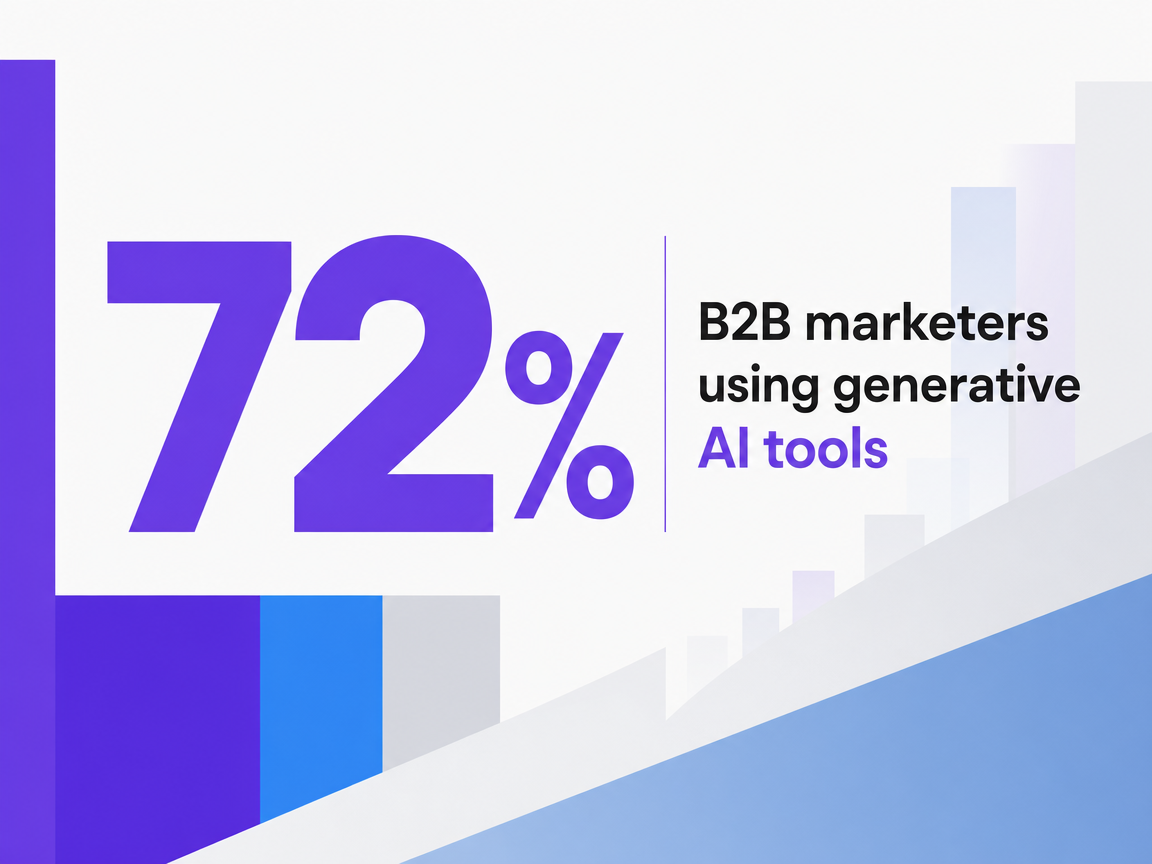 B2B marketers using generative AI tools
B2B marketers using generative AI tools
Frequently Asked Questions
References
- 1.B2B Content Marketing Benchmarks, Budgets, and Trends: Outlook for 2024 [Research].
- 2.Top Content Marketing Statistics – Forbes Advisor.
- 3.28 AI marketing statistics you need to know in 2025.
- 4.The Most Effective AI Uses for Content Marketing in 2025 [New Research].
- 5.AI Content Marketing Market Share | CAGR of 25.68% - Market.us.
- 6.Content marketing statistics 2026.
- 7.Content Marketing and AI – Best Practices.
- 8.2026 Marketing Statistics, Trends, & Data.
- 9.B2B Content Marketing Benchmarks, Budgets, and Trends: Outlook for 2024.
- 10.Generative AI's Transformation of Content Marketing - Deloitte Digital.
- 11.How Should Gen AI Fit into Your Marketing Strategy?.
- 12.Gen AI Boosts Productivity, But Can't Turn Novices Into Experts.
- 13.Scaling AI for results: Strategies from MIT Sloan Management Review.
- 14.AI Use Is Rising at Work but Productivity Gains Lag.
- 15.How Generative AI Changes Productivity.
- 16.How Gen AI Is Transforming Market Research.
- 17.The State of AI: Global Survey 2025.
- 18.The Projected Impact of Generative AI on Future Productivity Growth.
- 19.Generative AI Takes Off with Marketers.
- 20.The economic potential of generative AI: The next productivity frontier.
- 21.AI Will Shape the Future of Marketing.
- 22.Deloitte Digital's latest research forecasts generative AI's transformation of marketing content.
- 23.The economic potential of generative AI: The next productivity frontier.