
Key Takeaways
- Lean content operations close the demand gap through workflow discipline, not new hires, since 41% of B2B marketers face flat 2025 budgets and hiring is rarely an option 6.
- A documented strategy with revenue-tagged KPIs, a content-to-pipeline ratio, and named sales alignment is the binary gate that separates calendars from genuine content programs 3.
- AI belongs after fundamentals are in place, governed by a four-stage signal, recommendation, human sign-off, and execution workflow that protects brand voice while recovering 11.4 hours per marketer weekly 8.
- Audit quarterly in sequence—strategy, audience, narrow channel mix, then AI production—and retire any asset that cannot be traced to revenue-tagged URLs or influenced pipeline.
The Lean-Team Paradox: Demand Outpacing Capacity
Demand for marketing content grew 1.5x in 2023, yet marketing teams met that demand only 55% of the time, according to Deloitte Digital's research on generative AI in content operations 8. This gap highlights the reality for most in-house content roles: briefs multiply, headcount remains stagnant, and the calendar bears the brunt.
The shortfall isn't a tactical issue. Lean teams are proficient in writing briefs, building content clusters, and executing editorial plans. Their primary challenge is achieving the necessary throughput at their brand's required standard, coupled with the measurement discipline executives expect.
Budget data suggests this pressure will continue. As of August 2024, 33% of B2B content marketers planned to increase content budgets by 1–9% in 2025, while 41% anticipated flat budgets, and 8% predicted cuts 6. For most managers, this financial outlook precludes hiring as a solution. The output gap must be closed through workflow optimization, not new hires.
Early adopters of generative AI are already addressing this. The same Deloitte study found these teams meet content demand 1.5 times more often than peers without AI plans, saving approximately 11.4 hours per content marketer per week 8. This efficiency gain is central to this checklist: each item evaluates whether it expands capacity or consumes it.
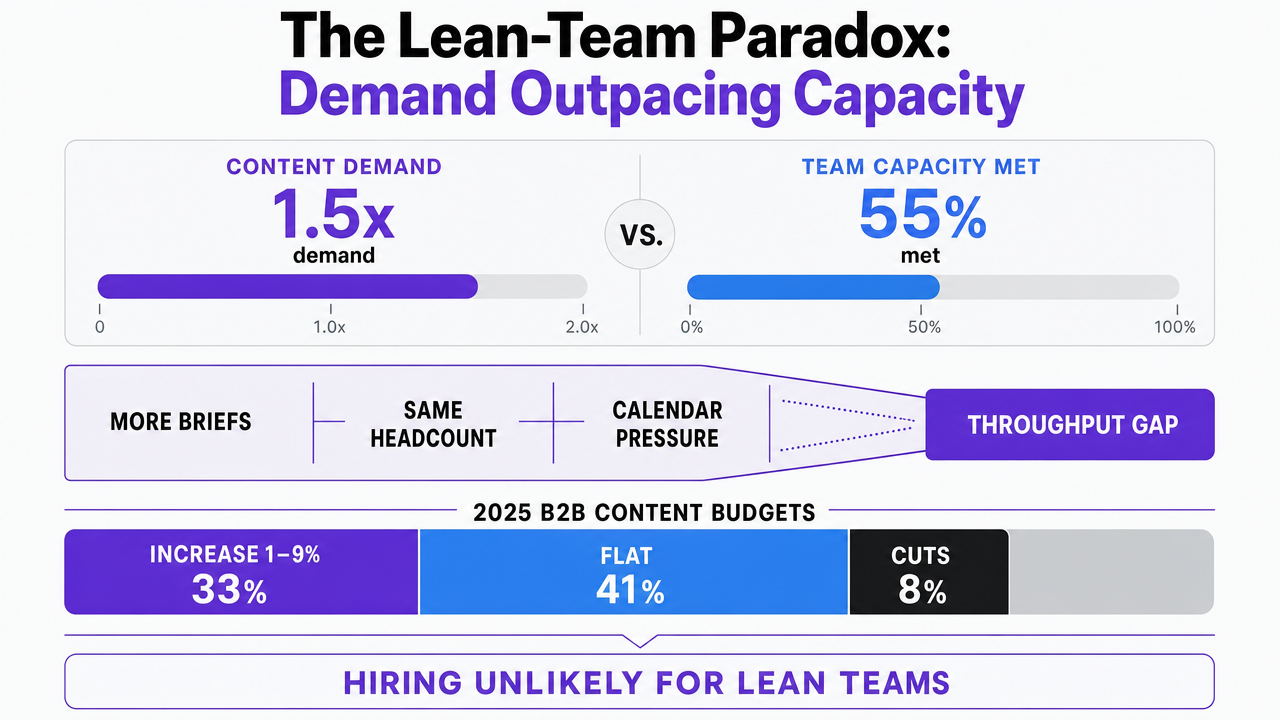 Visualize the 2025 B2B content marketing budget distribution that the section explicitly cites, supporting the argument that hiring is not an option for lean teams
How to Use This Checklist as a Diagnostic Audit
This checklist is designed to audit an existing content operation, not to establish one from scratch. Each item specifies a benchmark, an acceptance criterion, or a measurable outcome. A team passes an item only by providing evidence: a documented artifact, a tracked metric, or a workflow output.
The structure reflects how top-performing B2B programs achieve success. Content Marketing Institute's 2026 trends data indicates that effective teams attribute their results to content relevance and quality (65%), team skills (53%), and sales alignment (45%) 3. Volume ranks below these factors. The audit sequence follows this hierarchy: strategy, audience, channel discipline, then production capacity.
Managers should conduct this checklist quarterly, flagging any item below its threshold as a corrective action with a designated owner and deadline. Items are scored as pass or fail; partial credit can obscure critical gaps that ultimately impact pipeline targets.
A key sequencing rule is "fundamentals before AI." Applying generative tools to an undocumented strategy will only accelerate the production of incorrect outputs. Therefore, the AI workflow section is placed after the strategy, audience, and channel sections.
Documented Strategy Tied to Revenue
The Documentation Threshold and Why It Correlates with Performance
A documented content marketing strategy consistently distinguishes top performers. Content Marketing Institute and MarketingProfs data shows that leading B2B teams are significantly more likely to operate from a written strategy, which correlates with stronger cross-team collaboration and a sharper focus on audience and quality 1. "Documented" means a living, version-controlled document that defines the target audience, required business outcomes, primary channels, and performance measurement methods, not just a one-time slide deck.
The threshold is binary: either the strategy is written, version-controlled, and used for brief approval, or it isn't. Teams failing this often confuse an editorial calendar with a strategy. A calendar lists what's published; a strategy explains the purpose and expected return of each item.
For lean operations, documentation also serves as a triage tool. Items not linked to a written objective are the first to be cut when capacity is constrained, a common reality for most B2B teams 4.
Acceptance Criteria: Goals, KPIs, and Content-to-Pipeline Ratios
A strategy document passes audit only if each goal has a numeric KPI and a clear revenue connection. Vague objectives like "build thought leadership" or "grow brand awareness" fail unless paired with measurable proxies, such as branded search volume, share of voice in a specific SERP cluster, or assisted pipeline from a particular content track.
Three acceptance criteria are particularly diagnostic:
- Named outcome metrics. These include organic sessions to revenue-tagged URLs, marketing-qualified leads sourced from content, sales-qualified leads with content as a first touch, and content-influenced pipeline. Each metric requires a baseline and a quarterly target.
- A content-to-pipeline ratio. This measures pipeline dollars influenced per asset published or per hour of editorial capacity spent. This ratio prompts discussions about which formats and clusters genuinely yield ROI, rather than those that merely feel productive.
- Sales alignment. CMI's 2026 trends data highlights that 45% of effective B2B teams credit alignment with sales as a key driver of results 3. The strategy document should identify the sales counterpart, the joint review cadence, and specific accounts or segments where content and sales will coordinate.
Strategies meeting all three criteria provide managers with a clear justification for shipping content. Those falling short leave editorial decisions vulnerable to the loudest voices in planning meetings.
Audience Research with a Measurable Floor
Audience understanding is the most frequently cited driver of B2B content marketing success. In the CMI/MarketingProfs benchmark, 82% of top performers credit understanding their audience as the primary reason for their program's effectiveness, ranking it above content quality, industry expertise, and team capability 2. This sets a baseline: any content operation unable to demonstrate how it studies its buyers fails the audit, regardless of its editorial calendar's polish.
The key question isn't whether personas exist, but whether the team can present research artifacts produced within the last two quarters. Three documents define this measurable floor:
- Win/loss interview notes. A minimum of six conversations per quarter with closed-won and closed-lost buyers, recorded and tagged by objection, trigger event, and source content. While sales can participate, the content team is responsible for synthesis.
- Search and SERP analysis. A current map of keyword clusters the brand competes in, scored by search intent, ranking position, and pipeline contribution. Clusters without a named owner or tracked revenue tag fail this item.
- Voice-of-customer extracts. Direct language from sales call transcripts, support tickets, and review platforms, refreshed quarterly and integrated into briefs. Generic persona PDFs from an old launch are insufficient.
Lean teams often neglect this work because it doesn't immediately produce a publishable asset. However, this is a critical oversight. Without fresh audience insights, every brief relies on outdated assumptions, and the 82% advantage shifts to competitors who conduct these interviews 2. The acceptance criterion is simple: an editor must be able to retrieve the research artifact supporting any brief within five minutes, or the item fails.
Accelerate Content Production With Zero Commitment
Test-drive an efficient workflow and publish live content before making any long-term decision.
A Narrow Channel Mix Anchored by SEO and Owned Media
Digital spending now accounts for 53.8% of the average marketing budget, according to The CMO Survey 11. For lean content teams, this allocation necessitates concentration, not broad coverage. Spreading two writers and a manager across six channels leads to superficial work. The budget realities support focusing on a few key channels and deprioritizing others.
The ideal anchor pair is organic search and owned media: a domain optimized for revenue-tagged SERP clusters, complemented by a brand-controlled email list and resource hub. Both strategies offer compounding returns, are resilient to algorithm changes on rented platforms, and align with the cluster-based production model that lean editorial calendars can sustain.
An audit passes this item when three conditions are met:
- Named primary and secondary channels. The strategy document clearly specifies which two channels are responsible for pipeline generation and which serve as downstream repurposing targets. Social media, video, and syndication support the primary channels; they do not compete for original production hours.
- A SERP cluster map with owners. Each priority cluster has a tracked ranking position, a content lead, and a target pipeline contribution. Clusters lacking owners are either eliminated or consolidated.
- Owned-audience metrics with a baseline. Subscriber count, list growth rate, and engagement on owned properties are reported alongside organic sessions. Rented reach is reported separately and given less strategic weight.
This discipline is subtractive. CMI's 2026 trends data indicates that effective teams prioritize relevance, quality, and sales alignment as success drivers, not channel breadth 3. A narrow channel mix enables a small team to achieve these benchmarks, whereas a broad mix guarantees they will fall short.
The AI Production Layer Under Human Governance
Where AI Pays Back: Hours, Output, and Revenue Deltas
The productivity benefits of AI in content operations are now proven. Deloitte Digital's research on generative AI in marketing found that early adopters save an average of 11.4 hours per content marketer per week and exceed their revenue expectations by 14%, compared to 2% for companies without AI plans 8, 9. For a three-person editorial team, this recovered capacity is equivalent to adding a fourth team member without the associated salary.
The specific use cases are crucial. The CMO Survey's Fall 2023 report identifies content personalization (52.8%) and content creation (49.2%) as the top marketing applications of AI 10. These are precisely the workflows that consume most of a lean team's time: first drafts, variant production, segment-specific rewrites, and SERP-optimized briefs.
McKinsey's analysis of generative AI in marketing reveals a similar pattern: AI significantly reduces the time required for audience segmentation, SEO optimization, and personalized outreach 12. This consistent data indicates that AI is most effective when applied to high-volume, pattern-heavy production tasks. It is less effective for strategy development, sales alignment, or original audience research. This checklist item requires identifying which workflows fall into each category.
The Approval Workflow: Signal, Recommendation, Human Sign-Off, Execution
Productivity gains from AI are unsustainable without proper governance. Deloitte's research notes that most early AI adopters use generative tools to adapt and enhance content rather than fully creating complex assets, reflecting ongoing concerns about brand voice and quality control 8. The workflow must explicitly incorporate this caution to prevent velocity gains from being eroded by rework and brand inconsistency.
A robust AI production workflow consists of four stages, each with a documented handoff:
- Signal. A tracked input triggers production, such as a SERP gap, a sales objection in CRM, a declining cluster, or a campaign brief. The signal is logged with its source and date.
- Recommendation. The AI layer generates a draft brief, outline, or content variant, including the strategic rationale. The recommendation specifies which audience artifact and content cluster it serves.
- Human sign-off. An editor approves, modifies, or rejects the recommendation based on the documented strategy. No content proceeds without this step.
- Execution. Approved work moves to publication, with the original signal and approval record preserved for measurement.
The audit criterion is whether any published asset can be traced through these four stages in under two minutes. Workflows that fail this trace test rely on trust rather than governance, which can lead to compromises in brand voice and measurement integrity.
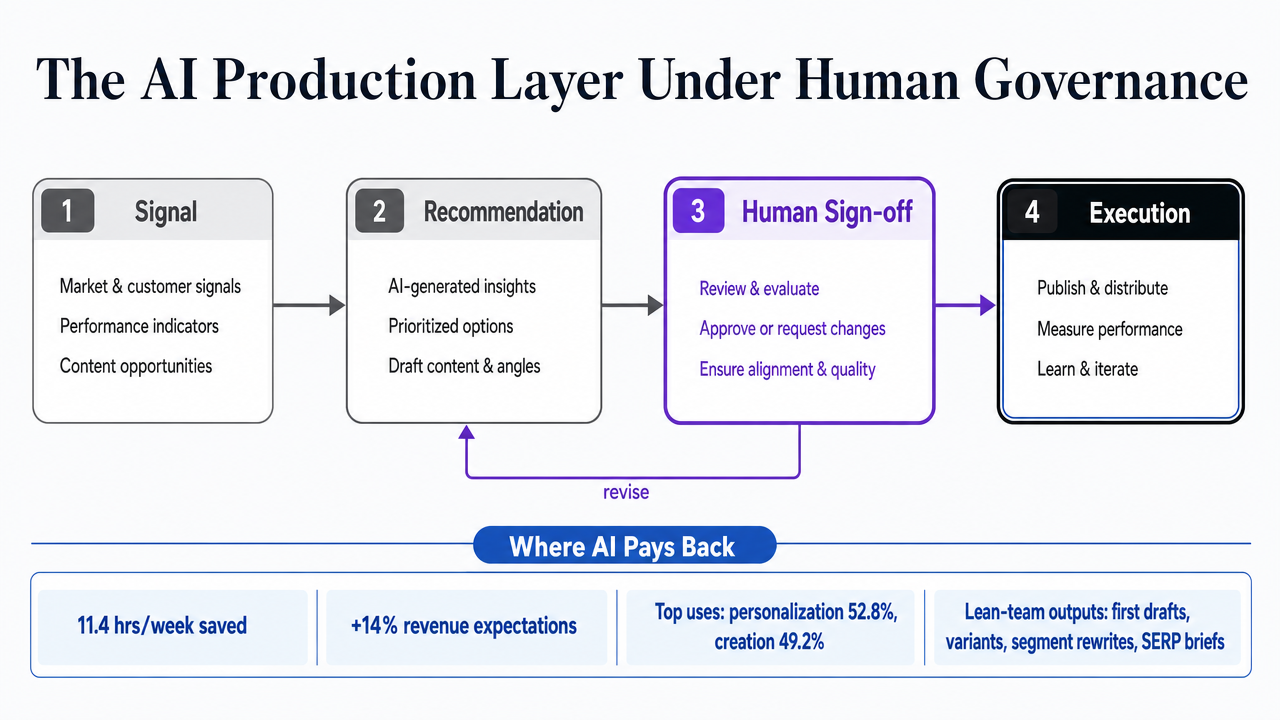 Visualize the four-stage AI approval workflow described in the section (signal, recommendation, human sign-off, execution) as a governance process diagram
Production Economics: Cost Per Asset Before and After AI Assistance
Forbes Advisor estimates the typical cost of a single content asset between $550 and $2,000, depending on length, research depth, and channel 5. This range establishes the financial boundaries for lean teams discussing production economics with finance.
The traditional lean content stack involves fixed and variable costs that quickly accumulate. A staff content manager handles strategy, briefs, and editing. Freelance writers manage first drafts at a per-asset rate within the Forbes range 5. Agencies provide overflow support at a higher blended rate. A tool stack covers SEO research, editorial workflow, analytics, and distribution. Each layer adds coordination time, which, though not invoiced, impacts the calendar.
The AI-assisted model alters the variable costs. Deloitte Digital's research shows early adopters save an average of 11.4 hours per content marketer per week, with productivity concentrated in drafting, variant production, and optimization 8. For a three-person team, this recovered capacity is roughly equivalent to one full editorial position each week, redirected to tasks AI doesn't perform well: audience research, sales alignment, and final editorial judgment.
The following comparison uses the Forbes per-asset range, Deloitte's hours-saved figure, and a monthly output assumption. Managers should customize this table with their specific staff rates and freelance contracts.
| Variable | Traditional Lean Stack | AI-Assisted Production |
|---|---|---|
| Cost per asset (drafting) | $550–$2,000 5 | Internal hours + platform cost |
| Editorial hours per asset | Manager review + freelance coordination | Manager review only; draft pre-staged |
| Weekly capacity per marketer | Baseline | Baseline + 11.4 hours recovered 8 |
| Monthly output assumption | Team's current baseline | Same baseline, fewer external invoices |
| Coordination overhead | Briefing cycles, freelance handoffs, agency status | Single approval queue, internal handoff |
The audit question is not whether AI generally lowers costs, but whether the team can demonstrate, per asset, how hours and dollars have shifted. Operations unable to trace this shift fail the item, even if total spend has decreased.
See How Leading Teams Streamline Content Operations—Without Adding Headcount
Get a personalized walkthrough of data-driven workflows that accelerate content production, coordinate approvals, and maintain enterprise quality at scale—purpose-built for lean marketing teams managing high-stakes campaigns.
Cutting the Work That Doesn't Ship: Briefing Loops, Status Meetings, Vendor Coordination
Every hour spent coordinating is an hour not spent producing. For a three-person team managing 1.5 times the demand, coordination overhead determines whether deadlines are met 8. The audit item is simple: identify recurring non-production work and eliminate, defer, or automate it.
Three categories consume the most lean-team capacity:
- Briefing loops. Briefs that undergo multiple revisions before drafting begins. The solution is a single brief template directly linked to the audience artifact, SERP cluster, and KPI from the strategy document. If a brief cannot be completed in one pass, it indicates incomplete upstream research, not a flawed brief format.
- Status meetings. Weekly editorial standups that merely reiterate information already available on an editorial calendar. LinkedIn's analysis of lean B2B marketing budgets recommends streamlining process overhead and reallocating capacity to automation and higher-impact work, rather than adding tools or meetings to an inefficient system 7. A shared calendar with status fields can replace most standing meetings without sacrificing visibility.
- Vendor coordination. This includes freelancer handoffs, agency status calls, and tool-stack reconciliation. Each invoice carries an unbilled coordination cost. Consolidating drafting, optimization, and routing into a single approval queue eliminates bottlenecks.
The acceptance criterion is a weekly time audit. Any recurring activity consuming more than 30 minutes that does not result in a published asset, a tracked metric, or an approved brief is flagged for elimination at the next quarterly review.
Measurement Integrity: Tracking Outcomes, Not Activity
Activity dashboards can be misleading by omission. A weekly report detailing twelve articles published, four newsletters sent, and three webinars hosted fails to answer critical questions an executive will pose during a pipeline review. The audit item here assesses whether the measurement framework reports outcomes valued by the business, or merely tasks completed by the team.
The CMO Survey's data shows marketers track a mix of tactical and long-term metrics, with digital accounting for 53.8% of average marketing budgets 11. For lean operators, the measurement layer must align with the spending. A program investing over half its budget in digital content cannot credibly report only impressions and publish counts as a measure of integrity.
Three reporting standards differentiate outcome tracking from activity tracking:
- Revenue-tagged URLs. Every priority asset is mapped to a tracked URL with an associated pipeline value. Organic sessions without a revenue tag are considered noise.
- First-touch and influenced pipeline. Content-sourced MQLs, content-influenced SQLs, and dollar value by cluster are reported quarterly, alongside session and ranking data.
- Content-to-pipeline ratio over time. Pipeline influenced per asset published, trended across four quarters, reveals which clusters yield compounding returns and which decline.
Any asset that cannot be traced to one of these three metrics is a candidate for retirement at the next quarterly review, regardless of its performance on activity metrics.
Sequencing the Checklist: Fundamentals Before AI
Order is more critical than ambition. Content Marketing Institute's 2026 trends data indicates that successful teams prioritize content relevance and quality (65%), team skills (53%), and sales alignment (45%) as key drivers, rather than the sophistication of their tools 3. AI enhances these fundamentals; without them, it merely automates incorrect outputs faster.
A sound sequence involves four passes:
- The strategy document with its revenue-tagged KPIs.
- The audience research artifacts that inform briefs.
- The narrow channel mix and SERP cluster map.
- Only then should the AI production layer be activated, with the four-stage approval workflow already in place.
Teams that reverse this order often fail the audit on measurement integrity. Output may increase, but no asset can be traced back to a documented objective, making the content-to-pipeline ratio impossible to calculate. The perceived velocity on dashboards vanishes during pipeline reviews.
Run the checklist quarterly. Score each item against its acceptance criterion, assign an owner and deadline for anything below threshold, and maintain the sequence. Platforms like Vectoron are designed to execute the production layer once the fundamentals are documented, not to replace them.
 Growth in Demand for Marketing Content (2023)
Growth in Demand for Marketing Content (2023)
Frequently Asked Questions
References
- 1.B2B Content Marketing Benchmarks, Budgets, and Trends: Outlook for 2024 Research.
- 2.B2B Content Marketing Benchmarks, Budgets, and Trends (Takeaway Report).
- 3.B2B Content and Marketing Trends: Insights for 2026.
- 4.B2B Content Marketing Benchmarks, Budgets, And Trends.
- 5.Top Content Marketing Statistics – Forbes Advisor.
- 6.Changes in organizations' content marketing budgets in 2025 according to B2B content marketers worldwide.
- 7.B2B Marketing Budgets in 2023: 4 Key Planning Considerations.
- 8.Deloitte Digital's latest research forecasts generative AI's transformation of content marketing.
- 9.Generative AI's Transformation of Content Marketing.
- 10.The CMO Survey: Highlights and Insights Report – Fall 2023.
- 11.The CMO Survey: Topline Report – March 2023.
- 12.Marketing and sales soar with generative AI.
- 13.Manufacturing Content Marketing Benchmarks and Statistics.