
Key Takeaways
- Treat governance as the first evaluation layer, requiring named roles, mapped workflows, roadmaps, and retention rules represented as structured objects rather than attached documents 1, 8.
- Score the content model on custom fields, taxonomy management, and cross-linking between planning artifacts and assets, since schema decides whether metadata discipline holds as the library scales 5, 9.
- Configure workflow with named review states and required accessibility gates that block publish, so approval logic lives in the platform instead of email threads 2, 11.
- Demand approval-first AI where every recommendation is logged, routed for human sign-off, and prevented from bypassing the editorial workflow, following the NIST AI Risk Management Framework 3, 13.
- Judge intelligence by whether the platform links assets to measurable goals at brief creation, ingests analytics automatically, and shapes the next roadmap with evidence 14, 10, 12.
The Calendar-Tool Era Is Ending
Content planning software used to be a color-coded calendar with a review column. That definition is aging fast. Forrester's Content Platforms Landscape, Q3 2024 tracks a market in which management, workflow, and intelligence functions are collapsing into single platforms aimed at complex organizations 15. The follow-up Wave evaluated the top providers across 24 criteria, a scoring surface far wider than any editorial calendar was ever built to cover 18.
The pressure on in-house teams reflects that same shift. A lean editorial group is now expected to run governance, accessibility review, AI-assisted drafting, cross-channel distribution, and performance attribution, often without adding headcount. The U.S. Department of Labor's guidance treats content governance as an operating discipline — identify the team, map the workflow, draft a roadmap — not a documentation exercise 1. Georgia's Digital Services playbook frames planning as a lifecycle covering goals, audience, scheduling, SEO, accessibility, and measurement 4.
Software that only schedules posts cannot carry that load. The teams re-platforming every 18 months are usually the ones that bought on interface polish and calendar views, then discovered the workflow, metadata, and measurement layers underneath were missing. The rest of this guide lays out a five-layer evaluation rubric built for the way modern content operations actually run.
Reframing the Category: From Editorial Calendar to Content Operating System
The clearest signal that content planning has outgrown the calendar metaphor sits inside Forrester's evaluation criteria. The Forrester Wave: Content Platforms, Q1 2025 scored top providers across 24 criteria spanning workflow, collaboration, and intelligence — a scoring surface that assumes buyers now need one system to run planning, production, approval, and measurement together 18. A tool built around dated cards and status columns cannot answer even a third of those criteria.
A content operating system behaves differently from a calendar in three concrete ways:
- It stores planning artifacts — vision, current-state analysis, guiding principles, recommendations, and roadmap — as first-class objects rather than attached documents, matching the structure Georgia Digital Services recommends for a working content strategy 5.
- It routes every asset through a defined approval chain rather than a shared inbox, reflecting the DOL's definition of governance as a mapped workflow with named reviewers 1.
- It treats performance data as an input to the next planning cycle, not a quarterly export.
The distinction matters because the alternative is drift. Calendar tools optimize for visibility: who is doing what, when. Operating systems optimize for repeatability: the same brief structure, the same review gates, the same metadata on every asset, so the tenth piece of content in a campaign is governed like the first. That repeatability is the same principle information governance research uses to define trustworthy content processes 9.
Managers evaluating vendors should read the 24-criteria breadth as a warning. Any platform that answers only the calendar and task-management criteria is a point tool with a marketing label, not a system the editorial operation can grow into.
The Five-Layer Evaluation Rubric
Layer 1 — Governance: Roles, Roadmap, and the Approval Chain
Governance is the layer that determines whether a platform can carry an editorial operation or only decorate one. The DOL's content governance guidance is direct about what governance actually is: a named team, mapped workflows, and a documented roadmap for review, approval, and publication 1. Software that cannot represent those three elements as structured objects — roles with permissions, workflows with states, roadmaps with owners — is a task tracker with editorial branding.
The strongest single rubric for scoring this layer comes from the peer-reviewed scoping review on information governance, which identifies eight principles that map cleanly to platform features: accountability, transparency, integrity, protection, compliance, availability, retention, and disposal 8.
- Accountability shows up as role-based permissions and audit logs.
- Transparency shows up as visible workflow states and change history.
- Integrity and protection show up as version control and access boundaries.
- Compliance shows up as required review gates.
- Availability, retention, and disposal show up as inventory, archive rules, and structured sunset workflows.
A vendor demo can be scored against those eight in a single call.
The NIH-hosted federal governance table adds the operational artifacts buyers should insist on seeing inside the tool itself: content analysis, maintenance plans, process-and-approval for site development, and project charters 7. Charters and maintenance plans that live in a shared drive are not governance — they are documentation about governance. When those artifacts live inside the planning platform and drive workflow behavior, the operating discipline scales.
Content managers scoring this layer should treat any platform without configurable approval chains, role-based permissions, and retention rules as disqualified from the shortlist, regardless of interface polish.
Layer 2 — Content Model: Metadata, Classification, and Reusable Artifacts
The content model is the schema underneath every asset — the fields, tags, relationships, and classifications that make a piece of content findable, reusable, and measurable a year later. Information governance research defines this discipline as the principles behind consistent, repeatable, and trustworthy processing of data 9. Applied to editorial operations, that means a platform's data model, not its calendar view, decides whether the tenth campaign asset inherits the same brief structure, persona tags, funnel stage, and topic cluster as the first.
Georgia Digital Services describes a working content strategy as a set of structured artifacts: vision, current-state analysis, guiding principles, recommendations, and roadmap 5. A capable platform stores those as objects that link to the assets they govern, not as PDFs stapled to a project folder. Briefs reference the guiding principles they inherit from. Assets reference the persona and funnel-stage records they target. Campaign roadmaps reference the goals they advance.
Buyers evaluating this layer should ask vendors to demonstrate three things in a live workspace:
- Custom field creation on any content type
- Taxonomy management across topics and audiences
- Cross-linking between planning artifacts and produced assets
Platforms that force teams into fixed fields or flat tag lists cannot support the metadata discipline a scaling operation depends on, and the cost of that gap compounds every quarter as the content library grows.
Layer 3 — Workflow and Approval: Briefs, Reviews, and Accessibility Gates
Workflow is where governance and content model become daily behavior. A defensible workflow moves an asset through named states — brief, draft, editorial review, SEO review, legal or compliance review, accessibility check, approval, publish — with the right reviewer assigned to each state and no way to skip a gate. The NIH governance table treats process and approval for site development as a standard governance artifact, not a nice-to-have 7, and the DOL guidance is explicit that everyone should understand review, approval, and publication steps 1.
Accessibility belongs inside this layer, not appended to it. The ADA's web guidance makes clear that state and local governments and businesses open to the public are expected to make websites accessible to people with disabilities 2. Section 508 training reinforces that accessibility checks — document properties, evaluation, automated checks — are a defined workflow step for documents and downloadable assets, not a post-publish cleanup task 11. Content planning software should let a manager configure accessibility review as a required gate for any asset type that will be published publicly, with the check assigned to a named role.
Scoring this layer means running a real brief through a trial workspace. Can a manager configure a workflow with five review states, assign different reviewers per state, require accessibility validation on downloadable assets, and prevent publish until every gate closes? Platforms that answer yes handle scale without turning approval into an email thread. Platforms that answer no push the coordination work back onto the content manager, which is precisely the overhead the software was purchased to remove.
Layer 4 — AI Oversight: Human-in-the-Loop by Design
AI features are now table stakes in content planning demos. The oversight design underneath those features is not. Forrester's 2026 B2C predictions warn that a third of companies will harm customer experiences with frustrating AI self-service, a scope note that specifically covers B2C customer experience touchpoints but signals the broader downside of AI deployed without governance 17. Content workflows sit close enough to that risk surface — brand voice, factual accuracy, published claims — that the warning belongs in the evaluation criteria.
The framework that matters for scoring this layer is the NIST AI Risk Management Framework, built explicitly to help organizations manage risk from AI systems to individuals, organizations, and society 3. Applied to a content planning platform, NIST's stance translates to concrete questions:
- Does the tool log which AI actions were taken on which asset?
- Can a reviewer see and edit AI-generated drafts before they enter the approval chain?
- Are AI recommendations — topic suggestions, headline variants, distribution targets — presented as ranked options for human decision, or executed automatically?
- Is there a documented approval step before AI output ships?
Recent enterprise AI research reinforces the point. The 2025 scoping paper on scaling enterprise AI in healthcare treats governance as a core tenet of risk mitigation, not a compliance layer bolted on afterward 13. The principle transfers cleanly to marketing operations: AI at scale without oversight amplifies whatever error, bias, or off-brand output slips into the model, and content is a public artifact.
Buyers should reject platforms where AI actions bypass the approval workflow defined in Layer 3. Approval-first AI — every recommendation surfaced for human sign-off before execution — is the operational form NIST's framework takes inside a content platform.
Layer 5 — Intelligence and Measurement: Closing the Loop to Revenue
The measurement layer is where content planning software stops looking like project management and starts behaving like a revenue instrument. Forrester defines content intelligence as the capture, correlation, and analysis of data about content and its consumption to inform buyer insights, drive activation, and deliver more meaningful performance measurement 14. A planning platform that does not either produce that intelligence or integrate with the systems that do leaves the editorial team measuring outputs instead of outcomes.
The engagement literature review points to what should be measured on the asset side: organization, navigation, readability, consistency, efficiency, and scannability all drive user engagement and belong in the performance signals a platform tracks or ingests 10. Beyond on-page quality, the platform should link assets to downstream metrics — organic sessions, pipeline influence, cost per published asset — so the next planning cycle uses last cycle's results as an input.
Metric-driven planning is now the operating norm for serious organizations. The FTC's 2026 strategic plan is explicit that the plan establishes metrics to track the agency's work, a small but telling signal that measurable objectives, not task counts, define what strategic planning means 12.
Buyers should score this layer on three questions:
- Does the platform tie every asset to a measurable goal at brief creation?
- Does it ingest performance data from the analytics stack automatically?
- Does it surface which topics, formats, and channels are producing pipeline, so the next quarter's roadmap is evidence-shaped rather than opinion-shaped?
Platforms that answer yes to all three are the ones that stop the re-platforming cycle.
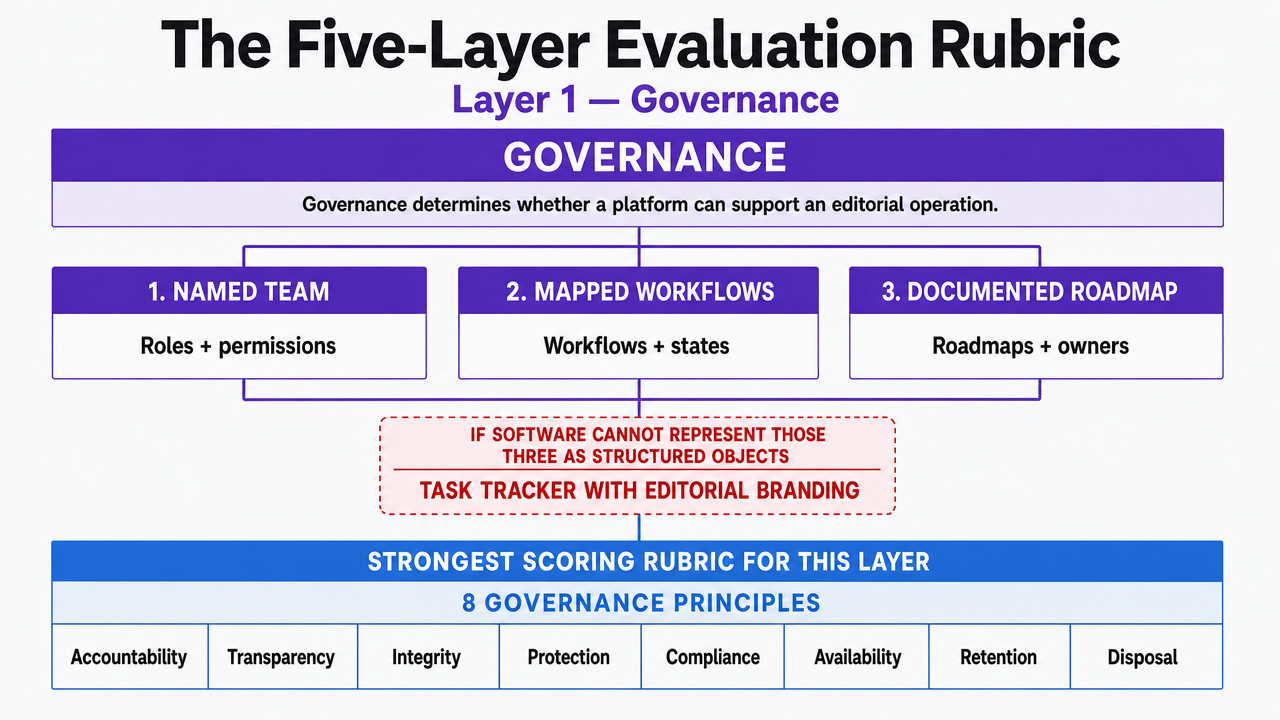 Visualize the five-layer evaluation framework that structures the entire article, giving readers a scannable reference for the rubric's layers and their core scoring criteria
Test Your Content Planning Workflow in Real Time
Experience hands-on content publishing and performance tracking before making any long-term commitment.
Audit Cadence: The Feature Most Buyers Forget to Score
Most vendor demos never touch the question of what happens to an asset 12 months after publish. That gap is where content libraries decay into stale claims, broken links, and pages that quietly contradict newer positioning. Rutgers Communications recommends auditing websites at least annually, and ideally every semester, to keep content accurate and current 6. Applied to a marketing operation, that translates to a hard cadence: a full inventory review once a year at minimum, and a lighter targeted sweep every six months.
A planning platform earns its keep on this axis by treating the audit as a workflow, not a spreadsheet exercise. The features to score are specific:
- Does the tool maintain a live inventory of every published asset with owner, last-reviewed date, and topic classification?
- Can a manager filter that inventory by age and flag every piece past a review threshold into a queue with assigned reviewers?
- Are there structured outcomes — refresh, consolidate, redirect, archive — that trigger the same approval chain used for new production?
The eight information governance principles include availability, retention, and disposal for exactly this reason 8. Assets have lifecycles, and the platform either enforces them or lets the library rot. Buyers who add audit cadence to the evaluation rubric catch the tools that plan content well but abandon it after publish.
Best-of-Breed CMP or Unified Platform: Making the Consolidation Call
Every content operation eventually hits the same fork: keep a specialized content marketing platform sitting alongside separate SEO, analytics, distribution, and approval tools, or consolidate into a unified platform that runs the full lifecycle. The trend line in the analyst research points hard in one direction. Forrester's coverage of revenue marketing platform convergence describes multiple marketing and content technologies collapsing into unified platforms that combine data, orchestration, and measurement across campaigns, with efficiency gains that pull point tools into broader suites 16. The Content Platforms Landscape, Q3 2024 reinforces the same movement inside the content category itself, describing platforms that integrate management, workflow, and intelligence functions for complex organizations 15.
That trend does not automatically make consolidation the correct call for every team. A best-of-breed CMP still wins when the editorial operation has deep, category-specific requirements — regulated content review chains, complex localization, or a proprietary content model — that a generalist platform cannot represent without customization debt. The signals that favor consolidation are different: a stack that already spans an editorial calendar, a brief tool, a CMS, an SEO platform, an analytics layer, and an approval router, with the content manager spending measurable time each week reconciling records across systems.
The practical scoring question is whether the candidate platform can answer the full 24-criteria surface Forrester used to evaluate content platforms in the Q1 2025 Wave 18. If a unified platform covers governance, content model, workflow, AI oversight, and intelligence at parity with the incumbent point tools it would replace, the consolidation math usually clears. If it covers four layers well and one layer thinly, the point tool for that layer stays, and the integration contract between the two systems becomes the next thing to score.
See How Leading Teams Streamline Content Planning Across Channels
Request a walkthrough of advanced content planning workflows that reduce manual coordination, accelerate approvals, and ensure brand consistency at scale for complex marketing organizations.
A Step-by-Step Selection Process
Step 1: Document the Current Operating Model
Vendor conversations get sharper when the buying team can describe its own operation in the same terms it will score software against. Before the first demo, a content manager should map the current state on paper: named roles and reviewers, the actual workflow states an asset moves through, the metadata already tracked on briefs and assets, the audit cadence in place, and the metrics reported to the VP or CMO each month. Georgia Digital Services frames this as the current-state analysis that anchors any working content strategy 5, and the DOL treats the same exercise as prerequisite governance work — identify the team, map the workflow, draft the roadmap — before tooling decisions are made 1.
Step 2: Score Vendors Against the Five Layers
With the current-state document in hand, the shortlist gets scored against the five-layer rubric rather than against feature checklists supplied by the vendors themselves. Each layer produces a small set of pass-fail questions: configurable approval chains and retention rules for governance, custom fields and taxonomy for the content model, required accessibility gates for workflow, approval-first controls over AI actions, and asset-to-outcome linking for intelligence. The eight information governance principles — accountability, transparency, integrity, protection, compliance, availability, retention, disposal — give the governance layer a defensible checklist reviewers can score in real time during a demo 8. Any platform that clears four layers but fails one becomes a conditional shortlist entry, not a leader.
Step 3: Pressure-Test with a Live Brief in a Trial
Scored demos flatter every vendor. A trial workspace with a real brief separates the shortlist. The content manager should push a live campaign through the tool end to end: create the brief with the metadata model, assign a five-state workflow with named reviewers, require an accessibility check on any downloadable asset per Section 508 practice 11, route AI-generated drafts through an approval gate before they enter editorial review 3, and confirm the finished asset ties back to a measurable goal the analytics stack can read. Platforms that carry that brief cleanly, without workarounds or exported spreadsheets, are the ones worth a procurement conversation. The others reveal their gaps in the first two working days.
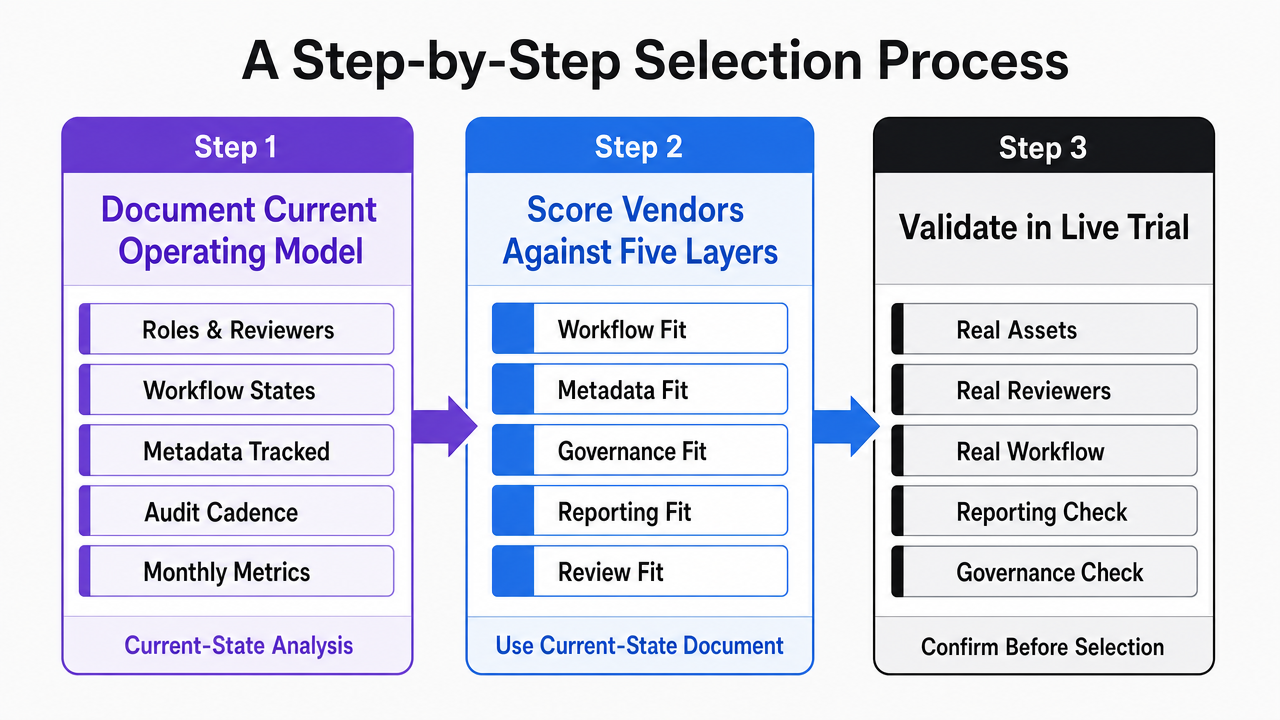 Show the three sequential selection steps as a horizontal process flow so buyers can follow the recommended sequence from current-state documentation through live trial validation
Where Vectoron Fits
The five-layer rubric points toward a specific kind of platform: one that treats planning, approval, AI execution, and measurement as a single governed loop rather than four separate tools stitched together. That is the design premise behind Vectoron's AI Marketing Team Platform. Specialist strategists for content, SEO, social, and related channels produce ranked recommendations, but nothing ships until a human approves it through a shared Command Center — the approval-first pattern the NIST AI Risk Management Framework calls for when AI operates at scale 3. Planning artifacts, workflow states, and performance signals sit in one system, matching the convergence trend Forrester tracks across content and revenue marketing platforms 15, 16. Managers running a two-week trial can score it against the same five layers used on every other shortlisted vendor, then decide on the evidence.
Frequently Asked Questions
References
- 1.Content governance: lightweight practices your team can adopt now.
- 2.Guidance on Web Accessibility and the ADA.
- 3.AI Risk Management Framework.
- 4.The Content Strategy Playbook.
- 5.Your Content Strategy.
- 6.Content Management.
- 7.Web governance—sample Federal agencies.
- 8.A framework for health information governance: a scoping review.
- 9.Foundations of information governance for smart manufacturing.
- 10.A Literature Review: Website Design and User Engagement.
- 11.Module 2: Testing a PDF for Accessibility.
- 12.FTC Publishes New Strategic Plan.
- 13.Scaling enterprise AI in healthcare: the role of governance in risk mitigation.
- 14.Getting Smart On Content Intelligence.
- 15.The Content Platforms Landscape, Q3 2024.
- 16.Converging Platforms For Greater Efficiency: The Rise Of Revenue Marketing Platforms.
- 17.Forrester's 2026 B2C Marketing, CX, & Digital Business Predictions.
- 18.The Forrester Wave™: Content Platforms, Q1 2025.