
Key Takeaways
- Treat tool selection as an operating-model decision: diagnose gaps across planning, workflow, assets, and analytics before evaluating vendors, since disconnected apps leak velocity at every handoff 9, 13.
- Require planning tools to support Forrester's five building blocks—resources, asset management, metadata, infrastructure, and measurement—so the calendar connects to briefs, assets, and performance data 9.
- Govern AI-assisted planning with approval queues, audit trails, and named reviewers up front, because structured workflows cut production time 30–50% while ad-hoc AI use fragments quality and inflates oversight 4, 15.
- Score vendors against a five-part framework covering strategy-to-brief alignment, AI depth beyond drafting, approval governance, integration surface, and measurement tied to the calendar's taxonomy 7, 8, 11.
- Model capacity gains before buying by applying the 30–50% cycle-time range to writer hours, then take that math into demos to separate drafting speed from real capacity 4.
- Convert the framework into a weighted scorecard with veto criteria on approval queues and metadata, so the tool decision reaches leadership as documented evaluation rather than preference.
- For multi-brand portfolios, raise the weight on shared taxonomy, asset management, and brand-scoped approval routing so cross-portfolio reporting and governance actually hold up 8, 15.
- Use the first 30 days to migrate brief templates and taxonomy, encode roles and audit logging, connect DAM and analytics, then recalibrate against the capacity model with leadership 8, 12, 15.
Why tool selection is now an operating-model decision
The content planning conversation has shifted. What used to be a calendar-app question — Airtable versus Trello versus a Google Sheet — is now a question about how a team produces, governs, and measures content end to end. Forrester frames this shift bluntly: most organizations are missing infrastructure across planning, calendaring, workflow, distribution, asset management, and analytics, and gaps in any one of those blocks limit what the others can do 9.
That framing matters for lean in-house teams under pressure to publish more without hiring more. McKinsey's 2024 State of Marketing argues that performance now depends on integrating creative work, analytics, and executional craft through connected martech and GenAI systems — not on picking a single best-of-breed app 5. A calendar that lives outside the brief template, the asset library, and the performance dashboard forces the team to hand-carry context between tools. Every handoff is where velocity leaks.
McKinsey's guidance on where to start is worth adopting: run a tech diagnostic to identify missing tools and process changes across talent, data, analytics, and operating models before evaluating vendors 13. Tool selection follows operating-model diagnosis. Reversed, it produces a stack that fits no workflow in particular and scales none of them.
The five building blocks your planning tool has to support
Resources and alignment: encoding roles, not just assignments
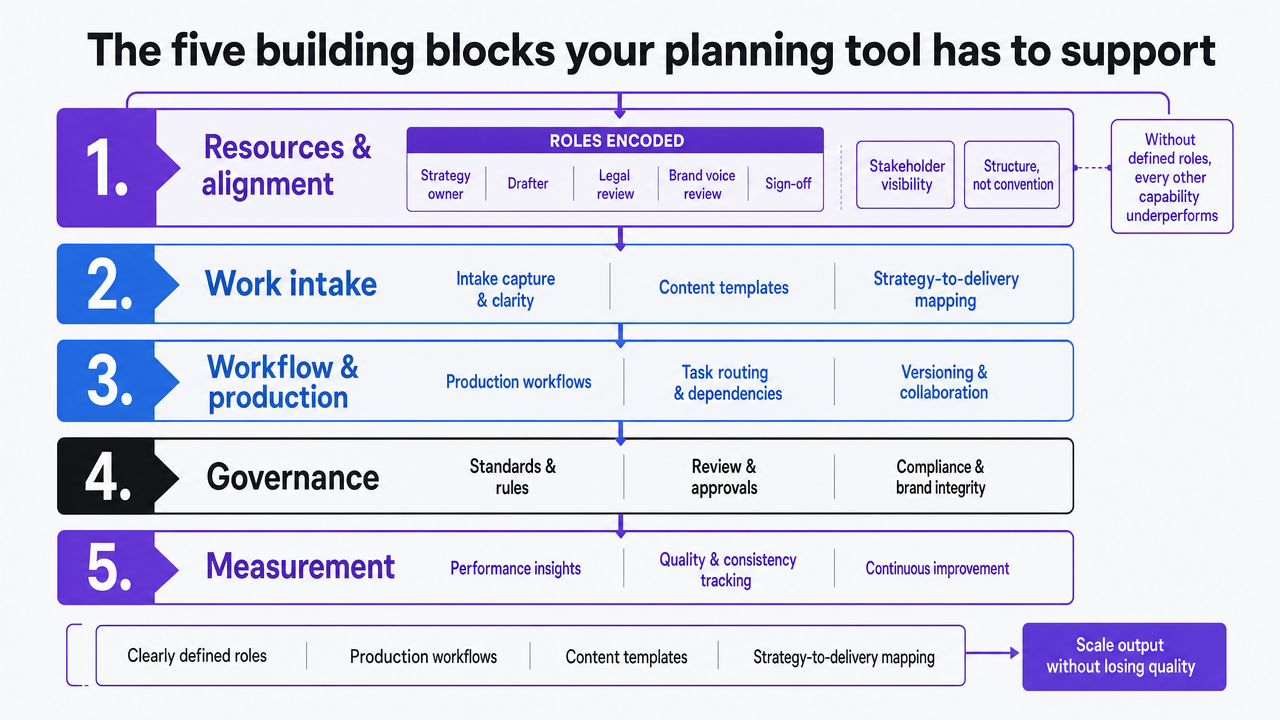
Most calendars assign tasks. Few of them encode who owns strategy, who drafts, who reviews for legal or brand voice, and who signs off before publish. The distinction sounds semantic until a piece stalls for four days because three people thought someone else had it.
Forrester's content operations model puts resources and alignment first for a reason: without defined roles and stakeholder visibility, every other capability underperforms 9. A content operations framework grounded in strategy-to-delivery mapping names three pillars — clearly defined roles, production workflows, and content templates — as prerequisites for scaling output without losing quality 10.
A planning tool earns its place when it encodes those pillars as structure, not as convention. That means role-specific views, brief templates tied to content types, and workflow states that reflect the actual approval sequence a lean team runs — not a generic Kanban board. The Content Engine Maturity Model recommends a common brief template and a shared calendar as the entry point for aligning stakeholders and building a content improvement roadmap 12. If a tool cannot host both artifacts, it is a task tracker with a calendar view, not a planning system.
Asset management and metadata: why the calendar can't live alone
A calendar shows what is scheduled. It does not show what already exists, what can be repurposed, or which assets are approved for which channel. That gap is where content waste lives.
Forrester argues for digital asset management as the anchor of modern content operations: as teams face pressure to produce, govern, and distribute across more channels and regions, DAM has to evolve beyond storage into workflow, rights management, and integration with adjacent planning platforms 8. Planning tools that treat asset management as someone else's problem force writers and designers to rebuild context every cycle — searching for the last approved logo lockup, the current disclaimer, the localized headline that already tested well.
Metadata and taxonomy sit next to asset management as the second half of the same discipline. Forrester's five building blocks name metadata explicitly because it is what makes assets findable, reusable, and measurable 9. Without a shared taxonomy for topics, audiences, funnel stages, and channels, reporting collapses into anecdote and reuse becomes accidental.
A planning tool that supports these blocks connects the calendar entry to the brief, the brief to the asset library, the asset to its metadata, and the metadata to the performance record. This connection is made visible in an infographic mapping Forrester's five building blocks—resources and alignment, asset management, metadata and taxonomy, infrastructure, and measurement—to concrete tool capabilities 9.
Infrastructure and measurement: the connective tissue most stacks miss
Infrastructure is the block Forrester flags as most commonly missing. Its research finds that most organizations lack the systems needed to support planning, calendaring, workflow optimization, distribution, asset management, and analytics as a connected set 9. Each capability might exist somewhere in the stack, but they do not communicate with each other.
The consequence for a lean content team is measurable. When the calendar sits in one app, briefs in a doc, drafts in a CMS, assets in a shared drive, and performance in a BI tool, the team spends hours reconciling states instead of producing work. McKinsey's State of Marketing 2024 makes the same point from the performance side: teams that integrate creative work, analytics, and executional craft through connected martech and GenAI systems outperform teams running the same functions in parallel 5.
Measurement closes the loop. A planning tool without a path to performance data cannot answer the questions a VP of Marketing will actually ask — which topics converted, which channels underperformed, which formats deserve more capacity next quarter. Selection criteria have to include the reporting layer, not treat it as a downstream concern.
The approval-first lens: governing AI-assisted planning before it fragments your team
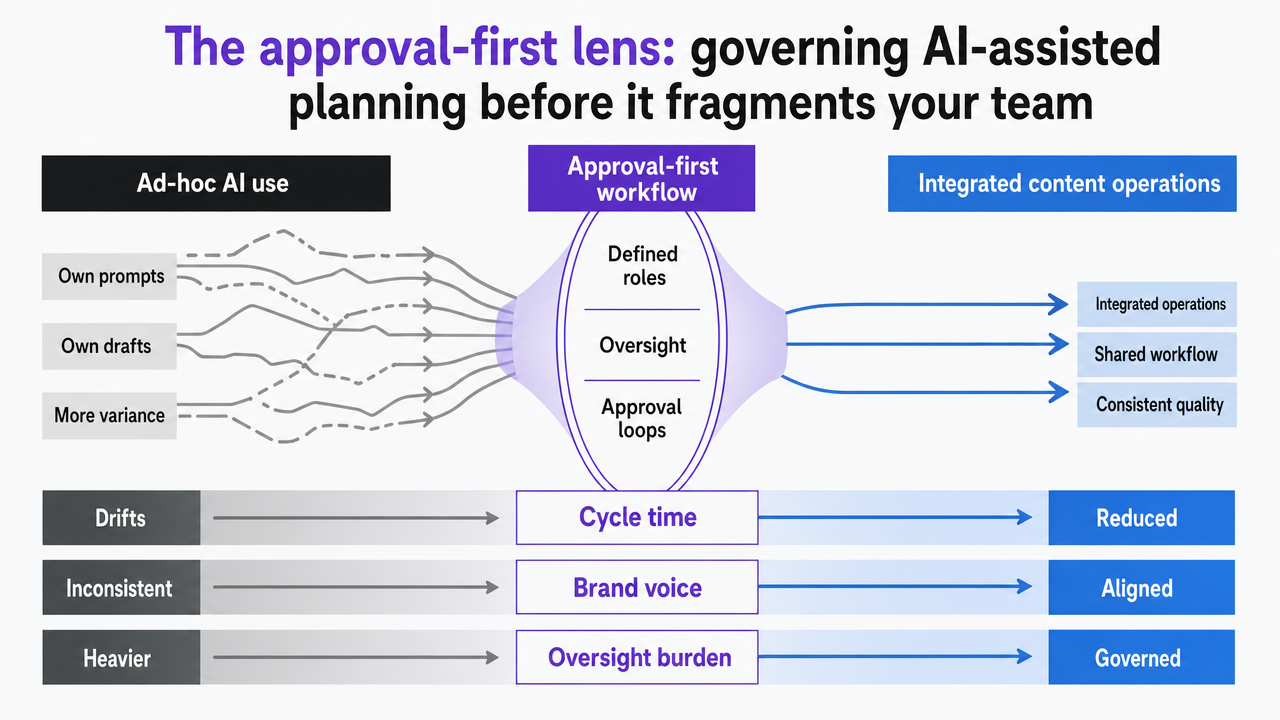
Ad-hoc AI use is the fastest way to lose the productivity gains a planning tool is supposed to deliver. When writers each open their own chatbot tab, prompt in their own style, and paste outputs into whatever draft they happen to own, the team ends up managing more variance, not less. Research from the University of Vaasa on generative AI in content marketing production makes the same observation from the strategic side: without clear workflows and governance, GenAI adoption produces fragmented processes, inconsistent quality, and heavier oversight burden 3.
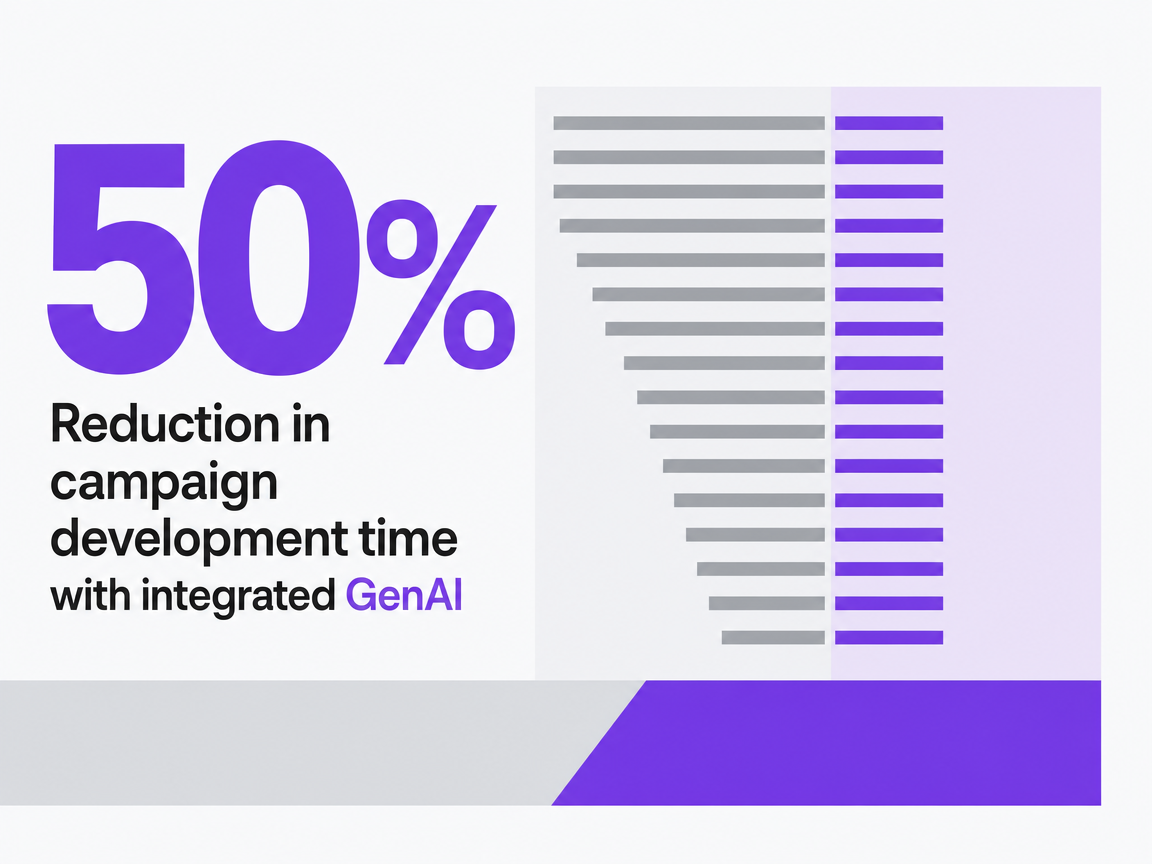
The contrast in outcomes is quantifiable. A CalStateLA study on team-based marketing workflows found that early adopters who integrated GenAI into structured workflows—with defined roles, oversight mechanisms, and purpose-built approval loops—cut campaign development time in half and reduced content production costs by up to 50% 4. The same paper warns that ad-hoc AI adoption dilutes brand voice and inflates risk when it happens outside those guardrails 4. Same technology, opposite results, depending on whether governance is designed in or bolted on later. A comparison chart of ad-hoc AI use versus integrated content operations across cycle time, brand voice consistency, and oversight burden makes the trade-off legible in one frame 4.
NIST's AI Risk Management Framework offers a governance vocabulary in-house teams can borrow without adopting a compliance regime. Its four functions—govern, map, measure, manage—apply directly to AI-assisted planning: define who is accountable for AI outputs, map where AI touches the content workflow, measure quality and drift, and manage risks through the lifecycle 14. The companion Manage playbook specifies the operational discipline: regularly track and monitor negative risks and benefits throughout the AI system lifecycle, with escalation and decommissioning paths when tools exceed tolerance 15.
Translated into planning-tool requirements, that means approval queues that route AI-generated drafts to named human reviewers before publish, audit trails that show which prompts and models produced which assets, and quality thresholds that trigger review escalation. A tool without those controls forces the team to invent them in spreadsheets and Slack threads — which is where oversight burden quietly doubles.
Test real-world content planning at scale now
Experience full-cycle content production and approvals in your actual workflow before making any commitment.
A five-part evaluation framework you can run against any vendor
Strategy-to-brief alignment: does the tool encode your content strategy?
Start with the artifact that connects strategy to production: the brief. If a planning tool cannot host a common brief template tied to each content type, it is asking the team to keep strategy in one place and execution in another. That gap is where scope drift begins.
The Content Engine Maturity Model treats a shared brief template and shared calendar as the entry point for stakeholder alignment and any content improvement roadmap worth building 12. Content Marketing Institute frames the calendar itself as the implementation plan for a documented strategy, with quarterly goal-setting, capacity checks, and content-mix decisions baked into the planning cadence 11.
Run this test on any vendor demo: ask to see a brief created from a strategy input—target audience, funnel stage, primary keyword, business outcome—that auto-populates a calendar entry, a workflow, and an approval path. If the demo requires re-entering the same fields in three places, the tool does not encode strategy. It stores it.
AI-assisted planning: ideation, curation, and localization at scale
AI-assisted planning is where the productivity math actually shifts—and where evaluation gets sloppiest. Vendors demo a prompt box and call it AI. That is not the capability worth paying for.
Research from the University of Jyväskylä on generative AI in digital content marketing found that GenAI's operational value shows up in three specific places: faster idea generation, richer design variation, and personalization at scale 7. The University of Vaasa thesis adds the strategic layer—GenAI supports planning and curation by helping teams organize, refine, and align content with audience needs and marketing objectives, not just draft faster 3. Lindenwood's paper reinforces the small-team scalability angle: AI platforms let lean teams create, manage, and optimize campaigns at a scope previously reserved for larger organizations 1.
Translate those findings into vendor questions. Can the tool generate topic clusters from a keyword and cluster them by funnel stage? Can it produce localized variants of an approved piece without requiring a new brief for each market? Can it suggest curation candidates from existing assets before the team drafts something new? A JETIR study on AI-powered content creation notes that automation gains show up most clearly in SEO optimization and personalization workflows—the same places lean teams lose the most hours 2.
Tools that only draft do not compress planning cycles. Tools that ideate, cluster, and localize do.
Approval queues and governance controls
Every AI-touched asset needs a named human reviewer before publish. That is the operational translation of the governance argument, and it is the criterion most planning tools fail on quietly.
Look for three specific controls. First, routing rules that assign AI-generated drafts to reviewers by content type, channel, or risk level—not a single generic approval column. Second, audit trails that record which prompt, model, and reviewer touched each asset, so drift can be traced to a source rather than argued about in retros. Third, escalation thresholds that flag pieces exceeding a defined quality or risk boundary for higher-level review before they move.
Those requirements map directly onto NIST's Manage function, which calls for regularly tracking and monitoring negative risks and benefits throughout the AI system lifecycle 15. A planning tool that leaves reviewers to reconstruct that trail from Slack threads is offloading governance onto the team's calendar. The scorecard should mark that as a red flag, not a workaround.
Integration surface: DAM, analytics, and the rest of the martech stack
A planning tool's integration surface is a better predictor of long-term velocity than its feature list. Forrester's argument for treating digital asset management as the anchor of modern content operations is precisely this: DAM has to connect to workflow, rights management, and adjacent platforms, or teams end up rebuilding context every cycle 8.
Audit the integration list against four concrete surfaces. The DAM or asset library, so calendar entries link to approved creative rather than pointing at a shared drive. The CMS, so approved drafts publish without a copy-paste step that strips metadata. The analytics stack, so performance data flows back into the same taxonomy the calendar uses. The customer data platform if the team runs personalized campaigns—McKinsey's State of Marketing 2024 flags CDPs and analytical software as central to data-driven performance, not optional 5.
Native integrations beat Zapier bridges. Ask vendors for named integrations, API depth, and a list of customers actually running the stack you plan to run.
Measurement and capacity planning
Measurement is the block most planning tools treat as a downstream problem. It is not. If the tool cannot answer which topics converted, which formats underperformed, and how much capacity the team has left this quarter, the VP of Marketing is going to keep asking those questions in meetings the team could have skipped.
Two capabilities separate serious measurement layers from dashboards bolted on for the demo. First, performance data tied to the same metadata schema the calendar uses—topic, audience, funnel stage, channel—so reporting rolls up without manual tagging. Second, capacity views that show planned output against realistic writer hours, which is what CMI recommends for quarterly editorial planning 11. An empirical study on AI utilization and content quality found a measurable path from AI use through content quality to team productivity, with a path coefficient of 0.288 for the indirect effect 6. That relationship is only visible if the tool measures both sides of it.
If measurement lives in a separate BI tool, the loop is broken.
Production capacity math: modeling output before you buy
Before a vendor call, model the capacity gain in a spreadsheet. The math is simple enough to run in ten minutes and specific enough to change which tools make the shortlist.
Start with four variables the team already knows: articles per month (A), average writer hours per article (H), effective writer hours per week (W), and headcount (N). Baseline capacity is A × H, and available capacity is N × W × 4. The gap between them is the shortfall the tool has to close.
Apply the sourced cycle-time delta as a range, not a point estimate. The CalStateLA study on team-based marketing workflows found that early adopters who integrated generative AI into structured workflows—with defined roles, oversight mechanisms, and purpose-built approval loops—reduced content production time by 30 to 50 percent, with some teams cutting campaign development time in half and content production costs by up to 50 percent 4. Scope matters: that range reflects early adopters running integrated workflows, not teams layering a chatbot on top of an existing calendar. Ad-hoc AI use produces different numbers, usually in the wrong direction. A horizontal bar chart showing the 30-to-50 percent range with that scope label sits well next to the calculation.
Model two scenarios against the baseline. Conservative applies a 30 percent reduction to H, giving adjusted capacity of A × (H × 0.70). Aggressive applies 50 percent, giving A × (H × 0.50). For a four-person team publishing 20 articles a month at 12 writer hours each, that is 240 baseline hours, 168 conservative, or 120 aggressive. The delta is either 72 hours reclaimed for higher-value work or 120 hours available for additional output—roughly six to ten more pieces per month at the same quality bar.
Take that model into vendor demos. Ask which capabilities produce the reduction, which require integrated workflows to hit the upper bound, and which customers actually operate at that level. Vendors who cannot answer are selling drafting speed, not capacity.
 Reduction in campaign development time with integrated GenAI
Reduction in campaign development time with integrated GenAI
The scorecard: turning the framework into a vendor evaluation
A framework only earns its keep when it produces a decision. Turn the five building blocks and the approval-first lens into a weighted scorecard the team can run against every vendor demo—same rubric, same scoring, same reviewers.
Score each vendor from 0 to 3 on the criteria below. Zero means absent. One means partial or requires custom work. Two means native and functional. Three means native, configurable, and demonstrated by a reference customer running at the scale the team plans to run.
- Strategy-to-brief alignment (weight: 15%). Common brief template tied to content type, auto-populating calendar entries and workflows 12.
- Resources and roles encoded in structure (weight: 10%). Role-specific views, named approvers, workflow states matching the actual sequence 9, 10.
- Asset management and metadata (weight: 15%). Native DAM connection or built-in asset library with shared taxonomy across topics, audiences, funnel stages, and channels 8, 9.
- AI-assisted planning depth (weight: 15%). Ideation, clustering, localization, and curation—not drafting alone 3, 7.
- Approval queues and audit trails (weight: 15%). Routing rules, prompt and model logging, escalation thresholds for AI-generated assets 15.
- Integration surface (weight: 15%). Native connections to CMS, analytics, and CDP where relevant 5, 8.
- Measurement layer (weight: 15%). Performance data tied to the calendar's metadata schema and capacity views 11.
Any vendor scoring below 1.5 weighted average drops off the shortlist. Any capability scoring 0 on approval queues or metadata is a veto, regardless of the average. Bring the completed scorecard to the VP of Marketing conversation—it turns the tool decision into a documented evaluation rather than a preference.
See How Centralized Content Planning Accelerates Team Output
Request a tailored walkthrough of unified content planning tools that improve approval cycles, increase publishing velocity, and maintain consistent brand quality across all channels.
If you manage a portfolio of brands or business units
A note for readers whose scope is broader than a single content team: if the role covers multiple brands, business units, or regional markets, the evaluation framework holds but the weighting shifts. Metadata and taxonomy move from important to decisive, because a shared schema across brands is what makes cross-portfolio reporting possible at all. Without it, each unit produces its own taxonomy and the parent org gets a stack of incompatible dashboards.
Asset management weight goes up for the same reason. Forrester's case for DAM as the anchor of content operations gets stronger when rights, localization, and channel approvals multiply across brands 8. A shared library with brand-scoped permissions beats one library per unit every time.
Governance also changes shape. Approval queues need brand-level routing so a legal reviewer for one unit does not become a bottleneck for another. Apply the same NIST Manage discipline—track risks and outputs through the lifecycle—but scope the monitoring by brand so drift in one unit does not contaminate the portfolio view 15.
What to do in the first 30 days after you pick a tool
The first month decides whether the tool becomes infrastructure or another tab. Treat it as a rollout with named owners, not a rollout with a training deck.
Week one: migrate the brief template and taxonomy before anything else. Load the common brief template, topic and funnel-stage tags, and channel definitions into the tool so every entry created from day one carries the shared schema 12. Skipping this step is how teams end up with two taxonomies six weeks in.
Week two: encode roles and approval routing. Assign named reviewers by content type, wire AI-generated drafts into a separate approval lane, and turn on audit logging for prompts, models, and reviewer actions—the operational read of NIST's Manage function 15. Run one live piece end to end before onboarding the rest of the team.
Week three: connect the DAM, CMS, and analytics feed so calendar entries, assets, and performance data share the taxonomy 8. Verify that a published piece reports back into the calendar view without manual tagging.
Week four: run the capacity model against actual output and recalibrate. Bring the numbers, the scorecard, and the audit trail to the VP of Marketing review. Platforms like Vectoron's approval-first orchestration are built around this loop—but the discipline matters more than the vendor.
Frequently Asked Questions
References
- 1.The role of generative artificial intelligence in the new age of marketing.
- 2.A Study on AI‑Powered Content Creation in Digital Marketing.
- 3.Generative artificial intelligence in content marketing production.
- 4.Integrating Generative AI Into Team‑Based Marketing Workflows.
- 5.State of Marketing 2024.
- 6.The Role of Artificial Intelligence Utilization and Content Quality on the Productivity of Content Marketing Teams.
- 7.The Impact of Generative Artificial Intelligence on Digital Content Marketing.
- 8.Digital Asset Management Anchors Modern Content Operations.
- 9.Five Keys to Successful Content Operations.
- 10.Content Operations: Connecting Strategy and Delivery.
- 11.7 Steps to a More Strategic Editorial Calendar.
- 12.Assessing Your B2B Content Strategy and Operations.
- 13.The next frontier of personalized marketing.
- 14.AI Risk Management Framework | NIST.
- 15.Manage - AIRC - NIST AI Resource Center.