
Key Takeaways
- Throughput ceilings stem from approval latency and handoff friction, not writer capacity, so governance redesign unlocks velocity faster than adding freelancers or tooling.
- Treat content as five connected loops—Strategy, Production, Approval, Distribution, and Feedback—where performance signals flow backward to update briefs and production specifications 1, 5.
- Split approval into parallel brand, accuracy, and ranking checkpoints with named owners, so AI-assisted drafts clear review without sequential bottlenecks 2, 6.
- Defend the workflow with three metrics: brief-to-publish cycle time, approval latency by checkpoint, and asset performance against the KPI named in each brief 1, 4.
Why throughput stalls before it scales
Most in-house content teams hit a throughput ceiling, often between eight and twelve published assets per month. This isn't usually due to a lack of writers, but rather issues like approval latency, inefficient briefing processes, and the cumulative impact of handoffs between strategists, writers, editors, SEO leads, and legal reviewers. Simply adding more freelancers doesn't resolve this; the bottleneck remains at the review stage.
Teams that successfully overcome this ceiling have shifted their approach. Instead of viewing the content workflow as a linear editorial calendar, they treat it as a governed operating system. Harvard Business School Online describes content strategy as a continuous cycle of goal-setting, audience research, channel selection, production, distribution, and KPI-driven refinement 1. Similarly, Digital.gov defines content strategy as planning, creating, delivering, and governing content to meet user needs and organizational goals 5.
Achieving velocity at scale is fundamentally a governance challenge, not a staffing one. Generative AI is already being used within enterprise teams for drafting, ideation, and decision support 10. Organizations that safely leverage this output are those that have redesigned their approval processes, not just acquired more tools. This guide will break down the content workflow into five interconnected loops, highlighting where human judgment is crucial at each stage.
The five-loop operating model
From linear calendar to connected loops
A content production workflow should be seen as a closed system, not a simple queue. It consists of five interlocking loops: Strategy, Production, Approval, Distribution, and Feedback. Each loop has a distinct decision, a specific deliverable, and a measurable Key Performance Indicator (KPI). Crucially, each loop provides feedback to the preceding one. The editorial calendar is merely an element within this larger system, not the system itself.
Digital.gov's definition of content strategy—planning, creating, delivering, and governing content against user needs and organizational goals 5—aligns well with this operating model. Planning occurs in the Strategy loop, where brief quality and topic-to-pipeline fit are key KPIs. Creation happens in Production, with cycle time per asset as the primary KPI. Delivery spans the Approval and Distribution loops, measured by approval latency and channel-weighted reach. Governance is embedded in the Feedback loop, where asset performance against the initial strategic goal is the central KPI.
Adopting this five-loop perspective, rather than a linear pipeline, is vital because it ensures that performance signals travel backward through the system. Performance data informs and updates future briefs. Friction in the approval process leads to adjustments in production specifications. This transforms the calendar from a mere wish list into a defensible forecast that the system can realistically achieve.
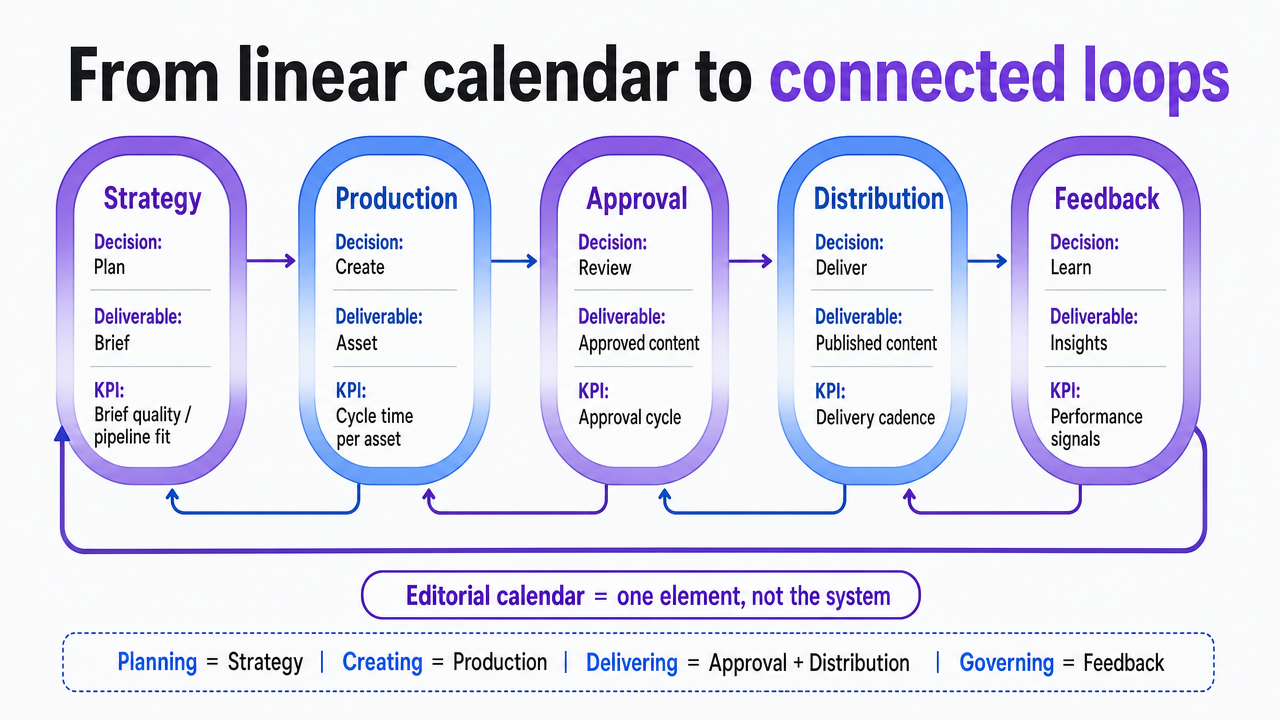 Visualize the five-loop operating model that structures the entire article, showing how Strategy, Production, Approval, Distribution, and Feedback connect with backward signal flow
Where governance becomes the velocity unlock
Governance is often perceived as a hindrance to speed. However, the opposite is true, especially for teams scaling output with AI-assisted drafting, ideation, and decision support 10. In these environments, the primary constraint is no longer how quickly a writer can produce a draft, but how rapidly a reviewer can clear it without introducing brand, accuracy, or ranking risks.
The U.S. Department of Labor's governance guidance emphasizes this point: clearly mapping planning, publication, and retirement workflows provides the entire team with visibility into who is involved at each step and where bottlenecks occur 2. This transparency enables parallel work. When SEO, brand, and legal reviewers understand their specific checkpoints, they can work concurrently instead of sequentially.
Governance design becomes the key to unlocking velocity when three conditions are met:
- roles are defined for each checkpoint rather than per asset;
- AI-generated drafts include the same metadata humans use for approval;
- and every approval decision informs and refines the brief template, ensuring subsequent assets start closer to a publishable state.
When these conditions are in place, governance shifts from being a brake to a compounding force for throughput.
Loop one: strategy intake
KPI-first briefs that survive scrutiny
The strategy loop falters when briefs focus on topics rather than desired outcomes. A brief specifying only a keyword cluster, word count, and deadline tells a writer what to create, but not what success looks like. Such a brief, presented to a CMO months later, offers no clear justification for the asset's budget allocation.
Harvard Business School Online offers a solution: identify KPIs aligned with the goal, benchmark current performance, and track metrics like monthly viewers, downloads, or clicks before the asset is published 1. The brief serves as a contract, outlining the goal, target audience, primary KPI, and secondary indicators that will show the asset's effectiveness within 60 to 90 days of publication.
The Small Business Administration (SBA) reinforces this discipline by stating that tactics failing to generate ROI should be updated, not repeated 4. This review obligation must be integrated into the brief itself, rather than being relegated to a quarterly retrospective. Each brief should include the KPI it will be measured against and the threshold below which the asset will be flagged for revision, repurposing, or retirement.
Audience, channel, and topic decisions before a single draft
Three critical decisions belong to the strategy loop and must precede any production work: who the asset is for, which channel will carry it, and what topic and angle will capture attention within that channel.
HBS Online sequences these as audience identification, topic and keyword research, and channel selection, all before the editorial calendar is even built 1. The International Trade Administration adds an analytical layer: define the goal, identify the best market, review web analytics, and pinpoint channels already delivering reach 7. Channel selection, therefore, becomes a data-driven decision, not a default choice.
For content teams utilizing AI-assisted drafting, the audience and channel decisions become even more crucial. While personalized content generation at scale 8and AI-assisted tailored social posts 9can significantly increase value, this only happens when the initial targeting is accurate. A precise brief, specifying a named audience segment and a single primary channel, provides the production loop with clear constraints for optimization. Conversely, a vague brief will lead to fast drafts that ultimately fail to achieve objectives.
Test a live content workflow in real time
Experience hands-on control by publishing real content through a centralized workflow during your trial.
Loop two: production with AI in the workflow
Role swimlanes and the hidden tax of handoffs
Production bottlenecks rarely stem from the writing process itself, but rather from the gaps between roles. A draft might languish in a strategist's inbox awaiting clarification, an editor might return comments already addressed, or an SEO lead might request structural changes after legal has approved the copy. Each handoff incurs a small, cumulative cost.
The U.S. Department of Labor's governance guidance highlights that mapping the workflow makes the entire team aware of the steps involved in content creation, review, or retirement, and clarifies who is responsible at each stage 2. This transparency is precisely what a swimlane model provides.
- The strategist owns the brief and the KPI.
- The writer owns the first draft.
- The editor is responsible for voice, structure, and factual review.
- SEO handles search intent, internal linking, and technical metadata.
- The approver signs off on brand and risk.
- The publisher manages CMS integration and channel scheduling.
When each lane has a named owner and defined inputs, sequential waiting is replaced by parallel work. SEO can audit an outline while the writer drafts the body. Legal can review high-risk passages without delaying the entire asset. Mass.gov explicitly warns against siloed handoffs, which lead to poor content experiences and conflicting updates across channels 3. Swimlanes offer a solution to these issues.
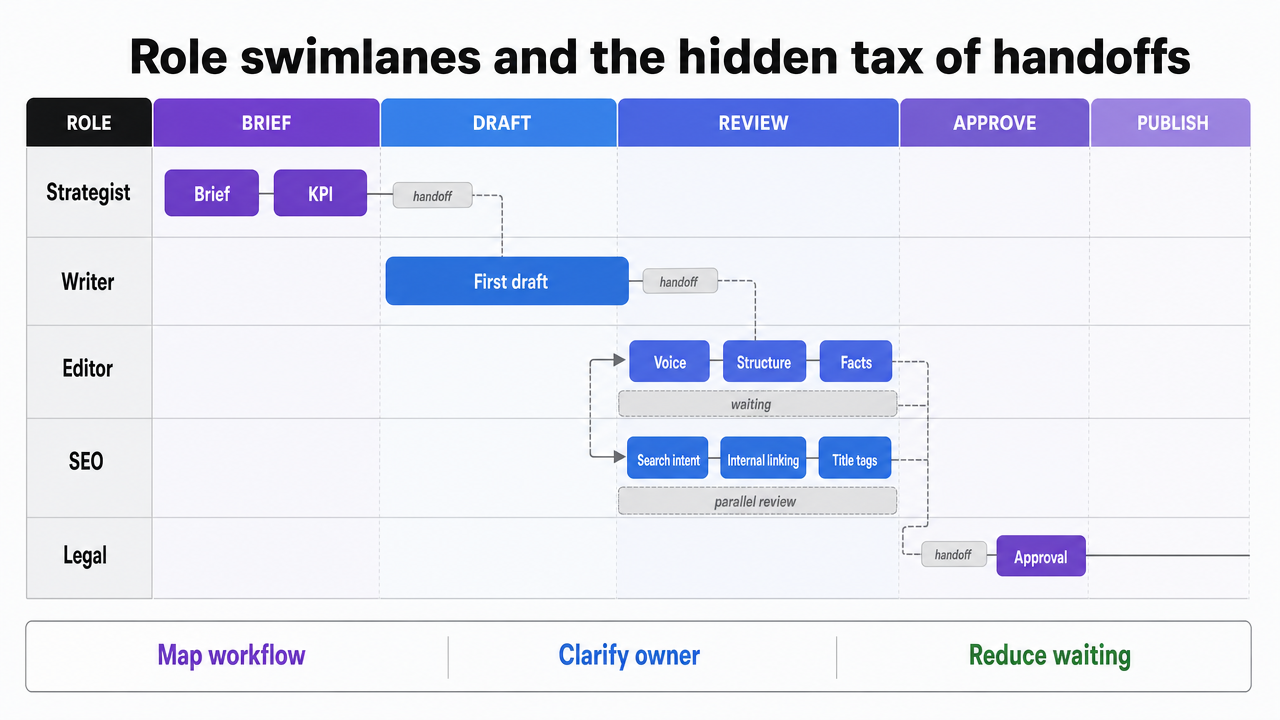 Show the parallel swimlane production model with named role owners, directly supporting the section's argument that swimlanes replace sequential waiting with parallel work
The AI maturity ladder content teams climb
Most content teams are not debating whether to use AI in production, but rather assessing their current stage of adoption. CalState's analysis of AI in marketing workflows describes a progression: from isolated experimentation (e.g., a single writer brainstorming headlines with a chatbot) to coordinated, team-based adoption, and finally to integrated co-creation. In this advanced stage, generative AI becomes a collaborative partner deeply embedded in nearly every aspect of the team's workflow 6.
Early stages of AI adoption are characterized by individual writers using AI for speed gains or research summarization. Output quality can be inconsistent because practices are private and prompts are not shared. Teams at this level often report individual speed improvements but minimal impact on overall team throughput.
Intermediate stages involve shared prompt libraries, draft templates, and review checklists that incorporate AI-generated metadata. This leads to stabilized quality and reduced cycle times. The most advanced stage is structural: briefs, drafts, SEO audits, and distribution variants are produced within a connected system where AI handles routine generation, and humans manage critical approval checkpoints. This enables operational personalization at scale, as seen in healthcare AI applications 8and AI-assisted social content production 9, moving it from aspiration to reality. Understanding this maturity ladder helps content marketing managers strategically plan their next AI investments.
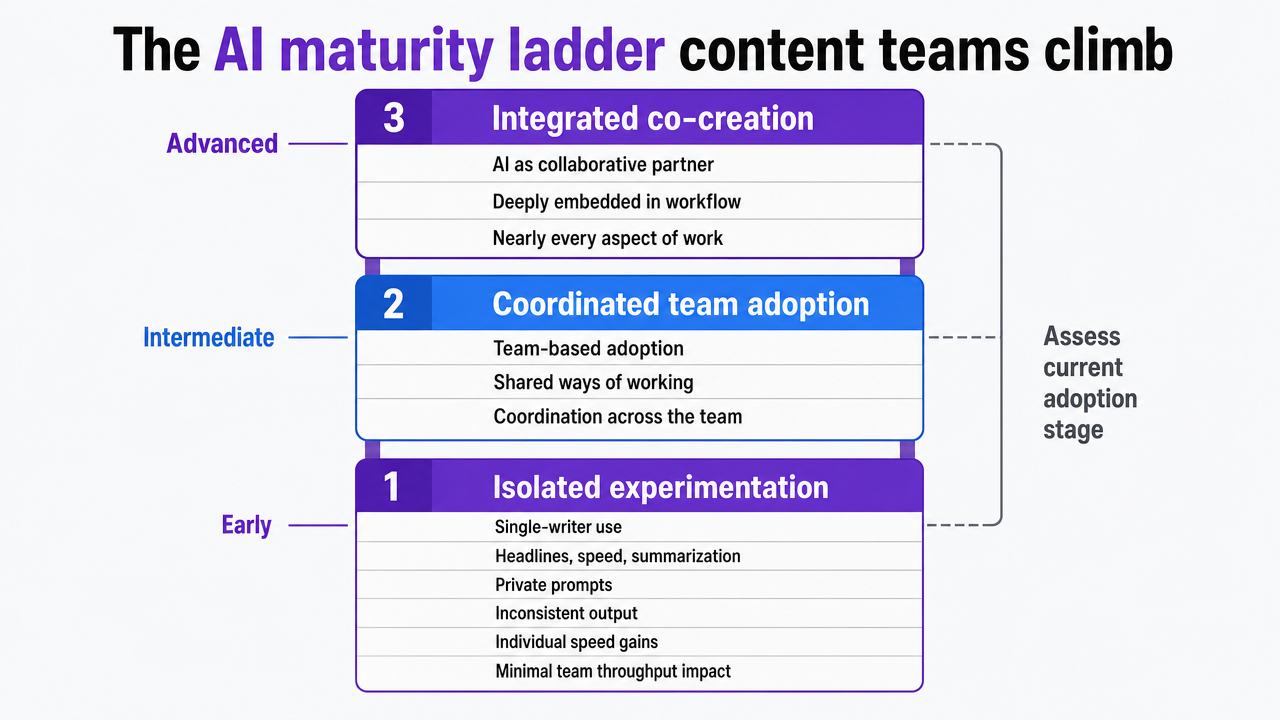 Visualize the three-stage AI maturity progression cited from CalState analysis, supporting the section's framework for assessing current AI adoption stage
Loop three: approval as the quality gate
Human judgment at brand, accuracy, and ranking checkpoints
The approval loop is where AI-assisted production either thrives or fails. While drafts arrive faster, the challenge lies in ensuring the review process maintains standards for brand integrity, factual accuracy, and search performance.
The solution is to divide approval into three distinct checkpoints, each with a designated owner and a clear decision.
- The brand checkpoint assesses whether the voice, claims, and positioning align with company standards.
- The accuracy checkpoint verifies every factual statement, statistic, and attributed claim, ensuring it is sourced or removed.
- The ranking checkpoint determines if the asset is optimized for its target query, considering search intent, internal linking, structured data, and metadata for indexability and competitiveness.
These checkpoints should operate in parallel, not sequentially. The U.S. Department of Labor's governance guidance emphasizes that mapping ownership at each step reveals and resolves bottlenecks, allowing work to progress without holding up the entire asset 2. CalState's analysis of integrated co-creation reinforces this principle: AI handles routine generation, while human judgment focuses on critical checkpoints where brand, accuracy, and ranking risks reside 6. Approval transforms from a single inbox into a structured gate with multiple entry points, each managed by the appropriate role.
Auditing and retiring the back catalog
Approval doesn't conclude with publication. The same gate must reopen periodically because every published asset either contributes positively or negatively to the overall content library. The SBA is clear: tactics that fail to generate ROI should be updated, not repeated 4. For content, this translates to a quarterly audit cycle with three possible outcomes for each asset: keep, refresh, or retire.
The rationale for retirement is operational, not sentimental. Mass.gov documented a public-sector organization's "ROT" (Redundant, Outdated, Trivial) content cleanup, which resulted in a 65% reduction in negative user feedback and 33% fewer pages to manage 3. While this is a specific case, it illustrates that smaller, current libraries generally outperform larger, stale ones in terms of user experience and operational costs. The audit process itself belongs within the approval loop because the same three checkpoints apply. Brand drift, accuracy decay, and ranking erosion are the factors that can move an asset from "keep" to "refresh" to "retire." The U.S. Department of Labor's guidance considers retirement a fundamental stage of the content lifecycle, not an afterthought 2. Treating it as such ensures the content library remains defensible.
Loop four: distribution and channel cadence
Distribution is often where content workflows underperform. An asset might be published to a blog, shared once on LinkedIn, and then the team moves on. The effort invested in its creation and approval is not fully leveraged through adequate channel coverage.
The International Trade Administration's guidance treats channel selection as an evidence-based decision, not a default: define the goal, identify the audience, review web analytics, and pinpoint channels that actually deliver reach 7. Applied to the distribution loop, this means each asset should have a channel plan integrated into its brief, not added as an afterthought. This plan should specify the primary channel, secondary repurposing formats, and the schedule for re-promotion over the subsequent 60 to 90 days.
AI significantly alters the economics of this loop. Tools capable of generating tailored social posts and personalizing creative output at scale 9can convert one approved asset into multiple channel-specific variants without re-entering the full production loop. The constraint then shifts to approval. Each variant still requires brand and accuracy checks, but these can be performed more rapidly against the established standards of the master asset. Distribution evolves from a single push to a defensible, scheduled sequence.
See How Leading Teams Streamline Content Approvals and Orchestration
Request a walkthrough of centralized content workflows proven to cut approval cycles by 40% and maintain brand governance across multi-channel initiatives.
Loop five: performance feedback that closes the system
The feedback loop distinguishes a content workflow from a mere content factory. Without it, assets are published, traffic numbers accumulate on a dashboard, but nothing within the system changes based on the data. The loop closes when performance signals flow back into the briefs, production specifications, and channel plans that initially generated the assets.
The SBA frames this as a discipline: tactics that fail to generate ROI should be consistently measured and updated, not simply repeated in the next cycle 4. Harvard Business School Online sets the prerequisite conditions: benchmark current performance, define KPIs aligned with the goal, and track metrics like monthly viewers, downloads, and clicks against that benchmark 1. The feedback loop interprets these metrics and communicates the results back to the Strategy loop, leading to brief updates, topic reprioritization, or retirement decisions.
Three key signals should be part of the review cadence:
- Asset-level performance against the KPI named in the brief, evaluated over a 60- to 90-day window;
- Channel-weighted reach and engagement, reviewed against analytics as recommended by the ITA on a regular schedule 7;
- Approval friction data, including cycle-time and revision-count metrics, which indicate whether Production and Approval loops are becoming more or less efficient under AI-assisted volume 6.
When these three signals inform the next quarter's briefs, the system improves iteratively. If they remain unexamined in a dashboard, the workflow reverts to a simple calendar.
Operator economics for multi-location and portfolio teams
Central, distributed, and hybrid staffing models compared
For content marketing managers overseeing production across multiple locations, brands, or practices, the choice of staffing model has a greater cost impact than tooling decisions. Organizations like a dental support organization with sixty offices, a law firm network with twelve regional sites, or a senior living portfolio with twenty communities cannot operate with the same workflow as a single-headquarters team. The key is determining which work is centralized and which remains local.
Mass.gov's content operations guidance outlines three working models—central, distributed, and hybrid—and their respective trade-offs 3. The chosen model dictates ownership of strategy, production, and approval, as well as the inherent risks the team accepts.
| Variable | Central | Distributed | Hybrid |
|---|---|---|---|
| Strategy ownership | Central team | Each location | Central team |
| Production ownership | Central team | Each location | Central team, local input |
| Approval ownership | Central | Local | Central brand and accuracy, local relevance |
| Brand consistency risk | Low | High | Low |
| Local relevance risk | High | Low | Moderate |
| Best fit | Tightly branded portfolios | Independently operated locations | DSOs, law firm networks, senior living groups |
Mass.gov explicitly warns that siloed handoffs in distributed setups lead to poor content experiences and conflicting updates across channels 3. Most multi-location operators gravitate towards the hybrid model because it centralizes brand and accuracy approval, where scrutiny is paramount, while decentralizing topical and location-specific judgment. AI-assisted production enhances this design, allowing central teams to produce master assets and approved variants, which local owners then adapt against fixed brand checkpoints, rather than creating content from scratch.
Agency retainer versus in-house plus AI-augmented production
The second economic consideration is whether to outsource production via an agency retainer or manage it in-house with AI augmentation. This comparison is structural, not merely a pricing exercise.
| Variable | Agency retainer | In-house plus AI-augmented |
|---|---|---|
| Briefing cycles | External, scheduled | Internal, continuous |
| Revision rounds | Capped per contract | Unbounded, queue-limited |
| Approval latency | Cross-organization | Single-organization |
| Cost structure | Fixed monthly | Variable per asset |
| Scaling lever | Add retainer hours | Add approval capacity |
The retainer model is effective when production volume is predictable and brand voice is stable. The in-house, AI-augmented model is preferable when volume fluctuates, approval needs to be compressed from weeks to days, and the team is progressing along the integrated co-creation ladder where AI handles routine generation and humans focus on approval checkpoints 6. The deciding factor is which model allows the team to consistently measure tactics and update those that fail to generate ROI 4. The model that shortens the feedback loop ultimately proves more advantageous.
What to defend to a CMO next quarter
A compelling case to a CMO isn't about a longer editorial calendar, but a focused set of commitments tied to the five loops. Three key metrics underpin this argument.
- First, the brief-to-publish cycle time, measured against the previous quarter's baseline. The Strategy and Production loops influence this metric, and AI-assisted drafting only maximizes value when approval capacity scales alongside it 6.
- Second, approval latency by checkpoint, broken down for brand, accuracy, and ranking. The U.S. Department of Labor's governance guidance states that mapping ownership at each step makes bottlenecks visible and solvable 2.
- Third, asset performance against the KPI specified in each brief, reviewed over a 60- to 90-day window and categorized as keep, refresh, or retire 1, 4.
Requesting more headcount is often the wrong approach. Instead, the focus should be on increasing approval capacity and establishing a governed system that seamlessly connects strategy, production, approval, and feedback. This is the operating model Vectoron is built around, enabling content marketing managers to present a data-driven case rather than a narrative one.
Frequently Asked Questions
References
- 1.How to Create a Content Strategy That Drives Results.
- 2.Content governance: lightweight practices your team can adopt now.
- 3.Starter kit: Content management is experience management.
- 4.Marketing and sales | U.S. Small Business Administration - SBA.
- 5.Content strategy | Digital.gov.
- 6.Integrating Generative AI into Team-Based Marketing Workflows.
- 7.Understanding Digital Marketing - International Trade Administration.
- 8.Generative Artificial Intelligence Use in Healthcare.
- 9.The Role of Artificial Intelligence in Personalizing Social Media ....
- 10.AI assistance in enterprise UX design workflows.