
Key Takeaways
- Reframe review as a routing problem rather than a uniform checklist, since scaling depends on matching approval depth to each asset's actual risk profile.
- Sort every asset into three lanes—fast, standard, and high-risk—based on claim density, regulatory surface, and reputational exposure before writing any SOPs.
- Assign named primary and backup reviewers for each stage instead of routing to team aliases, because committees create the delays that stall pipelines.
- Enforce stage-level SLAs inside the project tool with automatic escalation on breach, since email handoffs cannot maintain a state machine or timestamp record.
- Build a versioned pre-approval library of locked claims, disclosures, statistics, and visuals so that 50–60% of monthly output bypasses redundant review.
- Consolidate disclosure, endorsement, substantiation, and citation checks into one compliance stage with a named reviewer who holds actual sign-off authority.
- Log asset version, reviewer identity, timestamp, and library entry IDs for every approval so the record survives audits, departures, and regulator inquiries 10.
- Roll out the system in 90 days by sequencing taxonomy and roles first, then SLAs and the library, then audit logging and consolidated compliance.
Why approval bottlenecks — not writing capacity — cap content output
Content teams often face delays not because writers lack capacity, but because drafts get stuck in a review cycle. A finished draft might wait days for a subject matter expert (SME), then loop back for a legal check, and finally await a sign-off that was never scheduled. This pattern is common, even outside marketing, where large-scale review systems struggle with significant human labor required to review individual pieces of content, leading to delayed responses and backlogs 7. This issue is identical for a marketing team producing many blog posts monthly.
The solution isn't more reviewers. Federal guidance on lightweight content governance suggests mapping the actual steps involved in content creation, review, and retirement. This includes diagramming planning and publication workflows to make roles and handoffs clear 4. Once mapped, bottlenecks typically reveal a stage lacking an owner, a deadline, or defined exit criteria, rather than a shortage of drafts.
This blueprint approaches content review as a routing and Service Level Agreement (SLA) problem. It adapts patterns from health content governance, federal approval workflows, platform moderation research, and NIST control language for in-house marketing teams focused on velocity, quality, and compliance.
Reframe review as a routing problem, not a checklist
Most in-house review processes fail by treating every asset uniformly. A short social media caption, a pillar page for a bottom-funnel keyword, and a landing page with clinical outcome claims often enter the same queue, await the same three reviewers, and clear the same five checkpoints. This system doesn't differentiate between low-risk assets and those that could attract regulatory attention.
Platform moderation research suggests a different approach. Large-scale review systems don't use a single, flat chain. Instead, they combine automated filters with human review and tiered escalation. This ensures high-risk items receive thorough scrutiny, while low-risk items move through with minimal friction 2. The routing logic, not the checklist's depth, enables the system to scale effectively.
This principle applies to marketing organizations producing numerous assets monthly. The key question isn't "what steps should every piece go through?" but "which lane does this piece belong in, and who owns each stage of that lane?" A checklist assumes uniform risk, whereas a routed system acknowledges risk as a variable and sorts content accordingly.
This reframing leads to three key shifts. Approval depth becomes dependent on asset type, claim density, and regulatory exposure, rather than reviewer seniority. Reviewer time is prioritized for assets where errors have significant consequences. The workflow stops treating a blog roundup and a paid landing page as equivalent. The following section outlines the three lanes most in-house teams need and the criteria for assigning assets to each.
Build a three-tier risk taxonomy before writing a single SOP
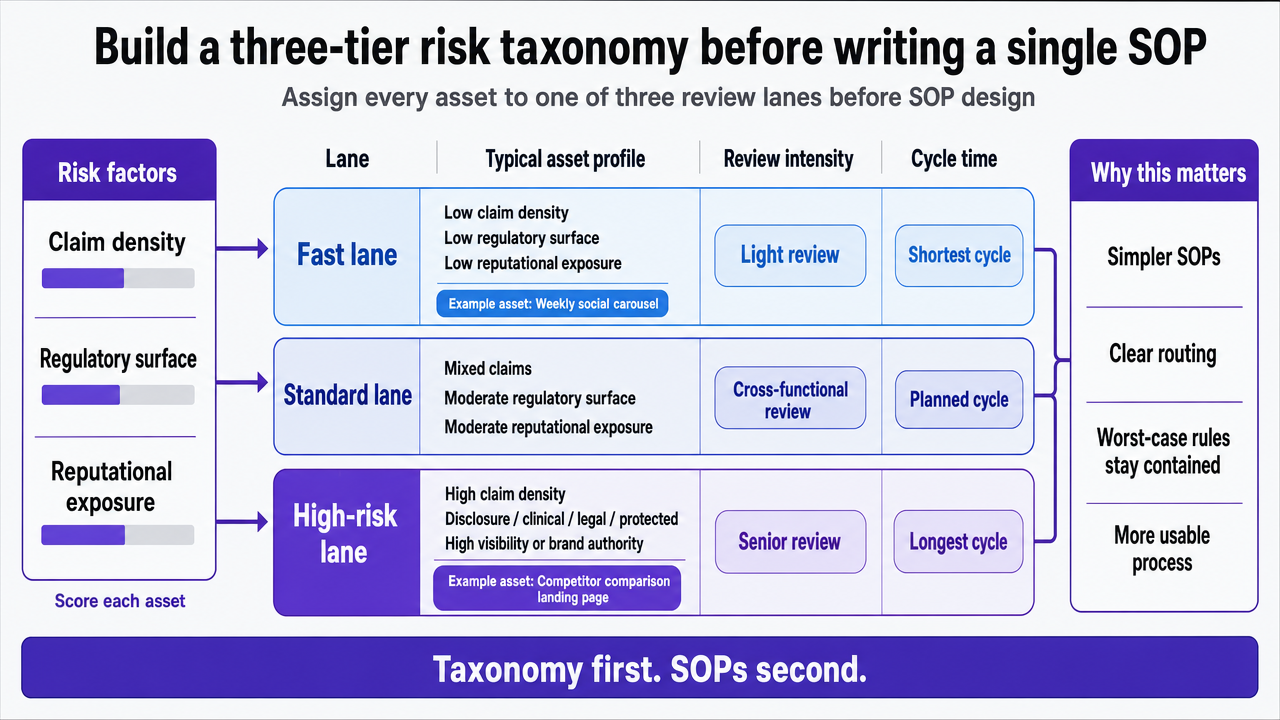
Before developing any standard operating procedures (SOPs), the review workflow needs a taxonomy to assign every asset to one of three lanes. This taxonomy simplifies SOPs. Without it, every SOP must account for the worst-case asset, leading to lengthy, unmanageable documents that are rarely followed.
A practical taxonomy categorizes assets based on three factors: claim density (number of factual or performance claims), regulatory surface (whether content involves disclosure rules, clinical outcomes, legal advice, or protected categories), and reputational exposure (visibility and brand authority tied to the asset). For example, a weekly social media carousel scores low on all three, while a landing page comparing service outcomes to a competitor scores high. The taxonomy formalizes this intuitive differentiation.
Fast lane: low-risk, high-volume assets
The fast lane is for assets with no new claims, no regulatory surface, and low reputational exposure. Examples include social captions repurposed from approved blog content, internal newsletters, roundup posts citing pre-published sources, and email nurture sequences using pre-cleared modules. Typically, one reviewer, such as the managing editor or content lead, approves these against a concise checklist covering brand voice, formatting, and link integrity.
The target cycle time for this lane is four business hours from submission to publish-ready. The Department of Labor's (DOL) lightweight governance guidance supports this model: map workflows, clarify roles, and bypass extensive checkpoints for content that doesn't require them 4. Approximately 50% to 60% of a mature content operation's monthly output should qualify for this lane once a pre-approval library is established.
Standard lane: brand-critical assets requiring editorial and SME review
The standard lane accommodates most original blog content, gated resources, webinar decks, and mid-funnel landing pages. These assets often contain new claims, express a brand position, or represent the brand in organic search results. Two approvers are necessary: an editor for structure, voice, and evidence, and a subject matter expert for technical accuracy.
This approach aligns with governance models in regulated health content, where SMEs are formal content reviewers, not ad-hoc consultants 1. The target cycle time is three business days end-to-end, with the SME stage capped at 24 hours. Assets in this lane receive a thorough editorial review, not just a proofread, as the checklist anticipates the need for claim substantiation and structural refinement.
High-risk lane: legal, compliance, or reputationally exposed content
The high-risk lane includes assets that make clinical, legal, financial, or comparative outcome claims, feature endorsements or testimonials, target regulated audiences, or represent an executive position. These require three or more approvers: an editor, an SME, legal or compliance, and a final sign-off from a designated content owner. The Utah DNR's internal review policy mandates review and approval by multiple individuals before publication, with additional leadership review for sensitive material 9. Platform moderation research confirms similar tiered escalation for high-risk content in large review systems 2.
The target cycle time for high-risk content is five to seven business days. In summary, the fast lane requires one approver and four hours, the standard lane needs two approvers and three days, and the high-risk lane demands three or more approvers and up to a week.
Assign named roles, not committees
Content approval is done by individuals, not committees. When a workflow specifies "marketing and legal will review," the draft often sits in a shared queue with no personal ownership, causing delays if a reviewer is unavailable. This common issue in stalled review pipelines arises from routing to a team address instead of a named, accountable individual.
The solution is a named-role map, integrated into the project tool, specifying one primary and one backup for each review stage. NIST's control language for governed approvals emphasizes this principle: approval authorities must be notified of proposed changes, and no change proceeds until that specific authority signs off 10. Content review requires the same. A stage without a named owner is a delay, not a functional step.
The five roles every review workflow needs
Five roles generally cover most in-house scenarios. The content owner is accountable for the asset from brief to publication and can override stalled stages. The managing editor ensures voice, structure, and evidence, and is the sole approver for fast-lane items. The subject matter expert validates technical accuracy for standard and high-risk assets. The compliance or legal reviewer approves disclosure, claim substantiation, and regulated language. The final approver, typically a director or VP, releases only high-risk assets.
Health content governance formally defines several of these roles, including enlisting subject matter experts as content reviewers rather than treating their input as optional 1. Each role should be assigned to a named person and a named backup within the workflow tool, not a group alias.
How SMEs get pulled in without becoming the bottleneck
Subject matter experts (SMEs) are often a bottleneck because content review isn't their primary job. Three strategies help keep them on track:
- Cap SME review at 24 hours in the standard lane and automatically route to a pre-assigned backup if the deadline passes.
- Send SMEs only the specific claims needing validation, not the entire draft, using inline comments.
- Maintain a rotation to distribute the workload, preventing any single SME from being overburdened, a practice recommended by the DOL's lightweight governance guidance for socializing roles across the wider team 4.
Test a scalable content review workflow now
Experience efficient, approval-driven content reviews on live projects before committing long term.
Set SLAs at each stage and enforce them with the project tool, not email
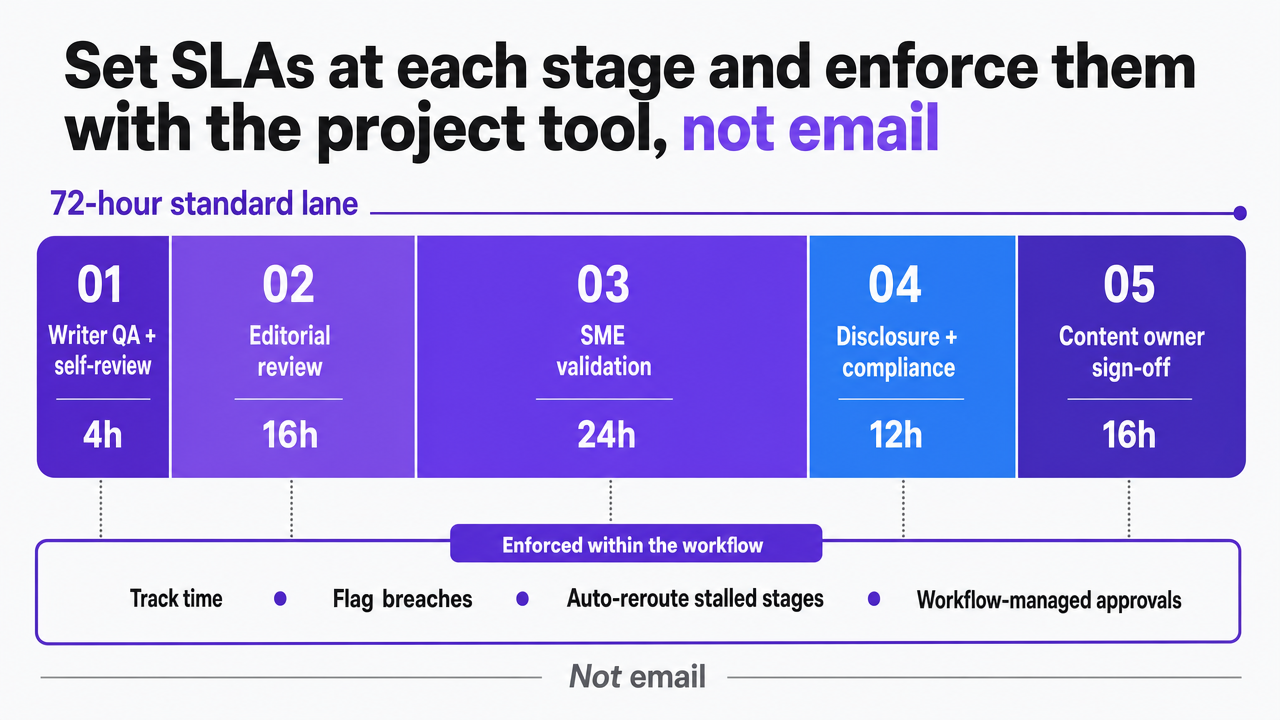
An SLA communicated via Slack is ineffective. Enforcement requires a project management tool to track time, flag breaches, and automatically reroute stalled stages. California's formal policy approval workflow explicitly mandates this discipline: review periods are defined, changes are incorporated within specific windows, and multiple approval signatures are captured before final sign-off, with each checkpoint managed within the workflow itself, not in a reviewer's inbox 8.
For a standard-lane asset aiming for a 72-hour end-to-end cycle, the time budget can be distributed as follows:
- Writer QA and self-review take the first 4 hours.
- Editorial review takes 16 hours.
- SME validation is capped at 24 hours.
- Disclosure and compliance checks run for 12 hours.
- Final content owner sign-off completes the remaining 16 hours.
This allocation ensures that the most prone-to-drift stages—SME and compliance—are completed within a single business day each, while editorial, where most substantive rework occurs, receives the largest continuous block.
Three mechanisms transform these numbers from aspirations into enforceable contracts:
- Each stage transition is a status change in the project tool, not an email handoff, ensuring automatic timestamp capture.
- Reviewers see only their assigned stages in a personal queue with a countdown.
- Any breach triggers a defined escalation—first to the named backup, then to the content owner—instead of passive reminders from the editor.
NIST's control language for governed approvals outlines similar requirements: approval authorities must be notified of proposed changes, and no change proceeds until that authority signs off 10. The project tool enforces both aspects: notification is automatic upon stage entry, and progression is blocked until sign-off is recorded. Email cannot fulfill these functions because it lacks a state machine.
Build a pre-approval library to eliminate the most expensive reviews
The most efficient review is the one that never happens. Any claim, statistic, disclosure, or visual asset that has been previously vetted and approved eliminates the need for re-review. Many in-house teams repeatedly approve the same language because it resides in individual drafts rather than a shared, accessible library.
A pre-approval library is a versioned inventory of reusable, pre-cleared components. Five categories offer significant value:
- Locked claim language (performance claims, differentiator statements, comparative phrasing approved by legal)
- Disclosure snippets (FTC-compliant endorsement language, affiliate disclosures, testimonial framing aligned with clear and conspicuous placement guidelines 5)
- Pre-cleared statistics with sourcing and expiration dates
- Brand voice rules with examples
- Cleared visual assets with usage rights
Governance research supports this as a high-leverage strategy for small teams. Analysis of moderation frameworks indicates that workflows fail when governance artifacts exist only on paper and are not operationalized into enforceable, reusable components at the point of creation 11. The DOL's lightweight governance guidance similarly advises content teams to share governance artifacts broadly rather than burying them in policy documents 4.
Operationally, each library entry needs an owner, a version number, a review date, and a scope note specifying where the component is approved for use. For example, a statistic cleared for organic blog use may not be cleared for paid landing pages. When a library entry is used in a draft, the review workflow bypasses the corresponding checkpoint—the editor confirms the entry ID, and SME and legal stages do not revisit settled questions. This single mechanism can move 50% to 60% of a team's monthly output into the fast lane.
Bake disclosure and compliance checks into a single stage
Disclosure and compliance checks are often fragmented across multiple reviewers, each focusing on a different risk aspect, with no single owner for the final decision. This leads to redundant reviews and potential gaps. For instance, a social media manager might check FTC hashtags, an editor might review testimonial framing, and legal might assess comparative claims.
Consolidating these checks into one named stage is both faster and safer. The FTC's guidance establishes a single standard for disclosure: endorsements and material connections must be clear and conspicuous, and companies are responsible for monitoring endorser content 5. This standard is best managed by one reviewer using a unified checklist, rather than being distributed among several.
The consolidated compliance stage covers five key areas:
- Endorsement and testimonial disclosures
- Substantiation for comparative and performance claims
- Regulated-audience language (health, financial, legal)
- Affiliate and sponsorship markers
- Citation integrity for statistics not from the pre-approval library
A shared checklist, tailored to asset type, makes this a 30-to-90-minute review for most standard-lane content, avoiding multi-day delays.
The reviewer must have the authority to release or block content, not just offer suggestions. A compliance stage that only provides comments without a sign-off vote is ineffective. The workflow tool should record the approval as a discrete state change, aligning with the traceable-approval patterns required by governed control frameworks before any change proceeds 10.
Make every approval auditable
An approval that cannot be reconstructed months later is merely a memory. If a regulator, plaintiff's attorney, or internal auditor inquires about who cleared a specific claim on a landing page from a previous quarter, the answer must be a timestamped record, not a search through old communications.
NIST's control catalog directly states the standard: approval authorities must be notified of proposed changes, changes are prohibited until approvals are received, and the entire cycle must be documented within policy 10. For content review, this means every stage transition is logged immutably: who submitted, who approved, when the sign-off occurred, which library components were used, and which checklist items were confirmed.
Four fields typically suffice for audit needs:
- Asset version hash
- Reviewer identity per stage
- Approval timestamp
- Specific library entry IDs referenced in the draft
Systematic moderation research confirms that governance fails when policies exist but enforcement isn't captured as discrete, retrievable events 11. A workflow tool that stores state transitions automatically generates this record, whereas an email-based workflow provides no legally usable documentation.
See How Enterprise Teams Streamline Content Review Without Sacrificing Oversight
Discover actionable methods and technology frameworks for orchestrating multi-layer content approvals at scale—designed for agencies and brands aiming to increase content output while maintaining governance and quality standards.
When the reader operates across multiple locations or regulated practices
The blueprint above assumes a single-brand in-house team. Multi-location operators—such as DSOs, behavioral health networks, home services franchises, or law firm groups with multiple state bars—face a different cost structure that the three-lane taxonomy doesn't fully address. It's important to explicitly acknowledge this scope shift before applying the framework.
Three variables increase review costs across a portfolio. Per-location legal review becomes complex when disclosure rules vary by state or practice license; a claim approved in Texas might need re-review for California. Per-state disclosure variance adds review passes for regulated language, patient testimonials under state medical board rules, or attorney advertising disclaimers, which the FTC considers the sponsor's ongoing monitoring obligation regardless of who published the asset 5. Per-brand voice guardrails multiply when a parent organization manages 12 sub-brands, each with distinct positioning and requiring its own approved library.
Law firm groups face an additional constraint. Public-facing legal content is implicitly measured against the same evidentiary standard as court filings under Federal Rule 11, requiring factual contentions to have evidentiary support 6. This standard makes the high-risk lane the default for legal marketing, not an exception.
The operational solution is a shared pre-approval library at the parent level with location-scoped overrides, rather than 12 parallel workflows. One library, versioned per jurisdiction, prevents review labor from scaling linearly with the number of locations.
Orchestration tooling: what to buy versus what to build
The described workflow requires software that maintains state, records approvals, and routes work by asset type. Most in-house teams already possess two of the three components: a project management tool (e.g., Asana, Monday, Jira) and a CMS. What's typically missing is the orchestration layer that integrates risk-tier routing, SLA enforcement, pre-approval library references, and audit logging into a single governed loop.
The build-versus-buy decision has a predictable outcome. Custom building the pre-approval library is defensible, as its components are brand-specific and frequently change. However, it's advisable to buy the orchestration layer—the routing engine, the stage-based state machine, and the immutable approval log. Building these from scratch means recreating the traceable-approval pattern already specified by governed control frameworks 10.
Three evaluation criteria are more important than feature lists:
- Does the tool enforce sign-off as a discrete state change, or does it accept a comment as approval?
- Does routing rely on asset metadata (risk tier, claim density, channel) or manual assignment?
- Does the log remain accessible if a reviewer leaves the company?
Platforms like Vectoron consolidate these into an approval-first orchestration layer; anything less essentially rebuilds email with a nicer interface.
A 90-day implementation sequence
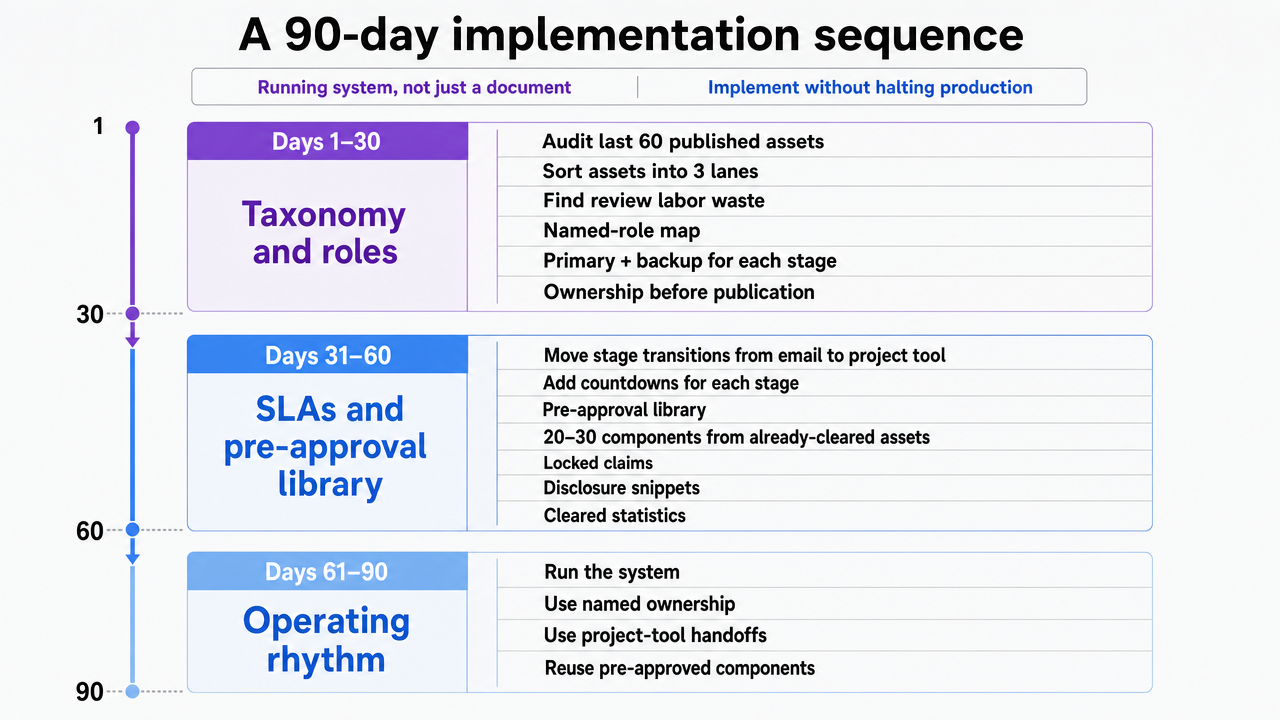
This blueprint is valuable as a running system, not just a document. Ninety days is sufficient to implement the system without halting production.
- Days 1–30: taxonomy and roles. Audit the last 60 published assets and retroactively sort them into the three lanes. This distribution will highlight where current processes waste review labor. Publish a named-role map with primary and backup individuals for each stage, aligning with the ownership discipline required by the Utah DNR policy before content publication 9.
- Days 31–60: SLAs and pre-approval library. Transition stage transitions from email to the project tool, incorporating countdowns for each stage. Populate the pre-approval library with 20 to 30 components from already-cleared assets, such as locked claims, disclosure snippets, and cleared statistics. The DOL's guidance emphasizes sharing governance artifacts across the team rather than keeping them in an unread policy PDF 4.
- Days 61–90: audit log and consolidated compliance stage. Activate immutable approval logging and combine scattered disclosure checks into a single stage with a named reviewer possessing sign-off authority. Weekly, measure cycle time by lane and adjust SLAs based on breach patterns, not subjective opinions.
Frequently Asked Questions
References
- 1.Section 7: Establish Content Governance - Health Literacy Online.
- 2.Content Moderation and Governance in Online Platforms.
- 3.General Discussion Developing Policies and Procedures for Social Media (Flow Chart).
- 4.Content governance: lightweight practices your team can adopt now.
- 5.FTC’s Endorsement Guides: What People Are Asking.
- 6.Federal Rules of Civil Procedure, Rule 11.
- 7.Reimagining Social Media Governance: Harm, Accountability, and Repair.
- 8.Formal Policy Approval Process Workflow.
- 9.DNR-23-30 Internal-Review-Policy.
- 10.Security and Privacy Controls for Information Systems and Organizations.
- 11.SoK: Content Moderation in Social Media, from Guidelines to ....