
Key Takeaways
- A content strategy template works as a production protocol with six sequential decision layers—goals, audience, topics, formats, distribution, and measurement—each terminating at a human approval checkpoint.
- Bind every content stream to one client revenue metric plus one leading indicator, and segment audiences by channel-access profile rather than persona, since 76% of adults 18-29 versus 28% of adults 65+ get news from social media 7.
- Add a generative engine optimization field to measurement, since only 16% of brands systematically track AI search performance, creating a differentiation opportunity for agencies willing to audit AI answer visibility quarterly 3.
- Focus next on auditing one active account against the six layers, naming approvers at each gate, and porting the corrected template into a reusable vertical library to compress hours per deliverable across the portfolio.
The Template as a Production Protocol, Not a Planning Document
A content strategy template earns its place inside an agency by compressing hours per deliverable, not by cataloging good intentions. Harvard Business School Online frames content strategy as the plan that guides how a company creates and distributes content across goals, audience, topics, formats, calendars, distribution, and measurement 1. That skeleton is sound. The problem is that most agencies still treat it as a document clients sign off on during onboarding, then quietly abandon by month three.
The 2025 version of this template functions differently. It is a production protocol with named decision layers, each tied to a measurable output and a human approval checkpoint. Harvard Business Impact defines content marketing strategy as a structured approach to creating and distributing content that motivates a target audience to take a desired action 12. Agencies that operationalize that definition treat every layer as a gate: a topic does not enter production without a goal binding, a format does not ship without a distribution plan, a distribution plan does not run without a measurement hook.
Harvard's continuing education arm frames AI as a category shift in how marketing work gets produced, not a productivity add-on layered onto old workflows 13. That distinction matters here. A template built for AI-assisted execution assumes capacity is elastic and governance is the constraint. The sections that follow render each of the six decision layers as a protocol an agency can run across accounts.
Six Decision Layers That Make the Template Operational
Harvard Business School Online's framework identifies the raw ingredients of a content strategy: goals, audience, topics, formats, calendars, distribution, and measurement 1. Rendered as an agency production protocol, those ingredients collapse into six decision layers that each carry a measurable output and an approval checkpoint. The order matters. Goals set the revenue metric that constrains every layer below. Audience determines segmentation stakes. Topics inherit both, and formats inherit topics. Distribution is downstream of format choice, not a parallel decision. Measurement closes the loop by feeding data back into topic and format selection.
Each subsection below defines one layer, names the KPI or governance rule attached to it, and calls out the failure mode agencies see when the layer is skipped or hand-waved. The layers are deliberately sequential. Skipping to distribution before audience segmentation is settled is the single most common cause of retention loss on client accounts, because it produces content that performs on the wrong channel for the wrong buyer at the wrong stage.
Goals: Binding Content Output to a Client Revenue Metric
The goals layer answers one question: which client revenue metric does this content move? Harvard Business School Online's framework treats goal-setting as the first decision because every subsequent choice inherits from it 1. Harvard Business Impact sharpens the point by defining content marketing strategy as a structured approach to motivating a specific audience action 12. A template that lists 'brand awareness' or 'thought leadership' as goals has skipped the layer.
Operators serving legal, dental, behavioral health, and home services accounts need to bind each content commitment to a metric the client already tracks in their CRM or intake system: qualified consultations booked, new-patient starts, ranked pipeline value, or cost per qualified lead. The template should force the account team to select exactly one primary metric per content stream, plus one leading indicator that predicts it. A blog cluster targeting personal injury intake, for example, binds to signed cases as the primary metric and consult-request form completions as the leading indicator.
The failure mode is goal inflation. When a single deliverable is tagged to awareness, engagement, SEO, and pipeline simultaneously, none of them get measured. The template's job is to prevent that by making metric selection a required field, not an optional annotation.
Audience: Segmentation Stakes for Wide-Age Service Verticals
Audience definition inside the template determines whether one distribution profile will serve the account or whether the account requires parallel streams. For service verticals with wide age spreads, the answer is almost always parallel streams. Pew's 2025 data on younger news consumers found that 76% of adults ages 18 to 29 get news from social media at least sometimes, compared with 28% of adults 65 and older 7. That gap is not a preference difference. It is a channel-access difference that reshapes where an audience can be reached at all.
Consider the practical consequences across three verticals agencies commonly hold. A behavioral health practice serving both adolescent intake (parents ages 35 to 50) and adult outpatient services (ages 25 to 65) cannot run one distribution mix. A personal injury firm targeting car-accident claimants spans every adult cohort. A senior living operator markets to both the resident (75+) and the adult child decision-maker (45 to 60). Each account demands segmented audience definitions inside the template, with explicit primary and secondary cohorts and separate channel weightings attached to each.
The template should require three audience fields per stream:
- demographic definition
- decision context (self-purchaser versus proxy decision-maker)
- channel-access profile
The channel-access profile is what turns audience segmentation into a production constraint rather than a persona exercise. If the primary cohort is adults 65 and older, the template will not permit an Instagram-heavy distribution plan because the source data shows the reach is not there.
Segmentation stakes rise further when the same account serves both cohorts. The template's rule: two cohorts, two streams, two measurement plans. Collapsing them into one plan is the failure mode that produces content clients cannot attribute to either outcome.
Topics: Building a Reusable Brief Architecture Across Accounts
The topics layer is where agencies bleed the most senior time when the template is weak. Every new client engagement begins with topic discovery, competitive scans, and stakeholder interviews. Without a reusable brief architecture, that work happens from scratch on each account.
A production-grade template defines topic selection as a four-field brief: buyer question, intent stage, evidence sources the writer must cite, and the primary metric the topic binds to (inherited from the goals layer). Harvard Business School Online's framework treats topic choice as an audience-problem match, not a keyword-volume match 1. The brief architecture enforces that by making the buyer question a required field before any keyword or search-volume data enters the record.
Reusability comes from vertical libraries. A behavioral health topic library holds the recurring buyer questions across adolescent intake, adult outpatient, substance use, and family services. A legal library holds them across personal injury sub-types, family law, and estate planning. New accounts inside a known vertical inherit the library on day one, and the brief architecture then customizes for the specific practice's positioning. Onboarding compresses from weeks to days because the template does not require rediscovery of questions the vertical has already answered a hundred times.
Formats: Mobile-First Defaults and Vertical-Specific Exceptions
Format selection follows topics, and the default is mobile-first. Pew reports that 86% of U.S. adults at least sometimes get news from smartphones, computers, or tablets 5. That baseline sets the constraint: any format that fails on a 375-pixel viewport fails the template. Long-form pillar articles need scannable subheads and short paragraphs. Charts need standalone captions. Video needs subtitles by default because audio-off consumption is the norm on mobile feeds.
Vertical-specific exceptions still matter. Legal accounts serving high-value case types benefit from long-form authority pages that resolve intent-heavy queries; the format constraint there is depth plus mobile readability, not brevity. Home services accounts push toward short video demonstrations and before/after visual proof, because the buyer decision is visual and comparison-driven. Senior living accounts require formats that a 60-year-old adult child reads on desktop during work hours and forwards to a parent, meaning printable PDFs and email-friendly summaries carry more weight than in a consumer retail context.
The template should list allowed formats per vertical library and mark each with a mobile-readability check as the last production gate. Formats that fail the check do not ship. This is the layer where format proliferation kills margin: agencies producing six formats per topic when the audience consumes two.
Distribution: Channel Weighting Based on Actual Platform Reach
Distribution is where generic templates default to 'be everywhere' and lose the account. A defensible distribution layer weights channels against actual U.S. platform reach. Pew's 2025 social media survey found that 84% of U.S. adults use YouTube, 71% use Facebook, and 50% use Instagram 6. Those figures set the ceiling on what any channel can deliver against a general U.S. adult audience.
The template converts reach data into a weighted allocation, not an unweighted checklist. For a home services account targeting homeowners ages 35 to 65, YouTube and Facebook carry primary weight because reach and demographic overlap are highest there. Instagram enters as a secondary channel for visual proof content, not as a co-primary channel. For a behavioral health account targeting parents of adolescents, Facebook parent groups and YouTube educational content outperform Instagram for reach against the actual buyer, even though Instagram is often the first channel agencies pitch.
The template should require three fields per channel decision:
- reach against the defined audience cohort
- format compatibility (inherited from the formats layer)
- the measurement hook that connects channel activity to the goal metric
Channels that cannot post a measurement hook do not enter the mix. That single rule eliminates most of the vanity-channel expansion that quietly drains production hours on client accounts.
Channel weighting also decays. The template needs a quarterly review field where the account team reassesses weights against the latest platform-reach data and the client's own attribution signal. Static distribution plans built at onboarding are the second-most-common cause of retention loss, behind skipped audience segmentation.
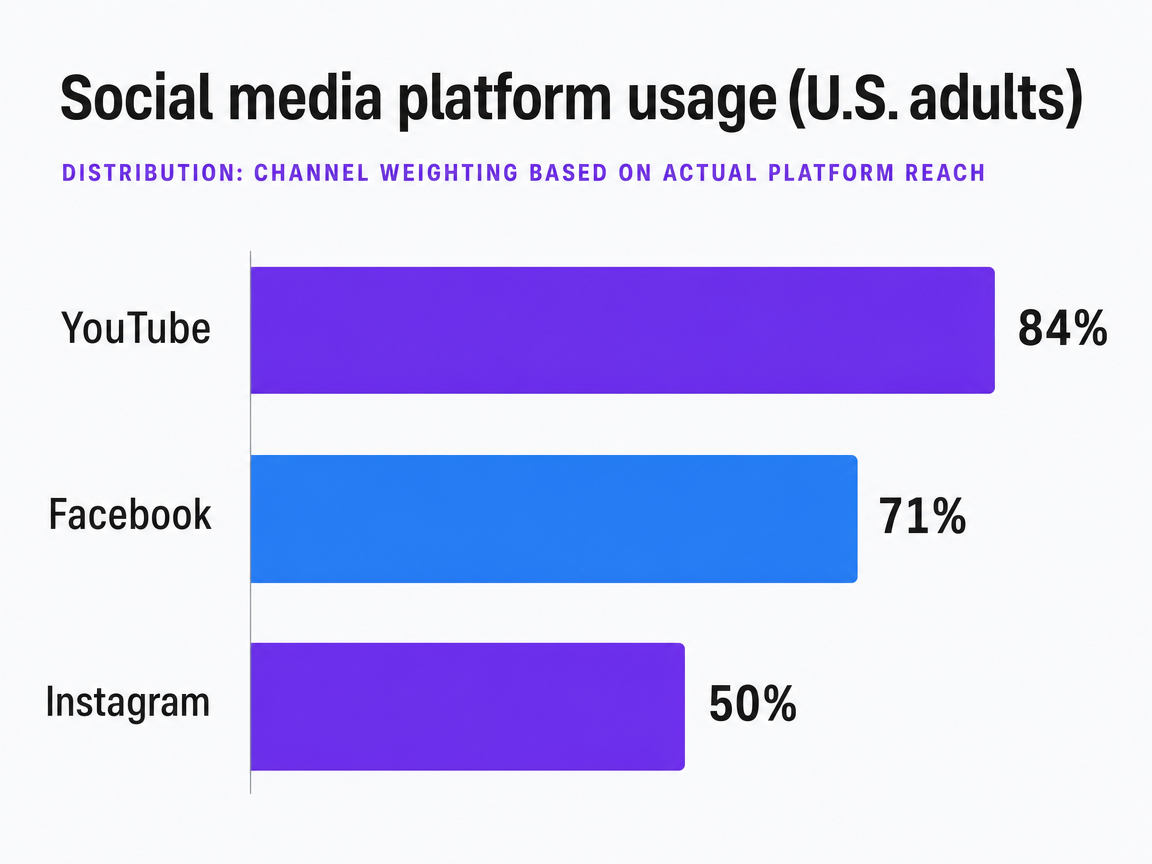 Social media platform usage (U.S. adults)
Provides a breakdown of the usage rates for major social media platforms among U.S. adults, per Pew Research.
Measurement: Adding a GEO Layer to Legacy Content KPIs
The measurement layer inherits the primary metric set in the goals layer and adds the tracking scaffolding around it. Legacy content KPIs still apply: organic sessions, ranked keywords, conversion rate on tracked forms, and attributable pipeline value. The 2025 addition is generative engine optimization tracking. McKinsey reports that only 16% of brands systematically track AI search performance, and it recommends firms define GEO-specific KPIs to close the gap 3. The study looked at how brands are responding to AI-powered search environments such as ChatGPT, Gemini, Copilot, and AI Overviews, and it found that most brands still measure search only through traditional SERP tools.
For agency templates, that gap is an opportunity to differentiate on measurement discipline. The template should carry a dedicated GEO field per content asset covering three items:
- whether the asset appears in AI-generated answers for the target queries
- which sources the AI engines cite alongside it
- how the asset's structure supports LLM extraction (clear headings, direct-answer opening paragraphs, cited evidence)
Tracking is manual today for most agencies, but a scheduled quarterly audit against a fixed query set produces defensible client reporting that the other 84% of brands cannot show.
Measurement also feeds back into topics. Content that ranks in traditional search but never appears in AI answers signals a format problem, not a topic problem, and the template should route that finding back to the formats layer for revision. Content that appears in AI answers but does not convert signals a goals-binding problem worth resolving upstream.
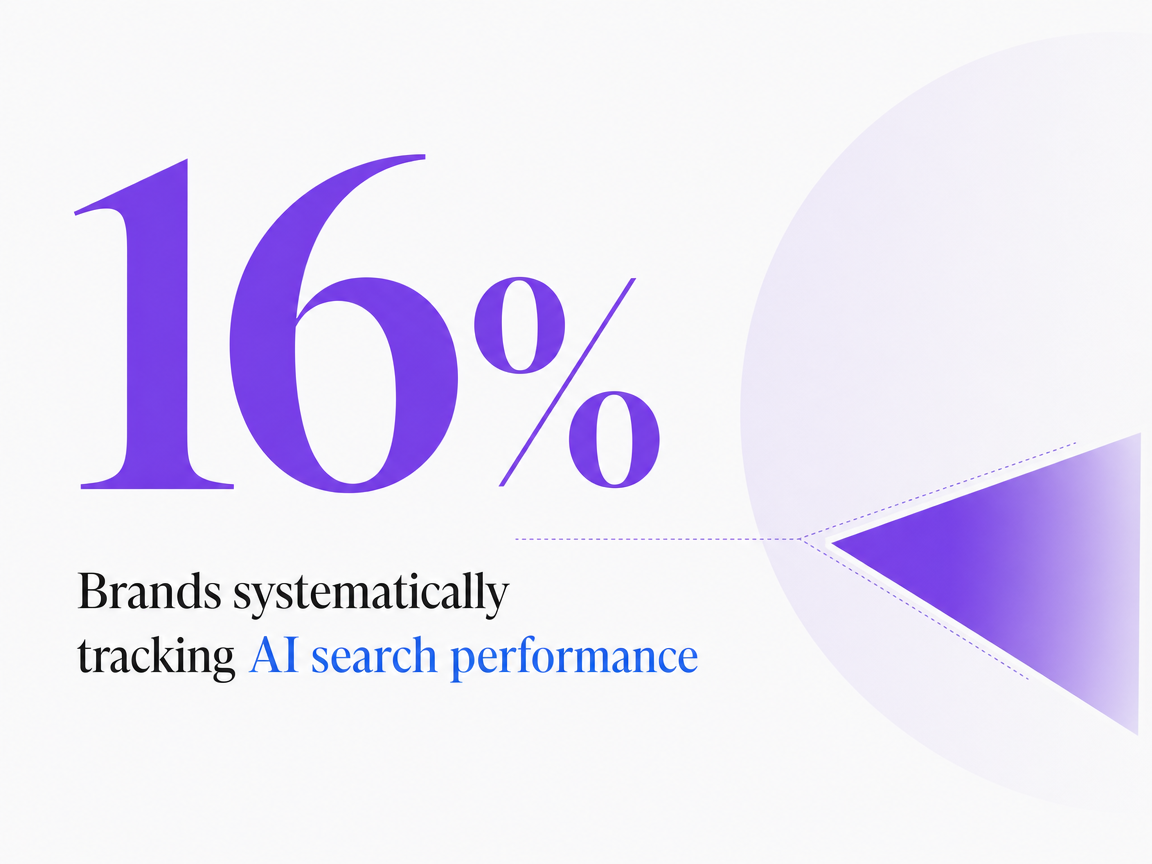 Brands systematically tracking AI search performance
Brands systematically tracking AI search performance
The Approval Gate: Governance as a Template Requirement
Every decision layer in the template terminates at the same place: a human approval checkpoint. That is what separates a production protocol from a content mill. The NIST AI Risk Management Framework treats trustworthiness as something that must be incorporated into AI systems by design, not audited after the fact, and it is written for voluntary adoption across organizations building or using AI 2. Federal policy direction reinforces the same posture. The White House AI Action Plan directs federal agencies to publish guidelines and resources for AI evaluation and governance 8, and the NTIA accountability report positions testing and evaluation as central to how AI systems should be reviewed 9. None of these documents regulate agency content workflows directly. They set the reference standard that sophisticated clients, especially in healthcare and legal verticals, will begin measuring vendor practices against.
Inside the template, the approval gate is a named checkpoint after each layer, not a single sign-off at the end. Topics get approved before drafts. Drafts get approved before distribution. Distribution plans get approved before spend. That sequence is what the framework language actually implies when translated into production terms: reviewable decisions at the points where errors are cheapest to fix. Executive-order guidance on trustworthy AI development lists eight guiding principles that shape how federal actors expect AI to be governed 10, and the operational translation for agencies is the same discipline: named reviewers, documented decisions, reversible actions.
The template should carry three governance fields per layer:
- the named approver, which is a role, not a person, so accounts do not stall when someone is out
- the review artifact, which is the specific output being reviewed (brief, draft, distribution plan, measurement report)
- the rollback rule, which specifies what happens if a downstream layer surfaces a problem with an already-approved upstream decision
Skipping the rollback field is what creates the situation where a measurement report reveals a topic problem and no one has the authority to pull the content stream and reset.
Governance discipline is also what clients in high-stakes verticals are actually paying for. A behavioral health group, a personal injury firm, or a multi-location dental group cannot ship content that misstates clinical, legal, or regulatory specifics. The approval gate is where that risk is priced into the workflow rather than absorbed after publication.
Test a complete content strategy workflow now
Publish live campaigns using a data-driven content strategy template before you commit.
AI Aversion as a Design Constraint on Voice and Disclosure
Audience resistance to AI-generated content is a template variable, not a side note. Research from the University of Illinois developed an eight-item measure of consumer aversion to AI in marketing communications, documenting that discomfort with AI presence in marcom shifts perception and purchase intention 11. The study covered marketing communications broadly, not a specific vertical, and the mechanism it identifies matters for agency work: audiences penalize content that reads as machine-produced, regardless of underlying quality.
The template response is not to hide AI involvement. It is to design voice and disclosure decisions as named fields that shape production. Three fields carry the weight:
- Voice specification per content stream, defined by sentence rhythm, vocabulary register, and evidence density that a human editor enforces on every draft.
- A disclosure rule set by vertical and jurisdiction. Behavioral health and legal accounts operate under professional communication standards that already constrain machine-drafted claims; the template should surface those constraints before drafting, not after review.
- An attribution field that names the human reviewer accountable for the published piece, which is the practical mechanism that keeps AI-assisted content anchored to a person's judgment.
Harvard's continuing education analysis notes that AI adoption in marketing is expanding into content creation and personalization, and it raises ethical and skills-related concerns about over-automation 13. The template treats those concerns as production inputs. Voice drift, generic phrasing, and unsourced assertions are the three markers reviewers should flag on every draft, because those are the signals the Illinois measure associates with consumer discomfort 11. Catching them at the review layer is cheaper than losing the account after publication.
If You Manage Multiple Client Accounts: Portfolio Economics of One Governed Template
The scope shifts here. Everything above treats the template as a single-account production protocol. Agency operators running ten, twenty, or forty client accounts face a different math problem: the template's value compounds across the portfolio, or it does not compound at all. Bespoke onboarding on every new logo cancels the margin the template was supposed to protect.
Portfolio economics turn on four variables the template must standardize before any account enters production.
H : hours per deliverable
D : deliverables per client per month
C : the number of active client accounts
R : the blended hourly cost of the production team
Monthly production hours across the portfolio equal H × D × C, and monthly production cost equals H × D × C × R. A governed template compresses H by removing rediscovery on briefs, standardizing formats within a vertical library, and eliminating the ad hoc distribution debates that consume senior time on each account.
The worked example uses placeholders. Assume an agency runs C = 25 accounts producing D = 8 deliverables each per month. If the pre-template baseline is H = 6 hours per deliverable, the portfolio consumes 1,200 hours monthly at cost 1,200 × R. If a governed template compresses H to 3.5 hours through inherited vertical libraries, reusable brief architecture, and standardized measurement scaffolding, the portfolio consumes 700 hours at cost 700 × R. The 500-hour delta is the retention economics engine: it either funds margin, funds additional accounts at the same team size, or funds the senior review capacity the approval gate requires.
The compounding rule is that the template's value scales with C. One account gains modestly from a governed template. Twenty-five accounts gain the same per-account compression multiplied twenty-five times, minus the fixed cost of maintaining the vertical libraries. Harvard's continuing education analysis frames AI-integrated marketing workflows as a category change in how output scales relative to headcount 13, and the portfolio math is where that framing becomes concrete. Agencies that hold H flat as C grows are running the wrong template.
See How Leading Agencies Standardize Content Strategy for Scalable Growth
Request a walkthrough of a data-driven content strategy template that aligns production with measurable KPIs—purpose-built for agencies overseeing multi-channel client campaigns.
Where the Template Fails and How Operators Prevent It
Templates fail in predictable places, and operators who name the failure modes in advance keep them out of production. Three break the template most often across agency portfolios.
- The first is silent layer skipping. An account team inherits a vertical library and jumps to topics without re-binding goals to the client's current CRM metric. Six weeks later, the measurement report has no revenue anchor. Prevention is a required-field rule: the goals layer cannot be inherited, only re-selected per account, per quarter.
- The second is approval-gate erosion. Named approvers get busy, drafts move to distribution without review, and the governance discipline NIST frames as design-time trustworthiness 2 becomes a post-hoc audit. Prevention is a rollback rule with teeth: any layer that ships without its documented approver reverts, and the account team logs the miss. Two misses trigger a portfolio review.
- The third is measurement decay. Legacy KPIs get tracked; the GEO field goes blank for three quarters. Prevention is a scheduled quarterly audit against a fixed query set, treated as non-optional. Templates that survive are the ones where the discipline is enforced by the workflow, not the individual.
A Forward Directive for Agency Operators
The template is not a document. It is the workflow. Operators who treat it as an artifact will keep losing hours to rediscovery on every account, and operators who render it as a governed production protocol will compress delivery time while raising the review discipline that clients in legal, behavioral health, dental, and home services accounts are paying for.
The next quarter is the right window to rebuild. Audit one active account against the six decision layers, name the approver at each gate, and instrument the GEO field McKinsey's data shows most brands still ignore 3. Then port the corrected template into the vertical library and run the second account against it. Platforms like Vectoron exist to hold that protocol in place across the portfolio, but the discipline starts with the operator drawing the layers on paper first.
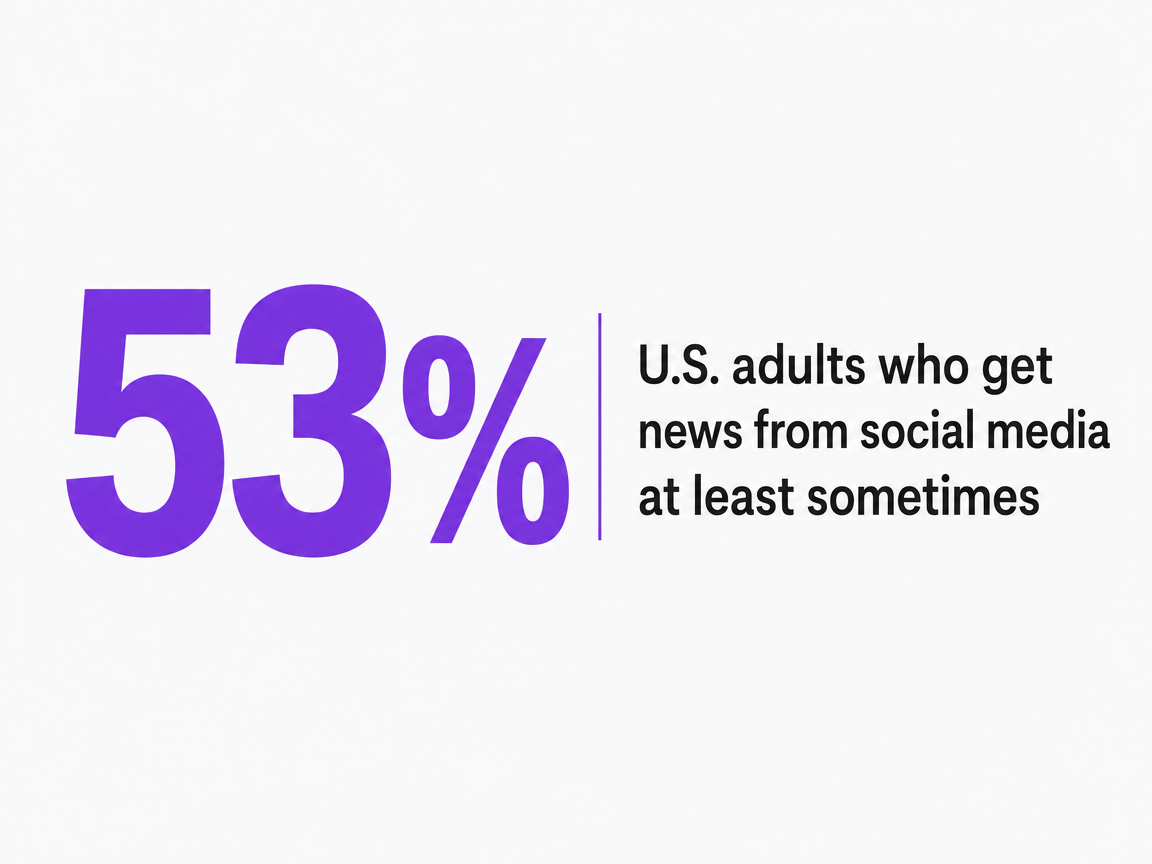 U.S. adults who get news from social media at least sometimes
U.S. adults who get news from social media at least sometimes
Frequently Asked Questions
References
- 1.How to Create a Content Strategy That Drives Results.
- 2.AI Risk Management Framework | NIST.
- 3.Winning in the age of AI search.
- 4.Social Media and News Fact Sheet.
- 5.News Platform Fact Sheet.
- 6.Americans' Social Media Use 2025.
- 7.Young Adults and the Future of News.
- 8.America's AI Action Plan.
- 9.NTIA Artificial Intelligence Accountability Policy Report.
- 10.Safe, Secure, and Trustworthy Development and Use of Artificial Intelligence.
- 11.Measuring Consumer Aversion Toward AI in Marketing ....
- 12.Content Marketing Strategy.
- 13.AI Will Shape the Future of Marketing.