
Key Takeaways
- Linear pipelines break at scale because they lack return paths for rejected drafts and no mechanism to feed performance data back into the next content cycle 10.
- A governed workflow maps five layers—intake, production, review, publish, and measurement—each with a named owner, approval gate, and documented handoff rather than sequential steps 8.
- Approval gates should be drawn as distinct shapes with defined check criteria, decision owners, and return routes, with budgeted time ranges tracked against actual review durations 3.
- Focus next on connecting measurement back to intake, drawing an explicit AI handoff line in production, and dividing SME lanes by topic or risk category to eliminate undefined routing.
Why the linear pipeline breaks under volume
Most content workflow diagrams start as a straight line: brief, draft, edit, publish. This works for small teams with low volume. However, it fails when volume increases, additional subject matter experts (SMEs) join the review process, or AI drafting tools are introduced.
The primary failure point is the lack of a defined return path for rejected drafts. Linear pipelines often treat approval as an implied handoff, meaning there's no clear process for revisions. Peer-reviewed editorial workflows, in contrast, document explicit revision loops because iterative exchanges between editors and authors are common before publication 4. Marketing teams without these loops accumulate silent rework.
The second issue is measurement. A pipeline that ends at publication doesn't feed performance data back into the next content cycle. The content marketing lifecycle is modeled as five stages, concluding with optimization and iteration, not a final shipping step 10. Increased volume exacerbates both these gaps. Managers scaling beyond a single writer need a diagram that supports governance, feedback, and clear ownership, rather than just more steps in a linear process.
The governed loop: five layers instead of five steps
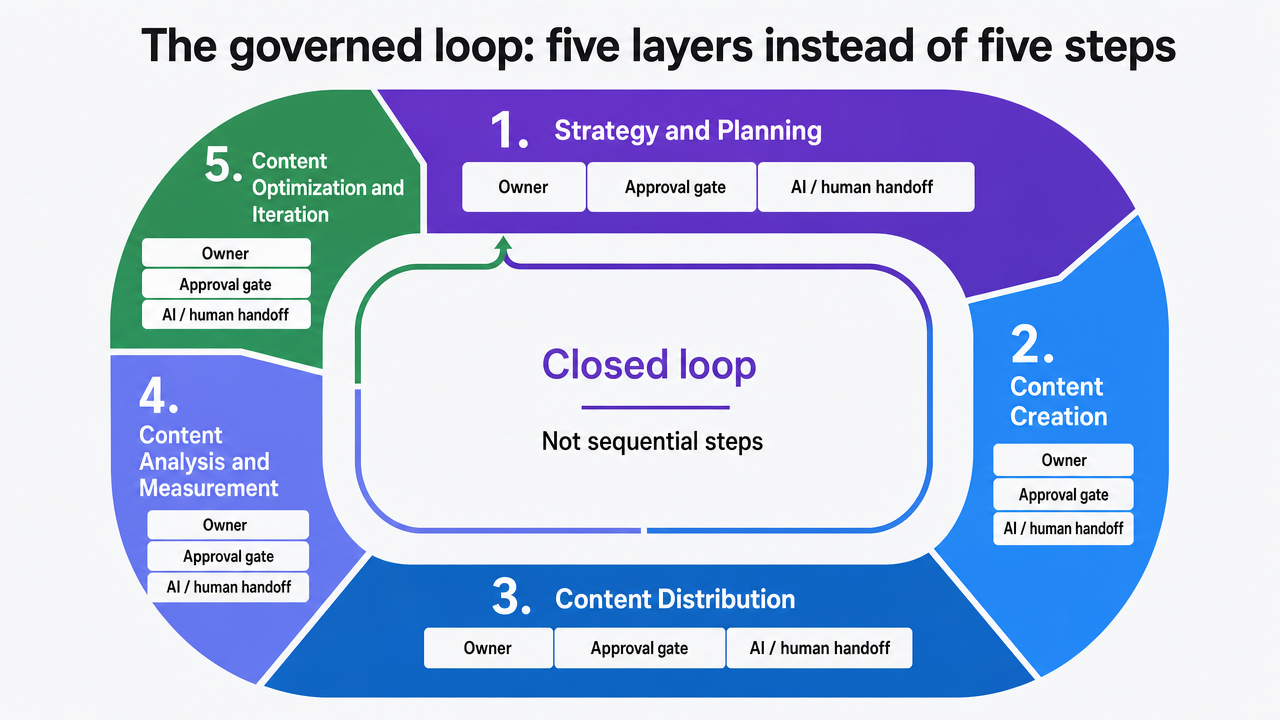
A robust workflow diagram maps five layers, not five sequential steps. This distinction is crucial because layers allow for parallel work, defined ownership, and return paths, while steps imply a single forward direction that scaling teams quickly outgrow.
The five layers are based on the content marketing lifecycle:
- Strategy and Planning
- Content Creation
- Content Distribution
- Content Analysis and Measurement
- Content Optimization and Iteration
The fifth stage directly informs the first 10. Representing this as a closed loop, rather than a pipeline, ensures that every content asset is justified by prior performance data and includes a clear measurement plan.
Each layer has three fixed attributes: a named owner, an approval gate, and a defined AI or human handoff. Governance frameworks in high-stakes fields require this level of specificity, mandating defined processes and responsibilities for content development, approval, publication, and revision 8. The layers provide the structure; the work flows through them.
Layer one: intake and prioritization
What enters the queue and who decides
Intake is a critical point where a workflow diagram either proves its value or silently fails. Every request entering the production pipeline should have four attributes:
- a business objective
- a target audience segment
- a performance hypothesis
- a source signal explaining the topic's relevance
Requests missing any of these are returned to the requester.
The five-stage content marketing lifecycle places strategy and planning before creation, emphasizing goal definition, audience selection, and format decisions as prerequisites 10. Teams that bypass this prerequisite check often face issues during review when SMEs reject drafts that should not have been initiated.
Digital health information governance frameworks similarly advocate for defined processes and responsibilities for content development, approval, publication, and revision 8. In the diagram, intake is represented as a funnel with a documented decision rule: criteria for advancement, reasons for routing back, and the owner of that decision. This rule is a visible, explicit object, not implicit tribal knowledge.
The strategist as gatekeeper role
The strategist manages the intake gate. This role is positioned at the boundary between the request pool and the production lane, with the authority to approve, reject, or request more information for a brief. Naming this role is important because generic 'creator' and 'reviewer' labels can obscure the decision-making processes essential for a scaling team.
A case study on a digital knowledge translation platform highlights the importance of standardized processes and clear roles for timely and quality digital content production 6. The strategist enforces both aspects at intake: a standardized brief format and role clarity, preventing a writer from also greenlighting their own assignments.
The gatekeeper also manages the return path. If a request lacks a performance hypothesis or duplicates existing content, the diagram routes it back to the requester with a documented reason, preventing it from entering the backlog. This explicit arrow prevents the queue from becoming a repository for unviable requests.
Layer two: production and the AI handoff line
Drawing the boundary between machine draft and human judgment
The production layer is where workflow diagrams must honestly integrate AI, rather than hiding it within a generic "draft" box. A scalable diagram explicitly defines the AI handoff line, specifying which tasks a model performs, which a human owns, and where their work exchanges.
Machine tasks include outline generation from an approved brief, first-pass draft assembly based on a defined structure, and mechanical checks like reading level, internal link density, and schema completeness. Human tasks involve source verification, brand voice calibration, and any claims with regulatory or clinical implications. The diagram illustrates this with a vertical dashed line within the production lane, with tasks assigned to either side.
Governance frameworks in high-stakes environments reinforce this separation, requiring defined processes and responsibilities for content development, approval, publication, and revision 8. This dashed line makes that definition visible. A writer receiving an AI-assembled draft knows precisely what has been done and what remains their responsibility to verify. A compliance reviewer can identify which artifacts to inspect. This boundary is a practical routing rule that a team can defend as volume and review chains grow.
Writer and SME collaboration inside the production lane
Within the production lane, writers and subject-matter experts collaborate on parallel tracks. The writer manages the draft and brand voice, while the SME ensures technical accuracy and adherence to regulated content standards. The diagram shows both roles linked to the same asset, with a defined exchange point rather than a linear handoff.
A case study on a digital knowledge translation platform highlights the challenges of coordinating multidisciplinary contributors and advocates for standardized processes and clear roles to maintain timely and reliable production 6. In the diagram, this clarity is shown as two named lanes converging on a single artifact: the writer produces the draft, the SME annotates or provides verified source material, and a documented exchange rule governs how their inputs merge before the draft leaves production.
This exchange point is crucial. Without it, SMEs can become bottlenecks, receiving drafts too late to influence them, and writers face rework that could have been avoided at the outline stage. Diagramming the SME as a production-lane collaborator, rather than a downstream reviewer, moves technical accuracy upstream, which is essential for maintaining quality in high-stakes verticals with structured, multi-stage expert review workflows 9.
Test a full workflow diagram from draft to publish
Experience a complete content workflow and publish live assets during your trial with zero commitment.
Layer three: multi-stage review as diagrammed objects
Treating approval gates as first-class shapes
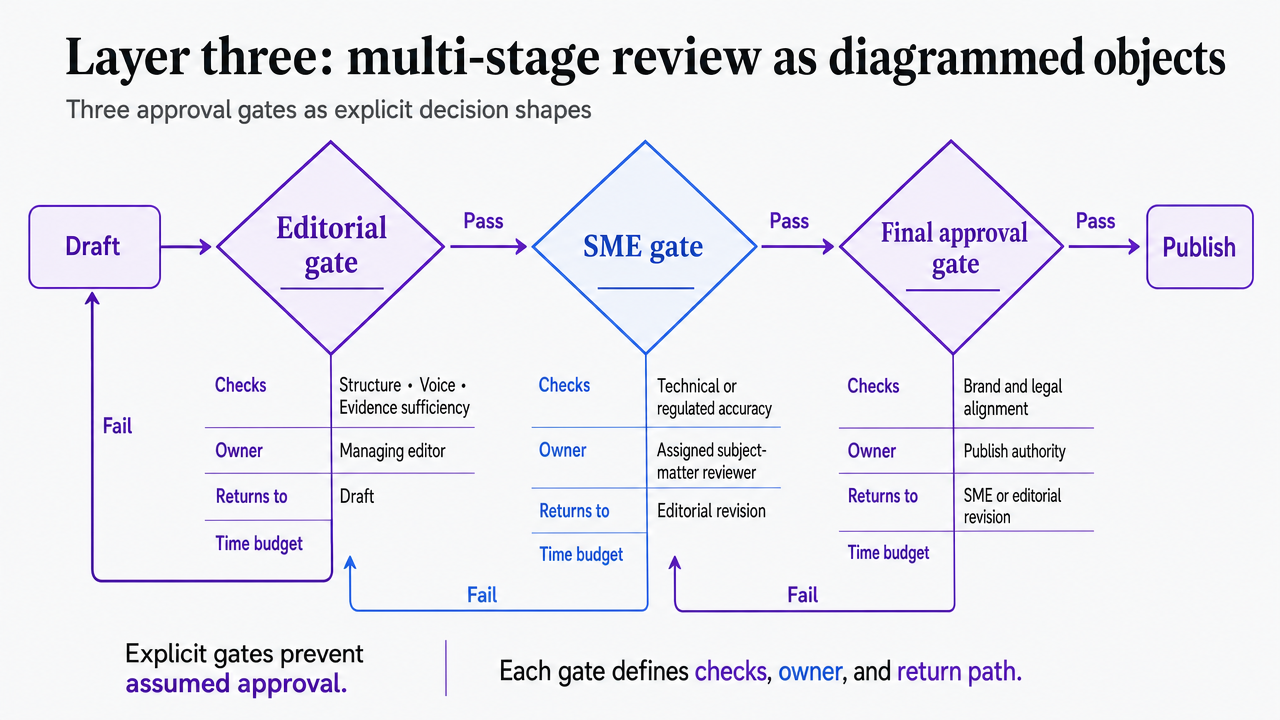
Review processes fail when approval is assumed rather than explicitly drawn. An approval gate managed through informal communication lacks a return path, clear failure criteria, and an owner accountable for routing decisions. The diagram addresses this by representing each gate as a distinct shape—typically a diamond—with three attributes: what it checks, who owns the decision, and where a failed draft returns.
Three main gates handle most of the review load in a scaling team:
- the editorial gate (checking structure, voice, and evidence sufficiency, owned by a managing editor)
- the SME gate (checking technical or regulated accuracy, owned by the assigned subject-matter reviewer)
- the final approval gate (checking brand and legal alignment, owned by the publish authority)
Each diamond routes rejected drafts to a specific prior stage, not a generic backlog.
Governance frameworks in high-stakes domains demand this specificity, requiring defined processes and responsibilities for content development, approval, publication, and revision 8. Drawing gates as explicit shapes forces the team to answer critical questions about failure points and subsequent actions, which implied handoffs often avoid.
Stage timing benchmarks from peer-reviewed workflows
Marketing teams often neglect to assign time budgets to their review gates, leading to delays. Peer-reviewed editorial workflows explicitly quantify each stage, providing content managers with benchmarks to set realistic budgets. Biomedical journal workflows, for example, document initial submission and administrative checks at 2 to 4 days, editorial triage up to 3 weeks, and reviewer selection from 1 week to 6 or more months 3. The key takeaway for marketing managers is not to adopt these exact durations, but to recognize that rigorous review workflows assign a range to each gate and treat variability in reviewer response as a diagrammed risk.
Applying this discipline to content operations means setting gate budgets like 24 to 48 hours for editorial review, 48 to 72 hours for SME review, and a fixed same-day window for final approval. The diagram displays each budget next to the gate, and the measurement layer tracks actual versus budgeted times. If SME response times exceed their budget, the diagram identifies it as a gate problem, not a writer problem, which is essential for balancing thorough review with timely publication under high volume 5.
Where clarity and audience testing attach
Clarity checks should occur within the editorial gate, not after it. Teams that add audience testing at the end of the review process often discover problems too late for easy fixes. The diagram positions a clarity checkpoint as a small shape linked to the editorial gate, running in parallel with structural and voice review.
The CDC Clear Communication Index offers a research-based tool for developing and assessing health communication products for target audiences 7. Marketing teams can adapt this pattern by using a scored checklist to measure reading level, main-message clarity, and call-to-action specificity for every draft before it proceeds to SME review.
Placing this checkpoint upstream transforms audience testing into a gate criterion. If a draft fails the clarity score, it returns to the writer with specific feedback on the failing dimensions, rather than a vague instruction to "make it clearer."
Layer four: publish, distribute, and version
Publishing is often simplified to a single arrow in most diagrams. However, a scalable workflow treats it as three interconnected operations: the publish event, distribution, and version recording.
The publish event includes the approved asset, metadata, schema markup, and a timestamp linking the release to its final approval. Peer-reviewed editorial workflows maintain this rigor, moving manuscripts through proofreading and layout before publication 4. Marketing teams that skip pre-publish checks incur rework through post-publish corrections, which are more costly and leave a visible trail.
Distribution branches out from the publish event into parallel channels—organic search, email, social, syndication—each with its own owner and timing rules. The diagram shows these as branches, not a serial chain, to prevent the slowest channel from delaying the fastest.
Versioning completes this layer. Governance frameworks require documented change processes and content maintenance, including who initiates revisions and how updates are communicated 1. In the diagram, every published asset has a version ID and a scheduled review date, ensuring that refreshes follow the same governed loop rather than becoming ad hoc edits that bypass review.
Layer five: the measurement feedback loop
Measurement determines whether the diagram functions as a loop or a dead end. Most workflow diagrams depict analytics as a terminal box: publish, measure, then stop. A governed loop, however, treats measurement as input for the next intake cycle, with a defined arrow returning performance data to the strategist who approves subsequent briefs.
Three signals are essential for this feedback loop:
- engagement performance against the initial hypothesis
- downstream conversion behavior tied to the asset's business objective
- content decay indicators that trigger scheduled refreshes
The content marketing lifecycle explicitly concludes with optimization and iteration, feeding measurement back into strategy rather than treating analytics as a standalone report 10. In the diagram, this closure is represented by a labeled arrow from the measurement layer to the intake funnel, carrying actionable data for the strategist.
This feedback loop also carries governance weight. Digital content governance frameworks require defined processes and responsibilities for content development, approval, publication, and revision, meaning revisions are scheduled events routed through the same gates as new production 8. Patient engagement guidance reinforces this, advocating for ongoing communication workflows with mechanisms to monitor responses and adjust messaging 2. A workflow diagram that omits this return arrow forces refreshes, corrections, and strategy pivots to occur outside the governed system, leading to brand voice erosion and accuracy drift.
See How Top Teams Structure Scalable Content Workflows
Request a walkthrough of real-world content workflow diagrams and governance models used by agencies and enterprise brands to accelerate production without sacrificing quality or control.
Three failure patterns a workflow diagram exposes
Bottleneck at review
A diagram immediately highlights a review bottleneck when gate budgets are placed next to gate shapes. If actual response times consistently exceed the budgeted window for the same gate, it indicates a design problem, not a discipline issue.
The solution is rarely to add more reviewers. Peer-reviewed editorial workflows account for reviewer availability, with selection ranges from 1 week to 6 or more months, treating it as a diagrammed risk 3. For marketing operations, this means splitting the problematic gate: separating structural review from voice review, or routing regulated claims to a smaller, dedicated SME pool with a shorter budget. The diagram helps balance thorough review with timely publication 5. The focus should be on redesigning the gate, not simply pushing harder on an inefficient one.
Missing feedback loop
A workflow lacking a return arrow from measurement to intake will consistently produce new briefs that disregard insights from previously published content. The diagram exposes this gap by prompting the question: what connects the analytics layer to the strategist's queue?
The content marketing lifecycle explicitly concludes with optimization and iteration feeding back into strategy 10. Teams that draw this arrow and include a payload—engagement against hypothesis, conversion against objective, decay indicators—can make informed briefing decisions. Teams that omit it will continue to generate content that competes with their own existing archive.
Undefined SME routing
A common, often overlooked, issue is a review lane labeled "SME" without clear rules for assigning drafts. Content managers discover this problem when a cardiology topic is sent to an orthopedic reviewer, or a compliance-sensitive claim goes to an already overloaded partner. A case study on a digital knowledge translation platform emphasizes the need for standardized processes and clear roles to align multidisciplinary contributors 6. In the diagram, this clarity means the SME lane is divided into named sub-lanes by topic or risk category, each with primary and backup reviewers and a documented routing rule at the entry point. Structured workflows with multi-stage expert review require this specificity in high-stakes verticals 9. Without it, SME routing becomes undocumented tribal knowledge.
If a team governs content across multiple locations
This section addresses multi-location service portfolios—such as DSO networks, law firm groups, senior living operators, and multi-site healthcare brands—where a single workflow diagram must govern content for numerous locations without compromising brand voice or accuracy. The core design change is not a new diagram, but rather a location layer added beneath the existing five layers. Each location is treated as a variant instance of an approved master asset, not a separate production stream. Digital content governance frameworks require documented decision-making, defined change processes, and content maintenance responsibilities that endure turnover and scale 1. Across a portfolio, this documentation prevents local offices from publishing variants that contradict the brand's clinical or legal positions.
In the diagram, the location layer connects at two points. First, at intake: local performance signals and market-specific requests enter the same funnel, tagged by location, and routed to the same strategist gate. Second, at publish: the master asset is distributed to location instances, each containing only approved variables like addresses, provider names, or service specifics, while the substantive claims remain locked to the reviewed version. Structured workflows with multi-stage expert review are essential for maintaining quality when the same asset is deployed across many sites 9. The diagram centralizes governance; it does not decentralize it.
From diagram to running system
A diagram becomes truly valuable when it serves as the routing layer for actual work. This transition involves three steps:
- Every shape on the diagram must correspond to a defined artifact in the team's tooling: the intake funnel to a structured request form, each gate diamond to an assignable review task, and the measurement return arrow to a scheduled report for the strategist.
- The team conducts a two-week audit against the diagram, logging all deviations—drafts that bypassed a gate, briefs without a hypothesis, refreshes that skipped versioning—and treats each deviation as an opportunity to revise the diagram, not a personal failing.
- The approval layer becomes the system's backbone.
Governance frameworks mandate defined processes and responsibilities for content development, approval, publication, and revision, making approvals integral to the workflow 8. Platforms like Vectoron consolidate this approval-first orchestration into a single command layer, but the underlying discipline begins with the diagram.
Frequently Asked Questions
References
- 1.Section 7: Establish Content Governance - Health Literacy Online.
- 2.Health IT Playbook: Patient Engagement.
- 3.Opening the black box: Understanding the editorial and peer review process in biomedical journals.
- 4.The editorial process in medical journals: reconciling different interests.
- 5.A content strategy and workflow for a regional medical journal.
- 6.Developing a digital knowledge translation platform: a case study of workflow and processes.
- 7.The CDC Clear Communication Index: A Tool for Developing and Assessing Health Materials.
- 8.Governance of digital health information: A framework for quality assurance.
- 9.Developing Content Management Workflows for Health Information Portals.
- 10.Content Marketing Lifecycle.